
Our readers keep the lights on and the garage heater humming. As an Amazon Associate, I earn from qualifying purchases.
Specs are compiled from manufacturer listings and verified buyer reviews and can change over time — please confirm the key details on the product page before buying.
The real battle with a turbocharger heat shield isn’t the advertised temperature rating — it’s whether the blanket actually stays intact after months of heat cycles. A cheap wrap that melts or disintegrates can do more harm than good, especially when it starts shedding material near your wastegate. This guide focuses on the construction quality and real-world fit that separate blankets you can install and forget from ones you’ll be replacing every season.
I’m Mo Maruf — the founder and writer behind GoCarLife. This guide is built by comparing the manufacturers’ published specifications and the patterns across verified customer reviews, so you get each pick’s real strengths and trade-offs instead of marketing spin.
The right turbo blanket keeps engine bay temps down and helps your turbo spool faster, so here is my breakdown of the best turbocharger heat shield options that actually hold up to real driving.
Our Picks at a Glance

How To Choose The Best Turbocharger Heat Shield
Before you pick a blanket, you need to know your turbo’s flange size. Most kits are built for T3, T4, or T25/T28 housings, and buying the wrong one means springs that barely reach or a wrap that hangs loose. Check your turbo’s model number first, then match it to the blanket’s stated application.
Inner Lining Is the Real Shield
The outer titanium or carbon fiber layer is mostly for reflecting radiant heat and looking good. The inner high silica cloth and stainless steel mesh are what physically contain the heat and stop the blanket from falling apart. A steel mesh inner layer keeps the structure rigid so the wrap doesn’t break apart under repeated high heat, which is why several owners call it out as the key durability feature.
Temperature Ratings Have Fine Print
You will see numbers like 1800F direct or 2500F intermittent on almost every listing. These ratings describe radiant heat tolerance, not what happens when the blanket touches a red-hot turbine housing for extended periods. If you run high boost or track the car, look for a blanket with a thicker silica cotton middle layer, not just the highest advertised number.
Quick Comparison
| Model | Best For | Heat Rating | Weight | Flange Fit | Amazon |
|---|---|---|---|---|---|
| FireShield T4 Titanium★ Best Overall | Overall durability and heat drop | 1800F direct / 2500F intermittent | 1.61 pounds | T4 | Amazon |
| BSTFLEX Carbon Fiber T3Sharpest Fit | Clean fit on T3 turbos | 1800F to 2500F radiant | 9.6 ounces | T3, T25, T28 | Amazon |
| FireShield T3 Titanium | Value for a T3 setup | 1800F direct / 2500F intermittent | 1.17 pounds | T3 | Amazon |
| BSTFLEX T25/T28 Shield Kit | Internal wastegate turbos | 1500F | 8.4 ounces | T25, T28 | Amazon |
| Ummickl T3 Titanium Blanket | Budget-conscious builds | 2500F radiant / 2200F | — | T3, T25, T28, GT series | Amazon |
In‑Depth Reviews
1. FireShield T4 Titanium Turbo Blanket
Our pick — 4.5★ from 200+ verified ratings; the strongest balance of quality and price.
The T4 pick that drops under-hood temps and stays put without shifting or fraying.
What wins people over on this T4 blanket is the build quality — owners describe it as thicker and more durable than cheaper options they have tried, and the fit on T4 flanged housings is tight and clean. The construction layers a stainless steel net on the inner side over high silica cloth, with a basalt titanium outer layer, so the structure stays rigid instead of collapsing into a brittle shell.
The heat rating reads 1800F direct and 2500F intermittent, and buyers report under-hood temps dropped noticeably after installation. At 1.61 pounds it is the heaviest blanket here, which is exactly what you want for a T4 housing that runs big and hot. Quality is the most-cited praise by a wide margin, with fit close behind.
This is the crowd favorite across thousands of owners, holding a 4.5-star average with consistently positive value-for-money feedback. The only thing to verify before buying is your exact T4 flange layout, since the blanket is purpose-built for that housing size rather than a universal shape.
What Owners Praise Most
- Build quality is the biggest win — well over a dozen owners single it out
- Clean, tight fit on T4 housings without shifting during use
- Noticeable under-hood temperature drop after install
Who Should Think Twice
- Specific to T4 flanges — not a universal shape for other housings
- Heavier than smaller T3-style wraps at 1.61 pounds
The go-to T4 wrap: if you run a T4-flanged turbo and want proven heat reduction with a quality build, this is the one to start with.
Check first: measure your housing against the T4 fitment before ordering, since this is not a one-size-fits-all blanket.
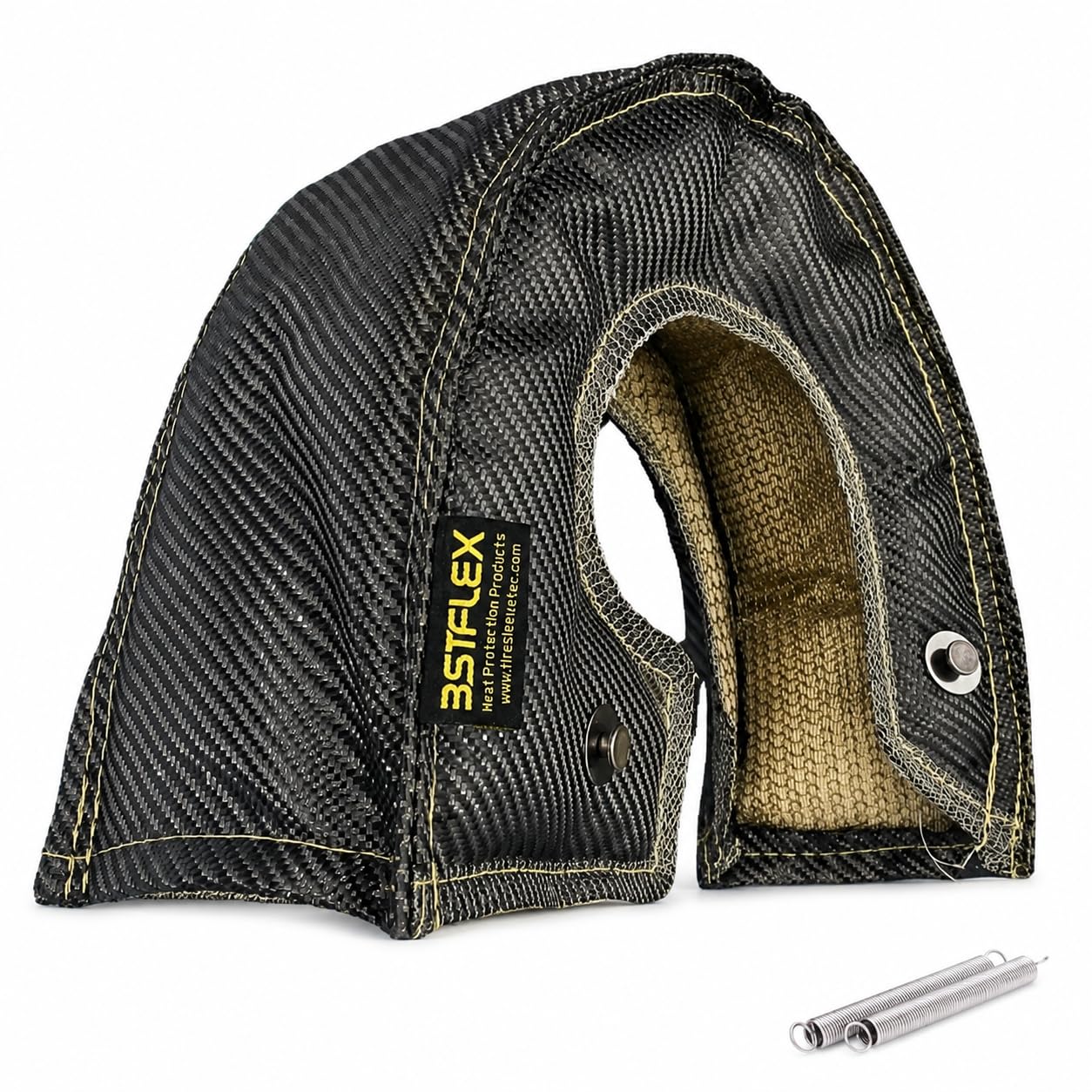
2. BSTFLEX Carbon Fiber T3 Turbo Blanket
A T3 carbon-fiber wrap that fits great and keeps heat down, but its durability is the honest catch.
The fit is the thing everyone raves about on this BSTFLEX blanket — it fits T3 turbos cleanly using the included springs, and owners mention it drops right into place. The outer carbon fiber layer sits over the same high silica cloth and stainless steel net inner construction as the best T4 pick, so the look is sharp while the structure stays rigid.
You get a blanket that holds heat inside the turbo housing instead of spilling it into the engine bay — it stays warm after a run but cool enough to touch, even when handling radiant heat from 1800F to 2500F. Customers note strong value for the money, and at 9.6 ounces it is noticeably lighter than the 1.61-pound FireShield T4 above, so it is easier to handle during install.
The honest trade-off here is durability. A chunk of reviewers point out the inner material breaking down over time, with some replacing it every six months or so, and a few mention melting under hard pulls. The review pages sum it up: great fit and looks, but the inside breaks down faster than the outside. It also emits some smell and light smoke during the first twenty or so miles — that is normal burn-off, not a defect.
Best for street builds: if you want a clean-fitting T3 shield that keeps bay temps down without the weight of a heavier blanket, this delivers.
The catch: plan on it being a consumable item if you run sustained high heat, since the interior degrades quicker than the exterior.
Reach for this if… you prioritize a precise T3 fit and a sharp carbon look over long-term abuse resistance.
Look elsewhere if… you track the car or run high boost frequently and need a blanket that survives years of extreme heat.
3. FireShield T3 Titanium Turbo Blanket
The T3 sibling of our top pick, offering the same mesh-core build for a lower price.
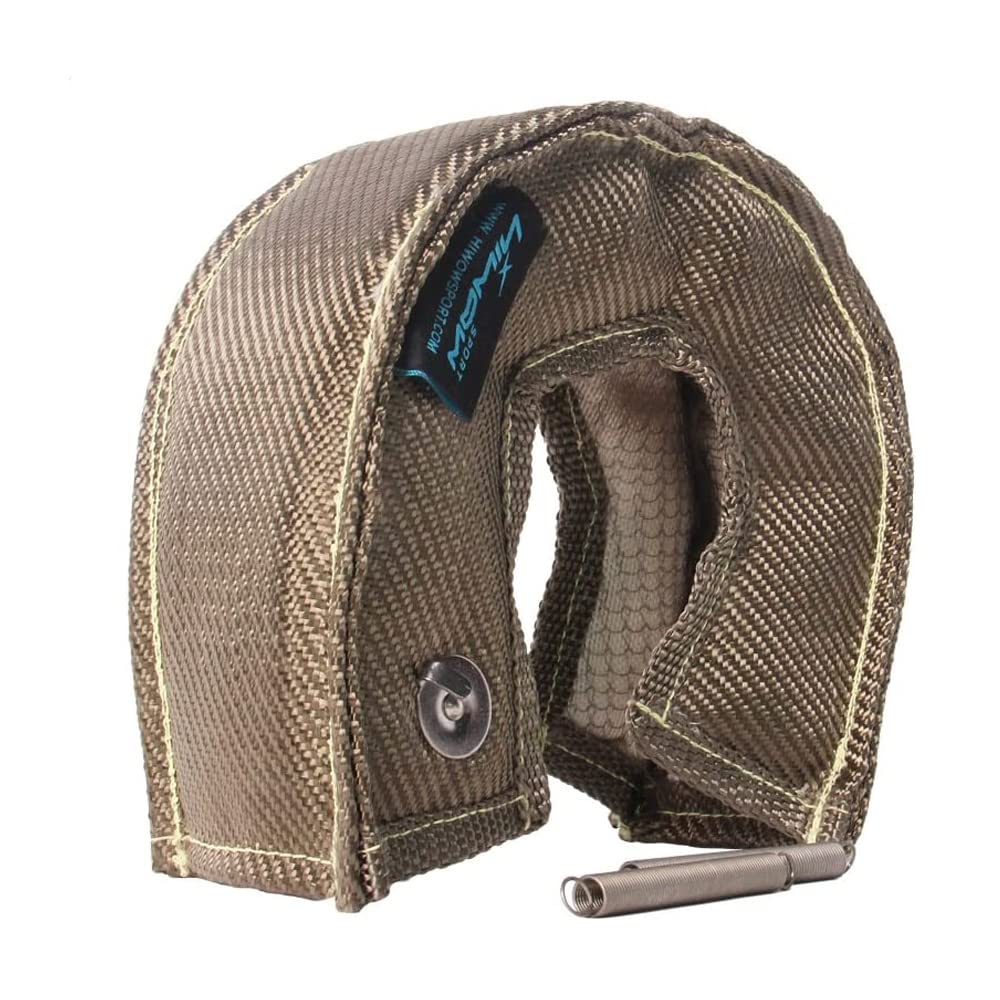
If you liked the FireShield T4 but run a T3 housing, this is the same family of blanket with a T3 fitment. It uses the identical inner stainless steel net over high silica cloth with a basalt titanium outer, and it carries the same 1800F direct and 2500F intermittent heat rating. At 1.17 pounds it is lighter than the T4 version, so it sits a bit easier on smaller housings.
Owners rave about the quality for the price, specifically the mesh inside keeping the blanket together after heat cycles and service removals. That reusability is a real edge over cheaper wraps that lose their shape the first time they get hot. The value-for-money feedback is consistently positive.
The one honest caveat is fit, which gets mixed feedback — some owners say it fits well, while a few report it did not work with their specific car setup. It is a quality product either way, but measure your T3 housing before ordering if you are unsure. The black version tends to look better than the beige over time, per owner observations.
A smart T3 buy: the mesh-reinforced interior gives it a reuse life that cheaper single-layer blankets lack.
Fit note: confirm your T3 housing dimensions, since fit is the one area where owner experiences split.
Best for the value-conscious T3 owner: you get the proven mesh-core construction without paying top-tier prices.
Who this is not for: anyone with an unusual T3 housing variation that the standard footprint will not cover.
4. BSTFLEX T25/T28 Titanium Turbo Shield Kit
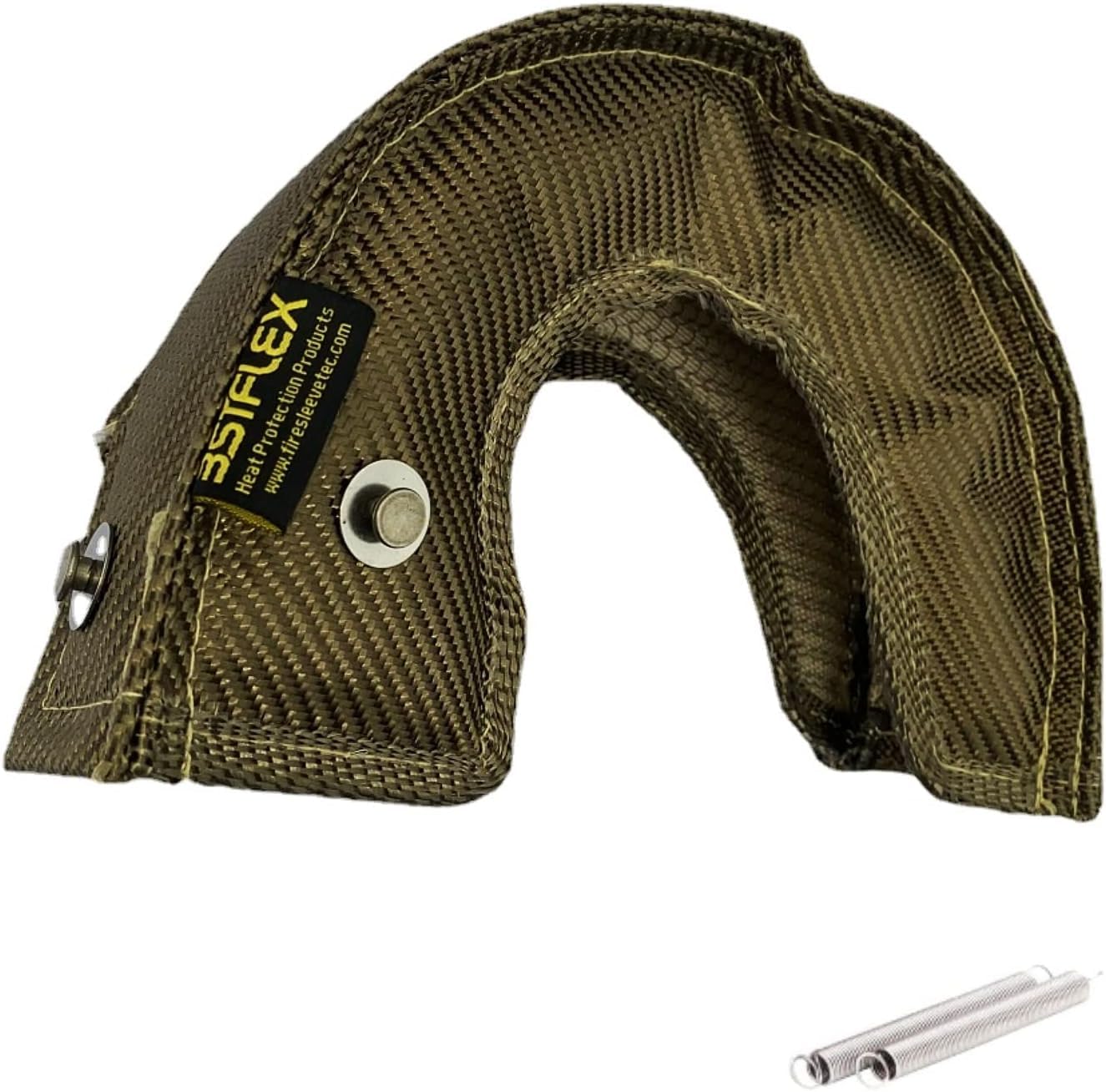
A compact 19-inch wrap built specifically for turbos with internal wastegates.
This one is different from the rest because it is sized for T25/T28 turbos with internal wastegates, not a general T3 shape. The 19-inch outer circumference with an approximate 2.5-inch inner width gives it a slimmer profile that fits where a larger blanket would foul the wastegate arm. It is the lightest option here at 8.4 ounces, which makes it ideal for tight engine bays.
The heat rating is lower than the T4 pick at 1500F, but for a smaller T25/T28 housing that is usually enough. Shoppers say it “actually one of the better ones I’ve seen” specifically because the steel inside keeps it from breaking apart under heat. The same basalt titanium outer and high silica cloth inner construction applies here, so the material quality carries over from the bigger blankets.
Expect to do a little trimming — owners note they made minor cuts to prevent resistance against the wastegate arms. The one recurring gripe is that once it gets hot, it loses flexibility and is not really reusable, with one hook pulling out of the material during removal. For a track-day blanket you leave in place, that is a fair trade at this weight and size.
Built For Tight Spots
- Steel inner mesh keeps it from breaking apart under heat
- Perfect footprint for internal-wastegate T25/T28 turbos
- Featherlight at 8.4 ounces for easy install
The Trade-Off
- Not intended for repeated removal — once heat-set it loses flexibility
- May need minor cuts around wastegate arms for clearance
Set-and-forget pick: ideal for a T25/T28 build where you want a snug, lightweight shield you install once and leave alone.
skip it if: you plan to frequently remove the blanket for service, since it loses flexibility after heat exposure.
5. Ummickl T3 Titanium Turbo Blanket

The budget-friendly T3 blanket with a wide turbo list and an honest warning about extreme heat.
For the price, this Ummickl blanket covers a lot of turbos — it lists T3, T25, T28, GT25, GT28, GT30, GT32, GT35, and CT26 housings, making it the most versatile fitment guide in this lineup. The construction uses double titanium fiber on both sides with a thickened silica thermal insulation cotton middle layer, and it ships with two locking springs. Dimensions come in at 7 inches tall, 7 inches wide, and 3.5 inches thick.
Owners running it on street setups report it fits fine, does its job, and noticeably reduces heat spilling from the turbine side into the engine bay. One owner has held up fine for six months on a VS Racing 6262 T3 setup. The heat rating is listed at 2500F radiant and 2200F, which sounds high, but there is a real durability caveat here that separates it from the FireShield options.
The honest warning from one owner is that the inner and outer materials are the same, so under repeated extreme heat — around 800F sustained — it can burn and become brittle, with fiberglass melting near 1220F. That means this is fine for a daily driver, but it is the wrong pick for a track car or anything running sustained high temps. For a budget street build, it is a solid value.
A true entry-level option: the widest turbo fitment list here makes it a safe fallback for common T3-family builds.
Know the limit: this is a street blanket, not a race blanket — sustained extreme heat can make it brittle and crack.
Best for the daily-driven T3 build: you get broad fitment and real heat reduction for a very accessible price.
Think twice if: you track the car or run sustained high boost, where the single-layer material’s limits show up.
Understanding the Specs
Heat Rating: Direct vs Intermittent
A blanket rated 1800F direct and 2500F intermittent means it can sit against radiant heat at 1800F continuously, but only handles the 2500F peak in short bursts. For a street car, the direct rating matters most because the turbo sits at operating temperature for long stretches. For a track car, pay attention to both numbers, since sustained high boost pushes the intermittent limit harder.
Inner Mesh and Construction Layers
The stainless steel net layered over high silica cloth is the structure that keeps a blanket from turning into a brittle shell after heat cycles. A blanket without that mesh — usually just titanium or carbon fiber on both sides — will hold up on a daily driver but can disintegrate under repeated extreme heat. The silica cloth itself does the insulating, while the mesh stops it from falling apart.
FAQ
Will a T3 turbo blanket fit my T4 turbocharger?
How do I know if I need a T25/T28 blanket instead of a T3 one?
Why does my new turbo blanket smell and smoke at first?
Will a turbo heat shield actually increase horsepower?
Can I reuse a turbo blanket after removing it for service?
What is the difference between a 1500F and a 2500F heat rating?
Do I need to trim my turbo blanket for wastegate clearance?
How long does a turbo blanket last on a daily driver?
Final Thoughts: The Verdict
If you want one dependable pick, the top turbocharger heat shield is the FireShield T4 Titanium Blanket because its mesh-reinforced build and proven heat drop make it the one you install and forget. If you want a sharp carbon-fiber look on a T3 turbo, grab the BSTFLEX Carbon Fiber Blanket. And for a budget-friendly daily driver, the Ummickl T3 Blanket covers the widest range of common turbos for the least money.
How We Picked
We do not accept paid placement. Every pick is matched to a real buyer and a real use-case; we do not hands-on test units.
Sources & Methodology
Specifications: manufacturer listings and product documentation. Review insights: verified customer reviews, as of August 2026. Pricing: not shown on this page (it changes often); check the current price via the retailer link.
As an Amazon Associate, GoCarLife earns from qualifying purchases. This does not affect which products we feature.