
Our readers keep the lights on and the garage heater humming. As an Amazon Associate, I earn from qualifying purchases.
Specs are compiled from manufacturer listings and verified buyer reviews and can change over time — please confirm the key details on the product page before buying.
High-pressure air is the lifeblood of PCP rifles, paintball markers, and workshop tools — and the right compressor makes the difference between a quick top-off and a long, frustrating wait. This guide cuts through the spec-sheet noise to help you match a machine to your actual tank size and how often you shoot or build.
I’m Mo Maruf — the founder and writer behind GoCarLife. This guide is built by comparing the manufacturers’ published specifications and the patterns across verified customer reviews, so you get each pick’s real strengths and trade-offs instead of marketing spin.
You want a turbo air compressor that gets your jobs done fast and keeps your tools running without constant stops. The right one saves you hours and keeps your gear ready every single outing, whether you are filling a small PCP (pre-charged pneumatic) cylinder or running a busy workshop.
Our Picks at a Glance


How To Choose The Best Turbo Air Compressor
Buying an air compressor is really about buying air delivery — how fast, how much, and at what pressure. If you only look at the horsepower number on the box, you will likely end up with a machine that either runs out of breath or costs more than you needed to spend. Instead, start with the tank you plan to fill.
Know Your Tank: PCP vs. Workshop
For PCP air rifles and paintball tanks, the key figure is maximum pressure — look for a unit that reaches 4500 PSI (300 bar) so you can fill a bottle to its rated limit. These compressors are portable and often run off a car battery. Workshop compressors are a different beast: they use a large storage tank and deliver a steady flow of air (measured in CFM) to run nail guns, spray guns, and impact wrenches, not to fill a bottle directly.
Match CFM to Your Tools
For workshop units, the single most useful number is CFM at 90 PSI (cubic feet per minute at a common working pressure). Every pneumatic tool specifies a CFM requirement. If your tool needs more CFM than the compressor delivers, the tank drains faster than it refills and the tool starves. To run a framing nailer or a spray gun comfortably, you want a compressor whose CFM rating at 90 PSI meets or beats the tool’s demand.
Duty Cycle and Cooling
High-pressure PCP compressors build serious heat during a fill. A machine that runs without oil and relies on a built-in fan can only run for a set period before it needs to cool down — often a few minutes on, a few minutes off. If you plan to fill large dive bottles or run a long job, look for a unit with water cooling or a generous duty cycle. Ignore this and you risk overheating the pump and shortening its life.
Quick Comparison
| Model | Best For | Max Pressure | Air Flow | Power Source | Amazon |
|---|---|---|---|---|---|
| GX Pump CS2★ Best Overall | Portable PCP fills | 4500 PSI | 8 L/min | 12V DC / 110V AC | Amazon |
| VEVOR 4500PSI Auto-StopBest Value | Budget auto-stop fills | 4500 PSI | — | 12V DC / 120V AC | Amazon |
| CHIKADIV 4500PsiCompact Pick | Auto-stop PCP fill | 4500 PSI | — | 12V DC / 110V-220V AC | Amazon |
| Craftsman 10-Gallon | Quiet shop tasks | 175 PSI | 4.0 CFM @ 90 PSI | 120V AC | Amazon |
| TUXING TXEDM042 | Large bottle fills | 4500 PSI | 50 L/min | 110V AC | Amazon |
| VEVOR 13.2 Gal Gas | Off-grid job sites | 115 PSI | 9 CFM @ 115 PSI | Gas Engine | Amazon |
| VEVOR 80 Gal | Industrial workshops | 145 PSI | 15.5 SCFM @ 90 PSI | 220V AC | Amazon |
| VEVOR 15HP Gas | Heavy-duty job sites | 115 PSI | 33 CFM @ 115 PSI | Gas Engine | Amazon |
| Ingersoll Rand 2475N7.5 | Continuous-duty shops | 175 PSI | 24.3 CFM @ 90 PSI | 230V AC | Amazon |
In‑Depth Reviews
1. GX Pump GX-E-CS2 Portable PCP Air Compressor
Our pick — over 4★ from 1,500+ verified ratings; the strongest balance of quality and price.
A proven 4500 PSI workhorse that turns a home outlet or a car battery into a rifle-filling station.
If you shoot PCP air rifles regularly, this is the machine that keeps coming back from the field with zero drama. It pushes up to 250W of power and reaches a maximum pressure of 4500 PSI (300 bar), which covers essentially every PCP bottle on the market. The unit weighs just 6.7 kg, so you can grab it by the handle and take it wherever you shoot — it runs on 12V car power or home 110V AC with the included converter.
The fill speed is what wins people over. In testing, it took a 0.5L container from 200 bar to 300 bar in about 8 minutes, and from empty to 300 bar in roughly 18-20 minutes. That is a solid pace for top-offs in the field. The clever part is the patented roller bearings at the top and bottom of the connecting rod — they reduce wear on the rod and wrist pin, which owners say makes the pump last years with proper care.
This is the manual-shutdown version, so there is no auto-stop pressure setting. You watch the gauge and turn it off yourself, which keeps attention on the pressure as it climbs. The seller is upfront that this is designed for tanks under 1 liter and suggests not inflating anything over 1L. The output nut is M10*1 with an 8mm quick connector, so most standard PCP hoses will hook right up.
Why owners stick with it
- Dual power means it works at home or from a car battery
- Oil-free and water-free — no messy maintenance or external water pump
- Compact 6.7 kg build is genuinely portable
Where you need to stay alert
- Manual shutdown means you must watch the gauge
- Not recommended for tanks larger than 1L
Best for: PCP rifle owners who fill small to medium bottles at home or in the field and want proven reliability.
Think twice if: you need to fill a large dive bottle over 1L — this pump is not built for that job.
2. VEVOR 4500PSI PCP Air Compressor with Auto-Stop
The entry point into PCP filling with hands-free auto-stop and a built-in power converter.
This VEVOR earns its place as the value pick because it removes the most common headaches for new PCP owners — guessing the pressure and babysitting the pump. It runs on a 500W motor with a built-in converter, so you can plug into a 120V wall socket at home or clip onto a 12V car battery outdoors. The dual display screen shows real-time pressure and temperature, and when the fill finishes it shows “E4” on the screen so you always know where you stand.
Auto-stop is the feature that makes this unit feel premium. Once the pressure hits your preset value, the machine shuts itself off — no overfills, no panicked dash to the switch. It will fill a 0.5L cylinder from 0 to 300 bar in about 25 minutes, which is on the slower side but perfectly acceptable for a budget unit. The 8mm quick-connect hose and battery clamp come in the box, so you are ready to go from the first unboxing.
There is a catch worth knowing before you buy. The seller is clear that this does not include an activated carbon filter, so if you plan to fill a scuba diving bottle for breathing air, you need to connect an external activated carbon filter. For paintball or PCP gun fills, the built-in oil/water separator handles the job. It has an alloy steel build that feels sturdier than its price suggests.
Where it shines: the hands-free auto-stop and dual power make this the simplest way to start filling your own PCP gear without spending a fortune. The trade-off is a slower fill time and the need to add an external filter if you ever fill a scuba bottle.
Reach for this if: you are new to PCP filling and want an affordable, automatic unit that works at home and in the field.
Look elsewhere if: you need to fill large scuba tanks for breathing — this unit needs an extra activated carbon filter for that job.
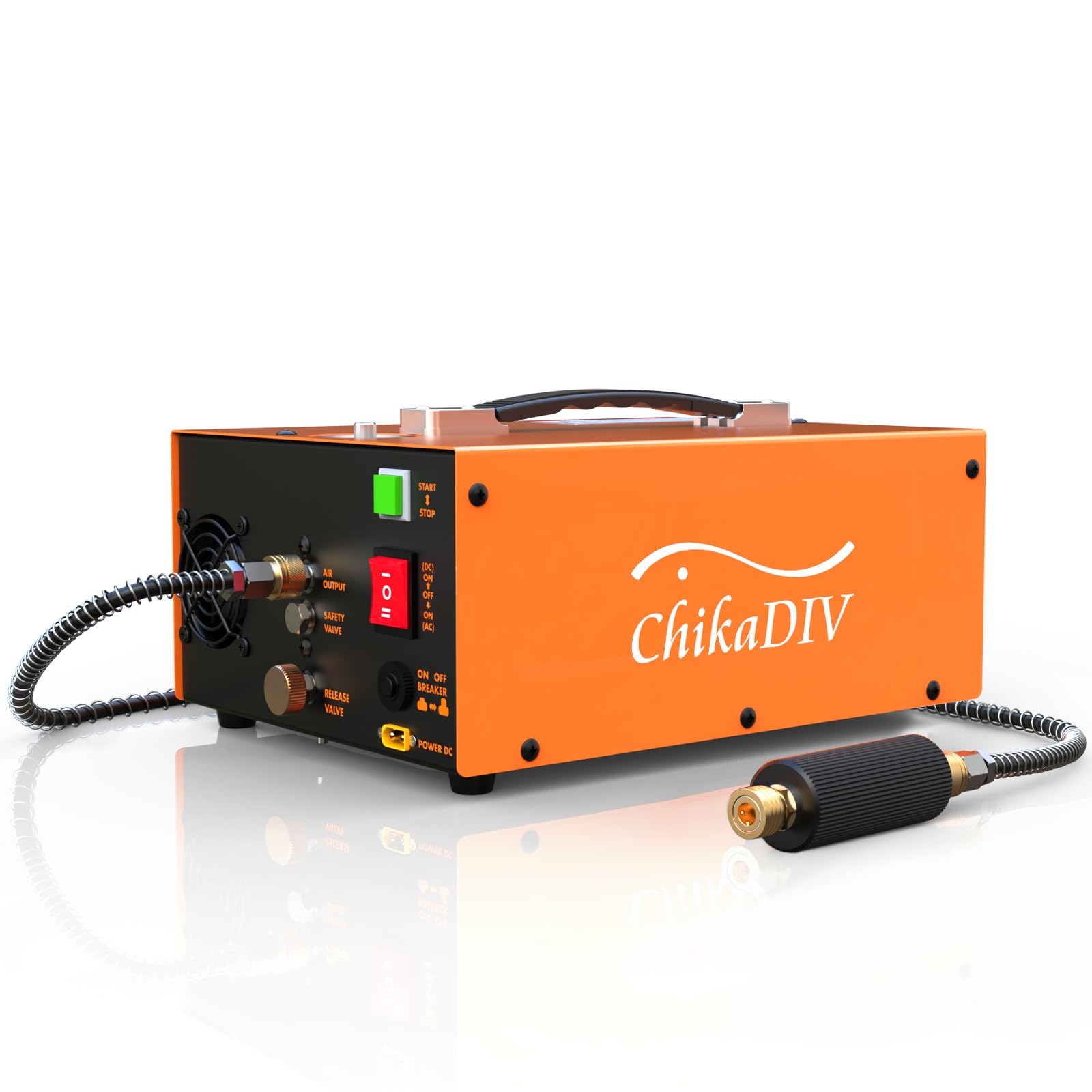
3. CHIKADIV PCP Air Compressor 4500Psi
A small-footprint auto-stop compressor with an integrated transformer for true grab-and-go filling.
This CHIKADIV stands out because it packs the transformer inside the case, so there are no bulky external power bricks or sketchy adapters to juggle. It supports AC 110V/220V household electricity and DC 12V car battery power, and you switch between them with a button on the side. That makes it the most self-contained unit in this lineup — you grab it, set it up, and stow it when you are done without untangling a mess of cables.
It uses a 350W motor and can reach 4500 PSI, which is plenty for PCP air rifles, paintball guns, and mini dive tanks. The fill claim is roughly 11 minutes from 0 to 3000 PSI on a 0.5L tank, and the auto-stop system watches the pressure in real time so you do not have to babysit the gauge. The steel frame keeps it durable even though the footprint is small enough to tuck into a trunk or gear closet.
Owners have pushed it beyond the spec sheet — some filled an 80 cu ft scuba tank from 0 to 3000 PSI in about 6 hours, which is slow but proves the machine can run long jobs. The recurring note is that it is loud, and the moisture filter needs annual checking. The 70 dB noise rating tells you this is not a silent unit, so working near it in an enclosed room will get noisy.
The honest read: a genuinely portable 4500 PSI auto-stop compressor that is faster than a hand pump and self-contained enough for real field use. Just budget for hearing protection and accept that large tank fills take hours.
Most at home with: PCP and paintball shooters filling small tanks who want auto-stop convenience in a compact steel-frame build.
A fair warning: its 70 dB operation is loud, and deep-cold scuba diving is not this unit’s strength.
4. Craftsman 10-Gallon Air Compressor

The 10-gallon workshop companion that pairs quiet-enough operation with real tool-driving CFM.
This Craftsman is built for the home workshop, not the shooting range. It delivers 4.0 CFM (cubic feet per minute, a measure of airflow) at 90 PSI (pounds per square inch, a measure of pressure) and 5.0 CFM at 40 PSI from a 1.8 HP (horsepower) motor, so you can run staple guns, brad nailers, framing nailers, airbrushes, blow guns, air drills, HVLP (high-volume low-pressure) spray guns, and pneumatic screwdrivers without running out of air. The 10-gallon tank holds a stable air supply, so the pump does not cycle constantly during light work, meaning less noise and wear on the motor.
The oil-free pump is the maintenance win here. You never deal with oil changes, and the rubber foot stabilizers cut vibration during operation. It rolls on rubber wheels with a handle, and the 23.6″ x 15.9″ x 24.8″ footprint means it tucks under a workbench after you finish. Owners consistently say it is easy to assemble — just the wheels and handle — and that it starts immediately from the start.
Real-world performance gets specific praise. In one test, it filled a 5-gallon pressure pot to 60 PSI in 19 seconds, which makes it a great fit for resin casting and pressure chambers. The honesty check: despite the “quiet” branding, owners describe it as still fairly noisy, closer to what you expect from a typical compressor. It is also not a high-pressure PCP unit — 175 PSI max means it is for air tools, not filling rifle bottles.
What owners appreciate
- Oil-free pump means minimal maintenance
- Wheels and handle make it easy to move and store
- Fast recovery at 4.0 CFM @ 90 PSI keeps tools running
What to expect
- Noisier than the “quiet” label suggests
- Arrived damaged in shipping for some buyers
Grab it for: weekend woodworking and DIY tasks that need a reliable, mobile air source for nailers and spray guns.
Not your pick if: you are filling PCP rifle bottles — this is a tool compressor, not a high-pressure bottle filler.
5. TUXING 4500Psi PCP Air Compressor

A 2.2kW dual-cylinder big bottle filler that moves 50 liters a minute for serious shooters.
This TUXING is the answer when your PCP habit grows past small bottles. It delivers 50 L/min of flow at 4500 PSI (300 bar), which is roughly triple the fill speed of the portable units above. A 0.5L tank goes from 0 to 300 bar in about 3 minutes, and even a large 6.8L bottle reaches 300 bar in roughly 45 minutes — a job that would take a small portable pump hours.
The two-stage compression cylinder system keeps performance consistent, and the auto-stop function shuts the machine down at your preset pressure. It uses both a water-cooling circuit and a fan-cooling system monitored by a digital thermometer, which means it is built for extended operation without cooking itself. The dual filtration system (a water-oil separator filter) helps keep moisture out of your bottles.
Here is the trade-off that matters: this is a heavy 28 kg unit that needs 110V power and external water supply, so it is a shop tool, not a field tool. The owner reviews are a genuine mixed bag — some say it is quiet and fast with zero problems, while others report receiving damaged units and poor manufacturer support. At this price point, buy from a source with strong return protection.
The bottom line: raw fill speed that small portables cannot match, with 4500 PSI capacity for large bottles. The risk is in quality control at delivery, so check it thoroughly on arrival.
Best suited for: shooters who fill large dive-style bottles and want 50 L/min speed without waiting hours.
Be cautious if: you need portability — at 28 kg with water cooling, this stays at home or in a shop.
6. VEVOR 13.2 Gallon Gas Powered Air Compressor

A gas-driven 7HP unit that brings 9 CFM to job sites with no electrical outlet in sight.
When your work happens far from a power outlet, this VEVOR is the answer. It runs on a 7HP gas engine that drives a piston pump delivering 9 CFM at 115 PSI — enough air for nail guns, air sanders, impact wrenches, and spray guns. The 13.2-gallon tank holds a decent reserve, and with 2 air outlets you can run two tools at the same time without one starving the other.
Mobility is the point here. Four smooth-rolling wheels and a push handle make it easy to move around a construction site, and since it burns gas, you can use it miles from any building. It is EPA certified for emissions, and the cast iron cylinders and frames are built for the wear of daily job-site abuse. There is even an automatic shut-off that kicks in when oil levels get low to protect the pump.
The honest caveat is that gas compressors of this type have drawn mixed owner experiences. Some report the belt guard arriving dented in shipping, while a few had units that would not run or lost the pump within months. It holds air and starts with proper fuel and oil, but buy it knowing that job-site machinery sometimes shows shipping wear.
Why it earns a spot: no other pick here lets you run air tools in a field or on a rooftop. The 13.2-gallon reserve plus dual outlets make it a genuine two-tool workhorse.
The right buyer: contractors and DIYers who need air tools where there is no electricity.
Who should skip: anyone who has access to a standard outlet — an electric unit will be quieter and more reliable.
7. VEVOR 80 Gallon Air Compressor

An 80-gallon stationary giant that floods a workshop with 15.5 SCFM at a whisper-quiet 86 dB.
For a shop that needs a constant, dependable air supply, this VEVOR is a serious contender. It uses a 6.5 HP oil-free motor to push 15.5 SCFM at 90 PSI, which is enough to run everything from nail guns to spray guns without the tank cycling constantly. The 80-gallon capacity means long stretches of stable air delivery, and the engineered cold-rolled steel body is built to hold up in harsh industrial environments.
The noise story is the standout here. At 86 dB, this is genuinely quiet for a compressor of this size — the oil-free technology cuts the operational sound significantly. That matters in a workshop where you spend hours on end. It filled a car-painting job at over 120 PSI with no water in the lines, which owners say makes it a real alternative to much more expensive oil-lubricated units.
There are setup realities to plan for. It needs 220V/60Hz single-phase power, which in a home garage usually means a dedicated circuit or hardwiring. The included power cord is short, and there is no regulator in the box — you will want a separate water separator and regulator for spray work. At 264.6 pounds it is a stationary installation, not something you move around.
The real appeal: industrial-grade air delivery at 86 dB with a massive 80-gallon tank. Budget extra for the electrical work and accessories it needs to reach full potential.
Ideal for: serious workshops and paint booths that need continuous air with minimal noise.
Not for: anyone without 220V power or space for a 264.6-pound stationary unit.
8. VEVOR 15HP Gas Powered Air Compressor

A 15HP gas monster throwing 33 CFM that runs spray guns and fills truck tires without breaking a sweat.
This is the top of VEVOR’s gas line for a reason. The 15HP engine drives a piston pump delivering a massive 33 CFM at 115 PSI, and the manufacturer claims fast inflation within 2 minutes. The 30-gallon tank with dual air outlets keeps two tools running simultaneously, and the cast iron cylinders and frames handle the pounding of daily job-site work.
Real owners are genuinely impressed. One described it as running a spray gun with no issue and filling truck tires fast, building pressure super fast — surprising for a unit that is portable. The 4 smooth-rolling wheels make it easy to move around a workshop or load onto a trailer for outdoor projects. The automatic shut-off protects the pump during low oil levels, which adds a layer of safety for longer runs.
The honest warning comes from the review pages: a couple of owners had units that broke down within months, and one flagged a nonfunctional pressure relief valve and a quick connect that was incompatible with standard US hoses. The cast iron construction is solid, but this level of machinery demands careful setup and inspection on delivery. Given the dual gas-engine complexity, this is best for those comfortable with basic engine maintenance.
The strong case: 33 CFM from a portable gas unit is rare firepower. For jobs where two tools must run at once with no power lines in sight, nothing else here compares.
Choose it for: heavy construction and job-site work that needs dual-tool air delivery at 33 CFM.
Pass on it if: you want plug-and-play reliability — gas engines add maintenance and some units arrive with issues.
9. Ingersoll Rand 2475N7.5 Two-Stage Air Compressor

The 15,000-hour cast-iron legend that runs continuously for shops that cannot afford downtime.
When a shop’s livelihood depends on air, this is the compressor they buy. The Ingersoll Rand 2475N7.5 is a 7.5 HP two-stage unit rated for 100% continuous duty — it is designed to run all day without a cool-down break. It delivers up to 24.3 CFM at 90 PSI and a maximum operating pressure of 175 PSI, backed by an 80-gallon ASME-certified receiver tank that holds a deep reserve of air.
The cast iron construction is the headline spec, and it earns the premium price. The pump is designed for over 15,000 hours of trouble-free use, and the individually cast cylinders, overhung crankshaft, and one-piece connecting rod make it genuinely easy to service when maintenance eventually comes. The All-Season Select synthetic lubricant runs 2,000 hours between changes — four times longer than petroleum-based oils — so you maintain it far less often.
Owners at this level describe it as “phenomenal” and note that even a medium-sized shop will never run out of air. The honesty check is the price and the power requirement: this is a 230V/1/60 unit that weighs 611 pounds, so it needs a dedicated circuit and a permanent home on a solid floor. It is overkill for a weekend hobbyist, but for a working shop it is the last compressor you will buy for a decade.
The long-game value: 24.3 CFM at 175 PSI with a pump built for 15,000+ hours. This is the machine that makes the phrase “the good stuff” feel literal.
Worth it for: professional shops and serious fabricators who run tools all day and cannot afford a compressor that quits.
Overkill for: home DIYers — the 230V requirement and 611-pound weight demand a dedicated shop space.
Understanding the Specs
PSI and CFM
PSI (pounds per square inch) measures air pressure — how hard the air is pushed. CFM (cubic feet per minute) measures air flow — how much air moves each minute. For PCP filling, you need a compressor that reaches 4500 PSI to fill your rifle’s bottle to its rated maximum. For air tools, CFM matters more than PSI: a nailer needs a steady flow, and if your compressor’s CFM at 90 PSI is too low, the tank drains faster than it refills and the tool loses power.
Duty Cycle and Cooling
Duty cycle is the ratio of running time to cooling time a compressor can sustain. A portable oil-free PCP unit often runs a few minutes on and a few minutes off to avoid overheating. A large stationary or water-cooled unit can run much longer, sometimes 100% continuously. If you fill big dive bottles or run long spray jobs, a compressor with effective water or fan cooling is essential to avoid cooking the pump.
FAQ
How long does it take to fill a PCP air rifle tank?
Can I use a workshop air compressor to fill my PCP rifle?
What does auto-stop mean on a PCP compressor?
Is a 12V car battery enough to run a PCP compressor?
Why does my compressor need a moisture filter?
What is the difference between an oil-free and oil-lubricated compressor?
How long can I run a PCP compressor continuously?
What size air compressor do I need for spray painting a car?
Can a gas-powered compressor be used indoors?
Final Thoughts: The Verdict
For the majority of shoppers, the turbo air compressor winner is the GX Pump CS2 because it pairs proven 4500 PSI capability with real portability at a reasonable weight. If you want auto-stop convenience without spending much, grab the VEVOR 4500PSI Auto-Stop. And for the professional shop that cannot afford downtime, the Ingersoll Rand 2475N7.5 is the one to reach for.
How We Picked
We do not accept paid placement. Every pick is matched to a real buyer and a real use-case; we do not hands-on test units.
Sources & Methodology
Specifications: manufacturer listings and product documentation. Review insights: verified customer reviews, as of August 2026. Pricing: not shown on this page (it changes often); check the current price via the retailer link.
As an Amazon Associate, GoCarLife earns from qualifying purchases. This does not affect which products we feature.