
Our readers keep the lights on and the garage heater humming. As an Amazon Associate, I earn from qualifying purchases.
Specs are compiled from manufacturer listings and verified buyer reviews and can change over time — please confirm the key details on the product page before buying.
You don’t want a portable pump that lives in the bed of your truck, gets dusty, and dies halfway through airing up 33-inch tires after a long trail day. You want a system that’s bolted on, wired in, and ready to go the moment you need it. This guide breaks down the best onboard units for everything from airing up tires to managing air springs, so you can pick the one that matches how you actually use your truck.
I’m Mo Maruf — the founder and writer behind GoCarLife. This guide is built by comparing the manufacturers’ published specifications and the patterns across verified customer reviews, so you get each pick’s real strengths and trade-offs instead of marketing spin.
You need a truck mounted air compressor that matches your specific job—whether that’s airing up 37-inch mud terrains, leveling a heavy load with air springs, or powering train horns under the hood. The right unit matches your duty cycle, CFM, and mounting space requirements.
Our Picks at a Glance


How To Choose The Best Truck Mounted Air Compressor
Before you buy, you need to know what the compressor will actually do on your rig. A unit built for air horns has a different job than one built to refill inflated air springs or air up four big tires after a trail run. Choose a compressor rated for your primary job—tire inflation, air springs, or horns.
Match the CFM to your tire size
CFM (cubic feet per minute) is the airflow rate that decides fill speed. Higher CFM directly reduces fill time for large tires. For big 35-inch and 37-inch tires, you want the highest flow you can get to avoid sitting on the trail longer than you need to.
Understand the pressure you actually need
PSI (pounds per square inch) is the maximum pressure the system can hold. Air springs and train horns typically need around 100 to 150 PSI, while full truck air brake systems need much more. Check the maximum working pressure on the spec sheet and make sure it clears the requirement of any air tool or accessory you plan to run.
Decide if a tank is worth the mounting space
A tank provides a reserve for short air-tool bursts without continuous pump operation. The trade-off is chassis space and the time needed to fill the tank before use.
Quick Comparison
| Model | Best For | Max Pressure | Airflow | Item Weight | Amazon |
|---|---|---|---|---|---|
| ARB CKMA12★ Best Overall | Fast tire inflation & lockers | Not specified | Not specified | 7.7 lbs | Amazon |
| LDMINDA 150 PSIBudget Champion | Air horns & budget builds | 150 PSI | Not specified | 5.02 kg | Amazon |
| maXpeedingrods UniversalBest Value | Air spring leveling | 100 psi | Not specified | 4.74 lbs | Amazon |
| Lhfacc In Cab System | In-cab bag control | 150 psi | Not specified | 4 ounces | Amazon |
| RETRUE Onboard System | Wireless bag monitoring | 100 psi | Not specified | 2.35 kg | Amazon |
| Vixen Air VXO4841B | Multi-use with tank | 200 PSI | 1.8 CFM | 30 lbs | Amazon |
| VIAIR 450C OBA | Offroad & 37″ tires | 150 PSI | 1.8 CFM | 4.54 g | Amazon |
| Viair 10005 OBA | Heavy-duty all-rounder | Not specified | 2.62 cfm | 4.54 g | Amazon |
| ARB CKMTA12 Twin | Highest flow & lockers | Not specified | 6.16 cfm | 1.6 oz | Amazon |
In-Depth Reviews
1. ARB CKMA12 On-Board Air Compressor
Our pick — over 4.5★ from 400+ verified ratings; the strongest balance of quality and price.
The go-to pick for serious tire air-up duty that owners trust for 33-inch rubber.
The ARB CKMA12 is the unit that shows up again and again in forums for good reason, and the crowd favorite here holds a strong 4.7-star score from a large base of owners. It can pump up 33-inch tires quickly — one owner reports going from 12 to 35 PSI in about 2 minutes. Its hard-anodized cylinder bore and sealed construction resist moisture and dust for long-term durability. The wiring harness gets the most mixed feedback — some call it “spaghetti-like” to sort, so plan for a bit of patience there.
It’s a 7.7-pound unit that mounts up high with a rotatable bracket, which helps you fit it into tight engine bays. Keep in mind the auto-shut-off kicks in around 90-100 psi, and that it takes about 2 minutes to fill a tank from 40 to 90 psi. The catch for many buyers is that you’ll likely need to buy your own fittings, and the install can eat a weekend if you’re not wiring savvy. It runs hot after heavy use — one owner noted temperatures in the hundreds of degrees Fahrenheit after airing up 31-inch tires from 10 to 45 psi in about 10 minutes.
The consensus is that it’s pricey up front, but several buyers report wishing they’d bought it first instead of cheaper alternatives. Quiet operation and a maxi-fuse for circuit protection round out the package. One owner noted they’ve been running it hard for years without a single issue, making it a reliable long-haul choice.
What Owners Love
- Fills 33-inch tires quickly, with a 2-minute jump from 12 to 35 PSI
- Solid engineering-grade materials with a hard-anodized cylinder bore
- Sealed against moisture and dust for under-hood durability
What to Know Before Buying
- No hose or inflator included; expect to budget for your own fittings
- Wiring harness is complex for non-locker use
- Install can take a full day or weekend
The Verdict: If you want a high-end, reliable compressor that airs up big tires fast and can also power lockers, this is the one to buy.
Think Twice If: You want the simplest possible wiring job or expect a complete plug-and-play kit with hoses included.
2. LDMINDA Air Compressor Pump W/3L Tank
A budget-friendly onboard pump with a 150 PSI rating for air horn setups.
If you want a low-cost entry into onboard air, this LDMINDA kit gives you a 150 PSI max working pressure and a 3L (0.8-gallon) stainless steel tank in one package. The pressure switch kicks on at 90 PSI and off at 120 PSI, and a built-in safety stops the pump at 110 PSI. A temperature switch shuts it down if it overheats past 80°C and restarts at 70°C—so you get confidence without watching the gauge.
Unlike the ARB above at 7.7 pounds, this unit weighs in at 5.02 kg and is designed as a universal fit for any 12V vehicle. Owners mostly use it for train horns, with one satisfied user noting the horns sound great. The honest catch here is durability: the recurring gripe is the reliability and longevity. One owner who mounted it under a flatbed, semi-exposed to rain and mud, reported it lasted about a year before dying. That means it’s a solid choice for a garage-kept truck or a lighter-duty build, not for a rig that lives in harsh weather.
You get an air hose and pressure gauge included, so you have the basics to start. Some owners mention a leak at the main port from the start, so check fittings right away. It sits firmly in the budget tier alongside the more expensive Vixen Air—a capable way to get air horns singing, but understand it’s a value play, not a lifetime commitment.
Best Value Read: For a fraction of the cost of the premium ARB, this gets your air horn system up and running with a tank included. Expect to replace it sooner than a premium unit, especially if mounted in the elements.
Reach for This If: You’re on a tight budget and need simple, reliable air for horns or bags on a daily driver that stays mostly clean.
Look Elsewhere If: You plan to mount it under a truck exposed to mud and weather, or you need it to run daily heavy tire duty.
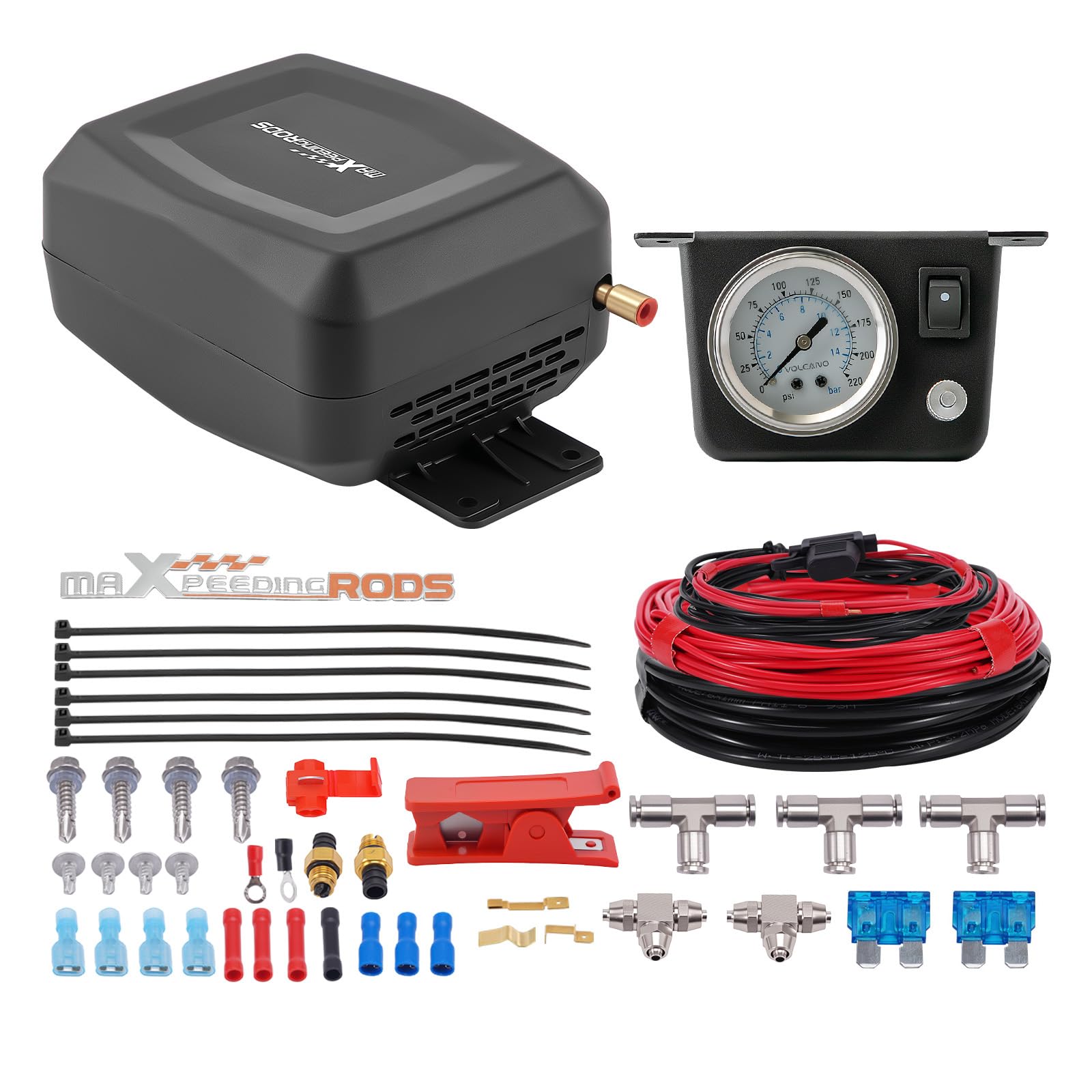
3. maXpeedingrods Universal Air Spring Compressor Kit
An easy-to-install air spring compressor that fills both bags from the cab.
At just 4.74 pounds, this is a compact option from maXpeedingrods that’s noticeably lighter than the 7.7-pound ARB above — a 62% gap that makes it easy to tuck away in tight spots. It’s built specifically for air spring leveling, with a max pressure of 100 psi and a recommended working range of 5-70 psi, which keeps things gentle on your air bags. The system doesn’t need an air tank, and the push-button gauge lets you fill both bags at the same time without leaving the driver’s seat.
Reliability is the trait that owners single out most, followed closely by how simple the install is. One owner mounted it inside the firewall on a 2016 F250 and found it quiet at idle, with instructions that are easy to follow. The important gotcha, per the review pages: you must fully seat the air lines into the connectors or you’ll get leaks, and the recurring gripe is the T-connectors and fittings that can leak if not perfectly seated. A few customers note having to refill their bags daily due to connection leaks, so take care during install.
The kit comes complete with the compressor, analog gauge, air line, manual, and mounting hardware. The main trade-off is that some owners found it won’t build enough pressure for their needs — one reviewer noted a max output of just 18 psi, which is far below the rated maximum. If you’re towing heavy loads and need to air up springs fast, this works, but don’t rely on it for tire inflation on 35-inch tires. It’s a purpose-built spring-leveling tool that’s great for the price.
Owners’ Consensus: The thing everyone raves about is the reliability for air spring duty. The trade-off is the push-in fittings, which demand a firm hand to avoid leaks.
The Decision: If you want an affordable, straightforward way to level a truck with air bags, this is a proven pick.
The Caveat: Make sure you seat every air line fully — a loose connection here is the most common complaint.
4. Lhfacc In Cab On Board Air Compressor System

This one puts inflate and deflate control for both air springs inside the cab.
For truck owners hauling loads that change weight constantly, this Lhfacc system offers a distinct advantage: a paddle valve that can inflate and deflate two air springs separately, paired with a digital air gauge that shows pressure synchronously. The compressor is rated at a max of 150 psi, and the whole package includes the compressor, digital gauge, paddle valves, pressure sensor, relay, air line, and wiring — everything you need except the air bags themselves.
Owners love the air release button, which one buyer mentioned is far easier than the schrader valves (standard tire-style valves) on other kits that take much longer to dump air. Another owner who’s been running it for 6 months straight reports zero problems. The instructions are described as very straightforward and easy to follow, and the kit includes all necessary mounting hardware for a clean install.
The one real-world consideration is clearance: you need a good 8 inches behind the mounting point for hoses to bend, or you’ll need to buy 90 or 45-degree adapters. A few owners also note that when you release the air, the odor vents near the switch, which can leave a rubber smell in the cab. The system drives the compressor automatically when you push the paddle valve to inflate, so you don’t have to worry about juggling switches while driving.
Standout Feature: The paddle-valve air release is a genuine upgrade over twist-style valves, making it quick to adjust pressure on the fly.
Pick This If: You regularly adjust air spring pressure from the cab and want precise, separate control over each bag.
skip it if: You don’t have roughly 8 inches of clearance behind your mounting spot for hose bends.
5. RETRUE Onboard Air Compressor System
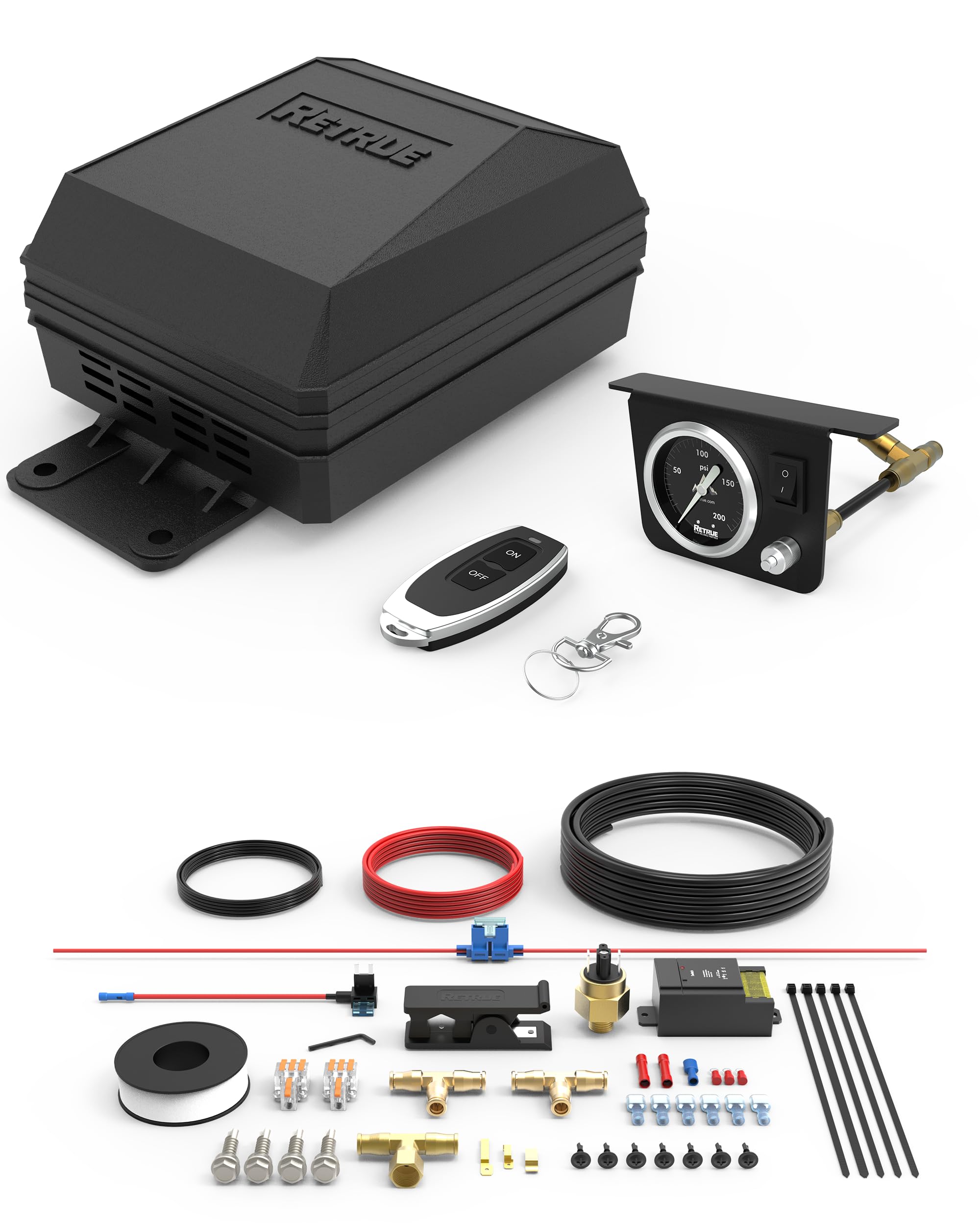
A wireless remote sets this air spring system apart for trailer-towing monitoring.
The RETRUE system earns its place with a feature you rarely find at this level: dual control options. You can inflate airbags with in-cab control on the road, or step outside and use the wireless remote to adjust and monitor pressure while you watch the truck level out with a trailer hooked up. Owners specifically love the remote for this exact scenario — standing outside the truck and seeing the level of the rig as it adjusts. The compressor reaches up to 100 psi, and the claimed speed is impressive: about 80 seconds to hit 50 PSI.
A built-in low-pressure sensor continuously monitors the airbags in real time, and if pressure drops below your preset value, the system automatically inflates to maintain optimal performance. The complete kit includes the compressor, control panel, 1/4″ air line (a quarter-inch line, the standard size for air bag systems), wiring, T-fitting, and mounting hardware, plus a detailed manual. The perceived quality is excellent according to multiple owners, and installation is reported as easy with all hardware included.
The honest trade-off is the included wire, which one owner described as small and cheap, and swapped out for thicker automotive primary wire during install. The pump also runs at 68 db (decibels, the loudness level) while airing up, which is noisier than the VIAIR 485C that owners call “super quiet,” but about what you expect for the price point. For a complete, modern air spring kit with remote monitoring, this is a strong contender that undercuts the premium ARB twin by a wide margin.
The Differentiator: The wireless remote and auto top-off sensor make this the easiest to live with for daily towing duty.
Reach for This If: You tow a trailer and want to monitor truck level from outside while the system self-corrects pressure.
Look Elsewhere If: You prefer top-tier wiring in the box or need near-silent operation.
6. Vixen Air 12V Air Suspension Kit

A complete 200 PSI setup with a 4-gallon tank for horns, bags, and tires.
For a jack-of-all-trades setup, this Vixen Air kit bundles a 200 PSI compressor with a 4-gallon steel tank that has 7 ports—so you can hook up suspension, train horns, tire inflation, and even air tools. The compressor flows 1.8 CFM and has a thermal overload switch (a safety feature that shuts it down before overheating). The tank’s corrosion-resistant powder coating and sealed, moisture- and dust-resistant compressor mean it holds up in the elements.
The 7-port tank is the standout here — it prevents airflow bottlenecks and gives you plenty of room to expand your setup later. Reviewers point out the quality is top-notch and the parts are all complete in the box. The compressor runs at 74 db, which is slightly louder than the RETRUE’s 68 db, but still described as “super quiet” by one owner. At 30 pounds with the tank, it’s not a featherweight, but the tank is what makes it versatile beyond just airing up springs.
The honest consideration is tank fill time. With a single 1.8 CFM compressor, it takes a while to fill that 4-gallon tank from empty — one owner bought a second compressor just to speed it up. One owner’s unit quit after four days, but the seller shipped a replacement the same day, and the replacement has worked great since. If you want a complete system that can grow with you — from air horns to seats to tools — this packs a lot of value.
What Makes It Special: The 4-gallon, 7-port tank is the most flexible foundation in this lineup for future air upgrades.
The Verdict: This is the pick if you want one system that does it all — horns, bags, tires, and light tool use.
The Trade-off: Plan for slow tank refills with the single pump, or budget for a second compressor later.
7. VIAIR 444C Dual Air Compressor

The offroad-ready system with a 2.5-gallon tank for up to 37-inch tires.
Purpose-built for offroad enthusiasts, this VIAIR OBA system pairs a 450C compressor with a 2.5-gallon tank, rated to handle tires up to 37 inches. The max working pressure is 150 PSI, and it delivers 100% duty cycle at 100 PSI, meaning it can run for up to an hour continuously. It flows 1.8 CFM and can fill a 37-inch tire from 15 to 30 PSI in 4 minutes, per the data — exactly what you want when you’re heading back to pavement after a trail run.
The kit is fully weatherproof and IP67 rated, so you can mount it inside the cargo area or outside on the bumper. It includes a 35-foot coil hose with a tire chuck (a built-in hose connector), a 2.5-gallon tank, a 1/4-inch quick connect stud and coupler, a drain cock, compression fittings, and 20 feet of 12-gauge wire with an inline fuse holder. Owners have run these for years—one has had one in their jeep for 10 years and still counts it as going strong, and another says the first unit lasted seven years under a truck exposed to the elements daily.
Installation is reported as straightforward with clear instructions, and the pressure switch with relay cuts in at 110 PSI and out at 145 PSI. One owner who fits it on a 2023 F250 above the spare tire calls it “exactly what an OBA system should be,” praising the serious build quality. This is the balanced choice for 4×4 owners who want tire inflation, air horns, and rear bags without overkill.
Performance Proof: Fills a 37-inch tire from 15 to 30 PSI in 4 minutes, with a proven 7-to-10-year lifespan in the field.
The Verdict: The best all-in-one for serious offroading, balancing tank capacity, weatherproofing, and proven durability.
The Catch: Don’t expect to run air impact tools — the 2.5-gallon tank is too small for sustained tool use.
8. Viair 10005 Heavy Duty Onboard Air System

A proven, high-flow workhorse that owners buy twice — and run for years.
The Viair 10005 has a loyal following and holds one of the strongest owner scores in this lineup. It flows 2.62 CFM—above the 450C’s 1.8 CFM but below the twin 444C’s 3.53 CFM—making it a solid mid-high performer. The kit includes a 30-foot hose and the full onboard package: pressure switch, dash switch, and gauge. That’s everything you need for a clean install that feeds tires, suspension air bags, and even a 20-ton air jack, as one long-time owner reports.
Owners call it well-built, easy to install, and worth the money. One owner’s first unit worked reliably for years in a 2008 Silverado HD3500 before they bought this second Viair for a new build. Another installed one under a 26-foot Class C frame and relies on it for air horn duty and 5th wheel towing. The package includes the compressor, tank, pressure switch with relay, dash panel gauge with ON/OFF switch, and electrical connections, so it’s a genuinely complete system.
The honest caveat is the install complexity. One owner on a 2007 FJ Cruiser took about 6.5 hours with custom brackets, and another on a 2019 F-150 noted the kit is “mostly complete” but may need extra hardware. A few owners mention the pre-sealed thread compound fails, so grabbing Teflon tape from the start saves an hour of rework. The system is fully weatherproof with an IP67 rating, and the compressor under the truck feeds into a cab-mounted gauge — a clean, professional setup. For a heavy-duty all-rounder that owners trust repeatedly, this is a top-tier pick.
The Reputation: “Always a good buy” is how owners describe a system they purchase a second time. At 2.62 CFM it’s a genuine workhorse.
Reach for This If: You want a proven, complete onboard system for towing, air bags, and tire inflation with room to spare.
Look Elsewhere If: You want a quick afternoon install — this one rewards patience and a few extra brackets.
9. ARB CKMTA12 Twin On-Board Air Compressor

The highest-flowing 12V compressor in its class at 6.16 CFM.
The ARB twin is the apex predator of this list, delivering a massive 6.16 CFM of airflow — more than double the VIAIR 444C’s 3.53 CFM and nearly 3.5 times the VIXEN Air’s 1.8 CFM. That flow rate translates to real-world speed: the data shows it can fill four 35×12.5r17 tires from 13 to 37 psi in exactly 5 minutes, or one tire from 20 to 40 pounds in under 2 minutes. The twin motor, dual cylinder design is water-sealed with 100% ball bearings, and the pistons use hard-anodized cylinder bores with PTFE (a low-friction polymer) impregnated carbon fibre seals for maximum trouble-free life.
With a 6.16 CFM rating, this is the highest flow rate of any 12V compressor of its size on the market, per the maker. Owners who’ve used it for over 4 years airing up 37-inch tires once or twice a month report not a single issue. The kit includes a complete wiring loom with plug-in contacts for air locker solenoids, dual heavy-duty Maxi-Fuses, an IP54-rated dash switch (protecting against limited dust ingress and water splashes), and two relocatable splash-resistant air filters with washable sintered bronze cartridges. It’s a complete, professional package.
The honest drawbacks are the price — it’s the most expensive unit here — and the installation complexity. The wiring harness is described as overkill if you’re not running lockers, with one owner building their own simple 2-wire harness instead. The install is measured in hours, not minutes, and isn’t considered novice-friendly. But for the owner who wants the fastest possible air-up times and the ability to run air tools, this twin delivers performance nothing else on this list can match.
Why It’s the Flagship
- 6.16 CFM flow fills 4×35-inch tires from 13 to 37 psi in exactly 5 minutes
- Water-sealed motors with 100% ball bearings for long life
- Can power air tools, not just tires and bags
What It Demands
- Premium price tag
- Complex wiring install, not for beginners
- Inflation kit sold separately
The Final Verdict: If you want the ultimate in speed and output and don’t mind a serious install, this twin is the gold standard for truck mounted air.
The Only Reason to Hesitate: The wiring is genuinely complex, so budget for a full day of careful installation.
Understanding the Specs
Duty Cycle
Duty cycle tells you how long a compressor can run before it needs to cool down. A 100% duty cycle at a given PSI means it can run continuously at that pressure without stopping to rest. For airing up four large tires in one session, you want a high duty cycle so the pump doesn’t overheat and shut down halfway through the job.
CFM and PSI
CFM (cubic feet per minute) measures the volume of air the pump moves, and PSI (pounds per square inch) measures the pressure it can build. Higher CFM means faster tire fills; higher PSI means the system can handle air tools and accessories that demand more pressure. A compressor rated for 150 to 200 PSI has enough headroom for air springs, train horns, and most tire inflation.
FAQ
What does IP67 rated mean for a truck mounted air compressor?
Can I run air tools with an onboard truck air compressor?
What is the difference between a 100 PSI and a 200 PSI compressor?
Do I need an air tank for a truck mounted compressor?
How long does a truck mounted air compressor last?
Can I mount the compressor inside the cab instead of under the truck?
Will a 12V truck compressor fill large tires like 35-inch or 37-inch?
What is a duty cycle and why does it matter?
Can a truck mounted compressor inflate air springs and tires?
How hard is it to install a truck mounted air compressor?
Final Thoughts: The Verdict
For most truck owners, the truck mounted air compressor winner is the ARB CKMA12 because it delivers the best balance of proven performance, build quality, and tire-airing speed that owners rave about. If you want the absolute fastest air-up times and plan to run air tools, grab the ARB CKMTA12 Twin—its 6.16 CFM is class-leading on this list. And for the budget-conscious buyer who mainly needs air springs leveled on the road, the maXpeedingrods Universal Kit is the one to reach for.
How We Picked
We do not accept paid placement. Every pick is matched to a real buyer and a real use-case; we do not hands-on test units.
Sources & Methodology
Specifications: manufacturer listings and product documentation. Review insights: verified customer reviews, as of August 2026. Pricing: not shown on this page (it changes often); check the current price via the retailer link.
As an Amazon Associate, GoCarLife earns from qualifying purchases. This does not affect which products we feature.