
Our readers keep the lights on and the garage heater humming. As an Amazon Associate, I earn from qualifying purchases.
Specs are compiled from manufacturer listings and verified buyer reviews and can change over time — please confirm the key details on the product page before buying.
Struggling with a stuck ball joint usually means a lot of hammering, swearing, and time wasted under the car. The right tool pushes the joint apart cleanly instead of forcing you to beat on it. This guide compares top separator sets and press kits to match your skill level and vehicle without overpaying.
I’m Mo Maruf — the founder and writer behind GoCarLife. This guide is built by comparing the manufacturers’ published specifications and the patterns across verified customer reviews, so you get each pick’s real strengths and trade-offs instead of marketing spin.
Match the tool to your ball joint type—a portable fork set for tie rods or a heavy C-frame press for press-fit joints.
Our Picks at a Glance


How To Choose The Best Tool For Removing Ball Joints
You have two very different types of tools to consider here, and picking the wrong one wastes money. A separator with forks is for tapered studs that sit in a socket — like tie rod ends and pitman arms. A C-frame press kit is for press-fit joints that have to be forced out of the control arm itself. Know which job you are doing before you buy.
Separator vs. Press Kit: Which Job Are You Doing?
For tie rods, drag links, or pitman arms, a hammer-driven fork-style separator works fast and costs little. But if your ball joints are pressed into the control arm and held by a snap ring, you need a press kit—it uses a threaded screw and receiving cups to push the joint out without hammering the control arm.
Size and Reach Matter More Than You Think
Fork sets include several opening widths — common sizes are 11/16″, 15/16″, and 1-1/8″ — because different studs have different tapers. A dedicated separator with a fixed opening like 15/16″ works on common tie rods but may not reach everything. A press kit needs enough adapters to cover both 2WD and 4WD axles, since the cups and tubes have to match the joint’s diameter.
Quick Comparison
| Model | Best For | Tool Type | Items | Opening Sizes | Amazon |
|---|---|---|---|---|---|
| OTC 6295 Front End Service Set★ Best Overall | Full front-end service | Puller / Separator Set | 5-Piece (+ Pitman Pullers) | Multiple | Amazon |
| OTC 6297 Ball Joint SeparatorTight-Spot Specialist | Press-fit studs, tight spots | Adjustable Separator | Single Tool | Up to 2 inches | Amazon |
| OMT 23pc Master Ball Joint Press KitChrysler Specialist | Chrysler & GM press-fit jobs | C-Frame Press Kit | 23-Piece | 4-Point Sockets | Amazon |
| OEMTOOLS 25104 Master Ball Joint Press | 2WD & 4WD trucks/SUVs | C-Frame Press Kit | 21-Piece | GM/Ford/Chrysler | Amazon |
| VEVOR 21 pcs Ball Joint Press Kit | Dana-axle 4WD vehicles | C-Frame Press Kit | 21-Piece | 9 Adapters | Amazon |
| Powerbuilt 648626 Front End Kit | DIY tie rod & pitman work | Puller / Separator Set | 6-Piece | Multiple | Amazon |
| Orion Motor Tech 5-Piece Pickle Fork | Variety of car/truck studs | Pickle Fork Set | 5-Piece | 5 Fork Sizes | Amazon |
| Lisle 18530 Ball Joint Separator | Light-duty tie rods | Fork Separator | Single Tool | 15/16 Inch | Amazon |
| DURATECH 5-Piece Ball Joint Separator | Budget-friendly DIY work | Pickle Fork Set | 5-Piece | 3 Fork Sizes | Amazon |
In‑Depth Reviews
1. OTC 6295 Front End Service Set
Our pick — over 4.5★ from 850+ verified ratings; the strongest balance of quality and price.
A 12.3-pound five-tool set that handles rusted tie rods, pitman arms, and ball joints.
This is the set for anyone who services their own suspension and wants one box that covers everything. It packs two pitman arm pullers, two ball joint separators, and three different tie rod pullers, so you aren’t hunting for a missing piece mid-job. At 12.3 pounds total, it’s a substantial kit, and the durable blow-molded case keeps every component organized and fits in a standard-depth toolbox drawer.
Owners repeatedly describe tackling parts on an “old, rusted out truck” — pullers handled two outer tie-rod ends and a pitman arm without complaint. The consensus from the review pages is that the tools are “well designed and heavily built,” with plenty of use and no issues. An experienced DIYer used it about 12 times on ball joints and tie rod ends with flawless performance, and notes it eliminates the need for hammering entirely.
The crowd favorite here sits at 4.7 stars with over 800 ratings behind it. The one recurring piece of advice across reviews: lubricate the forcing screw threads before first use and as needed to keep the turn smooth. OTC’s reputation for quality is the reason a mechanic recommended this exact set, and the quality held up.
complete front-end kit
- Five tools cover tie rods, pitman arms, and ball joints in one box
- Rugged construction built to last for years
- Blow-molded case keeps parts organized in a standard drawer
bulky to store
- Grease the screw threads first to avoid binding
- Heavier to haul around than a single separator
best overall: The DIYer doing full front-end service who wants one durable set that handles tie rods, pitman arms, and ball joints.
skip if space: you’re replacing multiple suspension parts at once and want professional-grade tools from a trusted name.
2. OTC 6297 Ball Joint Separator
An adjustable separator that opens to 2 inches to pop press-fit studs in tight FWD spots.
This single tool is the answer when forks and hammers just aren’t cutting it. It separates the ball joint from the spindle support arm on many domestic and import front-wheel-drive vehicles, and the adjusting screw opens up to 2 inches to fit different-size joints. Because it pushes instead of hammers, you avoid the collateral damage that comes with beating on suspension parts.
Buyers report joints popping off after “3 twists,” and one described removing all four ball joints on a 2005 Mazda 6 in under 5 minutes after other methods failed. The key to its success is a ball bearing on the bolt with an adjustable pivot, which lets it reach into tight spaces where a bigger pitman puller can’t go. It does need a 15/16″ socket on a ratchet to drive the screw.
This is the tool that wins people over with its functionality — it’s the #1 most-discussed aspect by far, with durability and quality right behind. The honest caveat: fit is part-specific, so a few owners found it didn’t work with every tie rod or ball joint, and one noted it can compress a boot if you’re not careful. Lube the threads and tap the bottom jaw to release if it gets stuck.
best wedge: The owner of a VW Passat, Mazda 6, or similar FWD car where access is tight and the joint is pressed in.
skip tight spots: it needs a 15/16″ socket to turn, and the joints can pop explosively — use a towel.
3. OMT 23pc Master Ball Joint Press Kit
A 23-piece press kit with four-point sockets for Chrysler’s uniquely threaded upper ball joints.
If you own a Chrysler, Dodge, or Ram product, this kit was clearly designed with you in mind. It includes four-point sockets sized specifically for Chrysler’s uniquely threaded upper ball joints, so you can remove and install without rounding off anything. The 9-inch C-frame press with a 6-inch opening and an extra-long jackscrew applies even, straight force to press out joints smoothly without damaging surrounding parts.
The kit handles ball joints, U-joints, and brake anchor pins on most 2WD and FWD vehicles including GM, Ford, Jeep, and Dodge. At 29.9 pounds, this is a serious piece of shop equipment, and it held up against the torque of a Milwaukee fuel impact without complaint. One owner used it successfully on a 2005 Ram 2500, calling the job “not easy” but the tool very effective.
The tools themselves earn strong praise for build quality and value — the crowd consensus is that it’s a high-quality set with everything you need for many Dodge and Chrysler jobs. The one recurring critique has nothing to do with the steel: the plastic case has weak latches that won’t hold up to heavy tools, so you may want a metal toolbox for storage.
best master kit: Owners of Chrysler, Dodge, and Ram vehicles who want a press kit with the exact sockets those brands need.
skip small jobs: the case latches are the weak point, so treat the box gently or move tools to a sturdier container.
4. OEMTOOLS 25104 Master Ball Joint Press Kit

A 21-piece forged-steel C-frame press that muscles out seized joints on GM, Ford, and Chrysler trucks.
When you’re dealing with a 304k-mile truck that’s never had its ball joints touched, you need a press that won’t bend under pressure. This kit uses a heavy-duty forged steel alloy C-frame, and it proved itself by pushing out stuck 18-year-old joints on a 2003 Ram 3500 4×4 without damage. It’s designed to remove and install press-fit upper and lower ball joints on 2WD and 4WD SUVs and light trucks.
The 21-piece set includes all the adapters needed for GM, Ford, and Chrysler vehicles, plus specialized adapters that turn it into a u-joint press kit so you can work around obstructions. Owners mention flawless performance on a 2001 Suburban 1500 4WD, removing stuck OEM lowers with a bit of heat. The cups don’t lock together, so you need extra hands on some jobs, and an F-250 job required a flat stock spacer due to cup stack length.
Quality is what wins people over here — it’s the most-praised aspect, with strong functionality and completeness right behind. The honest trade-off is durability, which gets mixed feedback: one owner mangled a cup on a Jeep JK, though the rest of the kit served well. Lubricate the threads (engine oil works) and you’ll get solid, repeatable use for weekend jobs.
best value press: DIY mechanics working on high-mileage GM, Ford, and Chrysler trucks and SUVs who need a press that handles seized joints.
skip solo work: the cups don’t lock together, so some jobs need an extra set of hands to hold everything in place.
5. VEVOR 21 pcs Ball Joint Press Kit

A 21-piece press kit with 9 adapters for Dana-axle 4WD trucks and SUVs.
This kit is engineered for serious 4WD vehicles, fitting axles like Dana 28, 30, 35, 44, and 60 across Ford, GM, Dodge, IHC, and Jeep models. The C-clamp is hardened to HRC32-38 and the jack screw to HRC28-36 through multiprocess heat treatment, so it’s built to handle high-stress jobs without bending or breaking. Each kit includes 9 adapters, 3 receiving tubes, and multiple cups to cover ball joints, U-joints, and brake anchor pins.
Owners confirm the heavy-duty steel holds up — one swapped two ball joints on an F-150 in under an hour, and another removed all four front ball joints on a Jeep JKU using a battery-powered 1/2″ impact driver. The black coating protects against water and corrosion, and the portable carrying case makes it easy to transport to a friend’s garage. It’s the #1 most-praised aspect of the kit, with high marks for quality and functionality.
Value is the recurring theme in reviews, with owners noting it rivals much more expensive name-brand kits. The durability feedback is mixed, so treat it as a high-quality occasional tool rather than daily professional equipment. Owners advise greasing before every use and avoiding impact tools in favor of breaker bars and ratchets to keep threads healthy.
budget pick: Owners of Dana-axle 4WD trucks and Jeeps who want a complete press kit at a value price.
skip heavy duty: the clamp is heavy and some jobs are easier with a second person — and avoid impacts to protect the threads.
6. Powerbuilt 648626 Front End Service Kit
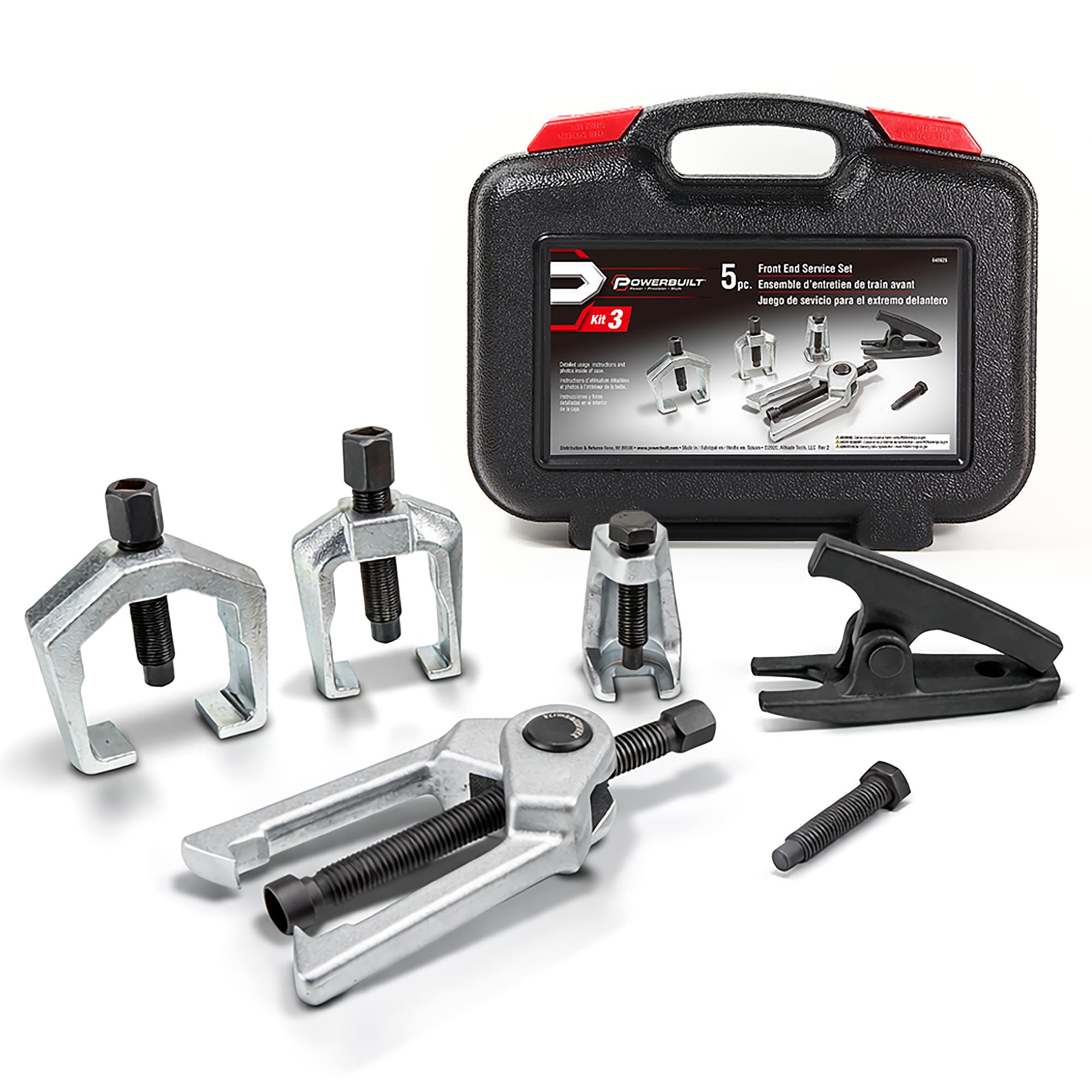
A beginner-friendly six-piece set that pops tie rods apart without the drama.
This kit is the right entry point if you’re doing your first tie rod or pitman arm job and want clear guidance. It includes a pitman arm puller, ball joint separator, and tie rod removal tools, plus plastic-laminated step-by-step instructions with detailed photos. The heavy-duty carrying case keeps everything organized and protected, so it’s easy to bring to a friend’s garage.
The stand-out experience comes from a Toyota Sequoia owner who pressed out an outer tie rod “just like that” within hours of ordering the tool. The set is praised for broad versatility and ease of use, and the quality is the most-mentioned positive aspect in reviews. At roughly 10 pounds (4.56 kg), it’s mid-weight between a single separator and a full press kit.
The recurring feedback loop is simple: great value and quality for the price, with durability getting mixed reviews — a few owners reported breakage during first use, while many others found it plenty strong for side jobs. The kit works best for the weekend DIYer rather than daily professional use, which is exactly who it’s marketed toward.
best all-rounder: The first-time DIYer doing tie rod ends or pitman arms who wants photo guidance and an organized kit.
skip max loads: it’s ideal for occasional weekend jobs, not a daily shop tool — a few owners hit breakage with heavy use.
7. Orion Motor Tech 5-Piece Pickle Fork Set

A five-fork set with solid construction that covers nearly every standard stud size.
This set gives you five fork opening sizes — 3/4″, 1″, 1 2/3″, 1 15/32″, and 1 3/32″ — so you can grab the right fit for ball joints, tie rods, and pitman arms across cars and trucks. Each fork is made from AISI 1045 medium carbon steel that’s been heat-treated for strength, then zinc-coated to resist corrosion. The knurled handles give you a sure grip even with greasy hands.
Owners appreciate the solid, single-piece construction, describing the tools as having “good weight to them.” The set handled a lower control arm ball joint job without issue, and the functional performance is the most-praised aspect. It’s a versatile pick that worked well for the DIYer replacing ball joints on multiple vehicles, with all the size options covered in one box.
The trade-off to know: durability gets mixed feedback, with most owners finding them sturdy but a few reporting breakage — one after just 4 hits. If you’re working on older, seized joints, it’s worth starting with the largest fork that fits and using controlled hits. The solid material and included storage setup make it a strong value for the price.
best fork set: The DIYer who wants one fork set covering the most common stud sizes on cars and light trucks.
skip stuck joints: a small number of owners saw breakage under hard hits, so let the correct fork size do the work.
8. DURATECH 5-Piece Ball Joint Separator Set

A budget-priced fork set that gets ball joints off in minutes, not hours.
This is the set to grab if you want maximum coverage for the least money. It includes three fork sizes — a track rod fork at 11/16″, a ball joint fork at 15/16″, and a pitman arm fork at 1-1/8″ — each designed to interchange with both handles. You get a knurled striking handle for conventional hammers and a shorter adapter handle for an air hammer, so you can work in tight, difficult-to-reach spaces.
The 40# forged and heat-treated steel with chrome-plated surfaces resists corrosion and extends service life. Owners consistently report having “ball joints off in minutes” and appreciate the variety of size and length options. The quality is the most-praised aspect, with strong marks for functionality and value, and the blow-molded case keeps everything neat and identifiable.
The durability feedback is mixed — the biggest caveat in an otherwise glowing set. Most owners find the hard steel perfectly adequate for weekend work, but some report breakage on first use, typically on stubborn seized joints. It’s a fantastic entry-level set that should serve the occasional DIYer well, but it’s not built to take the daily abuse of a professional shop.
best starter set: The budget-minded DIYer doing occasional tie rod or ball joint work who wants multiple fork sizes in one case.
skip pros: professionals hammering on seized joints daily — a few owners broke theirs on first use, so this suits lighter duty.
9. Lisle 18530 Ball Joint Separator

A featherweight single tool that pops tie rods with a few solid hammer blows.
At just 1.65 pounds, this is the tool you toss in the truck for quick tie rod work on the go. Its fixed 15/16″ opening fits standard tie rod studs, and the drop-forged, heat-treated construction gives it the strength to take repeated hammer blows. Owners describe it as “very solid, strong, and hardly scratched” even after use in a shop environment.
The standout story is from someone who used it on 4 Chevy pickups tie rods with a 5lb hammer and reported high confidence throughout. The functionality is the most-praised aspect, with durability and sturdiness right behind. It’s dramatically lighter than the 12.3-pound OTC 6295 set, which makes it the easy grab for a single recurring job.
The honest note on this one is origin — some buyers were disappointed it’s now made in China rather than the USA, though it still meets traditional Lisle standards in performance. If you need a simple, durable separator for standard tie rods and don’t want to haul a massive kit, this is the one. It’s built to last, and owners say it likely will be the last separator they need.
best compact: The mechanic who works on Chevy pickups or similar tie rod jobs and wants one reliable, lightweight tool.
skip big trucks: the fixed 15/16″ opening fits standard tie rods, not oversized or press-fit joints — and it’s now made in China.
Understanding the Specs
Fork Opening Size
The width of the fork’s gap determines which studs it can grip. Common sizes run from 11/16″ for track rods up to 1-1/8″ for pitman arms. The closer your fork matches the stud’s taper, the cleaner the pop and the less risk of damaging the boot. Sets with multiple sizes — like the DURATECH’s three forks — let you match the tool to the job instead of forcing one size to work.
Steel and Heat Treatment
Fork sets are typically forged from carbon steel like AISI 1045 and heat-treated for strength, with a corrosion-resistant coating — either chrome-plated or zinc-coated. For C-frame press kits, hardness ratings like HRC32-38 tell you how well the clamp resists bending under load. The harder the steel, the more abuse the tool takes before it deforms, which matters on seized 4WD joints.
FAQ
What is the difference between a pickle fork and a ball joint press?
Will a ball joint separator fit my truck’s tie rods?
How do I keep my ball joint tool from binding on the threads?
Can I use an impact driver with a ball joint press kit?
What does the C-frame opening size mean for my vehicle?
Will a 21-piece press kit work on my Ford F-150?
How do I remove a ball joint without damaging the boot?
Is an air hammer adapter worth having on a fork set?
What is the heaviest ball joint press kit I can expect?
Do I need a ball joint press kit for a 2WD car?
Final Thoughts: The Verdict
For the majority of shoppers, the tool for removing ball joints winner is the OTC 6295 Front End Service Set—it combines five professional-grade pullers with a rugged storage case, covering tie rods, pitman arms, and ball joints in one 12.3-pound box. If you work on press-fit joints in tight FWD spots, grab the OTC 6297 Ball Joint Separator, which adjusts up to 2 inches and pops joints with just a few twists. And for 4WD trucks with Dana axles or Chrysler products, the VEVOR 21 pcs Press Kit or the OMT 23pc Master Press Kit deliver the heavy C-frame force you need.
How We Picked
We do not accept paid placement. Every pick is matched to a real buyer and a real use-case; we do not hands-on test units.
Sources & Methodology
Specifications: manufacturer listings and product documentation. Review insights: verified customer reviews, as of August 2026. Pricing: not shown on this page (it changes often); check the current price via the retailer link.
As an Amazon Associate, GoCarLife earns from qualifying purchases. This does not affect which products we feature.