
Our readers keep the lights on and the garage heater humming. As an Amazon Associate, I earn from qualifying purchases.
Painting fiberglass is one of those jobs that looks simple until it isn’t. The surface feels smooth, “clean,” and ready… and then the new coating starts to fisheye, peel, stay tacky, or chip the first time it gets real use. That failure is almost never because you “picked a bad brand.” It’s usually because fiberglass isn’t one surface—it’s a stack: gelcoat with wax residue, oxidation, old polish, invisible oils, and sometimes an older coating with unknown chemistry.
So if you’re here looking for the best paint for fiberglass, I’m going to give you something more valuable than a shopping list: a decision system that explains why certain paints succeed on fiberglass and why others fail—even when the product has great reviews. When you understand the failure points, you don’t just buy a can. You buy a finish that actually survives sun, water, scrubbing, trailer bunks, bathroom humidity, pool chemistry, and the occasional “oops” bump.
This guide is built around real-life friction: the paint that levels beautifully until your garage gets humid, the bottom paint that works in cool water but gets challenged in hot, nutrient-rich marinas, the spray kit that looks perfect for a week and then lifts because the surface wasn’t deglossed enough. We’ll talk about those “after three months” realities—the stuff you only learn after you’ve done a job twice.
Below you’ll find 10 picks that cover the biggest fiberglass scenarios: boat hulls (topside and below the waterline), outdrives and underwater metals, RV roofs, fiberglass tubs and showers, fiberglass pool steps, and small repairs. Every pick is built from what the manufacturer actually states on its own listing: what it’s rated for, what it explicitly excludes, and the coverage, cure and prep numbers you need to plan the job.
How to Choose the Right Best Paint for Fiberglass (Without Peeling Later)
Here’s the first truth: “fiberglass paint” isn’t a category. Fiberglass is the substrate. The correct paint is determined by what the surface will experience after you apply it: sunlight, abrasion, constant immersion, pool chemicals, saltwater growth, or high humidity and cleaning products. Choose by exposure first, then choose by application method second, and only then worry about brand.
1. Identify your fiberglass “exposure zone” (this is everything)
Most wrong purchases happen because someone buys a marine paint for a bathtub, or a topside gloss for a boat bottom, or a roof coating for a surface that gets scrubbed. Use this quick zone map:
- Zone A — Above the waterline (boats / RV trim / fiberglass panels): You need UV stability, gloss retention, chip resistance, and a paint that levels well on gelcoat. One-part polyurethane topside paints dominate here.
- Zone B — Splash and spray (swim platforms, dinghies, transoms, waterline scuffs): Similar to Zone A, but prioritize abrasion resistance and easy touch-ups.
- Zone C — Below the waterline (boat bottoms): You’re not “painting,” you’re building a controlled-release anti-growth system. Ablative, hard, hybrid, copper-free, multi-season—all of that matters more than shine.
- Zone D — Constant immersion but not marine fouling (pools, fountains, fiberglass steps): Two-part epoxies are common here because they cure hard and resist water exposure and cleaning.
- Zone E — Flexible outdoor membrane (fiberglass RV roofs): You want a flexible coating designed to expand and contract, reflect heat, and tolerate weathering.
- Zone F — High humidity + cleaners (fiberglass tubs, showers, tile surrounds): The finish must handle scrubbing, soap film, and moisture. Prep and cure time become just as important as the paint.
2. Know what fiberglass “prep” actually means (not just sanding)
Fiberglass failures usually show up as: fisheyes, orange peel that won’t level, soft paint, or peeling sheets. The hidden causes are almost always contamination and gloss. Gelcoat often holds wax, polish, sunscreen oils, fuel residue, or boat soap film. That stuff blocks adhesion.
A professional-grade prep sequence looks like this:
- Degrease first: wipe with a proper surface prep solvent or dewaxer. (If you sand first, you can grind contamination into the pores.)
- Sand to remove gloss: you’re not trying to remove gelcoat; you’re trying to dull it uniformly so the paint can grab.
- Vacuum + wipe again: fiberglass dust is clingy. If you leave it, it becomes a weak layer between substrate and paint.
- Prime when the system expects it: primer isn’t “extra.” It’s the bond bridge that prevents chipping and uneven absorption.
3. Understand paint chemistry in plain language
Here’s the cheat sheet you can use without needing a chemistry degree:
- One-part polyurethane (topside): Great gloss and leveling, easier DIY application, strong UV resistance when formulated for marine use. Not for constant immersion.
- Marine primers (topside primers): High solids to fill tiny texture, improve bonding, and give a uniform base that makes your topcoat look “expensive.”
- Ablative bottom paint: Wears away gradually, constantly exposing fresh biocide. Reduces paint buildup over seasons. Often best for boats that move regularly.
- Hybrid / dual-resin bottom paint: Mixes durability of hard paint with controlled polishing to avoid heavy buildup.
- Copper-free antifouling: Uses alternative biocides; avoids galvanic corrosion concerns on aluminum/outdrives and can keep colors brighter.
- Two-part epoxy pool coatings: Hard, chemical-resistant finish for constant immersion environments like pools and water features.
- Acrylic roof coatings: Flexible, reflective “skin” designed for weather exposure and roof movement.
- Spray refinishing coatings (tub/tile): Convenience-first approach that depends heavily on prep and curing discipline.
4. Pick your “application personality” before you pick the can
Some paints are forgiving. Some are high-performance but demand patience. Decide which version of you is doing this project:
- The “I want it to look pro” painter: You’ll do roll-and-tip, you’ll sand between coats, and you’ll let it cure properly. You’ll love premium topside paint + the right primer.
- The “I want it done in a weekend” painter: Choose coatings that dry fast and don’t demand perfect weather. Avoid systems with tight pot life unless you’re confident.
- The “my boat lives in the water” owner: Bottom paint selection is about your water temperature, fouling pressure, and how often you move the boat.
- The “I’m fixing a problem area” DIYer: Small volume options and easy touch-ups matter more than multi-coat perfection.
5. The four instructions makers print that people skip
Read the listings for the products below side by side and the same four instructions keep appearing, no matter the brand:
- Thin coats, and a set number of them: TotalBoat says the high-solids content in Wet Edge is exactly why you apply thin coats—two to three are all it wants. Duralux prints the same discipline for its marine enamel: two thin coats, each allowed to dry overnight.
- Degrease before you sand: TotalBoat points you to its Dewaxer & Surface Prep as a solvent wipe for grease and oil before paint, and Dicor requires its Fiberglass Clean & Prep before any roof coating goes on. Prep products are part of the system, not an upsell.
- The exclusions are printed, and they are specific: Wet Edge is not for bottoms that stay in the water past 72 hours. Interlux Bottomkote NT excludes aluminum hulls. Rust-Oleum’s marine primer is above-waterline only. Match the zone before you match the brand.
- Cure time is not dry time: Wet Edge lists a 72-hour full cure. NADAMOO asks for three days before the tub sees water. Olympic Zeron has a pot life that starts the moment you mix. “Dry to the touch” is a milestone, not a finish line.
Now let’s make this easy: the next section gives you a quick table, then we’ll go deep on each product with the published coverage, cure and exclusion figures that turn “good paint” into a finish you actually keep.
Quick Comparison: 10 Best Paint for Fiberglass Picks (By Real Use Case)
Use this table to shortlist your best matches fast. Then jump to the full reviews for the “real life” details—like which paints level beautifully with a foam roller, which bottom paints handle haul-and-relaunch, and which kits demand strict curing discipline to avoid peeling.
On smaller screens, swipe or scroll sideways to see the full table.
| Model | Paint category | Where it belongs | Signature strength | Amazon |
|---|---|---|---|---|
| TotalBoat Wet Edge Topside (White, Gallon) | Topside polyurethane | Above the waterline (boats, RV trim, fiberglass panels) | Levels like a champ with roll-and-tip for “spray-like” gloss | Amazon |
| Interlux Fiberglass Bottomkote NT (Blue, Gallon) | Hybrid antifouling | Boat bottoms (underwater fiberglass) | Hard durability + slow polishing to reduce heavy buildup | Amazon |
| TotalBoat Krypton Copper-Free (Black, Quart) | Copper-free antifouling | Below waterline + underwater metals/outdrives | Bright colors + copper-free formula that plays nicer with aluminum | Amazon |
| Olympic Zeron Pool Paint (Black, 2-Part Epoxy) | 2-part epoxy | Pools, fiberglass steps, constant immersion surfaces | Thick, one-coat epoxy system built for durable water exposure | Amazon |
| Dicor RP-FRC-1 Fiberglass RV Roof Coating (White, Gallon) | Acrylic roof coating | Fiberglass RV roofs and roof maintenance | Flexible, reflective coating designed for roof movement and sun | Amazon |
| NADAMOO Bathtub & Tile Refinishing Spray (White, 2 Pack) | Refinishing spray | Fiberglass tubs, sinks, tile walls, bathroom fixtures | Fast spray application with a hard semi-gloss film—if you respect the 3-day cure | Amazon |
| Rust-Oleum Marine Wood & Fiberglass Primer (White, Quart) | Budget primer | Above-waterline fiberglass and wood (under topcoats) | Fast-drying, sands easily, improves adhesion and uniform gloss | Amazon |
| Duralux Marine Enamel (Cruiser Blue, Quart) | Topside enamel | Above the waterline (classic deep hull color) | Adheres to fiberglass; rated against salt water, oil and harbor gases | Amazon |
| Pettit EZ-Poxy Topside Aerosol (White) | Topside aerosol | Small fiberglass repairs and touch-ups above the waterline | One-part polyurethane in a spray can, fiberglass listed as the surface | Amazon |
| SENVEN Marine Boat Paint (35 oz, Gloss) | All-in-one enamel | Small boats, dinghies, minor fiberglass repairs | Quick-drying gloss for patch jobs when you need a hard film fast | Amazon |
In‑Depth Reviews: 10 Best Paint for Fiberglass Options (What Actually Matters)
This is where we go beyond “it’s glossy” and “it covers well.” Each entry below sets out what the maker says the product is designed to do, the coverage, cure and recoat numbers it publishes, and the exclusions it prints in its own words—because on fiberglass, the exclusions are usually where jobs go wrong. Ratings and review counts are Amazon aggregates at the time of writing.
1. TotalBoat Wet Edge Topside (White, Gallon) – The “Looks Sprayed” Finish Without a Spray Booth

Wet Edge wins “best overall” because it solves the problem most fiberglass owners actually have: you don’t just want coverage—you want a finish that makes the boat (or fiberglass panel) look renewed, not “painted.” This is a one-part polyurethane topside paint engineered to level and flow out, which is exactly what creates that near-spray look when you do a clean roll-and-tip routine.
The reason it feels like magic isn’t luck. The formula is designed to self-level, so brush marks relax instead of freezing. That matters on fiberglass because the substrate is unforgiving: gelcoat shows every ripple, every lap mark, every rushed section. TotalBoat says the same thing in plainer language: excellent flow out, dries perfectly smooth, and the high gloss and durability of a two-part polyurethane without the two-part workload. Coverage runs 350-400 sq ft per gallon, full cure is 72 hours, and the working temperature window is 50-90°F.
The pro move with Wet Edge is to stop thinking in thick coats. Thick coats trap solvent and invite sagging, softness, and extended cure time. Thin coats build depth and hardness, and they sand cleanly between coats. The other pro move: treat the primer as your texture manager. If your fiberglass has small pinholes, old oxidation scars, or sanding scratches, you don’t want to “hide” those with topcoat. You want to fill and fair with primer, sand smooth, then topcoat. That’s how the final gloss looks premium instead of lumpy.
Where Wet Edge shines most is on “high visibility fiberglass”: hull sides, decks above waterline, consoles, lockers, hatches, and RV exterior trim where you want a bright, clean look. The White gallon is a popular workhorse choice because it matches a ton of fiberglass applications and makes aging gelcoat look young again.
Why you’ll like it
- Levels beautifully – The finish relaxes as it dries, reducing roller texture and brush marks.
- High-gloss payoff – When applied thin and evenly, it looks closer to sprayed paint than most one-part products.
- DIY-friendly system – Roll-and-tip is achievable with basic tools if you control dust and work in sections.
- Rated for retention – TotalBoat lists maximum color and gloss retention, plus chip, crack, fade and UV resistance.
- Versatile on fiberglass – Great for boats, RV exteriors, and fiberglass parts that live in the sun.
Good to know
- If you apply it too thick, you can create orange peel or slow curing—thin coats are the secret.
- Weather matters: humidity and dust can ruin the “spray-like” look, so control your environment if you can.
- Above the waterline only: TotalBoat excludes boat bottoms that stay in the water longer than 72 hours.
Ideal for: anyone painting fiberglass above the waterline who wants a professional-looking finish without specialty spray gear.
2. Interlux Fiberglass Bottomkote NT (Blue, Gallon) – Hard-Paint Durability with Ablative-Like Smarts

Bottom paint is not “paint,” it’s an antifouling system. And the biggest misunderstanding people have is thinking that more coats or a thicker film automatically means more protection. In reality, different antifouling technologies behave differently. Hard paints can build up and turn into a sanding nightmare. Ablatives can wear away unevenly if the boat sits still for long periods or gets scrubbed aggressively. Hybrid systems exist because boat life is messy—and Interlux Bottomkote NT is a classic hybrid.
Bottomkote NT uses a dual-resin approach: it’s durable like a hard paint, but it has a slow polishing mechanism that helps renew the surface and reduce heavy paint buildup over time. That matters if you’ve ever inherited a boat with layers of old bottom paint. You can feel those ridges with your hand. They create drag, they flake, and they make the next job harder. A paint that resists “layer cake” buildup is a sanity saver.
Interlux is precise about where it belongs: the underwater areas of fiberglass, wood, and properly primed metal hulls—explicitly excluding aluminum—in fresh, salt and brackish water. Coverage is 500 sq ft per gallon, it carries a limited warranty, and it holds a 4.6-star average from 365 Amazon ratings. As with any biocide coating, work ventilated and mix thoroughly; pigments and biocides settle, and a casual stir is not enough.
The practical advantage for DIYers is speed. Fast-dry bottom paint can compress your haul-out schedule and reduce the chance your “one coat day” becomes a three-day weather gamble. But speed doesn’t replace prep. The best Bottomkote jobs come from: thorough scuff sanding, clean surfaces, correct primer/barrier coat when needed, and careful coat thickness in wear areas (leading edges, keel, bow, waterline).
Why it works for many boats
- Hybrid behavior – Durability with a polishing mechanism that helps avoid heavy buildup.
- Fast dry workflow – Helps you paint and keep your schedule tight during haul-out.
- Season-long protection – Designed for consistent antifouling across water types.
- 500 sq ft per gallon – Published coverage that makes a hull estimate straightforward.
- Stable color – Clean, stable color is useful for seeing wear patterns over time.
Good to know
- Interlux excludes aluminum outright; metal hulls must be properly primed first.
- Below-waterline use only — this is a boat-bottom coating, not a topside finish.
- Like most bottom paints, mixing quality directly affects performance—stir like you mean it.
Ideal for: fiberglass boat owners who want a durable underwater coating with reduced “paint layer buildup” pain over multiple seasons.
3. TotalBoat Krypton Copper-Free (Black, Quart) – Bright Color + Strong Growth Control Without Copper

Krypton exists for a very specific problem: you want serious antifouling performance, but you also care about copper-related issues—especially when you’re painting underwater metals like trim tabs and outdrives, or dealing with aluminum where galvanic corrosion concerns are real. Krypton is copper-free, and that changes both behavior and aesthetics: colors can stay brighter because you’re not mixing pigment into a copper-heavy base.
Where Krypton really shines in real-world use is on “awkward underwater parts”: outdrives, props (where appropriate), trim tabs, and other below-waterline metals where people want an antifouling coat without inviting corrosion worries. TotalBoat lists it for fiberglass, aluminum, wood and steel below the waterline, and says it can go straight over existing paint that is in good condition. The finish is an eggshell sheen rather than a gloss, which is kinder to surfaces that are rarely showroom perfect after sanding. The biocide package is dual-action— copper-free components plus zinc—aimed at barnacles, zebra mussels, slime, algae and weeds.
Another practical advantage for DIY scheduling: there’s no maximum dry time before launch. That means you can paint well ahead of the season, haul and relaunch without the panic of “did I miss the window?” That’s huge if your boatyard schedule is unpredictable or you’re painting in stages. For travelers who trailer or haul mid-season, this flexibility can feel like a superpower.
What’s the “real” Krypton tactic? Don’t skimp on stirring and don’t underestimate how much surface prep affects copper-free performance. Copper-free paints rely on the biocide package and the paint film wearing/renewing properly. If you apply it over chalky, oxidized, poorly cleaned surfaces, you can create weak spots where fouling starts. Coverage is 500 sq ft per gallon or 125 sq ft per quart, one to two coats do the job, and it averages 4.4 stars from 370 Amazon ratings.
Why it stands out
- Copper-free formula – Great option when you’re concerned about copper on underwater metals or aluminum setups.
- Bright, stable color – Cleaner pigment appearance than many traditional copper-heavy antifoulings.
- Flexible launch timing – No maximum dry-time-to-launch pressure helps real-world scheduling.
- Looks good while working – Eggshell finish hides minor prep scars better than high gloss.
- Quart size makes sense – Perfect for outdrives, trim tabs, and targeted antifouling projects.
Good to know
- Like all antifouling paints, performance depends heavily on prep and correct film thickness.
- Single-season protection — TotalBoat rates Krypton for one season, not multi-season.
- A quart covers 125 sq ft, so hull-sized jobs need the gallon.
Ideal for: copper-averse boaters, outdrive owners, and anyone who wants antifouling protection on fiberglass and underwater metals with flexible launch timing.
4. Olympic Zeron Pool Paint (Black, 2-Part Epoxy) – The Hard-Curing “One-Coat” Pool System

If your fiberglass project is a pool, a set of fiberglass steps, a coping section, or a water feature surface that stays immersed, you are in a totally different world than marine topside paint. Pool environments are about constant water exposure, cleaning, and chemistry. This is where two-part epoxies like Zeron have a long history: they cure hard, form a dense film, and can deliver a tile-like look when applied correctly.
Zeron is a high-solids epoxy marketed as a one-coat pool coating. The kit is a gallon of base plus a quart of catalyst — the gallon is short-filled to leave room for the catalyst, so the finished volume is one gallon. The kit includes a base and catalyst that must be mixed thoroughly and used within the workable time window—this is the big “epoxy reality” difference from one-part paints. With epoxies, you don’t paint at your pace. You paint at the chemical reaction’s pace. Kelley Technical Coatings puts it bluntly on the listing: the two parts must be thoroughly mixed and used timely to avoid hardening.
Here’s what expert users do:
- Mix in smaller batches instead of committing the whole kit at once—especially in warm weather.
- Stage your work area so you’re not walking around looking for tools while the pot life ticks away.
- Prep is non-negotiable because epoxy will lock in anything left behind—chalk, oils, loose material, old failing coatings.
Zeron also has a “feel” difference. It’s thicker than household paint, so it tends not to drip as easily, and it can cover well in a steady coat. But it’s still a coating system: surface profile, temperature, humidity, and cure schedule determine whether you get a hard, durable finish or a surface that marks easily. Kelley’s own service claim is specific: Zeron applied over primer yields up to eight years of dependable, low-maintenance service. Coverage is roughly 125-150 sq ft per gallon, and it is recommended for newly sandblasted surfaces, rough discolored plaster, fiberglass, steel and aluminum pools, applied by airless spray or roller.
If you want an immersion-ready finish on fiberglass, Zeron is the specialized tool for the job. Just don’t treat it like a casual repaint. Treat it like a controlled application process, and it rewards you with a hard, glossy surface that can dramatically refresh old fiberglass pool components.
Why it’s the right tool
- Epoxy hardness – Designed for constant immersion environments like pools and steps.
- Thick, high-solids feel – Covers well and creates a substantial film.
- Glossy “tile-like” look – Aesthetic upgrade when applied evenly on a well-prepped surface.
- Pro-style system – Built for serious pool restoration work, not just cosmetic touch-ups.
- Great for problem areas – Useful for fiberglass steps and coping where discoloration is common.
Good to know
- Pot life is real—mixing too much at once can turn the job into a race against hardening.
- Warm temperatures can shorten workable time; plan your schedule and batch size accordingly.
- Only 125-150 sq ft per gallon, and Kelley states results cannot be guaranteed and that on-screen color is not accurate — order the color card.
Ideal for: fiberglass pools, steps, and constant-immersion surfaces where a hard-curing epoxy system is the correct chemistry choice.
5. Dicor RP-FRC-1 Fiberglass RV Roof Coating (White, Gallon) – Flexible, Reflective Roof Refresh

An RV roof is fiberglass, yes—but it behaves more like a moving membrane than a rigid hull side. The roof expands, contracts, flexes slightly, and lives under relentless sun exposure. That’s why roof coatings are their own category. Dicor’s Fiberglass RV Roof Coating is built around a flexible acrylic resin approach, designed to refresh the appearance and protect the roof while tolerating that movement.
Dicor makes two claims for it: a super bright white finish that makes an old roof look new again, and a super flexible film that reflects the sun’s heat to help keep the interior cooler. It is a 100% acrylic resin coating, dry in about four hours, and it averages 4.4 stars from 369 Amazon ratings. The “white roof looks new again” factor also matters for resale and simple pride—RV roofs get stained, oxidized, and streaky over time, and a fresh coat can reset that visual age.
Where roof coatings succeed or fail is almost always preparation and application thickness. Roof coatings are not like topside hull paint. They’re designed to form a flexible layer, and that means you need uniform coverage without overworking it. The practical rule is boring but effective: apply in the recommended conditions, keep coats even, and respect dry times. One number decides your shopping list — Dicor rates this at 100 sq ft per gallon, so measure the roof before you order.
One requirement is easy to skip and Dicor repeats it three times on its own listing: always use Dicor Fiberglass Clean & Prep before this coating goes on, and use the coating with primer to upgrade an old roof. This is a system, not a single can — budget for the prep products as part of the job.
If your fiberglass project is an RV roof, don’t use boat topside paint. Use a roof-specific coating that is designed to stay flexible and reflective. Dicor is a targeted solution built for that exact problem.
Why RV owners like it
- Flexible acrylic system – Designed to expand/contract with roof movement.
- Bright white refresh – Restores a clean look and improves reflectivity.
- Weather-focused protection – Built for sun, rain, and outdoor roof exposure.
- Maintenance mindset – Great for extending roof life when paired with proper cleaning/prep.
- DIY-friendly application – More approachable than many specialty roof systems.
Good to know
- Coverage is 100 sq ft per gallon — measure the roof before ordering.
- Prep matters: roof coatings need clean, properly prepped surfaces to bond well.
- Dicor requires its Fiberglass Clean & Prep first, and pairs the coating with primer on worn roofs.
Ideal for: fiberglass RV roof owners who want a roof-specific coating that refreshes appearance and provides a flexible, reflective protective layer.
6. NADAMOO Bathtub & Tile Refinishing Spray (White, 2 Pack) – Fast Resurfacing, But Only If You Respect the Cure

Fiberglass tubs and shower surrounds are a special kind of challenge because the failure mode is brutal: peeling sheets where water sits, worn patches where feet and scrub brushes hit, and “looks great for a week” jobs that break your heart. Spray refinishing products exist because people want a bathroom refresh without full replacement. NADAMOO’s two-can kit is designed for ceramic, porcelain and fiberglass surfaces—bathtubs, tile floors and walls, toilets and sinks—and cures to a hard semi-gloss porcelain-style film that the manufacturer rates for abrasion and scratch resistance in high-humidity rooms.
The key word here is cured. NADAMOO’s own numbers set the discipline: tack free in 2–4 hours, but allow three days before any water exposure and three days for maximum hardness. Owners who get excellent results usually follow the same routine:
- They prep aggressively (cleaning, degloss sanding, removing soap scum and silicone residue).
- They apply multiple thin coats—NADAMOO specifies two light coats with about ten minutes between them.
- They avoid water contact during the full cure window, even if it looks dry on day one.
It sits at a 4.0-star average across more than 1,300 Amazon ratings. That is not about being “fussy.” It is about chemistry: a coating can feel dry to the touch long before it reaches full hardness and chemical resistance, and NADAMOO’s own three-day figure is the number that matters, not how the surface feels on day one.
Another real-world note: odor. NADAMOO states plainly that the product has a strong smell and that you should wear a respirator with windows and doors open. Plan for ventilation—that’s not optional in a small bathroom, both for comfort and for application quality (better airflow helps solvent flash and cure behavior).
Coverage is the last planning number: two cans cover roughly 25–35 sq ft at two light coats, so measure your tub or surround before you order. Here’s the expert way to think about this kit: it’s a convenience tool that works when you treat it like a system. If you’re willing to do prep like a pro and cure like a patient person, it can be a big visual upgrade on fiberglass bathroom surfaces. If you want to spray and use the tub immediately, you’re rolling the dice.
Why it can be a big win
- Fast visual transformation – Makes aged fiberglass look dramatically cleaner and newer.
- Spray convenience – Useful for curves, corners, and surfaces where rolling is awkward.
- Hard semi-gloss film – Cures to a porcelain-style finish rated for abrasion and scratch resistance.
- Works across common fixtures – Tubs, tile walls and floors, toilets, sinks.
- Clear published process – Two light coats, 10 minutes apart, 3-day cure, 25–35 sq ft per 2-pack.
Good to know
- Cure discipline is everything—the 3-day no-water window is the most common reason jobs fail.
- The manufacturer explicitly warns about strong odor; a respirator and open windows are required.
- Thin coats matter; heavy coats can trap solvent and reduce adhesion.
- Indoor use only, and the 4.0-star average across 1,354 ratings is the lowest in this guide.
Ideal for: fiberglass bathroom refinishing projects where you can commit to serious prep and a true cure window before exposing the surface to water and cleaners.
7. Rust-Oleum Marine Wood & Fiberglass Primer (White, Quart) – Simple Adhesion Insurance Above the Waterline

If you’re painting fiberglass above the waterline and you want a straightforward primer that improves adhesion and helps your topcoat look uniform, Rust-Oleum’s Marine Wood & Fiberglass Primer is a classic option. It’s meant as a base coat for better adhesion and longer-lasting finishes on wood and fiberglass—specifically above the waterline. Think: small boats, fiberglass repairs, interior lockers, utility areas, and projects where you want a reliable base without overcomplicating the system.
The numbers here are modest and honest. Rust-Oleum quotes a one-hour dry-to-touch time and 100 sq ft of coverage from the quart, and specifies it for bare, lightly rusted and previously painted surfaces as well as clean fiberglass. It is corrosion resistant, and Rust-Oleum designed it to sit under its own Marine Coatings Topside Paint so the finish dries to an even gloss. It averages 4.5 stars from 761 Amazon ratings.
This primer also sands easily, which is a big deal for fiberglass. Fiberglass wants to show every sanding scratch, and a primer that sands predictably helps you refine the surface. When you sand primer, you’re not trying to remove it—you’re leveling peaks and creating a surface that lets the topcoat level smoothly. That’s how you avoid the “looks okay from far away” finish and get something you’re proud of up close.
Where Rust-Oleum’s primer is especially helpful is on older, repaired, or imperfect surfaces. Primer acts as a stabilizer for slight differences in texture and absorption. It also helps prevent topcoat from “sinking in” unevenly on repairs, which can show up as patchy gloss.
If your project is a high-visibility hull side, check whether your topcoat brand sells a matched undercoat — most topside systems do, and staying inside one system removes any compatibility guesswork. But if you want a clean, dependable primer approach that gets the job done for many above-waterline fiberglass jobs, this one is an easy, proven tool.
Why it’s useful
- Improves adhesion – Helps topcoats bond better to fiberglass and older coatings.
- Sands easily – Makes surface leveling more predictable for smoother finishes.
- Dry to touch in one hour – 100 sq ft of coverage from the quart.
- Good for imperfect surfaces – Helps unify repairs and older fiberglass textures.
- Simple system – Straightforward primer step for better topcoat performance.
Good to know
- Not intended for below-waterline use; keep it above the waterline in marine applications.
- Rust-Oleum pairs it with its own Marine Coatings Topside Paint for a uniform finish gloss.
- Your sanding quality still determines the final look—primer supports prep, it doesn’t replace it.
Ideal for: above-waterline fiberglass projects where you want a straightforward primer step to improve adhesion and create a smoother base for topcoat.
8. Duralux Marine Enamel (Cruiser Blue, Quart) – Classic Deep Hull Color Without the Gallon
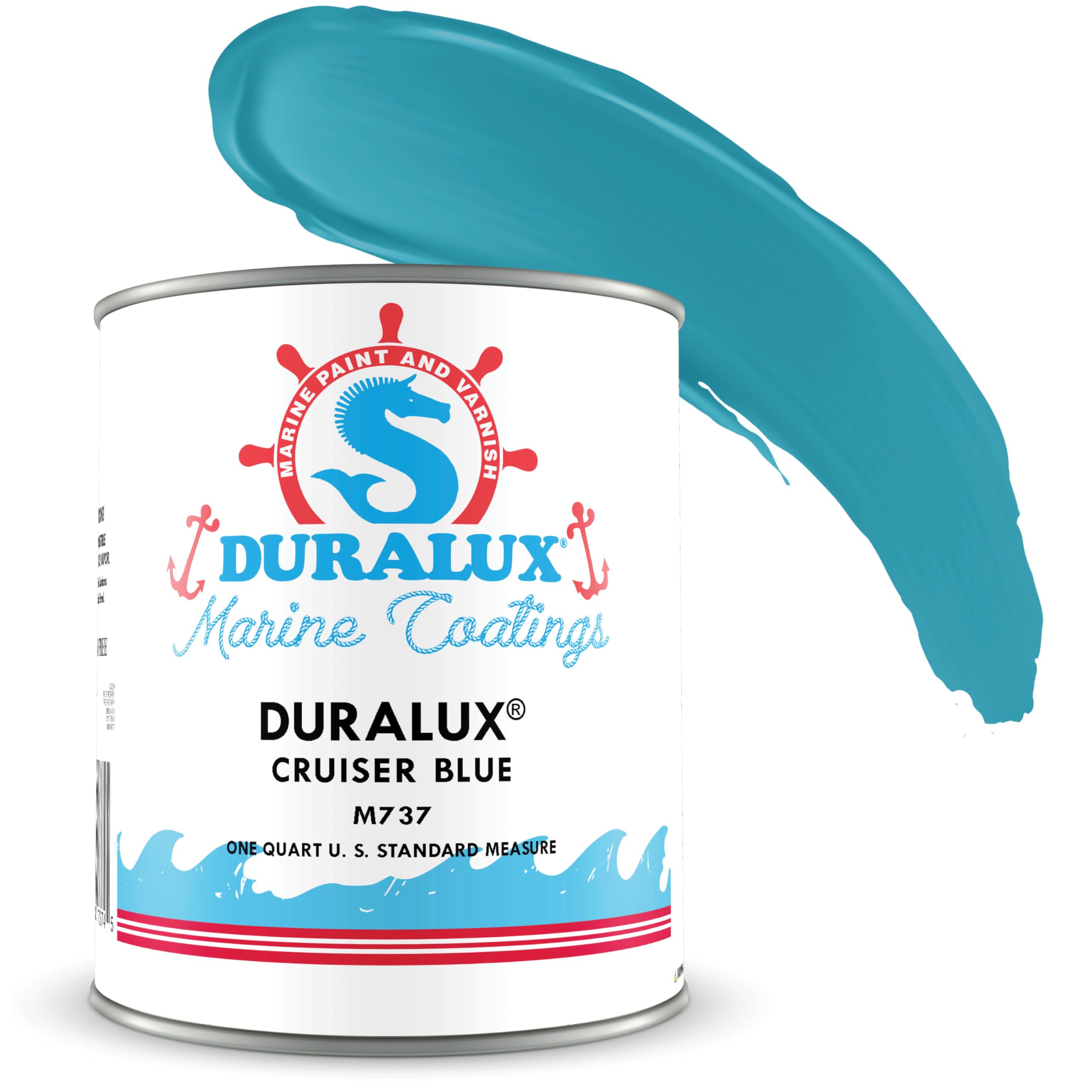
Color choice on a fiberglass hull is a commitment, and committing a whole gallon to a deep blue is a bigger one than most weekend projects need. Duralux sells this single-component topside enamel by the quart in Cruiser Blue, and the fitment line on the listing is refreshingly direct: it adheres to primed steel, metal, wood, aluminum and fiberglass. That last word is the one that matters here.
What Duralux claims is endurance rather than shine. The listing puts it up against salt water, oil, gasoline, repeated washings and the discoloration effects of harbor gases — a list clearly written for working boats, oil rigs, bridges and tanks as much as for pleasure craft. The finish is satin rather than high gloss, coverage is quoted at 300 square feet per gallon, and dry time is listed at four hours.
The application instruction is short and worth following exactly: two thin coats, applied by brush, roller or airless sprayer, with each coat allowed to dry overnight — and do not paint in direct sunlight. That last clause is the one people skip, and on a dark hull colour in summer it is the difference between a film that levels and one that skins over before it can. The quart is the size on test here; Duralux also lists a gallon on the same page.
This is the entry to reach for when you want a traditional marine colour on fiberglass without stepping up to a premium two-part system or buying more paint than the job needs. It averages 4.5 stars from 190 Amazon ratings.
Why it earns a slot
- Fiberglass named on the listing – Adheres to primed steel, metal, wood, aluminum and fiberglass.
- Built for harsh exposure – Rated against salt water, oil, gasoline, repeated washings and harbor gases.
- Quart size – A classic deep hull colour without committing to a gallon.
- 300 sq ft per gallon – Published coverage makes estimating straightforward.
- Brush, roller or airless – No specialist equipment required.
Good to know
- Satin finish, not the high gloss of a one-part polyurethane topside paint.
- Duralux specifies two thin coats with overnight drying between them — this is not a one-afternoon job.
- The listing says explicitly: do not paint in direct sunlight.
- Surfaces should be primed; this is an enamel topcoat, not a direct-to-bare-substrate system.
Ideal for: above-waterline fiberglass in a traditional marine colour, on a project sized for a quart rather than a gallon.
9. Pettit EZ-Poxy Topside Aerosol (White) – Spray-Can Polyurethane for Small Fiberglass Repairs

Not every fiberglass project justifies opening a quart, cleaning a brush and losing an afternoon. A hatch corner, a repaired scuff, a locker lid, a console edge — these are aerosol jobs. Pettit’s answer is EZ-Poxy in a 15.87 oz spray can, and its listed recommended surface is fiberglass, which is more than most general-purpose rattle cans will commit to.
The chemistry is the same idea as the premium topside paints higher up this list, in a smaller package. Pettit describes EZ-Poxy as a modern one-part polyurethane topside and deck enamel with silicone added for shine and brushability, carrying ultraviolet filters that support gloss retention. The phrase Pettit uses for the result is a “gelcoat-like brilliance,” which is exactly what you are trying to blend back into on a fiberglass repair.
The planning numbers are small and honest: 15 square feet per coat, a four-hour dry time, and a gloss finish. A brush is listed among the included components, so the can is set up for touching in as well as spraying. Pettit also prints the caveat that matters most on a repair — colour differences may occur between the actual paint and the colour chips shown — so if you are blending into an existing white, test on something hidden before you commit to a visible panel.
Treat this as a repair and maintenance tool rather than a hull-refinishing system. It averages 4.1 stars from 15 Amazon ratings, which is a genuinely small feedback pool, so buy it for what the spec sheet says rather than on the strength of consensus.
Why it earns a slot
- Fiberglass is the listed surface – Not a general-purpose can pressed into marine duty.
- One-part polyurethane in an aerosol – Topside chemistry without brushes, thinner or cleanup.
- UV filters for gloss retention – Pettit adds silicone for shine and brushability.
- 15 sq ft per coat – Sized honestly for repairs, not hulls.
- Brush included – Listed among the components for touching in tight spots.
Good to know
- Only 15 Amazon ratings at a 4.1-star average — a very small feedback pool.
- Pettit warns that actual colour may differ from the colour chips shown; test before a visible panel.
- 15 sq ft per coat means this is a repair can, not a refinishing system.
- The most expensive way to buy this paint per ounce compared with the quart cans here.
Ideal for: small fiberglass repairs and touch-ups above the waterline where an aerosol beats opening a quart.
10. SENVEN Marine Boat Paint (35 oz, Gloss) – Quick-Drying Patch Paint for Small Fiberglass Needs
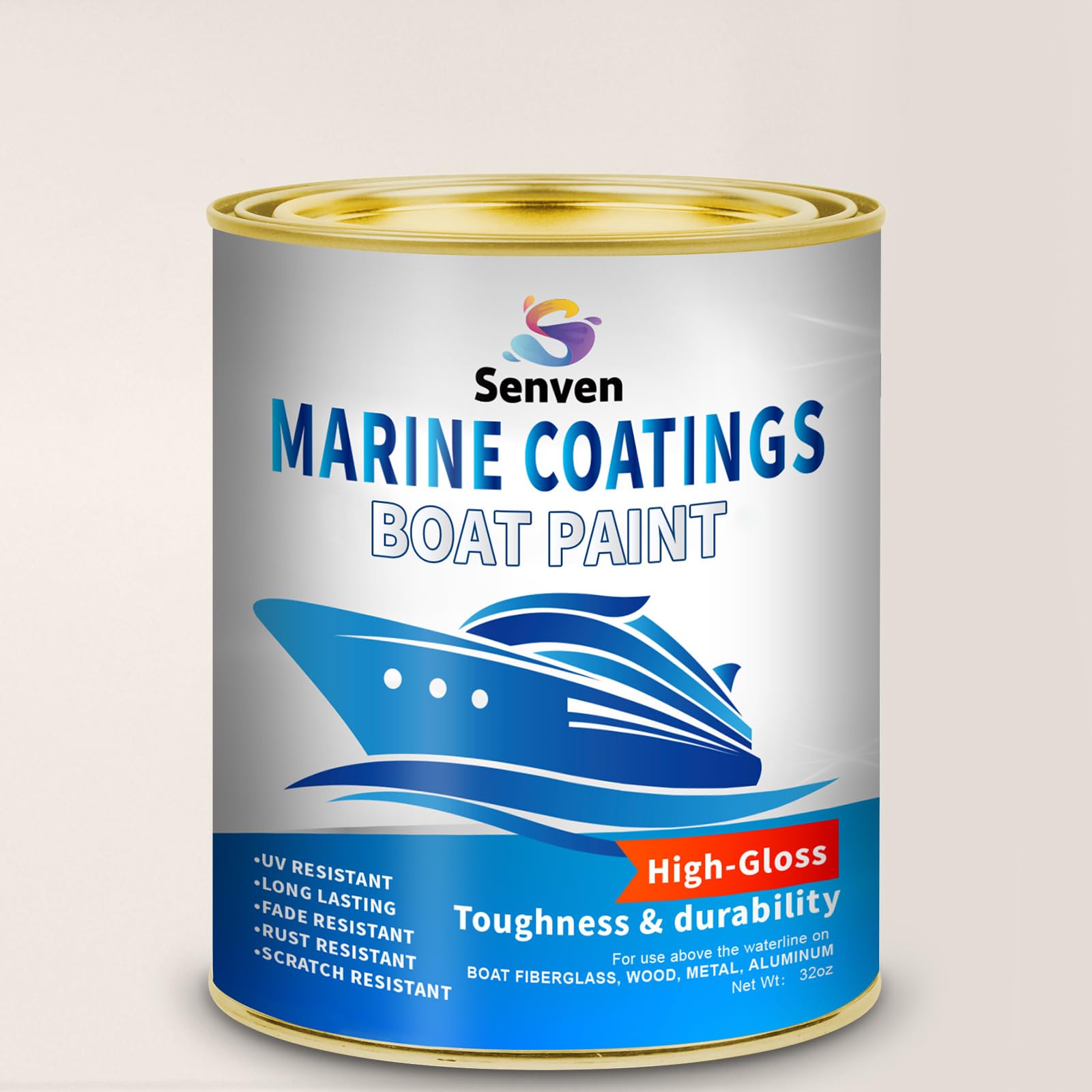
SENVEN’s 35 oz gloss marine paint sits in a different lane than the premium marine systems above. It’s positioned as an all-in-one enamel-style coating for boats and marine equipment, intended for fiberglass, wood, and metals. This kind of product is most useful when your project is small and practical: covering scratches, sealing exposed fiberglass after a repair, refreshing a dinghy, repainting a fiberglass slide or accessory, or touching up a bottom edge that takes occasional abrasion.
SENVEN’s published numbers fit that use: dry to the touch in as little as one to two hours, and 100-120 sq ft of coverage from the 35 oz can, brushed or sprayed. It is an oil-based, high-gloss formula that SENVEN describes as flexible with good leveling, UV resistant and abrasion resistant. If you need it thinner, SENVEN gives a 1:0.4 thinning ratio. It averages 4.2 stars from 194 Amazon ratings.
There is one contradiction on the listing you should settle before you buy. SENVEN’s headline calls it an all-in-one finish for topside, bottom and waterline, but a later bullet on the same page says it is not for continuous submersion on boat bottoms that stay in the water longer than 72 hours. Read the second one as the binding statement. A few application notes that follow from the spec sheet:
- Check what arrived — SENVEN notes its packaging has carried printing errors and says the paint needs no curing agent despite what some labels show.
- For brushing, maintain a wet edge and don’t overwork it—enamels can tack up and then drag.
- For spraying, set up overspray control, keep your distance consistent, and avoid spraying in windy conditions.
This is also where expectations matter. If you want the “spray booth” look on a yacht topside, use a topside system like Wet Edge plus primer. If you want a hard, glossy protective coat for a utilitarian fiberglass surface, SENVEN can be a practical option—especially for smaller jobs where convenience matters.
Finally, a key fiberglass truth: small repairs often fail because edges aren’t feathered. Whatever paint you choose, sand the repair edges so the coating transitions smoothly. Hard edges are where chips start. Feathering is where longevity starts.
Why it’s useful
- Quick-drying feel – Helpful for small repairs and time-sensitive projects.
- Hard, glossy film – Good for sealing exposed fiberglass and covering scratches.
- Multi-surface flexibility – Can be used on fiberglass, wood, and many metal items.
- Convenient size – Appropriate for spot repairs without buying large volumes.
- Practical DIY use – Works well when expectations match the job: patches and refreshes.
Good to know
- The listing contradicts itself on submersion; treat the 72-hour limit as the real one.
- 100-120 sq ft per 35 oz can — enough for patches, not for a hull.
- Not a substitute for true antifouling on boat bottoms that live in the water full-time.
Ideal for: small fiberglass repairs and practical marine touch-ups where quick cure and a hard film matter more than boutique finish perfection.
Why Fiberglass Paint Fails (and the Fixes That Actually Work)
Most coating failures on fiberglass come from one of four root causes: contamination, gloss (no mechanical tooth), incompatible chemistry, or trapped solvent from thick coats. If you fix those four, you can make almost any quality product behave better. Here’s how to diagnose and prevent the common failures before they happen.
The prep moves that change everything
- Dewax before sanding – Wax and polish residues cause fisheyes and adhesion loss. Wipe first, then sand.
- Sand to “uniform dull” – You’re not removing fiberglass; you’re removing shine. Shine = no grip.
- Vacuum like you mean it – Fiberglass dust becomes a weak layer if you just “wipe it around.”
- Use primer as a leveling tool – Primer fills micro texture; topcoat creates appearance. Don’t reverse those roles.
- Thin coats, not thick coats – Thick coats trap solvent and stay soft. Thin coats cure harder and level better.
- Respect cure time – “Dry to touch” is not “ready for full use,” especially in bathrooms and immersion environments.
- Mix coatings thoroughly – Bottom paints and primers settle; power-mixing prevents weak patches.
The failure patterns (and what they usually mean)
- Fisheyes: contamination (wax/oil/silicone). Fix: dewax/solvent wipe, then sand, then wipe again.
- Peeling sheets: wrong paint for the zone or inadequate deglossing. Fix: correct system + stronger mechanical profile.
- Soft or tacky paint: too thick, wrong temperature/humidity, or recoat timing issues. Fix: thin coats + correct conditions + patience.
- Orange peel texture: thick application, cheap rollers, or paint drying too fast. Fix: better tools + thinner coats + maintain wet edge.
- Uneven gloss: substrate inconsistency or uneven sanding. Fix: primer base + uniform sanding + clean wipe-down.
- Bottom growth despite antifouling: extreme fouling pressure, thin film areas, poor mixing, or boat sitting still. Fix: coat strategy + correct paint type + usage-aware maintenance.
When you treat fiberglass finishing like a system—prep, primer, coat thickness, cure timing—the project stops being a gamble. That’s the difference between “painted fiberglass” and “restored fiberglass.”
FAQ: Painting Fiberglass Without the Guesswork
Do I need primer when painting fiberglass?
Can I use topside boat paint on a fiberglass tub or shower?
What grit should I sand fiberglass to before painting?
Can I paint the bottom of my fiberglass boat with regular marine enamel?
Why do some bottom paints work for one boater but not another?
What’s the biggest mistake people make with fiberglass paint?
How many coats should I apply?
Final Thoughts: Buy the Paint That Matches Your Fiberglass Reality
The smartest fiberglass paint choice isn’t “the strongest one.” It’s the one that matches your exposure zone and your willingness to prep and cure properly. When you choose by reality—sun, water, abrasion, chemicals—you stop repainting the same surface every year.
Here’s how to turn this guide into one confident purchase:
- Want the best all-around topside finish for fiberglass above the waterline? Start with TotalBoat Wet Edge (White, Gallon). It’s the “looks professional without professional tools” pick.
- Need a hybrid bottom paint that avoids heavy layer buildup? Consider Interlux Fiberglass Bottomkote NT for a durable underwater system with polishing behavior.
- Want copper-free antifouling for underwater metals or aluminum-adjacent setups? Look at TotalBoat Krypton Copper-Free, a strong choice for outdrives, trim tabs, and copper-avoidance strategies.
- Painting fiberglass that stays immersed (pool steps, pool surfaces)? Use an immersion-ready epoxy like Olympic Zeron and respect pot life and cure timing.
- Refreshing a fiberglass RV roof? Use a roof-specific flexible coating like Dicor RP-FRC-1, built for roof movement and sun exposure.
- Resurfacing a fiberglass tub, sink, or bathroom surround? A dedicated refinishing option like NADAMOO Bathtub & Tile Refinishing Spray can deliver a dramatic upgrade when prep and cure discipline are handled like a pro job.
- Need a straightforward above-waterline primer step? Rust-Oleum Marine Wood & Fiberglass Primer is an easy, classic adhesion helper for many small projects.
- Doing smaller topside jobs or touch-ups? An aerosol like Pettit EZ-Poxy Topside Aerosol makes maintenance and repairs far more practical.
- Need a small-can option for quick fiberglass patch jobs? SENVEN Marine Boat Paint can be useful for small repairs and utility refreshes when expectations match the job.
If you take one thing from this guide, let it be this: the “right” choice is the one that matches the surface you’re painting and the way you’ll use it afterward. Pick the best paint for fiberglass for your real exposure zone, do the prep like you’re protecting your future weekends, and you’ll get a finish that feels solid, clean, and satisfying every time you see it.