
Our readers keep the lights on and the garage heater humming. As an Amazon Associate, I earn from qualifying purchases.
Trailer tires are the kind of “boring” purchase you only appreciate when they save your trip. Because when a trailer tire fails, it doesn’t fail politely. It can rip up fenders, shred wiring, damage brake lines, and turn a calm tow into a shoulder-side emergency that burns your day (and your wallet).
If you’re here searching for best american made trailer tires, you’re probably not just shopping — you’re trying to remove uncertainty from towing. And that’s exactly the right mindset. The problem is: most buying guides talk like a catalogue. They’ll repeat obvious specs (“10-ply is stronger!”) without explaining the stuff that actually causes blowouts, sway, shoulder wear, and that nagging feeling that your rig is “walking” behind you in crosswinds.
This guide is built differently. Instead of chasing marketing slogans, we focus on the real friction points that show up in owner feedback and long-haul towing communities: fresh DOT date codes, roundness and balance, heat management at highway speed, sidewall scrubbing on tandem axles, bead seating headaches from shipping, and the small setup mistakes that quietly destroy even “good” tires.
Below you’ll find 12 standout options across the most common trailer scenarios: heavy travel trailers, car haulers, equipment trailers, single-axle utility rigs, and smaller 12–13 inch wheel setups. Some are tire-only sets for maximum performance per dollar; others are complete wheel-and-tire assemblies for the fastest, least-fuss replacement.
If you read this all the way through, you won’t just know “what to buy.” You’ll know why it’s right for your trailer — and how to set it up so it stays right.
In this article
- How to choose the right trailer tire (the expert way).
- Quick comparison table of 12 standout picks.
- In-depth reviews of each tire (and wheel kit), with pros and cons.
- What really kills trailer tires (and the prevention routine that works).
- FAQ: size, load range, speed, DOT codes, and buying mistakes to avoid.
How to Choose the Best American Made Trailer Tires
A trailer tire isn’t “good” because it has a tougher-sounding name or a higher ply rating on a listing. It’s good because it carries your real load, at your real speed, in your real heat — without flexing itself to death. And here’s the truth: most tire problems come from a mismatch, not a mystery. Wrong load range. Old date code. Underinflation. Or a “close enough” size change that steals clearance.
Use the framework below and you’ll pick the right tire with the confidence of someone who’s done this a hundred times — even if it’s your first upgrade.
1. Start with the one thing you can’t negotiate: size
Your trailer doesn’t care what looks good on Amazon. It cares what fits. Before you fall in love with any model, confirm the size printed on your current sidewall (and compare it with your trailer placard / manual).
- ST205/75R15 and ST225/75R15 are two of the most common for travel trailers, utility rigs, and car haulers.
- ST205/75R14 is common on lighter travel trailers and smaller tandem rigs.
- ST175/80D13 and 4.80-12 show up on smaller utility, boat, yard, and compact camper trailers.
2. Know the difference between tire-only and wheel-and-tire assemblies
In this guide, you’ll see both:
- Tire-only sets (often in sets of 2 or 4): Best when you already have good wheels and want the strongest, most consistent tire choice.
- Wheel-and-tire assemblies (pre-mounted): Best when you need a fast replacement, want a ready-to-go spare, or your wheels are suspect (rust, bent lip, old valve stems).
But assemblies have a hidden rule: the wheel must match your trailer’s bolt pattern and your real-world load. That means verifying:
- Bolt pattern (example: 5 lug on 4.5″). Measure it — don’t assume.
- Wheel width and offset (affects fit and clearance).
- Valve stem rating (especially for higher pressure Load Range D/E tires).
- Wheel load rating (your wheel must be rated to carry what the tire can carry).
A great tire on an underrated wheel is not a great setup. It’s a weak link with nicer tread.
3. Load Range is about heat control as much as “strength”
Most people treat Load Range like a macho badge. “E is best!” Real life is more nuanced: Load Range is really a system — casing strength, allowable inflation pressure, and load capacity working together. Higher Load Range can give you more load headroom and stiffer sidewalls, but only if you run the right pressure and your wheels support it.
Here’s the simple decision logic:
- Calculate required load per tire using your axle rating (or your real loaded trailer weight).
- Add reserve. A healthy safety margin helps with heat, corners, potholes, and real-world weight shifts.
- Pick a Load Range that gives you margin without creating fit or wheel-rating problems.
Why the reserve matters: trailer tires don’t live an easy life. Tandem axles scrub in turns, sidewalls flex under sway loads, and the tire is often the “suspension” for smaller rigs. A tire operating near its limit runs hotter. Heat is the silent killer.
4. Speed ratings aren’t a suggestion
Trailer tire failures get blamed on “bad tires,” but speed is a huge factor because speed = heat. Many trailer tires are traditionally rated for lower speeds unless the sidewall explicitly states a higher speed symbol. In this list you’ll see several tires with higher speed symbols (like M or N), but that doesn’t mean you can ignore basics:
- Speed rating assumes correct inflation and load. Underinflated tires run hotter, faster.
- Hot days + high speed + heavy load is the trifecta that punishes weak setups.
- Small diameter tires (12–13 inch) spin faster at the same road speed, which can increase heat even on “short trips.”
5. Construction details that actually matter on trailers
If you only remember one thing from this guide, make it this: the right construction features reduce the two biggest trailer tire enemies — heat-related belt issues and sidewall damage.
- Full nylon cap ply over the tread: Several tires here feature a full nylon cap ply overlay across the tread area (not just small shoulder strips). This matters because it helps stabilize the belt package, especially under heat and sustained highway towing. It’s one of the most underrated “why this tire lasts” features when you’re doing real miles.
- Scuff Guard / sidewall protection rings: Tandem axles scrub. Tight turns scuff. Curbs happen. A scuff guard ring doesn’t make you invincible, but it can protect the sidewall from the kind of abrasion that starts tiny cracks and sidewall weakness.
- Steel-belted radials: Radials typically run cooler and track smoother at highway speed than bias tires. If you do long freeway pulls, radials are usually the calmer, more stable choice.
- Meaningful tread depth (not just “more is better”): Deeper tread can help longevity, but the real win is a compound and casing that resists irregular wear. Many trailer tires fail or wear unevenly from alignment/suspension issues long before the tread “runs out.”
6. DOT date codes are the “freshness” truth you can control
This is where smart buyers quietly win. Trailer tires often age out before they wear out. That’s why you’ll see experienced owners talk about “fresh date codes” like it’s a feature — because it is.
When your tires arrive:
- Find the DOT code on the sidewall (a sequence ending in 4 digits).
- The last 4 digits are week + year (example: 1225 = 12th week of 2025).
- Inspect for cracking, flat spots, or shipping damage before mounting.
Buying online doesn’t mean you’ll get old tires — but it does mean you should check. And if you’re buying a full set, try to get tires with matching (or close) date codes so they age together.
7. Setup mistakes that make even good tires “feel bad”
This is the part most guides skip: tires don’t tow alone. Your trailer’s suspension, bearings, alignment, and even your tongue weight all change how a tire wears. Here are the fixes that make new tires feel like a dramatic upgrade (because they remove the hidden problems):
- Inflate to the correct cold pressure for your tire/load combo — not “whatever feels fine.”
- Torque lug nuts correctly and re-torque after your first short drive day (common after a wheel install).
- Replace cheap valve stems with stems rated for your pressure, especially on Load Range D/E setups.
- Check wheel bearings and brake drag — heat from bearing issues gets blamed on tires all the time.
- Fix sway at the source (tongue weight, weight distribution, and axle alignment) instead of hoping a stiffer tire will “solve it.”
Now let’s get practical. The table below will help you quickly shortlist the models that match your trailer type and your towing reality.
Quick Comparison: 12 Best American Made Trailer Tires Picks
Use this table to match your trailer style (travel trailer, car hauler, utility, boat, small single-axle) to the right construction approach. Then jump to the in-depth reviews — that’s where the real value is: fit pitfalls, setup tips, and the “what owners actually notice” details.
On smaller screens, swipe or scroll sideways to see the full table.
| Model | Type | Best for | Standout trait | Amazon |
|---|---|---|---|---|
| Libra Trailer Parts (Free Country) ST205/75R15 Set of 4 (Load Range E) | Radial 10‑ply | Most 15″ travel trailers & car haulers needing serious load headroom | Full nylon cap ply + scuff guard + confident highway feel | Amazon |
| Carlisle Radial Trail HD ST225/75R15 (Single Tire, Load Index 113) | Premium radial | Heavier trailers needing ST225 size + a long-standing American tire brand | Redesigned HD casing rated 2,540 lbs at 65 psi | Amazon |
| Free Country Grand Ride ST225/75R15 Set of 4 (Load Range E) | Radial 10‑ply | Tandem axle travel trailers that want a full matched set | Full cap ply + scuff guard with huge owner popularity | Amazon |
| Mastertrack UN203 ST205/75R15 Set of 4 (Load Range E) | Radial 10‑ply | 15″ setups needing E range but staying in ST205 sizing | Double steel belts + 3-year road hazard warranty | Amazon |
| ROCKMAN ST205/75R15 Set of 4 (Load Range D) | Radial 8‑ply | Mid-weight travel trailers & utility rigs upgrading from stock tires | Full nylon cap ply + deeper tread for longevity focus | Amazon |
| Free Country Grand Ride ST205/75R15 Set of 2 (Load Range D) | Radial 8‑ply | Single-axle trailers or “replace two, keep a spare” strategy | Scuff guard + full cap ply in a two-tire buy | Amazon |
| ROCKMAN Wheel Assembly ST205/75R15 Set of 2 (5 Lug on 4.5″) | Wheel kit | Fast replacement or ready-to-go spare with matching wheel | Pre-mounted convenience + solid “ready now” fit | Amazon |
| HALBERD ST205/75R14 Set of 2 (Load Range D, 8PR) | Radial 8‑ply | Smaller travel trailers replacing both tires on a single axle | Thicker shoulder design + 2,040 lb per-tire rating | Amazon |
| Free Country Wheel Assembly ST205/75R14 Set of 2 (5 Lug on 4.5″) | Wheel kit | 14″ quick replacement when you don’t want mounting hassle | Scuff guard + full cap ply in a pre-mounted package | Amazon |
| Free Country ST205/75D15 Bias Set of 4 (Load Range C) | Bias (deep tread) | Local hauling, rougher surfaces, slower-speed utility use | Deep tread + sturdy bias feel for “work trailer” life | Amazon |
| eCustomrim ST175/80D13 Tire + Rim Set of 2 (5 Lug on 4.5″) | Wheel kit | Small utility/boat/camper trailers needing a fast refresh | DOT-approved assemblies mounted in the USA, 2-year warranty | Amazon |
| GarveeTech 4.80-12 Tire + Wheel Set of 2 (5 Lug on 4.5″) | Wheel kit | Very small utility/yard/boat trailers with 12″ wheels | Pre-mounted “ready to install” with stout load rating | Amazon |
In‑Depth Reviews: 12 Best American Made Trailer Tires for Real-World Towing
Now we go model by model — and we’re going to talk like people who actually tow, not like a spec sheet. For each pick, I’ll cover what matters in the real world: how it behaves under heat, how it handles tandem-axle scrub, what owners praise after long miles, what the “gotchas” are (clearance, bead seating, wheel ratings), and how to set it up so it lasts.
1. Libra Trailer Parts (Free Country) ST205/75R15 Set of 4 – The Heavy-Duty “Tow With Confidence” Upgrade
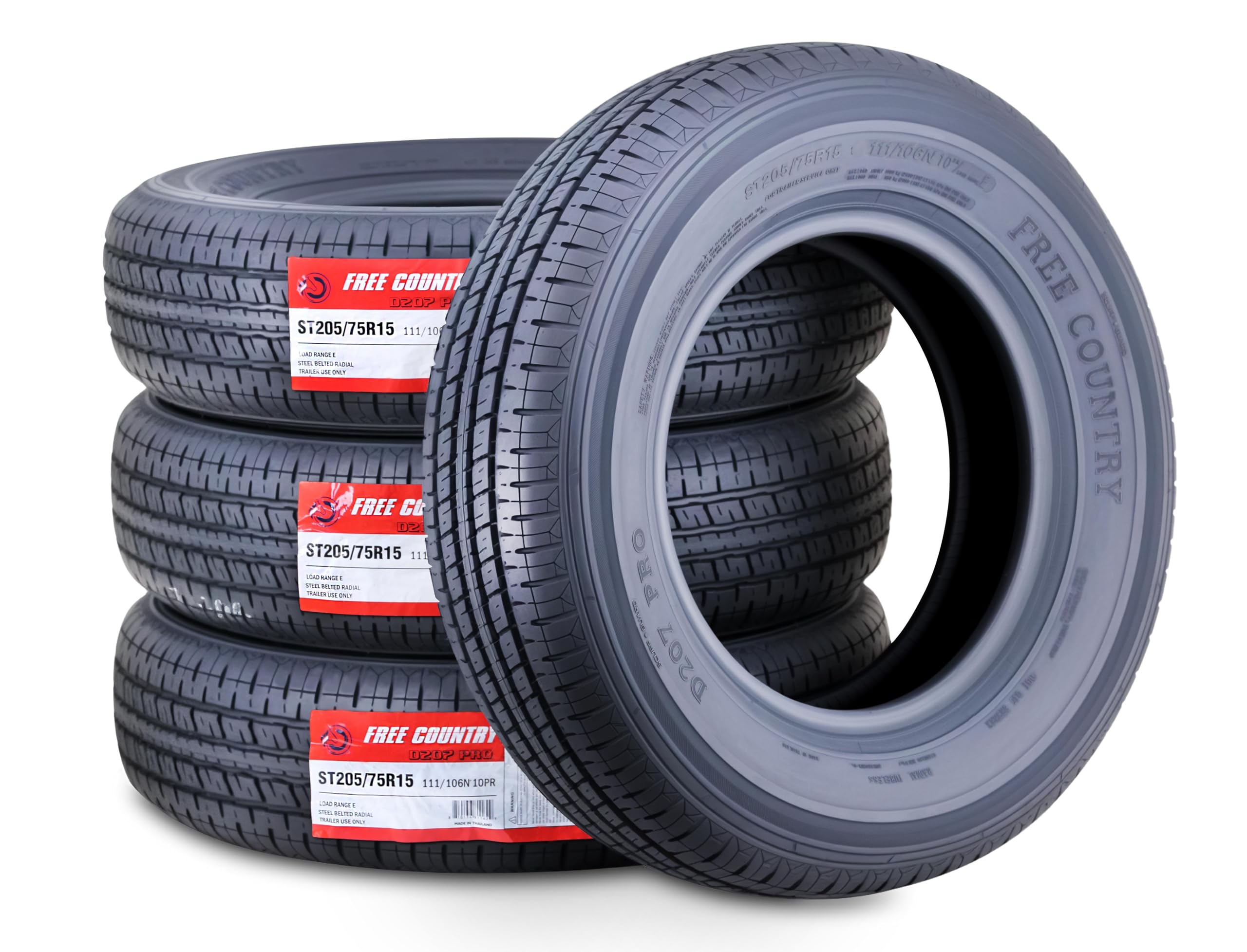
If you want one “do it right and stop thinking about it” choice for common 15-inch trailer setups, this is it. This set targets the exact pain point that frustrates trailer owners: the stock tires that technically meet minimum requirements, but feel sketchy in heat, feel soft in wind, and don’t inspire trust on long highway days.
What separates this set from generic 10‑ply listings is the combination of full nylon cap ply (across the tread) and a real scuff guard ring. That pairing is a practical answer to the two most common trailer tire realities:
- Heat cycles on the highway (belt stability matters).
- Sidewall abrasion from turns (tandem axle scrub, curbs, tight campsites).
Owner feedback repeatedly points to the same outcome: the trailer feels calmer. People describe smoother tracking and a more “planted” feel — especially noticeable if you’re coming off basic imported tires that have soft sidewalls or inconsistent build quality. One long-haul style review even highlights a heavy vehicle-on-trailer trip that ended with the tires still looking essentially unchanged, which is exactly the kind of “earned trust” you want from a set like this.
Here’s the expert nuance: Load Range E is a system. It’s not just “stronger.” To get the full benefit, you need the right supporting pieces:
- Wheels rated for the required pressure/load (don’t assume your existing rims are ready for higher-pressure setups).
- Valve stems that match your pressure (especially if you run higher PSI).
- Cold-pressure discipline (check before you roll, not after you’ve heated the tire).
When those are in place, this set becomes the type of upgrade that makes towing feel less like work and more like… driving. Not flashy — just stable.
Why it stands out
- Confidence at speed – The stiffer casing and belt package tends to reduce that “tail wag” feeling in wind.
- Full-cap construction – A meaningful feature for heat stability over long interstate pulls.
- Scuff guard protection – Extra sidewall defense where trailers actually get hurt (turns, curbs, campsite pivots).
- Matched set of four – Perfect for tandem axles when you want uniform behavior and uniform aging.
Good to know
- Load Range E setups are less forgiving of sloppy inflation habits — your payoff comes from running them correctly.
- Heavier-duty tires can feel stiffer when the trailer is lightly loaded; that’s normal, not a defect.
- Always confirm clearance on tandem axles (tire-to-tire and tire-to-fender) before changing brands or models.
Ideal for: travel trailers, car haulers, and equipment trailers running 15″ ST205 sizing that want a heavy-duty, confidence-first set without stepping into niche boutique pricing.
2. Carlisle Radial Trail HD ST225/75R15 – The “Replace the Sketchy Stock Tires” Workhorse
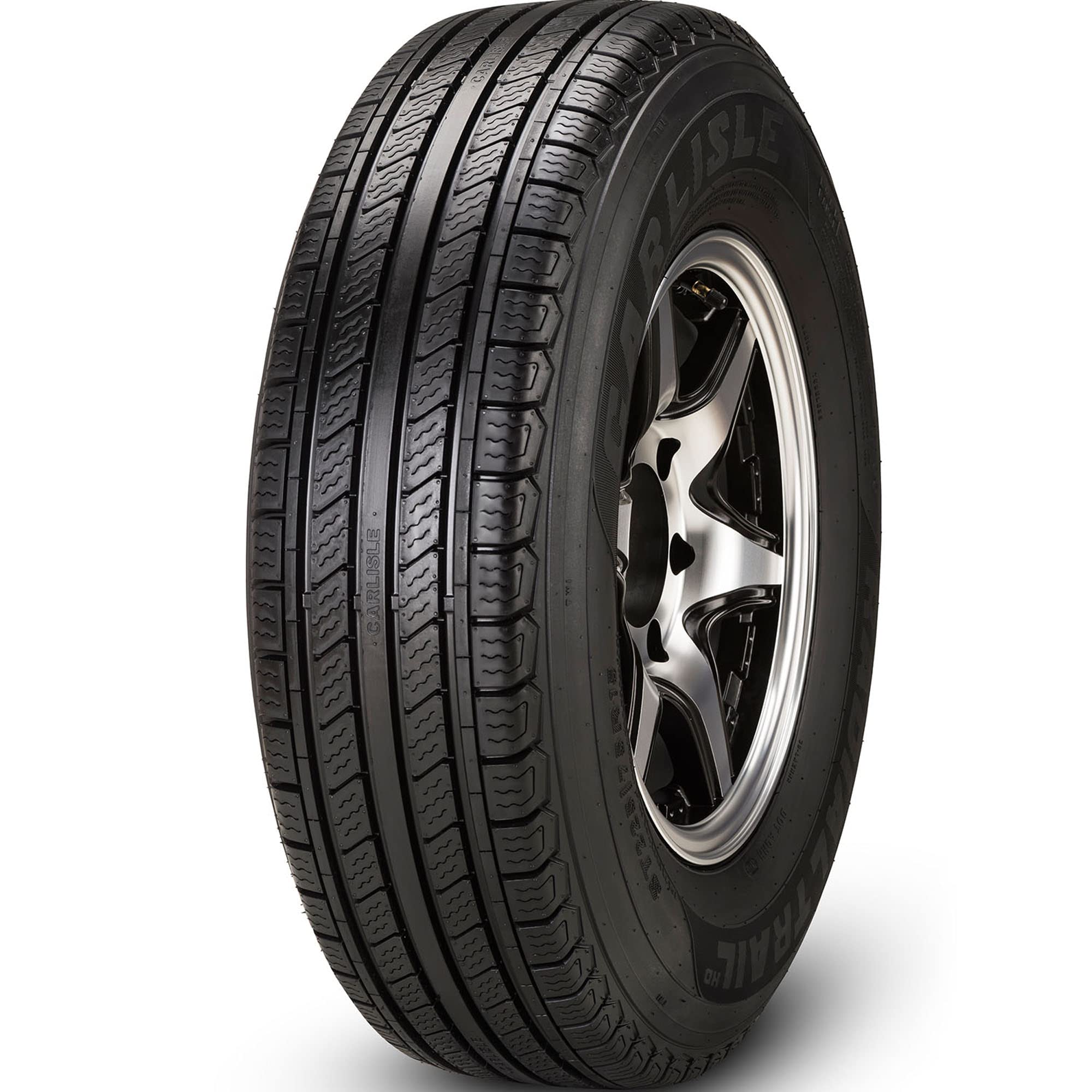
Carlisle is the name that shows up over and over when trailer owners stop gambling on unknown brands. The Radial Trail HD is built by The Carlstar Group, and it is the tire many people reach for when the factory rubber under their travel trailer, boat trailer, or car hauler has finally lost their trust. With a 4.7-star average across more than 2,900 Amazon ratings, it is one of the most heavily reviewed trailer tires you can buy — and it currently sits inside the top 20 of Amazon’s Trailer Tires category.
What you are really paying for here is engineering that was redone on purpose. Carlisle states the Radial Trail HD is a complete redesign of its long-running Radial Trail RH, specifically targeting three things trailer owners actually complain about: tread wear, heat resistance, and durability. In the company’s own real-world testing, the HD showed a 10% improvement in tire life over the RH it replaced. If you are running the older RH model, this ASIN (part 6H04611) is listed as a direct replacement for part 5151401.
The hard numbers matter more than the marketing. This is a Load Range D radial with a 113 load index, a 2,540 lb maximum capacity, a 65 psi maximum cold pressure, a 9/32″ tread depth, and an 81 mph speed rating. It is designed for short and long-distance towing across boating, cargo, utility, horse and stock trailers, plus towable RVs and toy haulers. Carlisle also publishes long fitment lists for common boat, utility, and cargo trailer brands — useful when you are trying to confirm you are not guessing.
But here’s the expert caution: ST225/75R15 is larger than ST205/75R15. That’s not “close enough.” It’s a different footprint and a different overall diameter. If your trailer was designed tightly (common on tandem axles), this size can create clearance issues unless you measure:
- Tire-to-fender clearance (vertical travel under bumps)
- Tire-to-frame clearance (inside sidewall)
- Tire-to-tire clearance (tandem axle spacing)
If you have the space, ST225 is a strong move because it typically brings higher load capacity and a more stable “big trailer” stance. If you don’t have the space, stay in ST205 and choose a stronger construction there (which you’ll see in multiple picks below).
Why owners love it
- Enormous review base – 4.7 stars from 2,900+ ratings is about as much real-world data as this category offers.
- Purpose-built redesign – Carlisle rebuilt the RH into the HD for better tread wear, heat resistance, and durability.
- Documented capacity – 2,540 lbs at 65 psi with a published 113 load index, so you can do the math instead of hoping.
- Wide trailer fitment – Boat, cargo, utility, horse/stock, towable RVs and toy haulers are all in the intended use list.
Good to know
- This listing is tire only — rim not included; order enough units if you want a full matched set.
- It is Load Range D, not E. If your trailer needs E-range headroom, look at the ST205 Load Range E sets below.
- ST225 sizing may not fit every trailer; measure clearance before switching sizes.
- Carlisle lists no manufacturer warranty on this part, so document your purchase date and check DOT codes on arrival.
Ideal for: heavier travel trailers and haulers that can safely run ST225 sizing and want a high-trust, brand-backed tire with a long-standing reputation for towing stability.
3. Free Country Grand Ride ST225/75R15 Set of 4 – The “Tandem Axle Reset Button”
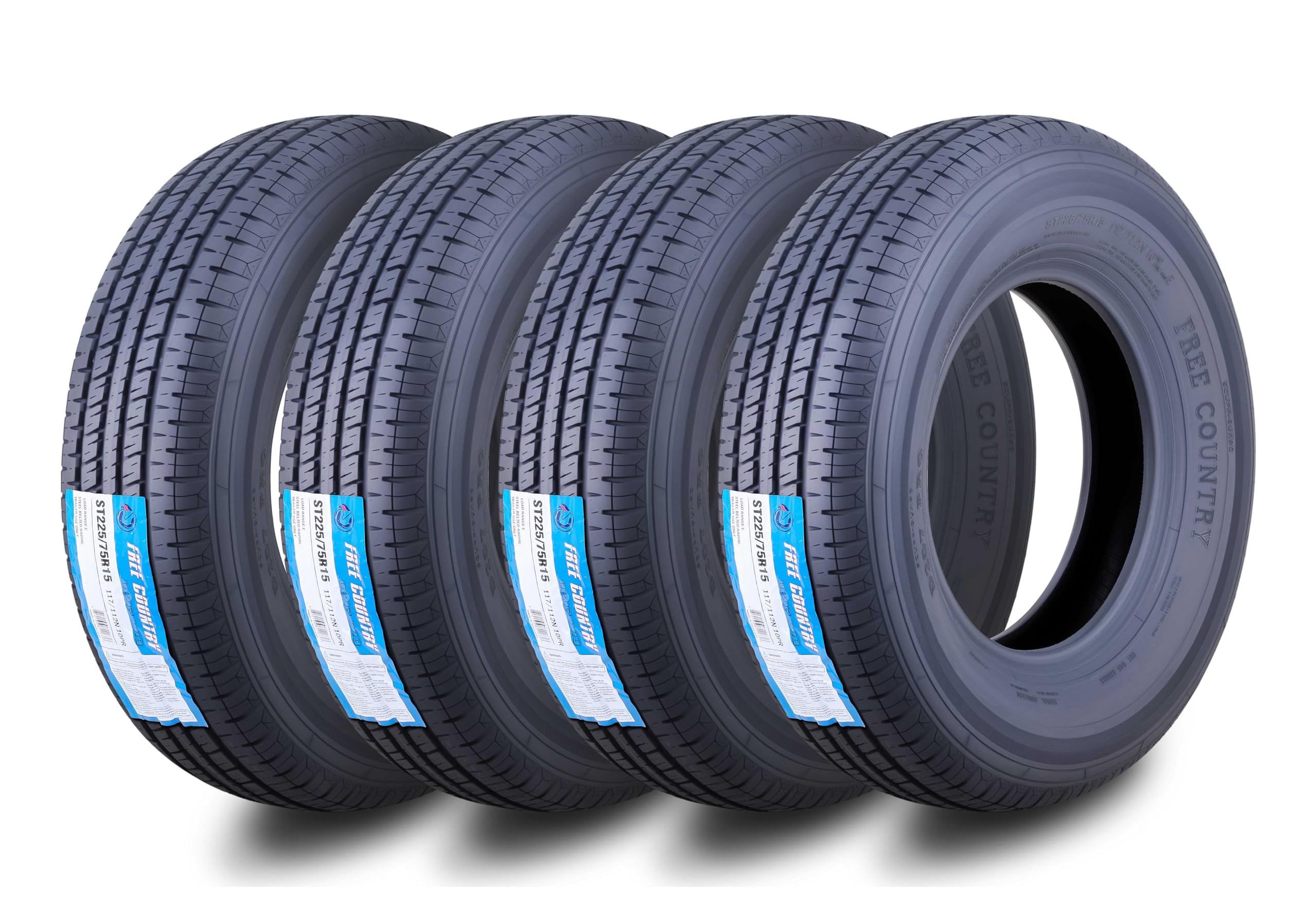
If your trailer runs ST225 sizing and you want the simplicity of ordering a matched set that thousands of owners already run successfully, this is one of the strongest “full reset” buys you can make. Why? Because the biggest towing improvement often isn’t one single tire feature — it’s uniformity across the rig: same model, same date window, same casing behavior, same pressure requirement, same tracking feel.
The Grand Ride line is popular for a reason: it’s built around the kind of construction details towing people care about, including a full nylon cap ply and a scuff guard ring that helps protect the sidewalls during tight turns and tandem axle scrub. And because it’s sold as a set of four, it naturally fits the most common travel trailer reality: two axles, four tires that should behave like a team.
Owner feedback tends to cluster around a few practical wins:
- Highway composure – “pulls nice at highway speed” is a recurring theme.
- Easy install / balance – People often mention the tires mount and balance without surprise fights.
- “Looks like quality” build feel – a subjective point, but it matters when you’re trusting rubber with your trip.
Here’s the expert insight: ST225 tires tend to make trailers feel more stable because you’re running a larger footprint and usually a higher load capacity. But that only helps if your trailer actually needs it and can fit it. Before buying, check:
- Wheel width (many ST225 setups call for a wider rim than ST205)
- Suspension travel and clearance
- Spare tire compartment fit (this is the “surprise annoyance” people forget)
If everything fits, a matched set like this can make towing feel like you upgraded your entire trailer, not just the tires.
Why it’s a smart buy
- Matched set for tandem axles – Uniform behavior reduces weird tracking differences across axles.
- Full nylon cap ply – A meaningful durability feature under sustained highway heat.
- Scuff guard ring – Adds sidewall defense where trailer tires actually get abused.
- Huge popularity – High owner adoption often means easier troubleshooting and shared best practices.
Good to know
- Verify clearance before moving into ST225 sizing — it can rub on tighter trailers.
- Higher-pressure setups require the right valve stems and wheel rating.
- If you tow light and local only, you might not need this much tire — but many owners like “extra headroom” for peace of mind.
Ideal for: tandem-axle travel trailers, horse trailers, and equipment rigs that run ST225 sizing and want a popular, heavy-duty set that’s built for the messy reality of towing.
4. Mastertrack UN203 ST205/75R15 Set of 4 – The Quiet Workhorse for 15″ ST205 Sizing
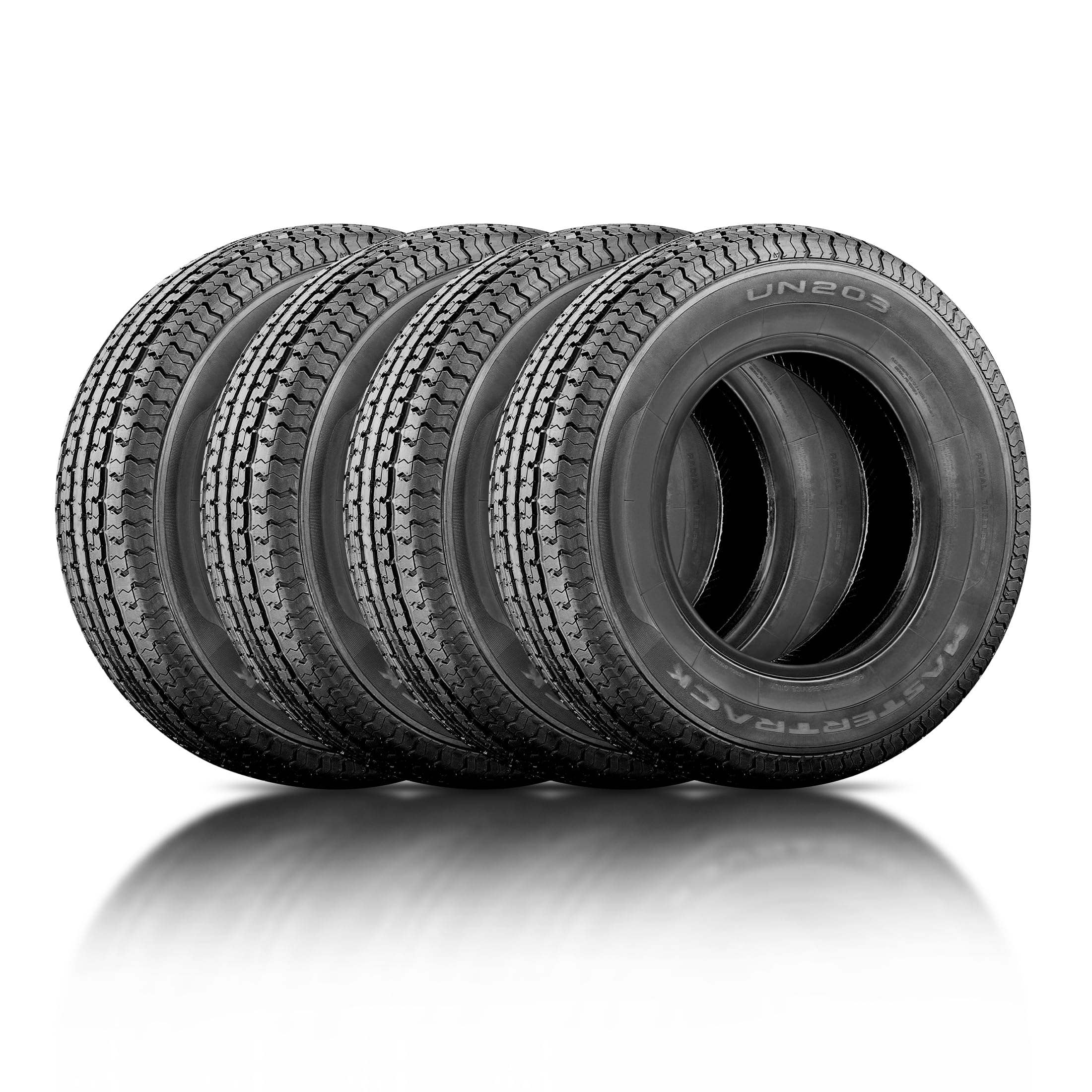
Not every great trailer tire has a famous name. The Mastertrack UN203 is a good example of a “sleeper” pick: it doesn’t dominate marketing, but it holds a 4.7-star average across 53 Amazon ratings and sits around the top 31 of Amazon’s Trailer Tires category — quietly respectable numbers for a brand most towing forums never mention.
Why this specific set matters: it keeps you in the common ST205/75R15 sizing while giving you Load Range E headroom. That’s a practical win for trailers that don’t have the clearance for ST225 but still want a stronger casing and higher load capacity. Think: car haulers that sit tight under fenders, utility trailers that carry dense loads, or tandem rigs where tire-to-tire clearance is already marginal.
The construction story is straightforward and specific. Mastertrack builds the UN203 with double steel belts for traction and shock absorption, plus solid shoulder ribs intended to spread pressure evenly across the road contact patch. The published numbers back the E-range claim: 10-ply Load Range E, load index 111, 2,400 lb capacity, 80 psi maximum pressure, and a 10/32″ tread depth on a 27.1-inch overall diameter. The wear-resistant compound is the part the brand leans on hardest — the pitch is longer life per dollar rather than headline performance.
One genuinely unusual perk for a value set: Mastertrack includes a 3-year road hazard warranty on purchases from October 1, 2025 onward. Road hazard coverage is rare at this price, and it takes some of the sting out of choosing a lesser-known brand — you have a documented path if a tire fails early.
The expert play with this set is simple: treat it like a serious tire, not a “cheap set.” That means correct inflation, proper torque, and (if you tow fast or far) balancing. Trailer tires aren’t always balanced from the factory, and a small imbalance on a trailer can turn into a big heat and wear problem over time.
Why it works
- Load Range E in ST205 sizing – Great when you want more headroom but can’t fit ST225.
- Double steel belt construction – Built for traction and shock absorption under load, with solid shoulder ribs.
- Set of four simplicity – Clean match for tandem axles and consistent tire behavior.
- 3-year road hazard warranty – Unusual coverage at this price point for buyers after 10/1/2025.
Good to know
- 53 ratings is a modest sample — strong (4.7) but nowhere near the data volume of a Carlisle listing.
- Trailer-specific tires only: Mastertrack explicitly states these are not for passenger vehicles.
- Wheels/rims are not included, and 80 psi is a real number — confirm your wheel and valve stem ratings first.
Ideal for: trailers that need Load Range E strength while staying in ST205 sizing — especially car haulers and tighter-clearance rigs that still do serious highway miles.
5. ROCKMAN ST205/75R15 Set of 4 – Deep Tread + Full Cap Ply for Real Trailer Life
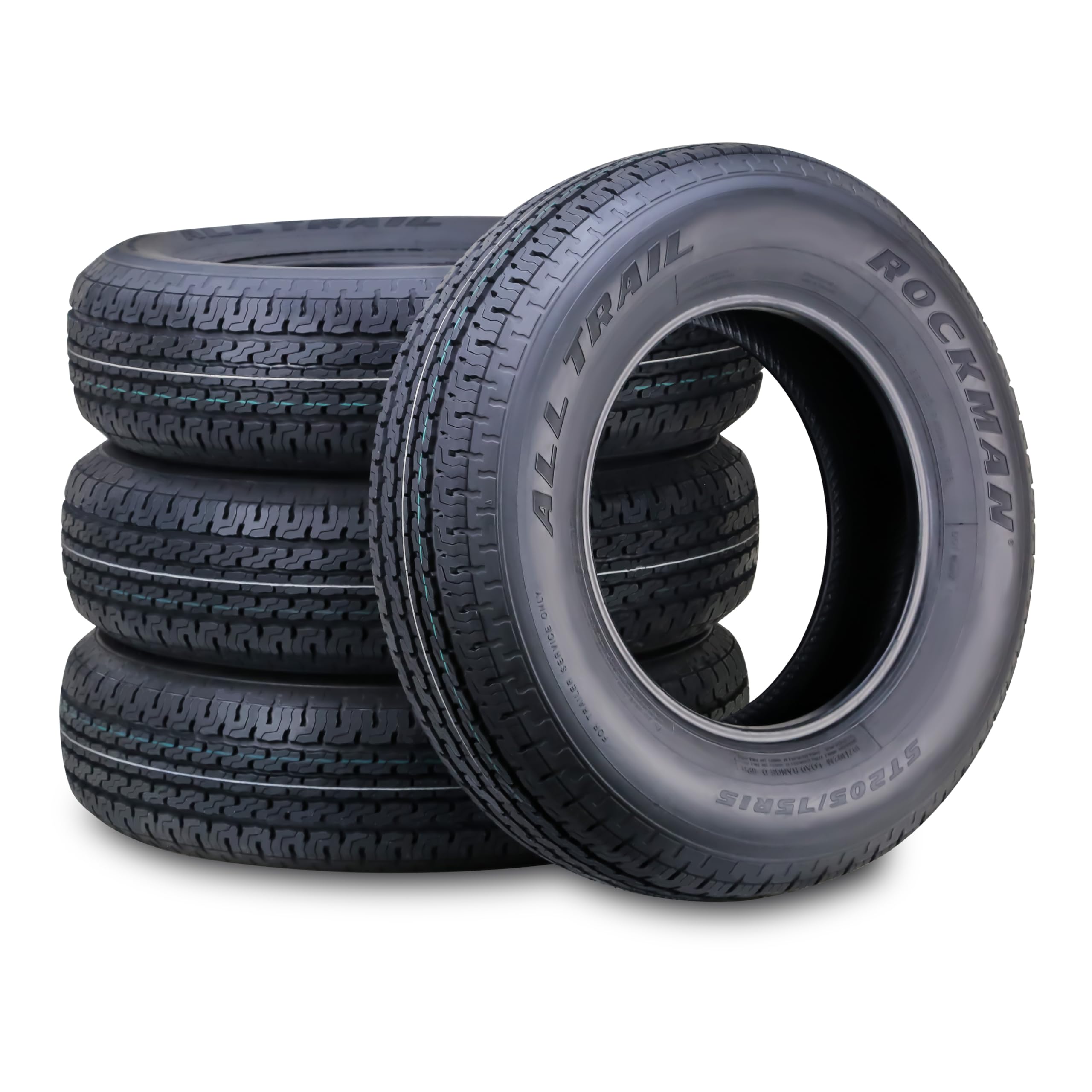
This is the kind of set that wins by fixing the “stock tire problem” without forcing you into the highest load range. For a lot of travel trailers and utility rigs running ST205/75R15, Load Range D is the sweet spot: enough capacity to tow confidently, enough casing stiffness to calm sway, and usually a better fit match for existing wheels.
What makes this ROCKMAN set interesting is the combination of two things owners actually notice:
- A full nylon cap ply across the tread (not just shoulder strips).
- Meaningfully deeper tread depth than the bare-minimum tires many trailers come with.
Why those matter in real life: a full cap ply helps stabilize the belt package under heat — one of the big reasons some trailer tires develop tread/belt issues after repeated highway days. And deeper tread can buy you more usable life if your trailer is well-aligned and you keep pressure correct.
Owner feedback can be almost comically enthusiastic when people swap out “factory tires” for a set that feels more planted. One of the most telling patterns is that people describe the towing experience changing — less wandering, less “fighting the lane,” and less fear at speed. That’s what you want from a real upgrade: not just new rubber, but a new feeling behind the wheel.
The expert setup tip for this set: because it’s a four-tire buy, you can treat your trailer like a system. Replace all at once, set all pressures cold, and check that your suspension isn’t silently chewing tires (worn equalizers, bent axle, uneven camber). A good tire will reveal a bad trailer faster — which is a gift if you listen.
Why you’ll like it
- Full nylon cap ply – A serious construction detail for sustained towing heat.
- Deep tread focus – Helpful if you want a longer wear window (with proper alignment and inflation).
- Load Range D practicality – Often easier to match to existing wheels than jumping straight to E.
- “Feels like a real upgrade” – Owners often describe noticeable improvement in tracking and confidence.
Good to know
- Deeper tread doesn’t cancel heat — inflation discipline still matters most.
- As with any online tire buy, verify DOT date codes when they arrive.
- If your trailer is truly heavy or you tow in extreme heat frequently, stepping up to an E-range set may offer more margin.
Ideal for: owners upgrading from basic stock ST205/75R15 tires who want a confidence boost and durability-focused construction without changing size or jumping to the stiffest load range.
6. Free Country Grand Ride ST205/75R15 Set of 2 – Scuff Guard Protection in a Practical Buy

Not everyone needs (or wants) to buy four tires at once. If you have a single-axle trailer, or you’re replacing a pair while keeping a matching pair as spares, a two-tire set like this is a smart, low-drama way to upgrade.
The Grand Ride ST205/75R15 set of two is popular because it delivers two of the most practical trailer-tire features: a full nylon cap ply across the tread and a scuff guard ring on the sidewall. Those are not “nice-to-have marketing.” They are features that target the two most common forms of trailer tire abuse: heat on the highway and scuffing in tight turns.
Owner feedback often highlights the things that matter on day one:
- Balancing well (a big deal for stability and long-term wear).
- Tracking smooth with the load (less bounce, less wander).
- Visible durability (sidewall protection that looks like it can take a beating).
Here’s the expert rule for two-tire buying: don’t create a mismatch. If you’re running tandem axles, it’s usually best practice to replace all four so the casing stiffness and rolling diameter stay consistent. If you absolutely must replace only two on a tandem setup, put the new tires on the same axle and keep pressures perfect — but understand it’s a compromise.
For single axle trailers, though, this kind of buy is ideal. You get a real construction upgrade without paying for tires you don’t need.
Why it’s a smart buy
- Practical two-tire purchase – Perfect for single-axle trailers or planned spare strategies.
- Scuff guard ring – Useful for frequent tight turns and curb-adjacent towing.
- Full nylon cap ply – A real durability feature, not fluff.
- Owner satisfaction pattern – People often mention smooth towing and solid construction feel.
Good to know
- For tandem axles, two tires can be a compromise — consider a set of four if you want uniform behavior.
- Always verify your current tire size and wheel width before ordering.
- Check date codes on arrival; trailer tires are sensitive to aging.
Ideal for: single-axle travel trailers, utility trailers, and anyone who wants a two-tire upgrade without losing scuff protection and heat-stability features.
7. ROCKMAN Wheel Assembly ST205/75R15 Set of 2 (5 Lug on 4.5″) – The Fastest “Bolt-On and Go” Fix
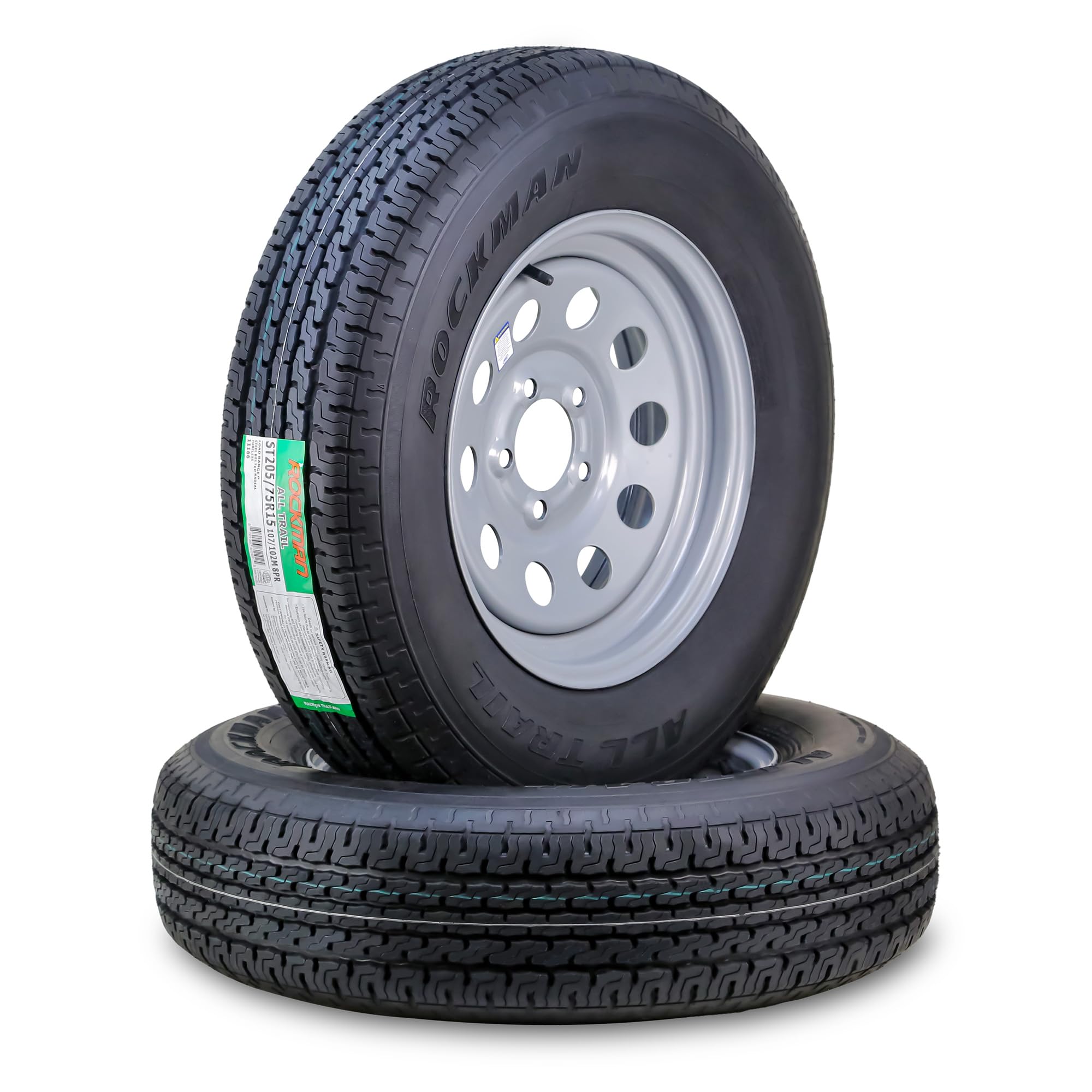
There’s a reason pre-mounted wheel assemblies stay popular: they remove an entire step of friction. No tire shop scheduling. No bead seating drama. No “my wheels are rusty and I’m not sure they’re straight.” You unbox, verify bolt pattern, torque correctly, and you’re back in business.
Owners often buy assemblies like this for one of three reasons:
- Emergency replacement (they need the trailer moving again quickly).
- Spare upgrade (they want a real spare, not a questionable old tire).
- Wheel refresh (old rims are rusty, bent, or just not trusted anymore).
In feedback, you’ll see people praise exactly what you hope to hear: the assemblies arrive ready, tires look round, fitment is correct, and they can be used immediately. That “nice and round” comment matters more than it sounds — a round tire is a calmer towing day. An out-of-round tire is vibration, heat, and uneven wear.
But wheel kits have one non-negotiable: fit verification. The listing may say “5 lug on 4.5,” but you still need to measure your own trailer because mistakes here are painful. Measure from the center of one lug hole to the outer edge of the hole directly across (or use a bolt-pattern template).
Then do the expert setup that prevents the most common “wheel kit regret”:
- Torque lug nuts properly and re-torque after a short drive day.
- Confirm clearance at full suspension travel (especially if your trailer sits low).
- Check inflation cold — shipping pressure isn’t your final pressure.
Do that, and this kit becomes the kind of simple, satisfying purchase that makes you wonder why you waited.
Why it’s worth it
- Fast replacement – No mounting appointment, no extra steps.
- Great spare strategy – A ready-to-go spare is a towing confidence cheat code.
- Pre-mounted convenience – Especially helpful if local shops are busy or expensive.
- Clean look – Silver mod rims give a simple, practical upgrade appearance.
Good to know
- Verify bolt pattern and wheel rating before buying — wheel kits aren’t one-size-fits-all.
- Steel wheels can chip or rust over time depending on climate; maintain accordingly.
- Always re-torque lug nuts after initial miles; it’s a common step people skip.
Ideal for: anyone who wants the fastest path to a safe, usable tire swap on common 15″ 5-lug trailer hubs — especially for spares, quick fixes, and wheel refreshes.
8. HALBERD ST205/75R14 Set of 2 – Thicker Shoulders for Smaller Travel Trailers
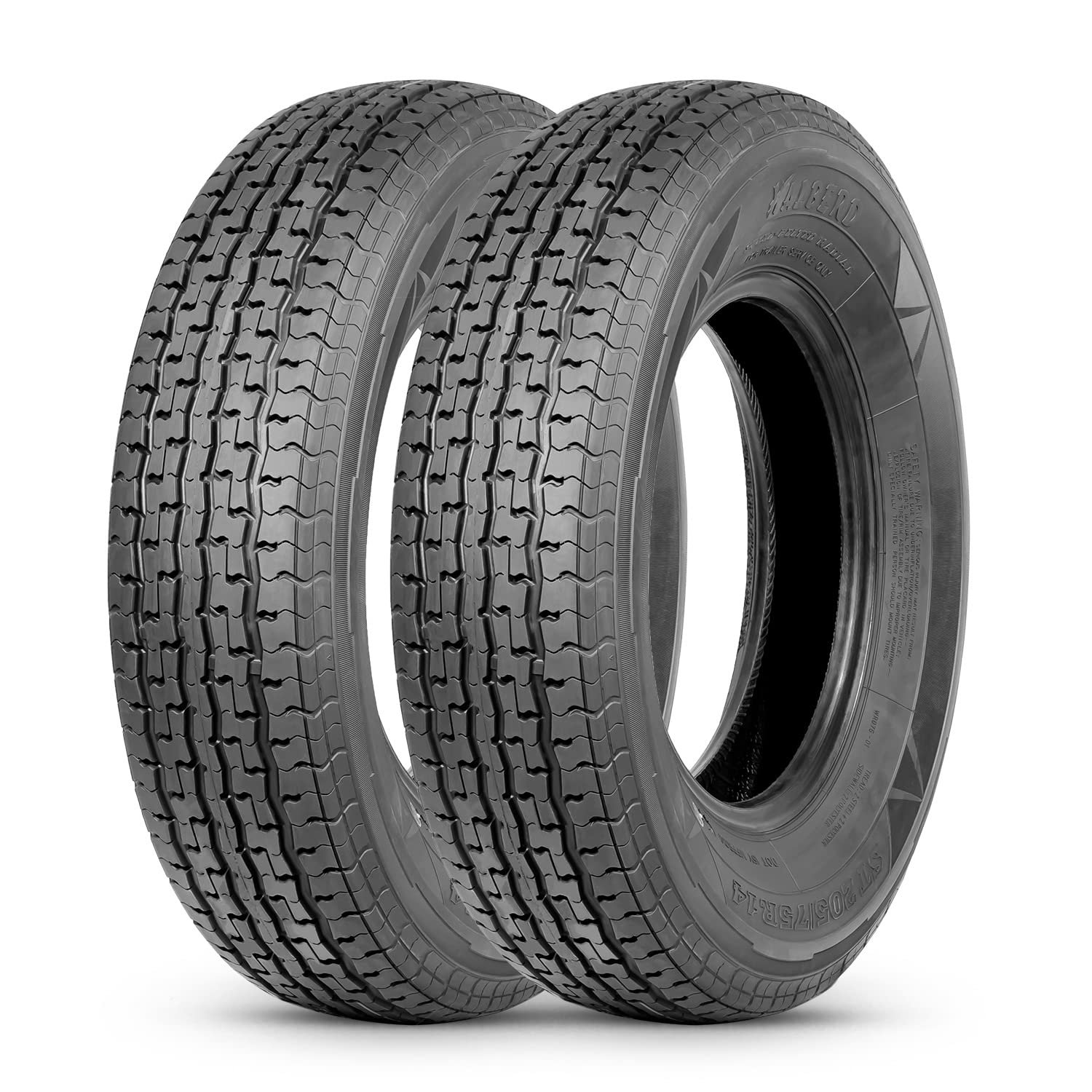
Smaller travel trailers often get stuck with tires that are “good enough” until they’re not — and when they’re not, you’re on the shoulder. That’s why this HALBERD pair is such a practical upgrade path for 14-inch rigs: it brings a purpose-built trailer construction (8-ply radial casing, reinforced shoulders, heat-managed grooves) to a size that lighter trailers actually run, and it comes as a matched pair so you can do a whole axle at once. It holds a 4.6-star average across 180 Amazon ratings.
The published spec sheet is unusually detailed for a value tire, and the numbers are the reason to consider it:
- Load Range D, 8-ply radial with a 105/101 M load/speed index.
- 2,040 lbs maximum load per tire at 65 psi.
- 203 mm section width on a 5.5″ rim, 664 mm (26.14″) overall diameter, 6.5 mm tread depth.
- 20.32 lbs per tire — light enough to handle solo during a roadside swap.
The expert reason the construction matters: smaller trailers can still experience big lateral forces. In crosswinds, the trailer behaves like a sail and pushes laterally into the tire sidewalls. HALBERD’s answer is a high land-ratio, high-stiffness tread block paired with a continuous shoulder block design and a thicker shoulder for impact resistance — and an optimized shoulder groove specifically aimed at reducing heat build-up where trailer tires typically cook themselves. Four longitudinal grooves handle drainage and straight-line stability.
But don’t overlook the wheel side of the equation. Many 14-inch trailer wheels have more limited load and pressure ratings than 15-inch wheels. Before upgrading, confirm:
- Your wheel’s pressure rating matches the tire’s intended pressure.
- Your valve stems are in good condition and rated correctly.
- Your bearings are healthy — because bearing heat can mimic “tire heat problems.”
Why it’s a smart pair
- Heat-conscious shoulder design – Optimized shoulder grooves are aimed squarely at reducing heat generation.
- Thicker shoulder build – HALBERD calls out impact resistance where trailer tires actually get hurt.
- Sold as a matched set of two – Perfect for doing a full single axle in one order.
- Clear, published numbers – 2,040 lbs, 65 psi, 105/101 M, all stated up front instead of implied.
Good to know
- Rims are not included — this is a tire-only pair.
- Load Range D, not E; if you need more headroom in 14″, you may be at the size’s practical ceiling.
- HALBERD is a manufacturer-direct brand, so confirm your original tire size and quantity before ordering.
- Even good tires age — check date codes and store your trailer tires out of UV when possible.
Ideal for: 14″ travel trailers and haulers that want a stronger 8-ply casing and shoulder protection, especially if the current tires show corner wear or feel nervous in wind.
9. Free Country Wheel Assembly ST205/75R14 Set of 2 (5 Lug on 4.5″) – Quick Swap with Scuff Guard Protection
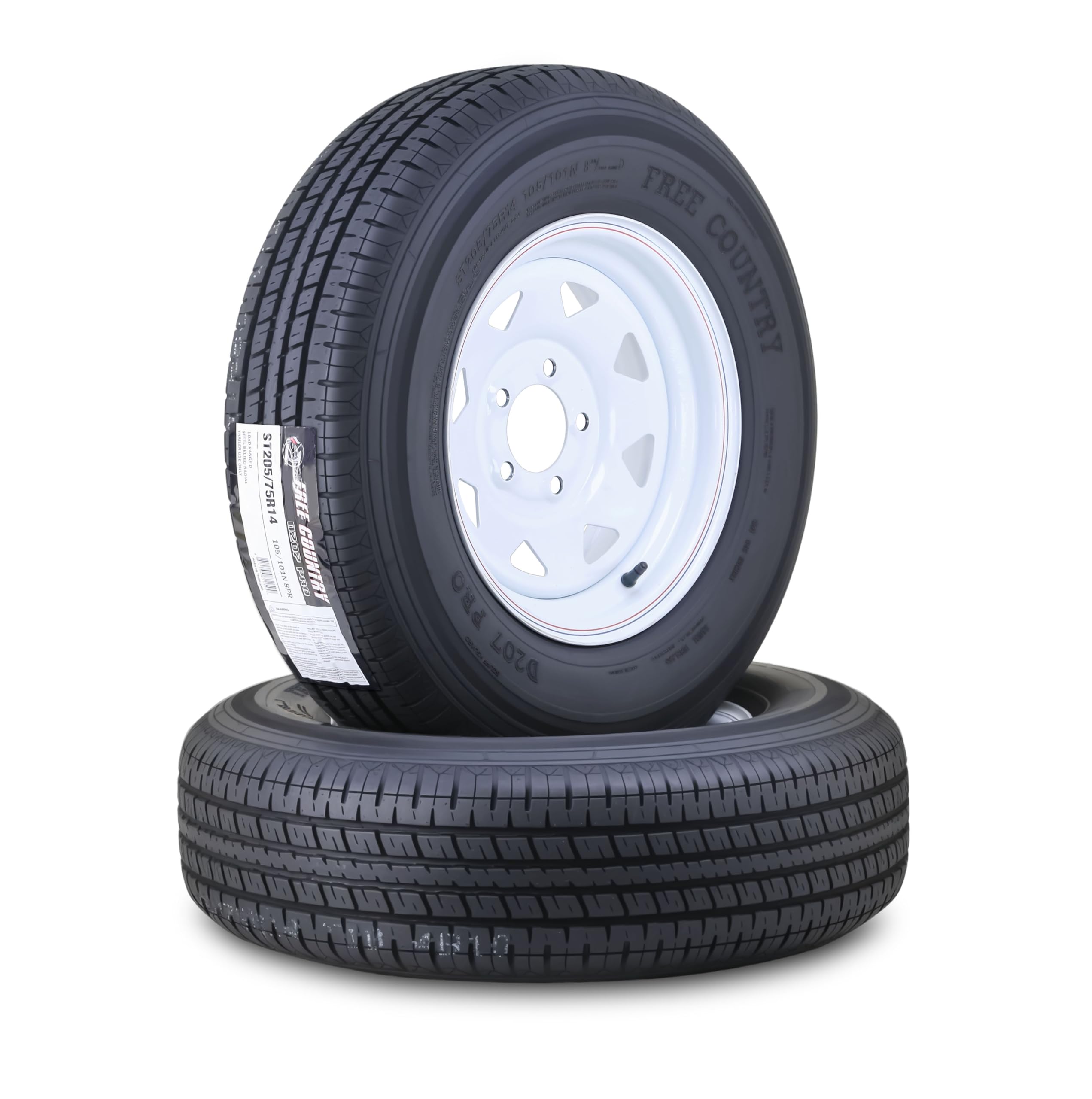
If your trailer runs 14-inch wheels and you want the simplest possible upgrade path — this is a strong answer. You get a pre-mounted assembly that’s ready to bolt on, plus the two construction features that matter most for trailer life: a full nylon cap ply across the tread and a scuff guard ring along the sidewall.
Why a 14-inch wheel kit can be a bigger win than people expect: many smaller trailers live hard lives. They get used for weekend trips, stored outside, parked on hot pavement, and pulled “just fast enough” that heat becomes a factor. A pre-mounted kit lets you replace two weak links at once: the tire and the aging wheel/valve stem setup.
Owners often mention practical satisfaction points like painted wheels looking good, fitment being straightforward, and the kit doing exactly what they needed without surprises. That’s the best compliment for a wheel assembly — because the entire point is simplicity.
Here are the expert checks that make this kit feel effortless instead of frustrating:
- Verify bolt pattern (5 on 4.5 is common, but don’t assume).
- Check lug nut style (some wheels require specific seat types).
- Torque and re-torque after initial miles.
- Set pressure cold for your load, not “whatever it shipped with.”
Do those steps and you’ll get the best version of this kit: fast install, stable towing, and less anxiety about sidewall scuffs and belt heat.
Why it’s a great kit
- Pre-mounted convenience – Saves time, eliminates mounting hassles.
- Scuff guard protection – Useful for the tight-turn reality of trailer life.
- Two assemblies at once – Ideal for single-axle trailers or as matching spares for a tandem setup.
- Simple replacement path – A good “no drama” buy for owners who just want to get back on the road.
Good to know
- Painted wheels can chip over time depending on weather and road salt exposure.
- Verify wheel rating and lug nut compatibility before installing.
- For saltwater boat trailers, corrosion resistance becomes critical — choose wheel finishes accordingly.
Ideal for: 14″ single-axle utility or camper trailers (and many small travel trailers) where you want a quick, clean replacement without tire shop hassle.
10. Free Country ST205/75D15 Bias Set of 4 – Deep-Tread Toughness for Local Hauling

Bias-ply tires are not “worse” than radials — they’re different tools. And for some trailers, a bias set is the right tool. If your trailer spends more time on rough pavement, gravel, yard surfaces, farm paths, or short local runs than it does on long interstate pulls, a stout bias tire can make a lot of sense.
This Free Country set is built around that work-trailer reality: a deep-tread approach, a sturdy casing feel, and the kind of basic durability that people want for local hauling. Owners often describe them as good quality for the money with solid traction and a confident “looks and feels tough” build.
The most important expert nuance is heat: bias tires generally run warmer than radials at sustained highway speeds because of how the casing flexes. So if your towing life is 2–3 hour interstate runs in summer heat, radials tend to be the calmer choice. If your towing life is shorter distances, mixed surfaces, and frequent turning, bias tires can be perfectly appropriate.
There’s also a very real, very practical note from owner experience: some shipments arrive tightly shrink-wrapped in pairs. That wrap can temporarily deform the tire shape, making mounting and bead seating harder until the tire relaxes. The simple solution is time and warmth (letting them sit in the sun or warm environment before mounting). It’s not a quality death sentence — just a logistics annoyance you’ll want to anticipate.
Why it’s useful
- Work-trailer toughness – A bias build can handle bumps and rougher surfaces well.
- Deep tread feel – Built for longevity in local hauling scenarios.
- Set of four simplicity – Great for matching your tandem setup or keeping a consistent spare strategy.
- Strong value positioning – A practical choice when you want function over premium branding.
Good to know
- Bias tires can run warmer at sustained highway speeds; radials often win for long freeway towing.
- Shipping wrap may temporarily deform the tire and complicate mounting; let them relax before installation.
- Always verify your speed/load requirements — “deep tread” doesn’t override heat physics.
Ideal for: utility and work trailers that do local hauling, mixed surfaces, and frequent turning where a sturdy bias tire makes sense — especially if long high-speed freeway runs aren’t your main use.
11. eCustomrim ST175/80D13 Tire + Rim Set of 2 (5 Lug on 4.5″) – The Simple Fix for 13″ Utility & Boat Trailers
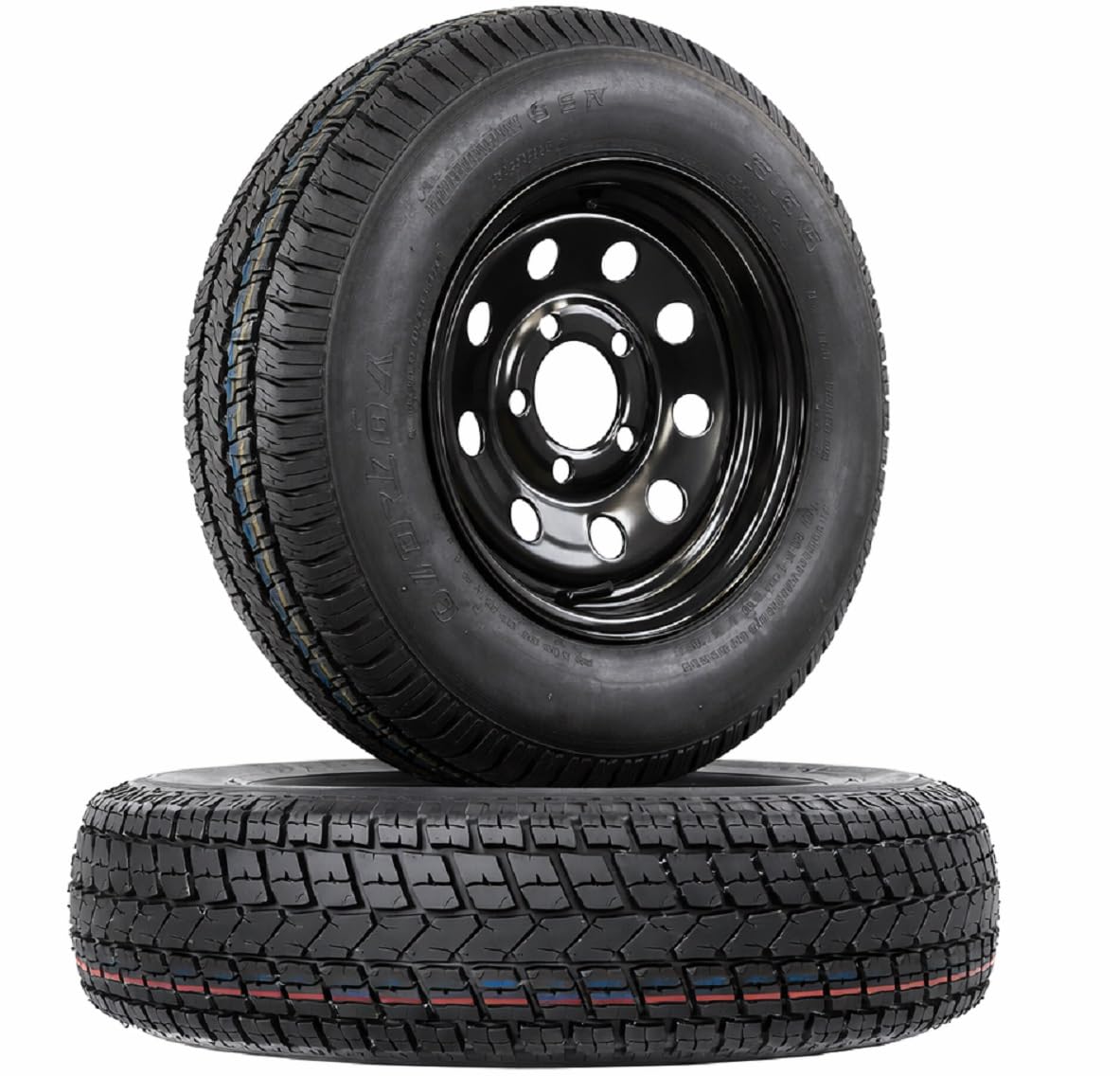
Small trailers are where people get lulled into bad habits. “It’s just a little utility trailer.” Then a tire fails — and suddenly your “little trailer” is blocking traffic with a shredded sidewall. A clean, bolt-on wheel-and-tire kit like this is often the smartest upgrade because it replaces the tire and the aging wheel/valve stem setup together. This eCustomrim pair is currently the #1 best seller in Amazon’s Trailer Tire & Wheel Assemblies category, with a 4.7-star average across 644 ratings.
This ST175/80D13 set is aimed at the most common 13-inch trailer use cases: utility trailers, small campers, some boat trailers, landscaping rigs, and general “tow stuff on weekends” setups. The published specs are exactly what you need to check fitment before you buy:
- Bias ply, Load Range C, 6-ply rated at 1,360 lbs max load and 50 psi.
- 24.4″ overall diameter on a 13 x 4.5″ rim with a 3.19″ center bore.
- 5 lug on 4.5″ bolt pattern — the most common small-trailer pattern.
- Tire, wheel and valve stem are all DOT-approved and arrive pre-mounted.
Here’s the expert detail people miss: small diameter trailer tires spin faster at the same road speed. That increases heat. That’s why 13-inch (and especially 12-inch) setups benefit massively from:
- Correct cold pressure (underinflation is brutal on small tires).
- Healthy bearings (bearing heat + tire heat is a disaster combo).
- Reasonable speed discipline for long runs.
Two details set this kit apart from generic imports. First, eCustomrim states the tire and wheel are mounted in the USA, which means they don’t arrive imported-uninflated with creases pressed into the rubber — a real and annoying failure mode with cheap mounted sets. Second, the listing calls out a variable-pitch tread with a radial-style footprint aimed at reducing road noise. On a trailer, that’s not just comfort — it can reflect a more controlled tread pattern that reduces weird vibrations and “hum” at speed. The rim also gets a corrosion-resistant coating, and the package carries a 2-year warranty with roadside assistance.
As always with wheel kits: measure bolt pattern, confirm lug nut seat style, torque correctly, and re-torque. Do that, and this becomes a satisfying “reset” for smaller trailers that have been rolling on tired, weathered rubber for too long.
Why it’s practical
- Category best seller – #1 in Trailer Tire & Wheel Assemblies with 644 ratings behind it.
- Fast bolt-on replacement – Arrives pre-mounted with DOT-approved tire, wheel and valve stem.
- Mounted in the USA – Avoids the creased-rubber problem of uninflated imported assemblies.
- 2-year warranty with roadside – Rare backing for a budget small-trailer kit.
Good to know
- Load Range C caps each tire at 1,360 lbs — do the math against your loaded trailer weight before ordering.
- Small tires heat up faster — pressure checks matter even more than on 15-inch setups.
- Not a “heavy travel trailer” solution; this is for smaller utility/boat/camper trailers.
- Verify your bolt pattern is 5 on 4.5″ and check lug nut seat compatibility before installing.
Ideal for: 13″ utility and boat trailers needing a quick, practical refresh — especially if the current tires are weathered, cracked, or simply unknown age.
12. GarveeTech 4.80-12 Tire + Wheel Set of 2 (5 Lug on 4.5″) – The “Get the Trailer Rolling Again” Two-Pack
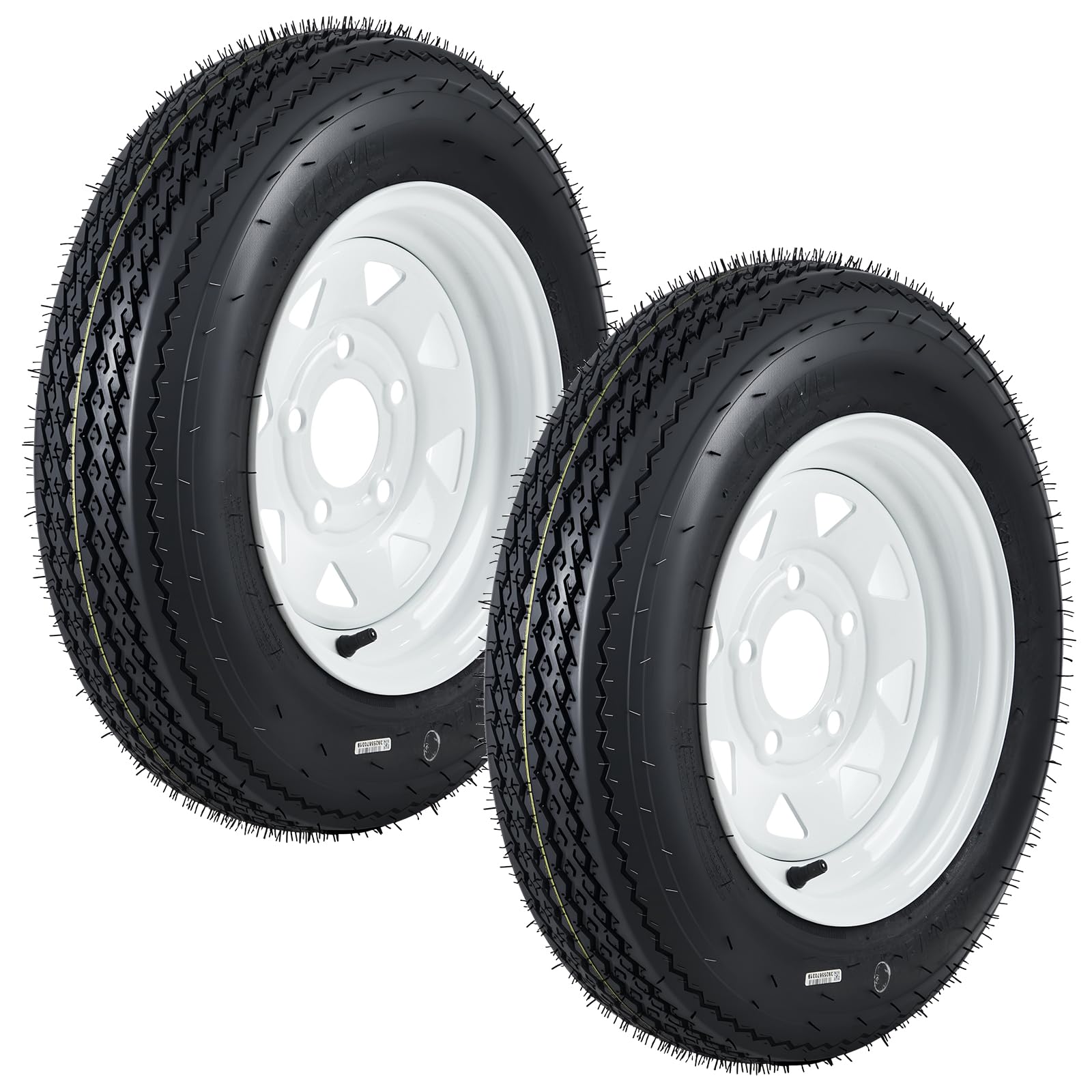
For very small trailers — yard trailers, compact utility rigs, small boat trailers, light campers — the goal is usually simple: replace the worn setup with something that fits, carries the load, and doesn’t waste your weekend. This kit is built for that reality: a pre-mounted two-pack that’s ready to install without additional equipment.
Owners commonly describe this kind of kit with the words you want: good value, looks great, does the job, and works well for light-duty hauling. That’s exactly how you should think about 12-inch tire kits: practical tools.
But 12-inch trailer tires come with one “expert caution” that isn’t negotiable: they spin fast. High RPM can create heat quickly, especially if the tire is underinflated or overloaded. So your best upgrade isn’t just buying the kit — it’s running it correctly:
- Keep pressure correct (small tires are brutally sensitive to underinflation).
- Stay realistic about highway use (light-duty doesn’t mean “infinite interstate”).
- Check bearings and hub temps periodically on longer runs.
Bias ply construction can be an advantage on small rigs because it offers good sidewall stiffness and shock absorption on rougher surfaces. That makes it a natural fit for yard and utility environments where pavement isn’t perfect.
If your trailer is truly light duty, this kit is a clean, efficient replacement that gets you back to hauling without fuss. If you’re planning long, high-speed highway tows, consider stepping into a larger wheel/tire size if your trailer can support it — that’s where heat management gets easier.
Why it works
- Pre-mounted convenience – Easy replacement without tire shop scheduling.
- Good for light-duty hauling – A common fit for small utility and boat trailers.
- Bias stability – Helpful on rougher terrain and bumpy surfaces.
- Two-pack simplicity – Perfect for single-axle small trailers that need a matched pair.
Good to know
- 12″ tires generate heat faster at road speed — maintain correct inflation and avoid overloading.
- Verify bolt pattern (5 lug on 4.5″) and lug nut style before install.
- If your use shifts to longer highway miles, consider whether your trailer can run a larger diameter setup.
Ideal for: small, light-duty trailers that need a fast, bolt-on replacement in 4.80-12 sizing — especially for yard work, short hauls, and utility use.
What Really Kills Trailer Tires (and the Prevention Routine That Works)
If you’ve ever seen a shredded trailer tire, you know the damage can look dramatic — but the causes are usually boring. Trailer tire failures are most often a slow build-up of heat, stress, and aging. Fix the inputs, and most “blowout stories” stop happening.
The five failure triggers that show up again and again
- Underinflation (the #1 heat multiplier): A slightly low tire flexes more. Flexing creates heat. Heat weakens the tire from the inside out.
- Overloading (even “just a little”): Trailers often get loaded unevenly. Water tanks, toolboxes, generators, and cargo shifts can overload one side without you realizing.
- Speed beyond rating: Speed turns heat into a problem fast. Even when a tire has a higher speed symbol, it assumes correct inflation and load.
- Aging and UV exposure: Trailer tires often sit. Sunlight, ozone, and time can age the rubber even if the tread looks fine.
- Alignment / suspension issues: Bent axles, worn equalizers, weak bushings, and brake drag can create irregular wear and extra heat that gets blamed on the tire.
One uncomfortable truth: installing a better tire often reveals underlying trailer issues, because the tire is no longer the weak link. If your new tires still show rapid shoulder wear or weird tread patterns, treat it as a diagnostic clue — not a reason to buy another tire.
The 10-minute towing routine that prevents most problems
- Before every trip: Check cold pressure, do a fast sidewall scan (cracks, bulges), and confirm lug nut torque is correct.
- After the first 10–15 minutes: Stop once and feel the hubs (carefully) and tire sidewalls. One hot hub can mean bearing or brake drag.
- At fuel stops: Quick visual scan for scuffs, cuts, or nails. Trailer tires pick up debris differently than tow vehicle tires.
- After installing new wheels/tires: Re-torque lug nuts after a short drive day. This is a common step that prevents wheel issues.
- During storage: Keep tires out of direct sun when possible, and avoid letting them sit under load for long periods on hot pavement.
This routine isn’t glamorous — but it’s exactly what separates “we tow all the time without issues” people from “why does this keep happening to us?” people. The right tires help. The right habits make them last.
FAQ: Trailer Tires Without the Confusion
Are trailer tires really different from car or truck tires?
What does “10‑ply rated” actually mean?
Should I replace all trailer tires at once?
How do I avoid getting “old” tires when ordering online?
Do I need to balance trailer tires?
Can I use a larger tire size for more load capacity?
Why do some new tires feel “wobbly” right after installation?
What’s the single best habit for preventing blowouts?
Final Thoughts: Buy the Tire That Matches Your Trailer’s Reality
The best trailer tire choice isn’t “whatever has the highest rating.” It’s the tire that fits your trailer, carries your real load with margin, runs cool at your real speeds, and survives your real turning and storage habits.
Here’s the fastest way to translate this guide into a confident purchase:
- Want the most balanced “upgrade everything” set for common 15″ trailers? Start with the Libra Trailer Parts (Free Country) ST205/75R15 Set of 4 (Load Range E). It’s a strong blend of construction, sidewall protection, and real-world owner confidence.
- Want the most reviewed big-name pick in ST225 sizing? Choose the Carlisle Radial Trail HD ST225/75R15. It’s the tire many owners move to when they want to stop playing guessing games — 4.7 stars from 2,900+ ratings.
- Need a full matched set of four in ST225 for tandem axles? The Free Country Grand Ride ST225/75R15 Set of 4 is a popular “reset button” option with a strong scuff-guard + cap-ply construction story.
- Need Load Range E strength but must stay in ST205 sizing? Look at the Mastertrack UN203 ST205/75R15 Set of 4. It’s a great fit for tighter-clearance trailers that still do serious miles, and it ships with a 3-year road hazard warranty.
- Want a mid-range ST205 set that owners describe as a dramatic towing upgrade? Grab the ROCKMAN ST205/75R15 Set of 4 for deep tread and full-cap construction without jumping to the stiffest load range.
- Need a “replace two” plan for a single-axle trailer? The Free Country Grand Ride ST205/75R15 Set of 2 is a practical buy with scuff guard protection built in.
- Want the fastest solution with wheels included? For 15″ choose the ROCKMAN Wheel Assembly ST205/75R15 Set of 2, and for 14″ choose the Free Country Wheel Assembly ST205/75R14 Set of 2. These are great for spares and quick turnarounds.
- Need a stronger 8-ply pair in 14″ sizing? The HALBERD ST205/75R14 Set of 2 is a strong stability upgrade for smaller travel trailers, rated 2,040 lbs per tire at 65 psi.
- Running a work trailer where bias makes sense? The Free Country ST205/75D15 Bias Set of 4 is a practical local-haul option with deep tread and sturdy feel.
- Small trailer kits (13″ and 12″)? For 13″ choose the eCustomrim ST175/80D13 Tire + Rim Set of 2. For 12″ choose GarveeTech 4.80-12 Tire + Wheel Set of 2. Both are built for quick, bolt-on replacement when you want your trailer back in action fast.
If you came here for best american made trailer tires, the real win is choosing a tire that matches how you tow — then running it correctly (fresh date codes, correct inflation, proper torque, and a quick heat check on travel days). Do that, and your tires stop being a worry… and start being the quiet, reliable part of your trailer that you never have to think about again.