
Our readers keep the lights on and the garage heater humming. As an Amazon Associate, I earn from qualifying purchases.
A torque wrench is one of the rare tools that can make you feel like a pro instantly—until it doesn’t. The click is faint, the scale is hard to read, the ratchet won’t swing in a tight engine bay, or you realize halfway through a job that the wrench you bought for lug nuts is the worst possible choice for spark plugs.
If you’re shopping for the best torque wrench for cars, you’re not looking for “a wrench that tightens bolts.” You’re buying confidence—confidence that your wheel lugs are evenly seated, your valve cover won’t seep after heat cycling, your brake caliper bolts are actually to spec, and you won’t create a problem that’s worse than the one you started with.
This guide is built around real-world friction points, not marketing bullets. I’m going to talk about what actually matters when you’re in a driveway, a garage, or a small shop: what makes a click unmistakable (or confusing), which setting systems keep your torque from drifting mid-job, why the handle length can be a blessing and a curse, and how digital torque “help” can either save you… or slow you down if the interface fights you.
Below, you’ll find 18 standout picks across the styles people truly use on cars: split-beam workhorses, classic clickers, digital alert wrenches, and multi-drive kits that cover everything from delicate engine fasteners to suspension and wheel work.
In this article
How to Choose the Best Torque Wrench For Cars (Without Buying Twice)
A torque wrench isn’t “good” because it has a fancy case or more numbers on the handle. It’s good because it helps you hit the right torque reliably and repeatably—on the fasteners you actually touch on a vehicle: wheels, brakes, suspension, engine accessories, underbody hardware, and interior bits.
1. Start with the real question: what are you tightening most?
Car owners usually fall into one of these patterns. Identify yours first—then choose a wrench that was built for it.
- Wheel & suspension focused: You want a confident 1/2-inch drive wrench with a higher torque ceiling and a clear, unmistakable signal at spec.
- Engine bay & maintenance focused: You need a 3/8-inch (and often 1/4-inch) wrench that’s comfortable at lower settings, with clean readability and good tight-space swing.
- Mixed DIY: You do a bit of everything and want either a smart bundle (multi-drive set) or a “two-wrench plan” that covers low and high torque without compromise.
- Shop / heavy use: You want durability, repeatable accuracy, and a setting system that doesn’t drift or get bumped out of position.
2. Drive size isn’t about strength—it’s about control
A larger drive size isn’t automatically “better.” It’s better when it matches the torque band and the socket ecosystem you’re using. For most car owners, a 3/8-inch drive is the sweet spot for engine and underhood work, while a 1/2-inch drive is the workhorse for wheels, brakes, and suspension. A 1/4-inch drive shines when you’re dealing with small fasteners where “a little too much” is the whole problem.
- 1/4-inch: delicate hardware, smaller components, interior and accessory work where precision matters more than muscle.
- 3/8-inch: general automotive maintenance—engine bay fasteners, brackets, smaller suspension bolts, and many brake jobs.
- 1/2-inch: wheel lugs, axle nuts (check your vehicle), suspension, larger brackets, and anything where leverage is your friend.
3. Choose a style based on how you work—click, split-beam, or digital
Here’s the no-fluff breakdown, based on what tends to go right (and wrong) during real car work:
- Click (micrometer) wrenches: Simple, familiar, and effective. Great when the click is crisp, the scale is easy to set, and you’re disciplined about storage and care.
- Split-beam wrenches: Built for repeatability and less storage fuss. They’re often faster to set and feel “shop-proof” when you use them frequently.
- Digital/electronic wrenches: Amazing for readability and alerts (beep/light/vibrate). They’re also the most likely to annoy you if the interface is slow or the batteries die mid-job.
4. Accuracy claims are only half the story—readability and feedback are the other half
A wrench can be “accurate on paper” and still cause mistakes if you can’t set it quickly or recognize the signal at torque. This is why real-world feedback matters:
- Scale clarity: Laser marks, high-contrast numbers, and glare reduction matter more than people think—especially in garage lighting.
- Signal strength: A loud click or a decisive tactile break is more than “satisfying”—it’s error prevention.
- Locking system: If the setting can shift while you work, you don’t have a precision tool—you have a guess.
5. Torque range strategy: aim for the middle, not the edges
Most torque tools are happiest when you’re not living at the very bottom or very top of their scale. In practice, this means:
- If your common torque values are low, get a tool designed for low values—don’t “force” a big 1/2-inch wrench to behave delicately.
- If you frequently torque high fasteners, get a wrench with a comfortable ceiling—don’t hit max range and call it “good enough.”
- For mixed work, build a two-wrench setup (often 3/8 + 1/2), or buy a good multi-drive kit that actually includes calibration certificates.
6. Don’t let “extra accessories” distract you from the core tool quality
Bundles can be brilliant—especially if they include the drive sizes you need and a case that keeps the tool protected. But accessories don’t matter if the wrench itself is fiddly to set, hard to read, or vague at the click. If you’re choosing a kit, look at the wrench mechanism first, then treat the extras as a bonus.
Quick Comparison: 18 Best Torque Wrench For Cars Picks
Use this table to spot the models that match your work style, then jump to the full reviews for the “real life” details— like how the setting mechanism behaves with greasy hands, whether the click is unmistakable, and which ones are built to survive repeated use without drama.
On smaller screens, swipe or scroll sideways to see the full table.
| Model | Type | Car-work strength | Best match | Amazon |
|---|---|---|---|---|
| Precision Instruments PREC3FR250F (1/2″) | Split-beam | Shop-grade repeatability + easy setting + flex head reach | DIYers and pros who want a “lifetime” 1/2″ workhorse | Amazon |
| TEKTON Split Beam Set (3/8″ + 1/2″) TRQ99902 | Split-beam set | Two-wrench coverage with rugged “leave-it-set” split-beam convenience | People who want one premium bundle for most car tasks | Amazon |
| DEWALT Tire Change Kit (1/2″) DWMT45012 | Kit | Break, spin, torque—complete wheel workflow in one case | Wheel work, lugs, and “grab-and-go” garage readiness | Amazon |
| GEARWRENCH Electronic (3/8″) 85076 | Digital | Target-torque alerts + solid feel for repeated mid-torque tasks | Engine bay work where you want beep/visual feedback | Amazon |
| DEWALT Digital (3/8″) DWMT17061 | Digital | Backlit screen + comfortable grip for long sessions | Tight-space torque work with clear at-a-glance reading | Amazon |
| ACDelco Digital Combo (3/8″ + 1/2″) ARM601-34 | Digital set | Two digital ranges + beep alerts for low and mid/high torque | DIYers who want digital coverage without buying 3 tools | Amazon |
| SUERCUP 1/2″ Digital (3.8–250.8 ft-lb) | Digital | Big bright display + high ceiling for big fasteners | Readers who struggle with tiny markings and need high range | Amazon |
| TEKTON 3/8″ Micrometer 90-Tooth TRQ51402 | Click | Fine swing arc + strong calibration story for mid-torque jobs | People who want precision in cramped engine bays | Amazon |
| CRAFTSMAN 1/2″ Click (50–250 ft-lb) CMMT99434 | Click | Long handle leverage + clear stamped scales for high-torque tasks | Wheel & suspension DIY without digital complexity | Amazon |
| LEXIVON 1/2″ Click (10–150 ft-lb) LX-183 | Value click | High-contrast readability + reliable “first torque wrench” feel | Budget-conscious buyers who still want confidence and clarity | Amazon |
| GROWNEER Digital (3/8″) 5–99.6 ft-lb | Digital | Beep/LED guidance + stored peak values for repeat jobs | DIYers who want digital confidence without premium pricing | Amazon |
| coobeast Digital (3/8″) 1.5–99.5 ft-lb | Digital | Big color screen + presets for repetitive torque tasks | Light-to-mid torque work if you want strong visual feedback | Amazon |
| Uharbour Digital (3/8″) 0.66–44.29 ft-lb | Digital | Low-torque precision for delicate fasteners | Small torque jobs where “a little too much” is expensive | Amazon |
| Hairich Digital (3/8″) 5–100 ft-lb | Digital | Track/Peak modes + data memory for repeated maintenance patterns | DIYers who like stored values and a clear alarm system | Amazon |
| SUZUME 3PCS Click Set (1/4 + 3/8 + 1/2) | Click set | Three-drive coverage + solid feel for mixed jobs | Garage owners who want one case to handle most tasks | Amazon |
| DISEN 9PCS Click Set + Adapters | Click set | All-in-one case with extensions/adapters for real-world access | Hobbyists who want broad coverage and convenience | Amazon |
| Matework Upgraded 8PCS Click Set | Click set | Improved lock ring design + sturdy case for portability | Occasional users who want a nicer-feeling budget kit | Amazon |
| YIYEIE 8PCS Click Set (1/4 + 3/8 + 1/2) | Click set | Broad coverage + adapters in one case for straightforward DIY | New torque wrench owners who want “everything in one box” | Amazon |
In-Depth Reviews: 18 Torque Wrenches That Make Car Work Safer (and Easier)
Now we’ll go model by model. I’m going to talk like a mechanic who hates redoing work: what feels effortless, what feels fiddly, what’s built for repeat jobs, and what you should know before you commit.
1. Precision Instruments PREC3FR250F (1/2″) – The “Buy Once, Trust Forever” Split-Beam Workhorse

If you want a torque wrench that feels like it was designed for people who actually use their tools, this is it. The split-beam style is the quiet hero of serious car work because it removes two common sources of error: struggling to set a value precisely and wondering if storage habits are slowly messing with accuracy. The “set it, lock it, use it” experience is the kind of calm you want when you’re tightening something that would be expensive (or dangerous) to get wrong.
Owners who use it for years often describe the same themes: durable construction, repeatable accuracy, and a setting system that’s faster than a twist-handle micrometer when you’re bouncing between torque values. The flex head adds real-world utility too—it helps you reach fasteners that are technically accessible, but annoying because of clearance or angle.
Where this wrench really shines is the confidence curve. The first time you use a split-beam wrench that “behaves,” you realize how much time you used to waste second-guessing: was that click real? did I overshoot? did the setting move? With this one, the mechanism feels purpose-built for controlled tightening rather than “good enough.”
Why it’s a top-tier car wrench
- Split-beam simplicity – Faster setting and less ritual around storage compared to many clickers.
- Easy-to-read, easy-to-set – The dial and lock feel designed for real hands, not showroom photos.
- Built for repeated use – Great choice if you torque wheels, suspension, and chassis hardware regularly.
- Flex head advantage – Helps you maintain good pull angle without fighting clearance.
Good to know
- Like many pro 1/2″ wrenches, it’s not built for ultra-low torque—pair with a 3/8″ or 1/4″ tool for delicate fasteners.
- Split-beam “feel” is different from classic clickers; the first job or two is a learning curve (then it becomes addictive).
- Not the smallest tool—amazing for undercar work, less ideal for cramped interior fasteners.
Ideal for: anyone who wants a long-term, high-confidence 1/2″ torque wrench for wheels, suspension, and bigger fasteners—without the drama.
2. TEKTON Split Beam Set TRQ99902 (3/8″ + 1/2″) – Two Wrenches, One “Real Garage” Upgrade

This set is for the person who’s tired of “making it work” with one wrench. The two-drive split-beam combo is a smart way to cover the majority of car torque tasks with the right tool, not the “closest thing you own.” The 3/8″ wrench lives in the engine bay world—brackets, accessories, smaller suspension bolts—while the 1/2″ wrench handles the big stuff: wheels, brakes, and heavier hardware.
Real-world owners consistently praise the same split-beam benefits: quick, precise setting; a lock that resists accidental movement; and the ability to store it without the constant “did I back it off enough?” worry. The audible/tactile torque signal is a big deal too—especially when you’re pulling higher torque values where you want certainty, not a subtle whisper of a click.
The underrated win is workflow. When your torque tool is fast to set and hard to mess up, you actually use it more. That means fewer “close enough” moments and fewer fasteners that come back to haunt you after heat cycling or vibration.
Why this bundle is special
- True coverage – Two drive sizes means you’re not abusing a tool outside its comfort zone.
- Split-beam convenience – Quick setting, stable lock, and less storage anxiety.
- Confidence click – Owners love the loud, satisfying signal at higher torque values.
- Shop-friendly durability – Built to tolerate real work and real handling.
Good to know
- The 1/2″ wrench is a serious tool—amazing for undercar work, less fun to maneuver in cramped spaces.
- Like most precision tools, it rewards gentle storage (case + avoiding drops) even though it’s built tough.
- Dial markings can feel small to some eyes; if you struggle with that, consider a big-display digital for certain jobs.
Ideal for: DIYers who want a premium two-wrench setup that feels like a “skill upgrade” every time you use it.
3. DEWALT Tire Change Kit DWMT45012 (1/2″) – The “Whole Wheel Job” Case

Some tools are “nice.” This kit is useful. If your car work includes wheels, tire rotations, seasonal swaps, brake jobs, or anything that has you touching lug nuts repeatedly, having a complete wheel workflow in one case is a real quality-of-life upgrade. You don’t have to hunt for sockets, you don’t have to improvise leverage, and you don’t have to guess at final torque.
Owners love the leverage and the confidence it brings on higher torque tasks. The breaker bar is not a gimmick—it’s the right tool for breaking loose stubborn fasteners so you’re not abusing your torque wrench mechanism. The torque wrench itself tends to get praise for being straightforward to set and “hard to miss” when it hits spec, which is exactly what you want when you’re torquing a pattern of lug nuts and you want consistent clamp across the wheel.
This kit is also a strong pick if you share tools with family or keep gear in a vehicle/shop space. When everything lives in one place, the odds you actually do the job properly go way up.
Why it makes wheel work easy
- Complete workflow – Break loose, run down, final torque—no missing pieces.
- Great leverage – Long handle makes high torque more controlled, less “body-weight yanking.”
- Case discipline – Keeps the precision tool protected and the sockets organized.
- Simple setting – Easy to adjust and repeat across multiple lugs.
Good to know
- It’s a wheel-focused kit—if your work is mostly low-torque engine fasteners, you’ll want a smaller wrench too.
- The wrench length is helpful for leverage but can be awkward in tight undercar spaces.
- As with all kits, confirm the socket sizes match your vehicles (many do, but don’t assume).
Ideal for: anyone who regularly touches wheels and wants a tidy, high-confidence setup for lug nut consistency.
4. GEARWRENCH 85076 (3/8″) – The Electronic Torque Wrench That Feels Like a “Real Tool”

Digital torque wrenches can be incredible—when they don’t feel like a gadget. The GearWrench earns its keep by feeling solid in-hand and giving you multi-sensory feedback (visual + audible + vibration) as you approach the target. That “approach warning” is a bigger deal than most people realize: it helps you slow down and finish smoothly instead of blasting through the click because you were pulling too aggressively.
This is especially useful in the engine bay. Many underhood fasteners are small enough to strip if you overshoot, but important enough that “snug” isn’t the plan. A clear, readable display and a warning before the final torque helps you land the finish like a controlled movement, not a surprise.
Owners do note a few interface quirks—like a fast timeout and torque setting behavior that can feel jumpy. But if you treat it like a precision tool (set your torque, do your job, then shut it down), it becomes a satisfying, confidence-building piece of your workflow.
Why digital fans like it
- Target approach warning – Helps you finish smoothly instead of overshooting.
- Easy-to-read display – Great if tiny engraved scales frustrate you.
- Solid ratchet feel – Doesn’t feel like a toy; it feels like shop gear.
- Multi-unit flexibility – Useful if you follow manuals using different torque units.
Good to know
- Timeout behavior can be annoying if you step away mid-job.
- Vibration feedback can feel subtle, especially with gloves; rely on beep/light too.
- As a 3/8″ tool, it’s not the best for heavy wheel torque—pair with a 1/2″ wrench for that world.
Ideal for: engine bay, accessory, and mid-torque work where visibility and warning alerts help you avoid expensive mistakes.
5. DEWALT Digital DWMT17061 (3/8″) – The Comfortable Digital for Long Sessions

This DeWalt is built around a simple idea: if you can see the number clearly and the tool feels good in your hands, you’re less likely to rush, and less likely to make a mistake. The backlit readout is a real advantage in garages where lighting is “fine” until you’re deep under a hood or working near the firewall.
The comfort factor matters more than people admit. A torque wrench is a precision tool, but it’s also a lever you’re applying force through. If the grip is awkward or the handle is short and you’re pulling near the top of its range, you end up compensating with body mechanics. Owners like the length and the feel because it makes mid-range torque work more controlled and less fatiguing.
It’s also a good “bridge” wrench for people who want digital readability but aren’t trying to build a full metrology lab. Controls can take a minute to learn, and some users wish the case were more rugged—but the actual wrench tends to get described as durable, accurate-feeling, and pleasant to use.
Why it earns a spot
- Excellent visibility – Backlit display is practical, not just “cool.”
- Comfortable grip – Helps you apply torque smoothly and consistently.
- Strong, clear feedback – Users describe a click/feel you can’t miss.
- Durable head protection – Rubber bumper helps when tools live real lives.
Good to know
- Digital tools depend on batteries—keep spares or remove batteries for long storage.
- Controls can feel “different” at first if you’re used to micrometer clickers.
- It’s a 3/8″ range tool; wheel and heavy suspension work still calls for a dedicated 1/2″.
Ideal for: DIYers who want clear numbers, comfortable handling, and digital confidence for engine bay and mid-torque tasks.
6. ACDelco ARM601-34 Combo Kit – Two Digitals That Cover “Small + Medium” Car Torque

This combo kit solves a real problem: most people don’t need five torque wrenches, but they do need coverage. The ACDelco set is designed to give you two useful ranges with digital alerts, which means you can handle lower-torque tasks with the smaller wrench and move up to the 1/2″ tool for bigger fasteners—without doing the “this wrench is kinda close” compromise.
Owners often describe the experience as “once you learn it, it’s easy.” That’s a fair summary of many digital tools: they reward a few minutes of familiarization. After that, the benefits are big—especially for people who like the reassurance of a beep and a clear display when the work matters (think sealing surfaces, critical brackets, and fasteners you only want to tighten once).
The other real-world win is the included hard-shell cases. Digital torque tools don’t love being tossed in a drawer. When a set ships with individual cases, it naturally encourages the habit that keeps the tools feeling “new” longer: protected storage and a consistent place to find them.
Why it’s a smart kit
- Two useful ranges – Covers many common car tasks without overbuying.
- Digital alerts – Beep and screen reduce “did I hit it?” uncertainty.
- Compact handling – Slim bodies help in tight work zones.
- Case protection – Separate cases keep tools safe and organized.
Good to know
- Digital learning curve: read instructions and practice once before a big job.
- Some buyers note packaging/shipping protection isn’t always ideal—inspect on arrival.
- If you often need very high wheel/suspension torque, consider a higher-range 1/2″ tool as your primary.
Ideal for: DIYers who want digital clarity in two ranges without paying for a full professional torque tool lineup.
7. SUERCUP 1/2″ Digital (Up to 250.8 ft-lb) – The “I Can Finally Read This” Power Tool
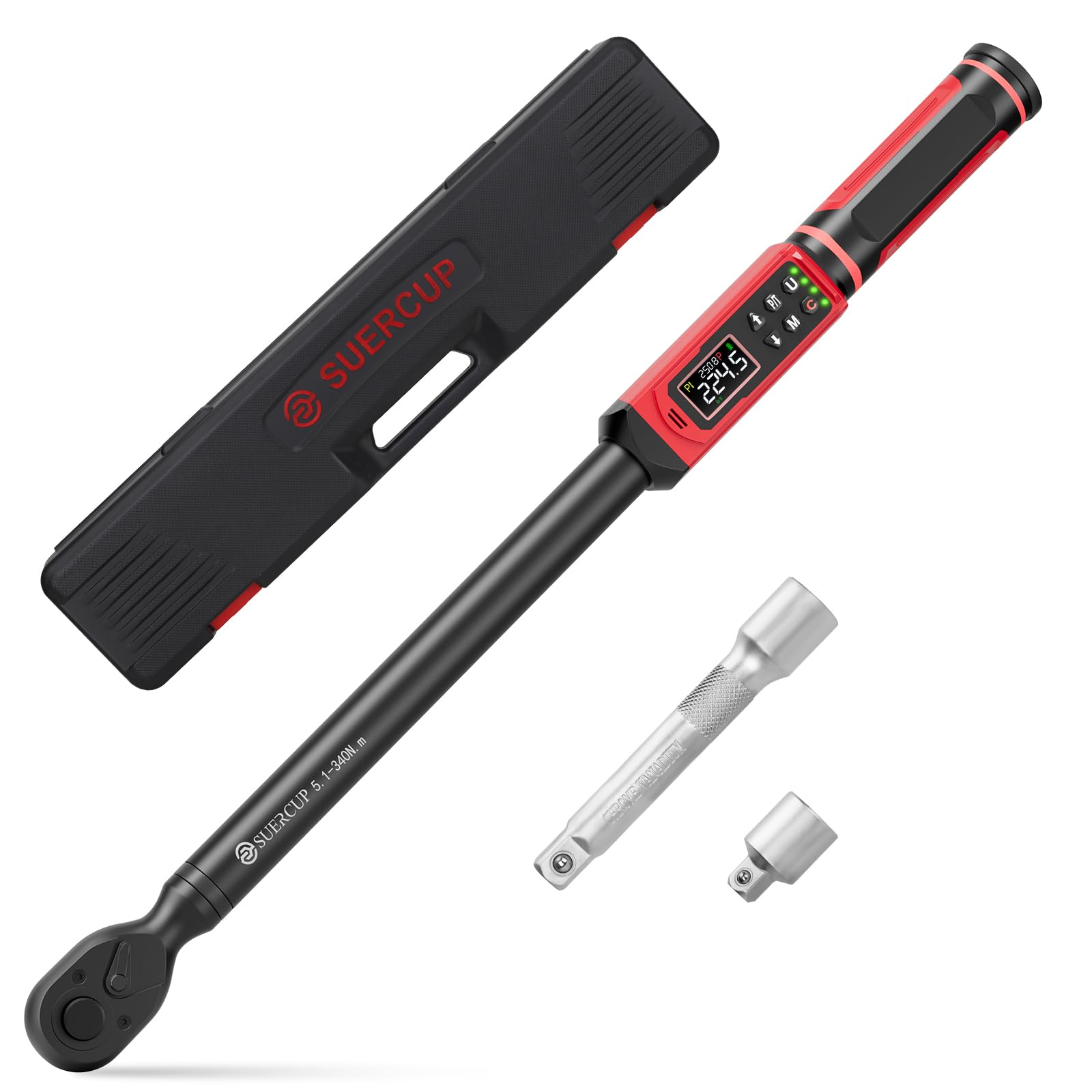
If you’ve ever squinted at chrome markings under fluorescent light and thought, “There has to be a better way,” this wrench is the answer to that pain. The selling point isn’t “digital.” It’s legibility. Owners with eyesight frustrations consistently appreciate the big, bright display because it turns torque setting from a guessing game into a clean, quick action.
On car work that matters—wheel hardware, suspension bolts, big brackets—multi-sensory alerts are your safety net. A strong vibration, a beep, and a flashing indicator help you stop at the right moment even when your body position is awkward (like torquing under a fender or reaching around a brake assembly).
The practical downsides are common to many value digital tools: the interface may not be “luxury simple,” and some users wish the manual explained torque-setting steps more clearly. The workaround is easy: do a short “practice run” on a non-critical fastener or a bench setup so the button sequence becomes second nature.
Why it’s a great 1/2″ digital
- Big, bright screen – Major win for readability and speed.
- Strong alert system – Beep/LED/vibration reduces overshoot risk.
- High ceiling – Designed for higher-torque automotive tasks.
- Preset + memory style features – Helpful if you repeat similar jobs often.
Good to know
- Button sequences can take a minute to learn; practice once and you’re good.
- It’s heavier than small clickers—normal for a high-range 1/2″ digital tool.
- Digital tools are happiest with fresh batteries, especially if you use vibration alerts a lot.
Ideal for: people who want a high-range 1/2″ wrench with excellent readability and clear stop signals for big fasteners.
8. TEKTON TRQ51402 (3/8″) – The 90-Tooth “Control Freak” Micrometer
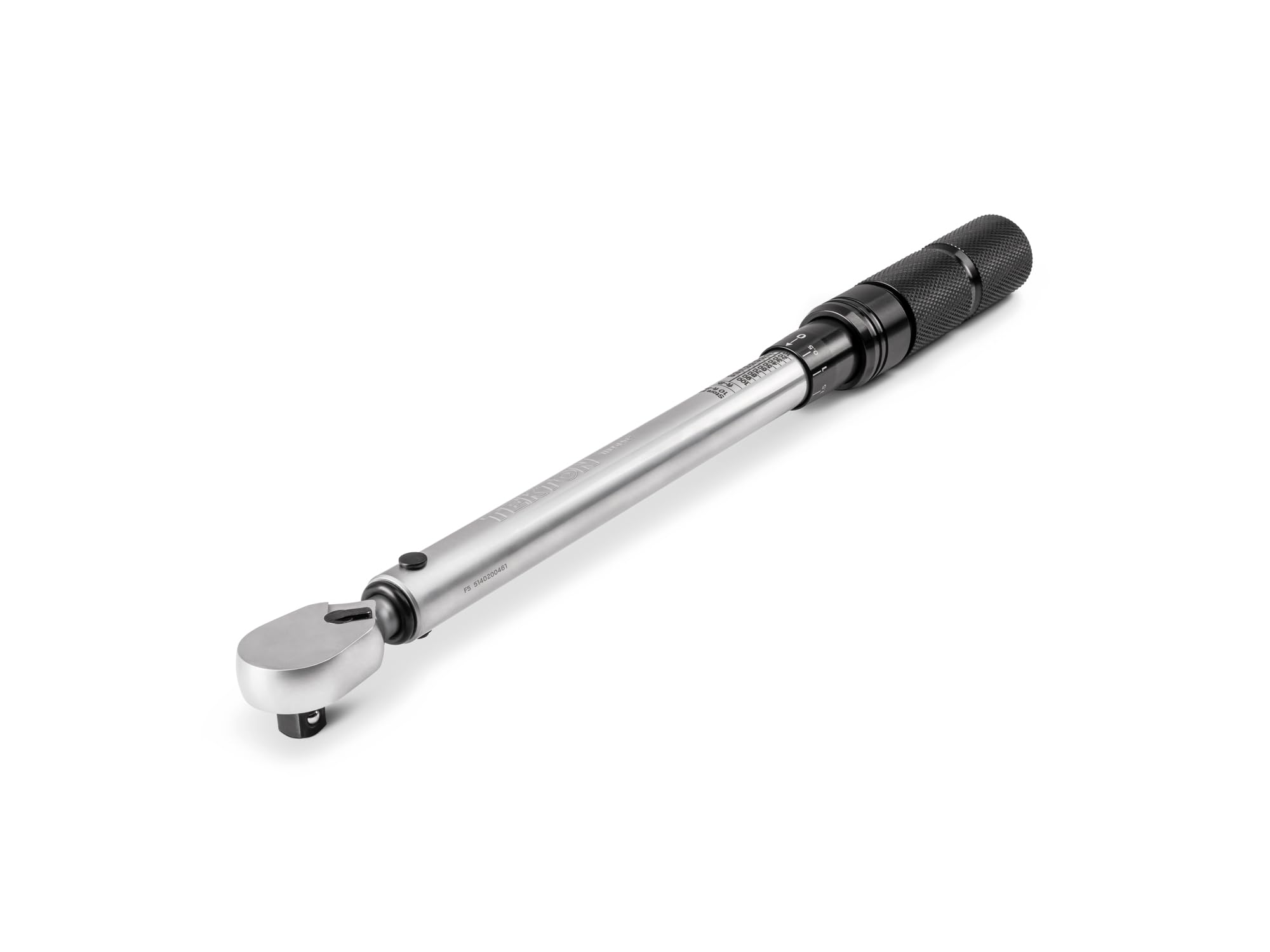
If you’ve ever had to torque a fastener where you only get a tiny swing before the handle hits something, you understand why ratchet tooth count matters. This Tekton is built around control in cramped spaces: a tighter swing arc, a setting system that doesn’t rely on a tiny thumb screw, and a handle texture that stays grippy when your hands are not showroom clean.
Owners who buy it for “I broke a bolt once and I’m not doing that again” jobs tend to love it. It’s the kind of wrench that makes small, precision torque feel safer: you dial it in, you pull smoothly, you get a solid click, and you stop. That’s the entire point of torque work—and it’s why this one earns loyalty.
Another quiet advantage is the calibration approach described in the listing: it’s designed to instill confidence in accuracy across the range, and it comes with a certificate. You don’t need to become a calibration scientist, but having traceable documentation is a nice “grown-up tool” signal when you’re building a serious garage setup.
Why it works so well on cars
- 90-tooth tight swing – Great for engine bays and awkward angles.
- Clear setting system – Locks your value without fussy knobs.
- Strong tactile click – Helps prevent the “just a little more” mistake.
- Excellent grip – Feels controlled even with oily hands.
Good to know
- Still a click wrench—treat it like a measuring instrument, not a breaker bar.
- Not meant for very high torque; it’s a mid-torque precision tool.
- If you want the “no storage ritual” lifestyle, a split-beam might feel even easier long-term.
Ideal for: engine bay and mid-torque work where tight swing and clean control matter more than brute force.
9. CRAFTSMAN CMMT99434 (1/2″) – The Straightforward High-Torque Click Wrench

There’s something refreshing about a tool that does the job cleanly without trying to impress you. The Craftsman is that type of wrench: a classic 1/2-inch click style designed for higher-torque automotive tasks. Owners often highlight the same points: solid build quality, a loud clear click, and the kind of handle length that makes higher torque feel controlled rather than desperate.
This is where many DIYers win big. If your main goal is wheel, brake, and suspension torque, a 1/2-inch click wrench can be the simplest path to consistency. The locking mechanism matters here—because you often torque multiple fasteners in a pattern, and you don’t want your setting drifting as you reposition and re-grip.
One review-style takeaway worth repeating: don’t treat a torque wrench like a general-purpose ratchet. Use a breaker bar for loosening, then use the torque wrench for final tightening. That’s how you keep accuracy and longevity in the real world.
Why it’s a strong DIY pick
- High-torque capability – Built for wheels and bigger hardware.
- Loud click – Less “did I feel it?” doubt at the finish.
- Comfort + leverage – Long handle makes torque smoother.
- Good lock – Helps you repeat settings reliably across patterns.
Good to know
- Length helps leverage but hurts maneuverability—tight spaces can be annoying.
- Not a low-torque specialist; pair with a 3/8″ tool for smaller fasteners.
- As with many clickers, storage habits matter (don’t force it below its minimum marking).
Ideal for: wheel, brake, and suspension DIYers who want a dependable, classic click wrench with a clear signal at torque.
10. LEXIVON LX-183 (1/2″) – The High-Contrast Clicker That’s Easy to Trust

Budget torque wrenches usually fail in one of two ways: they’re vague at the click, or they’re frustrating to set and read. The Lexivon’s big advantage is that it’s designed for visibility. The yellow-on-black markings are the kind of detail that makes you actually use the tool instead of “eyeballing it” because you’re annoyed.
Owners often describe it as “surprisingly nice” for the category, and that’s the right framing: it’s not trying to be a boutique pro tool, but it’s trying to eliminate common user mistakes. For car work, that’s huge. The torque wrench that gets used correctly is better than the fancier one that sits in the case because you don’t enjoy using it.
The other practical win is feel and consistency. Many DIYers don’t have a calibration lab at home. What they need is a tool that behaves predictably, clicks consistently, and doesn’t feel like it’s going to skip a tooth or wobble under load. This one tends to land in that “reassuring” zone for most everyday car maintenance.
Why it’s a smart value
- Easy readability – High contrast markings reduce setup errors.
- Solid feel – Owners often mention sturdy construction and smooth operation.
- Great starter 1/2″ – Covers many common car tasks without premium pricing.
- Case included – Helps you store it like a precision tool.
Good to know
- Not designed for extremely high torque tasks—check your vehicle needs for big fasteners.
- Like most clickers, it’s for tightening, not breaking loose seized hardware.
- If you want multi-unit alerts or a big screen, a digital tool will feel more “guided.”
Ideal for: DIYers who want a readable, dependable 1/2″ click torque wrench that feels far above “cheap tool” territory.
11. GROWNEER Digital (3/8″) – Peak Hold + Alerts for “Did I Really Hit Spec?” People

Digital wrenches shine when they reduce anxiety. The Growneer’s best “real life” feature is the one many people don’t realize they want: the ability to see and hold the achieved torque value. That’s a confidence booster on jobs where you torque, move to the next fastener, then want to confirm you actually hit the target after the tool is off the bolt.
The alert system is also well-thought-out for typical garage conditions. You get audible cues and light cues, so you’re not relying on a subtle tactile click alone. For many DIYers, that reduces over-torque mistakes because the tool tells you when you’re approaching the target and when you’ve arrived.
Value digital tools always come with “keep an eye on batteries” reality, and users note that battery life can vary. Treat it like a real instrument: use it, then power it down (or remove batteries for long storage). If you do, it can be a surprisingly capable tool for mid-torque car work.
Why it’s a great value
- Peak-hold confidence – Confirms the torque was reached after you stop.
- Clear alerts – Beeps and lights reduce “missed click” mistakes.
- Useful range for cars – Strong for many underhood and mid-torque tasks.
- Case + accessories – Helpful for DIY convenience and storage discipline.
Good to know
- Battery management is part of the experience—keep spares, especially for long projects.
- Digital interface takes a minute to learn; do a quick dry run before critical work.
- Not a replacement for a high-range 1/2″ wheel wrench if you do heavy torque jobs often.
Ideal for: DIYers who want digital guidance and peak confirmation without paying for premium metrology features.
12. coobeast Digital (3/8″) – Big Color Screen, Presets, and a “Check Your Work” Personality

This wrench is built for people who want visual clarity and guided feedback. The big backlit screen is a genuine benefit for garage work, and the preset system can save time if you do repeating maintenance patterns (the same torque values over and over across the same vehicle tasks).
Where you should be thoughtful is consistency. Some users report excellent results and call it precise; others have reported meaningful inaccuracy when checked against calibrated sources. That doesn’t automatically make it “bad,” but it does mean this tool is best treated as a wrench you validate early in ownership—especially if you’re using it for critical fasteners.
In practice, this is how you make it work well: use it for the categories where digital guidance is most helpful (mid-torque engine bay fasteners, controlled tightening sequences), and keep a trusted mechanical 1/2″ wrench for heavy wheel work. Used that way, it can be a comfortable, readable digital option for many DIYers.
Why people buy it
- Large screen readability – Great in low light and awkward angles.
- Strong alert system – Beep/LED helps prevent overshoot.
- Preset + memory features – Convenient for repeat torque values.
- Useful mid-torque band – Good for a lot of underhood work.
Good to know
- Mixed owner feedback on accuracy means it’s smart to validate early for your peace of mind.
- Battery drain can happen faster if vibration/alerts run frequently.
- Not a substitute for a high-range 1/2″ wheel-focused wrench for heavier torque tasks.
Ideal for: DIYers who want a big, readable digital experience for mid-torque jobs and don’t mind doing a quick accuracy sanity check early.
13. Uharbour Digital (3/8″) – The Low-Torque Specialist for “Don’t Strip That” Jobs

Car work isn’t all “big bolts.” Some of the most expensive mistakes happen on small fasteners: valve cover bolts, brackets into aluminum, components with fragile threads, and anything that lives in the “hand-tight plus a little” danger zone. A wrench like this exists to make those jobs boring—in the best way.
Owners appreciate the broad low-range coverage and the “feels high quality” handling. The vibration/buzzer/LED alert system is especially useful at low torque because the difference between correct and stripped can be small. It also helps new users build intuition: you learn what correct torque actually feels like instead of guessing and hoping.
One real-world note from user feedback: grip position matters. Digital tools can respond to how force is applied, so treat the handle area as the “calibrated grip zone” and avoid choking up near the head. Do that, and this kind of low-torque digital becomes a precision safety tool for delicate jobs.
Why it’s valuable for cars
- Low torque mastery – Great where over-torque is the real enemy.
- Clear alert feedback – Helps you stop exactly where you should.
- Dual-direction ratchet – Useful for varied access and work positions.
- Good packaging – Case and included power can reduce friction for first-time use.
Good to know
- Not for wheel lugs or heavy suspension torque—this is a small-fastener specialist.
- Digital workflow can be quirky if you want instant “turn and go.”
- Battery management matters if you keep it in storage for long periods.
Ideal for: delicate fastener work where precision matters more than brute force, especially on aluminum parts and sealing surfaces.
14. Hairich Digital (3/8″) – The Data-Memory DIY Helper
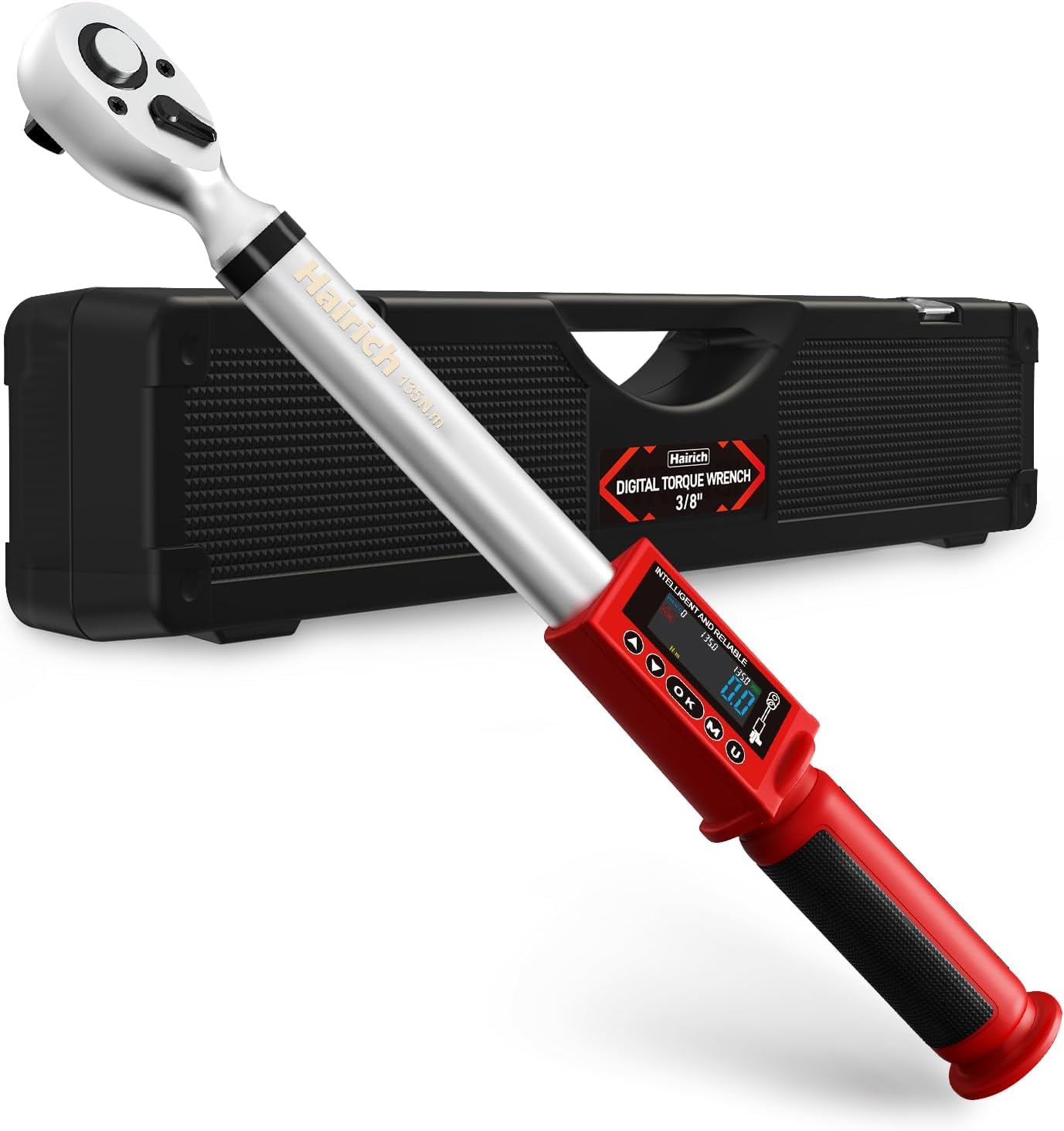
This wrench is aimed at DIYers who like structure. Track mode shows you what’s happening in real time; peak mode records the maximum torque value. That’s useful in two very practical situations: when you’re learning and want to confirm you hit spec, and when you’re doing repeated fasteners and want consistent results across a sequence.
Owners often mention it feels well made for the category and that it’s easy to use after a couple of projects. That “after a couple” part is worth respecting: digital torque tools are a tiny system, not just a lever. Once you know how to set torque quickly and interpret alerts, it becomes a comfortable part of your workflow.
One common “wish” is higher capacity on larger drive models in some sets—so treat this as a mid-torque helper rather than your only tool. In a smart garage lineup, this is the piece you reach for when you want clarity, alerts, and less chance of a small torque mistake.
Why it’s a practical digital
- Track + Peak modes – Helps you confirm and repeat torque consistently.
- Alerts you can’t miss – Light + sound guidance for safer tightening.
- Comfortable handling – Built for real grip and real use.
- Unit flexibility – Useful across different manuals and specs.
Good to know
- Digital tools require battery care and some UI patience.
- Best as part of a set of tools, not as your only torque solution.
- Learning curve is real but small—practice once before a critical job.
Ideal for: DIYers who want digital feedback and memory features for repeatable mid-torque maintenance work.
15. SUZUME 3PCS Click Set – The “One Case, Three Drives” Garage Builder
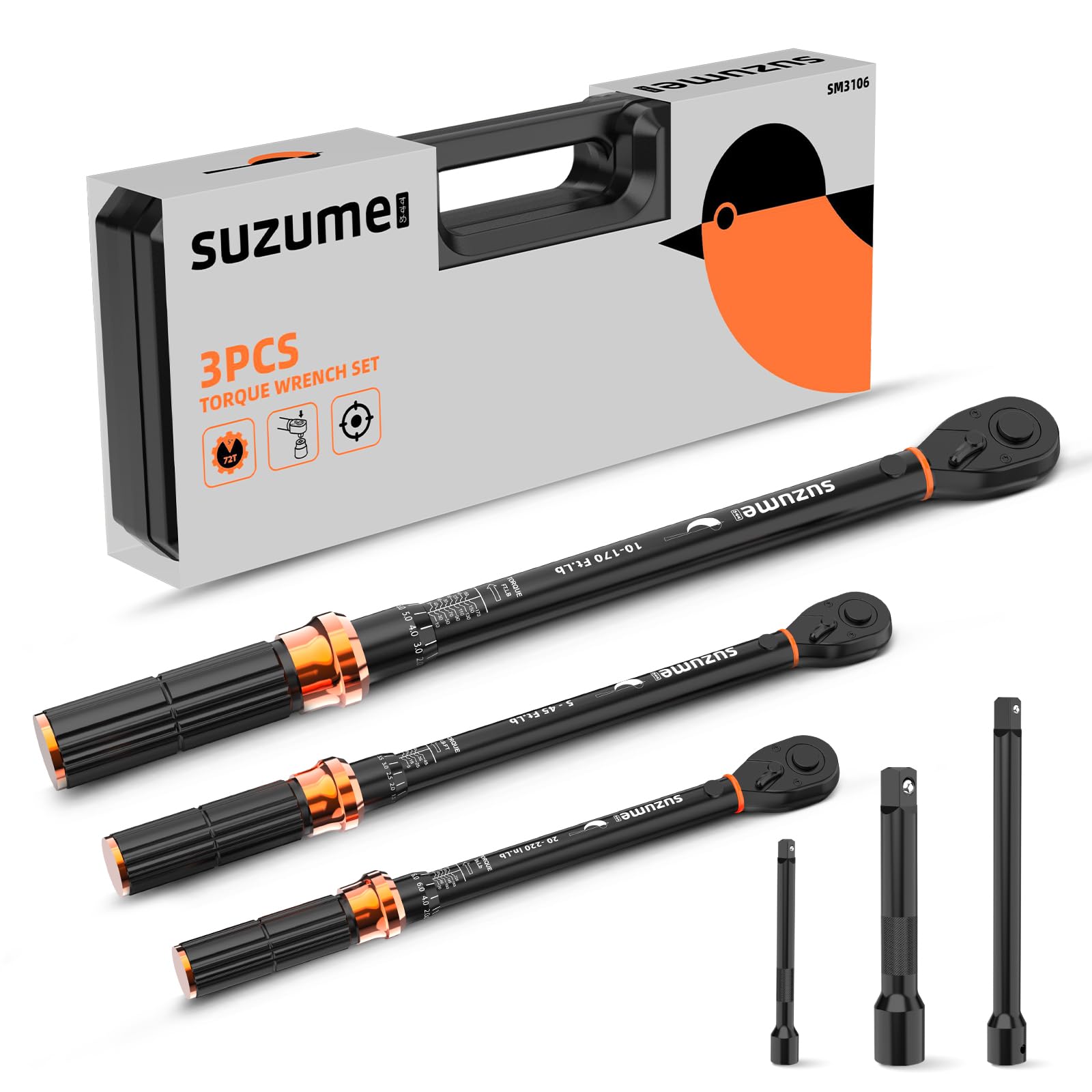
Multi-drive sets can be either a gimmick or a genuine “garage upgrade.” The SUZUME set earns attention because it’s aimed at real coverage: a 1/4 for delicate work, a 3/8 for daily car maintenance, and a 1/2 for heavier torque. That means you can stop forcing one wrench to do jobs it was never meant to do.
Owners who like it tend to describe “quality feel” and crisp operation. The 72-tooth mechanism gives you better control in tight areas, and the dual-direction head helps in practical access situations (though always follow torque specifications and tool guidance for direction of measurement). The dual-scale readability also helps if you bounce between specs written in different units.
One honest note from user feedback: click perception can vary, especially at low values. That’s not unique to this set—many clickers are more subtle at the bottom of their range. The fix is technique: slow, smooth pull; listen and feel; and don’t “double-click” a stationary fastener. When you use it correctly, this set can cover a huge percentage of typical car work with satisfying simplicity.
Why it’s a strong set
- Three-drive coverage – Handles small, medium, and bigger tasks properly.
- Solid build feel – Owners often describe it as sturdy and “quality.”
- Tight-space friendly – Fine-tooth ratchet helps when you don’t have room to swing.
- Great for a growing garage – One case, multiple capability bands.
Good to know
- Low-torque clicks can be subtle—use slow, controlled technique.
- Don’t overload the smallest wrench; choose the drive that matches the job.
- If you want “no-learning-curve clarity,” digital alerts can feel more beginner-friendly.
Ideal for: anyone building a home garage who wants three useful drive sizes in one case without going fully digital.
16. DISEN 9PCS Click Set – The “Access Matters” Kit (Adapters Included)
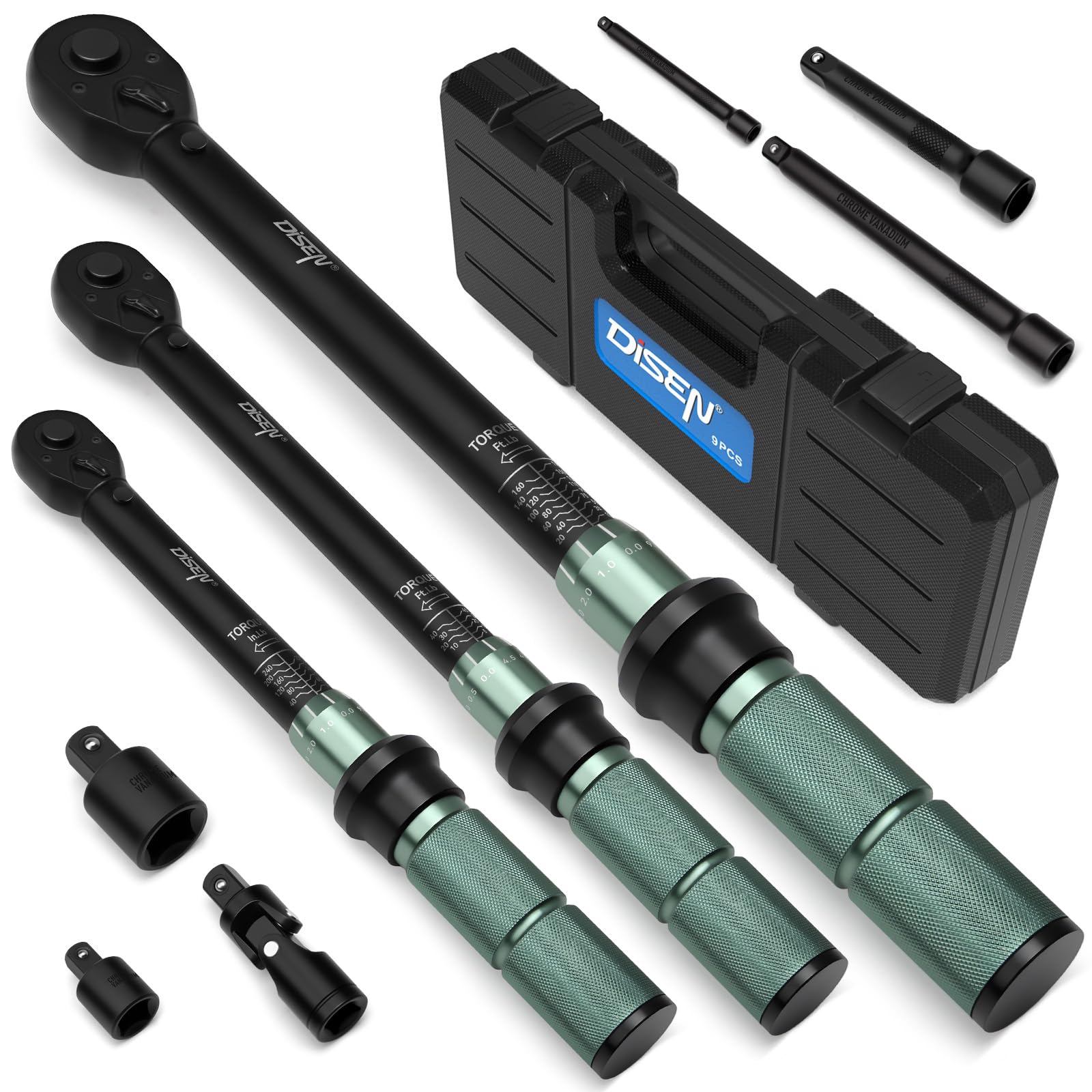
Torque work on cars often fails because of access, not because people don’t know the correct number. You can have the perfect wrench and still do the job poorly if you can’t keep the tool aligned, can’t reach the fastener comfortably, or end up pulling at an odd angle because you don’t have the right extension or universal joint.
That’s why kits like this can be valuable: they reduce the “I can’t get in there” friction that pushes people toward guesswork. Owners appreciate the fact that it comes with a calibration certificate and that the case keeps the whole system together. The audible click is described as distinct, which is exactly what you want when you’re doing patterns or finishing a sequence.
The smart way to use this kit is to treat the small wrench as a precision instrument, not a brute force tool. One review example mentions breaking the smallest wrench by overloading it—an honest reminder that drive size and torque range are not suggestions. If you match the wrench to the job, this set can cover a lot of car maintenance with one organized case.
Why it’s useful in real garages
- Adapters + extensions – Helps you torque properly when access is awkward.
- All-in-one storage – Encourages good tool care and reduces “lost parts.”
- Distinct click – Helpful for repeatable torque sequences.
- Broad coverage – Useful for bikes, cars, and general mechanical work.
Good to know
- Don’t overload the smallest wrench—use the correct drive for higher torque.
- Adapters can change effective torque if you extend the lever length (we’ll cover that below).
- Accessories may not feel as premium as the wrenches themselves; function matters more than polish.
Ideal for: DIYers who want a complete, organized kit and value access tools (extensions/adapters) as much as the wrench itself.
17. Matework Upgraded 8PCS Set – The Budget Kit With a Smarter Lock Ring
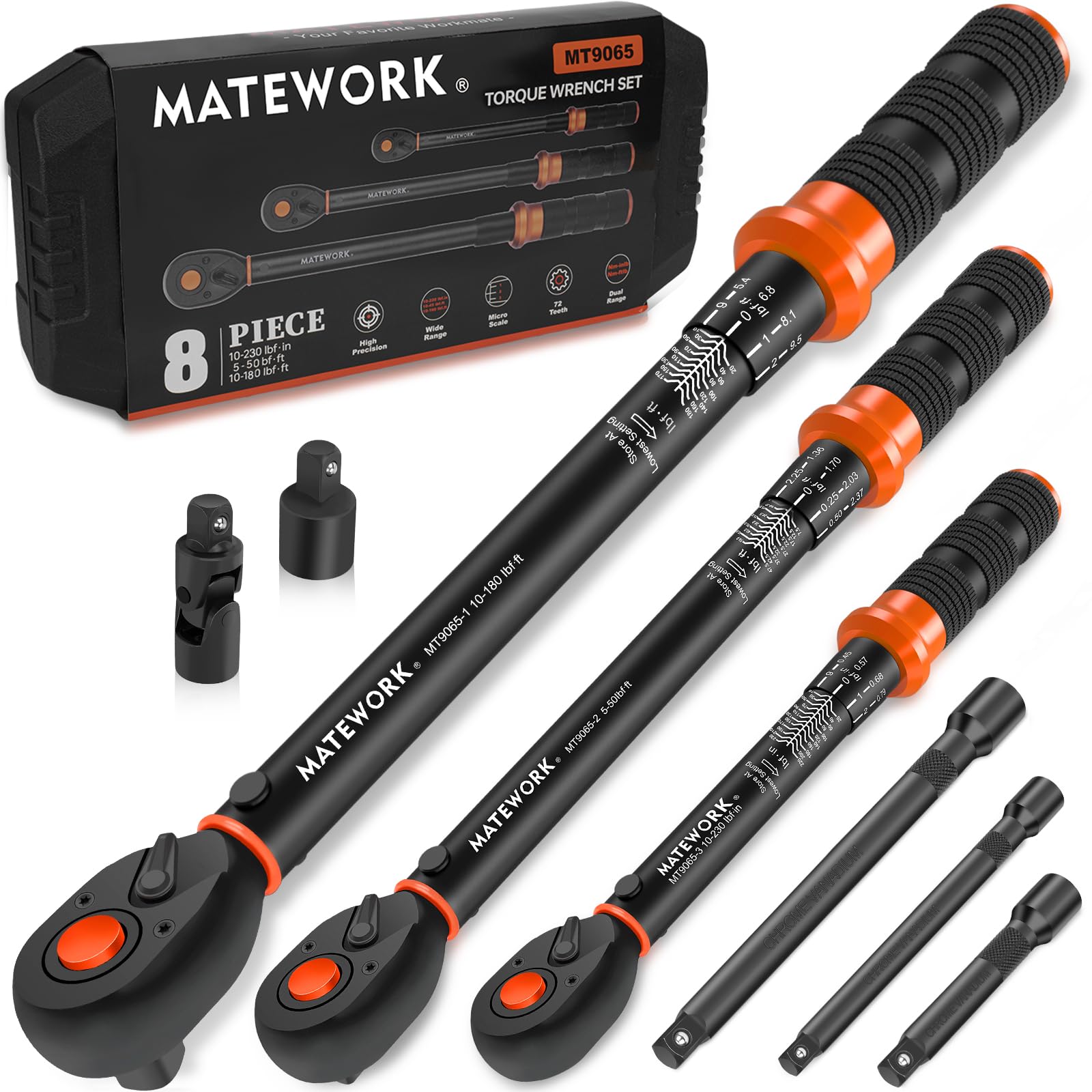
Not every garage needs a premium split-beam setup. Some people want a practical kit that covers a wide range of tasks and feels “good enough” without being disposable. That’s the lane this set is trying to own: three drive sizes, a case, and an improved lock ring system that makes setting torque less annoying than older budget designs.
Owners tend to describe it as accurate-feeling and versatile for occasional use, which is exactly the honest positioning. The kit gives you coverage and convenience: different sizes, extensions, an adapter, and a universal joint so you can actually reach what you’re trying to torque. For a lot of DIYers, that’s the difference between doing a job properly and doing it “however it fits.”
One user note is important: ensure the lock ring is fully locked after setting. That’s not a dealbreaker—many click wrenches rely on a lock mechanism—but it’s a reminder that precision tools reward good habits. If you set carefully, lock deliberately, and torque smoothly, this kit can handle a wide range of normal car maintenance.
Why it’s a smart “starter kit”
- Three sizes in one case – Covers a lot of real vehicle maintenance.
- Improved lock ring – Easier torque setting compared to older budget clickers.
- Useful accessories – Extensions and joint help access fasteners properly.
- Good value feel – Owners often describe “better than expected” quality.
Good to know
- Double-check the lock ring—some users note it can feel locked when it isn’t.
- As with any kit, match the wrench size to the torque needed (don’t overload the smallest).
- If you do frequent high-torque work, a dedicated premium 1/2″ tool will feel more confidence-inspiring.
Ideal for: DIYers who want one case that covers many tasks and don’t mind being a little “intentional” about the locking step.
18. YIYEIE 8PCS Click Set – The Simple Multi-Drive Bundle for Getting Started Right

If you’re new to torque wrenches, you want a set that reduces friction: everything arrives together, it stores neatly, and you can handle different classes of fasteners without buying three separate tools. This set is aimed at that buyer. You get three drives plus practical adapters, which helps you cover both delicate and heavier torque zones in a simple, organized way.
Owners often describe these kinds of sets as “good for my needs,” which is the right way to think about it. The real win is the habit it builds: when you own a torque wrench, you start paying attention to torque specs instead of guessing. That alone can improve the quality of your maintenance work immediately.
The most important “expert move” with any budget click kit is technique. Pull slowly. Stop at the click. Don’t re-click a stationary bolt. And don’t treat the wrench like a breaker bar. If you use it like a measuring instrument, it can do exactly what a new DIYer needs: help you tighten to spec without fear.
Why beginners like it
- Complete coverage – Three drives handle a wide range of tasks.
- Portable case – Encourages proper storage and tool care.
- Distinct click design – Helps reduce over-tightening mistakes.
- Good “learning tool” – Gets you using torque specs the right way.
Good to know
- Not a replacement for premium shop tools if you’re torquing daily at high loads.
- Adapters and joints improve access but can change leverage if used incorrectly (see the technique section).
- As always, choose the correct drive size for the torque task—don’t overload small wrenches.
Ideal for: first-time torque wrench owners who want an all-in-one kit to start doing car maintenance properly.
Torque That’s Actually Accurate: The Technique That Separates “Looks Tight” From “Is Right”
Here’s the part most buying guides skip: even the best torque wrench can give you the wrong result if the technique is wrong. Torque is only a proxy for clamp load, and clamp load is what actually holds parts together. Your job is to make the tool’s measurement match reality as closely as possible.
1. Smooth pull beats strong pull
Torque wrenches are designed for controlled tightening. The biggest user mistake is yanking fast—especially right at the end. Pull smoothly, listen/feel for the signal, and stop immediately. “One more click” is how people accidentally over-torque.
2. Hold the wrench where it’s designed to be held
The handle length is part of the calibration. Choking up on the shaft changes leverage and changes the torque delivered. Grip the intended handle area, keep the pull in a straight plane, and avoid “side loading” the head.
3. Don’t loosen fasteners with a torque wrench
Use a breaker bar (or a standard ratchet) to break fasteners loose. Then torque to spec on the way back in. This is not about being precious. It’s about keeping the mechanism accurate and consistent over time.
4. Extensions and adapters: the hidden math trap
Extensions that keep the effective lever length the same (straight extensions) generally don’t change the math. But adapters that extend the lever arm (like certain crowfoot positions) can. If you use a crowfoot, pay attention to orientation: keeping it at 90 degrees to the wrench is a common way to reduce lever-length change. If you’re unsure, keep the setup simple or look up the correct adjustment method.
5. Thread condition changes everything
Torque values assume a specific friction condition. Clean, dry threads behave differently than lubricated threads. If a manual calls for dry installation, don’t “help” with grease. If it calls for a thread locker, use what’s specified. The goal is repeatability—because repeatability is what makes torque meaningful.
FAQ: Torque Wrenches for Cars (Answered Like You Actually Have a Job to Finish)
Do I need one torque wrench or two for car work?
Click vs split-beam vs digital: what’s easiest for beginners?
Why do some torque wrenches feel like they barely click?
Can I use a torque wrench to loosen bolts?
Do digital torque wrenches replace click wrenches?
How do I keep my torque wrench accurate longer?
What’s the most common torque mistake on cars?
If I only buy one tool today, which should it be?
Final Thoughts: The Right Torque Wrench Makes You Calm Mid-Job
A great torque wrench doesn’t just tighten fasteners. It changes how you work: slower, cleaner, more confident. And that’s where the value is— not in owning a fancy tool, but in finishing a job without the “Did I just mess that up?” feeling.
Here’s the simplest way to translate this guide into the right purchase:
- Want the best overall “trust it for years” choice? Start with the Precision Instruments PREC3FR250F. It’s a high-confidence split-beam workhorse that feels built for real automotive use.
- Want premium coverage in one move? Choose the TEKTON Split Beam Set TRQ99902 for a 3/8 + 1/2 pairing that covers most common car torque jobs correctly.
- Mostly doing wheels and want a complete setup? Grab the DEWALT Tire Change Kit DWMT45012. It’s a clean wheel workflow in one case.
- Want digital alerts for engine bay work? Pick the DEWALT Digital DWMT17061 or the GEARWRENCH 85076 if you want beep/visual guidance that reduces missed-click stress.
- Want a big-display 1/2″ digital for higher torque work? The SUERCUP 1/2″ Digital is a strong choice when readability is a real problem and you want clear alerts.
- Want a classic, simple 1/2″ click wrench? The CRAFTSMAN CMMT99434 is straightforward and confidence-building for wheel and suspension DIY.
- Want a value clicker with excellent readability? Start with the LEXIVON LX-183. It’s a great “I’ll actually use this” pick.
- Want one case that covers multiple drives and common access needs? Go with the SUZUME 3PCS set, the DISEN 9PCS set, or the Matework 8PCS set depending on whether you prioritize three-drive coverage or accessories.
The best purchase is the one you’ll still feel good about when you’re tired, your hands are dirty, and you’re torquing the last fastener of the day. Pick the best torque wrench for cars that matches how you actually work—wheels, engine bay, or mixed DIY—and your future self will thank you every time the job ends clean.