
Our readers keep the lights on and the garage heater humming. As an Amazon Associate, I earn from qualifying purchases.
A dead battery rarely happens on a calm, convenient day. It happens when you’re late, it’s freezing, and your “simple errand” turns into a jump-start scavenger hunt. That’s why the smartest car owners don’t treat battery charging as an emergency tool—they treat it as a quiet, behind-the-scenes habit.
If you’re looking for the best car trickle charger, you’re not really shopping for a gadget. You’re shopping for reliability: a battery that doesn’t slump during cold starts, a vehicle that fires up after weeks of sitting, and a garage routine that removes surprise costs.
Here’s the part most buying guides miss: “trickle charger” is a messy umbrella term. Some units are true long-term maintainers with microprocessor control, temperature compensation, and safe float/pulse logic. Others are basically a low-amp charger that happens to be slow. Both can work—but they feel wildly different when you depend on them for weeks or months.
So this guide goes 1,000km deeper than the usual feature list. We’re talking about the friction points that show up in real owner life: how clamps behave on side posts, what happens when a battery is too low to be detected, whether cables stay flexible in deep cold, how “repair/desulfation” modes behave in the real world, and which chargers you can genuinely leave connected without babysitting.
Below you’ll find 14 standout picks—from ultra-reliable maintainers for daily drivers, to high-output workshop chargers that double as DC power supplies, to multi-bank units that keep an entire garage of toys ready to go.
In this article
How to Choose the Right Best Car Trickle Charger for Your Garage
A battery charger shouldn’t feel like a science project. The right one blends into your routine: plug it in, walk away, and come back to a battery that behaves like it’s been cared for (because it has). To pick well, you need to match the charger to three realities: your battery type, your driving pattern, and your environment.
1. Decide your real goal: maintain, recover, or support a workshop
Most people buy the wrong charger because they buy for a single moment (the one dead-battery morning) instead of their full year of use. Pick your lane first:
- Maintenance / storage: Your vehicle sits for days or weeks. You want a maintainer that safely holds charge long-term.
- Recovery: You get batteries that are low from sitting, cold weather, short trips, or a forgotten interior light.
- Workshop / fleet: You maintain multiple batteries, need faster charging, or want DC supply support for diagnostics and battery swaps.
2. Understand “trickle” vs “maintainer” (the difference is safety + brainpower)
Many products get called “trickle chargers,” but the best units behave more like battery managers. Here’s the practical difference:
- Old-school trickle charging: Constant low current. Works for topping off, but can be wrong for long-term unattended use.
- Smart maintaining: Multi-stage charging, then float/pulse maintenance with monitoring so the charger only feeds the battery what it needs.
If you want “set-and-forget,” choose a charger that explicitly supports automatic maintenance modes and is designed for continuous connection. This is where brands like NOCO and Battery Tender built their reputations: they aim to reduce overcharge risk while keeping the battery ready.
3. Match charger output to how quickly you want problems to go away
Amperage isn’t about bragging rights. It’s about what the charger can realistically do in the time you have:
- 1A–2A: Ideal for storage maintenance and small batteries (motorcycles, lawn equipment). Slow recovery for car batteries, but gentle.
- 3A–5A: The sweet spot for many households—fast enough to recover from sitting, still safe for long-term maintenance.
- 10A+: Great for frequent recovery work, larger batteries, or a “fix it tonight” schedule. Also useful in cold climates.
- 15A–25A: Workshop territory—fast charging, support functions (engine start aid, DC supply), and less waiting.
Translation: if your car sits for weeks, a smaller smart unit is fine. If you have a vehicle that does short trips in winter, a stronger charger can feel like a cheat code.
4. Battery chemistry matters more than most people think
Modern garages are a mix of battery types, and each one has preferences. The charger you buy should match what you own—not what you might own later.
- Flooded / standard lead-acid: Most chargers handle this well. The main question becomes maintenance quality and temperature behavior.
- AGM: Often benefits from precise voltage control; chargers with AGM modes reduce guesswork.
- Gel: Can be sensitive to charging profiles; use a charger that explicitly supports gel if you have it.
- LiFePO4: Only use a charger that has a dedicated lithium mode and clearly supports LiFePO4 profiles.
- 6V systems: Classic cars and vintage motorcycles need 6V support, not just 12V.
5. Temperature compensation isn’t a “premium extra”—it’s a real-world advantage
Charging voltage needs change with temperature. In hot garages, a charger without temperature awareness can push too hard. In cold garages, it can undercharge and leave you with “it starts, but it’s sluggish.” Smart chargers with temperature compensation can feel more consistent across seasons, especially for vehicles that sit.
6. The hidden quality test: cables, clamps, and the “daily-use feel”
This is the stuff that determines whether you actually use the charger or leave it in a box:
- Clamp quality: Do they bite securely, or do they slip with a small bump?
- Ring terminals / quick-disconnect: If you maintain a battery often, permanent eyelets become a lifestyle upgrade.
- Cable flexibility in cold: Some units use better cable jackets that don’t turn into plastic sticks in winter.
- Readability: Clear LEDs can be better than a flashy display if you just want “charging vs full.”
- Heat handling: Better chargers run warm, not scary-hot; cooling and internal protection matters.
Quick Comparison: 14 Best Car Trickle Charger Picks
Use this table to shortlist the chargers that match your driving and storage reality, then jump to the full reviews for the “real life” details— like which clamps stay put, which units recover low-voltage batteries more reliably, and which ones make multi-vehicle maintenance effortless.
On smaller screens, swipe or scroll sideways to see the full table.
| Model | Charger type | Signature strength | Best match | Amazon |
|---|---|---|---|---|
| NOCO GENIUS10 | Smart maintainer | Strong all-around output + temperature compensation + low-voltage recovery tools | Most households with cars, bikes, and seasonal equipment | Amazon |
| CTEK MUS 4.3 Polar | Cold-weather | Extreme-climate design + snowflake mode + reconditioning program | Cold garages and winter storage with real temperature swings | Amazon |
| TowerTop 25A Max Pro | Workshop | Fast charging + engine start aid + DC power supply mode for garage tasks | DIYers and multi-battery homes who want speed and functions | Amazon |
| NOCO GENIUS2X4 | Multi-bank | Four independent banks (2A each) for a whole garage lineup | Collectors, boats + cars, or “everything sits” garages | Amazon |
| NOCO GENIUS2X2 | Multi-bank | Two independent banks (2A each) for two vehicles at once | Two-car households and mixed equipment (car + mower) | Amazon |
| PCHH 12V/24V Heavy Duty (0–15A) | 12V/24V | Auto shutoff + maintain mode + repair + supports 24V systems | Trucks, farm equipment, and garages with 24V needs | Amazon |
| NOCO GENIUS5 | Smart maintainer | Balanced 5A performance in a compact, high-quality build | Daily drivers + weekend cars that need regular topping off | Amazon |
| Battery Tender 3 Amp Power Tender (6V/12V) | Maintainer | Simple, trustworthy maintenance logic + 6V/12V switchability | Classic cars, motorcycles, and “I just want it to work” users | Amazon |
| Battery Tender Plus (1.25A) | Iconic maintainer | Legendary long-term storage performance + ultra-simple workflow | Motorcycles, ATVs, and seasonal storage consistency | Amazon |
| LOKITHOR JC400 (9-in-1) | Hybrid tool | Jump starter + wall-powered charging/maintaining in one compact kit | Drivers who want one emergency tool that also maintains | Amazon |
| YONHAN 20A 12V/24V | Value charger | High output for quick recovery + winter mode + repair mode | Budget shoppers who still want speed and versatility | Amazon |
| DEWALT DXAEC2 (2A) | Basic maintainer | Simple 6V/12V maintenance with wall-hang convenience | Small garages and “keep it topped” needs | Amazon |
| NOCO GENIUS2 | Compact smart | 2A smart maintenance + temperature compensation + tidy form | Light maintenance and small-battery households | Amazon |
| NOCO GENIUS1 | Ultra-compact | Simple long-term maintenance for small batteries and storage | Lowest-effort maintenance for lawn equipment & backups | Amazon |
In‑Depth Reviews: 14 Chargers That Make Dead Batteries Way Less Dramatic
Now we’ll go model by model. I’m going to review these like a real garage owner, not a spec sheet: what feels effortless, what feels fiddly, what owners consistently praise, and the little “gotchas” that matter after the honeymoon phase.
1. NOCO GENIUS10 – The “One Charger That Handles Real Life” Choice

If you want one charger that does the “boring daily stuff” perfectly and still has the muscle for those “oh no” moments, the GENIUS10 is the sweet spot. It’s strong enough that you’re not waiting forever, but still smart enough to run maintenance without turning your garage into a babysitting job. That balance is exactly why many owners step up to this tier instead of buying multiple smaller chargers and hoping the right one is nearby.
What separates the GENIUS10 from a pile of mid-range chargers is the way it behaves when a battery isn’t cooperating. Real-world batteries don’t politely sit at half charge and accept a neat refill. They drop low from short trips, cold mornings, parasitic drain, or just being parked too long. The GENIUS10’s “recover and then maintain” personality is where it earns trust: it’s built for that messy middle.
One of the most useful “expert-level” benefits is how it supports a routine. With a quick-connect eyelet setup, the charger becomes a plug-in habit: hook up once, then topping off feels as simple as plugging in a lamp. Owners who keep a second car, a weekend truck, or a seasonal toy often say the charger pays for itself in avoided dead-battery days and fewer “why won’t this start?” mornings.
And yes—this is one of the models that makes the phrase best car trickle charger make sense in the modern way: not “slow charging forever,” but “smart, safe charging that keeps a vehicle ready.”
Why it’s the best overall
- Strong all-around output – Fast enough for recovery, gentle enough for long-term maintaining.
- Real-world battery friendliness – Handles the “not quite dead, not quite healthy” zone better than tiny maintainers.
- Convenient mounting + quick-connect ecosystem – Makes it easy to actually use consistently, not just own.
- Confidence features – Safety protections and clear mode selection reduce “did I hook it up right?” anxiety.
Good to know
- Like many compact high-output chargers, it can run warm while working hard—mounting with airflow is a smart habit.
- If you only ever maintain a single small motorcycle battery, a lower-amp Battery Tender or GENIUS1 can be enough.
- For multi-vehicle garages, a multi-bank unit may be more convenient than unplugging and rotating.
Ideal for: most households that want one dependable charger for cars, motorcycles, lawn equipment, and seasonal storage—without regret later.
2. CTEK MUS 4.3 Polar – Cold-Weather Charging That Doesn’t Panic
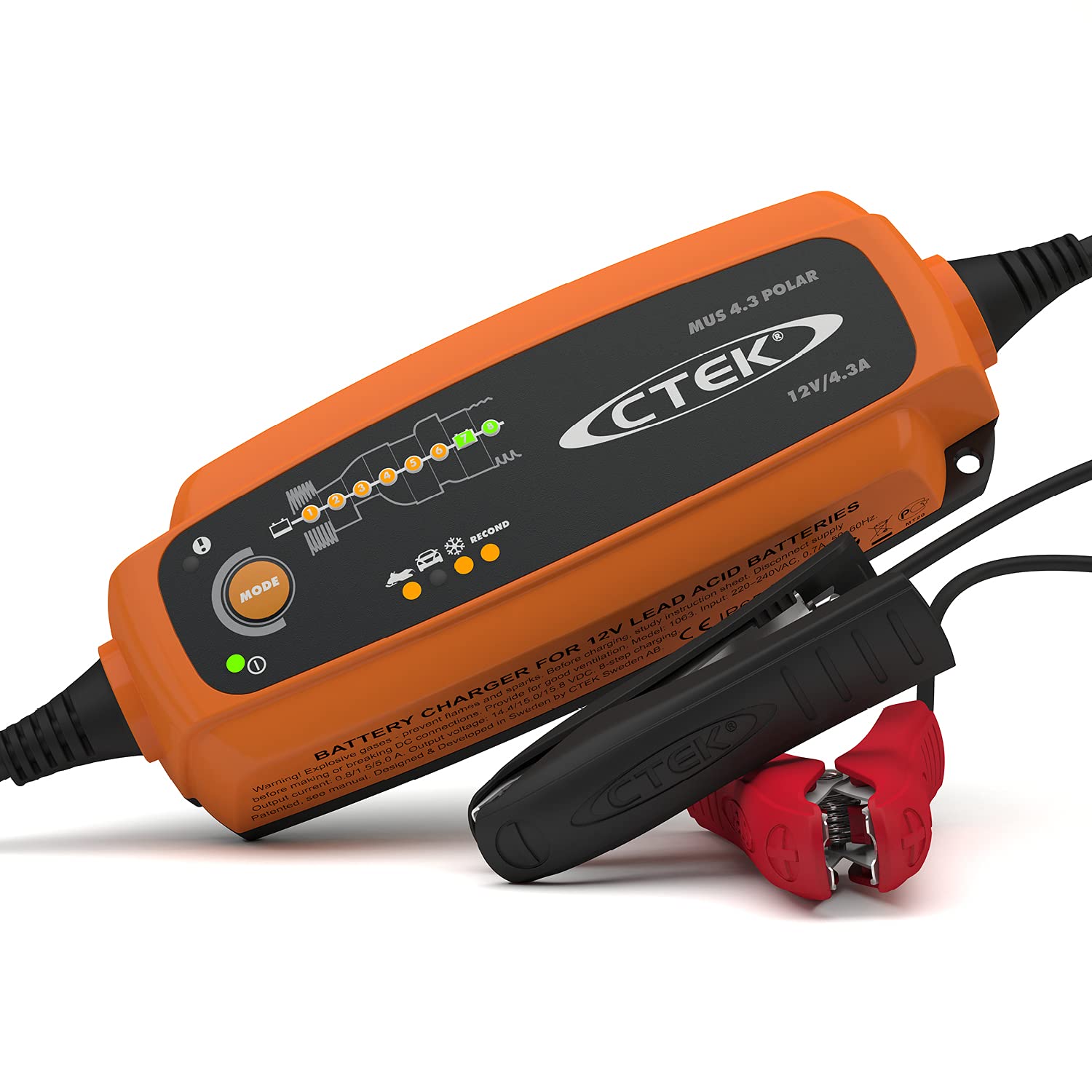
Some chargers “work in winter.” The CTEK Polar is designed for winter as a personality trait. If you’ve ever tried to deal with stiff cords, sluggish batteries, and a charger that seems confused by low temperatures, this one feels like a breath of fresh air. Its big promise is simple: keep charging behavior consistent even when your garage feels like a freezer.
Here’s what “extreme climate” really means in day-to-day use: you connect it, it does its 8-step logic, and it doesn’t act weird when the temperature drops. Owners who store vehicles in cold regions often report a difference in how the vehicle starts—less “barely turns over,” more “fires like it should.” That’s not magic. It’s battery conditioning and proper maintenance behavior when cold makes batteries less forgiving.
The Polar is also the kind of charger you buy when you care about doing things correctly. It has a reputation for delivering clean, stable charging behavior, which matters if you’re connecting to modern vehicles with sensitive electronics or you’re charging a quality AGM battery and don’t want voltage chaos. The snowflake mode is a practical feature, and the recond mode is the one you use on batteries that feel tired—especially after long storage.
If your climate isn’t harsh, you may not need this specific model. But if your winter is real—and you’re tired of chargers that quietly fail in cold—this is a very satisfying upgrade.
Why cold-climate owners love it
- Built for cold conditions – Designed to remain useful when other chargers become unreliable.
- Eight-step program – More nuanced than basic “charge then float,” especially for batteries that sit.
- Reconditioning option – Helpful for batteries that lost performance after long storage cycles.
- Stable, electronics-friendly behavior – A big confidence boost for modern vehicles and AGM setups.
Good to know
- It’s a specialized pick; if you don’t deal with real cold, a strong generalist like the GENIUS5/10 may be better value.
- Some owners wish every cable on earth was equally flexible—route carefully to avoid bending stress in deep cold.
- If you want “fast charging,” look at higher-amp workshop models instead.
Ideal for: people who park in cold climates, store vehicles over winter, or want a charger designed for deep-freeze reality rather than mild-garage theory.
3. TowerTop 25A Max Pro – Fast Charging + DC Supply + “Get It Started” Tools
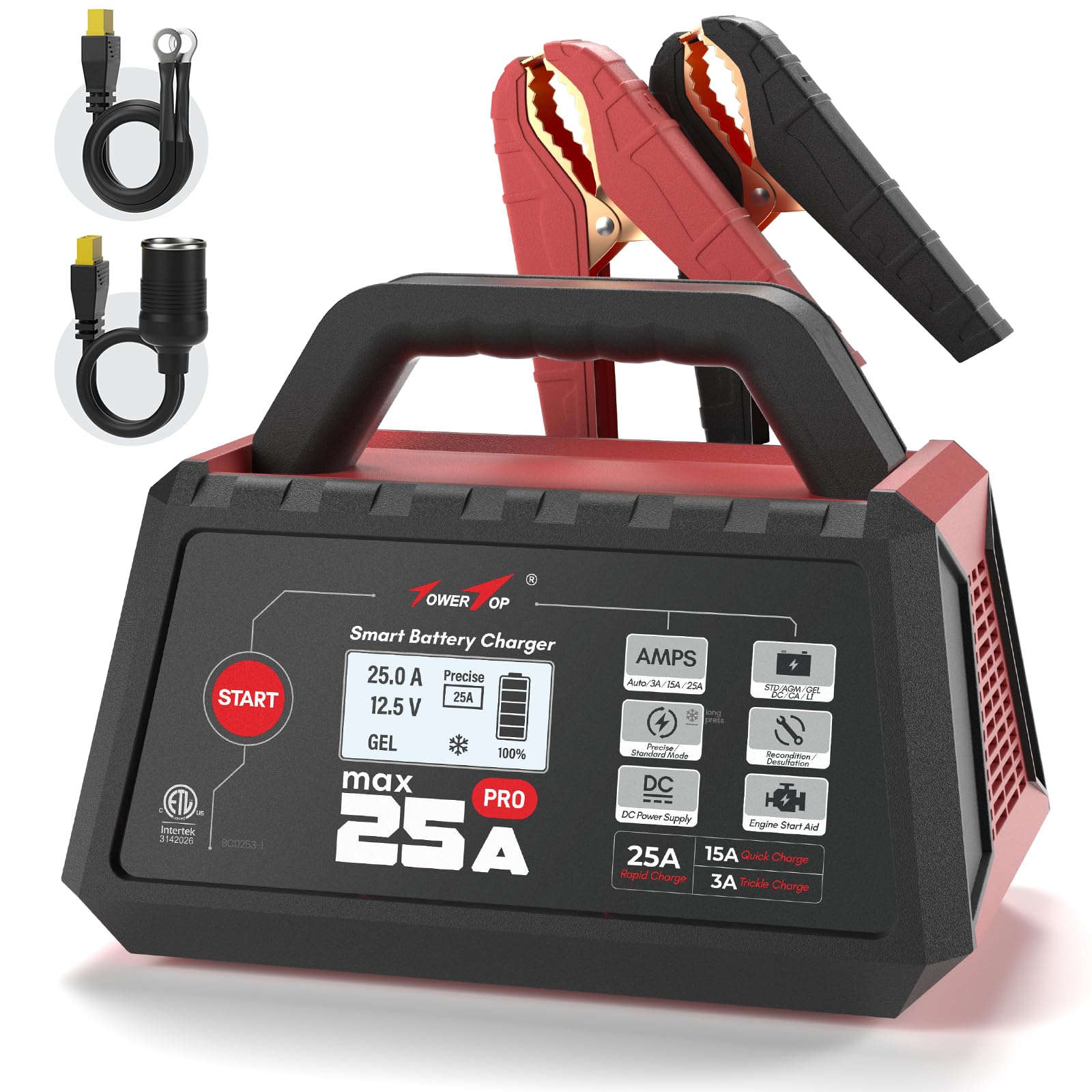
This is the charger you buy when you’re tired of waiting. The TowerTop Max Pro sits in that “home garage meets light workshop” zone: high output, lots of modes, and practical functions that go beyond simply charging a battery. If you do your own maintenance, own multiple vehicles, or have equipment that gets used seasonally, it can feel like a real productivity tool.
The big difference you feel immediately is speed. Higher output means your battery reaches a healthy state faster, which matters if you’re trying to recover from repeated short trips, cold starts, or a battery that has been dragged down by sitting. But speed alone doesn’t make a charger good—control does. That’s why the better experience comes from the “stages” plus the ability to choose modes for AGM, deep cycle, calcium, or lithium profiles.
Where this model becomes genuinely “expert-useful” is the combination of engine start aid and DC power supply mode. Engine start support can help wake up a battery enough to get a vehicle running without needing another car to jump you. DC supply mode is a garage superpower: it gives you a stable 12V supply for certain tasks—think diagnostic work, battery replacement routines, or powering 12V tools that you’d rather not run from a half-dead battery.
Owner feedback tends to repeat the same theme: “This replaced my old bulky charger and made everything easier.” That’s what you want from a high-output unit: not just speed, but clarity and less frustration. The screen helps, especially if you like to see what stage it’s in instead of staring at one mystery LED.
Why it’s a power move
- Fast recovery – Great when you want “charged tonight,” not “charged eventually.”
- Engine start aid – Useful for cold mornings and low-battery situations without relying on another vehicle.
- DC power supply mode – Handy for garage workflows and battery-related maintenance tasks.
- Mode flexibility – Designed to match different lead-acid types and lithium profiles rather than guessing.
Good to know
- Clamp ergonomics can make or break daily happiness; if your battery terminals are awkward, do a “fit check” before you commit to a routine.
- High-output chargers are best used with intention—this is more than a tiny maintainer you toss in a drawer.
- If you only need long-term storage maintenance, a lower-amp maintainer can be simpler and cheaper.
Ideal for: DIYers who want fast charging plus useful workshop functions—and want to actually see what the charger is doing in real time.
4. NOCO GENIUS2X4 – Four Batteries, One Clean Setup

If you have “a garage of stuff,” single chargers become annoying fast. You unplug, rotate, forget, and eventually one battery gets neglected. The GENIUS2X4 solves that problem by changing the workflow: you stop thinking of charging as an event, and start thinking of it as infrastructure.
The real magic isn’t just “four ports.” It’s the fact that each bank is independent. That means you can maintain different batteries at the same time without worrying about interference. One bank can be holding a motorcycle battery at maintenance while another is charging a car battery that dipped low, and you’re not playing a cable-shuffle game every weekend.
Owners who love this unit tend to say the same things: it keeps rarely used vehicles ready, it looks clean and professional mounted in the garage, and the extension cables make routing easier than expected. That routing matters. A multi-bank charger is only convenient if you can run cables neatly without tripping over them or yanking clamps loose when you walk by.
The other “advanced” advantage is that this kind of charger encourages good battery health by removing gaps. Batteries that sit partially discharged for long periods tend to age faster. When you keep everything topped and maintained, you avoid the slow slide into “why does this battery always feel weak?”
Why it’s a garage upgrade
- Four independent banks – Maintain multiple vehicles without rotation schedules.
- Clean routing potential – Extensions and a mountable form factor help create a tidy setup.
- Set-and-forget behavior – Great for classic cars, ATVs, lawn equipment, and seasonal vehicles.
- Confidence recovery features – Designed to handle low-voltage batteries better than basic multi-port units.
Good to know
- This is a “system” product—best when you commit to a mounted, organized setup rather than treating it like a portable gadget.
- For only two vehicles, the 2-bank version can be the smarter buy.
- Each bank is designed for maintenance and smart charging, not high-speed workshop recovery.
Ideal for: anyone maintaining multiple vehicles or batteries at once—especially garages where several things sit more than they drive.
5. NOCO GENIUS2X2 – The “Two Batteries, Zero Drama” Maintainer

Most people don’t need four banks. They need two—because real life usually looks like: one daily driver plus one “other thing” (second car, motorcycle, mower, ATV, boat battery, trailer battery… pick your favorite). The GENIUS2X2 is built exactly for that reality.
What owners consistently like is how it reduces effort. Each bank runs independently, so you can hook up two different batteries and stop thinking about it. If one vehicle sits longer, it still gets cared for. If the other vehicle gets driven more, the charger shifts to what that battery needs. That’s the whole point of smart maintenance: you shouldn’t have to micromanage.
Another underrated detail: the included cable ecosystem and the option to use ring terminals. People who actually love their charger long-term tend to be people who stopped using clamps regularly. Permanent eyelets + quick disconnect turns battery maintenance into a two-second action. And that two seconds is the difference between “I’ll do it later” and “it’s done.”
This model is also a good “quality signal.” It’s built to be left connected. Owners frequently describe it as trustworthy, consistent, and well-made— exactly what you want in a device you might leave on overnight or for long storage stretches.
Why it’s a smart buy
- Perfect scale for most homes – Two batteries maintained simultaneously without complexity.
- Independent banks – Different battery conditions don’t interfere with each other.
- Quick-disconnect friendliness – Easy to turn into a clean, repeatable routine.
- Reliable “set it and forget it” personality – Built for long-term maintenance use.
Good to know
- If you routinely need fast recovery on a large battery, a higher-amp single charger can be quicker.
- For one vehicle only, you can save space with a single-bank GENIUS model or a Battery Tender.
- It shines most when mounted and routed neatly—messy cables reduce the “joy” factor.
Ideal for: two-vehicle households and anyone who wants to eliminate the constant rotation dance of a single charger.
6. PCHH 12V/24V Heavy Duty (0–15A) – The “Truck + Equipment” Garage Workhorse

Most “car battery chargers” quietly assume you live in a 12V-only world. But plenty of garages don’t: trucks, some commercial equipment, certain farm setups, and various machines live in 24V territory—or at least show up in a household eventually. That’s where the PCHH heavy-duty charger becomes useful: it expands what your garage can handle without needing separate tools.
This unit leans into straightforward functionality: connect it, let it detect voltage, and let the automatic program do its thing. Owners who like it often mention how easy it is to understand, how the display makes it clear what’s happening, and how the auto shutoff helps them walk away without anxiety.
The repair and winter modes are the “real life” features here. Winter mode is helpful when cold weather makes batteries feel weak. Repair mode can sometimes revive batteries that are on the edge—especially ones that have sat and become sluggish. It’s not a miracle wand, but it can be the difference between “this battery is toast” and “this battery is usable for another season.”
One surprisingly practical side benefit is the heavy-duty feel. Some people want a charger that feels like it belongs in a barn or workshop: solid, durable, not delicate. This one fits that vibe. If you’re the type of owner who values “built like a tool,” you’ll appreciate it.
Why it belongs in tough garages
- 12V/24V flexibility – Helpful for mixed garages that include trucks or equipment.
- Auto shutoff + maintain mode – Lets you charge safely, then maintain without constant monitoring.
- Repair + winter support – Practical modes for seasonal battery struggles.
- Clear display and simple workflow – Less guessing, more “connect and go.”
Good to know
- Heavier, more “tool-like” units take up more space than compact maintainers.
- If you only ever maintain a single car battery, it may be more machine than you need.
- As with any higher-output tool, stable connections matter—make sure clamps are secure before walking away.
Ideal for: garages with trucks, equipment, or mixed voltage needs—and anyone who prefers a heavy-duty “workshop” charger feel.
7. NOCO GENIUS5 – The Compact Charger That Feels Like a Premium Tool

The GENIUS5 is for people who want something better than a basic maintainer, but don’t necessarily need a 10A powerhouse. It’s a “daily-use sweet spot” charger: compact, well-built, and capable enough that you don’t feel helpless when the battery is genuinely low.
Owners often describe NOCO chargers as “small but serious,” and the GENIUS5 fits that description. The build feels intentional, the clamps are generally sturdy, and the unit is designed to be mounted neatly if you want a clean setup. That matters more than you’d think: chargers that are easy to mount and route tend to get used more often, which is the whole game.
From a practical, expert perspective, the GENIUS5’s real strength is flexibility. It’s happy doing maintenance, but it can also do recovery work overnight without feeling painfully slow. If your vehicle sits a few days at a time, or you have a second vehicle that gets driven occasionally, this model often hits the “no regrets” zone.
One note that comes up repeatedly in owner discussions: learning the button logic. Many smart chargers compress multiple modes into one button, which can feel unintuitive at first. But once you understand your battery type and which mode you live in, it becomes muscle memory. And because the charger remembers settings, daily use becomes simple.
Why it’s so popular
- Balanced 5A output – Strong enough for recovery, still gentle for maintenance.
- Premium feel – Build quality and mounting options make it a “buy once” type tool.
- Great for vehicles that sit – Keeps batteries topped without overthinking it.
- Compact footprint – Easy to store, mount, or keep ready.
Good to know
- Mode selection can feel “button-puzzle” at first—quick learning curve, then easy.
- If you routinely revive big batteries from deep discharge, a higher-amp model can be faster.
- For multi-vehicle maintenance, a multi-bank charger can reduce plug-swapping.
Ideal for: drivers who want a compact, premium-feeling charger that handles both maintenance and recovery without being overkill.
8. Battery Tender 3 Amp Power Tender – Clean, Classic Maintenance for 6V/12V

Battery Tender’s reputation exists for a reason: they make maintainers that are easy to live with. The 3A Power Tender is the model you pick when you want a clean experience—no drama, no overthinking, just a reliable routine that keeps batteries ready. The 6V/12V switchability is also a big win if you maintain a classic car or vintage motorcycle alongside modern vehicles.
In real-life use, this unit shines when you want maintenance that doesn’t demand attention. It’s the “plug it in and forget it” personality done right, with clear LED indicators that tell you what’s happening at a glance. That matters because most people don’t want a charger that requires reading a screen—they want confirmation.
The 3A output is a good middle ground: more pep than tiny 1A units, while still gentle enough for smaller batteries. For mixed garages (car + motorcycle + mower), this is often the “one tool that works for most of the lineup” answer.
If your main use case is deep recovery of large batteries, you’ll appreciate higher-amp chargers. But if your use case is “prevent the problem,” this is exactly the kind of product that gets used for years without giving you a reason to think about it.
Why it’s a safe bet
- Simple, proven maintenance behavior – The whole point is reliability and repeatability.
- 6V/12V versatility – Great for classic vehicles and mixed-battery garages.
- Clear LED status – Easy to understand from across the garage.
- Good “middle output” – Stronger than tiny maintainers without being aggressive.
Good to know
- Not designed as a high-speed workshop charger; it’s a maintainer-first tool.
- If you prefer a screen that shows volts and amps, look at models with LCD readouts.
- Best experience comes from using ring terminals and quick disconnect for repeat use.
Ideal for: anyone who values proven long-term maintenance, owns a mix of 6V/12V vehicles, and wants a low-fuss, high-trust routine.
9. Battery Tender Plus (1.25A) – The Icon for Seasonal Vehicles (Because It Just Works)

Some products don’t need hype because they’ve become the default recommendation for a reason. The Battery Tender Plus is one of those. It’s built for the exact problem seasonal owners face: a battery that slowly drains while the vehicle sits—then surprises you the moment you want a ride.
This is not the charger you buy because you want speed. It’s the charger you buy because you want consistency. You connect it, it brings the battery up, then it holds it at a healthy level without overcooking it. That “float mode” behavior is the difference between a battery that stays ready and a battery that slowly ages in storage.
Owners who love Battery Tender units often mention longevity—these are the kind of devices that live in garages for years. They also praise the convenience of the quick disconnect harness. If you’ve never used ring terminals and a quick disconnect, this is your “aha” moment: instead of wrestling clamps every time, you just plug in a connector. It’s so easy that you actually do it.
For motorcycles, ATVs, boats, and seasonal cars, it’s hard to beat a maintainer that’s been trusted for this exact job for a long time. If your vehicle sits more than it drives, this is a quiet hero.
Why it’s a storage legend
- Designed for long-term connection – The core job is safe maintenance, not flashy features.
- Simple and dependable – You don’t need a degree to use it correctly.
- Quick disconnect harness – Makes consistent maintenance effortless.
- Great for small batteries – Motorcycles and powersports love this style of charger.
Good to know
- Recovery is slower than higher-amp chargers; patience is part of the deal.
- Best for maintaining and topping off, not for “I need this fully recovered in two hours.”
- Primarily 12V; if you need 6V support, choose the 6V/12V switchable model.
Ideal for: seasonal vehicles and anyone who wants a proven, low-drama maintainer that stays connected and quietly keeps batteries healthy.
10. LOKITHOR JC400 – The “One Box” Answer for Jump-Starts + Battery Care
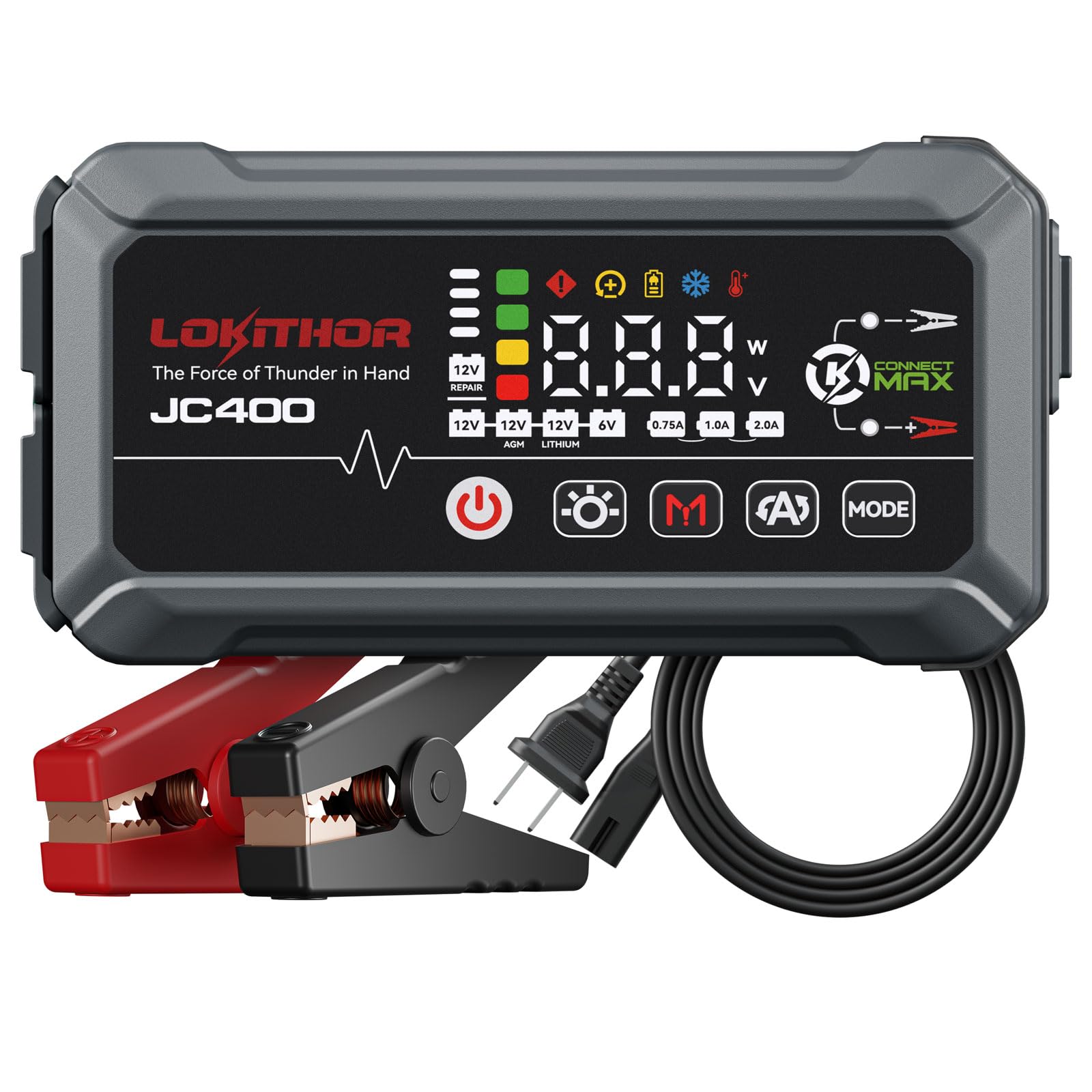
Most jump starters are single-purpose: they give you a burst, then you hope the alternator does the rest. The JC400’s appeal is that it tries to solve the whole problem: not just “start the car,” but “get the battery back to a state where the car stays started.” That matters a lot for modern vehicles and for batteries that are so weak they can’t sustain the engine after the initial boost.
Owners who had deeply discharged AGM batteries often describe this as a “battery rescuer” because it can be plugged into the wall to build and deliver charging behavior, not just a quick jump. That wall-powered support is the feature that changes outcomes in real emergencies: instead of calling a tow, you can sometimes give a depleted battery enough life to accept a proper charge.
The other benefit is obvious: it’s compact enough to live in the vehicle, and it brings extra utility (USB power, LED lights, multiple modes). If you want a glovebox-style safety net that also does slow maintenance at home, this is one of the more thoughtful all-in-one designs.
The trade-off is that you’re buying a multi-tool. A dedicated smart charger can offer more refined long-term maintaining behavior, and a dedicated heavy-duty charger can be faster for workshop recovery. But if your priority is “one box that covers emergencies and basic charging,” this makes a lot of sense.
Why it’s uniquely useful
- Jump starter + charger in one – Handles both “start now” and “recover after.”
- Portable and car-friendly – Small enough to store without taking over your trunk.
- Versatile output options – Different low-amp charging choices for maintain/topping routines.
- Extra utility – Power bank and lights make it a real roadside tool.
Good to know
- As a multi-tool, it’s not as specialized as a dedicated maintainer for long storage.
- Clamp connection quality matters; ensure good terminal contact for best results.
- For multiple vehicles at home, a multi-bank maintainer can be more convenient.
Ideal for: drivers who want one compact emergency tool that also supports wall-powered battery charging and maintenance routines.
11. YONHAN 20A 12V/24V – High Output on a Budget (With a Surprisingly Useful Repair Mode)

If you want faster charging without paying premium-brand pricing, this is where the YONHAN 20A tends to land. It’s positioned as a “do everything” charger for cars, trucks, and equipment—especially for people who need recovery more than they need museum-grade polish. And for many owners, that’s the perfect trade: practical power, clear display, and modes that cover the basics.
The feature that earns real praise is repair mode. When a battery is old or has been sitting, repair cycles can sometimes help it accept charge more effectively. It won’t fix a physically damaged battery, but it can nudge borderline batteries back into usable territory. Owners who use it on multiple batteries often describe it as a “before you replace it” step—especially helpful when you’re dealing with several vehicles and don’t want to buy batteries unnecessarily.
The winter mode is also practical. Cold weather changes how batteries behave, and a charger that adapts can make winter starts feel less stressful. Combine that with a bright screen that shows charge status, and you get a tool that feels more informative than most budget chargers.
The one thing to understand is the “value charger” personality: it packs features, but you should still treat setup as important. Make sure you choose the right mode for your battery type, and make sure the clamps are secure. A charger can only be as good as its connection.
Why it’s a value standout
- High output – Helpful for faster recovery on larger batteries.
- 12V/24V flexibility – Useful in mixed garages and equipment households.
- Repair + winter modes – Practical extras that owners actually use.
- Clear LCD feedback – Shows what’s happening instead of guessing from one light.
Good to know
- Budget chargers can vary in clamp feel and cable quality; handle connections with care.
- Repair modes help some batteries, not all—use it as a “try before replace” tool, not a guarantee.
- If you need a charger designed for permanent long-term connection, prioritize maintainer-first models.
Ideal for: shoppers who want higher output and useful modes without spending premium-brand money—especially for vehicles that need recovery more than gentle storage maintenance.
12. DEWALT DXAEC2 (2A) – The Simple Maintainer That Fits Small Garages

Not every garage needs a feature-packed smart charger. Some garages need one job done consistently: keep a battery topped off so the car starts when it’s been sitting. That’s the lane the DEWALT DXAEC2 sits in—basic, approachable, and easy to hang in a tight space.
The hanging hook is more useful than it sounds. In small garages, floor space is precious, and chargers that can be mounted or hung tend to get used more. That’s the hidden benefit: ease of storage leads to consistency, and consistency is what keeps batteries healthy.
Owners often describe this as a “float maintainer” style unit—meaning it keeps batteries near full charge and cycles as needed. For people maintaining a car battery through winter or keeping a backup vehicle ready, that’s often all they want. It’s also compatible with 6V and 12V systems, which can be helpful for classic owners who want one simple unit for multiple jobs.
This isn’t a high-output recovery tool, so don’t buy it for “save a deeply discharged battery quickly.” Buy it for “prevent the battery from getting deeply discharged in the first place.” When used that way, it’s a clean, low-fuss addition to a small garage.
Why it’s practical
- Simple maintenance behavior – Great for keeping batteries topped during storage.
- Wall-hang convenience – A real advantage in tight or busy garage spaces.
- 6V/12V compatibility – Useful if you maintain classic vehicles or varied equipment.
- Easy to operate – Little learning curve; connect, select, and go.
Good to know
- Not a fast charger; recovery from deep discharge takes time.
- If your battery repeatedly drops very low, consider stepping up to a stronger smart charger.
- Clamps on basic maintainers vary—ring terminals can make the setup more secure long-term.
Ideal for: simple maintenance needs, small garages, and owners who want an easy wall-hang unit to keep a car battery topped off during storage.
13. NOCO GENIUS2 – Small, Smart, and Surprisingly Capable (If You’re Patient)

The GENIUS2 is the classic “smart maintainer with brains” in a small output class. If your main goal is to keep a healthy battery healthy—especially on vehicles that sit—this can be a great tool. Just go in with the correct expectation: it’s not a fast charger, it’s a careful charger.
Where it impresses is in the smart behavior: it’s designed to monitor and adjust rather than blindly push current. That can help keep batteries from quietly drifting into a weak state. Owners who use it on generators, lawn equipment, and secondary vehicles often praise the simplicity: connect, choose the mode, and let it do its job.
The more nuanced reality is low-voltage recovery. When a battery drops extremely low, small chargers can struggle to detect or begin charging. Some owners have success after jump-starting a battery up to a detectable level, then letting the charger finish the job. If you regularly deal with batteries that are deeply discharged, stepping up to a stronger unit (GENIUS5/10) can feel dramatically easier.
But for the right use—maintenance and gentle topping—the GENIUS2 is a tidy, well-built, easy-to-store option that can support a good battery routine.
Why it’s a great “small smart”
- Compact and easy to store – Great for small garages and limited space.
- Smart maintenance behavior – Designed to keep batteries topped without overcharging.
- Good fit for smaller batteries – Generators, mowers, motorcycles, and secondary vehicles.
- Simple indicators – Easy to understand without a complex interface.
Good to know
- Recovery is slow; patience is required for car batteries from low states.
- Very low-voltage batteries may require a “get it detectable” step first.
- If you want faster results, the GENIUS5/10 is the natural upgrade path.
Ideal for: owners who prioritize compact storage and smart maintenance—especially for smaller batteries or vehicles that mostly sit and only need gentle topping off.
14. NOCO GENIUS1 – The Tiny “Always Ready” Maintainer for Storage Seasons

The GENIUS1 is for maintenance minimalists. It’s tiny, lightweight, and designed to keep small batteries healthy during storage: lawn tractors in the off-season, motorcycles that sit, backup vehicles that don’t get driven enough to keep the battery happy. If you want a simple “plug it in and walk away” maintainer, this is the smallest version of that idea.
The big advantage is lifestyle: because it’s small and easy to set up, you actually use it. That matters more than anything. Batteries die slowly when vehicles sit—especially if they have small parasitic draws (clocks, alarms, modules). A maintainer that gets used consistently is better than a fancy charger that sits on a shelf.
Just understand the boundary: 1A means it’s not designed for fast recovery. If your car battery is deeply discharged, it can take a long time, and some extremely low-voltage scenarios may require a higher-output charger to revive more reliably. But if your goal is “keep it topped,” it does that job well.
This is also a great “one-per-battery” strategy unit. If you have multiple small machines, sometimes the simplest approach is giving each a dedicated maintainer. That way nothing gets neglected.
Why people love it
- Ultra-compact and easy – Simple storage and simple setup.
- Perfect for maintenance – Ideal for seasonal storage and preventing discharge drift.
- Works well with quick-connect setups – Makes the routine effortless.
- Great for small machines – Lawn equipment, motorcycles, generators, and backups.
Good to know
- Not a fast charger; patience required for larger batteries.
- Very low-voltage batteries may need a stronger charger to begin recovery.
- If you want “one charger for everything,” step up to GENIUS5 or GENIUS10.
Ideal for: long-term maintenance of small or lightly-used batteries where convenience and consistent use matter more than speed.
How Smart Battery Charging Actually Works (and Why “Stages” Matter)
Most charger confusion comes from one misunderstanding: a battery isn’t a bucket you fill once. A modern charger is trying to do three different jobs: recover a battery safely, finish the charge without damaging it, and then maintain it without cooking it. That’s why “smart” chargers talk about stages.
What multi-stage charging is really doing
- Soft start / diagnosis: The charger checks what it’s connected to and begins gently if the battery is stressed.
- Bulk charging: This is the main “refill” phase—where higher amperage chargers save you the most time.
- Absorption / top-off: The charger finishes carefully so you don’t overheat or overpush the battery.
- Analyze: Some chargers check whether the battery is holding charge as expected.
- Float / maintenance: The charger holds the battery at a healthy level and resumes charging if voltage drops.
- Pulse maintenance: Some chargers use pulses to keep the battery conditioned without constant charging.
This is why many owners report “stronger starts” after using a quality charger consistently: the battery is not just charged, it’s kept in a healthier state of readiness.
The three features that change real-world outcomes
- Temperature awareness: A charger that adapts to cold or heat tends to behave more consistently across seasons.
- Low-voltage recovery logic: Batteries that sit too long can drop so low a charger can’t “see” them. Better chargers handle that situation more gracefully.
- Good connection hardware: No charger works well with a poor clamp bite. This is why ring terminals and quick disconnects can transform the experience.
A final mindset shift: the charger you love isn’t necessarily the one with the most modes. It’s the one that makes your routine easy enough that you actually keep your batteries cared for.
FAQ: Battery Trickle Chargers, Maintainers, and Real Garage Questions
Can I leave a smart maintainer connected all the time?
What’s the difference between “trickle charge” and “maintain” mode?
How many amps do I actually need?
I have an AGM battery. Do I need a special charger?
What about lithium (LiFePO4)?
Will “repair/desulfation” modes fix a bad battery?
Should I use clamps or ring terminals?
Final Thoughts: Picking the Best Car Trickle Charger Once (and Being Done)
The perfect charger isn’t the one with the most buttons. It’s the one that makes battery care feel effortless—so you actually do it. When you remove the friction, you remove the dead-battery surprises.
Here’s the simplest way to turn this guide into the right purchase:
- Want the most capable “one and done” charger? Start with the NOCO GENIUS10. It’s the best blend of recovery ability, maintenance intelligence, and long-term satisfaction for most households.
- Live in a truly cold climate? Choose the CTEK MUS 4.3 Polar for an extreme-cold-friendly approach and a charger that’s designed to stay consistent when winter is harsh.
- Want workshop speed and extra functions? Grab the TowerTop 25A Max Pro for fast recovery, engine start aid, and DC supply mode that makes garage work smoother.
- Maintaining multiple batteries all year? The NOCO GENIUS2X4 (or the GENIUS2X2) lets you stop rotating chargers and start treating maintenance like a clean system.
- Need 24V support for trucks or equipment? Look at the PCHH 12V/24V Heavy Duty Charger for mixed-garage flexibility and practical modes.
- Want simple, trusted maintenance (including 6V vehicles)? Choose the Battery Tender 3 Amp Power Tender for a clean, classic workflow.
- Mostly seasonal storage for smaller batteries? The Battery Tender Plus or the NOCO GENIUS1 can keep things ready with minimal effort.
- Want one emergency tool that also charges at home? The LOKITHOR JC400 is a practical all-in-one for people who want both jump-start and charging support.
Pick the tool that matches your life: how often you drive, how cold your winters are, and whether you maintain one battery or a whole garage. Get that right, and your best car trickle charger stops being a purchase—and starts being a quiet upgrade to your peace of mind.