
Our readers keep the lights on and the garage heater humming. As an Amazon Associate, I earn from qualifying purchases.
Upgrading door speakers looks simple on paper: remove panel, swap speaker, done. In real life? It’s a chain of tiny decisions that determine whether your car suddenly sounds expensive… or just “a little different.”
If you’re searching for the best 6.5″ car speakers (yes—exactly that phrase), you’re usually trying to solve one of these problems: (1) your factory speakers are blown or tired, (2) your music feels flat and harsh at the same time, or (3) you want real mid-bass punch without turning your trunk into an audio lab.
Most buying guides fail because they treat speakers like numbers: max watts, frequency response, “4-way must be better,” and a pile of bullet points that don’t help you make the one decision that matters—which speaker will actually sound right in your car, with your power, at your volume. A 6.5″ coaxial speaker is not a “portable Bluetooth speaker.” It’s a driver bolted into a thin, rattly door, powered by a head unit that may be underpowered, wired with factory-thin cable, and asked to compete with road noise that changes at every speed.
This guide is built differently. Instead of doing the “AI fluff tour,” we’re going to talk like people who actually care about sound: what each model tends to do well, what it can’t do, how it behaves on factory power vs. a real amplifier, and what each listing actually publishes—RMS and peak power, sensitivity, impedance, frequency response, mounting depth, and what comes in the box.
Below you’ll find 14 strong picks (no duplicates, no filler): mainstream coaxials that are genuinely satisfying on factory power, better-built budget options that punch above their class, and a few pro-audio style monsters (Orion / DS18 / Pioneer P.R.O.) for the “make it loud and clear” crowd. If you read this start to finish, you’ll know exactly which one to buy—and why.
In this article
- How to choose the right speaker for your car, your power, and your sound taste.
- Quick comparison table of 14 standout models.
- In-depth reviews of each speaker, with pros and cons.
- The real upgrade formula: install, sealing, tuning, and why doors matter.
- FAQ + final buying tips to lock in the right choice.
How to Choose the Best 6.5″ Car Speakers for Your Build
A 6.5″ speaker upgrade can be tiny (a quick replacement) or transformational (you rediscover your favorite playlists). The difference usually comes down to five decisions: system goal, power plan, door fit, sound profile, and install quality. Here’s the real framework that avoids regret.
1. Start with your “power truth” (factory head unit vs amplifier)
Be honest: are you running factory power for the next year, or are you adding a 4-channel amp soon? This one answer decides everything.
- If you’re staying on factory power: prioritize efficiency (sensitivity) and smart impedance choices. Speakers like JBL’s 3-ohm designs can feel “louder per watt” and more alive without an amp.
- If you’re adding an amp or already have one: you can choose speakers that trade sensitivity for control, mid-bass authority, and lower distortion at higher volume (CT Sounds Meso is a great example).
- If you’re building for loud & clear SPL style: you may not even want “normal coaxials.” Pro midrange and hybrid compression designs (Orion, DS18, Pioneer P.R.O.) live in a different world—amazing output, but they demand a crossover plan.
2. Decide your sound goal (not your brand)
“I want good bass” usually turns out to mean one of three different things:
- Mid-bass punch: kick drums and bass guitar feel physical up front. This is door-speaker territory, and it’s heavily influenced by door sealing and speaker cone control.
- Sub-bass: the deep low stuff you feel more than hear. If you truly want this, you’ll eventually want a subwoofer—no 6.5″ coaxial can cheat physics.
- Fullness and warmth: vocals sound less thin, cymbals stop stabbing your ears, and the system feels “bigger” at normal volume.
Pick the speaker that matches your goal. A “bright” speaker can sound exciting for 10 minutes and fatiguing for 40. A “warm” speaker can feel smooth for hours but may need a touch of EQ to bring out sparkle. Neither is “better”—it’s preference and install execution.
3. Understand coaxial vs pro midrange vs mid-bass drivers
A lot of confusion comes from mixing categories:
- Coaxial full-range speakers: the simplest upgrade. Woofer + tweeter in one unit. Great for doors, most factory swaps, and most people.
- 3-way/4-way coaxials: more drivers in the same footprint. This can increase perceived detail, but it can also make tuning trickier (more “stuff” to integrate), and placement still matters.
- Pro midrange / bullet speakers: designed to stay clean at higher volume and project sound. Amazing clarity and output, but they often need a high-pass filter and usually aren’t meant to be your only source of treble unless designed as a hybrid.
- Mid-bass drivers (P.R.O. style): built to slam the midrange/mid-bass region with authority. They’re not “complete” without tweeters and crossovers.
4. Fit matters more than you think (depth, cutout, and basket width)
The #1 surprise failure is not “bad sound”—it’s “doesn’t fit.” Door speakers can hit window tracks, interior panel bracing, or factory plastic mounts. Before you buy, check:
- Mounting depth: shallow doors need shallow baskets. JVC publishes a 1-23/32″ top-mount depth for the CS-J620; DS18 publishes a 2.77″ mounting depth for the PRO-HY6.4MSL despite the “shallow” in its name.
- Cutout diameter: some speakers have larger frames that need minor trimming or adapters.
- Connector style: harness adapters keep the swap clean and reversible, and they reduce install time dramatically.
- Grilles and panel clearance: included grilles are great—unless your factory panel already has its own grille and there’s no clearance for the included one.
5. The “door as an enclosure” rule (why some upgrades disappoint)
A car door is a leaky, vibrating enclosure. If you bolt in a great speaker and leave the door untreated, you’re asking the speaker to perform with one hand tied behind its basket.
- Sealing improves mid-bass: foam rings, baffles used correctly, and sealing the speaker to the door can make bass feel tighter and louder.
- Deadening reduces distortion you can hear: rattles and panel resonance mask detail, making you think the speaker is “harsh” or “thin.”
- High-pass filtering protects clarity: most door speakers clean up dramatically when you filter low bass away, and the pro drivers here publish their own crossover points—DS18 recommends 140Hz for the PRO-HY6.4MSL, PRV 145Hz for the 6MR400-4.
Quick Comparison: 14 Best 6.5″ Car Speakers Picks (Real-World Order)
Use this table to spot the models that match your goal, then jump to the full reviews for the published numbers— power handling, sensitivity, impedance, frequency response, and mounting depth.
On smaller screens, swipe or scroll sideways to see the full table.
| Model | Speaker style | Sound strength | Best match | Amazon |
|---|---|---|---|---|
| JBL GTO629 Premium 6.5″ Coaxial (Pair) | Coaxial 2‑way | Factory-power loudness + punchy mid-bass with adjustable “bite” up top | Most drivers who want a big upgrade without adding an amp | Amazon |
| Alpine S2-S65 S‑Series 6.5″ Coaxial (Pair) | Coaxial 2‑way | Hi‑Res detail + controlled highs when installed and tuned properly | Listeners who want clean, refined clarity (amp optional, but helpful) | Amazon |
| Rockford Fosgate Punch P1650 6.5″ (Pair) | Coaxial 2‑way | Classic “punch” feel + strong separation when EQ’d correctly | Drivers who want satisfying impact and clear vocals without going full custom | Amazon |
| CT Sounds Meso 6.5″ Coaxial (Pair) | Coaxial 2‑way | Strong mid-bass authority + “you hear details you missed” energy | Enthusiasts who will tune (or run a DSP) and want power handling headroom | Amazon |
| Pioneer A‑Series Plus TS‑A1681F 6.5″ (Pair) | Coaxial 4‑way | Easy upgrade path + crisp “wake up the system” sparkle | Factory replacement shoppers who want install flexibility and lively sound | Amazon |
| KICKER DSC650 6.5″ Coaxial (Pair) | Coaxial 2‑way | Fun, energetic highs + strong “loud for the effort” feel | Drivers who like a lively top end and want a quick, noticeable swap | Amazon |
| Rockford Fosgate Prime R165X3 6.5″ (Pair) | Coaxial 3‑way | Reliable clarity + good “restore the sound” upgrade for worn factory speakers | Drivers who want a trusted brand replacement that’s easy to live with | Amazon |
| DS18 PRO‑HY6.4MSL 6.5″ Hybrid Shallow (Single) | Hybrid pro | Extreme loud + clear projection, 150W RMS with a high-intensity driver built in | Motorcycles/ATV/UTV and “loud & clear” builds with crossover discipline | Amazon |
| Pioneer P.R.O. TS‑M651PRO 6.5″ (Pair) | Mid‑bass driver | Competition-style mid-bass output + high efficiency “project” sound | Open-show/SPL builds (use with tweeters + proper crossovers) | Amazon |
| PRV Audio 6MR400-4 Bullet 6.5″ Midrange (Pair) | Pro midrange | 400W program power with an aluminium bullet phase plug | Very loud builds that prioritize mids/highs (and have a real amp) | Amazon |
| ORION Cobalt CM654 6.5″ Bullet Midrange (Pair) | Pro midrange | Loud, clean mids at a rated 96.67 dB efficiency (space required) | Budget SPL-style builds needing strong vocal presence | Amazon |
| Skar Audio TX65 6.5″ Elite Coaxial (Pair) | Coaxial 2‑way | Great materials for the cost + amp-friendly potential | Value hunters who still care about build quality (amp recommended) | Amazon |
| ORION Cobalt CB653 6.5″ 3‑Way Coaxial (Pair) | Coaxial 3‑way | Easy install + loud for the cost (rear fill favorite in some cars) | Drivers who need a simple replacement and want “more sound” fast | Amazon |
| JVC CS‑J620 6.5″ Coaxial (Pair) | Budget coax | Shallow, clean, and surprisingly clear for a basic factory fix | Older cars with blown speakers or tight depth limits | Amazon |
In‑Depth Reviews: 14 Best 6.5″ Car Speakers That Deliver in Real Cars
Now we go model by model. I’m not going to talk like a spec sheet. I’m going to talk like someone who wants you to love what you buy: how each speaker tends to “voice” your music, what install details affect the result, what the listing actually publishes, and what you should know before you commit.
1. JBL GTO629 – The “Factory Power Hero” That Still Sounds Legit Later

If you want a speaker that makes a factory system feel more alive without turning your install into a science project, the JBL GTO629 is a fantastic “start here” answer. This model has a very specific personality: it’s designed to extract more usable output from typical factory wiring and head units, and it tends to deliver a “bigger” presentation than many same-size coaxials—especially at normal driving volume where most people live.
The not-so-obvious reason it works so well is impedance. JBL builds the GTO629 as a three-ohm speaker specifically to compensate for the undersized wiring found in many cars and, in JBL’s words, “make the most of every watt your car stereo can deliver.” Combine that with the carbon-injected Plus One cone—which JBL says is larger than others in its size class, so it moves more air—and you get something that can feel louder and fuller straight after install, with no amplifier in the chain.
Sound-wise, think “energetic with control.” The midrange has a forward, engaging presence (vocals and guitars feel closer), and the upper frequencies are detailed and crisp—sometimes too crisp if your door placement aims the tweeter straight at your shins and your head unit has treble boosted. JBL anticipated this: the tweeter level adjustment is not a gimmick. The listing describes a dual-level tweeter volume adjustment, plus a patented UniPivot tweeter you can physically aim at your ears—both there to compensate for speakers mounted low in a door.
Here’s the expert move that makes these sound expensive: treat the door like part of the system. Use foam rings or proper sealing between speaker and door panel, and address basic door rattle (even minimal deadening helps). The GTO629 can produce mid-bass that exposes weak doors. That’s not the speaker “being bad”—that’s the speaker finally being strong enough to reveal what the door is doing. Check the published fit numbers first: 5-1/16″ cutout diameter, 2″ mounting depth, 6-1/4″ external diameter. Amazon shows 4.5 stars across 657 ratings, and JBL lists a 1-year manufacturer warranty.
Why you’ll like it
- Low-impedance three-ohm design – JBL’s stated aim is to compensate for undersized factory wiring and make the most of every watt the head unit sends.
- Adjustable top-end – Tweeter level control helps you tune “sparkle” to your ears and your car’s placement realities.
- Punchy, responsive mid-bass – When doors are sealed properly, kick drums and bass guitar feel more physical.
- Great long-term value – Still holds its own if you add a small amp later (you’re not “stuck” with a factory-only speaker).
Good to know
- That three-ohm impedance is a factory-power advantage, but check that any amplifier you add is rated to drive a 3-ohm load.
- These speakers are honest—bad recordings sound bad, and rattly doors will rattle. Treat the door and you’ll love the result.
- If you prefer a softer, warmer treble signature, Alpine may be a better match.
Ideal for: most drivers who want a confident “wow” upgrade on factory power, with enough headroom to still make sense if an amp is added later.
2. Alpine S2‑S65 – The Clean, Controlled “Hear Everything” Upgrade

Alpine’s S‑Series exists for people who don’t just want “louder.” They want cleaner. The S2‑S65 is the kind of speaker that makes you notice the small stuff: vocal texture, room reverb in live recordings, the separation between cymbal hits and guitar harmonics—details that factory speakers often smear together. If your current system sounds like everything is fighting for the same tiny space, this is a strong fix.
The “Alpine sound” here is generally balanced with a slightly refined top end. You get crisp highs, but the character is often less “sharp” than very bright budget coaxials. That makes it easier to listen for long drives—especially at highway speed where your ears naturally fatigue faster. Alpine’s published numbers line up with that brief: Hi-Res Audio certification out to 40kHz, a 70Hz–40kHz response, 88dB sensitivity, and a poly propylene, glass fiber and mica cone blend that Alpine says is chosen for high output with low distortion.
There’s a hidden nuance with detail-focused speakers: they can make your power limitations obvious. On a weak factory head unit, they may sound “nice but not dramatic” until you clean up the install and do basic tuning (even simple EQ and high-pass filtering). On a small amp, they often wake up and show why Alpine has a loyal following: better control, less strain at volume, and a soundstage that stays composed when the music gets busy.
A smart pairing strategy: if you run a subwoofer (even a modest one), the S2‑S65 becomes more impressive, because the coaxials don’t have to fight deep bass. Set a high-pass filter, let the sub do sub duties, and the Alpines focus on what they do best—clean mids and highs without stress. Alpine rates the set at 80W RMS and 240W peak with 1″ tweeters, and lists a 2.3125″ mounting depth.
Why it stands out
- Clarity-first tuning – Great for vocals, acoustic music, and “busy” mixes where stock speakers turn into mush.
- Less fatiguing top end – Detailed without feeling like an ice pick (especially when EQ’d properly).
- Plays well with a sub – High-pass these and let a sub handle lows for a very “grown-up” sound.
- Backed for a year – Alpine lists a 1-year manufacturer warranty, and the set sits at 4.6 stars across 162 Amazon ratings.
Good to know
- Rated at 80W RMS, so on weak factory power the gain is more about clarity than raw loudness; the headroom shows up with an amp.
- If you want the most “in-your-face” output without an amp, JBL’s low-impedance approach can feel more immediately dramatic.
- No grille in the box—Alpine sells the matching KTE-S65G grille separately.
Ideal for: drivers who care about clean detail, smoother long-drive listening, and a speaker that scales nicely if an amp or sub is added later.
3. Rockford Fosgate Punch P1650 – The Thump-Bump Upgrade That Stays Clean

“Punch” is not a marketing word for Rockford Fosgate—it’s basically their identity. The P1650 is built for drivers who want their music to feel alive and physical without needing a full custom system. Rockford rates the pair at 55 watts RMS and 110 watts peak into 4 ohms, over a 45Hz–20kHz response, with a PEI dome tweeter the company credits for accurate frequency reproduction and high volume output.
This speaker tends to reward good gain structure and sensible crossover settings. If you blast a coaxial full-range with deep bass at high volume, you’ll make any speaker sound strained. But if you set a proper high-pass (or use your head unit’s filter) and let the door speaker focus on mid-bass up, the P1650 can sound surprisingly composed and “bigger” than you expect. It’s the kind of speaker that makes you think, “I don’t need to upgrade again,” because it gives you the emotional part of the upgrade—impact and clarity—without forcing you into an expensive ecosystem.
Installation is one of the P1650’s quiet wins. Rockford calls the basket FlexFit2: a slot-mounted frame pattern that allows small adjustments so the speaker lines up with OEM mounting holes. The crossover is hidden inside the basket—Rockford’s Integrated Concealed Crossover—so there is no outboard box to mount, and grilles plus mounting hardware are included. Measure first: Rockford lists a 5.51″ mounting diameter and a 2.24″ mounting depth.
If you’re the kind of listener who turns it up and wants it to stay clean, consider pairing these with even a modest 4-channel amp later. That’s where Rockford shines: the speaker doesn’t just get louder—it gets more controlled. Cymbals become less splashy, vocals become more stable, and mid-bass hits feel tighter. The pair sits at 4.6 stars across 9,476 Amazon ratings, with a full 1-year Rockford Fosgate warranty.
Why people love it
- Impactful, satisfying sound – Great for rock, hip-hop, and anything where you want the beat to feel physical.
- Stays composed with basic filtering – High-pass these and they clean up dramatically.
- FlexFit2 basket – Rockford’s slot-mounted frame pattern allows variable adjustment of the mounting position to line up with OEM holes.
- Scales with upgrades – Works well now, gets better later with an amp and better door treatment.
Good to know
- No 6.5″ coaxial replaces a subwoofer for true sub-bass; these are about punch, not trunk-shaking lows.
- If you’re sensitive to bright treble, you’ll want to EQ and avoid boosting highs aggressively.
- Door treatment matters—these can expose door resonance and rattles.
Ideal for: drivers who want a punchy, energetic upgrade that still sounds clean when turned up—especially strong if you’ll add an amp later.
4. CT Sounds Meso 6.5 – The “Beefy Mid‑Bass” Coaxial for Enthusiasts

CT Sounds has a reputation for delivering “serious sound for the money,” and the Meso coaxials are a perfect example. These are not timid, polite speakers. They’re built to handle power and produce mid-bass that feels confident—especially when you give them a proper signal and don’t ask them to play sub-bass they were never meant to reproduce.
The spec sheet backs the attitude: CT Sounds rates each speaker at 75W RMS and 150W max, or 150W RMS and 300W max for the set, into 4 ohms. The cone is fiberglass with a nitrile butadiene rubber surround, and the attached silk-dome tweeter runs a CCAW voice coil on a neodymium magnet. That is a heavier-duty recipe than most factory-replacement coaxials use, which is why these are aimed at people who intend to feed them real power— provided you install and tune it correctly.
Here’s the expert truth: the Meso can sound a bit aggressive if you run it hot at high volume with no EQ plan. This isn’t unique to CT Sounds—any speaker with a forward presentation can do this in a reflective cabin. The fix is not “return the speakers.” The fix is tuning: set a sensible high-pass, smooth the treble region on your EQ (even a few dB matters), and make sure you’re not clipping your head unit or amp gain. When you do that, the same speaker often transforms from “a little sharp” into “clean, loud, and addictive.”
This is also a great model for people who plan to grow their system. With a DSP, the Meso becomes a “tune it into whatever you want” tool: warm and full for long drives, or bright and cutting for high-energy listening. And if you’re already running a subwoofer, this speaker can be the perfect front-stage partner because it doesn’t need to fake deep bass—it can focus on mid-bass and clarity. CT Sounds ships the pair with signature grilles plus premium wire and screws, and lists a 1-year warranty; the set sits at 4.5 stars across 432 Amazon ratings.
Why enthusiasts pick it
- Mid-bass authority – A strong choice when you want the front stage to feel physical, not just “audible.”
- Built to take power – Great if you have (or plan to add) a real amp and want headroom.
- Silk-dome tweeters – Attached silk domes on a CCAW voice coil and a neodymium magnet, per CT Sounds’ own spec.
- Upgradeable personality – With a DSP/EQ plan, you can shape these to your taste.
Good to know
- The Amazon listing publishes no sensitivity, frequency response or mounting depth—measure your door and check CT Sounds’ own spec sheet before ordering.
- Door sealing matters more here—leaks and rattles will steal the mid-bass you’re paying for.
- If you want “easy, plug-and-play perfection on factory power,” JBL or Pioneer may feel simpler.
Ideal for: enthusiasts who want a strong mid-bass coaxial and are willing to do basic tuning (or already run an amp/DSP) to unlock the best sound.
5. Pioneer A‑Series Plus TS‑A1681F – The “Everything in the Box” Upgrade

If you want an upgrade that feels like it was built for real people doing real installs, the TS‑A1681F is a smart pick. Pioneer clearly understands a common pain point: many “fits your car” speakers still need adapters, mounting tweaks, and hardware runs. This one ships with 6-1/2″ multi-fit installation adapters, tweeter mounts for surface and flush mounting, adapters for OE tweeter locations, and an in-line crossover network, so there is no outboard module to find a home for.
Sound-wise, A‑Series Plus is usually about “wake it up.” You’ll hear clearer treble detail than tired factory speakers, and vocals tend to step forward instead of hiding behind road noise. The 4‑way layout can create a sense of extra sparkle and “air” on top; Pioneer publishes a 35Hz–29kHz response and a 91dB sensitivity rating, which is a large part of why this one can feel lively on a modest head unit. If you listen to pop, modern hip-hop, EDM, or anything with bright production, these can bring excitement back.
The important nuance: more drivers does not automatically mean “better.” A 4‑way can also become too bright if your head unit’s EQ is already boosted or if your door placement is naturally harsh. The fix is simple: set treble flat first, listen for 2–3 days, then adjust. Many people do the opposite (crank treble on day one) and blame the speaker for “harshness” that is actually just an EQ stack-up.
Another “expert-level” tip for this model: if you don’t have a subwoofer, focus on sealing the speaker to the door and reducing door leaks. That’s how you preserve whatever mid-bass your door can provide. If you do have a sub, you can high-pass these and let them shine in the midrange and highs where they’re most impressive. The pair sits at 4.6 stars across 340 Amazon ratings.
Why it’s a great factory upgrade
- Install flexibility – Multi-fit hardware reduces “surprise trips” for adapters and makes the swap easier.
- Lively, crisp sound – A noticeable improvement in clarity and treble detail over many stock speakers.
- Strong value for the experience – Feels like a thoughtful upgrade path rather than just “a speaker in a box.”
- Plays nicely with future upgrades – Add a sub later and these become an even better front-stage solution.
Good to know
- 4‑way designs can get bright fast if you over-EQ; start flat and tune slowly.
- Rated at 80 watts continuous (350 watts maximum), so gain staging still matters if you amplify them.
- If you want a more “audiophile smooth” signature, Alpine may fit your taste better.
Ideal for: DIY upgraders who want install convenience, lively clarity, and a speaker that makes a factory system feel instantly more modern.
6. KICKER DSC650 – Loud, Easy, and Instantly More Exciting

KICKER’s DS series is popular for a simple reason: it’s a fast way to make a car sound more energetic. The DSC650 tends to deliver that “wait… my system can do that?” moment right away—especially if your factory speakers were dull, distorted, or simply worn out. For many daily drivers, this speaker hits the sweet spot of “easy install + obvious upgrade,” and that’s why it’s a recurring favorite.
The sound character is lively. You get strong perceived detail, and the highs can feel crisp and “up front,” which helps vocals cut through road noise. KICKER builds the DS with stiff polypropylene cones, ribbed UV-treated foam surrounds and zero-protrusion dome tweeters the company says stay clear of factory grilles and window motors. If your factory speakers were muddy, the DSC650 often feels like cleaning a window—you suddenly realize how much detail was being buried.
Here’s the important truth: KICKER can be bright. That’s not a flaw; it’s a tuning choice. It becomes a flaw only when your system piles brightness on top of brightness (factory EQ + treble boost + reflective cabin + coaxial tweeter firing sideways). The expert move is simple: set your EQ flat, give your ears a couple of drives, then decide whether you want to soften the treble a touch. Small changes go a long way here.
For mid-bass, the DSC650 can sound satisfying in a properly sealed door, but it’s not a “replace a subwoofer” speaker. If you want deeper low end, a small sub (even under-seat) transforms the system. If you don’t want a sub, focus on door sealing and basic deadening to keep mid-bass tight and avoid the rattles that make you think the speaker is distorting when it’s actually your door panel buzzing. Amazon lists the 4-ohm pair at 100 watts maximum output power with a 1-year manufacturer warranty; it sits at 4.6 stars across 3,132 ratings.
Why it’s popular
- Instant excitement – A noticeable jump in perceived detail and “liveliness” over many factory speakers.
- Easy to install – Fits many common applications with minimal drama.
- Great for lyric clarity – Vocals tend to cut through road noise well.
- Solid everyday value – A strong “I just want it better now” buy.
Good to know
- Can be bright in some cars; avoid stacking treble boosts and consider mild EQ if needed.
- Mid-bass depends heavily on door sealing; untreated doors can steal the punch you expect.
- The Amazon listing publishes almost nothing: no RMS rating, no sensitivity figure and no mounting depth—measure your door and check KICKER’s own spec sheet.
Ideal for: drivers who want a fast, exciting upgrade with clear vocals and crisp highs—especially when the factory system feels dull.
7. Rockford Fosgate Prime R165X3 – The Reliable “Restore the Sound” Replacement

Sometimes the smartest upgrade is not the fanciest one—it’s the one that fixes the actual problem: blown factory drivers, weak clarity, and “tin can” sound. The Rockford Prime R165X3 is built for that mission. It’s a practical, brand-trustworthy replacement that tends to sound cleaner and more consistent than aging stock speakers, especially in older vehicles where factory drivers are often paper-thin and already degraded.
The 3‑way layout is meant to give you a fuller sense of detail, but the real advantage here is predictability. Rockford’s entry-level line usually aims for a sound that’s clear enough to be satisfying without becoming too fussy. The published recipe is a polypropylene cone with a silk dome Piezo tweeter and midrange, rated at 45 watts RMS and 90 watts max into 4 ohms. If your car’s sound currently feels like it’s “stuck behind a blanket,” this is the type of upgrade that removes the blanket.
Where some people get surprised is bass expectations. A factory replacement speaker is not a subwoofer, and the R165X3 is not designed to pretend otherwise. You’ll get mid-bass improvement if the door is sealed well and the speaker is mounted firmly, but true low-end depth still needs a sub. The good news is that these pair well with a sub later: set a high-pass filter, and the speakers become cleaner while the sub does the heavy lifting.
One underrated advantage: if you’re installing in a “difficult” car (tight clearances, odd mounting patterns), grilles and mounting hardware are included in the box. Rockford lists a 5.51″ mounting diameter and a 2.15″ mounting depth, backed by a full 1-year warranty; the pair sits at 4.5 stars across 12,706 Amazon ratings.
Why it makes sense
- Dependable improvement – A solid step up from tired or blown factory speakers.
- Clearer highs & vocals – Helps music cut through road noise without needing extreme volume.
- Brand consistency – Rockford’s baseline build quality is a big reason people trust the Prime series.
- Good future pairing – Works well with a sub or amp later if you expand your system.
Good to know
- Bass depth depends heavily on door sealing and expectations; don’t expect sub-bass from a door speaker.
- 3‑way designs can vary in “smoothness” by car; use EQ if needed and avoid stacking treble boosts.
- If you want the most dramatic output on factory power, JBL may feel more immediately aggressive.
Ideal for: drivers who want a reliable replacement from a trusted brand and a noticeable clarity upgrade without overthinking the build.
8. DS18 PRO‑HY6.4MSL – Shallow Hybrid Loudness with Built‑In Driver
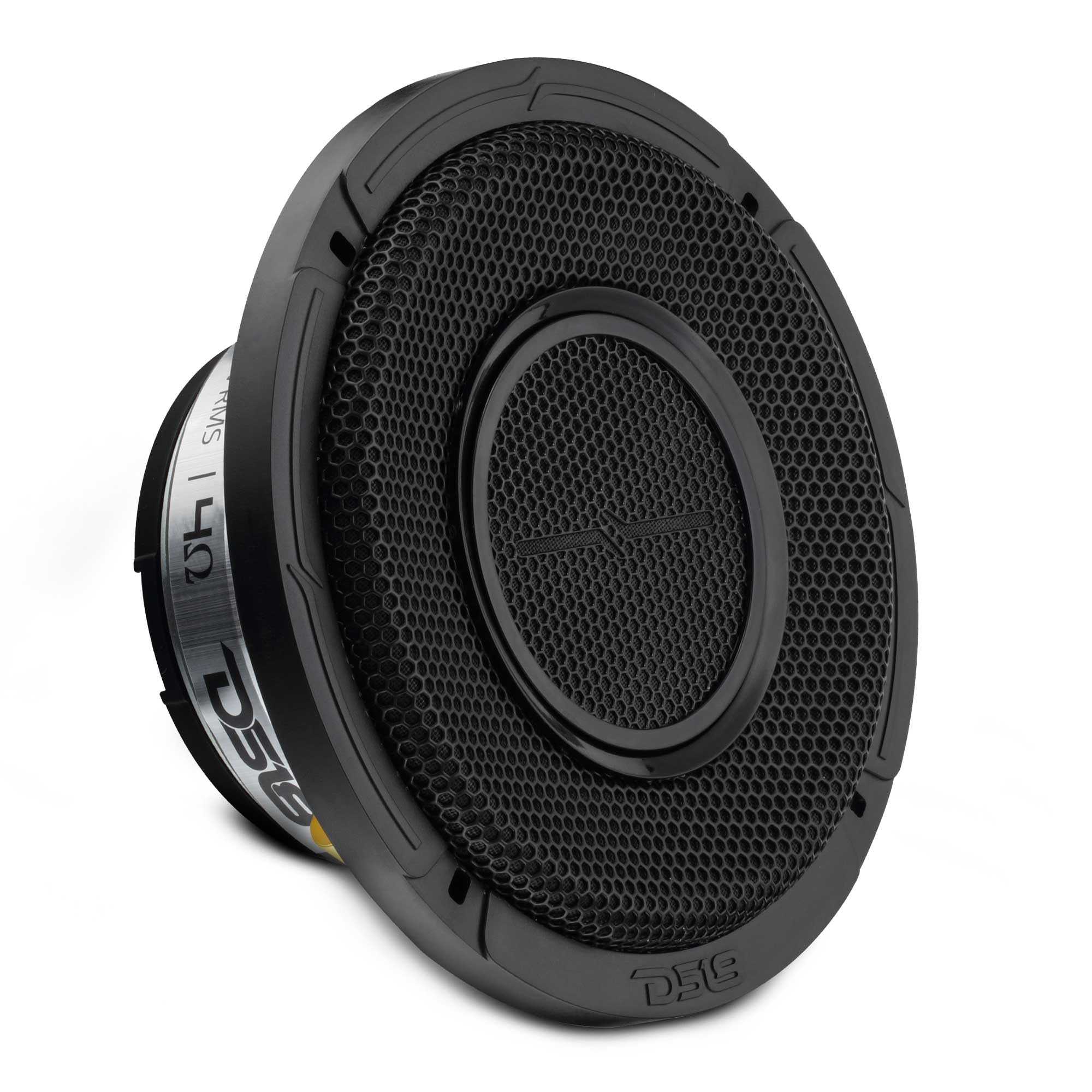
This is not a “normal door speaker.” The DS18 PRO‑HY6.4MSL is a hybrid pro-audio style solution: it combines a midrange speaker with a high-intensity driver built in, designed to stay loud and clear where many standard coaxials start to smear, distort, or disappear behind wind noise. If your vehicle is an open-air environment (motorcycle, ATV, UTV) or you simply want that “loud and clear across distance” effect, this is the lane DS18 plays in.
The big advantage is integration: with a typical SPL-style build, you might run separate midrange speakers and separate bullet tweeters/drivers. DS18 combines both in one chassis: a paper-cone, cloth-surround woofer on a steel basket, plus a titanium-diaphragm driver on a neodymium magnet behind a 3″ horn. The whole thing is rated at 150W RMS and 300W max into 4 ohms, with 93dB sensitivity at 1w/1m, and the grille is included.
The key to loving this product is setup discipline. Pro-style speakers need a crossover plan. Don’t run them full range and expect deep bass—DS18 puts the response at 120Hz–20kHz and recommends a 140Hz high-pass filter, so the low end has to come from somewhere else. Protect them with that filter and let subwoofers handle it. That’s how you get the “extreme loudness with clarity” experience without harshness or strain. In a motorcycle application, this is basically the whole game: keep mids and highs strong enough to overcome wind noise, and run bass separately. The speaker sits at 4.6 stars across 350 Amazon ratings.
Another practical note: this listing is a single speaker, so order the quantity your layout needs rather than assuming a pair. And despite the “shallow hybrid” name, check the numbers before you assume it drops into a tight door: DS18 lists a 2.77″ mounting depth, 3.52″ overall depth and a 5.6″ baffle cutout.
Why it’s a special tool
- Very loud, very clear – Built for environments where normal coaxials struggle (wind noise, open-air riding, loud builds).
- Hybrid simplicity – Driver built in, which can reduce component count and simplify space management.
- 93dB sensitivity – DS18’s rated efficiency at 1w/1m is what buys volume without an enormous amplifier.
- Grille included – DS18 ships the grille with the speaker; the woofer sits on a steel basket with a ferrite motor.
Good to know
- Not a “plug-and-play factory replacement” speaker—this is a build component that needs crossovers and sensible filtering.
- Response is listed as 120Hz–20kHz—there is no deep bass here by design, so plan subwoofer support.
- Sold as a single speaker—buy the quantity your layout requires.
Ideal for: motorcycles, ATVs, UTVs, and loud builds where clarity at volume matters more than “soft, home-audio style” smoothness.
9. Pioneer P.R.O. TS‑M651PRO – Mid‑Bass Output for Serious Loud Builds

This one is for a different kind of shopper: the person who wants their system to project. The Pioneer P.R.O. series is rooted in SPL and “open show” culture, where mid-bass and vocal presence have to stay loud and clean in less-than-ideal acoustic conditions. The TS‑M651PRO is not trying to be a cozy, smooth, all-in-one coaxial. It runs a lightweight pulp cone with a rated 94dB sensitivity and 120 watts of continuous power handling over a 50Hz–18kHz response—built to hit hard in the midrange/mid-bass region and keep its composure at higher output.
That means two things for your decision:
- You’ll need a tweeter plan. This is not a full-range coaxial experience. In most builds, you pair these with separate tweeters (or a driver/horn) and crossovers.
- You’ll want an amplifier. Efficiency helps, but these shine when driven properly and filtered correctly. A weak head unit won’t show what this speaker can do.
When installed and tuned in the right context, this type of driver can make a system feel “live.” Snare hits pop, vocals punch forward, and the system carries through noise and distance. In a normal daily driver with doors as the main enclosure, you’ll get the best results when the door is sealed well and the driver is mounted rigidly. If you treat the door like an afterthought, you’ll get a loud speaker fighting a leaky enclosure—which usually sounds harsh and hollow. Worth knowing before you commit: Amazon shows 4.4 stars across 113 ratings, the smallest review sample of any speaker in this guide.
One more practical note: Pioneer lists this as a 6.5″ speaker with product dimensions of 4.17 x 6.85 x 6.85 inches, and publishes no cutout diameter or mounting depth on the Amazon page. Measure your opening and your available depth before you commit, especially in tight doors.
Why it exists
- High-output mid-bass – Designed to stay strong where typical coaxials start compressing.
- Projects vocals well – Great for builds where you want lyrics to cut through everything.
- 94dB rated sensitivity – Pioneer’s efficiency figure, and the whole point of a P.R.O. series driver.
- Pairs with pro tweeters – A flexible platform for custom loud builds.
Good to know
- Not a plug-and-play coaxial: plan tweeters and crossovers.
- Needs proper filtering and ideally an amp to sound “right.”
- Fit can be tighter than typical 6.5″ coaxials—measure your door opening.
Ideal for: SPL/open-show style builds that prioritize strong vocal presence and mid-bass impact—best when paired with tweeters and driven by an amp.
10. PRV Audio 6MR400-4 Bullet – Clean, Powerful Midrange for “Loud & Clear” Builds
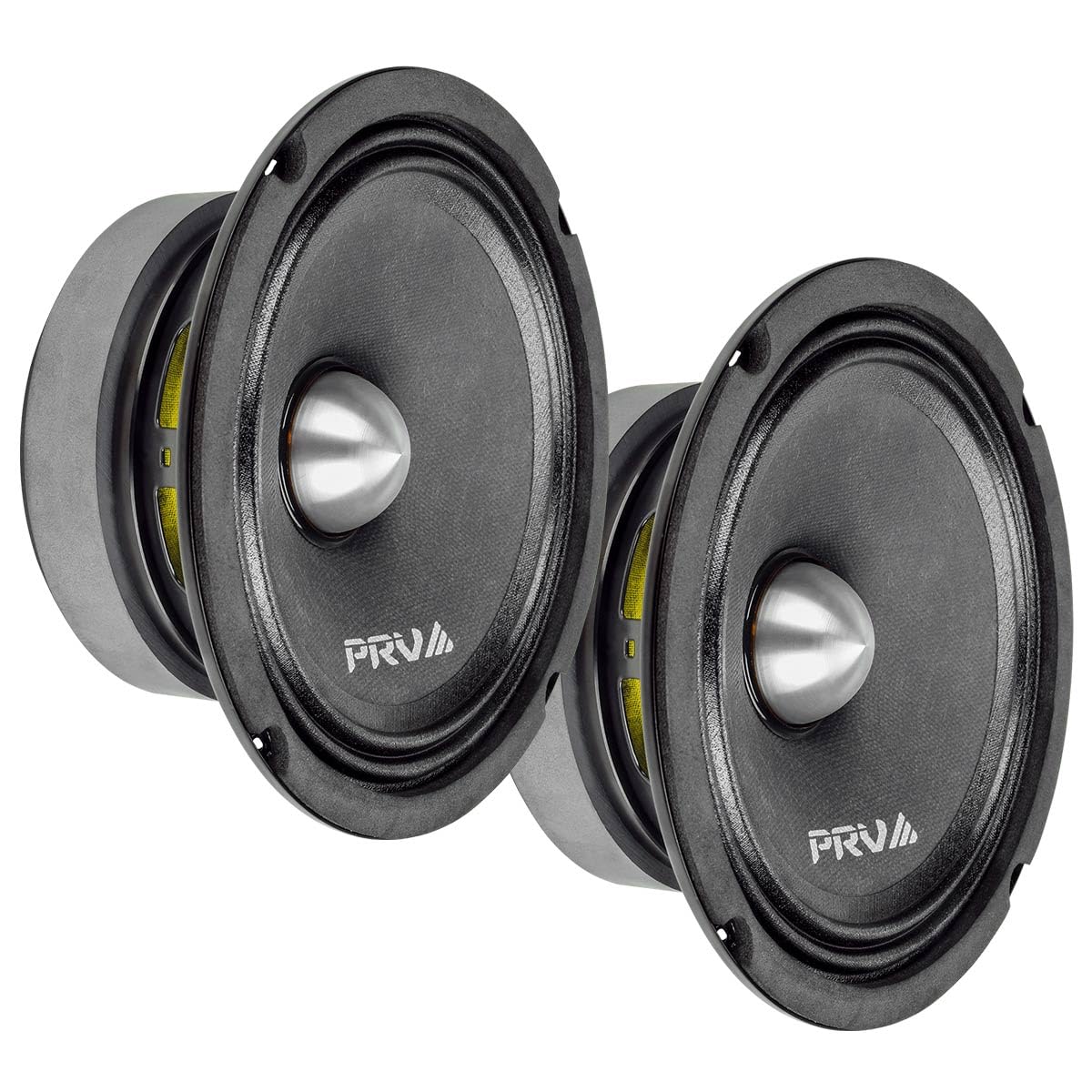
PRV Audio builds pro-audio drivers first and car-audio drivers second, and the 6MR400-4 Bullet is exactly what that heritage produces: a 6.5″ midrange sold as a pair, rated at 400 watts of continuous program power into 4 ohms with 95dB sensitivity, designed to stay loud and intelligible rather than smooth and polite. If you have heard a system where the vocals arrive like they are coming off a PA stack—in a good way—this is the category that does it.
The visual signature is the bullet phase plug in the centre of the cone. PRV machines it from pure aluminium and gives it two jobs: even sound dissipation off the cone, and acting as a radiator cooling system for the voice coil. That second job is the one that matters in a loud build, because a hot voice coil is what makes a midrange go dull and compressed.
This is not a plug-and-play coaxial. PRV positions the 6MR400-4 as one third of a three-way custom door system—sub for the low end, this driver for the mids, a dedicated tweeter up top—so you need an amplifier and you need to set a high-pass filter. Run it full range and you will get harshness and stress, exactly as you would with any pro midrange. PRV publishes the numbers you need: a 145–12,500Hz response and a recommended 145Hz high-pass at 12dB per octave for full power handling. Give it power and those crossover points and it becomes very hard to beat for projection.
Fit is the other practical reality. Pro drivers of this type carry bigger motors and need more clearance than a typical coaxial: PRV lists a 6.59″ overall diameter, a 5.65″ front-mount baffle cutout and a 2.62″ mounting depth. It currently holds a 4.6-star average from 114 Amazon ratings.
Why loud-build people love it
- 400W continuous program power – Real headroom for a midrange this size.
- Aluminium bullet phase plug – Even dispersion plus voice-coil cooling under sustained output.
- Great for vocals & mids – If lyrics matter and you like it loud, this is the lane.
- Sold as a matched pair – Two speakers in the box, built for a three-way front stage.
Good to know
- Not a full-range coaxial: needs crossovers and a separate tweeter plan.
- Fit can be challenging in tight doors due to motor depth and basket size.
- Without proper filtering and an amp, pro drivers sound harsh—setup discipline is everything.
Ideal for: high-output builds that prioritize strong, clear mids and vocals—best when paired with an amp, subs, and correct crossovers.
11. ORION Cobalt CM654 – Big Magnet Loudness on a Budget (Space Required)

The Cobalt CM654 is engineered around efficiency and output rather than refinement. ORION rates the pair at 250 watts RMS and 1000 watts max into 4 ohms, on a 1.5″ high-temperature voice coil, and quotes an efficiency of 96.67 dB. That efficiency figure is the reason a speaker like this gets loud on modest power.
This kind of speaker is designed for a specific job: midrange and upper-mid presence at high volume. Think vocals, guitars, snare snap—things that need to punch through noise and still sound intelligible. If you’re building a system where “loud but clear” is the goal, these can be a great value move. If you’re trying to build a smooth, hi-fi daily driver with soft treble and deep bass from the doors, you’re shopping the wrong category.
The main warning is physical: fit is everything. ORION’s measurements are a 6.54″ overall diameter, a 5.67″ mounting diameter and a 2.63″ mounting depth—though one of the listing’s own bullets quotes 2.75″ instead, so measure and assume the larger number. Some vehicles simply won’t accept these in the door location without modification, and it’s better to know that before you’re holding a door panel and wondering why nothing lines up. If you have more space (rear deck, custom pods, boxes, tailgate setups), they become easier to use.
From a tuning standpoint, the same rule applies as with the PRV bullet midrange: protect them with high-pass filtering, pair them with subs for the low end, and treat them like part of a system. Done right, they deliver high-output clarity that a typical coaxial can’t match at the same listening level. The pair sits at 4.6 stars across 788 Amazon ratings.
Why it’s a value play
- Very loud output – A serious jump in vocal projection for loud builds.
- Strong clarity at volume – Designed to stay intelligible when the system is pushed.
- 1.5″ high-temperature voice coil – ORION’s stated build for sustained high-output use.
- Bullet-centre design – ORION says the bullet lets the CM654 reach high-range frequencies without giving up the low-to-mid range.
Good to know
- Magnets are large; door fit can be tight or impossible without modifications.
- Needs proper filtering; running these full-range is a common mistake that leads to harshness.
- Not a complete full-range solution unless paired with other drivers/tweeters depending on your target response.
Ideal for: budget-minded loud builds needing strong midrange output—especially in cars where you have enough mounting space or custom locations.
12. Skar Audio TX65 – The Budget Pair That Doesn’t Feel “Budget”

Skar is one of those brands that sparks debate, but the TX65’s parts list is easy to check: a 1″ silk dome tweeter, a 1.25″ copper voice coil, a TPE surround and a ferrite magnet, rated at 100 watts RMS and 200 watts peak for the pair into 4 ohms. If you’re the kind of shopper who wants value but refuses to buy flimsy speakers, the TX65 is worth attention.
The sound character is generally “punchy with clarity,” but the real story is how these behave with power. Many budget coaxials sound fine at low volume and fall apart when pushed. The TX65 tends to handle normal daily driving volume well, and with an amp, it can open up further—especially in the midrange where better cone control and motor structure help. Skar publishes an 89dB sensitivity rating and a 45Hz–20,000Hz response, so they are efficient enough to be worth the swap on factory power, with the 100W RMS rating leaving headroom for later. A stable signal and controlled power unlocks detail and reduces the “grainy” harshness that cheap speakers can develop.
There are two practical realities to be aware of:
- The listing doesn’t publish fit numbers. Skar’s Amazon page gives no mounting depth and no cutout diameter, so measure your door opening and depth before you order.
- Install quality matters. A speaker like this can outperform its price class, but only if it’s mounted firmly and the door isn’t leaking air around the frame.
If you want a “budget but proud” result, pair these with basic door deadening or at least foam sealing. That’s how you avoid the classic budget-upgrade disappointment: “the speaker is better, but the door ruins it.” Fix the door, and the TX65 can become a true sleeper pick.
Why it’s a smart budget buy
- Silk dome and copper voice coil – A 1″ silk dome tweeter, 1.25″ copper voice coil and TPE surround at this price.
- Two-year warranty – Skar lists a 2-year limited warranty, and the pair sits at 4.6 stars across 2,955 Amazon ratings.
- Clear, punchy everyday sound – A meaningful step up from muddy stock speakers.
- Strong value proposition – Ideal when you want “good sound” without paying premium branding.
Good to know
- Some installs need minor fit adjustments depending on OEM mounting brackets.
- Not a “deep bass” solution; mid-bass is the ceiling without a sub and proper door sealing.
- For the cleanest out-of-box smoothness, Alpine and JBL are more “plug-and-love.”
Ideal for: value-focused buyers who still care about build quality and want a speaker that can grow into an amp-supported system later.
13. ORION Cobalt CB653 – Budget 3‑Way Volume with Simple Install Appeal
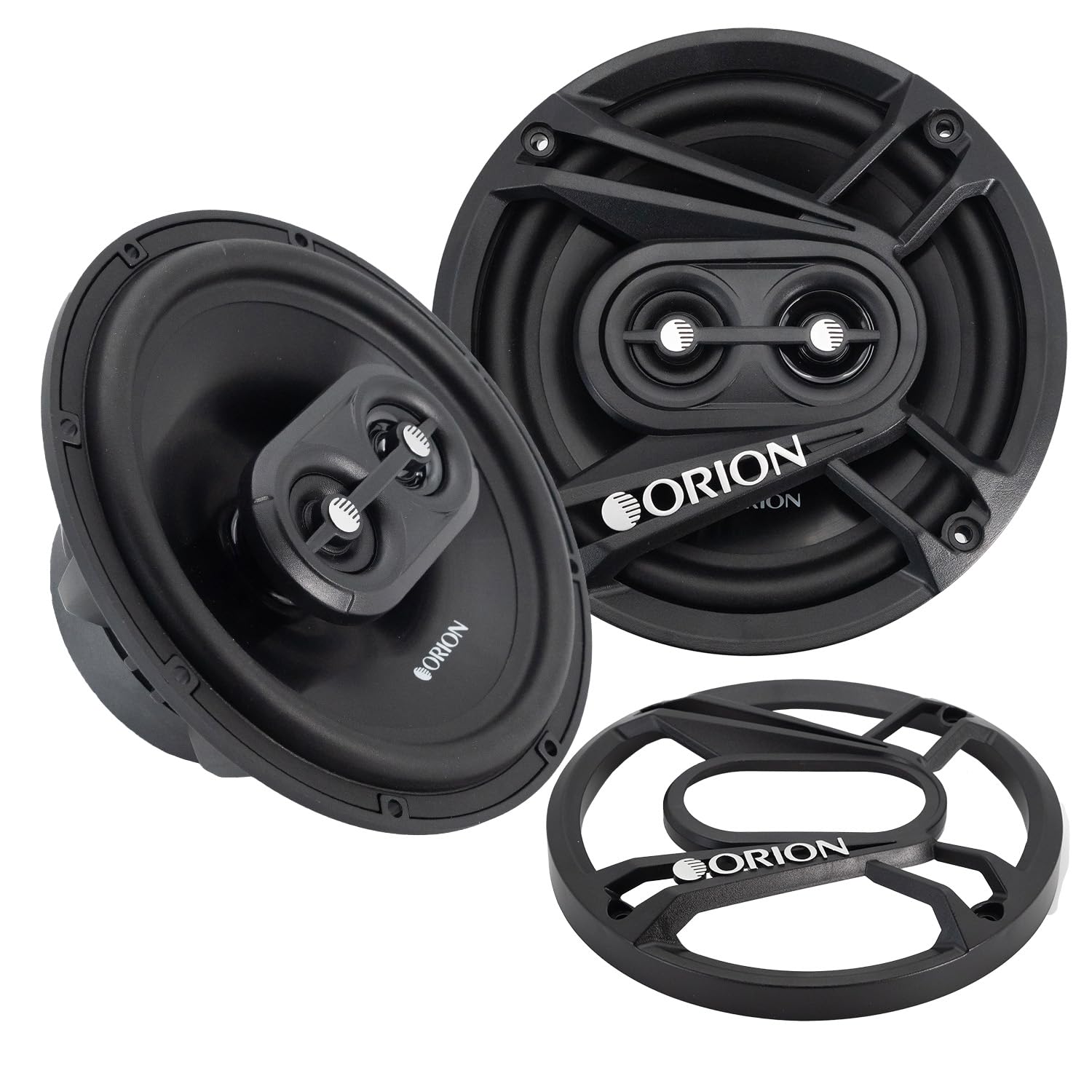
The Orion Cobalt CB653 is a classic “I just want it better than stock” buy—especially when the goal is replacing weak, muddy, or blown speakers without spending premium money. ORION rates it at 60 watts RMS and 240 watts peak into 4 ohms, with 88dB sensitivity, a polypropylene cone and a butyl rubber surround, and the box holds two speakers plus hardware and a manual.
Because it’s a 3‑way coaxial, you get a bit more perceived brightness and detail than a basic 2‑way in many cars. That can be a win if your factory system is dull. It can also be a mixed bag if your car is already bright or you listen to harshly mastered music. The published response starts at 75Hz, which tells you where the limit is: there isn’t much mid-bass weight down low to balance all that top end. That doesn’t make the speaker unusable—it just tells you where it shines.
The best “smart placement” for the CB653 in many systems is rear fill—rear doors, rear deck, tailgate. Why? Because rear speakers often serve as ambience and support rather than the main stage. In that role, you want clarity and volume without spending big. The front stage can then be your “serious” speakers, while the rears keep the cabin filled.
If you do use these up front, treat the install carefully: seal them to the door, avoid big treble boosts, and consider adding a small subwoofer later. That combination often turns a budget upgrade into a system that feels balanced. It sits at 4.3 stars across 211 Amazon ratings—the lowest average of the fourteen speakers here, which is worth knowing even at this price.
Why it’s useful
- Budget-friendly improvement – A simple way to restore and brighten a tired system.
- Easy install orientation – Good for DIY upgraders who want minimal drama.
- Great for rear fill – Adds clarity and presence in the back without over-investing.
- Everything in the box – ORION ships two speakers plus hardware and a manual.
Good to know
- Not a mid-bass monster; if you want weight and punch, choose JBL, Rockford Punch, or CT Sounds.
- 3‑way brightness can be fatiguing if you over-EQ; keep treble modest.
- Best results usually come with decent door sealing and a subwoofer for real low end.
Ideal for: budget shoppers needing a quick improvement and a solid rear fill option—especially when the factory speakers are weak or failing.
14. JVC CS‑J620 – The “Just Fix It” Speaker That’s Still Surprisingly Clear

If your situation is simple—your speakers are blown, your budget is tight, and you want clean sound back—this is the kind of product that makes sense. The JVC CS‑J620 is a long-running budget favorite because it does the basics well: it’s easy to install in many cars, it doesn’t demand fancy power, and it tends to deliver clearer highs and cleaner mids than dead factory paper cones.
The honest sound profile is exactly what you’d expect from a budget coaxial: clear enough to be satisfying, not deep enough to replace a subwoofer, and best when you don’t ask it to do impossible bass tasks. JVC rates each speaker at 30 watts RMS (300 watts peak) into 4 ohms, with 92dB sensitivity and a 35Hz–22kHz response, on a mica cone with a 1″ PEI tweeter. If your current speakers are muffled, distorted, or silent, this is a fast way to restore music to your daily drive.
Where this speaker quietly wins is practicality. JVC lists a 1-23/32″ top-mount depth—the shallowest published figure of any speaker in this guide—which helps in vehicles where deeper baskets hit window tracks or door bracing. Speaker wire extension cables, screws and mounting tabs come in the box. And because you’re not paying for premium branding or high-power handling, you can treat this as a “get the car sounding normal again” purchase—and save the bigger money for a future head unit, amp, or subwoofer if you decide you want more later.
Pro tip for budget installs: if you want more mid-bass, your best “free upgrade” is sealing. Foam tape around the speaker mounting surface, tight screws, and stopping door buzz can make a budget speaker sound like it cost more. That’s the kind of small effort that changes the whole experience. The pair sits at 4.4 stars across 10,190 Amazon ratings.
Why it’s worth considering
- Fixes blown speakers fast – A simple, low-drama replacement that restores clarity.
- Shallow mount friendly – Helpful in cars with tight door depth constraints.
- Clear highs for the class – Often feels much cleaner than old OEM speakers.
- Great “starter upgrade” – Lets you improve sound now while keeping future upgrade options open.
Good to know
- Not designed for deep bass; mid-bass depends heavily on door sealing and expectations.
- Rated at just 30 watts RMS per speaker, and JVC lists only a 30-day warranty on this listing.
- If you want a “wow” upgrade with real punch and refinement, step up to JBL, Rockford Punch, or Alpine.
Ideal for: tight budgets, older cars, and quick “restore the music” replacements—especially where shallow mounting depth matters.
The Real Upgrade Formula: Why Install Quality Matters as Much as the Speaker
Most “speaker disappointment” isn’t actually the speaker. It’s the system around it: the door leaks air, the panel rattles, the head unit clips, or the speaker is being forced to play bass it shouldn’t. When you fix the environment, even a modest upgrade can sound expensive.
What makes door speakers sound bigger (without buying more gear)
- Seal the speaker to the door – Air leaks kill mid-bass. Foam tape or proper sealing rings can make the same speaker sound tighter and louder.
- Stop the “free distortion” – Loose panels and buzzing clips add noise that masks detail. Fixing rattles often feels like a clarity upgrade.
- Use a sensible high-pass filter – Door speakers get cleaner when you filter deep bass away; where the listing publishes a figure, use it (DS18 recommends 140Hz, PRV 145Hz).
- Check polarity – One speaker wired backwards can destroy bass and make the whole system sound thin.
- Don’t clip your signal – Tweeter distortion at volume is often head unit clipping or bad gain staging rather than the speaker itself.
Think of your door like a leaky drum. Your speaker is trying to pressurize it. Seal leaks, reduce vibrations, and suddenly the same driver produces usable punch and clearer mids.
Tuning moves that fix the most common regrets
- Too bright / harsh: reset EQ flat, reduce treble a little, and avoid “loudness” modes that boost highs aggressively.
- No bass after upgrade: check polarity, seal the speaker, and ensure the speaker is mounted firmly (no air gaps).
- Distortion at higher volume: lower head-unit volume a notch and adjust amp gains correctly; apply a high-pass filter.
- Rattles on kick drum: tighten mounts, add foam between panel layers, and treat door skin resonance where possible.
- Vocals lost in the mix: don’t boost bass to compensate; instead slightly raise 1–3kHz region with EQ (small changes), or choose a more mid-forward speaker like Rockford Punch.
The fastest way to love your new speakers is to give them clean power, protect them with basic filtering, and tune with restraint. The goal is balance, not “more of everything.”
FAQ: 6.5″ Car Speakers (The Questions That Actually Decide Your Results)
Do I need an amplifier for these to sound good?
Why do some speakers sound “harsh” after install?
Is 3-way or 4-way automatically better than 2-way?
My doors say 6.5″, but some speakers say 6.75″. Will they fit?
Can I run pro midrange/bullet speakers in doors like normal coaxials?
What’s the fastest “cheap upgrade” besides buying speakers?
Final Thoughts: Buy the Speaker That Matches How You Actually Listen
The “right” speaker is the one that fits your car, matches your power, and suits your taste—without forcing you into a system you don’t want. Use this simple translation to pick confidently:
- Want the most confident upgrade on factory power? Start with the JBL GTO629 for a big, energetic improvement with adjustable treble control.
- Prefer clean detail and smoother long-drive listening? Choose the Alpine S2‑S65 for clarity that stays refined when installed and tuned well.
- Want punch, impact, and that classic “fun” sound? Go for the Rockford Fosgate Punch P1650. It’s a satisfying daily driver pick that scales beautifully with an amp later.
- Planning an amp or DSP and want strong mid-bass authority? Pick the CT Sounds Meso 6.5 and tune it into your preferred signature.
- Want install flexibility and a lively “wake up the system” upgrade? The Pioneer TS‑A1681F is a great “everything in the box” choice for DIY swaps.
- Need an energetic, easy replacement that feels immediately better? The KICKER DSC650 delivers that fast, exciting upgrade vibe.
- Want a trusted brand replacement that’s easy to live with? The Rockford Prime R165X3 is a practical “restore clarity” pick.
- Building for motorcycles/open air or extreme loudness with shallow space? The DS18 PRO‑HY6.4MSL is a hybrid loudness tool—just plan your crossovers properly.
- Chasing SPL-style mid-bass projection and willing to build around it? Consider the Pioneer P.R.O. TS‑M651PRO, paired with tweeters and the right filtering.
- Need pro midrange projection for loud builds? Look at PRV Audio 6MR400-4 Bullet or the value-friendly ORION Cobalt CM654 if you have the space and the amp power.
- Want budget value with better-than-expected build? The Skar TX65 is a strong “budget but serious” pick.
- Need the cheapest functional replacement options? The ORION CB653 and JVC CS‑J620 can restore sound fast—especially when your factory speakers are blown.
If you take just one thing from this guide, make it this: the best 6.5″ car speakers aren’t the ones with the biggest watt number. They’re the ones that match your power, your car’s install realities, and your ears—then get installed and filtered in a way that lets them breathe. Do that, and your next drive will feel like you upgraded the whole car, not just the speakers.