
Our readers keep the lights on and the garage heater humming. As an Amazon Associate, I earn from qualifying purchases.
There’s a special kind of frustration that only happens in a car: your phone has the playlist, the podcast, the navigation voice, and the call you actually need to take… but your dashboard is stuck in 2009. No Bluetooth. No AUX. No USB audio. Just FM radio and a cigarette lighter that somehow still works.
And sure, you can live with it. You can keep driving in silence, or you can wedge your phone speaker into a cupholder like it’s a DIY soundbar. But once you experience a clean, stable, hands‑free setup, you’ll never go back. The right adapter turns “old car problems” into “modern car convenience” in minutes — and for most drivers, the real unlock is choosing the best car audio transmitter for your exact dash situation.
Here’s the part most buying guides skip: car audio transmitters aren’t one category. They’re three. FM transmitters (wireless to your radio). AUX receivers (wireless to your aux port). And factory‑integration adapters (wired behind the dash, but controlled like OEM). If a guide treats all three the same, it’s not “simple” — it’s incomplete.
This guide is built differently. I used real owner feedback (the good, the weird, and the “why is my phone volume blasting now?”), plus the practical realities of driving: road noise, button feel, glare at night, station bleed on road trips, and the overlooked thing that makes or breaks every device… setup. Because the truth is: many “bad transmitters” are actually decent transmitters configured badly.
Below you’ll get a clean decision path, a quick comparison table, and deep‑dive reviews of every product listed — including the niche ones most people ignore (until they’re exactly what you need).
In this article
- How to choose the right setup for your car (FM vs AUX vs factory).
- Quick comparison table of all 14 products.
- In‑depth reviews: real-world strengths, annoyances, and best uses.
- Signal & setup guide: eliminate static, boost clarity, keep your sanity.
- FAQ: pairing, power drain, road trips, and call volume fixes.
How to Choose the Best Car Audio Transmitter for Your Vehicle
Before you pick a model, pick your path. If you choose the wrong path, you can buy the “best rated” unit in the world and still end up disappointed — because you’re forcing the wrong tool to do the wrong job.
1) The 3 Connection Paths (This is the real buying decision)
- FM Transmitter (Phone → Bluetooth → FM → Car Radio): Best for cars with only FM radio. Fast install. The tradeoff is that FM is an analog bottleneck, so setup matters a lot.
- AUX Bluetooth Receiver (Phone → Bluetooth → AUX → Car Stereo): Best for cars that already have an AUX port. This usually gives cleaner sound than FM because you bypass radio interference entirely.
- Factory Integration Adapter (Behind-dash, OEM-style): Best when available for your exact vehicle (like certain Honda/Acura models). This is the closest thing to “built-in Bluetooth” without swapping the head unit.
2) “Sound Quality” Isn’t One Thing — It’s a chain
People love arguing about Bluetooth versions, but your audio quality is usually decided by four unglamorous things:
- Radio interference (FM only): Station bleed, electrical noise, and weak transmission are the big three.
- Gain staging: The relationship between your phone volume, the transmitter volume (if it has one), and your radio volume.
- Speaker limitations: If your car speakers are tired, you’ll hear it more with Bluetooth than with FM talk radio.
- Codec + processing: On AUX receivers and premium adapters, better processing can mean less hiss and better voice clarity.
3) Call clarity is mostly microphone placement
Here’s the pattern that shows up again and again in owner feedback: cigarette-lighter FM transmitters can sound “quiet” on calls because the microphone is physically far from your mouth. Noise suppression helps, but distance still wins.
- Best call geometry: Visor-mounted or dash-mounted microphones (closer to your face).
- Good compromise: FM transmitters with stronger mic tech (dual mic + CVC/DSP).
- Pro move: If a factory adapter includes an external mic, mount it high (A-pillar or steering column area) so the mic “sees” your voice first.
4) The “3-Volume” Setup (the static killer most guides ignore)
Most cars end up with three volume controls that can fight each other:
- Phone volume (media + call)
- Transmitter/receiver volume (some models)
- Car radio volume
If you max all three, you often get distortion, hiss, or a harsh “robot” edge. The cleaner approach is:
- Set phone media volume to 80–90% (high enough for good signal, not so high it clips).
- Set transmitter volume to mid-to-high (not always max; some units get noisy at max).
- Use the car radio as your “daily driver” knob.
5) Power behavior matters more than you think
Some cars keep the 12V port live even when the car is off. That creates two realities:
- Power button = peace of mind: If your port is always-on, a dedicated power button saves you from unplugging constantly.
- Lighting control matters at night: “Breathing lights” can feel fun for five minutes, and then feel like a lighthouse in your peripheral vision at midnight.
6) Don’t buy features you’ll never use — buy the ones you’ll use daily
- Fast charging ports: Great if you road-trip or use GPS daily.
- USB / TF / microSD playback: Useful if you keep offline music, or want a backup plan when your phone dies.
- Remote control: Nice for passengers, but only if the device buttons are small or awkward.
- “One-click bass”: Can be awesome… or too much. The best implementations add punch without turning everything into mud.
Quick Comparison: 14 Best Car Audio Transmitter Options
This table is organized by real-world usefulness: best “solves the problem” picks first, then niche solutions for specific setups.
On smaller screens, swipe or scroll sideways to see the full table.
| Model | Type | Best For | Key Feature | Amazon |
|---|---|---|---|---|
| Bluetooth 5.4 FM Transmitter (Dual Mic, PD) | FM Transmitter | Most Drivers | Dual Microphones + Bass Mode | Amazon |
| Yomikoo Honda/Acura Factory Adapter | Factory Integration | Honda/Acura Owners | Steering Wheel Controls | Amazon |
| Twelve South AirFly Pro 2 | AUX Adapter | AUX Cars + Travel | TX/RX + Long Battery | Amazon |
| Avantree Roadtrip 2‑in‑1 | Speaker + FM | Best Calls | Visor Mount + Auto Power | Amazon |
| DS18 BT‑Two Waterproof Receiver | RCA Receiver | Aftermarket Amps | IP65 + Remote Trigger Out | Amazon |
| Anker SoundSync Bluetooth Receiver | AUX Receiver | Cleanest Sound on AUX | 12‑Hour Battery + Dual Pairing | Amazon |
| UNBREAKcable Bluetooth FM Transmitter | FM Transmitter | Set‑and‑Forget | Joystick Control + Power Button | Amazon |
| Syncwire 48W (Light Switch) FM | FM Transmitter | Flush Console Fit | Light Switch + Strong Charging | Amazon |
| LENCENT 48W Bluetooth FM | FM Transmitter | Balanced Everyday Use | PD + QC + Bass Mode | Amazon |
| Syncwire 38W Bluetooth FM | FM Transmitter | Simple Daily Driver | Stable Pairing + Bass Button | Amazon |
| Nulaxy KM18 (2026) Gooseneck | FM Transmitter | Hard-to-Reach Ports | Flexible Neck + Big Screen | Amazon |
| Scosche BTFM9 | FM Transmitter | Brand Reliability | Dual Charging + Voice Assist | Amazon |
| WYYHAA FM Transmitter (Remote) | FM Transmitter | Passenger Control | Remote + Rotating Screen | Amazon |
| 1Mii 2.4GHz TX/RX Set | Wireless Audio Link | Garage / Home Audio | Low Latency + Long Range | Amazon |
In‑Depth Reviews: 14 Car Audio Transmitters & Adapters (Real-World Utility Ranked)
Instead of repeating spec sheets, these reviews focus on what owners actually feel day-to-day: pairing behavior, night driving annoyances, mic pickup reality, and the little quirks that decide whether you keep the device plugged in… or throw it in the glove box forever.
1. Bluetooth 5.4 FM Transmitter for Car (Dual Microphones, PD/QC) – The “Just Works” Upgrade
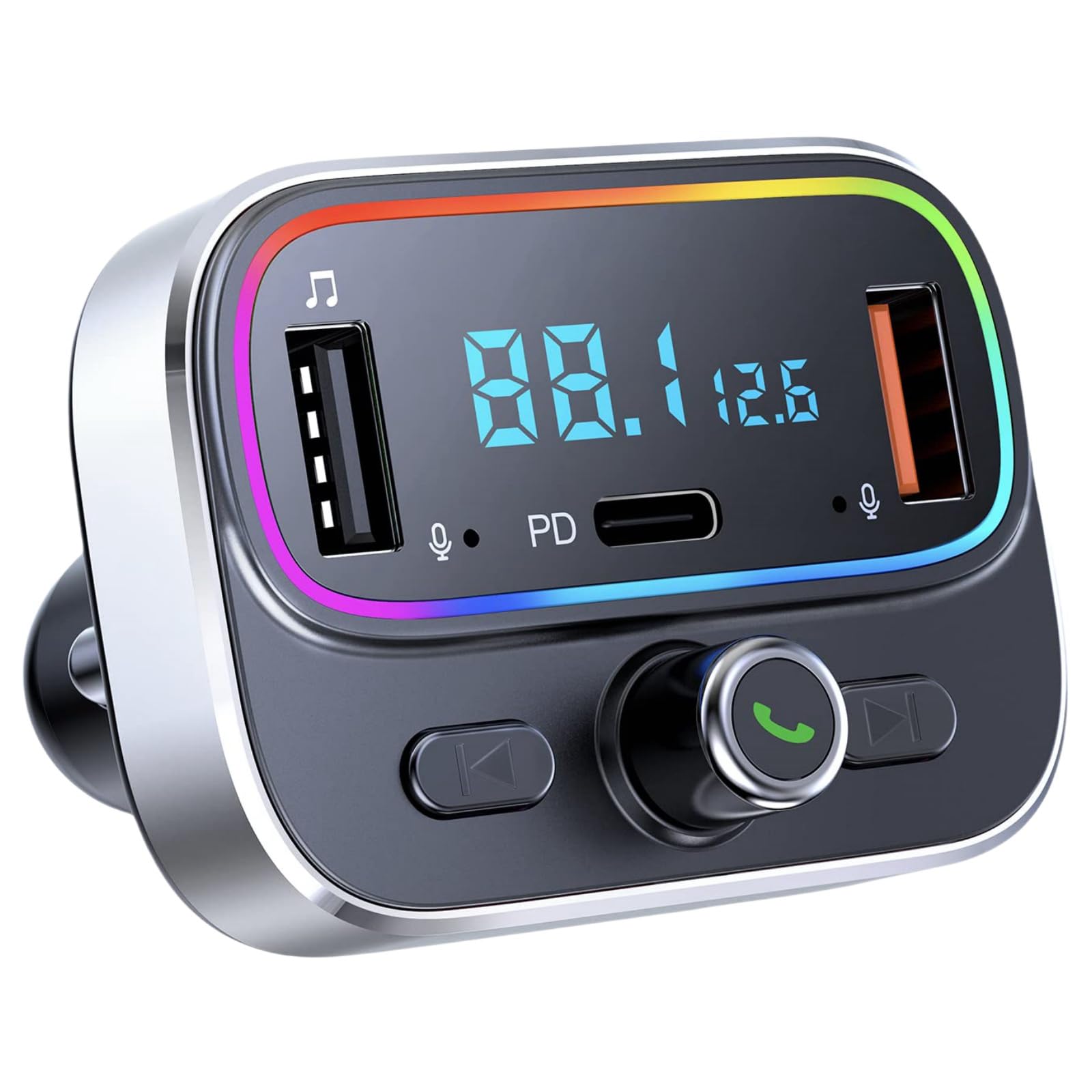
If you’re buying one device to modernize an older car, this style of transmitter is the sweet spot: strong everyday sound, genuinely usable call quality, and charging that’s actually practical. The standout detail is the dual microphone approach. In real driving, road noise and wind don’t just make you louder — they make your voice less distinct. Dual mic + noise suppression tends to preserve “voice shape,” so callers hear you as a person, not a muffled dashboard.
Where it wins in daily life is the balance: you’re not forced into a tiny screen and mystery buttons, but you’re also not dealing with a massive gooseneck that blocks your shifter. Owners consistently describe the setup as fast and painless: pair once, then it becomes a routine part of your start-up flow. The “bass” toggle is also a surprisingly useful tool when your car speakers are thin — as long as you use it as a gentle enhancement, not a sledgehammer.
Why it’s the top pick
- Call clarity advantage: Dual mic + noise suppression is noticeable in motion.
- Audio stability: DSP-style processing typically reduces the “warbly FM” feel.
- Practical charging: You can run GPS and still top up power.
- Everyday controls: Easy to operate without staring at it.
Good to know
- FM quality depends heavily on choosing a clean station (fixable, but necessary).
- In dense radio areas, you may need a new frequency when traveling far.
Ideal for: Most drivers with FM-only cars who want a modern, dependable Bluetooth + charging setup.
2. Yomikoo Honda/Acura USB + AUX + Bluetooth Interface – The “OEM Feel” Solution

If you drive one of the supported Honda/Acura models, this adapter is in a different league from FM transmitters — because it behaves like it belongs there. The strongest theme in owner feedback is integration: steering wheel buttons work, the factory radio panel still feels like home, and once installed, the device basically disappears into the car.
This is also where you often get a cleaner sound than FM. You’re not transmitting over radio waves; you’re feeding audio into the head unit’s ecosystem. That’s why picky listeners often describe it as “finally good enough to stop thinking about swapping the stereo.” If your goal is to preserve the stock look while adding modern phone audio, this is exactly that.
Why it feels premium
- OEM-style control: Steering wheel and radio buttons remain your interface.
- Clean audio path: Typically avoids FM hiss and station bleed.
- Auto-connect behavior: Many owners report it reconnects quickly at start-up.
- Hide-and-forget: No gadget clutter in the cabin.
Good to know
- It’s vehicle-specific — confirm your model/port compatibility first.
- Some setups need a Y‑adapter depending on factory options (DVD, etc.).
- USB/AUX/Bluetooth may not be usable simultaneously (plan your routine).
Ideal for: Honda/Acura owners who want the most “built‑in” experience without replacing the head unit.
3. Twelve South AirFly Pro 2 – Tiny Device, Big Lifestyle Upgrade

The AirFly Pro 2 is one of those products that doesn’t look impressive until you understand the use-case. It’s a two‑mode adapter: transmit mode makes dumb headphone jacks “Bluetooth‑capable,” and receive mode makes older AUX systems behave like modern Bluetooth systems.
In a car with an AUX port, using receive mode is the move. You skip FM entirely, which means you skip the biggest headache category: station hunting and interference. The second win is battery life: owners consistently love that it lasts through long travel days and still has fuel left. And if you’re the type who hates keeping dedicated gear for each scenario, AirFly’s “car + plane + gym TV” flexibility is the whole point.
Why it’s a top-tier pick
- AUX clarity: Usually cleaner than FM because there’s no radio layer.
- Versatility: Works in cars, planes, gyms, and older stereos.
- Battery endurance: Built for long sessions without babysitting.
- Dual pairing: Great for shared listening while traveling.
Good to know
- Initial pairing can feel “different” because it’s tiny and minimalist.
- If your car has no AUX, this isn’t the right path — go FM instead.
Ideal for: Drivers with AUX who want cleaner audio than FM — and travelers who want one device that covers everything.
4. Avantree Roadtrip – The Call-First Car Bluetooth Solution

Most FM transmitters try to be everything at once, and calls become “good enough.” The Roadtrip flips that: it’s built like a speakerphone first, and an FM transmitter second. That matters because call quality is a geometry problem — and a visor-mounted mic is simply closer to your mouth than a cigarette-lighter mic will ever be.
Owners who drive older cars often describe this as the first time callers stopped complaining about background noise. You also get a very “human” control style: a rotary dial for volume and a press for voice assistant. That’s a big deal while driving because it reduces fiddling. When you do want music through the car speakers, the FM mode gets it done — just remember the FM rules: pick a clean station and set volume intelligently.
Why drivers love it
- Call clarity advantage: Visor placement helps your voice cut through road noise.
- Simple controls: Dial + press is easier than tiny buttons.
- Two ways to listen: Built-in speaker or FM to car speakers.
- Convenience factor: Auto power behavior fits daily commuting.
Good to know
- FM audio still has FM limitations (slight hiss at very low volumes can happen).
- Mounting on a visor can be annoying for some drivers (height/hat issues).
Ideal for: People who take calls daily and want callers to hear them clearly — especially in older vehicles.
5. DS18 BT‑Two – Waterproof Bluetooth Receiver That Belongs in Real Builds

This is not the typical “plug into your lighter and pray” gadget. The DS18 BT‑Two is made for people who run amplifiers, boats, motorcycles, UTVs, and systems where RCA connections are the language. The reason it’s loved in that world is simple: it’s small, rugged, and designed to survive dust, spray, and vibration.
The most important feature is the remote trigger output. In plain English: once sound is detected, it can turn on your amp automatically. That turns your setup into a clean “key on → music works” experience. One real-world warning from owners: wiring matters. If you treat the trigger like an input when it’s actually an output, you’ll create chaos. Installed correctly, it can feel like a professional integration part — not a toy.
Why it’s special
- Waterproof confidence: Built for marine and powersports environments.
- RCA simplicity: Direct connection into amps or processors.
- Remote trigger out: Makes “auto on” setups feel seamless.
- Low draw: Designed for vehicle electrical realities.
Good to know
- Installation quality decides the outcome — ground and wiring must be solid.
- Some setups may need noise troubleshooting if grounding is sloppy.
Ideal for: Aftermarket amp builds, boats, motorcycles, and anyone who wants Bluetooth into RCA the right way.
6. Anker SoundSync – The Clean, No-Drama AUX Bluetooth Receiver

If your car already has an AUX port, this is one of the simplest “why didn’t I do this sooner?” upgrades. The SoundSync’s reputation comes from consistency: it connects reliably, it stays connected, and it doesn’t demand constant re-learning. It’s also small enough to hide, which matters if you don’t want to advertise “there’s a gadget here.”
In real use, AUX receivers often sound cleaner than FM transmitters because there’s no radio station layer to fight. The most common “advanced” issue is not the receiver — it’s power noise. If you charge your phone from the same port while listening and you hear a high-pitched whine, that’s usually a ground loop. The fix is simple (see the setup guide section), and once solved, this becomes a low-effort daily driver.
Why it’s a favorite
- AUX clarity: Bypasses FM interference entirely.
- Long sessions: Battery life supports extended driving.
- Dual device behavior: Helpful in shared vehicles.
- Compact: Easy to stash and keep the cabin clean.
Good to know
- If you charge while listening, you may need a ground loop fix in some cars.
- Call mic performance varies with placement (dash vs console vs pocket).
Ideal for: Cars with AUX input where you want better-than-FM sound with minimal fuss.
7. UNBREAKcable Bluetooth FM Transmitter – The Joystick Makes It Safer

A lot of FM transmitters “work,” but feel annoying to operate. The UNBREAKcable’s standout is the control design: the joystick layout is easier to find by touch, which reduces the urge to glance down mid-drive. That’s not a luxury feature — it’s a safety feature.
Owners also tend to obsess (in a good way) over the power button. In cars where the 12V port stays live, being able to shut the unit down without yanking it out is the difference between “I love this” and “I’m tired of this.” Sound-wise, the bass boost can add fun, but the smarter move is using it lightly and doing your “big EQ” on the phone if needed. Call quality is often reported as strong, though like all lighter-plug devices, mic distance can still matter.
Why it stands out
- Joystick control: Easy to adjust without staring.
- Power button: Perfect for always-on cigarette lighter ports.
- Stable Bluetooth: Fast pairing and consistent reconnecting is common.
- Charging + music: Handles daily GPS + streaming routines well.
Good to know
- Some users notice phone volume behavior changes at startup (quick to fix, but surprising).
- Call volume may need radio volume adjustments depending on vehicle acoustics.
Ideal for: Drivers who want tactile, easy controls and a true on/off button in an FM transmitter.
8. Syncwire 48W Bluetooth 5.4 FM Transmitter (Light Switch) – Clean Console, Clean Routine

This Syncwire model is for people who hate clutter. It sits compactly, doesn’t invade your cupholders, and doesn’t force a long gooseneck into your space. But the hidden hero feature is the light control. Lots of transmitters are “fine” during the day and then feel like a pulsing beacon at night. Being able to shut that down is a quality-of-life upgrade you’ll appreciate every evening drive.
On sound, the big win is usually consistency. Owners often describe it as something they set up once and then forget — especially if they pick a clean FM frequency and keep gain staging reasonable. One practical trick that shows up in real usage: maxing the device volume can create noise in some cars; backing it down slightly can reduce static while still staying loud and clear. Small tweak, huge difference.
Why it’s loved
- Compact footprint: Less cabin clutter, better ergonomics.
- Light control: Night driving comfort matters more than you think.
- Auto reconnect: Often behaves “start car → music works.”
- USB drive option: Handy offline backup for music or audiobooks.
Good to know
- Like all FM transmitters, long road trips may require frequency changes.
- Some vehicles are more sensitive to cutouts than others (station choice helps).
Ideal for: Drivers who want a tidy look, controllable lighting, and a stable “daily driver” FM transmitter.
9. LENCENT Bluetooth 5.3 FM Transmitter – The “Old Car, New Tricks” Classic

This is the type of device people buy when they’re tired of thinking about it. Plug in, pair, pick a station, done. The reason it earns repeat praise is that it does the fundamentals well: stable Bluetooth connection, straightforward controls, and a sound profile that doesn’t feel thin once you dial it in.
The bass mode is especially useful in older cars with weak low end, but the smarter way to use it is as a “seasoning.” If you crank it, you can drown vocals and make podcasts sound boomy. If you use it lightly, it adds warmth without sacrificing clarity. The compact design also matters: many people prefer units that sit close to the console so they don’t interfere with shifting or storage lids.
Why it’s reliable
- Easy pairing: Often reconnects without drama.
- Clean daily sound: Strong enough to feel like an “upgrade,” not a compromise.
- Charging support: Keeps phones alive during GPS-heavy drives.
- Light control: Better night driving comfort when you can shut it off.
Good to know
- FM transmitters can sound “flat” if gain staging is wrong (fixable in 60 seconds).
- In very crowded FM markets, frequency selection matters more than the device.
Ideal for: People upgrading an older car who want a straightforward Bluetooth + charging solution without overthinking it.
10. Syncwire Bluetooth 5.4 FM Transmitter (38W) – Small Device, Big Convenience

This model is popular with drivers who want consistency: get in, it connects, you drive. The audio quality tends to land in the “as good as FM gets” category — which is the honest benchmark for this entire product class. If you remember that FM transmitters are constrained by radio, you’ll appreciate how clean these can sound when properly tuned.
One real-world behavior to be aware of: some phones react to certain transmitters by changing system volume states (especially when calls come in or when the car starts). It’s not a dealbreaker, but it’s the kind of small annoyance that’s easy to fix once you expect it. If you primarily use your phone’s built-in Bluetooth for calls (and just want FM for music), you can usually manage that by controlling which profiles you enable on your phone.
Why it’s a solid pick
- Stable connection: Many users report consistent auto-connect behavior.
- Simple controls: Not complicated once set up.
- Good “FM-class” sound: Clear enough for music + podcasts.
- Useful bass key: Adds punch when used lightly.
Good to know
- Ambient lighting can bother night drivers if left on.
- Call mic distance can still be a limitation in louder vehicles.
Ideal for: Commuters who want a dependable FM transmitter that behaves predictably day after day.
11. Nulaxy KM18 (2026 Upgraded) – The Screen You Can Actually See
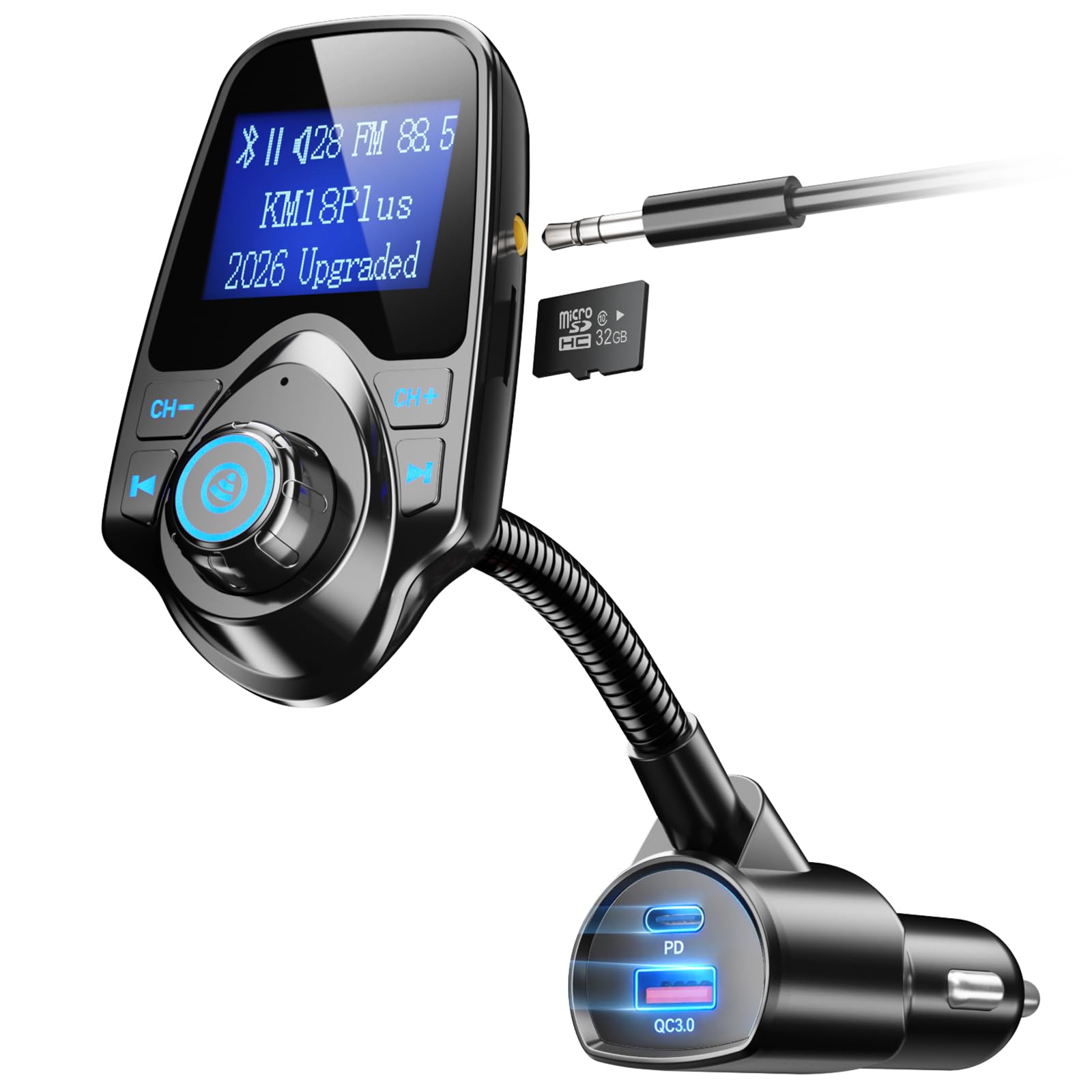
Some cars put the 12V port in a cave. Under the dash. Inside a storage cubby. Behind the shifter. In those cars, compact “flush” transmitters can be annoying because you can’t see the screen or reach the buttons. That’s exactly where the KM18’s flexible neck shines: you can angle the display into your line of sight and stop fumbling.
The display isn’t just cosmetic — it reduces mental load. If you’re switching stations on a road trip or taking calls, being able to see what mode you’re in matters. Owners also like the charging behavior because it supports the reality of modern driving: navigation + streaming + calls. The only caution: goosenecks take up more physical space, so if you drive a manual or have tight console clearance, measure your comfort.
Why it’s different
- Visibility: Adjustable screen angle is genuinely useful.
- Ergonomics: Easier to reach controls without contorting.
- Everyday features: Handles calls + music + charging together.
- Battery voltage display: Handy quick glance for electrical health.
Good to know
- Gooseneck takes space; some drivers prefer a lower-profile unit.
- As with all FM models, station choice controls your “static level.”
Ideal for: Cars with awkwardly placed 12V ports, and drivers who want a screen they can see without leaning.
12. Scosche BTFM9 – No-Frills, Solid, Easy to Live With

There’s a category of buyer who doesn’t want the “coolest” gadget — they want the least annoying gadget. The Scosche approach tends to be exactly that: simple controls, straightforward pairing, and a build that feels like it belongs in a vehicle environment.
What owners often appreciate is the predictability: it behaves like a small car accessory, not a finicky tech toy. Voice assistant support matters too, because the best transmitter is the one you can operate without picking up your phone. If you’re new to FM transmitters, this is the type of unit that reduces the learning curve: pair once, select a frequency, and then focus on driving.
Why it’s a safe choice
- Brand reliability vibe: Built like a real accessory, not a gimmick.
- Easy controls: Low learning curve for first-time users.
- Charging support: Keeps the daily commute powered.
- Voice commands: Helps reduce phone handling while driving.
Good to know
- Like all FM solutions, the “best station” can change across regions.
- If your car antenna is weak, you may hear more noise (antenna health matters).
Ideal for: Drivers who want a straightforward FM transmitter from a well-known accessory brand.
13. WYYHAA Bluetooth FM Transmitter (Remote Included) – Passenger-Friendly Control

This is a great pick when you care about convenience more than perfection. The remote sounds like a small feature, but in real life it changes the vibe: passengers can control volume or track changes without you reaching down and taking your eyes off the road. That’s especially useful in family cars and carpools.
Sound-wise, it can be surprisingly strong when you choose a clean station — and frustrating when you don’t. That’s not unique to this model; it’s FM reality. Where you’ll want to be honest with yourself is durability expectations. If you’re hard on accessories, prioritize sturdier builds. If you want something that’s simple, works well enough, and is easy to operate, this checks the boxes.
Why it’s practical
- Remote control: Great for passengers and family cars.
- Multiple playback modes: Bluetooth + storage options for offline audio.
- Rotating display: Helps viewing comfort depending on port angle.
- Easy operation: Large buttons reduce fiddling while driving.
Good to know
- Some users report occasional static depending on area (station choice is everything).
- Durability can vary — treat it like a tech accessory, not a tool.
Ideal for: Carpools, family vehicles, and anyone who wants passenger-friendly control via remote.
14. 1Mii 2.4GHz Wireless Transmitter/Receiver Set – Not Bluetooth, But Surprisingly Useful
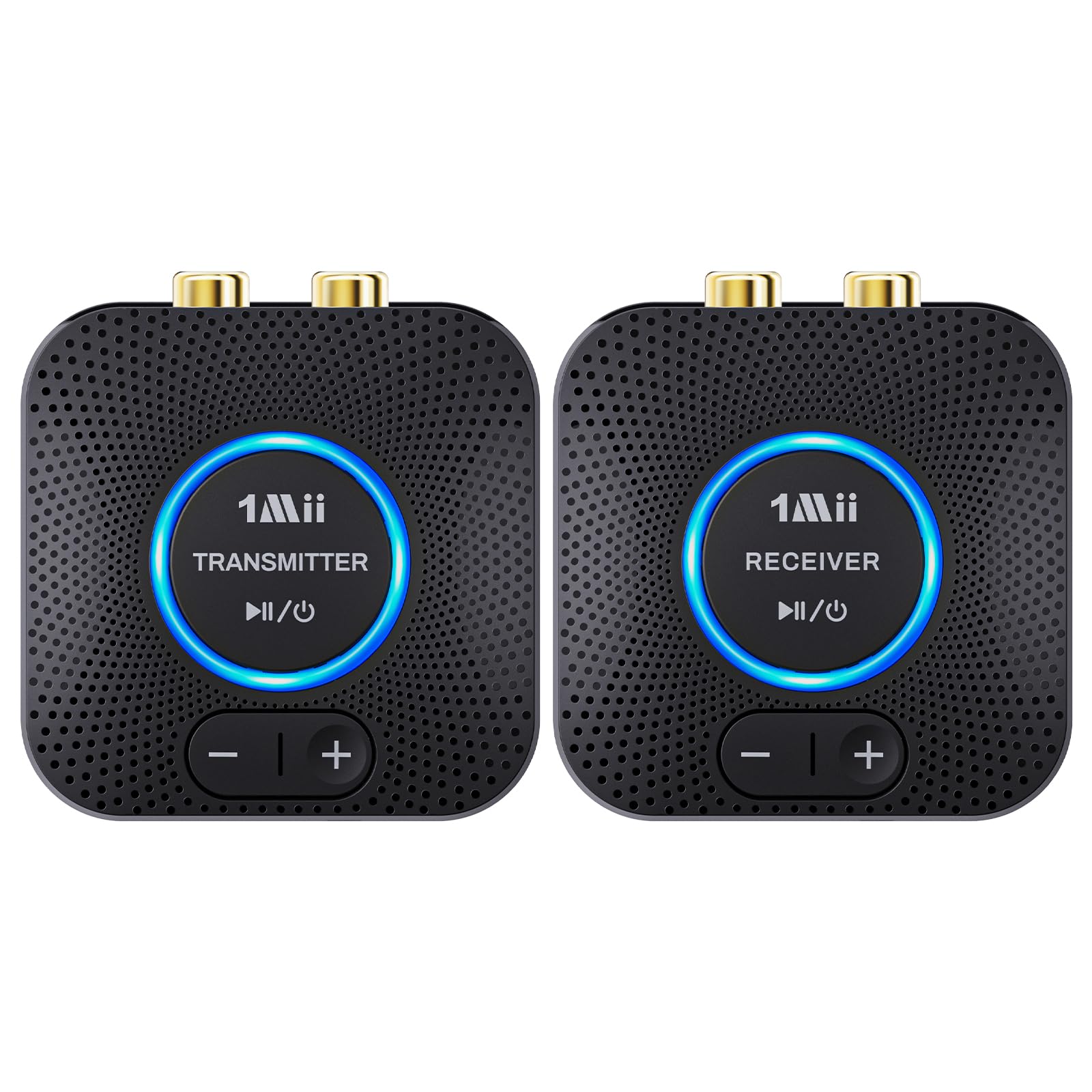
This one is the curveball — and it’s here because some people don’t just want “Bluetooth in the car.” They want wireless audio between devices without pairing to phones, without Bluetooth quirks, and with very low delay. This is a matched 2.4GHz transmitter/receiver set, meaning the two units talk to each other directly.
For strict “car use,” it’s not the default recommendation because it’s not designed around a cigarette lighter lifestyle. It needs power, and you’re working with AUX/RCA connections on both ends. But in the real world, it shines in garage setups, home stereo extensions, or situations where you want to move audio across distance without dropouts. If you understand what it is (a private wireless audio bridge), it can be a brilliant tool.
Why it can be a hidden gem
- Low latency feel: Better sync than many cheap wireless links.
- Long-range design: Useful across rooms, garages, and outdoor spaces.
- Stable paired link: No random device stealing the connection.
- AUX/RCA flexibility: Works with lots of wired gear.
Good to know
- It’s not Bluetooth — your phone won’t pair directly like a normal car adapter.
- More cables and power needs than typical car transmitters.
Ideal for: Garage/home audio linking, powered speakers, and niche setups where you want a private wireless audio bridge.
Signal & Setup Guide for the Best Car Audio Transmitter Experience
Most “static problems” aren’t permanent problems. They’re setup problems. Use this section like a checklist: fix the signal path first, then adjust sound.
FM Transmitters: How to kill static (the smart way)
- Pick a truly empty station: Don’t guess. Use your radio’s scan to find a frequency with nothing but silence (no faint talk, no hissy music, no bleed).
- Stay consistent: If it’s clean at your home location, save it and stick to it for daily commuting.
- Road trip rule: When stations change city-to-city, expect to retune. That’s normal. It’s not “the device failing.”
- Gain staging: Phone 80–90%, transmitter volume mid-to-high, radio as final control. If you hear hiss, lower the transmitter volume slightly and raise the radio volume.
AUX Receivers: How to avoid buzzing and whine
- Short cable wins: Keep AUX cables short and tidy to reduce noise pickup.
- Separate power paths: If charging the phone introduces a whine, try a different USB port or power adapter.
- Ground loop fix: If the whine only happens while charging, a ground loop isolator between AUX and stereo often solves it instantly.
- Placement matters: Don’t bury the receiver under metal; give it a clean line for Bluetooth signal.
Call clarity: make your microphone work for you
- Closer is better: Visor mounts typically outperform lighter-plug mics for calls.
- Face the mic: If you install an external mic (factory adapter), point it toward the driver’s mouth, not the windshield.
- Volume mismatch fix: Calls sometimes require higher radio volume than music. Before you switch back to FM radio, lower your radio volume first to avoid sudden blasting.
Battery drain: avoid the silent killer
- Always-on ports: If your 12V outlet stays on, use a device with a power button or unplug it.
- Auto-reconnect behavior: If your phone keeps connecting when you don’t want it to, “forget device” on the phone or disable the call profile for that device.
- Night driving comfort: Turn off ambient lights if they distract you. Comfort = safer driving.
FAQ: Car Audio Transmitters & Bluetooth Adapters
Why does my FM transmitter sound perfect in one area, but staticy in another?
What’s the cleanest option if my car has an AUX port?
People say they can’t hear me well on calls — what actually fixes that?
My phone volume jumps or behaves weird when the car starts. Is that normal?
Can I leave a Bluetooth adapter in the car full-time?
What if my car already has built-in Bluetooth for calls, but not for music?
Final Thoughts: The Verdict
If you want one reliable FM solution for most cars, the top all-around pick is the Bluetooth 5.4 FM Transmitter with Dual Microphones because it balances sound, calls, and daily charging without being finicky. If you drive a compatible Honda/Acura, the Yomikoo factory-style adapter is the closest thing to a true OEM upgrade. For AUX cars (and frequent travelers), the Twelve South AirFly Pro 2 gives you a clean, flexible setup that works far beyond the car.
Most importantly: don’t judge your choice until you’ve set it up correctly. With the right station, smart volume staging, and a realistic approach to call mic placement, you can get a modern driving experience out of a dashboard that predates streaming. That’s the real win — and that’s how you actually end up with the best car audio transmitter for your life.