
Our readers keep the lights on and the garage heater humming. As an Amazon Associate, I earn from qualifying purchases.
Specs are compiled from manufacturer listings and verified buyer reviews and can change over time — please confirm the key details on the product page before buying.
Your chainsaw or trimmer sits idle from fall to spring, and the ethanol in modern gasoline turns to gum and varnish inside the carburetor (the part that mixes fuel and air for combustion). A genuine two-stroke fuel stabilizer does double duty: it keeps that pre-mixed fuel fresh through months of storage and coats internal parts against corrosion, so the pull-start fires on the first or second yank come April instead of a frustrating Saturday of carburetor cleaning.
I’m Mo Maruf — the founder and writer behind GoCarLife. This guide is built by comparing the manufacturers’ published specifications and the patterns across verified customer reviews, so you get each pick’s real strengths and trade-offs instead of marketing spin.
Whether you are parking a boat for the season or just want your yard equipment to survive winter, the right two-stroke fuel stabilizer keeps your mix fresh and ready for months on end.
Our Picks at a Glance

How To Choose The Best Two-Stroke Fuel Stabilizer
Two-stroke engines share a common vulnerability: the oil is mixed directly into the gasoline, so whatever happens to that fuel happens to your engine’s internals. When the mix sits for months, the light fractions of the gasoline evaporate off, leaving behind a sticky, lacquer-like residue that plugs the tiny passages inside a carburetor. A stabilizer slows that chemical breakdown and keeps the fuel combustible.
Oil-plus-stabilizer combos vs. pure additives
Some products combine your 2-cycle oil and a stabilizer into one bottle, so a single mix handles both lubrication and fuel preservation. Others are pure fuel additives designed to be poured into already-mixed gas regardless of which oil you run. If you want simplicity at the fuel can, a combo saves you a step — and if you already have a favorite oil, a standalone conditioner gives you more control over ratios.
Ethanol tolerance matters most
Most pump gas today contains up to 10% ethanol, which is hygroscopic — it actively pulls moisture out of the air. That water separates from the fuel and settles at the bottom of your tank or carburetor bowl, where it can cause corrosion and phase separation. The stabilizers that earn the highest praise are the ones that absorb or neutralize that moisture, not just preserve the gasoline itself.
Quick Comparison
| Model | Best For | Volume | Fuel Treatment Scope | Weight | Amazon |
|---|---|---|---|---|---|
| Opti-2 2Cyc Oil★ Best Overall | One-mix simplicity | 1 liter | Treats 25 Gal. | 2.1 lb | Amazon |
| STP Premium 2-Cycle | JASO FD protection | 16 Fl Oz | Oil + stabilizer | — | Amazon |
| STP Multi-Purpose | Multi-engine flexibility | 16 Oz | Gas, diesel, 2 & 4 stroke | 1 lb | Amazon |
| Evinrude 2+4 Conditioner | Long marine storage | 32 Oz | 2 & 4 stroke gasoline | 16 oz | Amazon |
In‑Depth Reviews
1. Opti-2 2Cyc Oil with Fuel Stabilizer
Our pick — over 4.5★ from 500+ verified ratings; the strongest balance of quality and price.
One bottle that lubricates, stabilizes, and silences the smoke of your whole shed
This 1-liter bottle combines your oil and a fuel stabilizer into one pour, so you mix once for every two-stroke tool you own — the brand calls it a one-mix solution for all 2-cycle engines, and owners agree. It uses a lean ratio of just 1.3 oz of oil per gallon of gas, so a single can serves a chainsaw, a trimmer, and a backpack blower without juggling ratios. Buyers report engines starting easily after 5+ months of winter storage, the exact scenario that kills untreated mix.
What wins people over is the quality of the lubrication itself. Owners mention less wear and oil burn at extreme operating temperatures of 360-380°F than with Lucas, Amsoil, or Schaeffer’s, and at a lower price. The material is a hydrotreated light petroleum distillate with a flash point of 110 °C, and the semi-synthetic formula earns praise for cutting down carbon buildup inside the engine while running with little to no visible smoke.
There is one small rough edge: the printed decal with the mixing markings sits crooked on the bottle. That cosmetic slip is purely a label issue — the measuring device on the bottle is integrated and easy to use, and the formula itself is what owners call the best they have used in 15 years across Stihl and Echo equipment. A few users note it works in a 4-cycle engine in a pinch, though with some smoke, so keep it aimed at the 2-stroke gear it was built for.
What the owners rave about
- One mix covers all two-cycle engines, so you stock a single bottle instead of several
- Virtually smoke-free running, which owners notice immediately on older saws
- Prevents ethanol-related carb clogs and reduces carbon buildup versus other additives
- Integrated measuring device removes guesswork at the fuel can
The small catches
- The decal with mixing markings can arrive printed crooked
- Runs smoky in a 4-cycle engine, so it is really a 2-stroke product
Reach for this if: you want one dependable mix that oils and stabilizes every 2-stroke tool you own through a full winter.
Look elsewhere if: you need a pure additive to pour into an oil you already love — this is a complete oil-and-stabilizer system.
2. STP Premium 2-Cycle Oil with Fuel Stabilizer
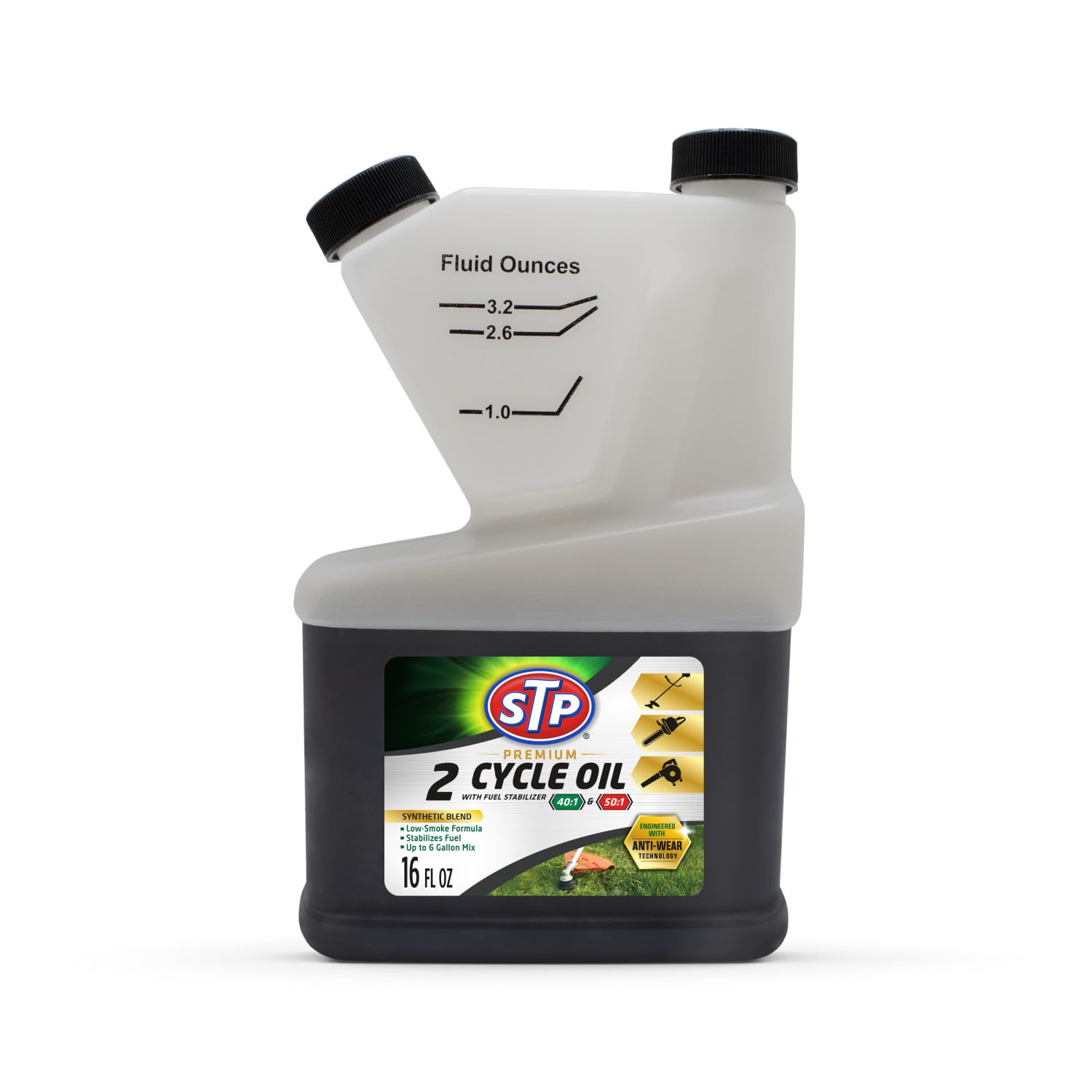
The JASO FD rated blend that commercial pros trust for their Echo gear
Serious owners compare this 16-fl-oz blend directly to Echo’s Red Armor oil, noting both carry the JASO FD rating — the highest certification tier for two-stroke engine lubrication, which tells you the anti-wear protection is genuinely top-tier. STP packs it with anti-oxidants that fight thermal breakdown of the oil when the engine runs hot, plus detergents that keep internal components clean and control carbon deposits that can seize a piston ring. Run this in air-cooled 2-cycle engines and it provides corrosion protection, while the built-in fuel stabilizer keeps the gas stable through those long stretches of infrequent use.
The measuring cup built right into the bottle is the detail that wins people over — owners call the dispenser great and note it gives you exactly the right amount of stabilizer every time, making the whole routine nearly simple to use. That ease of use matters on a product you’ll mix repeatedly over a season, not just once. The formula is a quality synthetic blend that keeps lawn equipment running smoothly, and it does all of this while doubling as a stabilizer so you do not need a second bottle for storage.
This 16-fl-oz size is the entry point to a system — one reviewer mentions buying the same JASO FD rated oil (a standard for high-performance two-stroke oils) by the gallon and refilling the 16-oz bottle, which is a cost-effective habit if you run commercial gear daily. The one honest trade-off is that this is a smaller volume than the 1-liter jugs on the market, so heavy users will refill more often. For a homeowner with a couple of tools, though, the size is perfect, and the price lands it firmly in easy-to-try territory.
Built-in measuring: the integrated cup on the bottle makes mixing accurate and fast — the aspect owners mention most after the lubricating performance itself.
Best for: owners of Echo or similar 2-stroke equipment who want JASO FD grade protection and a stabilizer in one tidy 16-oz bottle.
Think twice if: you burn through a liter a season — this size means more frequent refills before the next purchase.
3. STP Multi-Purpose Motor Treatment and Fuel Stabilizer

One 16-oz can that treats gas, diesel, two-stroke, and four-stroke alike
This is the most flexible stabilizer in the lineup because it works with gas, diesel, two-stroke, and four-stroke engines — so a single 16-oz can serves your chainsaw, your lawnmower, your snowblower, and even your car if needed. STP splits its job into two modes. For engines in storage, it stabilizes the fuel, fights rust buildup in the fuel tank, prevents oxidative degradation, fights tough cold starts, and removes water to prevent fuel line freeze. For engines in active use, it cleans deposits, fights friction, cleans fuel injectors and intake valves, and provides upper cylinder lubrication.
At just 1 lb, this is noticeably the lightest bottle in this comparison — the Opti-2 jug above weighs in at 2.1 lb, so this one is easier to tuck into a toolbox or carry out to the shed. The formula contains no corrosion-causing alcohol, which matters for any engine that sits for months, and STP says it helps restore lost horsepower and performance on engines that have been running on degraded fuel.
The honest trade-off is that this is a pure fuel treatment, not an oil — so it is designed to be added to fuel that already has your preferred 2-stroke oil mixed in. That makes it ideal if you already run a specific oil brand and just want a stabilizer layer on top, or if you want one additive that covers every engine on your property. Its multi-engine reach is precisely what makes it the budget-friendly pick: you buy one can instead of three specialty products.
One can, whole fleet: the multi-fuel compatibility is the defining advantage here — it removes water, fights rust, and cleans injectors across every engine type you own.
Choose this for: households that want a single stabilizer to protect every gas, diesel, 2-stroke, and 4-stroke engine on the property.
Pass if: you want an oil-and-stabilizer combo in one mix — this additive assumes your oil is already in the tank.
4. Johnson Evinrude OMC OEM 2+4 Fuel Conditioner
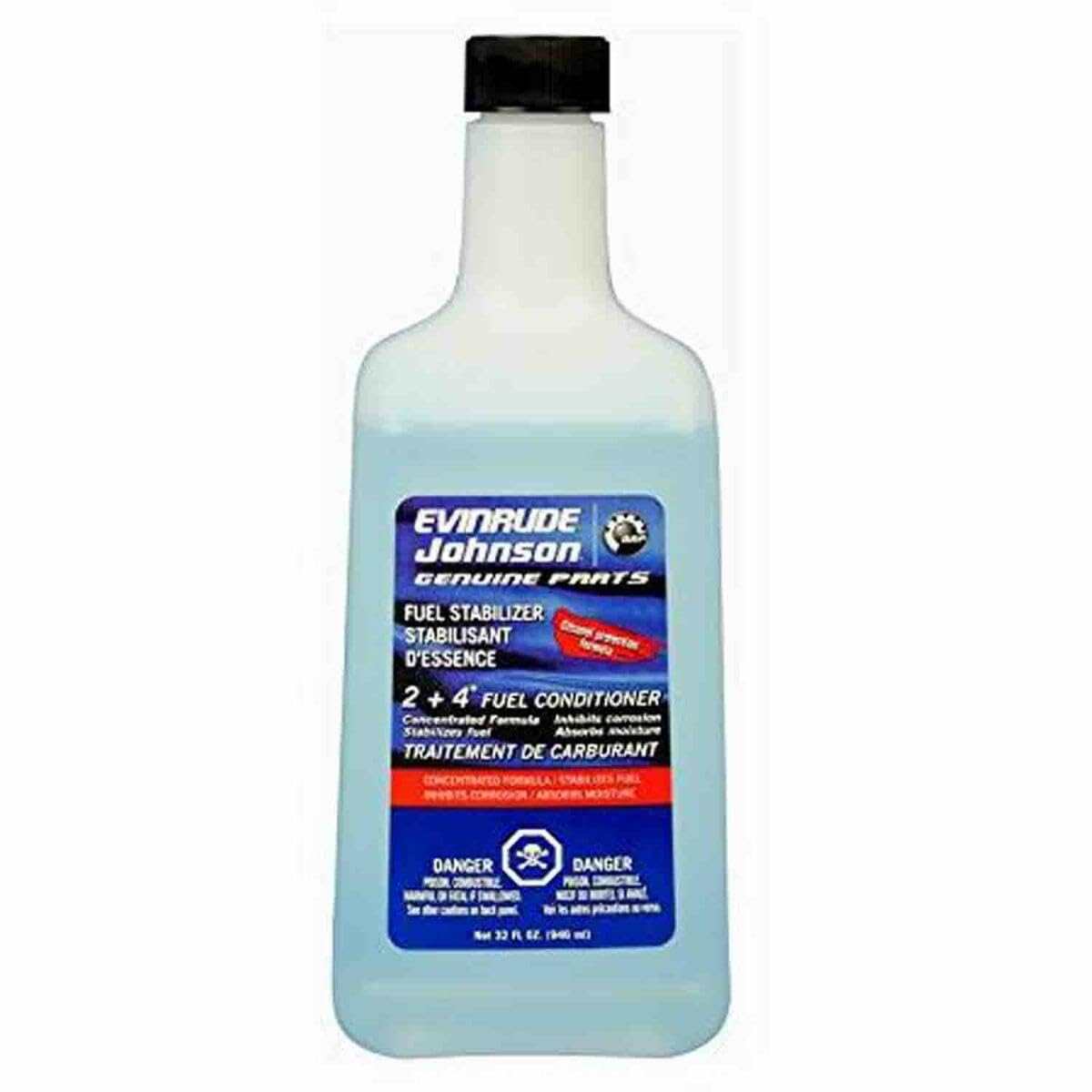
The OEM marine conditioner that keeps ethanol-treated boat gas firing up two years later
This 32-oz bottle comes straight from the original equipment manufacturer for Johnson and Evinrude outboards, and it is built for the harshest storage scenario in the two-stroke world: a boat sitting on a trailer all winter. The concentrated formula stabilizes fuel, inhibits corrosion, and absorbs moisture — the triple threat that ethanol-blend marine gas demands. Customers note treating ethanol gas at the station and the boat firing right up after the mix sat for up to two years.
Unlike the multi-purpose STP above, this conditioner is a focused marine treatment sized at 32 oz and weighing 16 oz, and it is rated for both 2-stroke and 4-stroke gasoline engines. That water-absorption duty is the standout feature for boaters, because ethanol fuel pulls moisture from the air into your tank and carburetor — the exact failure mode this formula is engineered to neutralize. The OEM pedigree means this is the same chemistry the factory trusts for its own outboards, not a generic aftermarket guess.
The trade-off is that this is a conditioner and stabilizer, not an oil — like the STP Multi-Purpose, you add it to fuel that already has your 2-cycle oil mixed in. It also carries a premium price for 32 oz, which makes sense for a boat owner protecting a significant investment, but it is overkill if you only need to winterize a single trimmer. If you trailer a boat and pull up to a gas station that only sells ethanol blend, this is the bottle owners keep reaching for.
Why boaters choose it
- OEM formula from the Johnson Evinrude factory, so it is matched to their outboards
- Absorbs moisture — the key defense against ethanol-induced corrosion
- Keeps treated gas ready for up to two years, per long-term owner reports
- 32-oz size covers a full season of marine fueling
What to weigh
- Premium price relative to 16-oz stabilizers
- Pure additive — you still mix your own 2-stroke oil separately
Reach for this if: you winterize an outboard or any marine two-stroke and want factory-grade moisture absorption plus multi-season fuel life.
Look elsewhere if: your only 2-stroke is a small yard tool — the premium and 32-oz volume outweigh the benefit there.
Understanding the Specs
JASO FD Rating
This is the highest certification tier for two-stroke engine oil, set by the Japanese Automotive Standards Organization. An FD-rated oil delivers the strongest lubrication and detergency, which is why commercial operators trust it to prevent ring sticking in air-cooled engines. When you see JASO FD on a bottle like the STP Premium, you are looking at a genuine top-tier formulation, not marketing padding.
Flash Point
The flash point is the lowest temperature at which the oil gives off vapor that can ignite — so a higher number means the product is safer to store and handle around heat. The Opti-2 bottle lists a flash point of 110 °C, which is comfortably above typical garage temperatures. For a stabilizer you might keep in a shed all summer, that safety margin matters more than it sounds.
FAQ
Can I use a regular fuel stabilizer in a two-stroke engine?
How long does treated two-stroke fuel actually last?
What is the difference between a fuel stabilizer and a fuel conditioner?
Will a stabilizer fix fuel that has already turned to varnish?
Does a one-mix oil with stabilizer replace my normal 2-cycle oil?
Is an OEM stabilizer worth paying more for?
Will a two-stroke stabilizer work in my 4-stroke lawnmower?
How do I know how much stabilizer to add to my gas can?
Final Thoughts: The Verdict
For most buyers, the two-stroke fuel stabilizer winner is the Opti-2 2Cyc Oil because it combines the oil and the stabilizer into one mix that covers every 2-stroke tool you own, with owners reporting 5+ months of trouble-free winter storage and minimal smoke. If you want that top-tier JASO FD lubrication with a built-in measuring cup, grab the STP Premium 2-Cycle. And for a boat sitting all winter on ethanol gas, the Evinrude 2+4 Conditioner is the one to reach for, with owners seeing it hold fuel ready for up to two years.
How We Picked
We do not accept paid placement. Every pick is matched to a real buyer and a real use-case; we do not hands-on test units.
Sources & Methodology
Specifications: manufacturer listings and product documentation. Review insights: verified customer reviews, as of August 2026. Pricing: not shown on this page (it changes often); check the current price via the retailer link.
As an Amazon Associate, GoCarLife earns from qualifying purchases. This does not affect which products we feature.