
Our readers keep the lights on and the garage heater humming. As an Amazon Associate, I earn from qualifying purchases.
Specs are compiled from manufacturer listings and verified buyer reviews and can change over time — please confirm the key details on the product page before buying.
That slow, grinding turn on a freezing morning is your battery telling you it’s done. The fix isn’t just any replacement — it’s picking the right chemistry, size, and cold-cranking rating for your specific car. This guide breaks down the main battery types, explains the numbers that matter, and walks through eight top-rated options so you can buy with confidence.
I’m Mo Maruf — the founder and writer behind GoCarLife. This guide is built by comparing the manufacturers’ published specifications and the patterns across verified customer reviews, so you get each pick’s real strengths and trade-offs instead of marketing spin.
From budget-friendly flooded options to premium AGM powerhouses, here’s what you need to know before you pop the hood and shop for the types of automotive batteries.
Our Picks at a Glance


How To Choose The Best Types of Automotive Batteries
Choosing a car battery boils down to three questions: what technology does your car need, what size fits the tray, and how much starting power do you need on the coldest morning of the year. Nail these three specs and the battery will serve reliably for years.
Flooded vs. AGM vs. Spiral Cell
The classic flooded battery uses liquid acid and needs the occasional top-up. AGM (absorbent glass mat) batteries trap the acid in fiberglass mats, so they are sealed, spill-proof, and handle vibration better — which is why they are standard in modern start-stop cars. Spiral-cell batteries like the Optima RedTop coil the lead plates into cylinders for maximum vibration resistance and faster charging.
Match the Group Size First
The group size is the physical footprint standard (like BCI 47 or H5). It dictates whether the battery bolts into your tray and where the terminals land. Measure your old battery and compare the length, width, and height before you order — a battery with the right specs but wrong dimensions is useless.
Read the Cold Cranking Amps
Cold Cranking Amps (CCA) measure how much current a battery can deliver for 30 seconds at 0°F. CCA is the key spec for reliable winter starts. Match or beat the manual’s CCA rating to avoid cold-start failures.
Quick Comparison
| Model | Best For | CCA | Capacity (Ah) | Weight | Amazon |
|---|---|---|---|---|---|
| MARXON Group 47 H5 L2★ Best Overall | Start-stop & Euro cars | 660 | 60 | 41 lbs | Amazon |
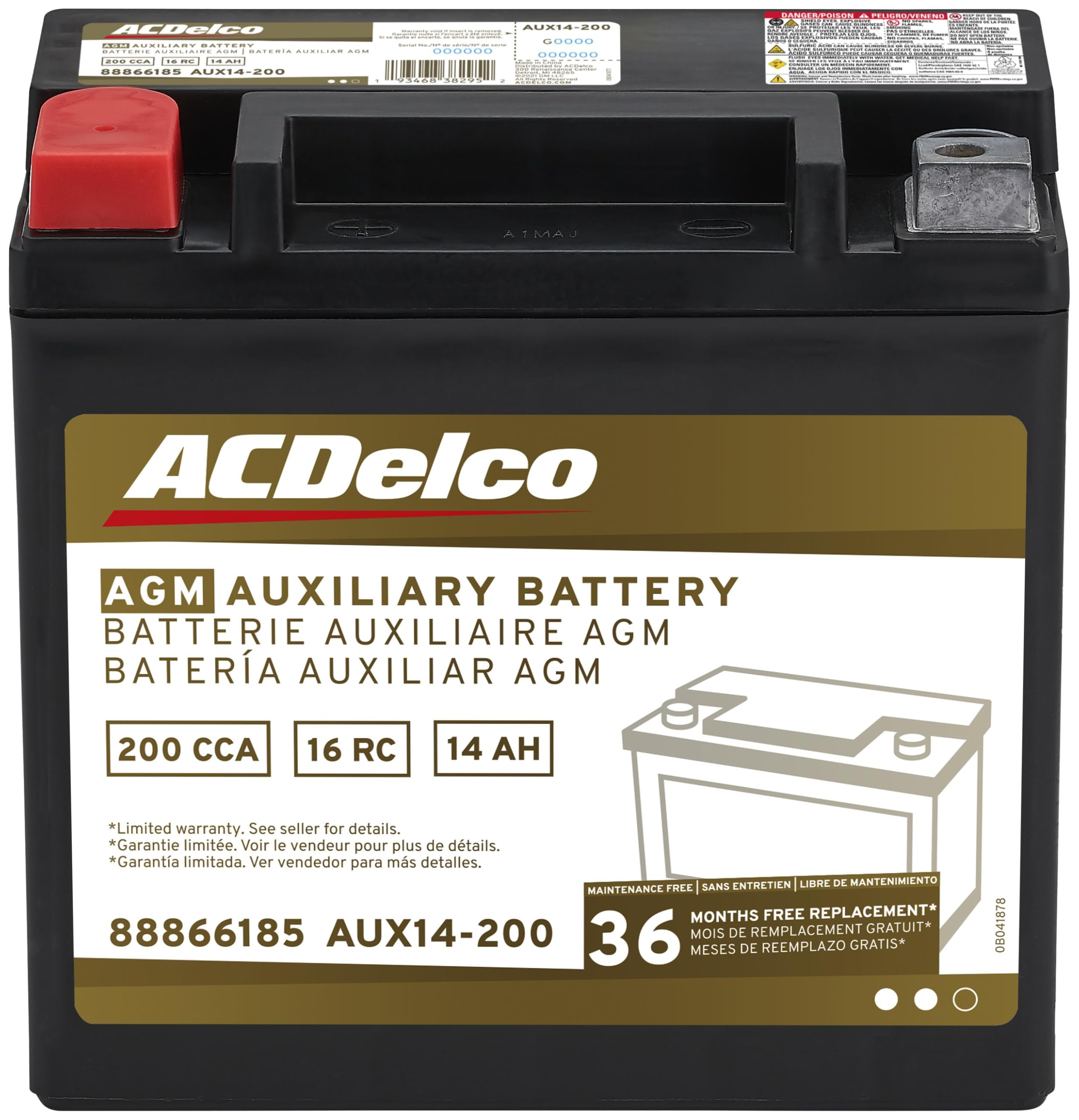
| ACDelco Gold AUX14-200Compact Auxiliary Pick | Auxiliary/start-stop | 200 | 12 | 10.9 lbs | Amazon |
| Weize Platinum AGM 24FCrowd Favorite | High-CCA daily drivers | 710 | 70 | 46.1 lbs | Amazon |
| Goodyear 47-H5-AGM | Reliable all-weather starts | 680 | 60 | — | Amazon |
| Interstate MTX-94R/H7 | Long-life pure lead AGM | 850 | 80 | — | Amazon |
| OPTIMA 34 REDTOP | Vibration-heavy trucks | 800 | 50 | 37.9 lbs | Amazon |
| OPTIMA DH7 YELLOWTOP | Dual-purpose & high loads | 880 | 80 | 54 lbs | Amazon |
| Odyssey ODX-AGM65 | Extreme performance | 930 | — | 60 lbs | Amazon |
In‑Depth Reviews
1. MARXON Group 47 H5 L2 Car Battery
Our pick — 4.5★ from 700+ verified ratings; the strongest balance of quality and price.
The AGM workhorse that brings modern start-stop tech to a budget-friendly price.
This MARXON delivers 660 cold cranking amps from a 60Ah AGM cell, which means your engine fires up reliably even when the mercury drops. The AGM (absorbent glass mat) construction means no water top-ups ever, and the spill-proof sealed case keeps corrosion off your terminals.
It is built for cars with start-stop systems, where the engine cuts off at red lights and restarts constantly — a duty that kills ordinary flooded batteries. Buyers report it charges to 97-98% capacity and shrugged off a deep discharge to 11V before restarting a V6, a resilience that comes from the AGM design’s tolerance for deep cycling.
At 41 pounds it is a solid, heavy unit that fits Euro cars and modern crossovers alike, with a 3-year replacement warranty backed by a US local office. It offers AGM performance at a budget-friendly price.
Why It Wins
- 660 CCA and 60Ah give strong all-weather starting
- Start-stop compatible with fast charging
- 3-year warranty with US-based support
Watch Out For
- At 41 lbs, it’s heavier than basic replacements
- Some units arrive with a weak top after shipping
The pick for: anyone with a start-stop or Euro car who wants AGM reliability without paying premium prices.
Think twice if: your car needs a Group 24F or 94R footprint — check your tray dimensions first.
2. ACDelco Gold AUX14-200
The tiny 10.9-pound second battery that keeps your start-stop system alive.
This ACDelco Gold is an auxiliary battery — the small second unit that powers your car’s start-stop electronics when the main battery rests. At just 10.9 pounds and 3.4″D x 5.9″W x 5.7″H, it is dramatically smaller than a main battery like the MARXON above, which measures 6.89″D x 9.53″W x 7.48″H and weighs 41 pounds.
It delivers 200 CCA, which is plenty for the job of keeping sensors and computers alive while the engine is off. The AGM construction is maintenance-free and leak-proof, and the high-density plate oxide gives dependable cycling for the constant charge-discharge rhythm of stop-start driving.
Owners mention it slots into the battery compartment perfectly and saves real money versus dealer-installed replacements. GM-backed fit means it drops into most makes and models, and the 36-month free replacement warranty covers the parts.
The recurring gripe is lifespan — some aux batteries give out inside a year, and the warranty process can push you through Amazon rather than ACDelco directly. That said, as a direct OEM-style swap for a failing auxiliary battery, it is hard to argue with the price.
The smart swap: this is the economical path to fixing a start-stop fault without a dealer visit.
Grab it for: a quick, cheap fix for a dead auxiliary battery in a start-stop vehicle.
Look elsewhere if: you need a main starting battery — this is far too small for that job.
3. Weize Platinum AGM Battery BCI Group 24F
The high-capacity AGM that out-cranks most rivals and holds a charge for weeks.
You get more reserve power for accessories and longer sits between drives with the Weize Platinum, a Group 24F battery (a standard size for many cars) that delivers 710 cold cranking amps (the starting power in cold weather) and 70Ah of capacity (a measure of energy storage). That is 70Ah versus the MARXON’s 60Ah, so you can run your radio or lights longer without worry. Customers note it starts a 2007 Lexus ES 350 after a 7-day sit, unlike the old flooded unit.
The AGM internals hold acid in glass fiber mats, so it shrugs off vibration and extreme temperatures from -22°F to 158°F. Rated at 710 CCA and measuring 771 CCA at 12.8v on a load test, one owner found it arrives fresh and over-delivers on its spec sheet.
You get a 3-year warranty and a 46.1-pound build, making this a serious upgrade for daily drivers, hybrids, and vehicles with high electrical loads. Thousands of reviewers point out more wins than losses, making it a safe bet.
The honest catch: a handful of shoppers say premature failure inside four months, and the battery is not suited for deep-cycle solar or marine work. Measure your tray and verify terminal orientation (left negative, right positive) before ordering.
The High Points
- 710 CCA and 70Ah beat most comparably priced rivals
- Holds charge well during long parking periods
- Wide -22°F to 158°F operating range
The Trade-offs
- A few units fail within months
- Not for deep-cycle solar or marine use
Reach for it if: you want maximum starting power and charge retention for the money.
skip it if: you are shopping for an auxiliary battery or need deep-cycle capability.
4. Goodyear 47-H5-AGM Platinum Series
A tire giant’s AGM that promises unstoppable starts in any weather.
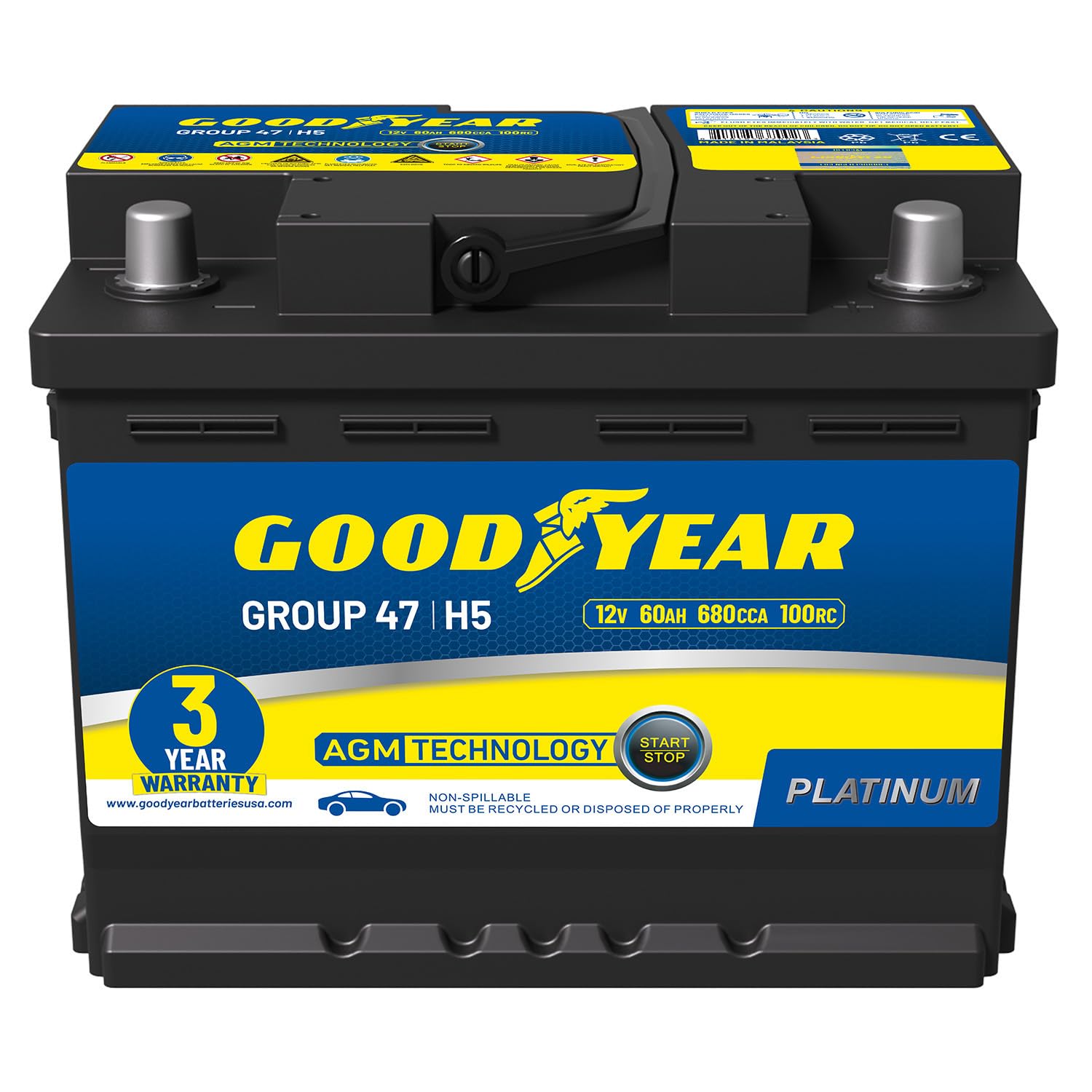
Goodyear brings its reputation for durability to the battery world with this 12V 60Ah AGM, delivering 680 cold cranking amps and a 100-minute reserve capacity. The reserve capacity (RC) number is the key here — it tells you how long the battery can run your car’s electronics if the alternator fails, and 100 minutes is solid protection.
Buyers report not just reliable starts but a noticeable upgrade in electrical stability: LED headlights run brighter with no flicker at idle after the swap. The AGM design is spill-proof and vibration-resistant, and Goodyear says it offers a longer cycle life than conventional batteries.
It is certified CE (a safety mark for products sold in Europe) and built in an ISO-certified factory (meeting international quality standards), and the 36-month warranty adds confidence. The physical footprint is 9.37 x 6.75 x 7.50 inches with positive on the right, negative on the left — so double-check your tray before committing.
The size gets mixed feedback, with some owners finding it too tall for certain trays, and the warranty path can be awkward if you need a claim. Still, for an auxiliary or main battery where fit is confirmed, this is a strong all-weather choice.
The honest read: strong cranking and a cleaner electrical system, provided it fits your tray.
Choose it for: a dependable AGM upgrade that stabilizes voltage and starts fast in cold weather.
Measure first: the height has caught out some owners — confirm your tray clearance.
5. Interstate Batteries MTX-94R/H7 AGM

Pure-lead AGM engineering from a name trust for 70-plus years.
Interstate’s MTX design crams more lead into the case, and that extra lead is why this battery claims a longer service life than a conventional alloy AGM and a flooded battery. At 850 CCA and 80Ah in a Group 94R footprint, it out-cranks both the MARXON (660 CCA) and the Weize (710 CCA) while carrying more total energy.
The pure-lead AGM construction suspends electrolyte in fiberglass mats instead of free-flowing liquid, which makes it spill-proof and vibration-resistant. Owners mention it saves tired SUVs from the junkyard — one saved an old Suburban in the Indiana snow, firing right up.
It is a heavy unit, and wrestling it past a radiator overflow can be the hardest part of the install. Worth noting: some owners found the manufacture date was already a year old on arrival, and a few report the fit is snug or the battery dies quickly in rare cases.
Despite mixed life reports, Interstate’s 70-year reputation tips the odds in its favor. For a luxury SUV, truck, or any vehicle that demands serious cranking power, this is a premium pick that earns its reputation.
What You Gain
- 850 CCA for easy cold starts
- 80Ah capacity for high electrical loads
- Pure-lead AGM for long service life
What To Expect
- Heavy and awkward to install
- Some arrive with an older manufacture date
Best for: large SUVs and trucks that need maximum cranking and long life.
Consider otherwise: if fitting is tight in your tray, the extra bulk may frustrate you.
6. OPTIMA 34 REDTOP

The spiral-cell icon built to outlast brutal vibration and start fast.
The Optima RedTop uses SPIRALCELL technology — lead plates coiled into cylinders rather than stacked flat — which delivers 99.99% pure lead performance and makes it more resistant to vibration than a standard flooded battery. At 800 CCA and 50Ah with a 100-minute reserve capacity, it is engineered for starting, not deep cycling, and it charges faster than conventional cells.
Customers note it starts trucks super-fast and shrugs off harsh winters that left weaker batteries grinding. One owner got 8 years out of a RedTop in a V8 Grand Cherokee — a longevity story that explains the brand’s cult following among off-roaders and truck owners.
The 37.9-pound sealed case is maintenance-free and can be mounted in multiple positions, giving flexible installation in tight engine bays. The honesty check: a few reviewers point out early failure within months, often traced to charging with a wrong charger — this battery wants an AGM-specific charger at 6 amps or less.
The premium price is justified by its vibration resistance for rough-road and high-load use.
The Big Wins
- High vibration resistance vs flooded
- 800 CCA for fast, reliable starts
- Versatile mounting positions
Know Before You Buy
- Needs an AGM-specific charger
- Premium price for the brand
Perfect for: trucks, off-road rigs, and anyone battling vibration or harsh winters.
Not ideal if: you want maximum reserve capacity for deep accessory use — that is the YellowTop’s job.
7. OPTIMA DH7 YELLOWTOP

The heaviest hitter here, blending starting power with serious accessory stamina.
You can start your engine and power winches, lighting, or audio without draining the battery, thanks to the Optima YellowTop, the dual-purpose member of the Optima family. It delivers 880 cold cranking amps (starting power in cold weather) and an 80Ah capacity (energy storage), with a 155-minute reserve capacity (how long it runs accessories on its own) — the largest reserve figure in this guide.
PUREFLOW technology packs 99.99% pure lead into compressed radial grid plates, giving the same high vibration resistance as the RedTop and a longer service life than a flooded battery. At 54 pounds, this is a serious chunk of hardware, and owners note it fits vehicles like the 2015 Chevy Silverado High Country exactly, powering every electrical component without complaint.
The longer reserve capacity (155 minutes vs the RedTop’s 100) is the practical difference — it keeps your accessories alive longer if the alternator fails. Owners praise its rock-solid reliability after installation, with no problems reported.
The price is the steepest in the Optima range, and battery life draws mixed opinions, with rare reports of early death. But the DIN A1 terminals and Group 94R footprint cover a wide swath of modern vehicles.
The standout spec: that 155-minute reserve capacity — nobody else here matches it.
Worth it for: drivers who run heavy accessories and need a battery that starts AND sustains.
Overkill if: your car is a simple daily driver with stock electronics.
8. Odyssey ODX-AGM65 Extreme Series

The 930-CCA monster that spins heavy diesel engines after months of sitting.
You get the strongest starting punch in this guide with the Odyssey Extreme Series, rated at 930 cold cranking amps (starting power in cold weather) and 1750 PHCA (pulse hot cranking amps, a measure of burst power on demand). It is built for the most demanding starts — shoppers say it spins Ford 7.3 and 6.0 diesel engines easily, even after the vehicle sat idle for 3 months.
The 135-minute reserve capacity and low static discharge make it ideal for standby or generator use, where a battery must hold charge for long stretches and deliver instantly. Tin-plated brass SAE posts resist corrosion, and the 4-year manufacturer warranty is the longest protection in this lineup.
It is genuinely heavy — 60 pounds in a Group 65 footprint — and owners warn it is noticeably heavier than the battery it replaces. Worth noting: battery life gets mixed feedback, with a few owners reporting a complete failure after 12 months, which is frustrating at this price point.
The value-for-money debate is real: some call it the best battery money can buy, others find it expensive. For a heavy-duty truck or diesel owner who demands maximum cranking and long idle periods, the Odyssey is the serious option.
The Heavyweight Edge
- 930 CCA — the highest in this guide
- 1750 PHCA for instant heavy starts
- 4-year warranty coverage
Weigh The Cost
- 60 lbs — the heaviest here
- Premium price with mixed life reports
Built for: diesel trucks and vehicles that demand maximum cranking after long sits.
Reconsider if: you are budget-conscious or your car only needs modest CCA.
Understanding the Specs
Cold Cranking Amps (CCA)
CCA is the industry standard for how much current a battery delivers for 30 seconds at 0°F. It is the number that decides whether your engine turns over on the coldest morning. Match or beat your owner’s manual recommendation — going higher never hurts, going lower risks a no-start.
Reserve Capacity (RC)
Reserve capacity measures how many minutes a battery can run your car’s essential electronics if the alternator dies. A higher RC means more time to reach a shop before you lose power. It also reflects how well the battery tolerates deep discharge from accessory use.
FAQ
What is the difference between AGM and flooded car batteries?
How do I know which group size battery fits my car?
Can I replace a flooded battery with an AGM battery?
What does cold cranking amps (CCA) actually mean for me?
Is a higher CCA always better?
How long should an AGM car battery last?
What is reserve capacity and why does it matter?
Can I mount an AGM battery in any position?
What is the difference between a starting battery and a dual-purpose battery?
Final Thoughts: The Verdict
If you want one dependable pick, the types of automotive batteries winner is the MARXON Group 47 because it delivers genuine AGM reliability — 660 CCA and start-stop compatibility — without the premium price. If you want maximum cold-cranking power for a heavy truck, grab the Odyssey ODX-AGM65. And for auxiliary battery swaps in start-stop vehicles, the ACDelco Gold AUX14-200 is the one to reach for.
How We Picked
We do not accept paid placement. Every pick is matched to a real buyer and a real use-case; we do not hands-on test units.
Sources & Methodology
Specifications: manufacturer listings and product documentation. Review insights: verified customer reviews, as of August 2026. Pricing: not shown on this page (it changes often); check the current price via the retailer link.
As an Amazon Associate, GoCarLife earns from qualifying purchases. This does not affect which products we feature.