
Our readers keep the lights on and the garage heater humming. As an Amazon Associate, I earn from qualifying purchases.
Specs are compiled from manufacturer listings and verified buyer reviews and can change over time — please confirm the key details on the product page before buying.
When your ball joints (the pivot points connecting your steering knuckles to your control arms) wear out, you’ll feel a wobble in the wheel, uneven tire wear, and a loose, wandering feel on the highway. The real question is which type fits your truck, driving style, and budget. Here’s a breakdown of the best types for everyday drivers, off-roaders, and heavy-duty truck owners, so you know exactly what you’re buying before you start turning wrenches.
I’m Mo Maruf — the founder and writer behind GoCarLife. This guide is built by comparing the manufacturers’ published specifications and the patterns across verified customer reviews, so you get each pick’s real strengths and trade-offs instead of marketing spin.
Whether you’re refreshing a daily driver or building a serious off-road rig, understanding the types of ball joints is what separates a smooth, reliable suspension from a constant headache of rework and premature wear.
Our Picks at a Glance


How To Choose The Best Types of Ball Joints
Choosing the right ball joint depends on three things: your vehicle’s exact model year, if you want a sealed or greaseable unit, and how aggressively you drive. Get any of these wrong, and you’ll get a part that doesn’t fit or fails early.
Match the joint to your exact application
Ball joints are not one-size-fits-all. A joint built for a 2005 Ford F-150 will not work on a 2013 Subaru Outback, and a heavy-duty kit for a Jeep Wrangler’s Dana 44 axle won’t bolt onto a stock Honda CR-V. Always verify the compatibility list covers your specific year, make, and model before purchasing.
Decide between sealed and greaseable
Factory sealed joints are maintenance-free but throwaway — once the grease is gone, you replace the whole part. Greaseable units have a fitting that lets you pump in fresh grease, which flushes out dirt and water and can significantly extend the life of the joint.
Know your control arm type
Most stock vehicles use press-in joints, which require a hydraulic press or a ball joint press tool to remove and install. Some aftermarket control arms use bolt-in joints, and these will only fit the specific brand of arm they’re designed for — a common source of fitment frustration.
Quick Comparison
| Model | Best For | Config | Weight | Greaseable | Amazon |
|---|---|---|---|---|---|
| MOOG K80149★ Best Overall | Ford F-150/Expedition daily drivers | Front Lower | 1.57 lbs | Yes | Amazon |
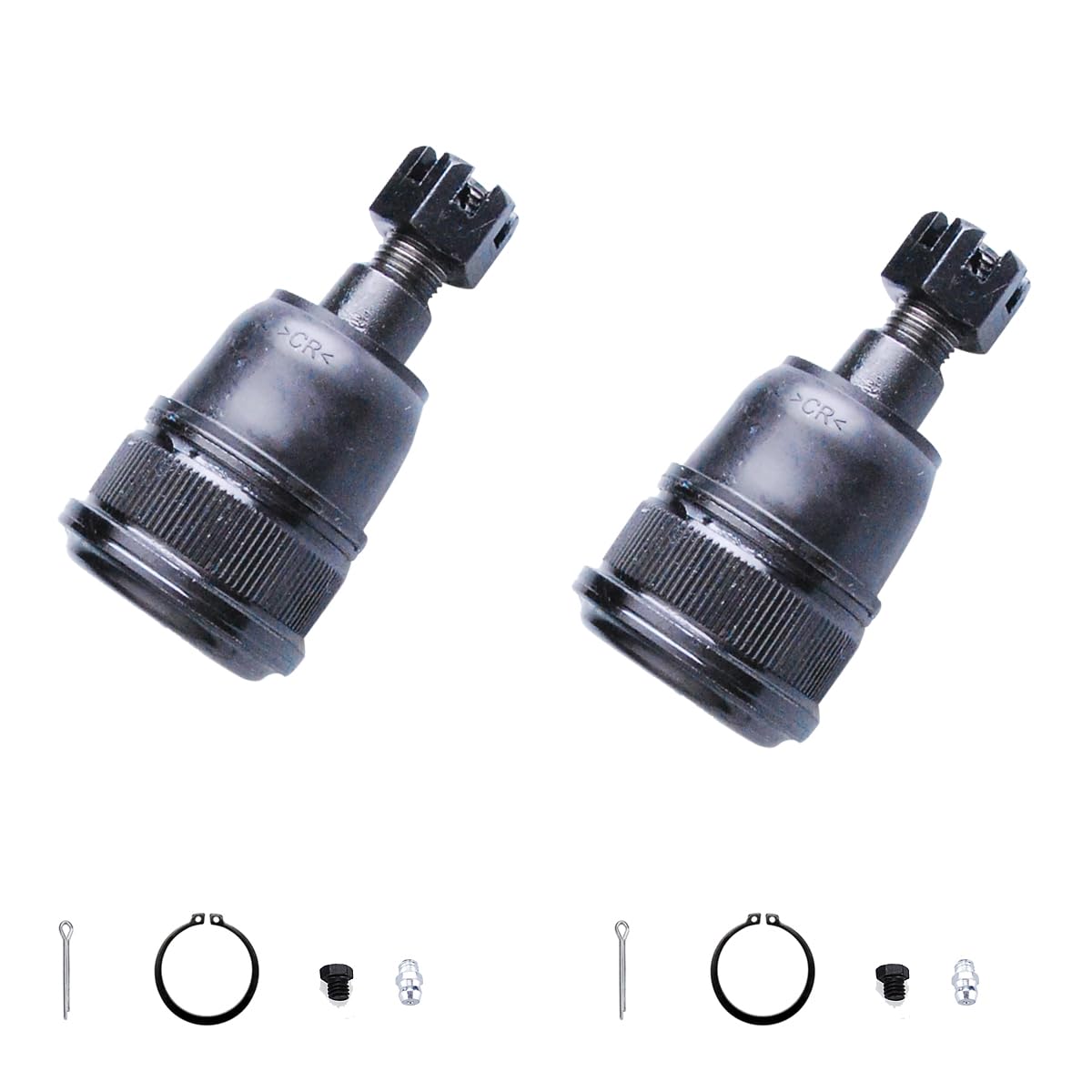
| HHCM K80223Best Value Kit | Honda CR-V / Element owners | Front Lower (2pc) | 12.2 oz | Yes | Amazon |
| MOOG K9513Subaru Specialist | Subaru owners (Outback, WRX, Forester) | Front Lower | 13.6 oz | Yes | Amazon |
| MotorbyMotor 4pc | Jeep Grand Cherokee / Wrangler | Upper & Lower (4pc) | 5.1 lbs | Yes | Amazon |
| Kryptonite KR6292 | Chevy/GMC trucks w/ aftermarket arms | Bolt-in Upper | — | Yes | Amazon |
| Spicer 706944X | Jeep TJ / XJ with Dana 30/44 | Upper & Lower (one side) | 2.3 lbs | Yes | Amazon |
| Rough Country 10626 | Jeep JK Wrangler 07-18 | Upper & Lower (4pc) | 5.45 lbs | Yes | Amazon |
| DV8 D-JKBLJNT-01 | Jeep JK Wrangler 07-18 | Upper & Lower (4pc) | 5.15 lbs | Yes | Amazon |
In-Depth Reviews
1. MOOG K80149 Front Lower Suspension Ball Joint for Ford F-150
Our pick — over 4.5★ from 850+ verified ratings; the strongest balance of quality and price.
The proven F-150 fixer that brings a sloppy front end back to life
For owners of 2003-2008 Ford F-150s, 2003-2006 Expeditions, and 2006-2008 Lincoln Mark LTs, this is the joint that ends the steering wander. At 1.57 pounds, it’s a solid, properly built press-in unit designed to enable controlled pivoting movement between suspension parts, which translates to stable handling and predictable steering response.
The grease fitting is where this joint separates itself from cheap factory replacements. Being able to pump fresh grease into the joint pushes out moisture and grit, which is why buyers report these still working great years after installation. Most owners say the quality matches or beats the factory original.
The honest trade-off here is that the grease nipple can be a chore to thread in during installation, and a handful of owners find getting grease into the fitting finicky. That’s a minor gripe against a part that restores proper alignment and consistent vehicle control for confident daily driving.
What F-150 owners love
- Perfect fit with all hardware included
- Greaseable design extends service life
- Quality that matches or beats factory OEM parts
The install reality
- Grease fitting can be stubborn to seat
- Takes muscle and the right press tools
Grab this if: you drive an F-150 or Expedition and want a greaseable, quality joint that restores steering stability.
Think twice if: you don’t own a press or aren’t comfortable wrestling with a stubborn grease fitting during install.
2. HHCM Front Lower Ball Joint Kit for Honda CR-V 2002-2006 / Element
A budget-friendly two-pack that nails the exact fit for CR-V owners
If you drive a 2002-2006 Honda CR-V or a 2003-2005 Honda Element, this two-piece kit delivers both front lower joints at once — replace both sides and you won’t have to crawl back under the car in six months. At just 12.2 ounces per joint, these are noticeably lighter than the 13.6-ounce MOOG Subaru unit, but they’re built to the international original factory standard with precision tolerances, so installation is straightforward.
Owners mention these seat perfectly in their cars, and the included grease fitting means you can keep them lubricated for the long haul. The value stands out: a matching pair, a 12-month warranty, and a price that makes replacing both sides painless.
The catch is fitment nuance: some owners note the joint sits slightly high and doesn’t play well with aftermarket control arms, and the boots have shown a tendency to crack for a few buyers. This is the right choice for a stock, unmodified CR-V or Element, not a build.
Perfect-match value: A two-for-one kit that fits stock CR-Vs and Elements perfectly, with a 12-month warranty backing it up.
Fitment watch: Stick to factory control arms — aftermarket arms can cause the joint to sit too high.
3. MOOG K9513 Front Lower Suspension Ball Joint for Subaru Outback
The machined joint Subaru owners trust after 188,000 hard miles
This MOOG joint is the definitive fix for the Subaru family, covering the Outback, Forester, Impreza, Legacy, WRX, WRX STI, and Crosstrek across a massive range of model years — from a 1988 XT all the way up to a 2024 Legacy. At 13.6 ounces, it’s the heavier of the two MOOG units here, and that heft comes from a machined exterior built to withstand road stress and varying driving conditions, so it lasts longer.
The thing everyone raves about is the quality — owners with 188,000-mile joints that had torn boots and no grease left report these restore solid steering response immediately. Customers note MOOG joints lasting 35 years without failure, while cheap alternatives failed within months. This joint proves that paying more upfront avoids costly rework.
There are two honest caveats. For WRX owners with STI aluminum control arms, you’ll need a steel “Boss Transverse Link” cone to make it work, and some reviewers point out the stock bolt isn’t large enough for their application. Durability gets mixed chatter, with one rare report of a failure within 100 miles, though the overwhelming pattern is years of trouble-free service.
Why owners trust it
- Machined construction with excellent quality reviews
- Fits an enormous range of Subaru models 1988-2024
- Perfect fit with all necessary hardware included
Before you buy
- WRX with STI arms needs an extra cone part
- Stock bolt may be undersized for some setups
Reach for this if: you own nearly any Subaru from the last three decades and want a machined, reliable joint that handles daily abuse.
Look elsewhere if: you’re building a WRX with STI control arms and don’t want to source additional conversion parts.
4. MotorbyMotor 4pc Front Upper and Lower Ball Joint Kit for Jeep Grand Cherokee / Wrangler

The complete front-axle refresh at a price that’s hard to argue with
For 1999-2004 Jeep Grand Cherokees and 2007-2018 Jeep Wranglers, this 5.1-pound kit gives you all four joints — two K3134 uppers and two K3185 lowers — so you can overhaul the whole front axle in one go. That’s the smart move on a Jeep, because mixing old worn joints with new ones just means the old ones fail next and you’re back under the truck.
Shoppers say paying less than half the local parts store price with matching quality. The joints connect the control arms and steering knuckles, providing optimum vehicle control and even tire wear, which is exactly what a Wrangler needs to keep the steering tight.
Installation isn’t the easy part, and owners are honest that removing the old joints takes real effort. Fit itself is reported as perfect, and the price makes it the cheapest route to a firm front end on these Jeeps.
Whole-axle value: Four joints in one box at a budget price — the most economical way to refresh a Grand Cherokee or Wrangler front end.
Bring your tools: Extraction is labor-intensive; expect to work for it, and note a few owners bought without installing yet.
5. Kryptonite Bolt-in Heavy Duty Upper Ball Joint KR6292 for Chevy Silverado / GMC Sierra

The bolt-in joint for trucks already running upgraded control arms
This is a specialist part with a narrow audience: it’s designed for AFTERMARKET CONTROL ARMS ONLY — specifically Kryptonite, Cognito, FTS, CST, and Fabtech upper arms that use a bolt-in design. If you’ve already upgraded your Silverado or Sierra 1500HD, 2500HD, or 3500HD control arms, this 1.5-inch groove diameter joint bolts straight in with a 3/8-inch hexagon bolt.
It ships pre-greased with premium Chevron Ultra EP2 Grease, and the exclusive grease relief port makes keeping it lubricated genuinely easy. The thick rubber boot provides serious protection against the elements, which matters on a truck that sees dirt, mud, and road salt. Owners running 12,000 miles on these report no visible wear, and fitment on a GMC Sierra 2500HD was described as a good fit.
The honest picture is mixed here. Some buyers report the joint needed replacement after just a few months and called it not heavy-duty, while others have had zero issues. This one lives or dies by whether you have the right aftermarket control arms — if you do, it’s a clean solution; if you’re on stock arms, it won’t work at all.
Upgrade-ready: Pre-greased with premium grease and built with a grease relief port for easy servicing on modified trucks.
Verify your arms: Only works with aftermarket bolt-in control arms — it will not fit factory stock arms, and durability reports are split.
6. Spicer 706944X Suspension Ball Joint Kit for Dana 30/44

The factory-original joint that Dana axle owners swear by
For Jeep owners with Dana 30 or Dana 44 front axles, this is the genuine OE replacement — Spicer is the actual manufacturer of the factory joints, and this 2.3-pound alloy steel kit brings that exact original fitment. It includes the upper and lower joints for one side, plus the nuts, washers, sleeve, and cotter pin you need to finish the job.
Owners rave about the fit, especially on D30 front axles, describing it as glove-like on an 06 Rubicon with a Dana 44. The quality reads as factory original at a reasonable price, and the forum consensus among Jeep owners is clear on Spicer being the top choice.
Installation gets mixed feedback: it’s straightforward if you have a press, but it’s a very involved job if you don’t. A few owners have flagged missing parts in the box and some durability variance, but the overwhelming pattern is confident, long-term use. This is the pick for purists who want exactly what the factory installed.
Factory-exact: Genuine OE quality and fit for Dana 30/44 axles, with all hardware included for one side.
Press required: Expect an involved install without a proper ball joint press, and check the box for all included parts.
7. Rough Country Heavy Duty Replacement Ball Joints for 07-18 Jeep Wrangler – 10626

The chromoly-stud set that cures death wobble on lifted JKs
For 07-18 Jeep Wranglers with Dana 30 or Dana 44 axles, this 5.45-pound set of four joints (two upper, two lower) is built for the abuse of big tires and lifts. The chromoly ball stud and polyurethane dust boot are the defining specs — chromoly is a hardened steel alloy that resists bending, and polyurethane boots hold up better than cheap rubber against trail debris.
The real-world result is what owners notice: a severe wobble on a 2012 JK with 38-inch tires was cured completely, and the front end went firm and responsive again. The grease fittings get consistent praise, and the low-profile design fits tight without interfering. Rough Country backs this with a Limited Lifetime Replacement Warranty, which is rare at this level.
Installation requires a press with a pull handle and Jeep adapters, and the bottom grease fitting needs a slight inward turn and minor knuckle grinding before install. One owner had a boot split after two months, but Rough Country’s customer service replaced the whole set — that warranty is the safety net. Durability chatter is mixed, but for hard-use JK owners, these are a proven upgrade.
Built for the trail
- Chromoly stud and polyurethane boot for durability
- Cured severe death wobble on a lifted JK with 38s
- Lifetime Replacement Warranty from Rough Country
The install ask
- Needs a press, Jeep adapters, and minor knuckle grinding
- Boot durability has mixed reports despite the warranty
Grab this if: you run a lifted JK with large tires and want a greaseable set that tightens steering and survives trail use.
Think twice if: you don’t have a press and adapters, or you’d rather not grind the knuckle for the grease fitting.
8. DV8 Upgraded Ball Joints for Jeep Wrangler JK 2007-2018
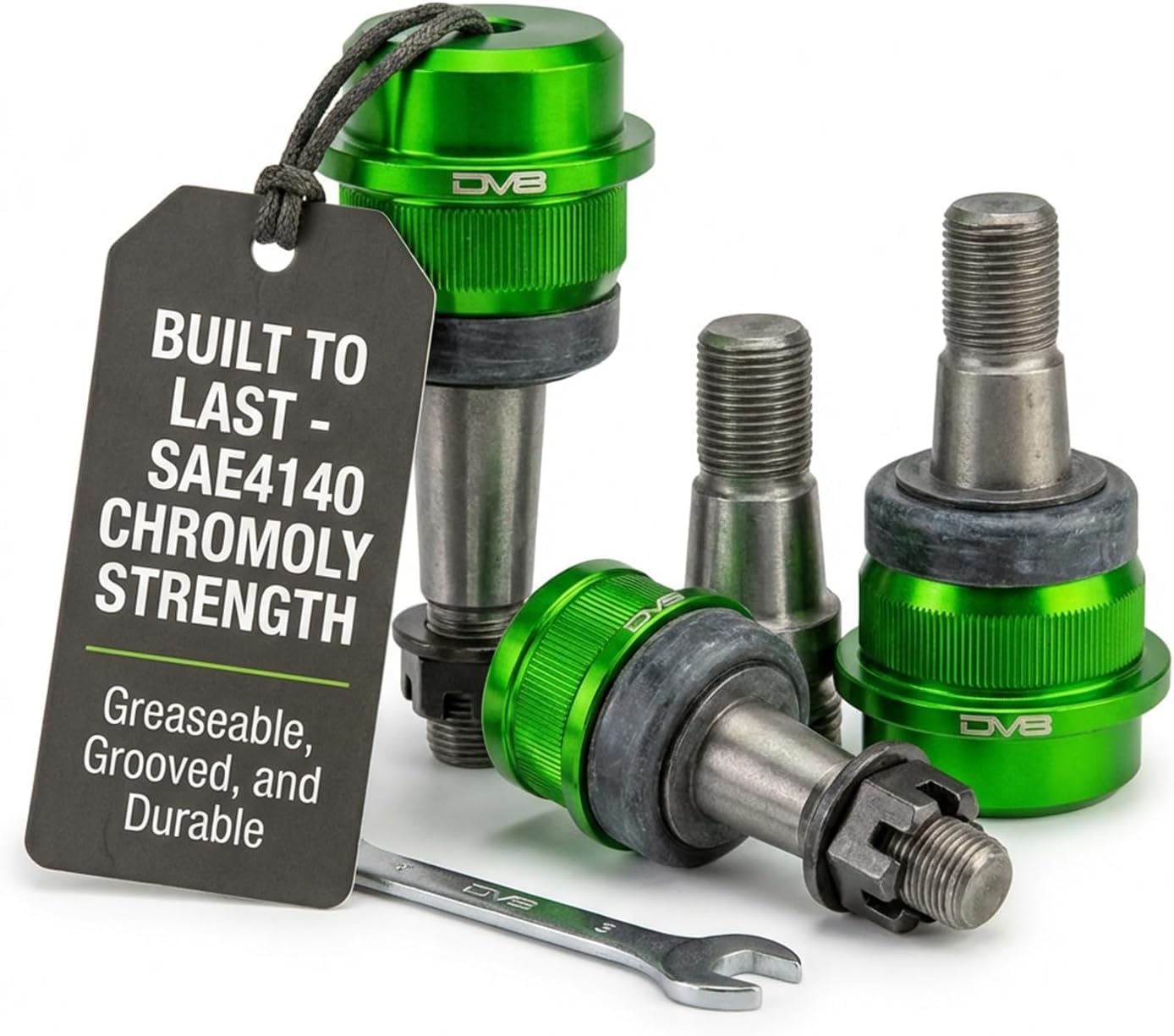
The CNC-machined 4-piece set with SAE 4140 chromoly studs built to lock into the knuckle
For Jeep Wrangler JK 2007-2018 models, this 5.15-pound kit delivers all four joints (two upper, two lower) engineered to press firmly into stock Dana 30 or Dana 44 steering knuckles. The defining spec is the material: the studs are heat-treated SAE 4140 chromoly paired with SAE 1045 housings — serious steel for serious loads.
The engineering answer to a common JK headache is the aggressive grooved splines machined into the housing, which bite into the knuckle to stop the joint from spinning. That’s the difference between a joint that stays put and one that works itself loose. Owners running 35s with 1-ton steering report over a year of issue-free service, and the greaseable design with integrated Zerk fittings lets you flush out old grease and trail gunk.
The kit includes all hardware and is designed to be a 2-to-4-hour front axle overhaul. The value is strong for what you get — owners describe it as strong, sturdy, and heavy duty, with the steering slop gone and the front end tight. Some mixed feedback on the joint quality itself exists, but the pattern is overwhelmingly positive.
Built to bite: SAE 4140 chromoly studs and grooved splines that lock into the knuckle, plus Zerk fittings for long life.
JK-specific: Only fits 2007-2018 Wrangler JK axles — verify your model before ordering.
Understanding the Specs
Greaseable vs. Sealed Design
A greaseable ball joint has a Zerk fitting (a small nipple) that lets you pump fresh grease into the joint with a grease gun. This flushes out dirt and moisture, which is the main cause of wear, and can significantly extend the life of the part. Sealed factory joints are maintenance-free but throwaway — once the grease is gone, the joint wears out and you replace the whole unit.
Chromoly vs. Standard Steel Studs
Chromoly (SAE 4140) is a hardened steel alloy that resists bending and deformation under heavy loads, making it the preferred material for lifted trucks and off-road rigs. Standard steel studs are fine for daily drivers but can bend or wear faster under the stress of large tires, lifts, and aggressive driving on uneven terrain.
FAQ
What’s the difference between an upper and lower ball joint?
How do I know which ball joint fits my vehicle?
How long do ball joints last?
Can I install ball joints myself?
What is a press-in vs. bolt-in ball joint?
Why does my steering feel loose or wander on the highway?
Are greaseable ball joints better than sealed ones?
What is a Zerk fitting and why does it matter?
Will a heavier joint last longer?
Final Thoughts: The Verdict
For most daily drivers, the types of ball joints winner is the MOOG K80149 because it pairs greaseable design with proven quality that owners trust for years. If you need a complete front-axle refresh on a Jeep, grab the Rough Country 10626 for its chromoly studs and lifetime warranty. And for Subaru owners who want a machined, wide-fitment joint, the MOOG K9513 is the one to reach for — the crowd favorite across Subaru builds, holding a 4.5-star score from 700+ owners, a strong sign of reliability.
How We Picked
We do not accept paid placement. Every pick is matched to a real buyer and a real use-case; we do not hands-on test units.
Sources & Methodology
Specifications: manufacturer listings and product documentation. Review insights: verified customer reviews, as of August 2026. Pricing: not shown on this page (it changes often); check the current price via the retailer link.
As an Amazon Associate, GoCarLife earns from qualifying purchases. This does not affect which products we feature.