
Our readers keep the lights on and the garage heater humming. As an Amazon Associate, I earn from qualifying purchases.
Specs are compiled from manufacturer listings and verified buyer reviews and can change over time — please confirm the key details on the product page before buying.
Picking a helmet by looks or price alone can leave you with a shell that whistles at highway speeds or presses on your forehead after an hour. Before you spend anything, know this: your head shape and the riding you actually do should decide the style — not the graphics, not the brand name, and definitely not the sticker price.
I’m Mo Maruf — the founder and writer behind GoCarLife. This guide is built by comparing the manufacturers’ published specifications and the patterns across verified customer reviews, so you get each pick’s real strengths and trade-offs instead of marketing spin.
The nine models here span modular flip-ups, full-face touring shells, retro 3/4 open-face options, and minimal half helmets. We break down how each fits, vents, and protects on real roads, so you can choose between the types of motorcycle helmets with confidence.
Our Picks at a Glance


How To Choose The Best Types of Motorcycle Helmets
The style of helmet you choose changes how much of your face is covered, how much wind noise reaches your ears, and whether you can flip the front up at gas stations. Start with the real question: what kind of riding fills most of your miles?
Full Face: Maximum Coverage, Maximum Noise Control
A full-face helmet wraps your entire head and jaw in one solid shell. It is the strongest choice for highway touring and sport riding because it protects the chin — the most common impact zone — and it blocks the most wind. The trade-off is heat and a tighter fit, so ventilation matters more here than in any other type.
Modular (Flip-Up): The Commuter Compromise
Modular helmets look like full-face shells but the chin bar hinges upward so you can talk, drink, or put on glasses without removing the helmet. That convenience costs a little weight and often a small amount of structural rigidity compared to a fixed full-face. Riders who stop frequently love them; pure track riders usually skip them.
Open Face (3/4) and Half Helmets: The Cruiser Vibe
Open-face helmets leave your jaw exposed for maximum airflow and a classic retro look, while half helmets cover even less. Both are popular with cruiser and chopper riders who want wind in their face. The honest trade-off is that neither protects your chin or teeth in a crash, and half helmets are the noisiest of all types at speed.
Quick Comparison
| Model | Best For | Type | Shell Material | Weight | Amazon |
|---|---|---|---|---|---|
| Shoei Neotec II★ Best Overall | Touring with premium modular convenience | Modular | Fiberglass / EPS | 4.1 lb | Amazon |
| MotuoMr Full FaceBudget Champion | New riders on a strict budget | Full Face | Polycarbonate / ABS | 1500 g | Amazon |
| ILM Model-317Two-Visor Value | Street riders wanting two visors included | Full Face | ABS / EPS | 1.86 kg | Amazon |
| BEON B-120 | Retro cruiser riders who want a sun visor | 3/4 Open Face | ABS | 1.72 kg | Amazon |
| LS2 Assault | Sport riders wanting a drop-down sun shield | Full Face | Kinetic Polymer Alloy | — | Amazon |
| BELL Pit Boss | Low-profile cruiser half-helmet fans | Half Helmet | Aramid / Carbon / Fiberglass | 1.67 kg | Amazon |
| HJC C91 | Modular riders wanting Bluetooth readiness | Modular | Polycarbonate | 3.5 lb | Amazon |
| ScorpionEXO T520 | Touring riders needing quiet comfort | Full Face | Polycarbonate | — | Amazon |
| Shoei RF-1400 | Performance riders wanting the quietest shell | Full Face | Fiberglass / EPS | 3.6 lb | Amazon |
In-Depth Reviews
1. Shoei Neotec II Modular Motorcycle Helmet
Our pick — over 4.5★ from 600+ verified ratings; the strongest balance of quality and price.
The flip-up touring titan that stays quiet well past legal speeds.
The Neotec II is built on Shoei’s Advanced Integrated Matrix (AIM) shell — a fiberglass and EPS blend that keeps the weight at 4.1 pounds while staying rigid on long hauls. That material choice is exactly why owners call it “super light” and easy to wear for hours, and why it disappears on your head instead of tugging at your neck in the wind.
Modular flexibility is the whole point here: the face cover and shield flip up so you can grab coffee or talk to a toll booth without unbuckling, yet it still delivers full-face protection when closed. The QSV-1 sun shield visor flips down for changing light, it is anti-fog and anti-scratch, and the included Pinlock EVO Lens handles cold-weather condensation. Ventilation is a genuine strong suit — owners in the rainy Pacific Northwest report zero fogging even when the vents are doing the work.
What wins people over is the build quality, which draws the most owner praise by far — the pieces fit tight, the ratchet chin strap adjusts smoothly, and glasses wearers say there is plenty of room. The trade-off is wind noise: buyers report it gets loud above 90 mph, and some still hear wind at highway speeds. A loud whistle can appear above 35 mph with the shield flipped up. It costs a premium, but owners consistently rate it the best non-carbon modular for touring.
Tour-ready comfort: The AIM shell and airflow system make this an all-day touring companion that riders call quieter and lighter-feeling than the previous generation.
High-speed caveat: Plan for earplugs on the interstate — wind noise is manageable but never disappears completely.
Reach for this if: you tour frequently and want the convenience of a flip-up with Shoei-grade protection and comfort.
Look elsewhere if: your budget tops out well below this level or you spend most miles over 90 mph and demand dead silence.
2. MotuoMr Full Face Motorcycle Helmet DOT Approved
The entry-level full-face that punches far above its sticker.
This MotuoMr shell uses a lightweight polycarbonate/ABS construction that meets DOT safety standards, and it keeps the whole thing at 1500 grams — light enough for a first helmet that you will not mind wearing. The quick-release buckle is the standout daily feature: it gets you on and off in seconds while still holding the helmet securely on your head.
Owners consistently talk about the fit and the smell-free, comfortable interior. As owners mention, it “fits perfectly, ear slots accommodate Bluetooth headphones” — a huge deal if you plan to add a comm unit later. The molded ear pockets mean you do not have to carve foam to fit speakers. The removable, washable lining and the padded wind collar work together to cut wind and road noise, and the top vents do a solid job of reducing fog in cold or wet weather.
The recurring gripe is the visor. Several customers note distorted clear visor and blurred vision issues, and replacement visors are perpetually out of stock. Durability also gets flagged — occasional reports of parts coming loose or the visor breaking easily. That makes it a brilliant starter helmet, but a rider planning years of daily abuse may want a tougher shield.
What new riders will love
- Bluetooth-ready ear pockets without any modification
- Lightweight 1500 g polycarbonate shell that meets DOT standards
- Quick-release buckle for easy on-and-off
The honest limits
- Visor clarity is a coin flip — some units arrive with distortion
- Replacement shields are frequently out of stock
- Long-term durability is unproven at this price
Best if: you are a new rider who wants a DOT-approved full-face that fits well and leaves room for Bluetooth speakers while staying affordable.
Think twice if: you ride daily in all weather and cannot tolerate any visor distortion — a pricier shield is worth it.
3. ILM Full Face Motorcycle Helmet DOT Certified Model-317
A sturdy full-face that ships with a spare visor in the box.
You get two visors in the box with the ILM-317, so you can swap to a tinted one for bright sun without spending extra. Its shell is ABS (a tough thermoplastic) with high-density EPS foam (the impact-absorbing liner), meeting or exceeding FMVSS-218 and DOT safety standards. At about 1.86 kg, riders consistently describe it as “lightweight yet protective.”
The interior is what gets the most praise: Comtex liners that are ultra-soft, elastic, and moisture-absorbing, with removable and washable pads. As reviewers point out, the fit is “perfect” with “velvety padding,” and the quick-release strap is firm yet easy to operate. Multiple air vents keep airflow moving, and owners note there is no fogging even in cooler rides.
This one has a real safety story behind it — owners credit the helmet with saving lives in actual crashes, which is the single most powerful thing a helmet can earn. The weaknesses: the visor can be slightly hard to see through for some, and noise at speed is average rather than exceptional. The quick-release visor mechanism makes swapping between the two shields a fast, tool-free job.
Protection first: A genuine DOT-certified shell with a documented record of holding up in real get-offs.
Fit note: It runs a touch small for some heads — if you are between sizes, size up.
Choose this for: a street or off-road rider who wants the security of a spare tinted visor included and a liner that is actually comfortable.
Pass if: you need whisper-quiet highway performance — this shell is solid, not silent.
4. BEON Half 3/4 Face Motorcycle Helmet Retro Vintage Style

A vintage 3/4 shell with a hidden sun visor that actually works.
The BEON B-120 feels light and substantial at just 1.72 kg, thanks to its thermoplastic ABS shell and high-density EPS liner. It meets both DOT FMVSS 218 and ECE 22.05 certification (the U.S. and European safety standards). The retro round shape is the whole personality here, and owners on Triumph Speed Twins and Indian Scouts say it gets compliments constantly.
The dual-visor system is the real a neat extra. There is a clear, anti-scratch outer visor plus a retractable inner sun visor that is anti-UV, and the whole thing clicks down smoothly without needing sunglasses. It also ships with an extra long outer visor for high-speed wind protection. The liner is super-soft mesh that is removable and washable, and the ear pads unclip via velcro so earbuds and glasses fit without pressure.
What wins people over here is the overall quality — it draws the most praise of any aspect. The Click-n-Secure quick-release buckle releases with one gloved hand, and the metal visor base unscrews by hand with no tools. The trade-off: above 70 mph, crosswinds and noise creep in, and the tinted visor feels light for early-morning sun. It is a style choice with real character, not a highway weapon.
top-tier value: Owners call it a genuinely affordable alternative to premium retro brands, with the same visual charm for a fraction of the outlay.
Speed limit: Keep this for cruises and city streets — the open face lets wind and noise in fast.
Reach for this if: you ride a cruiser or chopper and want vintage looks plus a built-in sun visor and a one-handed buckle.
skip it if: most of your miles are triple-digit highway runs where chin coverage matters most.
5. LS2 Helmets Assault Full Face Motorcycle Helmet

The sport shell whose adjustable vents and sun shield defy its price.
The LS2 Assault is built from LS2’s Kinetic Polymer Alloy (KPA) — a lightweight composite that pairs with a multi-density EPS liner across three shell sizes, so a small head does not swim in a big shell. Owners routinely say it feels “on par with helmets that cost more,” and the fit earns rave reviews for being snug without hot spots.
The retractable inner sun shield slides down on a slider to block glare without sunglasses. It flips down on a slider so you never ride into the sun squinting, and the optically correct Pinlock-ready faceshield (a visor that accepts an anti-fog insert) handles fog when you add the insert. Ventilation is the real standout: large adjustable vents on the chin bar and top work with the rear spoiler and side venturi vents to push air through, and riders confirm the airflow is excellent even with the visor sealed.
This helmet ships with the Pinlock lens included — a feature that usually costs extra — and it meets DOT FMVSS 218 requirements. The honest weakness is noise: shoppers say wind noise is high above 40 mph when the vents are open, though the included neck and chin curtains quiet it down noticeably. Glasses riders appreciate that sunglasses fit comfortably under the shell.
Why sport riders love it
- Retractable inner sun shield eliminates sunglass fiddling
- Pinlock anti-fog lens included in the box
- Adjustable multi-point ventilation with real airflow
Where it falls short
- Open vents create real wind noise above 40 mph
- Runs a tad small compared to other brands
- Visor only locks fully open or closed — no partial setting
Best for: sport and street riders who want premium features — drop-down sun shield, Pinlock, real vents — at a value price.
Not for: riders who want a hushed ride without wearing earplugs.
6. BELL Pit Boss Motorcycle Half Helmet

The half helmet that packs carbon-grade strength into a low-profile shell.
At first glance the Pit Boss looks like any cruiser half helmet, but the shell tells a different story: a proprietary blend of aramid, carbon fiber, and fiberglass delivers carbon-fiber-level strength in a more budget-friendly package. That mix is exactly why owners insist it is “a real helmet and not just a plastic DOT cover,” and it weighs a manageable 1.67 kg for all-day open-air cruising.
The fit system is the standout feature — it draws more owner praise than any other aspect. A micro adjustment wheel on the back dials in a snug fit, so oblong heads and true-to-size buyers both get a secure seat. The pull-down tinted visor extends and retracts easily, covering glasses while staying 3/16 of an inch off your nose. There is even a zip-in neck collar for cooler days.
Owners say the drop-down visor “drastically reduces wind resistance over 60 mph” when lowered, which is remarkable for a half helmet. The trade-offs: it is noisy without the ear cover, fits flat-backed heads awkwardly until you use the adjuster, and it has no vents. It meets Federal Motor Vehicle Safety Standard 218, so you are DOT-covered — but bare-faced riding is inherently a wind-noise compromise.
True-to-size fit: The twist-dial adjuster and zip-in padding make this the rare half helmet that does not wobble.
Open-air reality: No vents and modest sound damping mean this is a warm-weather cruiser lid, not a highway commuter.
Grab this if: you cruise on warm days and want the lightest, most adjustable low-profile half shell Bell makes.
Pass it by if: you need chin protection or a quiet ride — a full-face is the honest answer.
7. HJC C91 Solid Modular Motorcycle Helmet

The commuter modular that is ready for Bluetooth from the start.
The HJC C91 is a polycarbonate composite shell with an adjustable chin bar engineered using CAD technology, and at 3.5 pounds it is light enough for daily commutes. It meets DOT FMVSS 218 standards, so it has been tested for energy absorption, penetration resistance, and chin strap security — the three things that actually keep you safe.
Bluetooth riders take note: the C91 features speaker pockets and is Smart HJC ready, meaning it pairs with the 10B or 20B Bluetooth systems (sold separately). The HJ-17 Pinlock-prepared shield offers 99% UV protection, and the RapidFire Shield Replacement System lets you swap visors without tools. An integrated dark smoke sun visor deploys via a sliding system, which owners use constantly to cut glare.
What owners appreciate most is the value — they call it “the best bargain in its price range” with premium features that usually cost far more. The moisture-wicking, quick-drying liner is removable and washable, and interchangeable cheek pads across all sizes let you customize the fit. Glasses grooves keep eyewear comfortable. The catch is sizing: it runs small, with owners reporting they needed to go up two sizes, and it is heavier than some past helmets. Highway noise is present but better than an open-face.
Feature-dense value: Sun visor, Pinlock-readiness, and Bluetooth speaker pockets in one modular shell make this the smart commuter’s pick.
Sizing warning: Measure carefully and size up — this one genuinely runs small.
Choose it for: a daily commuter who wants a flip-up with integrated sun shade and Bluetooth readiness without a flagship price tag.
Look elsewhere if: you are between sizes and cannot try it on — the size-up recommendation is strong.
8. ScorpionEXO T520 Full Face Touring Motorcycle Helmet
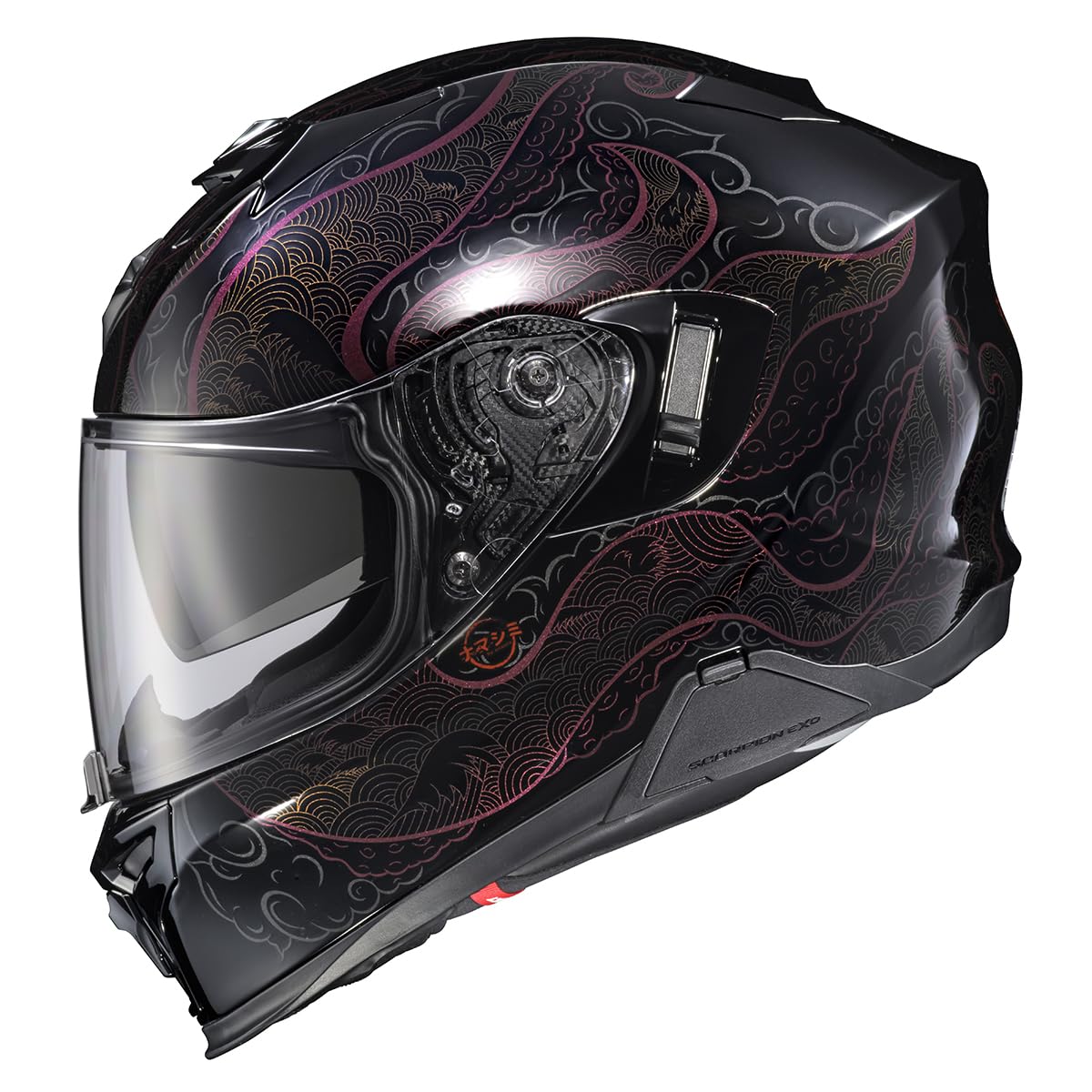
The touring full-face whose cheek pads inflate to kill wind roar.
The ScorpionEXO T520 is built for riders who log miles, and its signature feature is the AirFit Inflation System — a pump that inflates the cheek pads to custom-fit your face and reduce wind noise and lift. Paired with the included Aero Skirt chin curtain, this is one of the quietest shells in its class. Owners say it “cuts wind and bike noise significantly,” and one described it as the helmet that saves your eardrums.
Vision is a priority here. The Ellip-Tec Ratchet System pulls the shield tight against the eye port with an elliptical motion for a proper seal, and the Everclear shield is fog-free on both surfaces, shatter-resistant, and anti-scratch with 95% UV-A and UV-B protection. The Everclear SpeedView drop-down sun visor is retractable and interchangeable, so you get built-in sun coverage without swapping shields. A dual-position mouth vent acts as a defroster in one setting and full defrost-plus-ventilation in the other.
Safety credentials are strong: DOT FMVSS No. 218 and ECE certified, with a dual-density EPS liner and three shell sizes (XS-3XL) to tune fit across head shapes. The KwikFit cheek pads allow easy on-and-off of eyeglasses, and large-diameter speaker pockets accommodate most Bluetooth systems. The caveats: the inner sun shield can drop unexpectedly over bumps for some riders, and noise feedback is mixed — effective for many, a little loud for others. The Double D-Ring retention is secure but slower than a ratchet for quick stops.
Long-haul strengths
- Inflatable cheek pads tailor the fit and knock down wind noise
- Fog-free Everclear shield on both surfaces
- Retractable drop-down sun visor built in
The trade-offs
- Sun shield can drop on sharp bumps at night
- Double D-ring is slower than a quick-release buckle
- Some owners find it warm in summer heat
Best for: touring riders who value a quiet cabin, built-in sun protection, and a fit you can fine-tune mid-ride.
Not ideal if: you want a tool-free ratchet strap or ride in extreme heat and need maximum airflow.
9. Shoei RF-1400 Full Face Motorcycle Helmet

Shoei’s lightest SNELL-approved shell, tuned for the quietest ride yet.
The RF-1400 is the latest generation in Shoei’s flagship full-face line, and it carries the brand’s most prestigious pedigree. At 3.6 pounds it is Shoei’s lightest SNELL-approved full-face, built on a fiberglass and EPS shell that owners consistently describe as feeling “light, not bulky” even after hours in the saddle. It is certified to DOT, FMVSS 218, and the stricter SNELL standard — a safety trifecta that very few helmets match.
Noise reduction is the headline. Advanced shell aerodynamics and an all-new air-tight shield system cut unwanted wind and road noise, and the new window beading reduces turbulence. Owners say it is “the quietest Shoei yet,” filtering high-frequency noise while keeping traffic audible — and eerily, it stays quiet even at 80+ mph. The included Pinlock EVO Lens prevents fogging, and the CWR-F2 Shield is ready for quick swaps.
What owners rave about is the comfort: no pressure points, a snug fit that breaks in beautifully, and plenty of room for glasses. One caveat worth knowing — it is tight from the start. As owners put it: wear it for 20 minutes at a time a few times, and it “will mold to your face and fit really well.” The ventilation is excellent, staying cool even in direct sun, though the forehead vent is awkward to operate with gloves. The cheek pads include red emergency release tabs that let medical personnel remove them quickly from an injured rider — a thoughtful safety touch. It is an investment, but for long rides it is the quality that shines.
Premium protection: The combination of DOT, FMVSS 218, and SNELL certification makes this one of the safest shells you can buy.
Break-in required: Plan for a tight first week — this helmet molds to you, not the other way around.
Reach for this if: you are a performance or touring rider who wants the quietest, lightest, most aero-certified full-face Shoei builds.
Consider another if: you need a quick-release buckle or cannot tolerate a snug break-in period.
Understanding the Specs
Shell Material: Fiberglass vs Polycarbonate vs Aramid
The shell material decides how heavy the helmet is and how it handles impact energy. Fiberglass and composite blends like aramid or carbon fiber are lighter and often quieter, which is why premium Shoei and BELL models use them. Polycarbonate and ABS shells are heavier but far more budget-friendly, and they still meet DOT standards — they just transfer a bit more weight to your neck on long rides.
Certification: DOT vs ECE vs SNELL
Certification tells you the helmet passed real impact tests. DOT (FMVSS 218) is the minimum legal standard in the US and tests energy absorption and penetration resistance. ECE is the European standard, often considered stricter. SNELL is an independent, voluntary standard that is even tougher — you will only see it on premium lids like the Shoei RF-1400. More certifications means more rigorous testing, not more marketing.
FAQ
What is the difference between a modular and a full-face helmet?
Will a half helmet protect my chin in a crash?
How do I know a helmet will fit my head shape?
Can I wear glasses or sunglasses under a full-face helmet?
Is a DOT sticker enough to trust a helmet?
Why are some helmets so much noisier than others?
What does a drop-down sun visor actually do?
Can I install a Bluetooth headset in any helmet?
Final Thoughts: The Verdict
For most riders, the best types of motorcycle helmets winner is the Shoei Neotec II because it delivers full-face protection with flip-up convenience, premium fiberglass build quality, and the kind of comfort that makes touring easy. If you want a budget-friendly full-face that still fits Bluetooth speakers, the MotuoMr Full Face is the entry point — and the Shoei RF-1400 is a quiet, SNELL-certified option if your priority is maximum highway serenity.
How We Picked
We do not accept paid placement. Every pick is matched to a real buyer and a real use-case; we do not hands-on test units.
Sources & Methodology
Specifications: manufacturer listings and product documentation. Review insights: verified customer reviews, as of August 2026. Pricing: not shown on this page (it changes often); check the current price via the retailer link.
As an Amazon Associate, GoCarLife earns from qualifying purchases. This does not affect which products we feature.