
Our readers keep the lights on and the garage heater humming. As an Amazon Associate, I earn from qualifying purchases.
Specs are compiled from manufacturer listings and verified buyer reviews and can change over time — please confirm the key details on the product page before buying.
That dreaded low-tire-pressure light is on, and the dealership wants a fortune to swap one tiny sensor. A universal TPMS sensor fixes this by letting you program a single part to match your car’s frequency, signal ID, and valve type — usually for a fraction of the OEM price. The catch is that every universal sensor must be programmed with a compatible tool before it will talk to your car, and not all tools can talk to all sensors.
I’m Mo Maruf — the founder and writer behind GoCarLife. This guide is built by comparing the manufacturers’ published specifications and the patterns across verified customer reviews, so you get each pick’s real strengths and trade-offs instead of marketing spin.
Choosing the right replacement means matching frequency, valve stem, and your programming tool to the sensor you buy. Here is how to sort through the best universal tpms sensor picks.
Our Picks at a Glance


How To Choose The Best Universal TPMS Sensor
A universal TPMS sensor is a blank slate — it holds no data until you write your car’s information onto it. That means the tool you use for programming is just as important as the sensor itself. Before you buy, check which programming tools are compatible with the sensor, or you could end up with a part you cannot activate.
Frequency: 315 MHz vs 433 MHz
Your car’s tire pressure monitor communicates on a specific radio frequency, and most vehicles in North America use either 315 MHz or 433 MHz. A dual-frequency sensor like the Autel MX-Sensor carries both in one part, so you do not have to guess which one your vehicle needs. If you buy a single-frequency sensor, you must verify your car’s band first, or the sensor will never be detected.
Cloning vs Relearn
Some sensors can be “cloned,” meaning they copy the exact ID number from your old sensor. When a shop clones the ID and installs it in the same wheel position, your car thinks it is the original part, so no relearn procedure is needed. Other sensors are programmed with a new ID, which requires your car to go through a relearn process to accept the new signal.
Valve Stem: Rubber vs Metal
Rubber press-in stems are the most common and are quicker to install, but they can be prone to cracking over time. Metal screw-in stems are sturdier and better suited for high-speed or heavy-duty use, but they are usually heavier and can corrode if the finish is poor. Your wheel’s design often dictates which type fits best.
Quick Comparison
| Model | Best For | Frequency | Battery Life | Stem Type | Amazon |
|---|---|---|---|---|---|
| Autel MX-Sensor (1-Pack)★ Best Overall | DIY home mechanics | 315 + 433 MHz | 4-6 years | Rubber Press-in | Amazon |
| LAUNCH LTR-03 (4-Pack)Longest Battery | Adjustable angle flexibility | 315 + 433 MHz | 5-8 years | Metal Screw-in | Amazon |
| GEARWRENCH Rubber (4-Pack)Clone Favorite | Clone-only workflows | 315 + 433 MHz | — | Rubber Press-in | Amazon |
| GEARWRENCH Metal (4-Pack) | Shops wanting tough stems | 315 + 433 MHz | — | Metal Screw-in | Amazon |
| Schrader EZ-Sensor 33700 (4-Pack) | High-speed rated vehicles | 314.9 + 315 + 433 MHz | — | Adjustable Aluminum | Amazon |
| Autel MX-Sensor (4-Pack) | Complete set for one vehicle | 315 + 433 MHz | 4-6 years | Rubber Press-in | Amazon |
| Xtra-Seal Smart Sensor (10-Pack) | Fleet and shop inventory | Multi-Frequency | — | Snap-in | Amazon |
In‑Depth Reviews
1. Autel TPMS MX-Sensor (1-Pack)
Our pick — over 4.5★ from 300+ verified ratings; the strongest balance of quality and price.
A single-sensor fix that covers nearly any car you own.
This Autel MX-Sensor is built on the newest 88 chip, which gives it a stronger wireless signal during programming so the sensor pairs faster and more reliably with your tool. It combines both 315 MHz and 433 MHz frequencies into one part, claiming compatibility with 98% of vehicles on the road — so you do not need to stock a drawer full of different sensors for different cars.
What wins people over is how easy it is to set up. Buyers report that it programs cleanly with an Autel TS501 Pro via OBD copy or auto create, and one owner fitted it to a 2010 Toyota RAV4 and a Ford Ranger with six months of trouble-free use. The unit weighs only 11g, which is lighter than most sensors on the market, and it reads pressure from 0 to 800 kPa at an accuracy of ±10 kPa.
Unlike some other picks here that need a longer relearn process, this sensor is 100% cloneable — when you copy the original sensor ID and install it in the same position, no relearn is required. The battery is rated for 4-6 years or 24,000 miles, operating from -40°C to 125°C, and it is built to meet the SAE J1205 / J1206 industry standard. Just remember it must be programmed with an Autel tool: TS408, TS501, TS508, TS601, or one of the Autel diagnostic scanners.
What Owners Love
- Ease of setup leads the feedback — pairing takes minutes with an Autel tool
- Interchangeable rubber and metal valve stems for flexibility
- Rated for 4-6 years of battery life
What To Know
- Only programs with Autel TPMS tools, so other-brand scanners will not work
- Battery life is solid but shorter than the LAUNCH pick’s 5-8 years
The one to own: The best pick for a home mechanic with an Autel tool who needs one part for nearly every vehicle.
Plan around: You must already own or borrow an Autel programming tool, or this sensor stays a blank piece of metal.
2. LAUNCH LTR-03 TPMS Sensor (4-Pack)
A screw-in metal sensor built to outlast the competition.
This LAUNCH LTR-03 goes farther than most universal sensors on battery life, rated for 5-8 years — a clear step up from the Autel MX-Sensor’s 4-6 years. It runs on the FXTH87E chip with pressure readings accurate to 0.1 BAR, and it covers 99% of vehicle models with both 315 MHz and 433 MHz frequencies.
The standout upgrade here is the adjustable sensor angle. Unlike fixed sensors that may not sit flush inside your wheel hub, this one lets you rotate the body to fit the specific space inside your rim. Owners found programming straightforward, with one reporting it was very easy to get these sensors programmed with a Buick Encore 2017 using a LAUNCH computer.
This is also a set of four, not a single sensor, so you can replace your whole system in one go. The metal screw-in valve is built to prevent air leakage, and the sensor is certified to the SAE J1205/J1206 standard. It supports unlimited read and write, meaning you can move a used sensor to another tire or vehicle and keep using it — which cuts long-term costs.
Built to last: The 5-8 year battery life and adjustable metal build make this the durability-first choice. Sizing note: at 4.7 x 1.1 x 7.4 inches, this unit is far bulkier than the Autel MX-Sensor’s compact 1.97 x 1.97 x 1.97 inch footprint.
Reach for it if: You want a four-sensor set with the longest rated battery life and a metal valve that handles daily abuse.
Look elsewhere if: You need instant, hands-on programming help — this one ships blank and requires a relearn, and some owners hit friction getting shops to complete the setup.
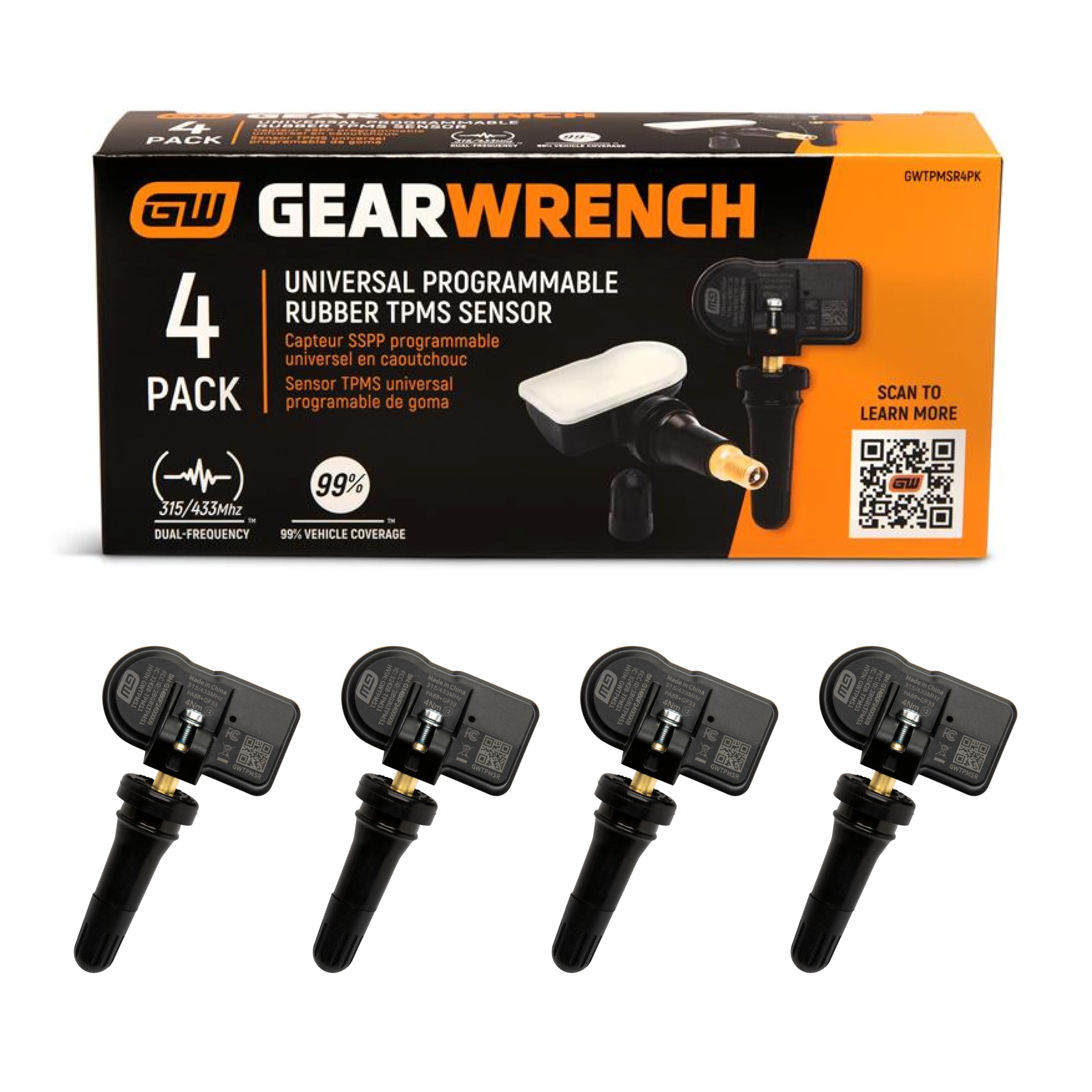
3. GEARWRENCH Universal Programmable Rubber TPMS Sensor (4-Pack)
A rubber-stem sensor that clones your old ID to skip the relearn.
This GEARWRENCH four-pack is the play if your car is being picky about relearn procedures. It is 100% ID cloneable, which means it copies the exact ID from your original sensor so your car accepts it as the factory part — no relearn required. That saves a trip to a shop that charges for the relearn step.
Dual-frequency technology covers both 315 MHz and 433 MHz in one sensor, with compatibility claimed for 99% of vehicles worldwide. It is tune for GEARWRENCH’s own programming tools, so if you already own that ecosystem, setup is quick. Owners describe it as an OE-level performer that gives precise pressure, temperature, and battery readings.
The rubber press-in stem is the more common style and installs quickly. At 5.1 ounces for the set, it is a standard weight that balances durability with ease of handling. One note in the feedback loop is that buyers who prefer metal stems tend to spring for the metal version of this same sensor — this rubber pack is the value-oriented route.
Setup simplicity: The clone feature is the whole appeal — copy the ID, install, and drive. This is the smooth path for DIYers who want to avoid the relearn ritual entirely.
Best for: A DIY owner with a GEARWRENCH tool who wants a rubber-stem sensor that clones instantly and skips the relearn process.
Skip if: Your wheel needs a metal stem, or you plan to use a non-GEARWRENCH programming tool.
4. GEARWRENCH Universal Programmable Metal TPMS Sensor (4-Pack)
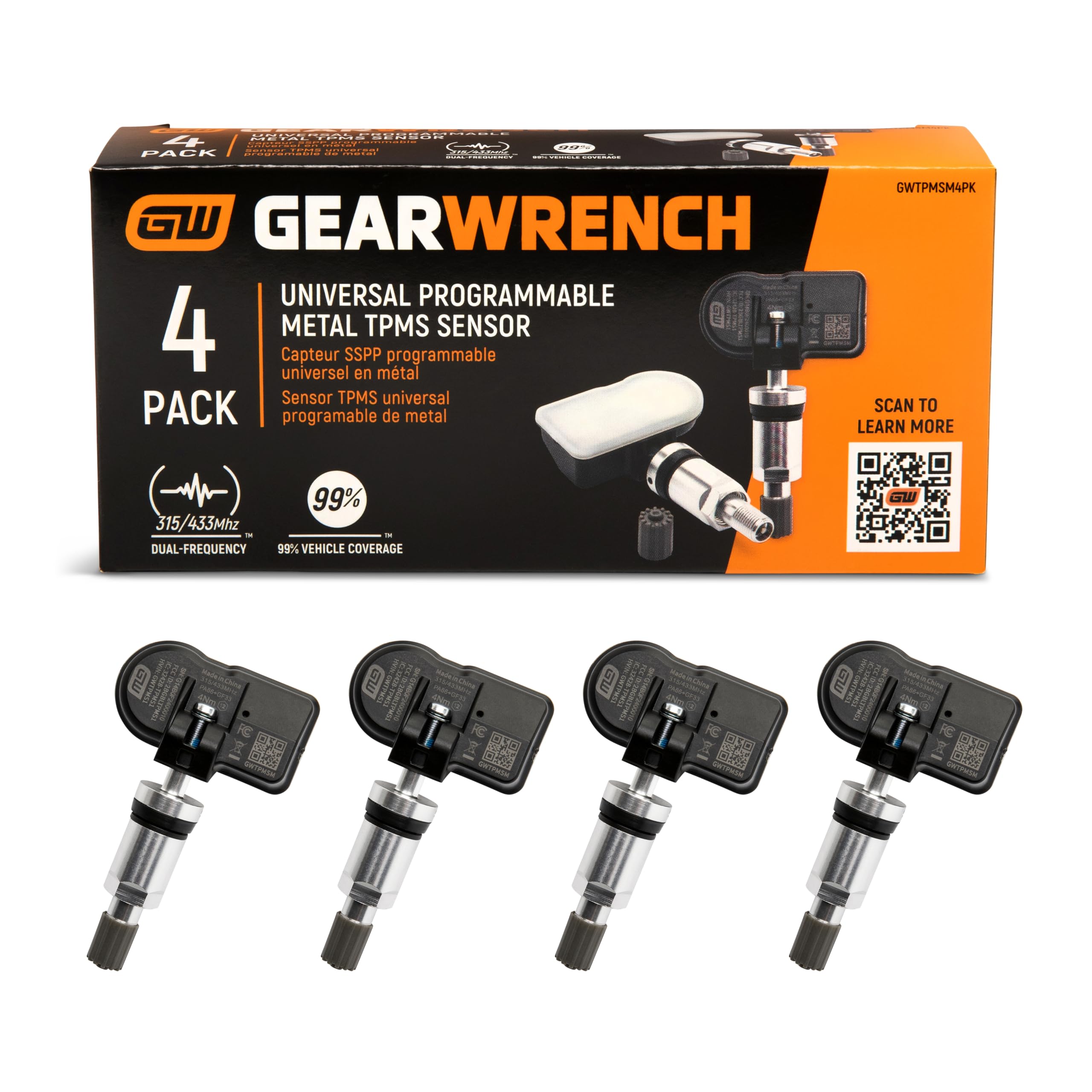
The same smart clone tech, wrapped in a tougher metal shell.
This is the metal-stem sibling to the rubber GEARWRENCH pack above, and it earns its place for wheels that see harder use. The metal construction is noticeably more durable than rubber, which is why owners mention it holds up well on demanding applications. It keeps the same 100% ID cloneable feature, the same dual 315 MHz and 433 MHz frequencies, and the same 99% vehicle coverage claim.
Real-world feedback shows a 2011 Prius owner installed the set with no issues, noting the universal compatibility and clone feature made setup quick and the sensors performed just like OEM. Another owner replaced three dead sensors on a Sequoia and had a shop handle the install and programming in short order.
The honest catch here is the programming tool requirement. These sensors need a separate programming tool, and some owners flag that the plastic caps feel like the weakest link. Also be sure to verify the current price on the listing — the value math changes depending on the day.
Strong Points
- Metal stems hold up better than rubber on rough roads
- Clone feature skips the relearn step entirely
- OE-level precision on pressure and temperature
Watch Outs
- Requires a separate programming tool to activate
- Some owners hit programming failures on certain vehicles
- Plastic valve caps are a minor weak spot
Go with this when: You want the durability of a metal stem combined with the convenience of ID cloning, and you already have a programming tool.
Think twice if: You are on a budget or prefer the quicker press-in rubber install — the rubber version does the same job at a friendlier price.
5. Schrader EZ-Sensor 33700 (4-Pack)
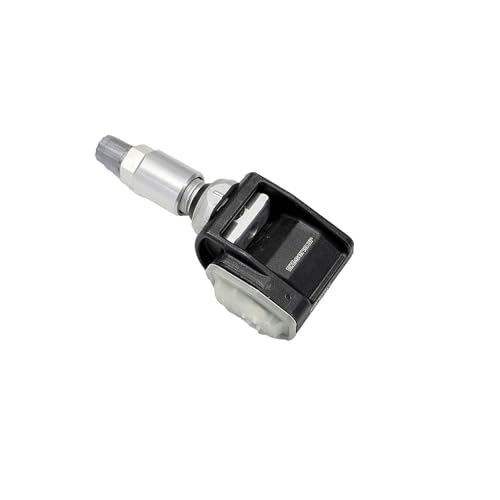
A high-speed aluminum sensor for drivers who push their cars.
For a sports car or modified wheels, the Schrader EZ-Sensor is built to handle the extremes. It can withstand speeds up to 200 MPH and pressures up to 115 PSI, so it won’t fail during a high-speed run or on a heavy load. The adjustable aluminum valve adapts to many rim designs, and it works on 314.9 MHz, 315 MHz, and 433 MHz frequencies, so it pairs with more vehicles than most other sensors here.
Customers note clean installs at Discount Tire shops, with a 2017 Toyota Tacoma working perfectly and a Chrysler Crossfire SRT-6 owner cloning his originals to avoid the dealer’s DRB III relearn tool. This is not a DIY product — the manufacturer is explicit that it must be programmed and installed by an experienced, trained technician using a compatible tool before the relearn procedure.
The trade-off is that programming has drawn mixed feedback. Some owners found it difficult to program, and a few report the TPMS error recurs after install, requiring repeated relearns. For most buyers with the right tool and a good tire shop, it works cleanly — but verify your tool is on the compatible list before you commit. Nut torque is 53 in-lbs and valve core torque is 3.5 in-lbs.
Built for speed: The 200 MPH rating and aluminum stem make this the choice for performance cars and aftermarket wheels. The recurring gripe is programmability — this one demands the right equipment and a technician’s hands.
Reach for it if: You drive a high-performance vehicle or aftermarket wheels and want a sensor rated to 200 MPH.
Look elsewhere if: You are a DIYer without a compatible programming tool — this sensor is not designed for home setup.
6. Autel TPMS MX-Sensor (4-Pack)
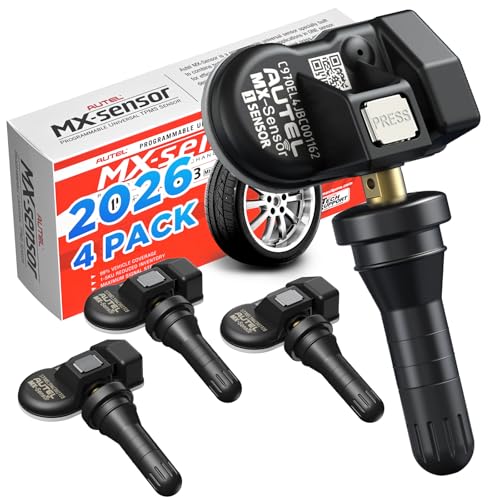
A full four-sensor kit that replaces your whole system at once.
This is the same trusted Autel MX-Sensor as the top pick, but bundled as a four-pack so you can replace every sensor in one session. If two or three of your sensors are failing, or you just want to reset the whole system’s clock, this set is the efficient route. It combines 315 MHz and 433 MHz frequencies with the newest 88 chip for strong wireless programming signals.
The strong signal is a real convenience — reviewers point out successful programming across vehicles including Ford F-150s and Silverado trailers, with one noting clean programming using the Autel TS401 tool. The press-in rubber design installs quickly, and the sensor body weighs just 11g, which keeps wheel balance stable. Measurement range runs from 100 to 900 kPa.
The 4-in-1 design means one SKU covers most TPMS-equipped vehicles, so you do not have to hunt for the right part number. It also supports unlimited reprogramming — no waste, no expiration. Just keep in mind that these are only programmable with Autel tools, not other brands of TPMS scanners, and they are not compatible with 12V/24V commercial vehicles or Bluetooth-based TPMS systems like Tesla.
Whole-system refresh: Four sensors, one consistent batch, and the same reliable 88 chip make this the set-and-forget choice for a single vehicle.
Best for: An owner replacing multiple dead sensors at once who already uses or plans to buy an Autel TPMS tool.
Not the pick if: You drive a commercial vehicle or a Tesla — the compatibility list stops at standard passenger cars.
7. Xtra-Seal Smart Sensor 17-43041 (10-Pack)

A ten-sensor box that keeps a busy shop stocked for months.
This Xtra-Seal box of ten is built for volume. It is a truly universal, programmable sensor with a multi-frequency design that covers 95% of vehicle applications, and the snap-in installation style is about as quick as a tire sensor install gets. For a repair shop or a fleet manager, this is the inventory play.
Owners who have used Xtra-Seal for years report no failures, which is the trust signal that matters in a bulk purchase. The recurring theme in the feedback is longevity — these are sensors people install and forget about. The multi-frequency approach also reduces the number of SKUs you need to stock, since one sensor handles multiple vehicle bands.
The trade-off is the commitment: a 10-pack is the right size for a professional environment, not for someone replacing one sensor on a single car. And because these ship blank, you will need a compatible programming tool to write the vehicle data before installation. The speed rating is listed simply as “Other,” so this is not the choice if your vehicle has extreme speed requirements.
Stock-the-shelf value: Ten true universal sensors at a per-unit cost that makes single-sensor buying look wasteful. This is the professional’s bulk box.
Go with it if: You run a shop or manage several vehicles and want one box that covers most of what rolls in.
skip it if: You only need one or two sensors — a single or four-pack is the smarter spend.
Understanding the Specs
Dual Frequency Explained
A dual-frequency sensor carries both 315 MHz and 433 MHz bands in one part. This matters because your car uses one specific frequency to talk to its sensors, and carrying both means you do not need to research which band your vehicle uses before buying. Almost every modern passenger car in North America runs on one of these two bands, so a dual-frequency sensor is the safest universal bet.
Battery Life And Reliability
TPMS sensors are sealed units — you cannot swap the battery, so the rated life is your real ownership window. Most universal sensors are rated between 4-6 years and 5-8 years, often paired with a mileage figure like 24,000 miles. A longer rating means fewer trips back to the shop for replacements, which is why the LAUNCH pick’s 5-8 year rating stands out against the Autel’s 4-6 years.
FAQ
Will a universal TPMS sensor work on my specific car?
What is the difference between cloning and relearning a TPMS sensor?
Do I need a special tool to program a universal TPMS sensor?
How long does a universal TPMS sensor battery last?
What is the difference between a rubber press-in and metal screw-in valve stem?
Can I install a universal TPMS sensor myself at home?
Why does my TPMS light stay on after installing new sensors?
Is a universal TPMS sensor as reliable as an OEM part?
Final Thoughts: The Verdict
For most buyers, the universal tpms sensor winner is the Autel MX-Sensor because its dual-frequency coverage, 11g weight, and 100% cloneable design make it the most flexible single-sensor fix on the board. If you want a full replacement set for one vehicle, grab the Autel 4-Pack. And for the longest battery life with an adjustable metal build, the LAUNCH LTR-03 4-Pack is the one to reach for — just confirm you have a compatible programming tool before you commit.
How We Picked
We do not accept paid placement. Every pick is matched to a real buyer and a real use-case; we do not hands-on test units.
Sources & Methodology
Specifications: manufacturer listings and product documentation. Review insights: verified customer reviews, as of August 2026. Pricing: not shown on this page (it changes often); check the current price via the retailer link.
As an Amazon Associate, GoCarLife earns from qualifying purchases. This does not affect which products we feature.