
Our readers keep the lights on and the garage heater humming. As an Amazon Associate, I earn from qualifying purchases.
Specs are compiled from manufacturer listings and verified buyer reviews and can change over time — please confirm the key details on the product page before buying.
Adding lights, a fridge, or a winch to your truck or boat means one thing: you need a clean way to protect the wiring. A universal fuse box gives each accessory its own protected circuit, so one bad wire doesn’t fry your whole setup.
I’m Mo Maruf — the founder and writer behind GoCarLife. This guide is built by comparing the manufacturers’ published specifications and the patterns across verified customer reviews, so you get each pick’s real strengths and trade-offs instead of marketing spin.
You’ll see exactly which fuse blocks handle the salt air, which ones light up when a fuse blows, and which is the best universal fuse box for keeping your rig’s electrical work organized and safe.
Our Picks at a Glance


How To Choose The Best Universal Fuse Box
Before you buy a fuse block, know your accessory count and your total current draw. A 6-circuit unit suits a light bar and a few switches; a 12-circuit block gives you room to grow.
Count your circuits first
Every accessory you add needs its own fuse slot. If you plan to wire headlights, a fan, a fridge, and a phone charger, count them all before you pick a panel. Most rigs fill up fast.
Know your amp budget
Each circuit is limited to 30A, and the whole panel tops out at 100A. That’s usually plenty for lighting and small accessories, but a big inverter or winch needs a direct battery connection instead.
Check the cover and materials
A clear, sealing cover keeps dust and splashes off your terminals. Materials like PBT (a heat-resistant plastic) and nickel-plated copper resist corrosion, which matters most in boats and off-road trucks.
Quick Comparison
| Model | Best For | Circuits | Max Panel Amps | Fuse Type | Amazon |
|---|---|---|---|---|---|
| Cyrico 12 Circuit★ Best Overall | Boat rewires & full build-outs | 12 | 100A | Blade (ATC/ATO) | Amazon |
| Nilight 6 WayBest Value | Adding aux lights & accessories | 6 | 100A | Blade (ATC/ATO) | Amazon |
| DaierTek 12 Way | Complete kits with terminals | 12 | 100A | Blade (ATC/ATO) | Amazon |
| JinYuan 12 Way | Budget 12-circuit builds | 12 | 100A | Blade (ATC/ATO) | Amazon |
| RED WOLF 12 Way | Restorations & solar rigs | 12 | — | Blade (ATC/ATO) | Amazon |
| RVBOATPAT Relay Box | Adding relays without the wiring | 11 | 40A | Blade (ATC/ATO) | Amazon |
| Blue Sea 12 Circuit | Marine-grade permanence | 12 | 100A | Blade (ATC/ATO) | Amazon |
In-Depth Reviews
1. Cyrico 12 Circuits Fuse Block
Our pick — over 4.5★ from 700+ verified ratings; the strongest balance of quality and price.
The 12-circuit panel that swaps into a boat like it was factory-wired.
When you’re replacing a worn-out panel on a boat or building a full accessory suite in a truck, this Cyrico block is the one that keeps everything tidy. It gives you 12 separate circuit slots and a grounding busbar, so every device gets its own fused path instead of sharing one risky connection. The whole panel is rated for 100A total, with each fuse slot handling up to 30A — enough for most lighting, fans, and 12V appliances you’d add to a rig.
The build quality is what wins people over: nickel-plated copper busbars resist corrosion, and the housing is heat-resistant and flame-retardant PBT and PC material. Every slot has an LED indicator that lights up the moment a fuse blows, which skips the old fuse-by-fuse guessing game. Buyers even report swapping it into boats and finding the fit and function dead-on, saying it lights up clearly when a fuse pops. It also ships with 24 blade inserts in different amp ratings plus stickers to label each circuit.
The twist-lock screws make installs fast, though that same tight fit forces you to organize wires carefully if you want the cover to close cleanly. The cover itself seals against dust and splashes, but on rough terrain one owner found it loose enough to fall off — so if you’re bouncing down washboard roads, plan to secure it.
What owners rave about
- LED per circuit pinpoints blown fuses instantly
- Nickel-plated copper resists corrosion in salt air
- Comes with 24 fuses and circuit labels
- Snug, high-quality screw terminals hold tight
Watch out for
- Cover can pop off on bumpy, vibrating roads
- Wiring needs patience to fit under the lid
Grab it for: boat rewires and 12V accessory build-outs where you want one clean, protected hub.
Think twice if: your build rides on serious washboard terrain and you can’t add a latch or zip-tie to hold the cover.
2. Nilight 6 Way Fuse Block
The compact 6-circuit block that cleans up accessory wiring without the bulk.
If you only need to add lights, a compressor, or a few switches, a full 12-way panel is overkill. The Nilight 6 Way gives you six circuits with a negative bus, so every ground terminates right on the block instead of daisy-chaining back to the battery. It runs on ATO/ATC middle-size blade fuses, rated to 30A per circuit and 100A per panel, and the open design makes it easy to reach and swap any fuse.
A red LED next to each slot lights instantly when that fuse blows, which is the single fastest way to diagnose a dead circuit on the trail. Buyers report the build feels anything but cheap, and people use it to run accessories off keyed power on side-by-sides and to clean up wiring on pontoons. One owner who has tried several fuse boxes notes the side terminals are heavy enough for a 30A 12VDC connection — that’s the kind of confidence you want in a power distribution point.
The trade-off is that six circuits run out quick once you start adding accessories, and one unit arrived with a dead indicator LED on a single slot. It’s an occasional fluke, not a pattern, but check each light before you button it up.
What makes it a value pick
- Negative bus keeps all grounds on the block
- Easy-open cover meets ABYC/USCG requirements
- LED warning light flags blown fuses fast
- Sturdy terminals handle a 30A connection
Keep in mind
- Six circuits limit bigger builds
- Rare dead LED from the start
Reach for it when: you’re adding a handful of accessories and want a clean, grounded, easy-to-diagnose hub at a friendly price.
Move up if: you know you’ll keep adding gear — the 12-way blocks give room to grow.
3. DaierTek 12 Way Fuse Block

A 12-way blade block that arrives with every terminal and fuse you need.
What sets the DaierTek apart is the box contents: it ships with two power terminals, 24 device terminals, and 30 blade fuses spanning 30A, 25A, 20A, 15A, 10A, and 5A. That means you won’t make a second trip to the parts store for rings or fuses — a real time-saver on a weekend install. The panel itself handles 12 circuits at up to 30A per circuit and 100A per panel, with both positive and negative sides for clean routing.
The push-lock cover seals the wiring inside, and each fuse slot gets a red LED that lights up when that fuse opens. The ratings mirror the Nilight above — 32V DC max, 30A per circuit, 100A per panel — so performance is comparable, but the included hardware tilts the value. Owners run these in golf carts on 48V-to-12V setups and in boats, and they report no difference from pricier name-brand panels they’ve used before.
The recurring gripe is the adhesive label sticker — owners say it doesn’t stick well, so plan to use your own labels or a marker. A few also note the fit of fuses can feel loose in the slots, so test each one before calling the install done.
Why it wins: the complete kit — terminals, fuses, and labels — means a single box handles the whole job, and the 12 circuits match premium options at a friendlier price.
The small catch: the included circuit stickers have weak adhesive, so bring your own labeling.
Pick this if: you want a go-box with everything included for a car, Jeep, golf cart, or boat build.
Expect to: supply better labels and seat each fuse firmly before you trust the circuit.
4. JinYuan 12 Way Fuse Box

A 12-circuit panel that fits tight spaces without sacrificing the ground bus.
If your install spot is cramped — under a dash, behind a seat, in a small boat console — the JinYuan earns its place. It packs 12 positive circuits with a matching negative terminal for each, so every device grounds locally on the block. That keeps wiring tidy and short in tight spaces where running grounds back to the battery would be messy. With 24 included fuses and 12 ground locations, it’s a proper little distribution hub.
The shell is fireproof PBT plus PC material with a dust- and splash-proof cover, and each fuse has a red LED that lights up when it blows. Owners set this up for CB radios and plan to keep adding to it, and one notes it beats an old cylinder-style fuse box easily. At its price point, you’re getting 12 circuits of organized power distribution without paying for a brand name.
The honest trade-off: this is a value-tier panel, so the fit isn’t as tight as premium marine gear. One buyer points out you get what you pay for versus name-brand equivalents — it works, but don’t expect the same refinement in the terminals.
Best for: budget-conscious builds that need lots of circuits in a small footprint, like CB radios, dash cams, and cabin lighting.
Fair warning: refinements are basic; for vibration-heavy marine use you may prefer a pricier block.
Choose it when: space is tight and you want 12 fused circuits with local grounds for under a dinner out.
Look elsewhere if: you need the absolute tightest terminals for a saltwater boat long-term.
5. RED WOLF 12 Way Fuse Block

A sturdy 12-way block with tin-plated copper internals that restorers and solar builders trust.
If you are restoring an old VW or wiring a solar setup, the RED WOLF fuse box keeps your electrical system reliable where others fail. Its internals use tin-plated copper (a coating that resists corrosion and carries current well), so power flows cleanly even in damp conditions. The housing shrugs off a wet environment, and it handles 12 circuits at 32V max (the highest voltage it can safely manage). Owners mention the fuses seat solidly in their holders — no wobble, no intermittent contact — which matters on a vehicle that vibrates down the road, since a loose fuse can cut power mid-drive.
The clear cover seals against dust and moisture, which is why boat owners and camper builders like it. It ships with 12 fuses spread across 5A, 10A, 15A, and 20A ratings, plus adhesive labels for circuit identification and mounting screws. Owners call the build sturdy and the install clean, with well-spaced side connections that make wiring easier than cramped panels.
The catch: it doesn’t include a negative bus. If you want grounds on the block itself, you’ll need a separate bus bar or a different panel. Also, the warranty is just half a year, which tells you it’s a solid value pick, not a lifetime marine component.
Standout trait: tin-plated copper internals and firm fuse seating make it a favorite for restorations and solar carts.
Plan around: no negative bus — bring your own grounding solution.
Grab it for: classic car restorations, boat accessory wiring, and solar rig setups where solid fuse seating matters.
skip it if: you expect every ground to terminate on the same block.
6. RVBOATPAT Fuse Relay Box

A pre-wired relay and fuse box that handles the heavy switching for you.
This one is a different animal: it’s not just a fuse block, it’s a pre-wired combination that holds six 4-pin 40A relays and eleven ATC/ATO fuses in one tidy box. The relays handle high-current switching for things like lights and air horns without overloading your factory switches. It’s pre-wired, so half the connection work is already done — you just land your accessory wires and the main power feed. On a 1987 F-150, owners call it a perfect way to isolate aftermarket wiring from the OEM system.
The included fuses span 5A to 30A: two each of 5A, 10A, 15A, 20A, and 25A, plus a single 30A. That’s enough variety for most builds, and the independent relay and fuse control means each circuit can be switched separately. Buyers describe it as high-quality, precision-made, and a good value for wiring or fabrication work.
The honest limitation: the cover is not waterproof. It has a moisture-redirecting lip rather than a gasket, so owners explicitly advise against mounting it where it’ll get sprayed — skip the boat engine bay and keep it somewhere dry. Also, the retaining clips for relays can be loose, though they still hold contact fine.
What it does for you
- Switches high-current loads via 40A relays
- Pre-wired design cuts install time down
- Generous fuse assortment for varied circuits
Where it falls short
- Cover is not waterproof — keep it out of spray
- Relay retaining clips feel a little loose
Reach for this if: you’re adding multiple switched accessories — lights, horns, fans — and want relays done for you.
Mount it: in a dry spot; the cover redirects moisture but won’t survive direct spray.
7. Blue Sea Systems ST Blade Fuse Block
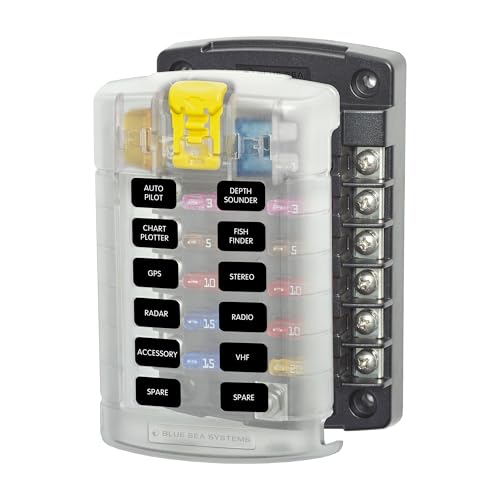
The marine-grade standard that belongs on any boat you plan to keep.
When you want the fuse block that professional boat builders reach for, this is it. Blue Sea Systems builds electrical gear to a different standard, and this 12-circuit ST Blade block is rated for 100A per block and 30A per circuit at 32V DC. The clear cover meets ABYC and USCG insulation requirements — marine-industry standards for safe electrical installation — and it has a push-button latch that opens easily for fuse swaps.
The positive distribution bus uses a #10-32 stud, and the screw terminals are #8-32 with captive star lock washers, so connections don’t vibrate loose. It ships with 20 write-on circuit labels and storage for two spare fuses right in the cover. Owners install these in Jeep engine bays with a main breaker and in cargo trailer camper conversions, praising how it cleans up accessory wiring versus inline fuses. It survives offroad splashes with the lid on.
The big caveat: fuses are sold separately, so factor that into the cost. And one owner found the main power-in post is press-fit, meaning you can over-torque it and disconnect the internal connection — so follow the recommended 24 in-lb stud torque and you’ll be fine.
Why it’s the marine standard
- Meets ABYC/USCG insulation requirements
- Captive star lock washers hold connections
- Stores two spare fuses in the cover
- Clear cover with write-on labels
Before you buy
- Fuses sold separately — extra cost
- Don’t over-tighten the power-in stud
Invest in this for: a permanent marine install or any build where reliability and standards compliance beat saving a few dollars.
Just remember: budget for fuses and respect the torque spec on the main stud.
Understanding the Specs
Amps per circuit vs. total panel load
Every circuit in these blocks is rated for 30A max, and the whole panel typically shares a 100A budget. That means you can run several 10A devices, but you can’t run three 40A loads off one 100A block. Add up your accessory draws before you commit.
Blade fuses: ATC vs. ATO
All the blocks here take ATC or ATO blade fuses — the standard medium-size automotive fuse. They’re cheap, sold everywhere, and easy to swap. Some kits include a spread of amperages so you can match each device’s current draw exactly.
Negative bus: why it matters
A negative bus gives you a metal strip right on the block where every device’s ground wire terminates. Without one, you’re chasing grounds back to the battery or a chassis point, which gets messy fast and invites voltage drops. If your build has many devices, look for a block with a built-in bus.
LED blown-fuse indicators
A red LED next to each fuse slot lights up when that fuse blows, so you know exactly which circuit failed without pulling every fuse. On a dark trail or a rocking boat, that’s the difference between a five-minute fix and an hour of poking wires.
FAQ
What size fuse should I use for each circuit?
Can I use these fuse boxes on a 24V system?
How many accessories can I run on a 12-way fuse block?
Is a fuse box with a waterproof cover safe for boats?
What does the negative bus do on a fuse block?
Do fuse blocks come with fuses included?
Can I mount a fuse box in my engine bay?
What’s the difference between a 6-way and a 12-way fuse block?
Final Thoughts: The Verdict
If you want one dependable pick, the universal fuse box winner is the Cyrico 12 Circuit because it pairs the full 12-circuit capacity with LED indicators, a grounding bus, and all the fuses you need in one well-made package. If you want a compact, budget-friendly way to add a few accessories, grab the Nilight 6 Way. And for a marine-grade install you’ll trust for years, the Blue Sea Systems 12 Circuit is the one to reach for.
How We Picked
We do not accept paid placement. Every pick is matched to a real buyer and a real use-case; we do not hands-on test units.
Sources & Methodology
Specifications: manufacturer listings and product documentation. Review insights: verified customer reviews, as of August 2026. Pricing: not shown on this page (it changes often); check the current price via the retailer link.
As an Amazon Associate, GoCarLife earns from qualifying purchases. This does not affect which products we feature.