
Our readers keep the lights on and the garage heater humming. As an Amazon Associate, I earn from qualifying purchases.
Specs are compiled from manufacturer listings and verified buyer reviews and can change over time — please confirm the key details on the product page before buying.
A failing fuel pump turns every drive into a guessing game — sputtering on hills, hard hot starts, and that moment of dread when the engine cuts out at a light. The fix is usually a simple swap to a universal 12V electric fuel pump, but picking the wrong one means either a carburetor that floods or an EFI system that starves. This guide breaks down the high-flow EFI units, the low-pressure carburetor pumps, and everything between so you match the pump to your exact setup.
I’m Mo Maruf — the founder and writer behind GoCarLife. This guide is built by comparing the manufacturers’ published specifications and the patterns across verified customer reviews, so you get each pick’s real strengths and trade-offs instead of marketing spin.
Before you buy a universal 12v electric fuel pump, know your engine type: low-pressure pumps suit carburetors, while high-pressure ones feed EFI (electronic fuel injection) systems. Matching the spec to your engine prevents overheating and pressure problems.
Our Picks at a Glance

How To Choose The Best Universal 12V Electric Fuel Pump
Your engine’s fuel delivery system decides everything. Carbureted engines need a gentle 2-7 PSI flow, while fuel-injected (EFI) systems demand 40+ PSI to push fuel through injectors. Buying the wrong type is the most common mistake in this category.
Match the Pressure to Your Engine
Low-pressure pumps around 2-4.5 PSI are perfect for carburetors, lawnmowers, generators, and boats. They prevent flooding and work with gravity-fed tanks. High-pressure pumps delivering 43-75 PSI are built for EFI systems, LS swaps, and turbocharged builds that need precise, consistent fuel delivery.
Fuel Type Compatibility Matters
Not every pump handles every fuel. E85 ethanol is corrosive, so check whether the pump materials can handle it. Some pumps are explicitly gasoline-only, while others are rated for diesel, biodiesel, and blended alcohol. Using the wrong fuel can destroy the pump internals fast.
Quick Comparison
| Model | Best For | Pressure | Flow Rate | Fuel Type | Amazon |
|---|---|---|---|---|---|
| Aeromotive 11542★ Best Overall | High-HP EFI builds | 40 PSI | 340 LPH | Gas & E85 | Amazon |
| ENGINEMAN 106092Best Value | Carbureted engines | 2-3.5 PSI | 28 GPH | Gasoline | Amazon |
| JDMSPEED RedQuiet Performer | High-pressure EFI | 3 bar | 135 ltr/hr | Gasoline | Amazon |
| CarBole 300LPH | EFI & turbo apps | 43-75 PSI | 300 LPH | Diesel or Gasoline | Amazon |
| Gautory 044 Blue | Racing & LS swaps | 75 PSI | 300 LPH | Diesel | Amazon |
| Mr. Gasket 42S | UTVs & boost pumps | Internal regulated | — | Gasoline | Amazon |
| Facet 40105 | Generators & RVs | — | — | Multi-fuel | Amazon |
| Holley 12-427 | Carbureted V8s | 4-7 PSI | 32 GPH | All fuels | Amazon |
| Facet FEP288SV | Priming & UTVs | 3-4.5 PSI | — | Multi-fuel | Amazon |
In-Depth Reviews
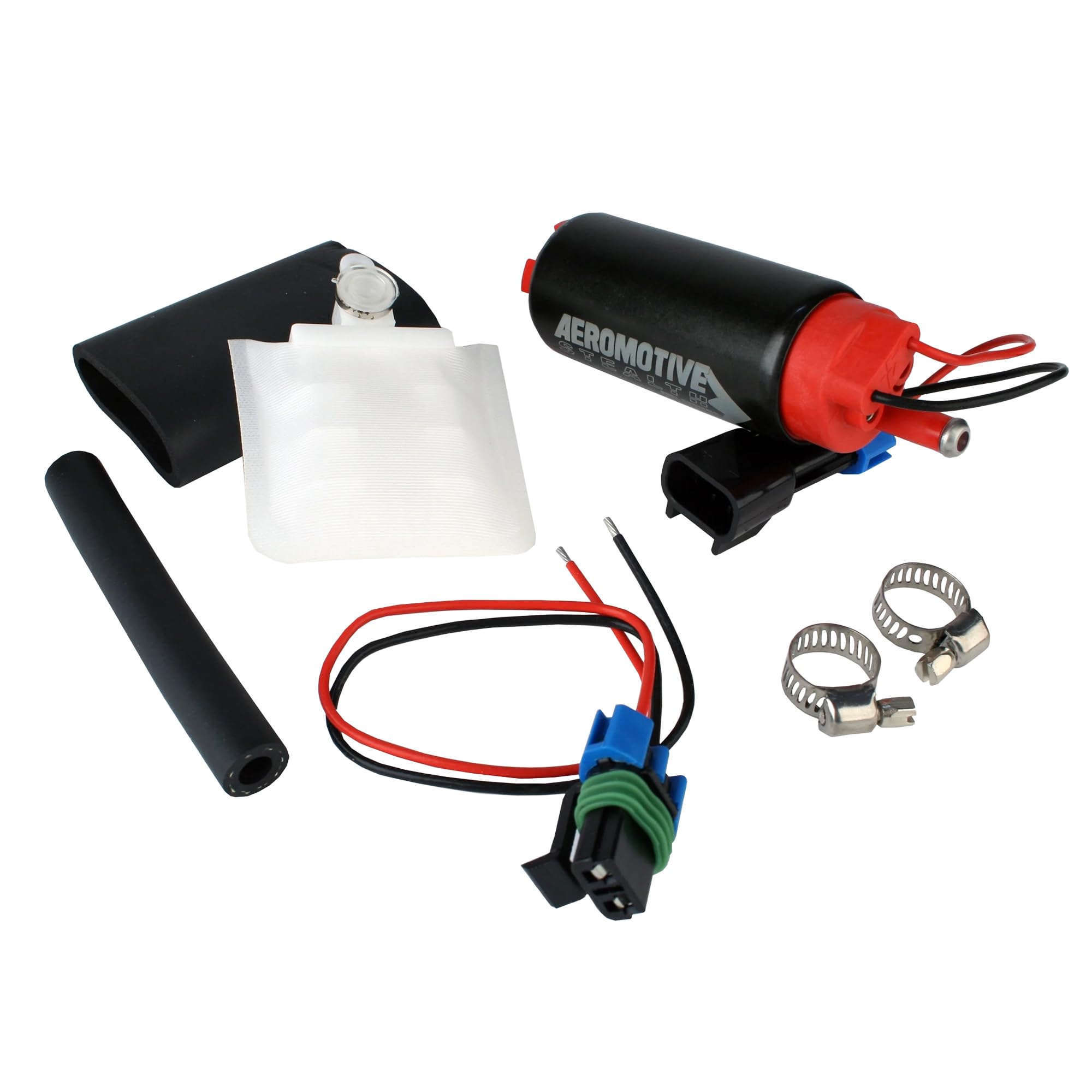
1. Aeromotive 340 LPH In-Tank Fuel Pump
Our pick — over 4.5★ from 100+ verified ratings; the strongest balance of quality and price.
The supercharged LS-swap champion that quietly feeds 340 liters of fuel per hour
For serious horsepower builds, this is the pump that keeps air-fuel ratios solid at wide-open throttle. It delivers over 340 LPH at 40 PSI, which means a supercharged LS3 or a turbocharged workhorse never starves for fuel under boost. The turbine design inside handles pulse-modulated systems smoothly, and the metal body shrugs off E85 ethanol where cheaper pumps corrode.
The 39mm body drops into factory in-tank hanger assemblies on many vehicles, and buyers report it literally dropping in with stock lines on a swapped 1990 300ZX — no modifications beyond an Aeromotive fuel pressure regulator. One owner running 6lbs of boost on 91 octane confirmed AFRs stayed healthy, while another converted a Suzuki GSF 1250 to E85 with zero problems. The kit includes a filter sock, wiring pigtail, rubber hose, clamps, and grommet so you are not hunting for parts.
This is an in-tank pump, so it will not work as an external inline unit. Check the Aeromotive application catalog before buying to confirm the 39mm body fits your sending unit. The performance and reliability send the strongest signal in owner feedback — this is the one to reach for when your build demands serious, consistent flow.
What Wins Owners Over
- Delivers over 340 LPH at 40 PSI for demanding EFI setups
- E85 compatible turbine design handles corrosive fuels
- Drop-in fit on many factory hangers with included kit
Who Should Look Elsewhere
- In-tank only — not for external inline mounting
- Verify fitment against the application catalog first
Reach for this if: you are feeding a boosted or high-compression engine that needs 340 LPH of reliable flow at 40 PSI without a whimper.
Consider a different route: if your vehicle needs an external inline pump — this one lives inside the tank only.
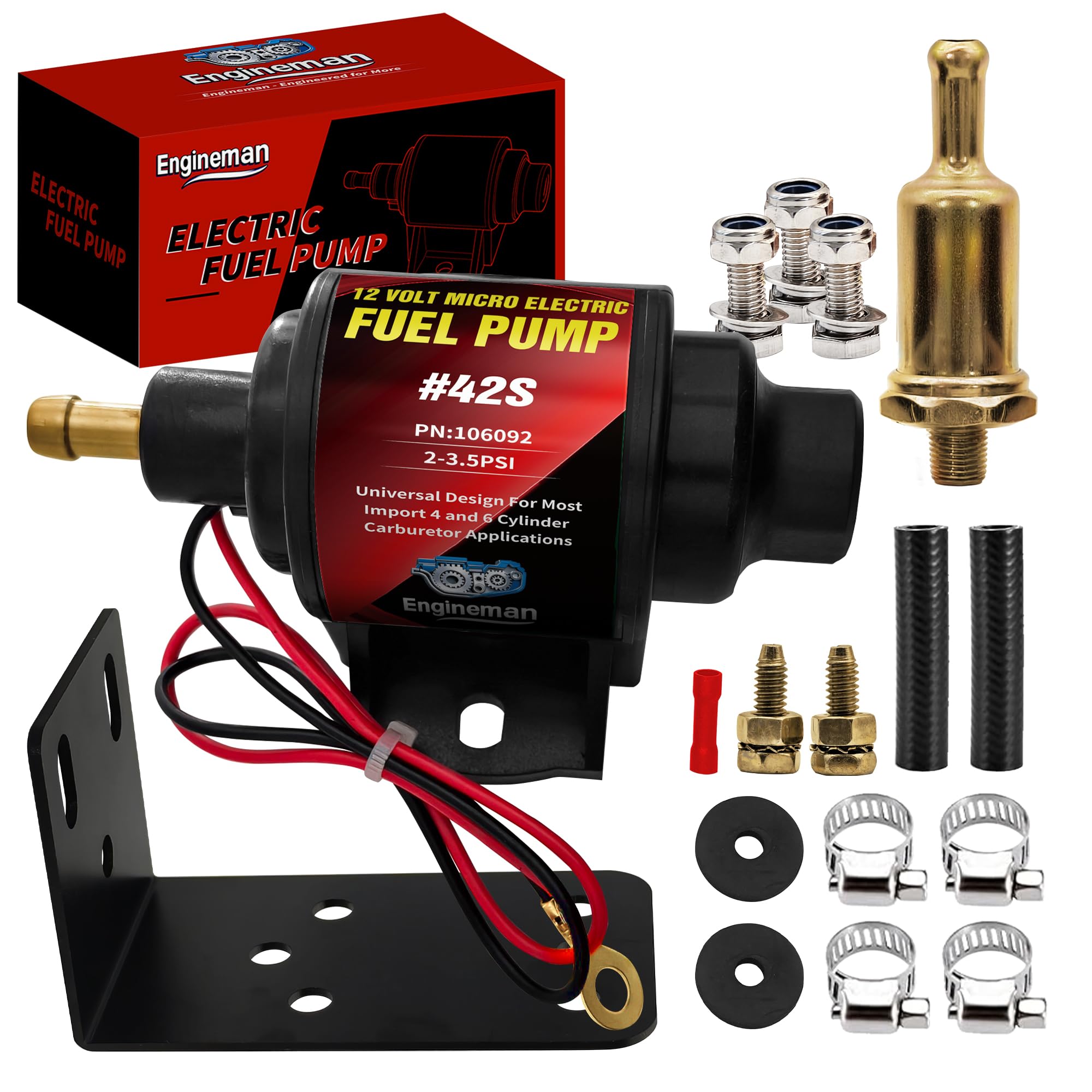
2. ENGINEMAN Universal Low-Pressure Fuel Pump
A 28 GPH workhorse for carbureted rides that keeps the fuel-air mix honest
If your engine has a carburetor, this pump delivers the gentle 2-3.5 PSI flow that prevents flooding while keeping the mixture right in cars, trucks, and generators. The copper-wound motor draws a consistent 1.0-2.0A, so you do not get voltage drops that starve the system under load. It moves 28 GPH (83 L/H) steadily, and the 5/16-inch inlet and outlet hoses make hookup straightforward.
The kit is genuinely complete — mounting bracket, fuel filter, two flex hoses, red/black wiring, and instructions for a DIY install in under 30 minutes. Owners have used it to pump old gas out of cars that sat idle for years, then repurposed it as a primer pump for vehicles that sit long periods. On a UTV with a low-pressure carb, it fixed the flooding problem completely. The mounting bracket’s 45-degree upward position keeps fuel inside between startups for instant ignition readiness.
This pump is designed for pure gasoline only — not E85, ethanol, methanol, race fuel, or water. One owner did report a motor that stopped turning very quickly, so it is worth bench-testing before full installation. But with 17 owners praising reliability and 11 more highlighting quality, the consensus says this budget-friendly pump does its job dependably.
Bulletproof simplicity: a 2-3.5 PSI inline pump that fixes carb flooding without fuss, backed by a 1-year manufacturer warranty.
The honest trade-off: gasoline only — feed it E85 or ethanol and you will shorten its life fast.
Ideal for: carbureted cars, lawnmowers, generators, and boats that need a reliable 28 GPH low-pressure feed.
Not for: EFI systems, E85 conversions, or any fuel other than pure gasoline.
3. JDMSPEED High-Pressure Inline Pump
A red, brass-bodied inline pump that runs so quiet you almost cannot tell it’s on
This external pump pairs a high-density brass and alloy steel body with a 135 ltr/hr flow at 3 bar (45 psi) — enough to feed a modified EFI system without breaking a sweat. The ½-inch (12mm) push-on inlet and ¼-inch (8mm) push-on outlet make it a straightforward swap for many applications. Owners running it at high pressure report it is a strong performer that stays almost undetectable while running.
The package includes a mounting clamp, rubber connection covers, terminals, gaskets, and nuts — everything you need to bolt it up. The red finish looks sharp in an engine bay, and the materials feel genuinely high-quality in hand. One owner used a couple of these for temporary applications on vehicles that had sat for years, and they worked great for reviving abandoned rides.
Keep expectations realistic on durability — feedback is genuinely split on construction quality, and some owners mention failures after very limited use. It is also a universal fit, so some adapting will be required, and no instructions are included, meaning you should have basic fuel-system knowledge. The reliability signal is strong at 16 owners, but treat the quality as a wait-and-see.
Best suited for: modified cars and trucks where a quiet, high-pressure 3 bar inline pump gets the job done.
Think twice if: you want a documented long-term track record — some units have failed quickly, so bench-test first.
4. CarBole 300LPH External Inline Fuel Pump
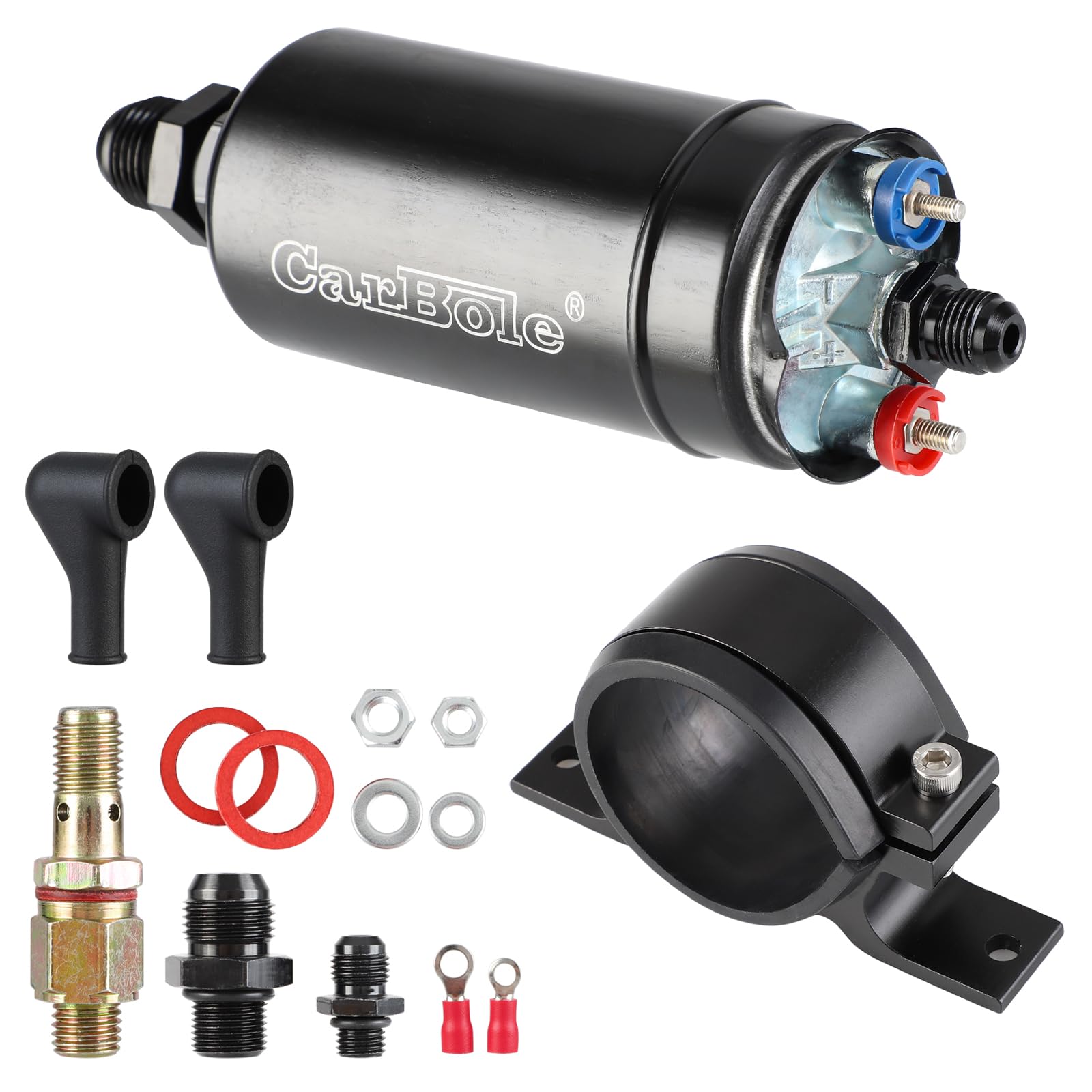
A stainless 300 LPH inline pump with AN fittings for EFI builds on a budget
This external pump brings serious flow numbers to the table at a price that undercuts most EFI options. It pushes 255 LPH at 43 PSI and tops out at 300 LPH at 43 PSI and 13.5V, which is enough capacity for higher-horsepower applications. The 10AN inlet and 6AN outlet threaded connections make it clean to plumb into new builds or swap in as a replacement.
The stainless steel body and included one-way check valve show thoughtful design. Owners put it on a 2003 Nissan Xterra after a gas tank swap and reported great fit, good pumping capacity, and solid value. It is designed for EFI systems only and works with both diesel and gasoline — but avoid alcohol fuels like E85, which can shorten the pump’s working life. A pre-filter is strongly recommended.
Here is the honest catch: reliability feedback is genuinely mixed, with some units stopping after a few startups. The pump also runs louder than ideal, and the mounting bracket does not isolate sound well — owners suggest M6 rubber isolator mounts. It is also not machined for ORB fittings, so use the included red washers. At this price, you get real flow for the money, but treat it as a budget EFI solution, not a lifetime part.
Big flow, small spend: 300 LPH max capacity with AN fittings makes this a compelling budget EFI entry point.
Pace yourself: reliability is a coin flip for some, and plan on extra rubber mounts to quiet it down.
Reach for it if: your EFI build needs 300 LPH of flow and you are willing to add sound-isolating mounts.
Look elsewhere if: you need E85 compatibility — this pump explicitly warns against alcohol fuels.
5. Gautory 044 Inline Fuel Pump

A blue 044-style pump for LS swaps that pushes 300 LPH at 43 PSI and stays quiet
This pump is built for EFI systems and racing setups, delivering a tested 200 LPH at 75 PSI under 12V and 255 LPH at 43 PSI under 12V. Crank it to 13.5V and it hits 300 LPH at 43 PSI — serious capacity for an LS swap or a high-performance build. The body is about 3 inches in diameter, noticeably larger than noisier pumps, and that size translates to quieter operation that owners consistently praise.
The packing list is generous: the pump, mounting bracket, AN6-to-M12 adapter, AN10-to-M18 adapter, rubber connection covers, insulated terminals, gaskets, nuts, and an outlet check valve. Customers note very high pressure — over 140 PSI out of a 3/8-inch line in one case — and solid hardware quality throughout. The recommended mounting spot is under the tank to improve conveying efficiency and prevent backflow.
This is a DC 12V EFI-only pump with an operating temperature range from -68°F to 194°F, so it handles extreme conditions. One owner did report a unit that malfunctioned immediately despite correct wiring and mounting, so it is worth testing before final install. With 38 ratings and a 4.4 average, the overall experience is positive, and the quiet operation is the standout trait.
Why it wins: 300 LPH flow with 75 PSI capability and a much quieter run than typical inline pumps.
The caveat: an occasional unit fails from the start, so bench-test before you button everything up.
6. Mr. Gasket 42S Micro Electric Fuel Pump
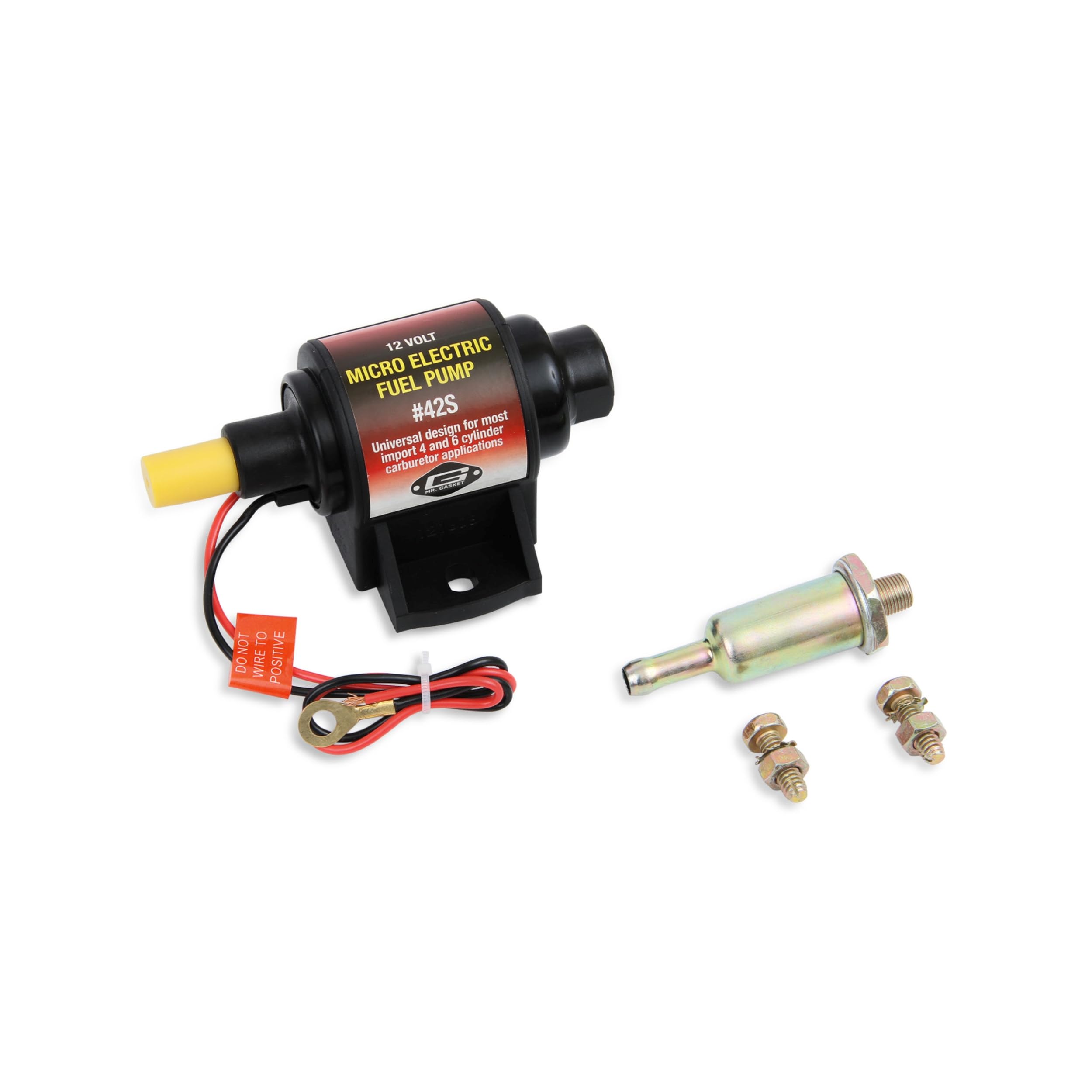
A solid-state micro pump with no diaphragms or mechanical parts to wear out
This tiny pump earned its reputation as an excellent fuel transfer and booster pump thanks to a solid-state design that eliminates diaphragms and mechanical parts entirely. The internal pressure regulation means you do not need an external regulator for basic setups, and the self-priming, 2-wire design makes installation genuinely easy. The 5/16-inch hose barbs fit standard fuel line.
It shines as a rescue pump — one owner tried three different regular fuel pumps before this one fixed a Yamaha Rhino that now starts right up. Another used it to replace a leaking pump on an old Jeep CJ, noting it works well with a pressure regulator and gauge to prevent carb flooding. On a Yamaha motorcycle, it beat the alternative of shelling out for a genuine OEM pump at several times the price.
Quality and value are the strongest signals, but functionality is genuinely mixed — some units have died quickly, one within 200 miles and outside the 90-day warranty. It is also note that a pressure regulator and gauge are recommended on carbureted applications to prevent flooding. This is a solid universal pump for UTVs, old Jeeps, and boost duties, but buy with realistic expectations about longevity.
Strengths That Shine
- Solid-state design with no mechanical parts to fail
- Self-priming with internal pressure regulation
- Easy 2-wire hookup with 5/16-inch hose barbs
Limits to Know
- Mixed longevity — some units fail within months
- May need external regulator to prevent carb flooding
Ideal for: UTVs, classic Jeeps, and fuel-transfer duty where a self-priming 2-wire pump makes sense.
Know this: durability is a real question mark, so keep expectations measured on lifespan.
7. Facet 40105 Solid State Fuel Pump

The US-built solid-state pump that keeps RV generators running season after season
This Facet pump is built in the USA to match or beat OEM (original equipment manufacturer) specs, so it fits and performs like a factory part. It handles gasoline, diesel, biodiesel, blended alcohol fuels, and fuel additives, making it the most versatile pick here. The alloy steel body and solid-state internals (no moving electrical contacts) give the reliability RV and generator owners rely on.
Owners have used it to replace failing pumps on Generac RV generators with excellent results. One toyhauler owner running a Generac 3600 generator says it has worked awesome and would buy it again. A Saab V4 owner replaced the OEM mechanical pump and confirmed the build quality is excellent. It is not remanufactured — this is a fresh, US-built unit, and the 1/8-inch NPT threads are note if you need adapters.
Expect some clicking noise — that is the nature of solid-state aftermarket pumps, and owners note it is common in this category. One owner called it “pretty noisy,” while another found it quiet when rubber-mounted. The quality and reliability signals are strong, and the US-built construction adds confidence. If you want a dependable pump for a generator, RV, or classic vehicle, this is a premium-feeling choice.
Built to last: US manufacturing, multi-fuel compatibility, and solid-state reliability make this a set-and-forget pump.
Expect a click: solid-state pumps tick — rubber mounting keeps the noise down.
Perfect for: RV generators, toyhaulers, and classic vehicles needing a durable multi-fuel pump.
Prepare for: the characteristic clicking sound of a solid-state pump, unless you add rubber isolators.
8. Holley 12-427 Mighty Mite Fuel Pump

A 32 GPH solid-state pump from Holley rated for up to 400 naturally aspirated horsepower
This Mighty Mite is a proven replacement for leaking mechanical pumps on classic carbureted rigs. It delivers 32 gallons per hour at a 4-7 PSI operating pressure, which is rated for up to 400 horsepower naturally aspirated. The solid-state design provides longer life than points-style pumps, and the simple 2-wire hookup is genuinely easy. It is also self-priming and self-regulating, with a 12-inch dry lift capability.
A 71 Chevy truck owner switched to electric after the mechanical pump left a mess in the crank case, calling the install very easy and the result great. Another owner uses it as a prime pump for a carb after the vehicle sits for 2+ days — a momentary switch primes for 3-5 seconds, then the mechanical pump takes over. It is compatible with all fuels and fuel additives, including gas, diesel, blended alcohol, ethanol, and E-85, so fuel choice is never a concern.
Reviewers point out the pump is louder than claimed when frame-mounted, with audible pulsing — so plan on rubber mounting if noise matters. Some owners reported pressure output lower than the 4-7 PSI spec, and a rare unit failed from the start. The pass-through design is a plus, allowing fuel to flow when the pump is off. This is a solid mid-range choice for carbureted V8s that need dependable flow while staying affordable.
Versatile and proven: 32 GPH with all-fuel compatibility, self-priming, and self-regulating for easy carburetor swaps.
Plan for noise: frame-mounting amplifies the pulsing, so rubber isolators make a big difference.
A natural fit for: classic trucks and cars replacing a mechanical pump, rated up to 400 naturally aspirated horsepower.
Reality check: expect some audible pulsing and verify pressure with a gauge — some owners see closer to 3 PSI.
9. Facet FEP288SV Cube Fuel Pump Kit

A compact Facet cube that excels at priming old engines and feeding UTVs
This low-pressure Facet pump is a favorite for fuel line priming on vehicles that sit for long stretches. It delivers a gentle 3-4.5 PSI through 1/8-inch NPT ports, which matches the requirements of carbureted engines and small UTVs. The plated steel, copper, brass, and plastic construction keeps it light at 1.3 pounds while remaining compatible with gasoline, diesel, biodiesel, E85, blended alcohol, and fuel additives.
Owners use it as a lift pump from a fuel cell to a surge tank, reporting it works well and is very strong. One classic car owner mounts it on the frame rail to replace a mechanical pump, running from a full tank to empty without the engine ever starving. On a UTV, it is simply described as “perfect.” The Packard connector and compact cube shape make it easy to tuck into tight spaces.
This pump is genuinely loud — owners describe it as noisy, and one added isolation rubber donuts between it and the metal deck to tame the sound. It also gets hot during operation, which the manufacturer confirms is normal, claiming the pump is strong enough to last around 5,000 hours. If noise and heat are dealbreakers, consider a quieter option, but for priming duty or a UTV this little cube gets the job done reliably.
Simple and strong: a 3-4.5 PSI cube that reliably primes old fuel systems or feeds a UTV without complaint.
Loud and warm: expect noticeable noise and operating heat — both are normal for this design.
Choose this for: priming old vehicles, feeding UTVs, or lifting from a fuel cell to a surge tank.
skip it if: you need near-silent operation or are sensitive to a pump that runs hot.
Understanding the Specs
Pressure (PSI) vs. Flow (LPH/GPH)
Pressure is the force pushing fuel, and flow is the volume moving per hour. Carbureted engines need low pressure around 2-7 PSI to avoid flooding the float bowl. EFI systems need high pressure at 40-75 PSI to atomize fuel through injectors. Flow rate (liters or gallons per hour) tells you how much fuel the pump can move at that pressure — match it to your engine’s demand.
Inline vs. In-Tank Positioning
Inline pumps mount outside the tank along the fuel line, which makes them easier to access and swap. In-tank pumps sit inside the fuel tank and are often quieter but harder to reach. A low-pressure inline pump relies on gravity feed, so mount it below the tank level. For priming, install the pump as close to the tank and as low as possible for best results.
FAQ
What PSI fuel pump do I need for a carburetor?
Can I use a low-pressure pump on an EFI engine?
Will a universal 12V electric fuel pump work with E85?
Where should I mount an inline fuel pump?
What does LPH mean on a fuel pump?
Is an electric fuel pump quieter than a mechanical one?
Can I use a diesel-rated fuel pump on gasoline?
Why does my electric fuel pump keep overheating?
Final Thoughts: The Verdict
For the majority of shoppers, the universal 12v electric fuel pump winner is the Aeromotive 340 LPH because it delivers over 340 LPH at 40 PSI with E85 compatibility and a drop-in design for serious builds. If you want a dependable carburetor fix, grab the ENGINEMAN for its 28 GPH low-pressure flow at a budget-friendly price.
How We Picked
We do not accept paid placement. Every pick is matched to a real buyer and a real use-case; we do not hands-on test units.
Sources & Methodology
Specifications: manufacturer listings and product documentation. Review insights: verified customer reviews, as of August 2026. Pricing: not shown on this page (it changes often); check the current price via the retailer link.
As an Amazon Associate, GoCarLife earns from qualifying purchases. This does not affect which products we feature.