
Our readers keep the lights on and the garage heater humming. As an Amazon Associate, I earn from qualifying purchases.
Specs are compiled from manufacturer listings and verified buyer reviews and can change over time — please confirm the key details on the product page before buying.
A vacuum leak can turn a smooth-running engine into a rough-idling mystery that eats fuel and throws check-engine codes. Chasing it by listening and spraying cleaner is slow and frustrating. A vacuum line tester changes that by pushing visible smoke into the system so the escape point literally shows itself.
I’m Mo Maruf — the founder and writer behind GoCarLife. This guide is built by comparing the manufacturers’ published specifications and the patterns across verified customer reviews, so you get each pick’s real strengths and trade-offs instead of marketing spin.
We focus on what actually matters when you shop for a vacuum line tester, from smoke output speed to pressure control, so you can order with confidence today.
Our Picks at a Glance
How To Choose The Best Vacuum Line Tester
You need a tester that matches how often you diagnose cars and which systems you check. A simple hand pump handles basic vacuum checks, while a smoke machine finds the tiniest leaks in EVAP (the emissions-control system), intake, and exhaust systems fast.
Decide Between a Hand Pump and a Smoke Machine
A hand-held vacuum pump is great for testing components like EGR valves or bleeding brakes, and it costs less. A smoke machine is the modern favorite because it fills the whole system with visible smoke, making the leak location obvious in seconds rather than requiring you to test each component one by one.
Look for Adjustable Pressure for EVAP Safety
EVAP systems are delicate and can be permanently damaged by too much pressure. A tester with adjustable pressure lets you keep the output under 1 PSI for EVAP work, then crank it up for tougher systems like turbo or boost leaks. This feature separates safe, professional-grade tools from cheaper models.
Check the Smoke Source and Speed
Smoke machines need a fluid to create the vapor, and some brands only work with their own expensive fluid. Many owners prefer models that accept cheap, pure mineral oil or baby oil, which keeps operating costs low. Also look at how quickly the unit produces smoke, since a fast warm-up means less waiting.
Quick Comparison
| Model | Best For | Power Source | Pressure Control | Weight | Amazon |
|---|---|---|---|---|---|
| AutoLine Pro HyperSmoke★ Best Overall | Best Overall | 12V Battery | Adjustable | 1.1 lbs | Amazon |
| Solary SD302Dual Mode | Dual Mode | 12V Battery | Gauge | 6.01 lbs | Amazon |
| OEMTOOLS 25136Pro Grade | Brake Bleeding | Hand Powered | 25″ Hg | 1.15 lbs | Amazon |
| DURATECH 2 in 1 Kit | Beginner Value | Hand Powered | 0-30 in/Hg | 2.22 lbs | Amazon |
| THIKPO SMT-108L | Budget Friendly | 12V Battery | Fixed | 3.94 lbs | Amazon |
| TUIREL C4 | Lightweight Pick | 12V Battery | Fixed | 3.74 lbs | Amazon |
| Andeman Tracer | High Pressure | 12V Battery | 19 PSI | 7.02 lbs | Amazon |
In‑Depth Reviews
1. AutoLine Pro HyperSmoke
Our pick — over 4.5★ from 950+ verified ratings; the strongest balance of quality and price.
The do-it-all smoker that protects delicate EVAP systems while still having the muscle for turbo leaks.
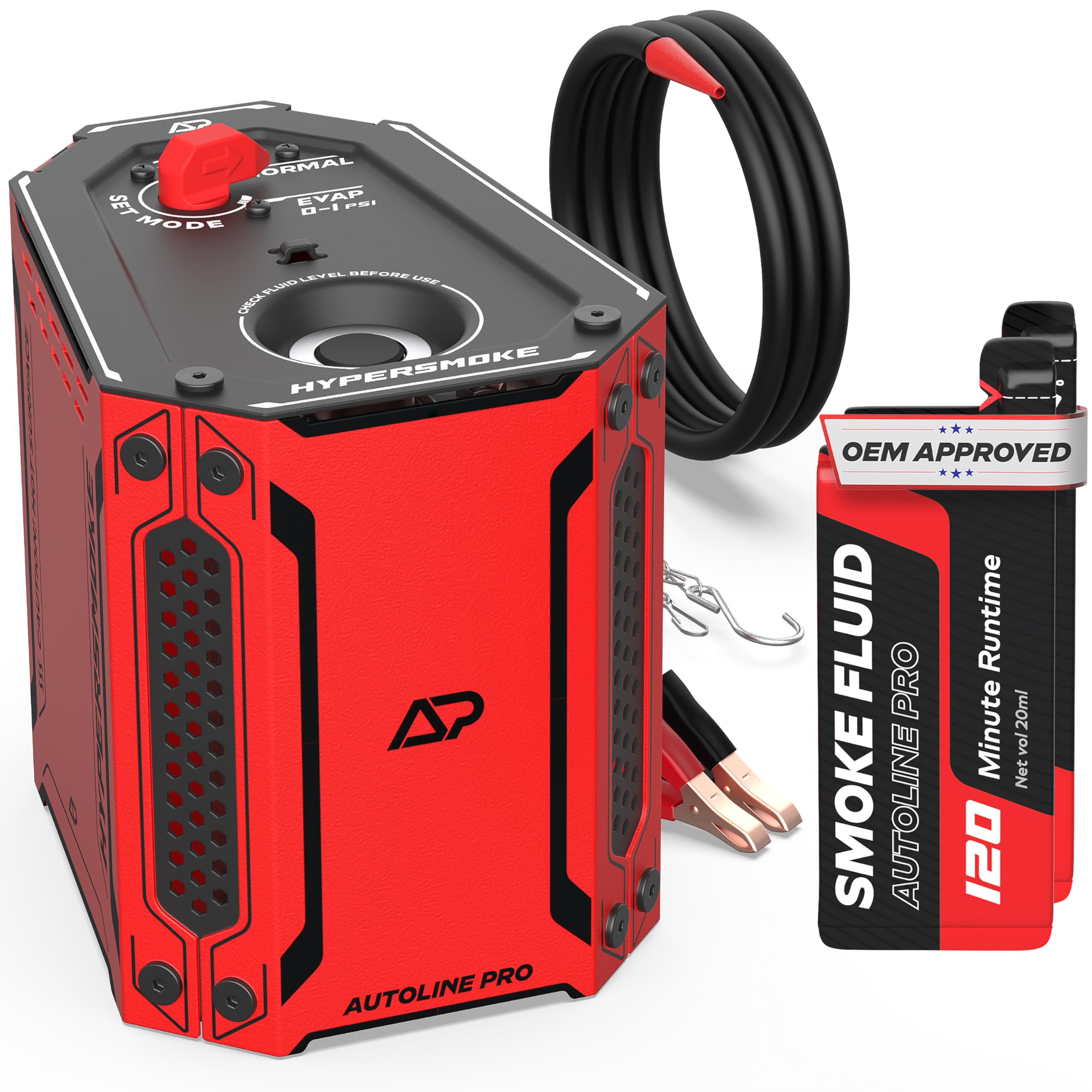
The HyperSmoke’s standout feature is its adjustable pressure, a rarity in this price class and the reason it tops this list. You can drop the output to under 1 PSI for EVAP testing, which matters because too much pressure can permanently damage that system, then dial it up to hunt boost or turbo leaks. This flexibility lets you safely test everything from intake manifolds to cooling systems with a single tool.
It is remarkably compact at just 1.1 pounds and 5 x 3 x 4 inches, making it the lightest smoke machine here and easy to hang right on the hood latch while you work. The built-in air compressor means you do not need a separate shop compressor, and the included OEM-approved smoke fluid is safe for sensors. Buyers report that its thick, steady smoke output finds small EVAP leaks quickly, with one noting it slashed diagnostic time dramatically.
Owners mention the fluid lasts about 60 minutes in real use rather than the advertised 240 minutes, and the smoke itself has a strong smell that can cling to clothes, so use it in a ventilated area. The package includes two bottles of fluid plus a tapered nozzle output hose, giving you plenty of runtime from the start to start diagnosing immediately. This is the crowd favorite for good reason.
Why it wins: the dual-pressure capability makes it the safest, most versatile smoke tester in this lineup, backed by a 3-year full coverage warranty.
Reach for this if: you want one tool that does safe EVAP checks and high-pressure turbo tests without breaking a sweat.
Know the smell: the stock fluid is effective but pungent, so plan to work outdoors or with a fan running.
2. Solary SD302 Automotive Smoke Machine
The smart two-mode tester that checks for leaks with air first, then pinpoints them with smoke.
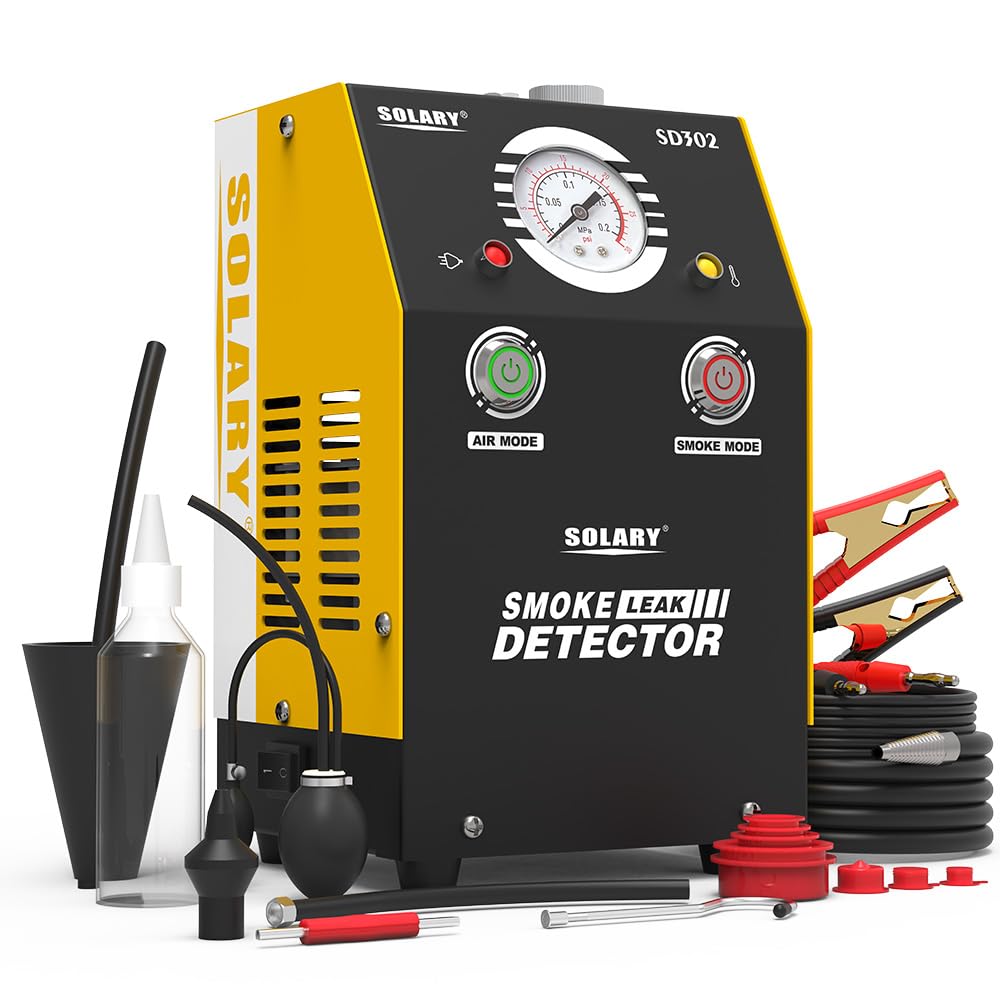
The SD302 stands apart with its air mode and smoke mode, which you control independently. Air mode injects air into the pipe to confirm a leak exists, while smoke mode generates thick smoke within 20 seconds to show you exactly where it is. This two-step approach saves time because you can verify a system is tight without ever filling it with smoke.
The built-in pressure gauge is another pro-grade touch: if the needle keeps climbing, the line is sealed, and if it falls, you have a leak to hunt. At 6.01 pounds and with a 12V connection straight to the battery, it is a heavier, more substantial unit than the budget picks, and owners consistently describe its build quality as solid. It handles EVAP, exhaust, intake, and fuel tank systems on cars, trucks, and even boats.
Reviews note it found an EVAP leak in under a minute and an exhaust leak in a few minutes using the supplied tailpipe adapter. The one mixed note is smoke production speed, which some find slower than expected, so be patient on your first fill. This is a trustworthy mid-priced workhorse for serious DIYers.
Smart workflow: the air-then-smoke sequence is a clever way to avoid unnecessary smoke exposure and speed up diagnosis.
Pick this for: a methodical approach where you verify the leak with air before committing to a smoke test.
Just so you know: the manual is a bit thin, but the controls are intuitive enough to figure out quickly.
3. THIKPO SMT-108-Pro Smoke Machine
The classic hand pump that pulls 25 inches of mercury for brake bleeding and vacuum checks without electricity.
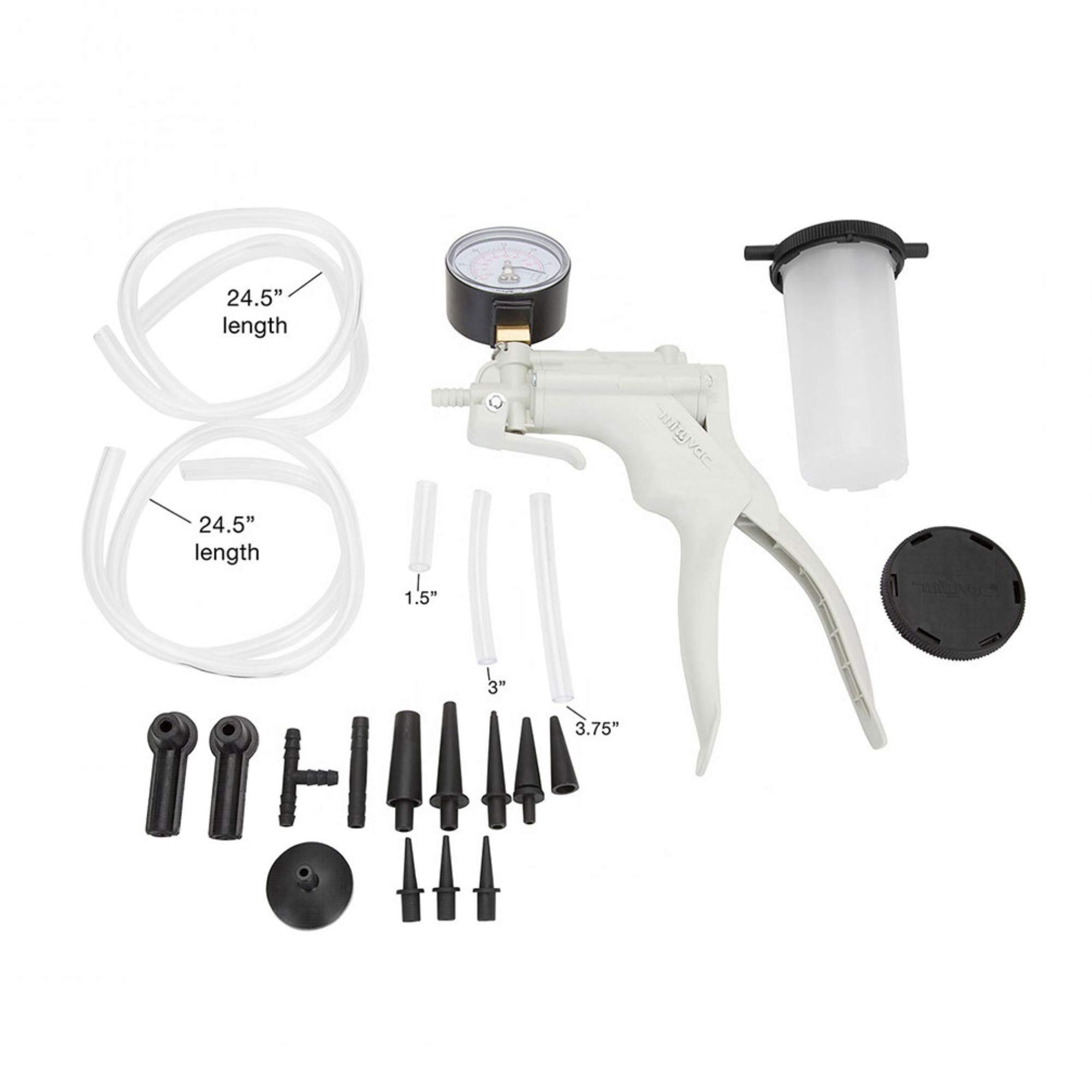
If you mostly need to bleed brakes or test individual vacuum components rather than smoke an entire system, this hand-powered kit is the affordable route. The vacuum pump holds up to 25″ (62cm) of mercury, which is plenty for bleeding brake lines, checking EGR valves, and testing cooling system components. It comes with 2 near-universal bleed screw adapters, 8 tapered adapters, and 2 lengths of 1/4″ tubing so you can reach most fittings.
Owners appreciate the included 23-page manual, which covers both diagnostics and brake bleeding thoroughly, and the no-mess design keeps caustic brake fluid contained in the collection bottle. The trade-off is durability: a few buyers found the plastic housing fragile, with one reporting it broke on first brake bleed use. The 12 x 9.8 x 2.2 inch footprint and 1.15 pound weight make it easy to toss in a toolbox.
Unlike the smoke machines above, this gives you a pressure port too, creating both vacuum and pressure for wider testing. It is the right tool if you prefer a simple, battery-free approach and do not need to find leaks across an entire engine bay. For pure vacuum diagnostics on a budget, this is a proven starting point.
Solid value: a low-cost, no-power way to handle brake bleeding and component-level vacuum checks with a detailed manual to guide you.
Choose this for: brake fluid changes and testing single parts like EGR valves without buying a smoke machine.
Handle with care: the plastic construction is the weak link, so treat it gently to make it last.
4. DURATECH 2 in 1 Brake Bleeder Kit

A complete hand-pump kit in a molded case, ready to test vacuum systems or bleed brakes on any vehicle.
The DURATECH kit is built for convenience, with every piece stored in a compact molded case so nothing gets lost between jobs. Its vacuum gauge reads 0-30 in/Hg and 0-760 mm/Hg, giving you accurate readings for testing vacuum-operated components, bleeding hydraulic systems, or siphoning fluids. The set includes a 4.05 OZ reservoir jar, 4 transparent hoses, and 3 adapters to fit cars, bikes, and motorcycles.
Customers note strong suction that sealed at over 20 psi in testing and successfully bled a classic Chevy in about 3 minutes when set up correctly. The contoured handle gives you a firm grip, and the premium hose resists heat and provides a reliable seal. The included extra gaskets are a thoughtful touch for maintaining that airtight connection.
The recurring gripe is reliability, as some units develop body leaks after short use and struggle to hold vacuum. Spillage is another common note, with the small reservoir filling quickly and stiff tubing making transfers messy. It is a capable entry-level kit, but treat it as a budget tool rather than a professional-grade investment.
Easy start: the organized case and clear gauge make this a friendly first kit for home mechanics.
Buy it for: occasional weekend brake jobs and basic vacuum testing where portability matters.
Expect to adapt: many owners recommend extra tubing for larger vehicles and a holder to keep the reservoir upright.
5. THIKPO SMT-108L Smoke Machine
The fast-filling smoker that runs on cheap baby oil and finds leaks across multiple engine systems.
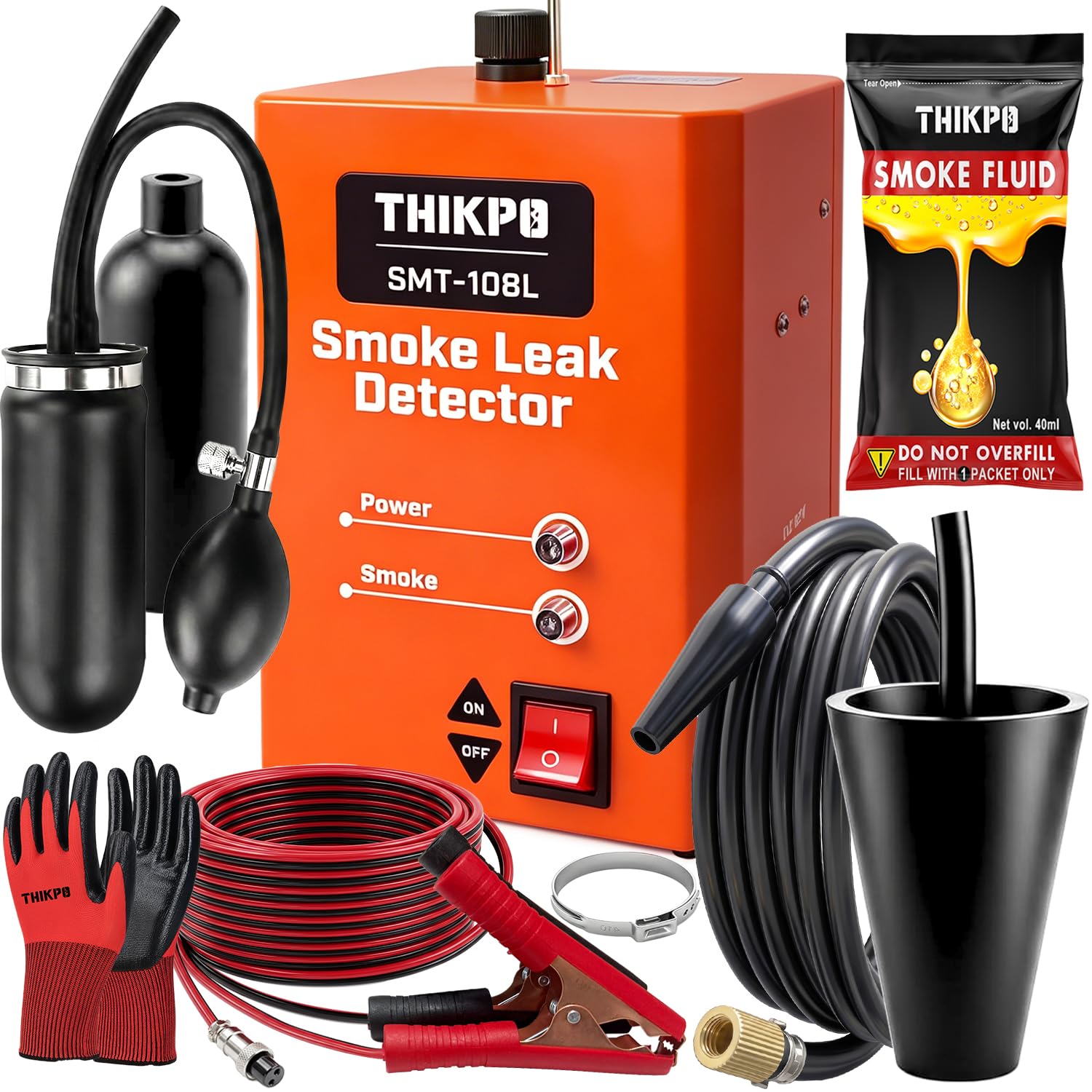
The SMT-108L gets to work quickly, generating dense visible smoke within about 8 seconds of startup thanks to its built-in air pump, so there is no external compressor to hook up. It connects to any standard 12V battery and hunts leaks in throttle bodies, intake and exhaust manifolds, EVAP systems, fuel tanks, turbochargers, and EGR valves. Owners love that it accepts common baby oil rather than pricey proprietary fluid, keeping every test inexpensive.
An integrated thermal cutoff protects the unit by shutting it down if internal temperatures exceed 167°F (75°C), and it is certified to operate from -4°F (-20°C) up to 122°F (50°C) for year-round use. The kit includes cone adapters, intake bladders, a bladder cover, smoke hoses, and a power cable. One buyer was shocked at how well it performed as a first smoke machine, solving a persistent lean-code issue.
The pressure aspect receives mixed feedback, so it is best for standard EVAP and intake leak finding rather than precision pressure testing. Just remember it does not include oil, so pick up pure mineral or baby oil without fragrance before your first job. For the money, this is a remarkable entry point into smoke diagnostics.
Fast and cheap: near-instant smoke plus dollar-store oil makes this the most economical smoke tester to run.
Grab this if: you are new to smoke testing and want quick results without a big investment or ongoing fluid costs.
Remember: oil is not included, and the pressure output is basic rather than adjustable.
6. TUIREL C4 Smoke Machine

The featherweight smoker that slips into tight spots and works on cars, bikes, snowmobiles, and boats.
At just 1.3 kg, the TUIREL C4 is one of the lightest powered smoke machines available, making it easy to carry around the garage or stow in a service vehicle. It is built with a premium metal body and a built-in air pump, so it generates its own pressure without needing a shop compressor. It runs on 12V DC and accepts 10ml-20ml of baby oil or paraffin oil, producing thick, consistent smoke in about 30 seconds.
Owners found it located a VW Rabbit leak in 2 minutes, and it is praised as a lifesaver for backyard mechanics. The kit includes an inflatable bladder and adapters for a snug seal on various pipe sizes. A smart protection system shuts it down if it overheats, with an indicator light that turns off until the temperature returns to a safe level.
The included cone can pop out under pressure, and it occasionally misses very small leaks that a dedicated vacuum pump would find, so it is not the most sensitive tool here. The hook on the case also separated for one owner, a minor annoyance. It remains a great value for general leak hunting on a wide range of vehicles.
Featherweight: the low weight and universal compatibility make this a top choice for varied fleets and cramped work areas.
Pick this for: a portable, easy-to-store smoke tester that handles multiple vehicle types without fuss.
Watch the cone: the seal can pop out under high pressure, so secure it well before testing.
7. Andeman Automotive Smoke Machine

The heavy-duty alloy smoker with serious pressure that reveals even micro-leaks in seconds.
The Andeman Tracer delivers a powerful 19 PSI output with 6L/min airflow, enough to push smoke through entire systems and expose micro-leaks that weaker units miss. It generates thick smoke within 10 seconds of startup, and the heavy-duty alloy construction makes it exceptionally durable for daily shop use. Its intelligent thermal protection cuts power automatically if temperatures exceed 105°C, providing a solid safety net.
This is a self-contained unit, so you simply add 20ml of baby oil or glycerin and start testing EVAP systems, turbo leaks, or intake manifolds without any external compressor. The 7-in-1 kit includes 7 tapered caps made from automotive-grade plastic to create airtight seals on all pipe sizes, plus delivery hoses for pinpoint accuracy. Owners found it located an oil leak instantly on a Honda Element and checked a full EVAP system on a Sonata with ease.
At 7.02 pounds, it is the heaviest unit in this lineup, so it is better suited to a stationary shop bench than constant carrying. The oil is not included, just an empty bottle, which surprises some buyers at first. If you want maximum pressure and rugged build for professional work, this is a strong contender.
Power output: the 19 PSI pressure and rapid smoke generation make this a high-performance option for serious diagnostics.
Choose this for: a shop-grade tool that can handle tough turbo and crankcase leaks without flinching.
Plan for the weight: the alloy build adds pounds, so this is a bench tool rather than a carry-everywhere unit.
Understanding the Specs
Adjustable Pressure
This lets you control how much force the smoke or air pushes into the system. It matters because EVAP systems can be permanently damaged by pressure above 1 PSI, while turbo and boost systems need higher pressure to reveal leaks. A machine with adjustable pressure is safer and more versatile than a fixed-output model.
Smoke Output Speed
This is how quickly the machine produces visible smoke after you turn it on, measured in seconds. Faster output means less waiting and quicker diagnosis, whether it is 8 seconds, 10 seconds, or 30 seconds. It directly affects how long a diagnostic job takes, especially when you are testing multiple systems.
FAQ
Can a vacuum line tester damage my EVAP system?
What is the difference between a hand pump and a smoke machine?
Do I need a separate air compressor to use a smoke machine?
What kind of fluid should I use in a smoke machine?
Can I use a smoke machine to find exhaust leaks?
How long does it take for a smoke machine to produce smoke?
Will a vacuum line tester work on motorcycles and ATVs?
Is the smoke from these testers safe to breathe?
Final Thoughts: The Verdict
If you want one dependable pick, the vacuum line tester winner is the AutoLine Pro HyperSmoke because its adjustable pressure makes it the safest and most versatile option, protecting delicate EVAP systems while still finding turbo leaks. If you want a methodical air-then-smoke workflow, grab the Solary SD302. And for professional-grade precision with pressure decay testing, the THIKPO SMT-108-Pro is the one to reach for.
How We Picked
We do not accept paid placement. Every pick is matched to a real buyer and a real use-case; we do not hands-on test units.
Sources & Methodology
Specifications: manufacturer listings and product documentation. Review insights: verified customer reviews, as of August 2026. Pricing: not shown on this page (it changes often); check the current price via the retailer link.
As an Amazon Associate, GoCarLife earns from qualifying purchases. This does not affect which products we feature.