
Our readers keep the lights on and the garage heater humming. As an Amazon Associate, I earn from qualifying purchases.
Specs are compiled from manufacturer listings and verified buyer reviews and can change over time — please confirm the key details on the product page before buying.
A vacuum gauge for automotive work is the oldest engine stethoscope there is. Before laptops and scan tools, this simple dial told a mechanic whether valves were leaking, timing was off, or a muffler was plugged. The right gauge with a sturdy hose and proper adapters lets you tune a carburetor or bleed brakes yourself, while a cheap tester with collapsing hoses gives false readings. This guide breaks down nine real options to help you find the one that fits your garage and your skill level.
I’m Mo Maruf — the founder and writer behind GoCarLife. This guide is built by comparing the manufacturers’ published specifications and the patterns across verified customer reviews, so you get each pick’s real strengths and trade-offs instead of marketing spin.
Whether you are chasing a rough idle or tuning a classic carburetor, the right vacuum gauge for automotive work turns guesswork into a clear diagnosis you can trust.
Our Picks at a Glance


How To Choose The Best Vacuum Gauge for Automotive Work
A vacuum gauge does one simple thing: it measures the suction an engine creates inside its intake manifold. That one number tells you a lot about what is happening inside — from sticky valves to a clogged exhaust. The key is choosing a gauge that gives you a stable, accurate reading every time you hook it up.
Know Your Engine Type
The biggest fork in the road is whether you work on carbureted engines with mechanical fuel pumps. Several kits here are specifically rated for carburetor engines with fuel pumps operating below 10 PSI (0.7 Bar). If you are tuning a classic car or a lawn mower, you need those low-pressure readings. If your vehicle has fuel injection, you will want a gauge that tests the vacuum-driven components instead.
Hose Quality Is Not a Suggestion
The included hose is often the weak link. A soft vinyl tube can collapse under vacuum or melt under hood heat, which gives you a false reading and can ruin your diagnosis. Look for an oil-resistant rubber hose rated to handle the working pressure — several buyers report swapping out the stock tube for a sturdier line before trusting the tool.
Quick Comparison
| Model | Best For | Vacuum Range | Pressure Test | Carrying Case | Amazon |
|---|---|---|---|---|---|
| AUTO METER 2337★ Best Overall | Permanent dashboard install | — | — | No | Amazon |
| ATPEAM Tester KitBest Value | Carb tuning value | 0-28 in-Hg | 0-10 PSI | Yes | Amazon |
| DASBET Bleeder KitMost Versatile | One-man brake bleeding | 0-30 in-Hg | — | Yes | Amazon |
| WUODAO Tester | Intake fine-tuning | 0-28 in-Hg | 0-10 PSI | Yes | Amazon |
| Lucky Seven 2-in-1 | Budget brake bleeding | 0-30 in-Hg | — | Yes | Amazon |
| VECKYJL Tester Kit | Evap system checks | 0-28 in-Hg | 0-10 PSIG | Yes | Amazon |
| ABN 4-in-1 Kit | Diagnostic needle patterns | 0-28 in-Hg | 0-10 PSIG | Yes | Amazon |
| Innova 3620 | Accurate carb tuning | — | — | No | Amazon |
| Lisle 20300 | Quick shop diagnosis | 0-25 in-Hg | 0-14 PSI | No | Amazon |
In-Depth Reviews
1. AUTO METER 2337 Autogage Vacuum Gauge Panel
Our pick — over 4.5★ from 300+ verified ratings; the strongest balance of quality and price.
The permanent answer for drivers who want vacuum readings on every drive, not just in the shop.
This is a gauge you install in your dash and read while you drive. It is a 2 1/16-inch head that fits standard panels, with a color-coded face and a left-to-right sweep that makes it easy to glance at on the road. The kit includes brass compression fittings and a mounting panel so you can wire it in properly.
The standout feature is the illumination — the kit includes a bulb and socket assembly with red and green bulb covers, so you can match your dash lighting. Drivers report the gauge is accurate, steady, and responsive, and they mention improving fuel economy by adjusting how gently they accelerate based on the live reading.
There is one recurring theme in the owner feedback: the included vacuum hose is the weak point. Multiple owners mention the supplied vinyl tube collapses under engine bay heat or yellows and cracks over time. The fix is simple — swap in a proper vacuum line — but it is an extra step you should budget for with this pick.
Why Owners Install It
- Accurate, steady, responsive readings you can trust while driving
- Illuminated face with red and green bulb covers for dash matching
- Fits standard 2 1/16-inch panels with included mounting hardware
The One Thing to Replace
- Included vinyl hose collapses under heat and yellows with age
- A stronger, smaller-diameter line is the recommended swap
Install it if: you want a permanent, illuminated vacuum readout inside your vehicle for daily driving and fuel-economy habits.
Plan for this: budget for a quality vacuum line upgrade right away, since the stock hose is the weak link owners flag most.
2. ATPEAM Vacuum and Fuel Pump Tester Gauge Kit
The budget-friendly kit that covers four tests without breaking your tool budget.
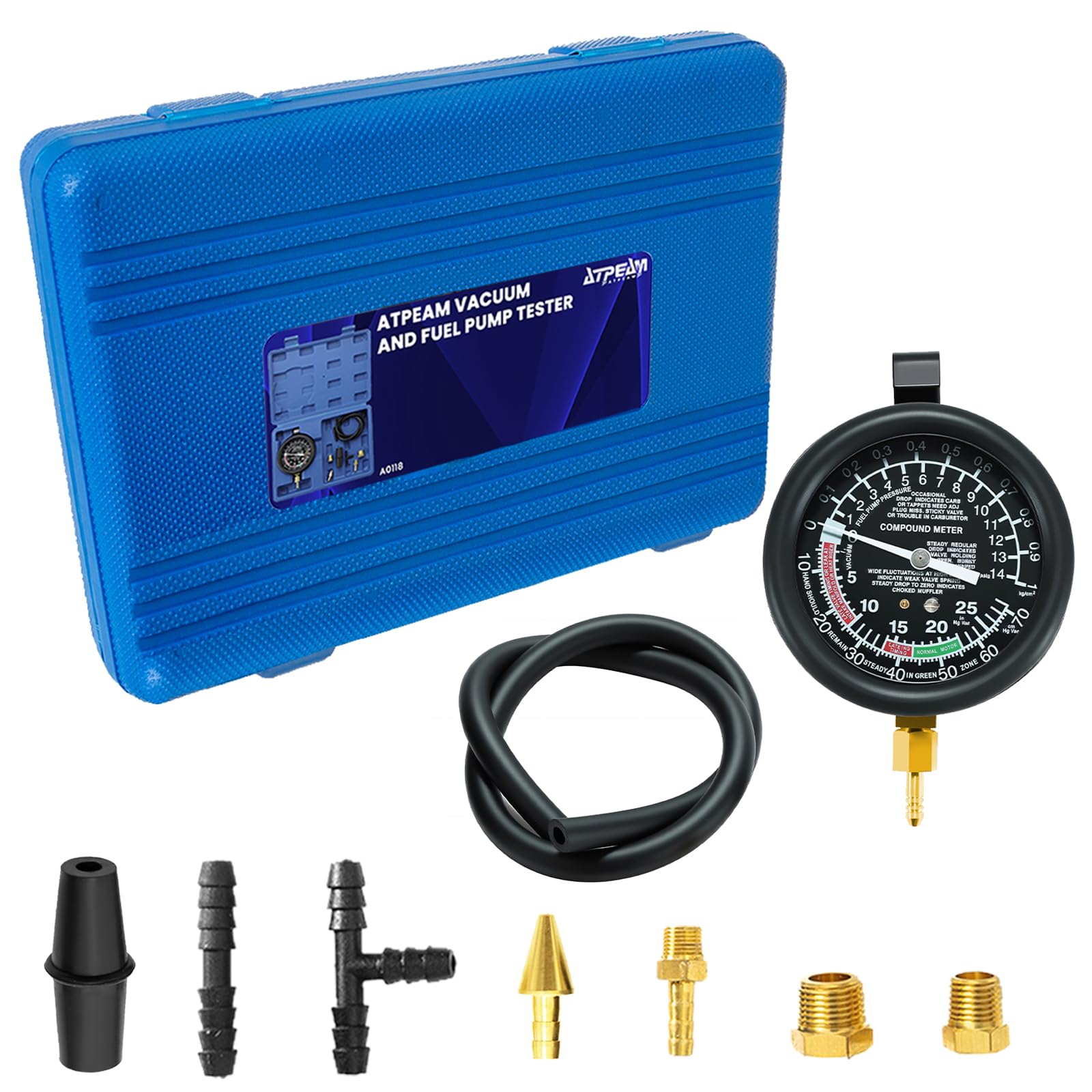
This kit reads both sides of the fuel system: it measures 0-28 IN-Hg vacuum and 0-10 PSI pressure on a 4-inch color-coded dial. The rubber side notches give you a firm grip while you hold it, and the extra-long 24-inch rubber hose reaches where you need it, rated for a 40 PSI (2.8 Bar) maximum working pressure.
The package includes a 14mm/18mm manifold adapter, brass cone adapter, and multiple plastic and brass fittings, all organized in a molded storage case. Owners have used it to adjust air-fuel mixture screws and set timing — one classic car owner passed the info on that it worked very well even when the engine had an incorrect flywheel installed.
It is a value pick, and the reviews reflect that. The functionality and quality are the most-praised aspects here, with the molded case for storage earning specific compliments. At 1.61 pounds, it is a lighter kit than the DASBET bleeder setup, which comes in at 1.72 pounds if you are comparing shop bags.
Solid all-rounder: covers fuel pump pressure, fuel pump vacuum, carburetor intake manifold, and vacuum tests in one affordable kit.
Keep in mind: a couple of users mention wanting a few more fittings, but agree the price leaves room to buy what you need.
3. DASBET Hand Held Vacuum Pump Tester Set
The one-man brake bleeding solution that also diagnoses engine vacuum systems.
This is the tool for anyone who has ever tried to bleed brakes alone. The hand pump creates suction so you do not need a second person pushing the pedal, and the included 4.5oz reservoir jar catches the old fluid. The pressure range reads 0-30 in Hg and 0-760 mm Hg on the attached gauge, so you get a clean readout while you work.
Build quality starts with aluminum alloy parts coated in black oxide for corrosion resistance, with PVC tubes chosen for heat resistance. The complete kit includes the pump, 3 transparent hoses, 6 adapters, 2 connectors, and a storage case. Customers note using it to bleed a clutch system and two sets of brakes with calipers successfully — the review pages sum it up: it is the easiest method they have tried when there is nobody around to push the pedal.
The honest trade-off is fit and durability. Some owners note the bleed nipples do not fit every vehicle, with one specific report of trouble on a Kawasaki. The quality feedback is genuinely mixed — the gauge holds pressure for many, but a handful mention breakage or leakage concerns, so treat this as a capable budget tool rather than a lifetime purchase.
Do-it-alone tool: the clear win here is solo brake and clutch bleeding, which owners rate as the most effective method they have tried.
Reality check: adapter fit is the recurring gripe — it works on most brake jobs but not every bleed valve size.
4. WUODAO Fuel Pump Pressure and Vacuum Tester

For the classic car owner who fine-tunes with a timing light in one hand and this gauge in the other.
This kit is built around the same 4-inch color-coded dial with rubber side notches, reading 0-28 IN-Hg vacuum and 0-10 PSI pressure. It ships with a 2ft/61cm rubber hose at 13/64-inch ID and 23/64-inch OD, rated to 40 PSI, plus the full set of brass adapters including a T-type fitting for inline hookups.
The heavy-duty plastic blow-molded carrying case with a handle is the practical detail here — it keeps the gauge and all six adapters organized so nothing gets lost between jobs. Owners using it for classic car tuning report strong results: the review pages show a distributor being adjusted until the needle settled at good vacuum, with the car running better than it ever had.
It is a newer kit with fewer ratings behind it, so treat it as a solid performer that is still building its track record. The dial, the brass fittings, and the case all point to a well-thought-out kit for the price.
Classic-car companion: pairs perfectly with a timing light for distributor fine-tuning, as owners describe getting a good vacuum reading and smoother idle.
Consider before buying: with a smaller owner base so far, long-term durability is less proven than the bigger-name kits.
5. Lucky Seven 2 in 1 Brake Bleeder Kit

The cheap-and-cheerful bleeder that proves you do not need a second person or a lift.
This red-cased kit is the entry point for one-man brake bleeding. It covers a 0-30 inHg and 0-760 mmHg pressure range on its gauge, and the included adapters are designed to fit a variety of vehicles, including motorcycles. It comes in a blow-mold case with a carrying bag for easy transport.
The value angle is the headline here — owners consistently call it good value for the money, and the universal design means it handles brake bleeding across different models. One owner even found a second life for it as a food vacuum sealer, using it on dry pasta, candy, and dehydrated fruits for pantry storage.
The honest caveat is consistency. The most-discussed aspect is functionality, and the feedback is split: it works well for some owners, while others report it stops working after the first use. Sealing is also a noted issue, and the smaller bleeder valves can be too small for this kit’s larger fittings. If you need a one-time bleed or a spare tool, this fits the bill — just do not expect it to outlast a pro-grade kit.
Why It Sells
- Genuine value for money with multiple adapters and tubes included
- Works on cars and motorcycles with a universal design
- Surprisingly useful beyond brakes, like food vacuum sealing
What to Watch
- Functionality is split — some stop working after first use
- Does not fit smaller bleeder valves, and sealing can be iffy
Reach for this if: you want a low-cost bleeder for occasional brake jobs and value the included case and adapters.
Look elsewhere if: you need a daily-use tool that handles every bleeder valve size without sealing concerns.
6. VECKYJL Vacuum Gauge Automotive Tester Kit
The modern diagnostic helper for evap systems that older kits simply cannot test.
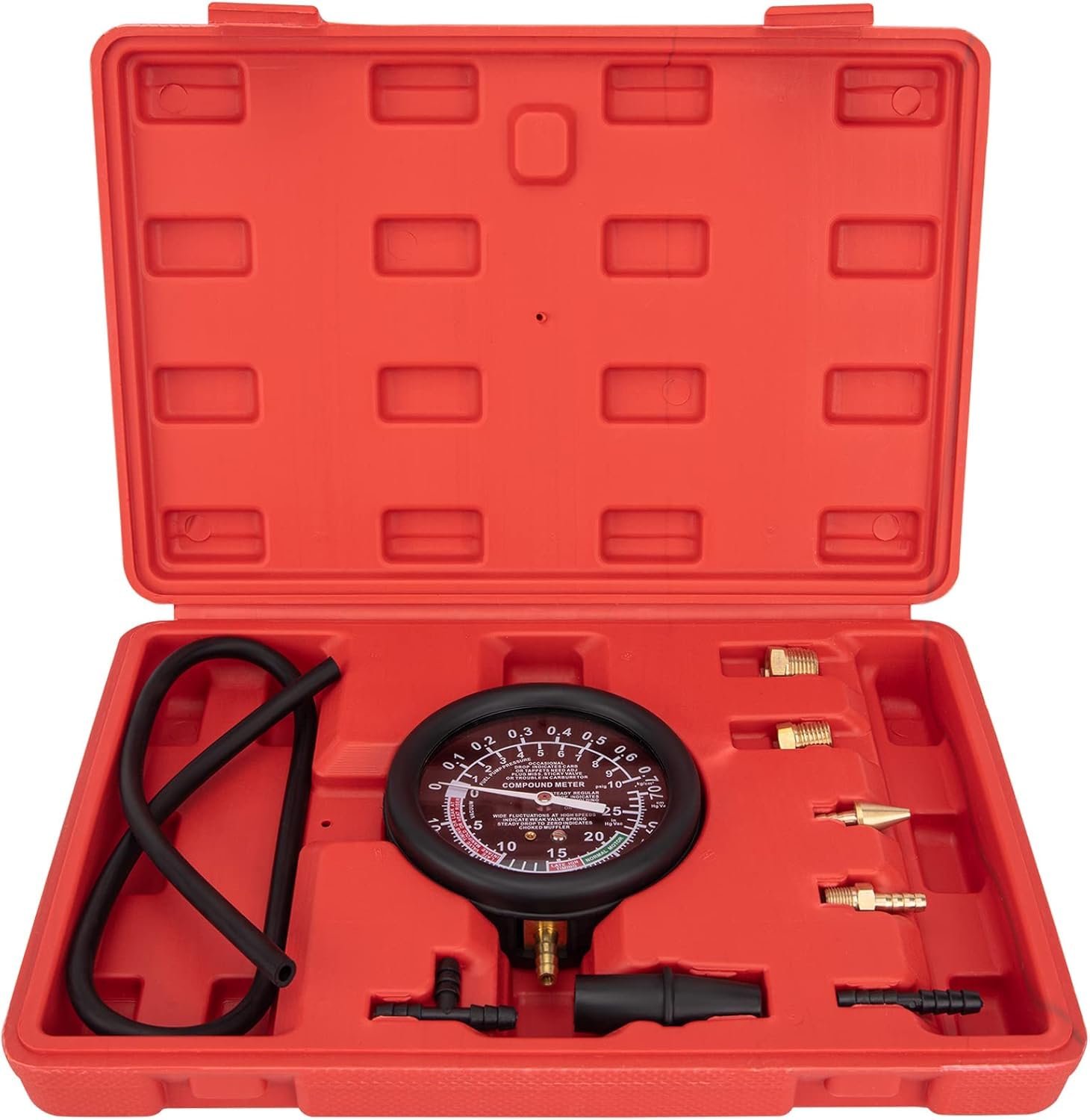
This kit reads 0-28 IN-Hg vacuum and 0-10 PSIG pressure on its 4-inch color-coded dial, with the same rubber side notches for grip. It ships with a 24-inch rubber hose rated to 40 PSI (2.8 Bar), a 14mm/18mm manifold adapter, and the full brass fitting set, all in a carrying case with a 3-month warranty.
What sets this one apart is the real-world versatility. Reviewers point out using it to test evaporative system purge valves on modern trucks — one Silverado owner had the evap purge valve tested with great results, enjoying the extra vacuum fittings as a bonus. It is also useful for locating leaks in gas lines, checking valve timing, and testing brake assist systems.
The build quality earns praise as sturdy with no cheap components, per the review pages. It is a newer entry to the market, so the owner base is still small, but the early consensus points to a well-made kit for diagnostics beyond just carburetor tuning.
Modern versatility: handles evap purge valve tests that older carb-focused kits miss, plus the classic vacuum leak checks.
Note the warranty: at just 3 months, it is shorter than some competitors offer, so treat it as a working tool, not a heirloom.
7. ABN Car Vacuum and Fuel Pump Tester Gauge Kit

The crowd-favorite 4-in-1 kit that turns needle patterns into engine diagnosis.
This kit is the closest thing to a complete diagnostic workshop in a case. The 4-inch dial reads 0-28 IN-Hg vacuum and 0-10 PSIG pressure, and the color-coded scales plus rubber edge make it easy to read and grip. It is rated for carburetor engines with mechanical fuel pumps operating below 10 PSI (0.7 Bar), and the 2-foot hose handles up to 40 PSI.
The real value is the included diagnostic guide baked into the product description. ABN tells you what the needle pattern means: an occasional needle drop indicates carb or tappet adjustment is needed, a steady regular drop suggests an open or burnt valve, and a steady drop to zero points to a choked muffler. This turns a simple gauge into a real troubleshooting tool.
Owners consistently praise the large dial and the included adapters. One report describes using the low-pressure range to reset fuel pressure on a kerosene heater with accuracy verified against a GM engineer’s gauge. The heavy-duty 12.75 x 2.25 x 7.25-inch blow-molded case keeps everything organized.
The most common note is a minor one — the plastic T-connection can break, and the 2-foot hose is short, though replaceable. The recurring gripe is the T-fitting at 7/32-inch being too large for some 5/32-inch lines. With strong ratings across a large owner base, it is the pick that balances capability, value, and proven real-world performance.
The Strengths That Win
- Large 4-inch easy-read dial with rubber edge for grip
- Diagnostic needle-pattern guide included for valve and muffler checks
- Heavy-duty blow-molded case with full adapter set
- Accuracy verified against professional gauges
The Minor Gripes
- Plastic T-connection can break on first use
- T-fitting too large for smaller 5/32-inch vacuum lines
The verdict: buy this if you want the proven 4-in-1 kit with the largest owner base and a guide that helps you actually interpret what the needle is telling you.
Be ready for: a possible plastic T-fitting break and the need to source a larger line for some vehicles.
8. Innova 3620 Vacuum/Carburetor Fuel Pressure Tester

The professional-grade tester with a heavy-duty Bourdon tube movement for accuracy that lasts.
This is the gauge for the serious tuner. It includes a heavy-duty Bourdon tube meter movement — the mechanical heart of a precision gauge — inside a 3 1/2-inch dial with dual-calibrated, color-coded scales. The housing is alloy steel and rubber, built for longevity in a shop environment.
The included components are a step above the commodity kits: properly rated fuel hose and brass fittings, plus a 24-inch oil-resistant rubber hose with a universal fitting adapter, tapered adapter, and a Tee connector. Owners use it to set racing carburetor power valves, needing precise 1/2 manifold vacuum readings, and to set idle mixture screws on carburetors with an easy-to-read gauge.
The accuracy is the defining trait here. One owner replaced a gauge that had drifted out of spec and called the Innova easy to read, accurate, and a great price. It falls between the budget kits and the premium panel gauges, and the 1-year limited warranty backs the build quality.
Pros-grade internals: the Bourdon tube movement separates this from cheaper diaphragm gauges, giving you accuracy that holds up.
Sizing note: the 3 1/2-inch dial is smaller than the 4-inch dials on the ABN and ATPEAM kits above, but the alloy steel construction justifies it.
9. Lisle 20300 Vacuum Gauge and Fuel Pump Tester

The no-frills, pocket-friendly gauge with the widest pressure range in this lineup.
For a quick shop check, this simple gauge gives you more range than most. It reads 0-25 inch Hg and 0-800 mm Hg for vacuum, and 0-14 PSI and 0-1000 g/cm² for pressure — the pressure side goes 4 PSI higher than the 0-10 PSI kits above. That means it can handle a wider set of fuel system checks.
At just 5.6 ounces, it is the lightest gauge here and comes in a simple skin-pack rather than a foam case. It uses an NPT thread style for the fitting. The simplicity is the appeal: no adapters to organize, no case to carry, just a reliable gauge for the toolbox.
Owners call it good quality and accurate, with a reputation for being helpful in diagnosing engine issues. The recurring mention is that it works well for its purpose. One owner notes the dial is slightly off and requires a bit of visual compensation — a minor quibble for a tool at this price with this much range.
The simple route: a no-case, no-frills gauge that still reads both vacuum and pressure with the most range here.
Be aware: the dial may need a tiny visual correction, and the plastic housing is not as rugged as alloy steel builds.
Understanding the Specs
Vacuum Range (in-Hg)
The vacuum range tells you how much suction the gauge can measure. Common ranges include 0-25 in-Hg, 0-28 in-Hg, and 0-30 in-Hg. A healthy gasoline engine typically pulls around 18-22 in-Hg at idle. The higher the top number, the more headroom you have for testing different engines, but most automotive diagnostics only need up to 25 in-Hg.
Pressure Range (PSI)
Many vacuum gauges double as fuel pump testers, and the pressure side matters here. Mechanical fuel pumps on carbureted engines operate at low pressures — often below 10 PSI. Kits like the ABN and ATPEAM read 0-10 PSI, while the Lisle extends to 0-14 PSI. Match the pressure range to what your fuel system actually produces.
FAQ
What is a good vacuum reading on a gasoline engine?
Can I use this gauge to bleed my brakes alone?
Will these kits work on fuel-injected engines?
Why does my included hose keep collapsing?
What is the difference between in-Hg and mm Hg on the gauge?
Can I install a vacuum gauge permanently in my dash?
How do I use a vacuum gauge to tune a carburetor?
What does a fluctuating needle mean on the gauge?
Are the brass adapters universal across these kits?
Is a vacuum gauge still useful for modern cars?
Final Thoughts: The Verdict
The vacuum gauge for automotive winner for most garages is the ABN 4-in-1 Kit because it pairs a large easy-read dial with a diagnostic guide that helps you interpret needle patterns, all backed by the largest and most positive owner base here. If you want a permanent dashboard installation, grab the AUTO METER 2337 for its illuminated 2 1/16-inch panel-mount design. And for the solo brake-bleder, the DASBET Hand Held Pump is the one to reach for when you are working alone.
How We Picked
We do not accept paid placement. Every pick is matched to a real buyer and a real use-case; we do not hands-on test units.
Sources & Methodology
Specifications: manufacturer listings and product documentation. Review insights: verified customer reviews, as of August 2026. Pricing: not shown on this page (it changes often); check the current price via the retailer link.
As an Amazon Associate, GoCarLife earns from qualifying purchases. This does not affect which products we feature.