
Our readers keep the lights on and the garage heater humming. As an Amazon Associate, I earn from qualifying purchases.
Specs are compiled from manufacturer listings and verified buyer reviews and can change over time — please confirm the key details on the product page before buying.
When a water heater or air tank pulls a vacuum, it can siphon water back out or even crush itself inward. The right vacuum regulator valve stops that by letting air in at the right moment, and picking one is mostly about matching the thread size and pressure range to your system.
I’m Mo Maruf — the founder and writer behind GoCarLife. This guide is built by comparing the manufacturers’ published specifications and the patterns across verified customer reviews, so you get each pick’s real strengths and trade-offs instead of marketing spin.
You will see how a simple brass fitting can protect your equipment, and the vacuum regulator valve options here cover everything from domestic water tanks to air compressor stations.
Our Picks at a Glance

How To Choose The Best Vacuum Regulator Valve
Before you buy, you need to know which side of the system you are protecting. A valve built for a hot water tank works differently from one made for a vacuum pump line, so the choice starts with your exact setup.
Thread Size Is The First Filter
Every valve connects with a threaded pipe fitting, and the size is the very first thing to check. A 3/4 inch inlet fits standard water heater tees, while a 1/4 inch NPT is the common size for air compressors and pneumatic tools. If you pick the wrong thread, nothing else about the valve matters.
Pressure Range Determines The Job
Some valves are rated for high working pressure like 200 psi, which suits water service lines. Others are made for very low pressure systems measured in inches of mercury, which is the right scale for vacuum work. You want a valve whose range covers your operating pressure, not one that is simply larger or stronger.
Material And Adjustability
Brass resists corrosion and holds up in wet or humid environments, which is why most water-rated valves use it. If you need to fine-tune the relief point, look for an adjustable model. If you just need to prevent a tank from collapsing, a fixed relief valve is simpler and often more reliable.
Quick Comparison
| Model | Best For | Inlet Size | Max Pressure | Adjustability | Amazon |
|---|---|---|---|---|---|
| Watts LFN36-M1★ Best Overall | Water heater protection | 0.75 inches | 200 psi | Fixed relief | Amazon |
| Control Devices VR38-100Precision Pick | Vacuum pump systems | 0.38 inches | 20 psi | 0-30″ Hg | Amazon |
| MEANLIN MEASURE | Air compressor stations | 0.25 inches | 180 psi gauge | Knob control | Amazon |
| TAISHER 5-Pack | Multi-tool airflow control | 0.25 inches | 150 psi | Inline knob | Amazon |
| SNS AR2000-N02 | Low pressure precision | 0.25 inches | 42 psi | 0-40 PSI | Amazon |
| LNCHKA DLJ+F | Filtering + regulation combo | 0.25 inches | 145 psi | 0-120 PSI | Amazon |
In‑Depth Reviews
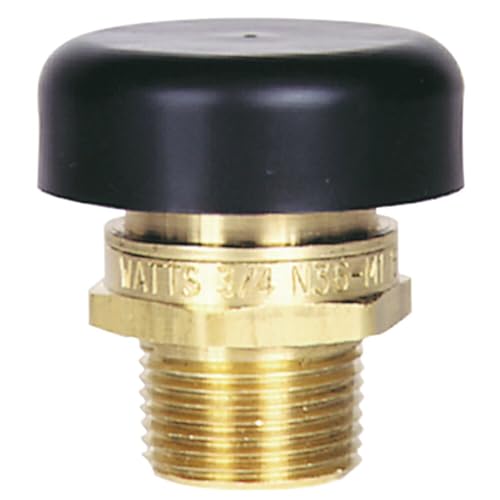
1. Watts LFN36-M1 Water Service Vacuum Relief Valve
Our pick — over 4.5★ from 100+ verified ratings; the strongest balance of quality and price.
The crowd favorite that ends the hunt for a hard-to-find water heater part.
This is the valve for anyone with a water heater or supply tank that keeps siphoning water back out of the system. It automatically lets air into the piping to stop a vacuum from forming, which protects both the water heater and the tank from damage.
The 0.75-inch National Pipe Tapered inlet is the standard size for water heater tees, and the body handles a maximum working pressure of 200 psi (13.8 bar). The brass body is lead-free, tested to ANSI Z21.22, and CSA certified, so it is built for the wet, hot conditions inside a domestic water system.
Buyers report the low-profile design fits tight spaces where a bulkier fitting would not, and the install is a simple screw-in job with a tee. As owners mention: “I drove all over town to find one of these but none of the pluming supply stores had one in stock.” That scarcity is exactly why this part earns its place on your shelf.
What Owners Appreciate
- Functionality is the top praise — owners say it works perfectly and stops leaks
- Quality construction stands out in the feedback
- Compact profile fits tight plumbing spaces
Know Before You Install
- This is a vacuum relief valve, not a backflow preventer
- Some owners bought a spare because local hardware stores do not stock it
Grab it if: you need a proven, lead-free relief valve for a water heater or tank with a 0.75-inch tee.
Think twice if: you are regulating an air compressor line, where a 0.75-inch inlet is the wrong size.
2. Control Devices VR38-100 Brass Vacuum Relief Valve
The adjustable brass fitting that gives vacuum pump users fine control.
This one is for people working with real vacuum systems, not water lines. The relief pressure adjusts from 0 to 30 inches of mercury, which is the scale that matters when you are pulling a vacuum on a reservoir or a pump setup.
It connects with a 3/8-inch male National Pipe Tapered thread, and that 0.38-inch inlet is a deliberate fit for compact vacuum plumbing. The brass body and stainless steel spring resist corrosion, so it holds up in marine tanks and fuel setups where moisture is always present.
What wins people over is the smooth adjustability. Customers note it regulates a screen printing exposure system “allows just enough relief to help extend the life of the pump as well as not put the blanket through necessary stress and stretch.” That is the real value: protecting downstream equipment from harsh vacuum swings.
Adjustable and reliable: the threaded brass construction and pre-applied sealant make setup straightforward, and the low stack height fits where bulkier valves will not.
The honest caveat: because it is so finely adjustable, a few users expect it to respond to very small vacuums instantly, so match it to a system that actually pulls meaningful vacuum.
Perfect for: vacuum pump lines, fuel tanks, and custom rigs where you need to dial in the relief point.
Not for: standard residential water heaters — that job belongs to a 0.75-inch water-rated valve, not a 3/8-inch vacuum fitting.
3. MEANLIN MEASURE 1/4 Inch Air Compressor Regulator

A complete replacement kit that brings an old compressor back to life.
If you have an aging air compressor with a dead regulator, this kit is a direct swap-in. It ships with the regulator, a 0-180 PSI dial gauge, a shut-off switch, plugs, couplers, and even Teflon tape, so you rarely need to buy extra parts.
The 1/4-inch NPT ports are the standard for most home compressors, and the aluminum body keeps it light. The plastic adjustment knob gives you a smooth “light touch” flow setting, which is ideal when you are dialing in pressure for a specific tool.
Reviewers point out it fits older tanks well, with one report that it “was a perfect fit for my Craftsman air compressor.” Others have used it to step an 80 psi tank down to 20 psi for hobby paint work. The catch is quality: the included fittings get mixed feedback, and some shoppers say minor leakage at the joints even with pipe dope applied.
Why It Earns A Spot
- Functionality is the most-praised feature — it regulates accurately
- Fit gets solid marks, especially on older compressors
- Everything needed for install is in the box
Watch The Fittings
- Quality is the most-discussed issue, and it is mixed rather than glowing
- A few owners saw leakage from the supplied joints
Reach for this if: you want a budget-friendly, all-in-one regulator kit to revive a home compressor.
Look elsewhere if: you need premium fittings straight from the start — plan to swap in your own quality connectors.
4. TAISHER 5-Pack Brass In-Line Air Flow Regulator

Five solid brass valves that let you control airflow on multiple tools at once.
This is a smart buy if you run several air tools and want each one on its own flow control. The pack gives you five inline regulators, each with a 1/4-inch National Pipe Tapered male inlet and a 1/4-inch NPT female outlet, so you can thread them directly between a hose and a tool.
The solid brass body handles a working pressure of 150 PSI across a temperature range of -65°F to 250°F (-53°C to 121°C). That generous temperature span means it stays reliable even in unheated garages or near hot equipment.
Buyers use these to “slow air flow to Die grinders & other air tools,” and they like the round knob that stays out of the way. The honest trade-off is that the knob is easy to bump, so once you set it, you want to keep it protected from accidental touches during use.
Great for multi-tool shops: the five-piece count means you can leave one permanently attached to each tool without buying singles.
Set-and-protect: the smooth knob is convenient but sensitive, so position it where it will not get knocked during work.
Best if: you have multiple air tools and want a cheap, corrosion-resistant valve on each.
Skip if: you need a precise gauge readout — these are simple inline regulators without a pressure dial.
5. SNS AR2000-N02 Low Pressure Air Regulator

The regulator that lets you fine-tune down to single-digit PSI for delicate work.
Most standard regulators cannot go low enough for tasks like vacuum bagging or light spray work. This one is built for that, with a pressure range of 7 to 42 PSI and a rated flow of 19.4 SCFM (550 L/min), so it is a specialist for low-pressure precision.
It connects with a 1/4-inch National Pipe Tapered thread and includes a mounting bracket and gauge for panel installation. The aluminum alloy body keeps it lightweight, and the pull-up rotary knob adjusts pressure without accidental changes.
Buyers report being able to set it between 1-3 PSI for sensitive projects, though they note it is “touchy” at those very low settings. That is the nature of precision low-pressure work — it rewards patience and small adjustments.
Built for fine control: the 0-40 PSI range with a bracket and gauge makes it ideal for panel-mounted setups.
Note the trade-off: one buyer found the ports are not all the same size, and the “low pressure” label is not perfectly accurate, so check your fittings before installing.
Choose this if: your project needs regulated airflow below 42 PSI with a readable gauge.
Pass if: you are working at standard compressor pressures of 90-120 PSI — this range is too low for you.
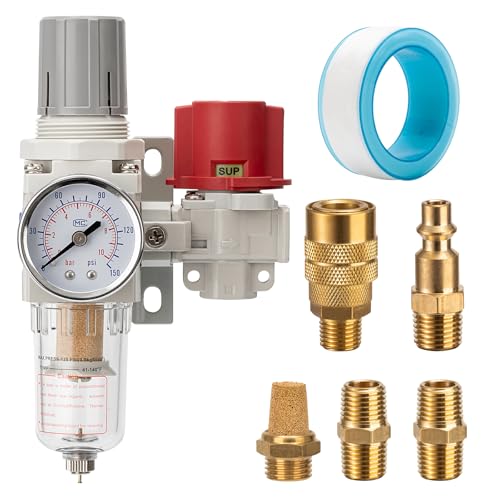
6. LNCHKA Filter Regulator Combo with 5 Micron Element
A filter and regulator in one unit that cleans the air while it controls the pressure.
For a workshop compressor feeding spray guns or sandblasters, this combo does two jobs at once. It filters harmful debris with a 5 micron brass element and regulates pressure with a 0-150 PSI gauge, all in a single 1/4-inch NPT body.
The unit handles a maximum pressure of 145 PSI with a recommended adjustment range of 0-120 PSI, and it flows 18 SCFM (500 L/min). It is rated for compressors up to 2.68 hp, so it matches typical single-stage home and small shop units.
The transparent polycarbonate bowl lets you see contaminants at a glance, and the bottom drain valve makes water removal quick. Owners mention the hose dump valve is “super handy if you need to change attachments frequently,” and the box includes two 1/4-inch NPT plugs and brass rapid air connectors for flexible mounting.
One unit, two benefits: filtering debris extends tool life while the regulator keeps pressure steady for consistent results.
Set expectations: fit and finish gets mixed reviews, and one owner had a plastic part fail after a day — treat the bowl and knob gently.
Grab it if: you want cleaner, regulated air for spray guns and sandblasters without buying separate filter and regulator units.
Think twice if: you run a larger compressor above 2.68 hp — this combo is sized for smaller systems.
Understanding the Specs
Maximum Pressure Rating
This number tells you the highest pressure the valve can safely handle. A water service valve rated for 200 psi is built for the high pressure in domestic supply lines, while a vacuum relief valve rated for just 20 psi is meant for low-pressure systems measured in inches of mercury. Matching this to your system is not optional — exceed it and the seal can fail.
Inlet Connection Size
The thread size is the gateway to compatibility. A 0.75-inch inlet fits water heater tees, while a 0.38-inch or 0.25-inch National Pipe Tapered thread suits pneumatic and vacuum systems. Always measure your existing port before ordering, because a thread mismatch means the valve simply will not install.
FAQ
What is the difference between a vacuum relief valve and a backflow preventer?
Will a 1/4 inch NPT regulator fit my air compressor?
How do I know if my water heater needs a vacuum relief valve?
Can I use the same valve for water and air applications?
What does the 0 to 30″ Hg range mean on a vacuum valve?
Is a brass valve better than an aluminum one for air flow?
Why does my regulator leak at the threaded joints?
How much airflow can a filter regulator combo handle?
Final Thoughts: The Verdict
Across the board, the vacuum regulator valve winner is the Watts LFN36-M1 because it is the proven, lead-free fix for water heater protection with the highest owner satisfaction. If you need precise vacuum control for a pump system, grab the Control Devices VR38-100. And for an all-in-one workshop solution that filters and regulates, the LNCHKA DLJ+F is the one to reach for.
How We Picked
We do not accept paid placement. Every pick is matched to a real buyer and a real use-case; we do not hands-on test units.
Sources & Methodology
Specifications: manufacturer listings and product documentation. Review insights: verified customer reviews, as of August 2026. Pricing: not shown on this page (it changes often); check the current price via the retailer link.
As an Amazon Associate, GoCarLife earns from qualifying purchases. This does not affect which products we feature.