
Our readers keep the lights on and the garage heater humming. As an Amazon Associate, I earn from qualifying purchases.
Specs are compiled from manufacturer listings and verified buyer reviews and can change over time — please confirm the key details on the product page before buying.
A van air conditioner unit is the difference between a sweltering metal box and a place you actually want to sleep. The real question isn’t just how cold it gets—it’s whether your battery bank can feed it all night without forcing you to run a generator. This guide focuses on rooftop RV-style units and 12V DC models, not portable household ACs, so every pick here is built to bolt onto your rig and run off your house battery.
I’m Mo Maruf — the founder and writer behind GoCarLife. This guide is built by comparing the manufacturers’ published specifications and the patterns across verified customer reviews, so you get each pick’s real strengths and trade-offs instead of marketing spin.
You need a van air conditioner unit that actually cools your space without draining your battery or drowning out conversation. The right pick depends on three things: how you power it, how loud it runs, and how many BTU (the cooling output) your layout demands.
Our Picks at a Glance
How To Choose The Best Van Air Conditioner Unit
Picking an AC for your van isn’t like buying one for a house. You’re balancing three things that fight each other: how much space you need to cool, how much power your battery bank can supply, and how much noise you can tolerate at 3 a.m. Start by figuring out which of those matters most to you.
Match the BTU to your space
BTU (British Thermal Units) is the cooling capacity—roughly, how much heat the unit can remove per hour. A 10,000 BTU unit suits a small camper van or a trailer bedroom, while 15,000–18,000 BTU covers a long 30-foot coach or a cargo van that bakes in the sun. Buyers report that a 12,000 BTU unit can feel closer to an 8,000 BTU in real-world cooling, so undersizing is a common mistake. Look for a unit rated at or slightly above what your square footage suggests.
Decide: 12V DC battery power or 110V generator power
The biggest fork in the road is power source. A 12V DC unit runs straight off your house battery and solar, with no inverter needed—ideal for off-grid boondocking. A standard 110V rooftop unit needs shore power or a generator, though some owners run them on a big enough battery bank through an inverter. If you plan to sleep in parking lots or BLM land without hookups, a 12V unit is the way to go. If you mostly camp with power, a conventional rooftop AC gives you more BTU per dollar.
Check amp draw and your wiring
Amp draw tells you how hard the unit pulls on your electrical system. A 12V unit drawing 30–50 amps at full blast needs thick cable—owners repeatedly mention upgrading to 4AWG or 6AWG wire to avoid voltage drop. If you’re on a 300Ah battery, a unit that sips 350W in ECO mode at night is very different from one that pulls 700W in turbo. Read the specs before you buy, not after the install.
Consider noise and heat pump features
Decibel (dB) ratings matter more in a van than a house because you’re sleeping inches away. A unit at 55 dB is audible but tolerable; 40 dB is library-quiet. Many 12V units also include a heat pump—9000–12,500 BTU of supplemental warmth—which extends your camping season without firing up a separate furnace. Just remember a heat pump is for mild cold, not arctic conditions.
Quick Comparison
| Model | Best For | Cooling Power | Noise Level | Power Source | Amazon |
|---|---|---|---|---|---|
| RecPro 15K Quiet★ Best Overall | Large coaches | 15,000 BTU | 55.4 dB | 110-120V | Amazon |
| Treeligo 11KBest Off-Grid | Off-grid solar setups | 11,000 BTU | Below 45 dB | 12V DC | Amazon |
| Gidrox 10KTop Performer | Vanlife on battery | 10,000 BTU | 40 dB | 12V DC | Amazon |
| Outequip 10K | Class B vans | 10,000 BTU | Quiet ECO mode | 12V DC | Amazon |
| Countrymod 10K | Boondocking | 10,000 BTU | 44 dB sleep mode | 12V DC | Amazon |
| Outequip 10K w/ Heater | Year-round vans | 10,000 BTU | 40 dB | 12V DC | Amazon |
| RecPro 13.5K | Motorhomes | 13,500 BTU | 59.7 dB | 110-120V | Amazon |
| TOSOT 16K | Quiet cooling | 16,000 BTU | 43 dB | 110-120V | Amazon |
| Furrion Chill Cube 18K | Airstreams & sprinters | 18,000 BTU | 56 dB | 110-120V | Amazon |
| FOGATTI 16K | Low bridges | 16,000 BTU | 43 dB | 110-120V | Amazon |
| Gidrox 12K Heat Pump | Off-grid all seasons | 12,000 BTU | 40 dB | 12V DC | Amazon |
In‑Depth Reviews
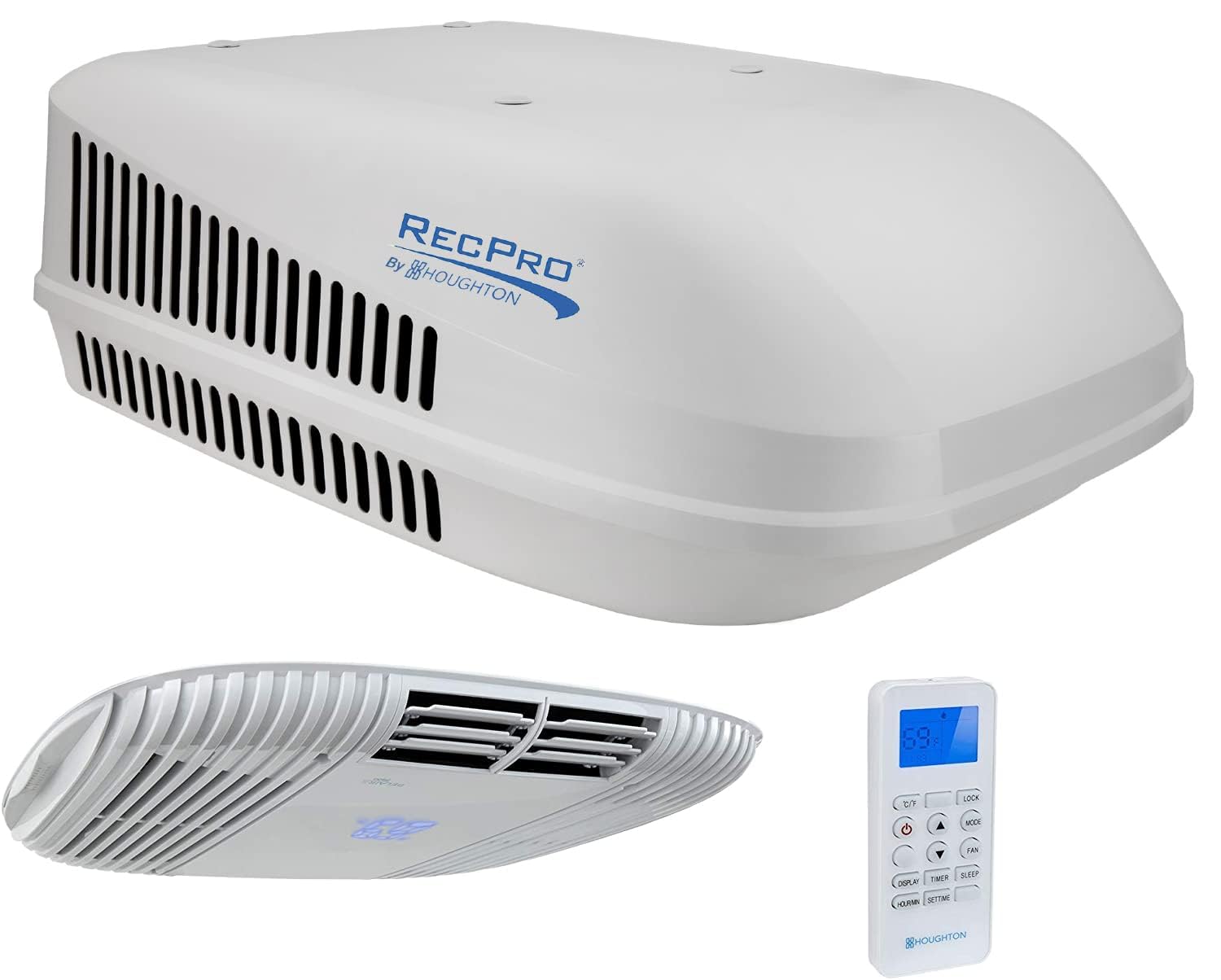
1. RecPro RV 15K Quiet AC Heat Pump
Our pick — 4.5★ from 300+ verified ratings; the strongest balance of quality and price.
The big-coach champion that replaces two loud units with one whisper-quiet heat pump.
Owners of 36-foot coaches call this RecPro “the one you want” because it cools a long, open living space, not just a van bedroom. It delivers 15,000 BTU of cooling—a full 50% jump over the 10,000 BTU 12V units on this list—so you get real airflow across a big area. The heat pump adds supplemental warmth, turning it into a four-season machine rather than a summer-only band-aid.
At 55.4 dB, it’s rated quiet, and owners consistently back that up: against an older Dometic, against Coleman Mach units, against everything they’ve lived with before. One rig owner swapped out two Coleman Mach units and now runs both on a single generator circuit, cooler and quieter than before. The included wireless remote and LED touch display mean no thermostat wiring to run, and adjustable ductless vents let you steer airflow where you need it.
The catch is weight—over 100 lbs—and a physically demanding install. A couple of owners needed longer bolts for thick roofs and warned that wiring into a welded metal frame takes patience, with one 3-day DIY job. Owners mention it cools a 36-foot coach at 58 dB low and 65 dB high, which is impressively contained for a unit this powerful. Annual energy consumption sits at 5694 kWh per year, so it’s built for owners who have shore power or a serious generator, not for silent solar boondocking.
Why owners pick it
- The defining strength: cooling muscle (15,000 BTU) with genuinely quiet running (55.4 dB)
- Built-in heat pump extends use into chilly evenings without a furnace
- Complete kit—installers praised the ease once it’s lifted onto the roof
- Ducted and non-ducted compatibility covers almost any rig layout
The trade-offs
- Weighs over 100 lbs—you’ll want a second pair of hands
- 110-120V power means shore power or generator, not silent battery operation
- Occasional timer quirk: setting the clock can trigger the timer, fixed by pulling the remote battery
Best for: owners of large trailers, fifth wheels, and 3x-foot coaches who want one powerful, quiet unit to replace older loud ACs.
skip it if: you’re off-grid and need to run cooling from solar alone—this unit wants 110-120V power behind it.
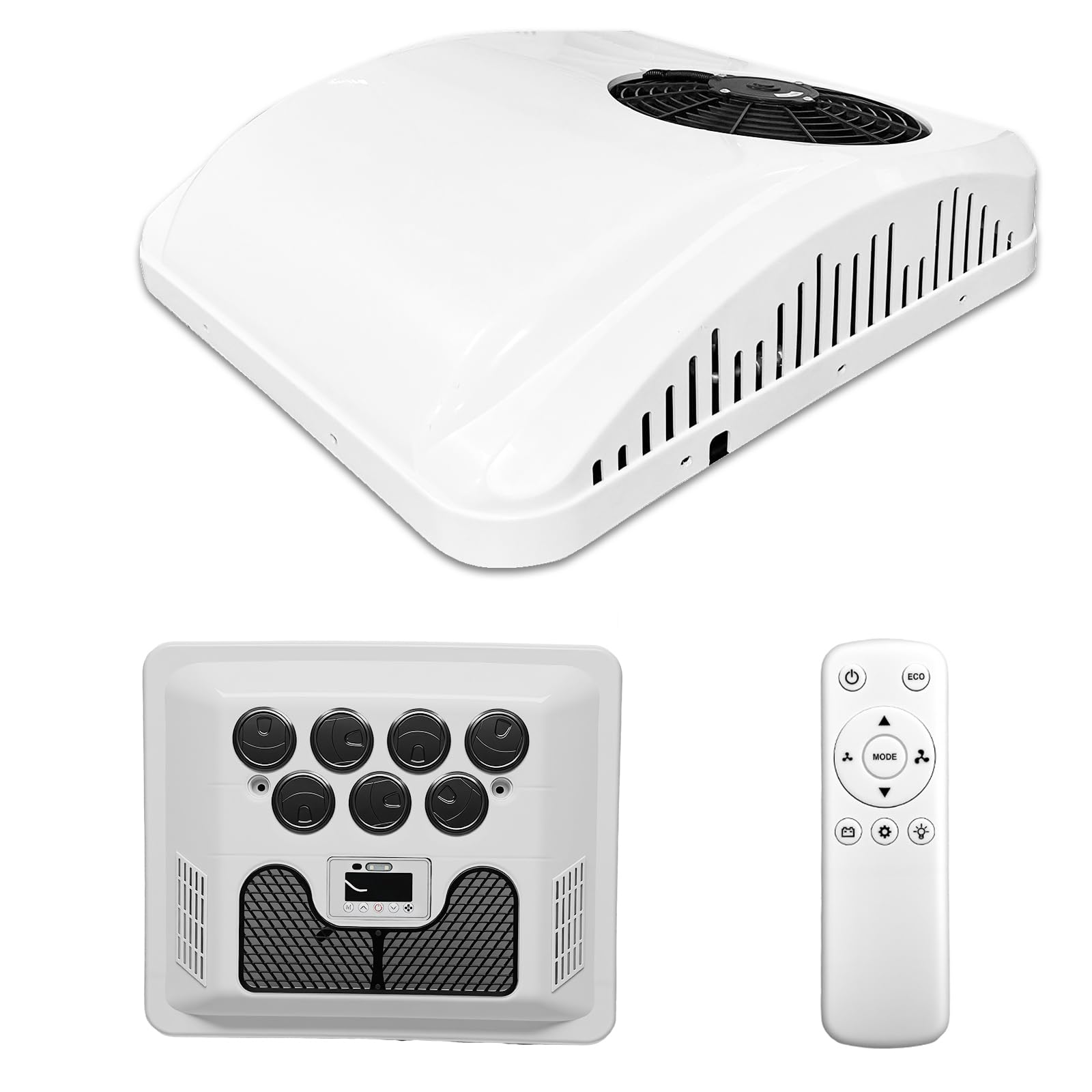
2. Treeligo 11000 BTU 12V DC Rooftop
The solar-friendly roof unit that cools a bedroom fast in triple-digit heat.
If you want to sleep off-grid without a generator, this Treeligo is built for exactly that scene. It runs on 12V DC straight from your house battery, with operating power ranging from 330W to 1000W depending on mode—no inverter, no fuel, no shore power required. One owner runs it off 3x100W solar and 2x100Ah batteries with an MPPT controller and reports it “cools 5th wheel bedroom fast in 100°F.” That’s the real-world validation off-grid buyers need.
If you want one room cold, not a whole coach, this unit’s 11,000 BTU is a 50% power gap on the cooling side versus the RecPro 15K above—but it’s aimed at a different buyer: the van or trailer sleeper. Noise stays below 45 dB (about as loud as a quiet library), which owners describe as genuinely quiet, and the inverter compressor plus 4000 BTU heat function make it usable in shoulder seasons too. Installation needs only a 12.60″ x 10.24″ roof opening, and the compact indoor unit (23.2″ x 19.3″) saves valuable headroom.
The honest caveat is support. A couple of owners hit a wall when units stopped working—one saw error codes 2P-4P and couldn’t get a response from customer service, another had a fan issue that was resolved quickly via email. It’s the kind of split that makes this a strong pick for hands-on DIYers who can troubleshoot, and a riskier bet for buyers who want white-glove support. Fully FCC and UL certified, it’s a solid value for solar-powered boondocking.
Off-grid balance: this is the rare 12V rooftop unit that one solar owner verifiably runs through a 100°F afternoon on solar and battery alone—no shore power needed.
Know this: pairs best with a 300Ah+ battery (one owner runs it at 50A), and you should be comfortable with DIY support if something goes wrong.
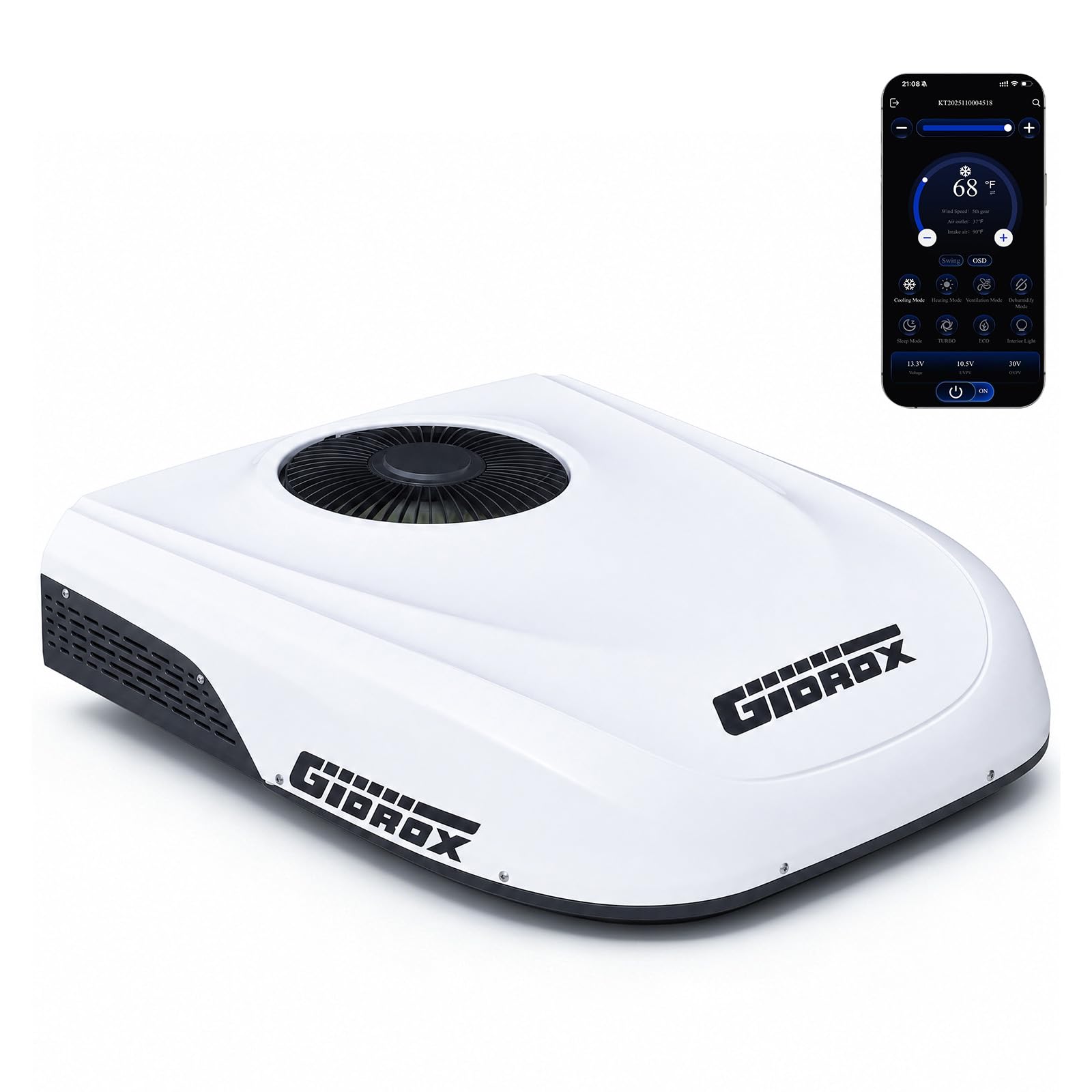
3. Gidrox 10000 BTU 12V DC Rooftop (Cooling Only)
The night-owl’s choice: 40 dB sleep mode and a 350W ECO draw that sips battery.
This Gidrox is engineered around one idea—sleeping through a hot night without draining your bank. Tested average power consumption is about 350W in nighttime operation at 30°C ambient, and the spec sheet claims roughly 60% energy savings versus traditional ACs. That translates to all-night comfort on a 400Ah battery, which is exactly the math vanlifers run before a purchase. The 10,000 BTU inverter compressor cools a small space within 3 minutes, and the brushless fan holds sleep mode at a library-quiet 40 dB.
Owners who measured their draw report a tidy picture: fan-only 25-50W, eco 350W, cooling 420W, turbo 650-700W, dehumidifier 250W. That transparency makes it easy to plan your solar. The 54 lbs total weight and 14″ x 14″ roof cutout compatibility keep install realistic for a solo owner, and you get a 19.7 ft power cable plus all mounting hardware in the box. Control comes three ways—smartphone APP via Bluetooth, infrared remote, or physical buttons—so you’re never stuck fumbling in the dark.
The recurring gripes are small but real: ECO mode locks at 79°F, so adjusting temperature kicks you out of eco, and there’s no battery cutoff setting. One owner in a 30-foot camper found it “not that strong” and planned to buy two, which is a fair warning that this 10K unit is built for vanlife-sized spaces, not long coaches. The HEPA filter and clean flush mount round out a package that owners describe as clean and effective for its size.
Night-ops specialist: the measurable 350W ECO draw and 40 dB sleep mode make it the quietest, most battery-friendly pick here for a van bedroom.
Reality check: treat the 10,000 BTU as vanlife-sized cooling—a 30-foot trailer will need two of these to match an old 13.5K.
4. Outequip 10000 BTU 12V Rooftop
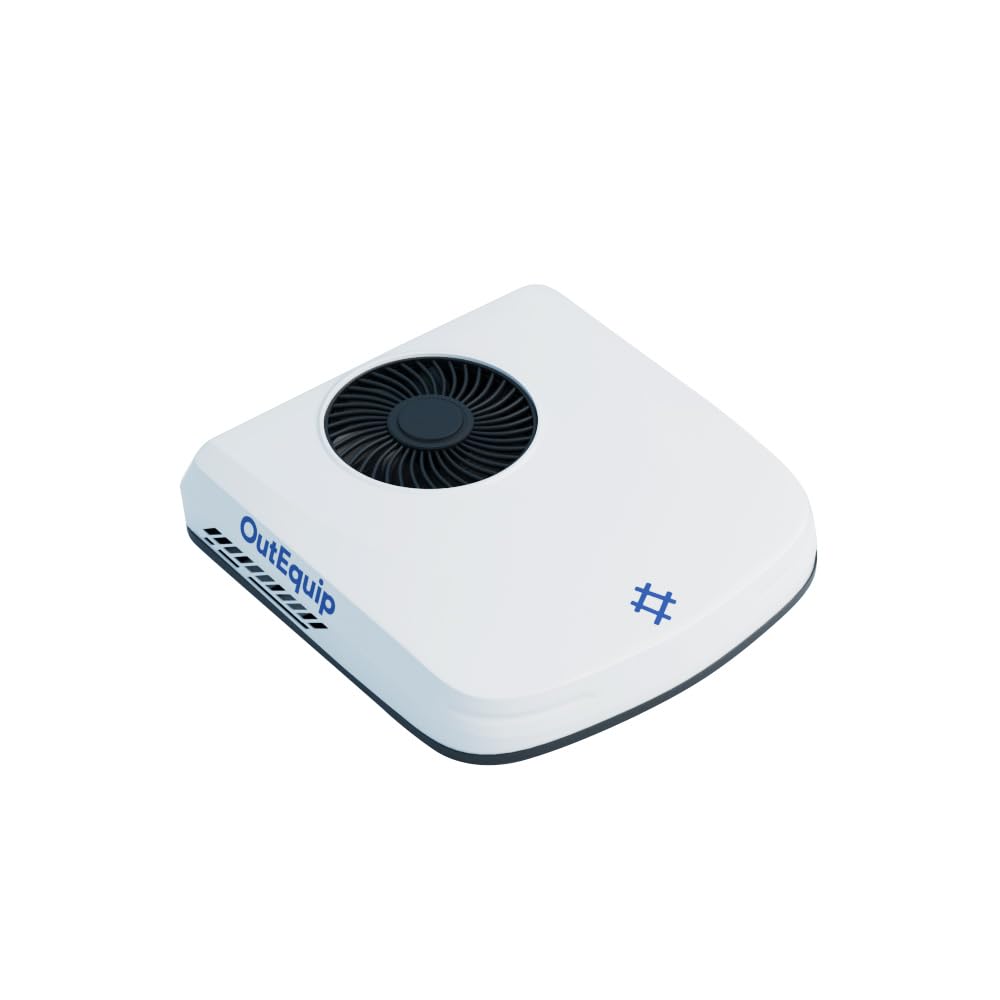
The lightweight roof unit that slips onto a Class B van and tames Phoenix heat.
At just 43 lbs, this Outequip is the featherweight of the 10,000 BTU crowd—light enough that one owner completed a solo 2-day install with no roof modifications. That low weight makes it a natural fit for Class B vans and low-profile campers where every pound and every inch of roof clearance counts. It cools within 15 minutes, and owners confirm it holds 80°F in 105°F Phoenix heat at about 21A on the inverter compressor, jumping to ~51A in Turbo when you need fast recovery.
The power math is what wins people over: drawing about 50A on startup, dropping to ~30A while maintaining, it gives a 480Ah bank roughly 8 hours of cooling and a 600Ah bank about 10 hours when parked. Customers note staying comfortable in Texas heat and even cooling a 7×14 insulated trailer in 100°F+ sun while drawing surprisingly low wattage. The brushless copper motor fans and spring-supported mounts keep it quiet—one owner calls the exterior “quieter than the roof vent”—and the EPDM foam gasket plus zinc-coated condenser handle weather well.
The thing everyone raves about is cooling performance, with quality and quiet operation close behind. The recurring fit note is sealing the condenser area to prevent water ingress, and a 360Ah battery gives about 6-7 hours max before you need to recharge. It’s worth flagging that a shore charger may not power the AC and charge your battery simultaneously, so plan your power split. For a vanlifer who wants a proven, quiet, lightweight 12V unit, this is a top-tier choice.
Where it shines
- 43 lbs solo-installable—no roof crane crew needed
- Verified 80°F hold in 105°F Phoenix heat at ~21A
- 8 hours from a 480Ah bank, 10 hours from 600Ah
- Quiet enough that the exterior is “quieter than the roof vent”
Install notes
- Seal the condenser area well to avoid water ingress
- Shore charger may not run AC and charge battery at once
- Gasket and bolt torque instructions could be clearer
Reach for this if: you drive a Class B or low-profile van and want a lightweight 12V unit proven in extreme desert heat.
Look elsewhere if: your space exceeds a couple of hundred square feet—this 10K unit is sized for van bedrooms and small trailers.
5. Countrymod 10000 BTU 12V DC Rooftop (Black)
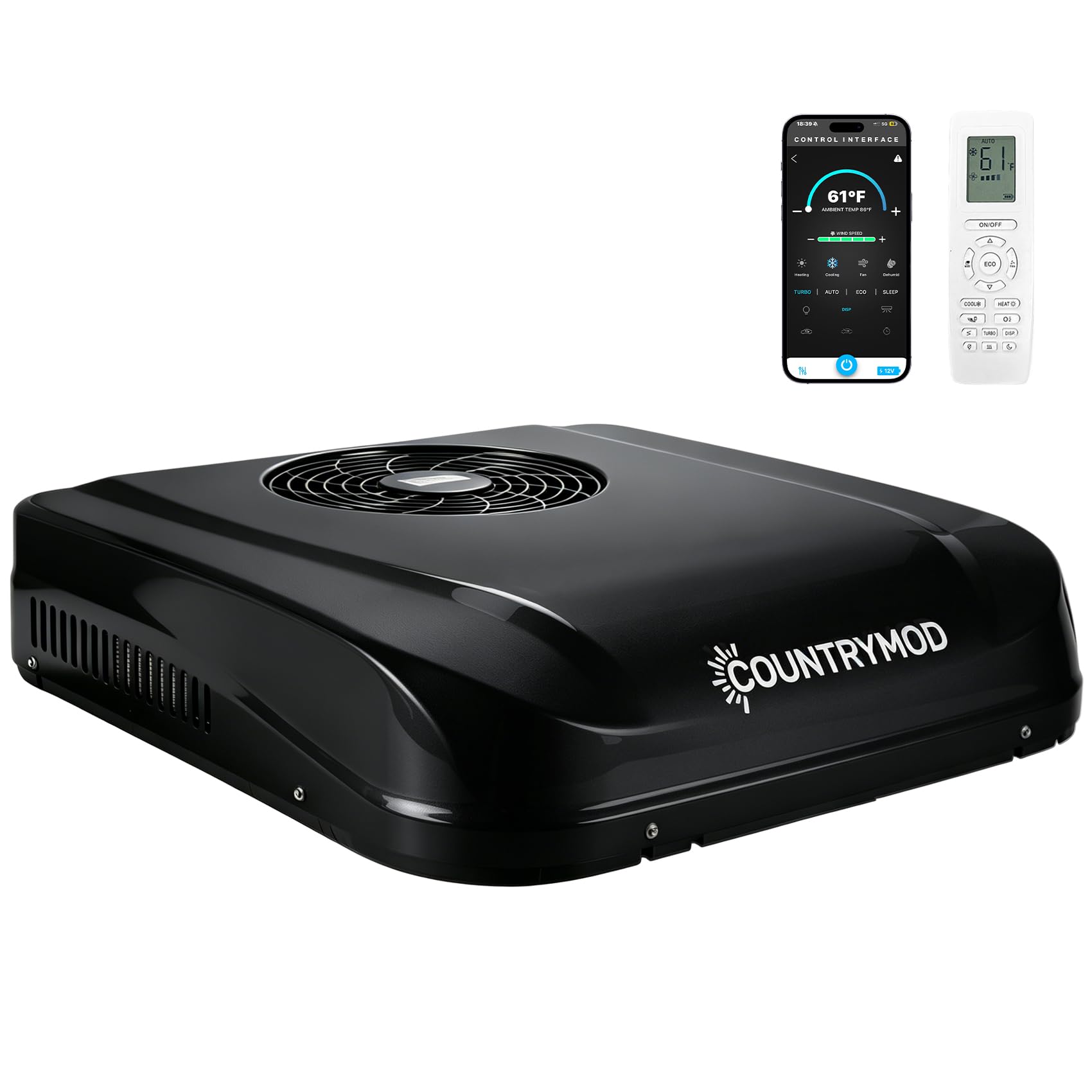
The boondocker’s bargain that holds 80°F at noon in 113°F Nevada heat.
This Countrymod is the budget pick that refuses to act like one. The 10,000 BTU variable-frequency inverter design draws only 260W in ECO mode and 590W in Turbo—numbers so efficient that one owner kept a 300Ah battery running for 12 hours in ECO. That’s the kind of real-world math that makes off-grid living possible without a generator. It uses less than 50 amps and claims only 50% of battery capacity in typical use, which owners consistently confirm.
You get a “just a low hum” at 44 dB in sleep mode and 45-55 dB in general operation, even in a poorly insulated black passenger van with 360-degree windows. The horizontal compressor design reduces vibration and lowers the center of gravity, which owners say adds stability on the road. It mounts to a standard 14″ x 14″ roof vent with no ductwork needed, and you control it via keypad, remote, or smartphone app—though the Bluetooth controller had a rough patch that customer service (a responsive rep named Tony) replaced quickly.
Owners comparing it to a 120V unit say it runs quieter and cooler, and keep a 30-foot trailer’s bedroom ice cold while cooling the rest moderately. The instructions are thin—you’ll want 6AWG wire for the run, longer all-thread bolts for arched roofs, and possibly 4AWG for a 30-foot cable path. Lead-acid batteries won’t cut it; this unit wants LiFePO4 to hold voltage above 12V at the unit. For a budget-conscious vanlifer with a modern battery bank, this is exceptional value.
Efficiency king: at 260W ECO, it stretches a 300Ah battery to 12 hours—verified in 113°F conditions at 80°F daytime hold.
Plan ahead: budget for proper 6AWG wiring and a LiFePO4 bank; lead-acid owners will be disappointed.
6. Outequip 10000 BTU 12V Rooftop (w/ Heater)
The all-season 12V unit with a PTC heater for shoulder-season comfort.
This Outequip takes the same proven 10,000 BTU 12V platform and adds a 4,500 BTU PTC heater—a ceramic heating element that provides supplemental warmth without needing a furnace. It’s designed for mild temperatures and small spaces, not arctic winters, but for a vanlifer who camps through spring and fall, it extends your season meaningfully. Owners call the cooling effective and note it reaches “25 degrees” easily, with installation praised as straightforward and instructions well-written.
The install experience is where this unit stands apart: reviewers point out accurate instructions, about 15 feet of 6AWG wire and fuse included with only 0.03V drop, and a 4-hour solo install into a 2020 Ford Transit 250. At 43 lbs and 6″ tall, it keeps a low profile and runs at 40 dB—quiet enough that owners say it’s inaudible inside or out on low. The 12/24/48V compatibility is a rare flexibility that lets you match it to whatever electrical system your build uses, and the Bluetooth app plus remote give you full control.
The thing everyone raves about is installation, with cooling performance close behind. The honest limit: the 4,500 BTU heater is supplementary only—owners say “heat not for arctic” and it will not warm a large or poorly insulated space in deep cold. One owner noted the lid screws are hard to remove and connectors are fragile enough to keep spares handy. For a Transit, Sprinter, or Promaster owner who wants cooling plus mild heat from a single roof unit, this is the smart all-rounder.
Why it wins
- Clear install: about 15 ft of 6AWG wire included, 0.03V drop
- 40 dB quiet, 43 lbs, 6″ tall—low profile for vans
- Rare 12/24/48V compatibility for custom builds
- 4,500 BTU PTC heater for mild-cold camping
The catch
- Heater is supplemental—not enough for extreme cold or large spaces
- Screws and connectors are fragile; keep spares
- Turbo mode is loud initially before settling
Best for: van builders who want one roof unit handling both summer cooling and shoulder-season warmth.
Think twice if: you camp in true winter—the 4,500 BTU heater is a boost, not a furnace replacement.
7. RecPro 13.5K Non-Ducted RV Air Conditioner

The straightforward 13.5K replacement that cools a motorhome and runs on a small generator.
This RecPro 13.5K is the no-nonsense upgrade for owners whose old Atwood AirCommand or Coleman has given up. At 13,500 BTU and 59.7 dB, it’s a solid mid-power unit that one owner says is 20 dB quieter than their old Furrion, and another reports cools a 23-foot motorhome in 99°F SoCal sun without compressor noise. The key spec for generator users: it runs on a 2200W generator with SoftStart, so you don’t need a massive genset to get cold air.
The thing everyone raves about is installation—owners describe a clean 4-bolt mount, a plenum included, and clear assembly instructions, with one doing a 30-minute install with a 12-year-old helping. It works with both ducted and non-ducted systems, uses 10.38 BTU/Watt efficiency, and pulls low amps so you can run multiple appliances without overloading. The remote and LED touch display give you cool, dry, fan, sleep, and timer modes with zero thermostat wiring.
There’s a frank caveat for humid regions: one owner in Florida found the fan keeps running after the compressor cycles off, dumping moisture back inside, and flagged it “not for humid regions.” The remote also needs direct line-of-sight and can be finicky, which owners rate as mixed. For dry-climate RVers with shore power or a capable generator, this is a quiet, efficient, easy-install workhorse.
Easy-install workhorse: 4-bolt mount, plenum included, and verified running on a 2200W generator with SoftStart.
Not for the humid South: the recirculating fan behavior makes it a poor fit for Florida-style humidity—look at the 12V inverter units for better dehumidifying.
8. TOSOT 16000 BTU RV Air Conditioner

The 43 dB whisper machine with WiFi, heat pump, and a 600 sq ft reach.
If decibel level is your make-or-break spec, this TOSOT is the unit owners point to. At 43 dB it’s quieter than a normal conversation, and the maker claims it’s 32% quieter than standard RV ACs—a figure that shows up in review after review. An owner who replaced a failing Dometic 13.5K says this is quieter, cools faster, and has better airflow, keeping a 23-foot trailer at 70°F in 105°F heat. Another calls it an “absolute lifesaver” in a Winnebago Revel sprinter, noting 48 dB on low.
You get 16,000 BTU of cooling plus a 12,500 BTU heat pump, working in ambient temps from 23°F to 115°F—a genuinely all-season range. The WiFi control via the Gree+ app means you can adjust temperature, fan speed, and mode from anywhere in the rig, and a remote is included. Installation is DIY-friendly for a non-ducted 14.25″ x 14.25″ opening, with all hardware and a clear guide, and shoppers say a clean 2-hour job with no leaks. The 2-year warranty and ETL certification add confidence.
The catch is subtle: one owner notes the cooling “struggles above 95°F” even while praising the heating, and there’s an undercurrent of concern about TOSOT brand longevity and parts availability down the road. The unit ships in two packages, so wait for both before scheduling install. For light sleepers who want smart control and a heat pump without the 12V premium, this delivers.
Standout strengths
- 43 dB—quiet enough to sleep through, verified by owners
- 16,000 BTU cool + 12,500 BTU heat pump, 23°F to 115°F range
- WiFi via Gree+ app plus remote for full smart control
- Uses only 800W on high cooling, enabling boondocking on battery
Watch-outs
- Cooling power drops off above 95°F ambient
- Brand long-term parts availability is an open question
- Ships in 2 packages—confirm both arrived before install
Reach for this if: quiet sleep and app control matter more than battery operation, and your rig has shore power or a good generator.
pass on it if: you’re planning silent solar-only boondocking—this wants 110-120V power.
9. Furrion Chill Cube 18K Non-Ducted

The 18K beast that cools a 31-foot Airstream in 15 minutes and ramps its amp draw down.
This is the unit for people who refuse to be hot. At 18,000 BTU, the Furrion Chill Cube provides well over one ton of cooling (1.5 tons to be exact), and buyers report two of them cooled a 31-foot Airstream in 15 minutes at 89°F in the shade. The variable-speed compressor is the star: it runs constantly instead of hard cycling, which eliminates the abrupt starts and amp spikes that kill battery banks. One owner replaced a Dometic 13.5K that pulled 1700W with this unit at a max draw of 1100W, ramping down to 800/500/300W.
That efficiency shows up in the real world: with a 1000Ah LiFePO4 bank, the same owner runs about 10 hours off battery versus 1 hour before, and boondocked 2 days without a generator. At 72.4 lbs, it’s about 10% lighter than comparable units, and the aerodynamic roof profile reduces drag and wind resistance—which owners say improves gas mileage. The 56 dB running noise is a big step down from the 66 dB of the Dometic it replaced, and the foam seal comes pre-attached for a clean fit on 2.5″ roofs.
The design makes it “2,000W generator ready,” so a modest genset can feed it. The honest downside is the nightmare scenario: one owner’s unit arrived with a defective control board after professional install, and the warranty claim took over a month with parts unavailable elsewhere—missing 3 trips in the process. It’s a rare but real risk with a premium brand. Also note the air distribution box (ADB) is sold separately, so factor that into your total cost.
Brute-force cooling
- 18,000 BTU cooled a 31′ Airstream in 15 minutes
- Max 1100W ramping down to 300W—huge battery savings
- 56 dB vs the 66 dB Dometic it often replaces
- 72.4 lbs is about 10% lighter than the category norm
Fair warnings
- The ADB (air distribution box) is sold separately—budget for it
- Rare control-board failures can mean slow warranty claims
- A single unit still needs shore power or a generator bank
Best for: large trailers and sprinters where fast, powerful cooling and battery-friendly variable speed are non-negotiables.
Think twice if: you can’t stomach the separate ADB cost or the rare warranty-claim risk on a big purchase.
10. FOGATTI 16K BTU RV AC with Heat Pump
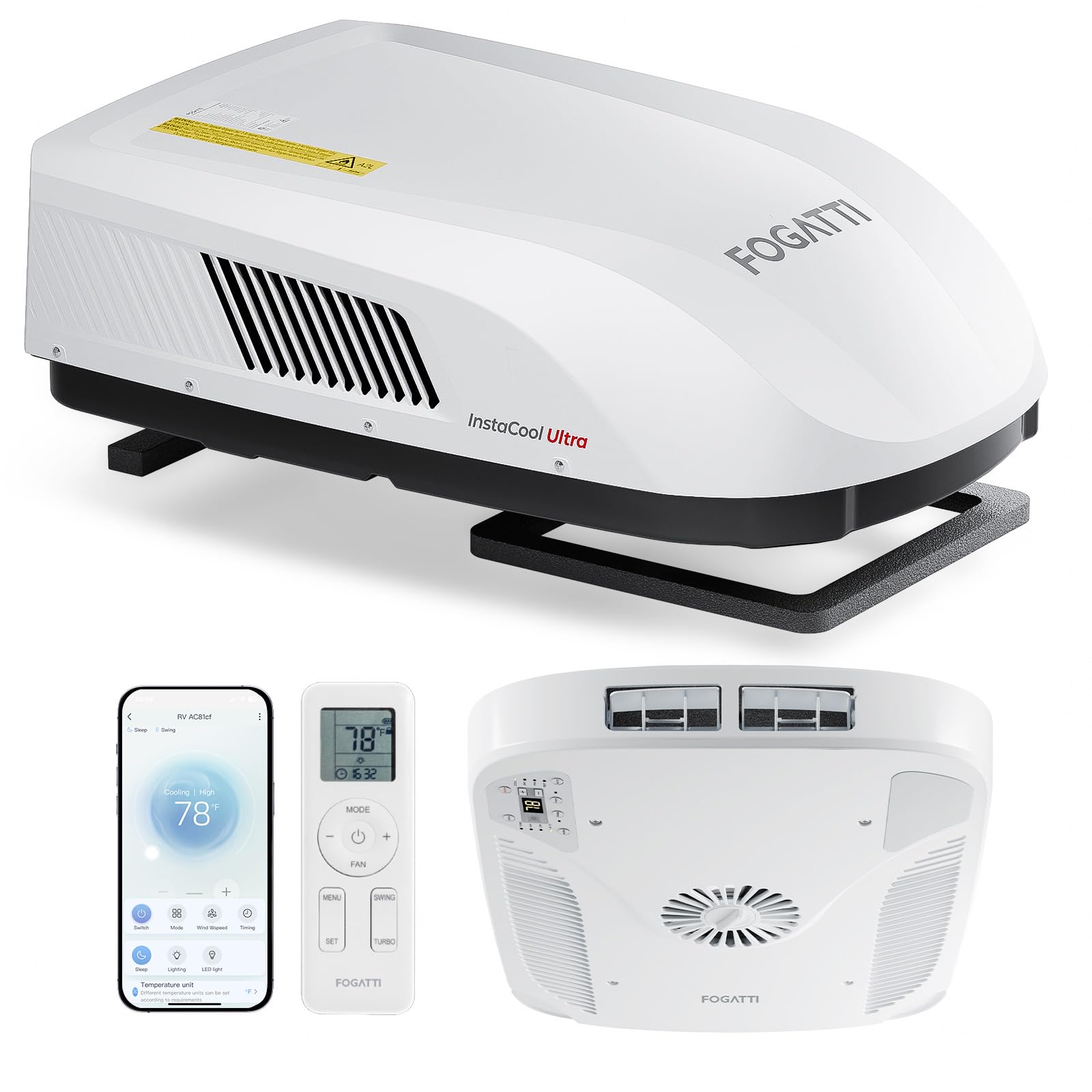
The 12.2-inch-tall rooftop unit that clears low bridges and cools in 4 minutes.
Built for the road literally, this FOGATTI stands just 12.2 inches tall, which matters if you thread through low underpasses or park in garages with clearance anxiety. The dual-motor, triple-fan system pushes 418 CFM of airflow and the maker claims 30% faster cooling—noticeable within 4 minutes. With an EER 11.8 efficiency rating, it’s designed to use less power while moving that air, and owners confirm it’s “very quiet, very cold.” The 16,000 BTU output pairs with a 12,500 BTU heat pump for year-round use.
Control flexibility is the headline feature: remote, touchscreen ADB panel, or WiFi app let you adjust temperature from anywhere in the rig, and the motorized fins sweep multi-directionally—an owner with a Class C RV installed two and loves the directional airflow. The dual-layer base absorbs road bumps and foam insulation protects key components, and the ETL certification plus 15/20-amp time-delay fuse requirement keep the electrical side clear.
The honest review split is on performance: some owners say it “cools down great” while another who replaced a noisy 15K unit found it “seems to have half the capacity” and notes you can’t plumb condensate down a drain tube—it runs down the side of the camper. Installation is the other sticking point: the inside air handler needs careful alignment, short shipping screws, and tiny frame holes that are hard to find. Noise is the top praise with 7 mentions, and it holds ~60% humidity at 72°F even in 97% outdoor RH. It’s a quiet, low-profile choice if your rig has clearance needs.
Clearance specialist: at 12.2″ tall it beats low bridges, and the motorized sweeping fins plus WiFi control are genuinely premium touches.
Know the split: some owners find 16K BTU underwhelming for larger rigs, and condensate routing is an afterthought—confirm your expectations before buying.
11. Gidrox 12000 BTU 12V DC with Heat Pump
The 12V all-in-one with a 9,000 BTU heat pump and 40 dB sleep for year-round off-grid.
This Gidrox is the bigger sibling to the 10K model, adding a 9,000 BTU heat pump and stepping cooling up to 12,000 BTU with an EER up to 12.3. That heat pump claims to save roughly 65% energy versus standard heaters, making it a true four-season 12V unit. At 40 dB in Sleep mode with a brushless fan and sound-insulation design, it’s library-quiet, and the 350W average nighttime consumption (at 30°C ambient) keeps a 400Ah battery going all night. Control comes via Bluetooth app, infrared remote, or physical buttons.
Owners praise the build quality as premium and sleek, noticeably lighter than old-school units, and note it runs off 12V beautifully with proper wiring and a large battery bank. One owner uses it on battery, shore power, or generator interchangeably and calls the Bluetooth app easy. The dehumidifier function is a bonus for humid nights, and the “cools/heats quickly” feedback is consistent across verified reviews.
The sharp-edged truth from owners: a 12K DC unit performs like a good 8K AC unit, and it’s “weaker than 13.5k predecessor” in raw cooling. One owner measured high voltage drop—11.7V on a full LiFePO4 bank—so budget for proper thick wiring. The bolts run short (one owner needed M8x1.25 threaded rod), the buttonbeep can’t be disabled, and the Bluetooth-only app is basic. Owners also note the AC cycles around 370W while the heater runs ~550W, which they call inefficient for a whole trailer. For a vanlifer who wants cooling plus mild heat in one 12V roof unit, this is still called “the best trailer AC seen” by a long-time owner, but it demands honest expectations on raw cooling strength.
Four-season 12V option: the 9,000 BTU heat pump plus 12,000 BTU cooling and 40 dB sleep mode make it the most complete battery-powered package here.
Set your expectations: it cools like a strong 8K, not a 13.5K, and needs thick wiring to avoid voltage drop—plan for a big LiFePO4 bank.
Understanding the Specs
BTU: What “Cooling Power” Really Means
BTU (British Thermal Units) measures how much heat a unit removes per hour. A 10,000 BTU unit is sized for a van bedroom or small camper; 15,000–18,000 BTU covers a 30-foot coach. Owners consistently report that 12,000 BTU DC units feel like a good 8,000 BTU in real-world cooling, so always size up slightly for a van that bakes in the sun.
dB: What “Quiet” Actually Sounds Like
Decibels (dB) measure sound pressure. A 40 dB unit is library-quiet—you’ll hear it but it won’t wake you. At 55 dB it’s like gentle rain, audible but tolerable. In a van, you’re sleeping inches from the unit, so a 10 dB difference is the difference between a good night and a bad one. Look for 40-45 dB for dedicated sleepers.
FAQ
Will a 12V DC van air conditioner run off my solar setup?
Can I install a rooftop RV air conditioner myself?
Is a 10,000 BTU unit enough to cool a camper van?
What’s the difference between a heat pump and just a cooling unit?
How much battery do I need for overnight air conditioning?
Will a standard 110V rooftop AC work in my van without shore power?
What wire gauge do I need to install a 12V RV air conditioner?
How noisy is too noisy for a van air conditioner?
Final Thoughts: The Verdict
For most people, the van air conditioner unit winner is the RecPro 15K Quiet Heat Pump because it delivers serious 15,000 BTU cooling at a gentle 55.4 dB with a heat pump for year-round comfort—ideal for anyone with shore power or a generator. If you want true off-grid battery operation, the Outequip 10K 12V is the lightweight (43 lbs) choice that one owner verifiably holds at 80°F in 105°F Phoenix heat. And for the biggest battery-saving numbers, the Furrion Chill Cube 18K ramps from 1100W down to 300W, which owners say turns a 1-hour battery runtime into 10 hours—the crowd favorite for large trailers and boondocking sprinters.
How We Picked
We do not accept paid placement. Every pick is matched to a real buyer and a real use-case; we do not hands-on test units.
Sources & Methodology
Specifications: manufacturer listings and product documentation. Review insights: verified customer reviews, as of August 2026. Pricing: not shown on this page (it changes often); check the current price via the retailer link.
As an Amazon Associate, GoCarLife earns from qualifying purchases. This does not affect which products we feature.