
Our readers keep the lights on and the garage heater humming. As an Amazon Associate, I earn from qualifying purchases.
Specs are compiled from manufacturer listings and verified buyer reviews and can change over time — please confirm the key details on the product page before buying.
Valve spring compressors are the tool that separates a weekend head job from a tow to the machine shop. The right one holds a spring rock-solid so you can pop the keepers (the little locks holding the valve in) without cursing—and the wrong one bends, slips, or launches parts across the garage.
I’m Mo Maruf — the founder and writer behind GoCarLife. This guide is built by comparing the manufacturers’ published specifications and the patterns across verified customer reviews, so you get each pick’s real strengths and trade-offs instead of marketing spin.
Whether your spring is a 1-inch bike valve or a 140 lb big-block monster, the best valve spring compressor handles it without flex or fuss.
Our Picks at a Glance


How To Choose The Best Valve Spring Compressor
You need a tool that matches the spring size you are actually compressing. A lawnmower spring and a race-spec dual spring are not the same job—picking the wrong tool either won’t fit or will bend under pressure.
Spring Size and Retainer Fit
Most compressors list a specific spring range, like 3/4 inches to 1-1/16 inches. Check the diameter of your retainer (the metal cap on top of the spring) and make sure the adapter cups can hold it without slipping. A good fit means the tool stays centered while you work.
Leverage and Reach
A longer handle gives you more mechanical advantage—that means less muscle needed to compress stiff springs. If you are working with the cylinder head still on the engine, you also need a tool with a slim profile and good visibility so you can see the retainers in tight gaps.
Quick Comparison
| Model | Best For | Style | Spring Range | Weight | Amazon |
|---|---|---|---|---|---|
| OTC 4572★ Best Overall | Heavy-duty heads | Lever action | Up to 1-3/16″ retainers | — | Amazon |
| ARES 15017Top Performer | High leverage & visibility | Direct action lever | — | 5.24 lbs | Amazon |
| Proform 66784Stud-Mount Specialist | Stud-mount big blocks | Screw-on stud | 1-inch studs | 3.2 lbs | Amazon |
| Powerbuilt 940541 | Tight firewall clearance | Stud-mount | 3/8″ & 7/16″ studs | 2.9 lbs | Amazon |
| OTC 4573 | Universal installed heads | Jaw clamp | 1-3/8″ to 5-5/8″ jaw | — | Amazon |
| GEARWRENCH 2078D | Marine & classic V8s | Screw clamp | — | 8.8 oz | Amazon |
| Orion Motor Tech | Bench work & DOHC | Direct lever | 1″ & 1-3/16″ adapters | 5.72 lbs | Amazon |
| Performance Tool W89409 | Bench & flathead jobs | Jaw clamp | 2-1/2″ to 6-1/4″ closed | 4.1 lbs | Amazon |
| Lisle 23300 | Small engines & mowers | Screw clamp | 3/4″ to 1-1/16″ | 10.08 oz | Amazon |
In‑Depth Reviews
1. OTC 4572 Large Valve Spring Compressor
Our pick — over 4.5★ from 950+ verified ratings; the strongest balance of quality and price.
Thick 3/8″ metal and zero flex make this the shop-grade pick for stubborn heads.
Buyers report it doesn’t flex on tight Porsche 944 double springs—a job that defeats Harbor Freight, Napa, and rental tools. The thick 3/8″ metal construction means the frame holds its shape while you lean into stiff springs, so nothing slips mid-stroke.
The direct action lever (a handle that pushes straight down onto the retainer) gives you better visibility of the keepers in tight spaces. It ships with two adapters that fit retainers up to 1″ (25 mm) and 1-3/16″ (30 mm), covering most production heads—from Gen III hemi heads to 4.6L Ford heads, according to owner reports. The plated finish resists rust, and the high-grade materials hold up for years in a home garage.
Performance wins people over here—over two hundred owners single out how well it works. The catch is the handle: it is not a one-hand grip like a vice-grip design, so you hold it centered with two hands while pressing the lever from the top. It needs both hands to lock into place, but the tank-like build is worth the extra coordination.
What Wins People Over
- No flex on heavy double springs—Porsche 944 proven
- Thick 3/8″ metal frame that feels indestructible
- Two adapters cover 1″ and 1-3/16″ retainers
- Leaves hands free for installing keepers
The Trade-Off
- Awkward to lock in place; needs two hands
- Not a one-hand grip like vice-grip designs
Reach for it if: you are doing a full head job on a performance or late-model engine and want a tool that will not bend when the spring fights back.
Look elsewhere if: you need a one-handed clamp for a quick single-cylinder repair—this one is built for serious work, not quick grabs.
2. ARES 15017 Valve Spring Compressor
Removed 32 valves in about 30 minutes with zero prior experience.
Owners mention this tool makes fast work of overhead valve engines—one owner stripped 32 valves in half an hour with no experience using the tool. The direct action lever keeps the retainer visible, so you can see exactly where the keepers are before you pop them free.
It weighs 5.24 lbs, giving it a solid, substantial feel that absorbs the shock of stubborn retainers. The design shines on Dodge 360 magnum heads and marine diesels, according to repeated owner reports. Owners call it durable, and the limited lifetime warranty from ARES backs it for life.
The honest trade-off is leverage. A few owners note the stubby handle does not give enough mechanical advantage, so the retainer can be tough to release. The workaround is simple: tap the back of the tool with a hammer while keeping tension on the retainer, and it pops loose. It is a learning curve, not a flaw.
Shop-grade durability: this is the tool you keep for years and reach for on every cylinder head—marine diesels, Volvo 5-cylinders, and Dodge magnum heads all show up in owner success stories.
Choose it if: you want a heavyweight direct-action compressor with a warranty that means you never buy a second one.
Consider the catch: you may need to tap the handle with a hammer to release keepers—a minor habit, but real.
3. Proform 66784 Valve Spring Compressor
Screws onto the rocker stud and crushes even stiff AFR dual springs.
This one is different from the lever tools—instead of a clamp, it screws directly onto the 1-inch rocker stud. That stud-mount design gives it a rock-solid anchor point, so it compresses springs where other tools slip off. Customers note it works on stiff AFR dual springs—the ones that defeat ordinary compressors—with minimal effort.
The dual-threaded shaft flips to fit both stud sizes by pulling the cotter pin, so you can jump between small-block and big-block Chevy heads. It is made from alloy steel and weighs 3.2 lbs, light enough to move around the engine bay. Owners say it works better on the car than on the bench, and the lock nut at the bottom stabilizes the foot so it does not wander off the retainer.
Owners praise how effectively it compresses heavy springs, including 140 lb units. The setup is slightly awkward until you get the hang of it, but the speed of a stud-mount design beats hand-cranking a screw-type clamp.
The Stud-Mount Payoff
- Anchors to the stud so it cannot slip off the spring
- Fits both stud sizes—just flip the threaded part
- Handles stiff 140 lb springs without flexing
- Locks compressed to free both hands
Who Should Skip It
- Setup is slightly awkward until you learn the angle
- Best on the car, not on a bench
This is your tool if: you work on Chevy small-blocks or big-blocks and want a compressor that uses the stud as its anchor.
Think twice if: you mostly do bench work with the head off—a clamp style is easier there.
4. Powerbuilt Valve Spring Compressor 940541
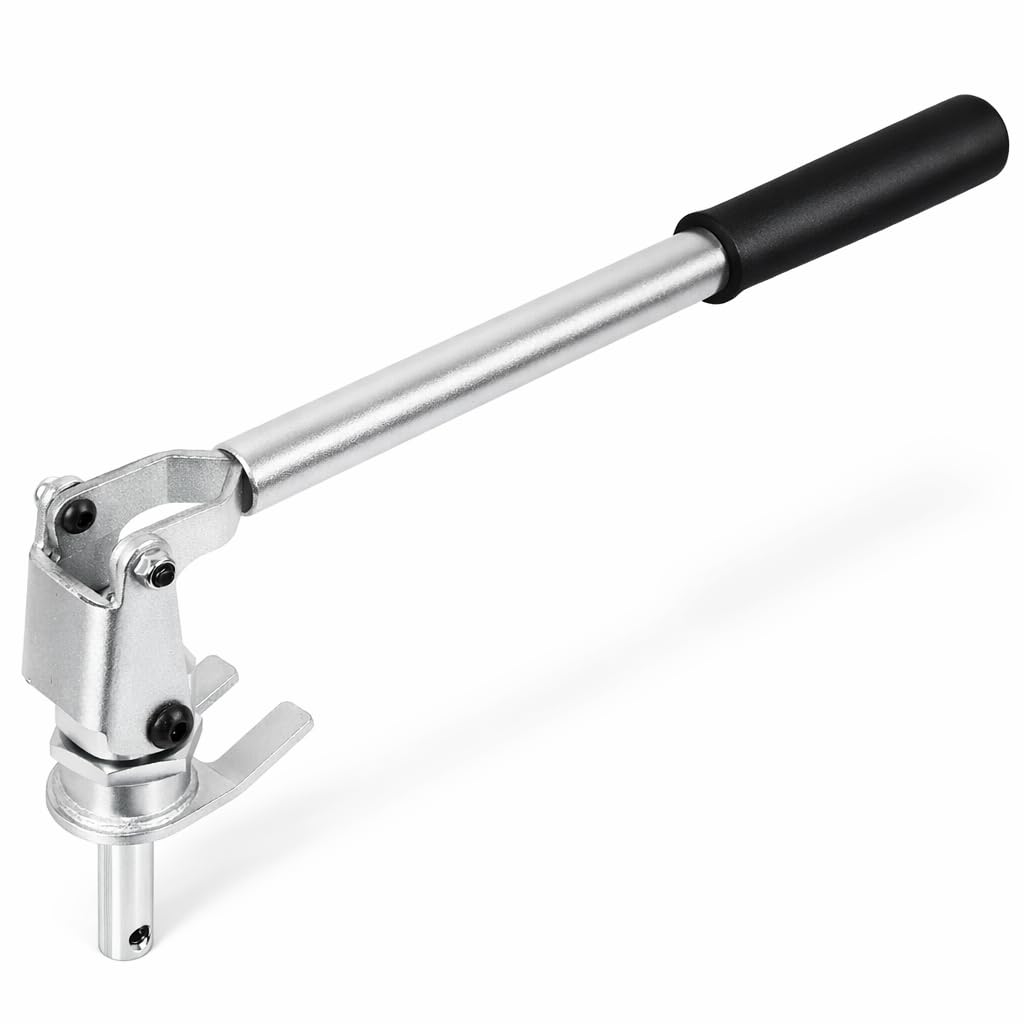
Built for gasser drag cars where the motor sits right against the firewall.
Some engines are shoehorned in so tight you cannot reach the rear cylinders. This Powerbuilt compressor solves that—it fits on 3/8″ or 7/16″ studs by reversing the threaded cylinder, and the slim profile slides into gaps where bulkier tools cannot go. Reviewers point out using it on Bowtie cast iron heads and old Chevy trucks without pulling the heads.
The 12″ long handle gives plenty of leverage, so you are not fighting the spring with your bare hands. It locks in place to free up both hands—critical when you are balancing a magnet and a keeper in a cramped bay. It meets or exceeds ANSI standards, a quality benchmark rare at this price point.
Owners rave about how it makes a miserable job easy. Build quality earns consistent praise, making it a genuine bargain for budget-minded buyers.
Made for the tight spots: the stud-mount design and slim profile mean it reaches rear cylinder springs on firewall-tight drag cars where other tools physically will not fit.
Grab this when: your engine bay is so tight you are dreading the job before you start—the 12″ handle does the muscle work.
skip it if: you work on heads with odd stud sizes outside 3/8″ and 7/16″—this one is specific.
5. OTC 4573 Universal Overhead Valve Spring Compressor

Spring-loaded jaws grip and compress without removing the cylinder head.
This is the tool for on-car work where you do not want to pull the head just to swap a valve seal. The spring-loaded jaws easily grip and compress valve springs, and the legs have a built-in offset that keeps the tool vertical and stable during use. It handles jaw openings from 1-3/8 to 5-5/8 inches and a throat clearance of 5-7/8 inches.
Shoppers say it is a quality Taiwanese piece that worked well on a Ford 390 and took only about a minute per spring on a 1999 Ford Ranger V6. It is ideal for cars, vans, and light trucks with tight underhood clearances—exactly where you need a compact tool that still gets the job done.
Owners praise its functionality—it simply works. The honest caveat is that ease of use is mixed; some owners find it much easier to use, while others report the tool slipping off the spring. And if you have an LS engine with small springs, the jaws will not fit them. It is a universal tool, but not a universal fit.
Where It Shines
- Spring-loaded jaws grip securely on installed heads
- Compact design fits tight underhood clearances
- Built-in offset keeps the tool vertical and stable
- Quality construction from Taiwan
Who Should Look Elsewhere
- Jaws are too big for small LS engine springs
- Some buyers report slippage on certain spring designs
Pick it for: a quick on-car valve seal job on a Ford, Toyota, or classic V8 without pulling the head.
Look elsewhere if: you are working on a modern LS engine—the small springs will defeat these jaws.
6. GEARWRENCH Universal Overhead Valve Spring Compressor 2078D

A featherweight 8.8 oz screw-clamp that still handles a full Ford 302 valve job.
Do not let the tiny weight fool you—this compact screw-clamp did a complete valve job on a 1974 Ford 302, according to owner reports. The thick plastic handle is easy on your hands, and it removes valve springs on most cars with overhead valves without pulling the cylinder head. It is also reusable and works on Mercruiser marine heads.
Hand-turning the screw compresses springs smoothly, and the clamp design stays put once it is set. Owners praise how well-built and easy it is to use on GM and 3.1 heads. The one caveat: the top knob is plastic, so you cannot attach a ratchet or socket for extra speed—on a 16-valve engine, your hand will do the turning.
Owners praise its performance and rock-solid build quality. The mixed feedback lands on the grip—a few owners mention the springs can pop off if the tool is misaligned, so wear leather gloves and keep the clamp square on the retainer.
Small but mighty: at just 8.8 oz, it slips into a tool bag and still punches above its weight on classic V8 valve jobs.
Reach for it if: you want a simple, hand-turning clamp for a classic V8 or marine head and like tools that are light enough to carry anywhere.
Look elsewhere if: you have a 16-valve engine—the plastic knob means no ratchet assist and your hand does all the work.
7. Orion Motor Tech Large Valve Spring Compressor

Structural-grade 1045 steel with a center lock that frees both hands.
This direct-action compressor by Orion Motor Tech nails the budget price point without skipping the features that matter. It is made from structural-grade 1045 steel with galvanized zinc plating, so it resists wear and corrosion while you crank on stiff springs. The silica-gel handle reduces hand fatigue during long jobs—a real blessing when you are doing all 16 valves on a DOHC head.
It ships with two adapters for retainers up to 1″ and 1-3/16″, and the non-bending lever gives a longer reach for hard-to-reach spaces. Customers note it worked perfectly on 1998 Subaru 2.5L DOHC heads, handling valve seal replacement and lapping without drama. When properly adjusted, the center lock holds the spring compressed hands-free, so you can remove or install the keepers with both hands.
The trade-off is consistency. One owner had a bent end on the first unit and needed a replacement, and there is a report of the adapters not fitting Fiat Spider 1800cc keepers. Most buyers are happy—it even beats the Lisle tool for some owners—but check your retainer size before you buy.
The Value Case
- Center lock holds the spring so both hands are free
- Galvanized zinc plating resists rust
- Silica-gel handle reduces hand fatigue
- Worked on 1998 Subaru 2.5L DOHC heads
The Risk
- Adapters do not fit every retainer—Fiat Spider 1800cc failed
- Occasional quality issues like a bent end on arrival
Buy it if: you are on a budget but need a real lever-action compressor with a hands-free lock for a Subaru, Honda, or similar DOHC job.
Check before you buy: measure your retainer, and if it is an odd European size like a Fiat, look elsewhere.
8. Performance Tool W89409 Heavy Duty Overhead Valve Spring Compressor

Comes with small and large jaws plus a case—a bench-work all-rounder.
This clamp-style compressor is built for bench work with the cylinder head off. It ships with both small and large jaws for use on various engine types, and the jaw capacity is wide—open from 5-3/4 in. to 9-3/8 in., closed from 2-1/2 in. to 6-1/4 in. A storage case keeps everything organized in your toolbox.
Buyers with older MG sports cars—two TC’s and an MGA—say it made head rebuilding dramatically easier than their old compressor. It works well on flathead valve springs too, and the bilingual instructions in English and Spanish are a thoughtful touch. Replacement parts are readily available, so you can keep it running for years.
The honest downside is build quality. Some owners describe it as flimsy and cheaply made, and durability is a recurring concern—a few report attachments bending or cracking. It takes quite a bit of strength to operate on stiff springs. It is a functional bench tool for the money, not a heavy-duty daily driver.
Bench-work bargain: the wide jaw range and included case make it a sensible first compressor for home head rebuilding, not a pro-shop staple.
Choose it if: you rebuild heads on the bench for classic British cars and want both jaw sizes in one affordable package.
pass on it if: you need a heavy-duty tool for daily professional use—the attachments will not hold up.
9. Lisle 23300 Small Engine Valve Spring Compressor

A 10.08 oz precision clamp for Briggs, Tecumseh, and Kohler small engines.
If your project is a lawnmower, generator, or air-cooled small engine, this is the tool. The Lisle 23300 is made from alloy steel and weighs just 10.08 oz, so it is easy to hold in one hand while you work the screw with the other. It handles springs from 3/4 inches to 1-1/16 inches—right in the range for Briggs and Stratton, Clinton, Harley-Davidson, and similar engines.
Reviewers point out it did a good job on a Kohler 18hp engine, and it is celebrated as “awesome for small engines.” The design gives you smooth, controlled compression—much easier than prying with a screwdriver, as owners put it. Its compact size means you can get it into tight spots around small motor housings.
The important caveat is honesty about its limits. As shoppers say, it is “not heavy duty, however, so do not think it would work on heavy valve springs.” This is a precision tool for small springs only. One owner also noted the black clamping piece can get loose and angle after extended use, requiring a shim. It is the right tool for small jobs, no more.
Perfect For Small Jobs
- Compact 10.08 oz design fits tight engine bays
- Works on Briggs, Tecumseh, Honda, and Kohler
- Smooth controlled compression beats prying with a screwdriver
- Great value, long-lasting alloy steel
Know The Limit
- Not for heavy valve springs—small engines only
- Black clamping piece can loosen over time
This is your compressor if: your world is small engines—mowers, flatheads, generators—and you want the precision tool made for that exact job.
Do not buy it if: you are touching a car or truck head; the springs are too strong for this compact clamp.
Understanding the Specs
Jaw Opening vs. Spring Size
The jaw opening tells you the maximum width of the spring the tool can clamp. A tool like the OTC 4573 opens from 1-3/8 to 5-5/8 inches, so it fits a wide range of standard springs. The Lisle 23300 is capped at 1-1/16 inches—perfect for a mower but useless for a big-block. Match the jaw range to your actual spring diameter before buying.
Retainer Adapters
Adapters are the cups that sit on top of the spring retainer to push it down. Different engines use different retainer sizes, so a tool like the OTC 4572 with 1″ and 1-3/16″ adapters covers most production heads. If your retainer is an odd size—like a Fiat or LS engine—you need to verify the adapter fits or the tool will slip off mid-compression.
FAQ
Will a valve spring compressor work with the cylinder head still on the engine?
What is the difference between a lever-action and a screw-type compressor?
Can I use a small engine compressor on a car engine?
How do I know if the adapters fit my valve spring retainer?
What does “direct action lever” mean?
Is a stud-mount compressor better than a clamp-style one?
Why do keepers pop off during compression?
How much force does it take to compress a valve spring?
Can I use a valve spring compressor for installing valve stem seals?
What is the advantage of a tool with a storage case?
Final Thoughts: The Verdict
For most buyers, the valve spring compressor winner is the OTC 4572 because it is the only tool in this list that owners describe as having zero flex on heavy Porsche 944 double springs—the thick 3/8″ metal frame simply does not bend. If you want a stud-mount anchor for a Chevy big-block, grab the Proform 66784. And for small engine mower work, the Lisle 23300 is the one to reach for.
How We Picked
We do not accept paid placement. Every pick is matched to a real buyer and a real use-case; we do not hands-on test units.
Sources & Methodology
Specifications: manufacturer listings and product documentation. Review insights: verified customer reviews, as of August 2026. Pricing: not shown on this page (it changes often); check the current price via the retailer link.
As an Amazon Associate, GoCarLife earns from qualifying purchases. This does not affect which products we feature.