
Our readers keep the lights on and the garage heater humming. As an Amazon Associate, I earn from qualifying purchases.
Specs are compiled from manufacturer listings and verified buyer reviews and can change over time — please confirm the key details on the product page before buying.
A dead battery at the worst moment usually isn’t the battery’s fault — it’s the terminals. Corroded, loose, or undersized clamps silently strangle the flow of power to your starter, and no amount of jumping fixes that. This guide breaks down which vehicle battery terminals actually hold a grip, resist corrosion, and give you room to add accessories without turning your engine bay into a rat’s nest.
I’m Mo Maruf — the founder and writer behind GoCarLife. This guide is built by comparing the manufacturers’ published specifications and the patterns across verified customer reviews, so you get each pick’s real strengths and trade-offs instead of marketing spin.
The crowd favorite here holds a 4.8-star score across 400-plus owners, and the deeper you dig into the review pages, the clearer the pattern gets: alloy builds and a complete kit beat bare clamps every time.
Our Picks at a Glance

How To Choose The Best Vehicle Battery Terminals
The first thing to settle is your battery post type. Most cars, trucks, and RVs use a standard top post — a tapered cone that the clamp squeezes around. Measure your posts, because positive and negative are almost never the same size.
Match the Post Taper
A standard top post battery uses a 19 mm tapering positive cone and a 17 mm tapering negative cone. Some cheap terminal sets ship both clamps identical, which forces you to shim the negative side. Look for a set that’s clearly labeled positive and negative, or one that acknowledges the difference outright.
Count Your Connection Points
If you’re wiring auxiliary lights, an amplifier, or a winch, a basic two-bolt clamp won’t cut it. Distribution-style terminals with multiple threaded studs let you bolt several ring terminals in one place instead of stacking them precariously. Decide how many accessories you plan to add before you pick.
Alloy vs. Lead
Lead clamps are soft and cheap, but they deform under over-tightening and corrode faster. Alloy or copper builds conduct better and hold their shape, but they cost more. Your choice here is really a trade-off between budget and long-term grip.
Quick Comparison
| Model | Best For | Material | Weight | Connection Points | Amazon |
|---|---|---|---|---|---|
| DLronwey Military Spec★ Best Overall | Complete budget kit | Alloy | 14.4 oz | Multi-wire (2 pcs) | Amazon |
| Kaas 12-WayPremium Pick | Corrosion-proof premium | 6061-T6 Aluminum | 1.17 lb | 12 | Amazon |
| Ampper Lead Alloy | Direct-fit replacement | Lead Alloy | 5 oz | 2 (1 pair) | Amazon |
| Bateria Power Kit | Copper conductivity | Copper | 10.8 oz | Multi-wire (2 pcs) | Amazon |
| QWORK Military Spec | Multi-vehicle spares | Alloy | 2.64 lb | 4 pairs | Amazon |
| Vgate 12-Way | Accessory-heavy builds | Aluminum | — | 12 (4 holders + 8 studs) | Amazon |
In‑Depth Reviews
1. DLronwey Military Spec Battery Terminal Connectors
Our pick — over 4.5★ from 450+ verified ratings; the strongest balance of quality and price.
The complete alloy kit that fixes factory cable-end failures without a trip to the shop.
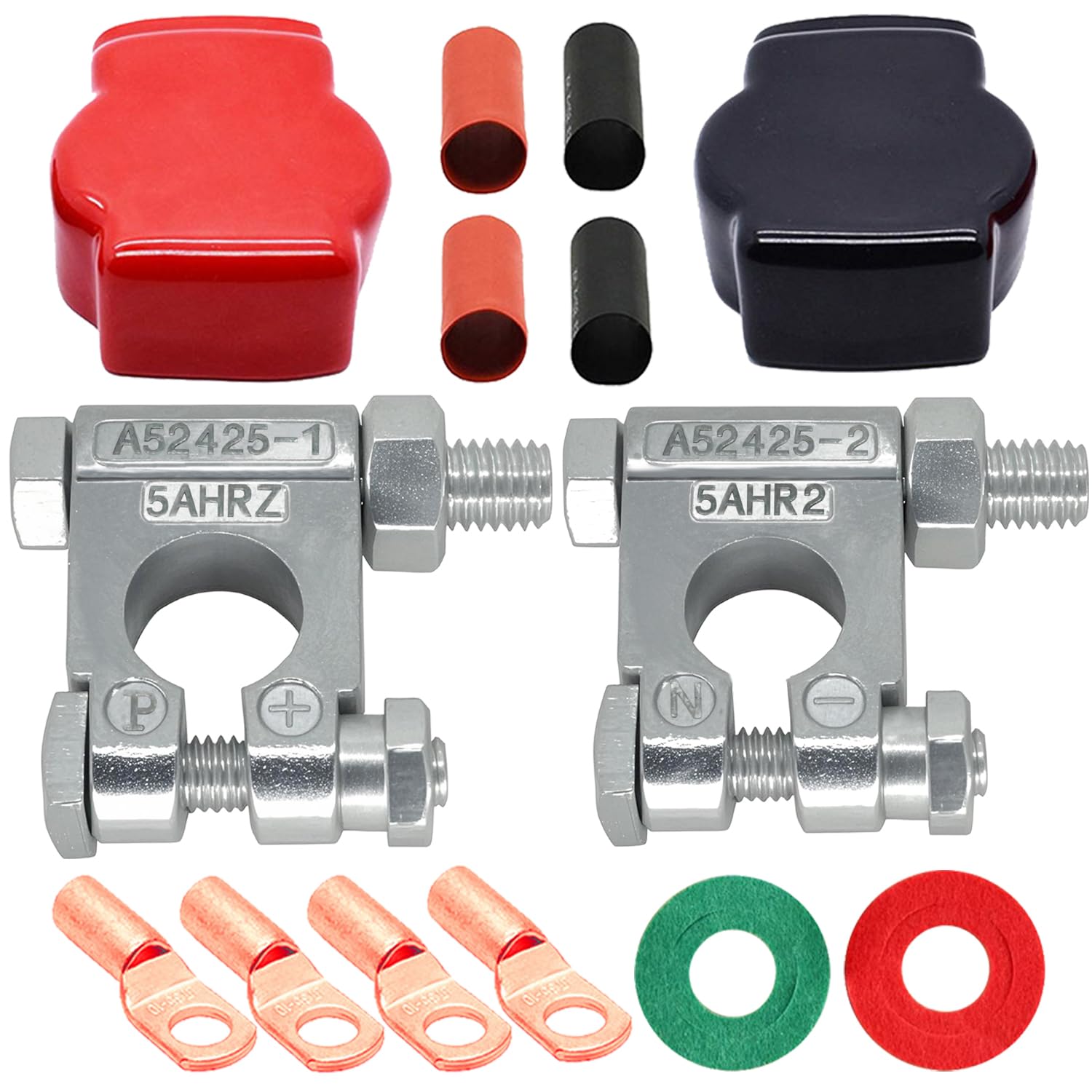
This is the rare budget kit that actually arrives with everything you need: 2 heavy-duty alloy terminals, 2 color-coded covers, 2 anti-corrosion gaskets, 4 pieces of heat shrink tubing, and 4 No. 2 3/8″ copper lugs — all packed in a storage case. Weighing 14.4 ounces, it’s nearly three times the heft of the bare-bones Ampper set, and that mass translates into a beefy feel reviewers call out again and again.
What wins people over is the quality — it’s the single most-praised trait across owner feedback, and the functionality runs a close second. One owner’s 2006 Dodge Ram 3500 4×4 got new life when these ends saved them “a whole lot of work and money” by installing onto existing cables with just a slight modification. The alloy material resists corrosion and keeps conductivity strong, while the clearly marked positive and negative poles remove guesswork.
The one honest catch: the included copper lugs only suit No. 2 wires, so if your factory cables run a different gauge you’ll need a crimping tool and your own lugs. A few owners note the lugs run small, and this isn’t a tool-free job — plan for a terminal crimper before you start.
What Owners Love
- Complete kit with lugs, heat shrink, covers, and case included
- Alloy construction resists corrosion and stays solid under load
- Room to add ring-terminal accessories on the securing bolt
Know Before You Buy
- Copper lugs only fit No. 2 wire — other gauges need your own
- A terminal crimping tool is required for installation
Reach for this if: you want a drop-in alloy upgrade with every part in the box and a one-year quality guarantee behind it.
Look elsewhere if: your battery cables aren’t No. 2 gauge and you’d rather not crimp your own lugs.
2. Kaas 12-Way Anode Top Post Terminal Set
A CNC-machined distribution block that keeps a dozen accessory wires tidy and corrosion-free.
If your engine bay is growing — lights, radios, amplifiers — the Kaas is the upgrade path. It’s machined from heat-treated 6061-T6 aluminum alloy with a color anodized finish that resists corrosion, and the 1.17-pound build feels precision-made in hand. The clever part is the conductive zone: the anodic layer is removed exactly where the battery post and cable connect, so you get corrosion resistance without sacrificing electrical flow.
Owners rave about the quality first and the functionality second, and the connectivity story is what sets this apart. A 2004 F-350 owner mounted one and gained space for a ring connector or bare wire on the side, while a 4Runner builder praised the easy-tighten head and anti-loosening screw that stops the clamp from detaching under vibration. The red and blue color coding makes positive and negative unmistakable at a glance.
The trade-off for all that machining is price — this is the premium end of the field. It fits 8AWG up to 4/0 (XL) AWG cables and suits SAE, DIN, and EN tapered top posts, but JIS pencil posts are excluded, and lithium batteries need an additional stud-to-post adapter.
Worth the upgrade: the anti-loosening screw design and anodized finish address the two most common terminal failures — vibration loosening and corrosion buildup — in one machined package.
Best for: stereo builders and overlanding rigs that need a clean, expandable power distribution point at the battery.
Who should pass: anyone on a stock daily driver who just needs a simple two-bolt clamp and won’t use 12 connection points.
3. Vgate 12-Way Lead Acid Terminal Connector

Twelve attachment points in one solid block, built to tidy a messy engine bay into a work of art.
The Vgate is the organizer’s dream. It ships as 4 hole-holders and 8 threaded studs — two 2/0 AWG and two 2 AWG holders plus 4, 6, and 8 mm screws — so you can land every accessory cable on its own dedicated point instead of stacking ring terminals. Owners describe the fitment as perfect and the look as good enough to be “compared to jewelry in a box.”
Functionality is the most-praised trait by a wide margin, and the versatility follows close behind. One owner called it a lifesaver for a “big 3” upgrade — the classic battery-to-alternator and chassis-ground wiring improvement — and noted it cleaned up cluttered wiring while improving stereo sound versus a chassis ground. The solid aluminum build tightens securely without snapping, and installation is genuinely easy.
The catch is the clamp tightness, which earns mixed feedback — the tip is to fully loosen the clamp before installation so it seats properly and stays secure. It’s built for lead-acid batteries (AGM, GEL, WET, MF, and CA/CA) with SAE, DIN, or EN tapered posts; JIS pencil posts aren’t supported, and lithium setups need a separate stud-to-post adapter.
The organizer’s pick: this is the cleanest way to run multiple accessory circuits without a separate fuse block bolted elsewhere.
Choose this if: you’re upgrading a sound system, adding off-road lights, or running any accessory wiring that deserves its own stud.
Think twice if: you want a bare stock replacement — the 12-point layout is overkill for a plain two-cable setup.
4. Bateria Power Heavy Duty Copper Terminal Kit
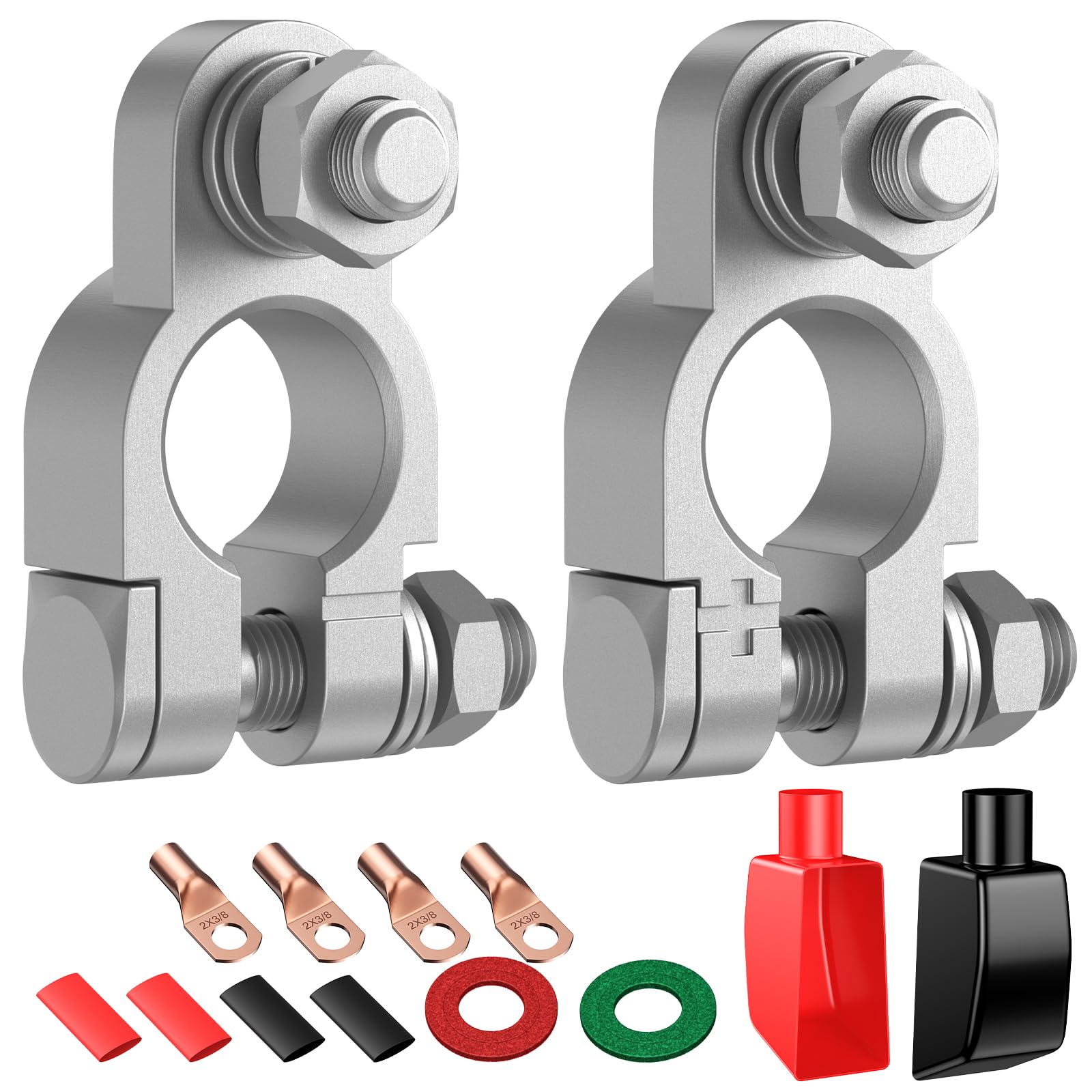
Copper terminals that lock solid and stop intermittent shutdowns on modern trucks.
Copper is the conductivity king, and the Bateria Power kit leans into it hard. The terminals deliver superior current flow with lower heat generation and better corrosion resistance than cheaper materials, and the kit includes 2 anti-corrosion washers, 4 heat-shrink tubes, 2 protective covers, and 4 No. 2 3/8″ copper lugs. At 10.8 ounces it’s a substantial mid-weight build that splits the difference between budget alloy and premium machined.
The quality is the standout — owners consistently call it out first, with fit running second. A 2024 Chevy Silverado 2500 owner replaced a corroded connector with a perfect fit and strong grip, and another said the connectors “lock very solid not cheap pos.” The recurring scene in reviews is a car that kept shutting off or failing to start, fixed instantly by swapping in these terminals.
The honest note: a few buyers expected beefier hardware than the product photos suggest. It’s solid but not massive, and the included lugs only suit 2-gauge wire just like the DLronwey kit. For most cars, trucks, boats, and RVs with standard top posts, it’s a direct and satisfying fix.
Conductivity first: if you want copper’s lower heat and tighter grip without stepping up to machined-aluminum pricing, this is the sweetener.
Grab this for: a corroded factory terminal that’s causing intermittent electrical shutdowns on a modern truck.
skip it if: the visual heft matters to you — these photograph bigger than they feel in hand.
5. QWORK Military Spec Battery Terminals (4 Pairs)
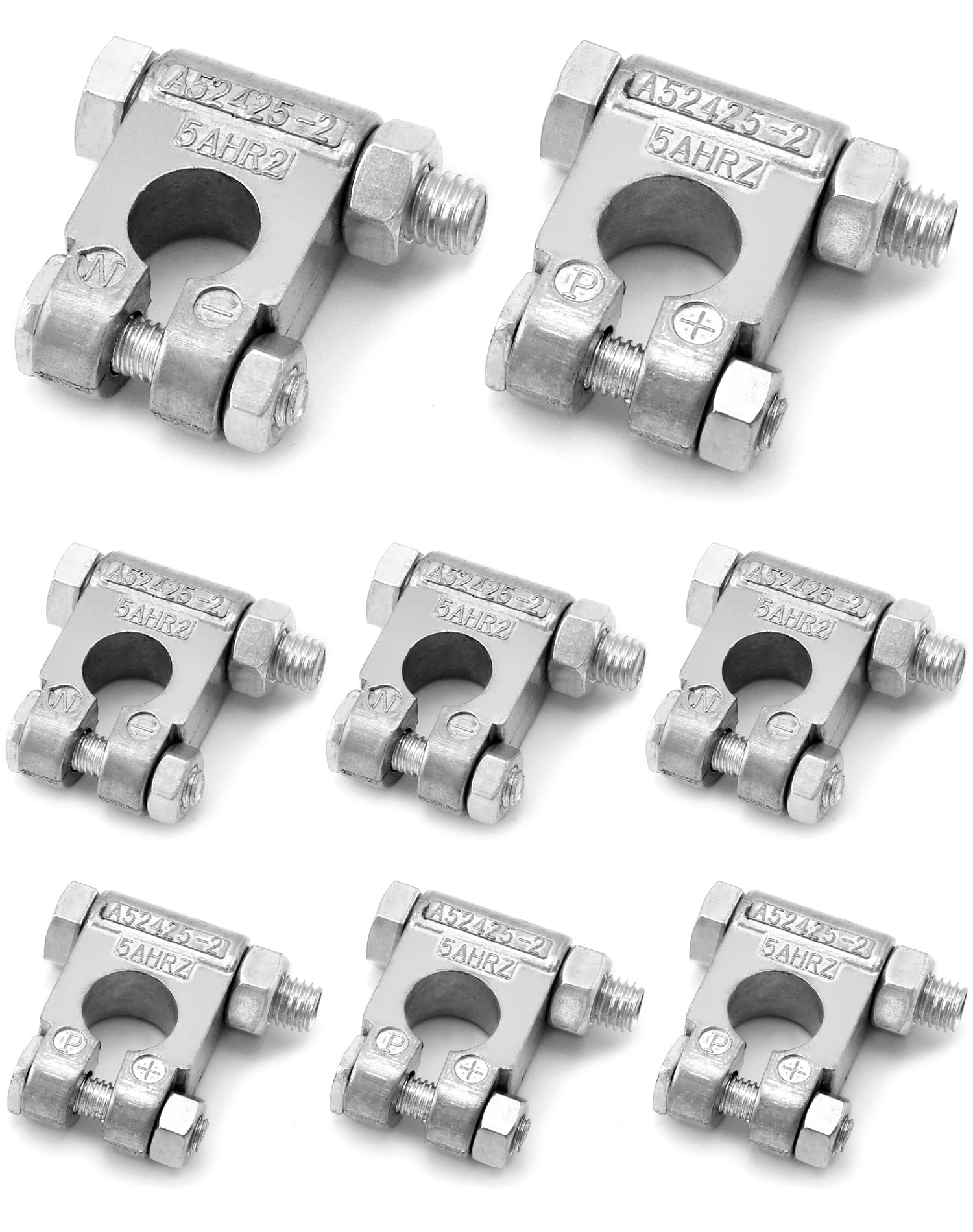
Four pairs of military-spec alloy clamps for the household with more vehicles than patience.
This is the hoarder’s bundle and honestly a smart one. QWORK sends 4 pairs of positive and negative terminals — 8 clamps total weighing 2.64 pounds — so you can refresh the truck, the boat, and the RV in one order and still have spares. The alloy build is marked for 19 mm tapering positive and 17 mm tapering negative posts, and the standard 3/8″ bolts make lug mounting straightforward.
Owners praise the quality and heavy-duty construction in equal measure, and the value lands well for the volume. One pickup owner replaced both sets of battery connections and was “very pleased with the fit,” though they had to fit bigger cable lugs on a couple of wire ends to accommodate the larger bolts. The sentiment that sums it up: “every car should come from the factory with these.”
The small quirks are worth knowing. One set had a reversed “N” cast into the negative terminal mold — purely cosmetic, not the seller’s fault. And because the bolts run larger than stock, plan for bigger lugs on thicker wires. Each alloy terminal accepts multiple battery cables, so your accessory options stay open.
Bulk-value logic: at this pair count, you’re paying for the convenience of never buying terminals again for any vehicle you own.
Buy it for: the multi-vehicle household or shop bench that wants a ready stash of quality clamps.
pass on it if: you only need one clean pair — the four-pair box is more than a single-car owner will ever use.
6. Ampper Heavy Duty Lead Alloy Military Spec Terminal Ends

A featherweight 5-ounce pair that swaps in without a single modification.
Simplicity is the Ampper’s whole pitch. These lead alloy top-post clamps are engineered for a direct fit with no modifications, and the 5-ounce weight — a staggering 2.9x lighter than the DLronwey kit — tells you exactly how minimal this approach is. They’re built for standard top post batteries with 19 mm positive and 17 mm negative cones, and they handle battery extension, parallel connection, and ground connection duties.
The lead is the story: owners note it’s “thicker on these than the cheapie versions,” and the wider body handles double wires nicely. A shop owner who has “used for years” still sees them on repeat customers’ vehicles, which is about as strong an endorsement as a terminal gets. The quality praise leads the feedback, and value-for-money is a recurring theme compared to parts-store pricing.
Here’s the quirk you need to know: both terminals are the same size. Because the negative post runs about 2.8 mm smaller on most batteries, the negative clamp needs a shim or a slight lead build-up for a perfect bite. That fit issue is the most-discussed aspect and it’s genuinely mixed — some owners shim it, others love the direct fit on the positive side. One Caterpillar user found the lead too soft to grip and had to walk away, so full-torque heavy-duty isn’t this clamp’s lane.
The minimalist fix: priced for a quick swap with zero modification, provided you can live with shimming the slightly-too-big negative clamp.
Pick this for: a fast, cheap, no-tools-required replacement on a standard passenger car.
Pass if: you’re running a commercial or oversized battery that needs serious clamping force — soft lead isn’t it.
Understanding the Specs
Top Post Taper (19 mm / 17 mm)
The positive post on a standard top post battery is a 19 mm tapering cone; the negative is a 17 mm tapering cone. A terminal built for both must have two different clamp bore sizes. When a set ships identical clamps, the negative side will always be a looser fit that may need a shim — that 2.8 mm difference is exactly where cheap sets fail.
Gauge Rating (8AWG to 4/0 AWG)
AWG numbers describe wire thickness, and lower numbers mean thicker wire. An 8AWG wire handles modest accessory loads, while a 4/0 AWG cable carries massive starter and alternator current. A terminal that accepts both gives you headroom to add bigger cable later. Terminals that only fit No. 2 lugs limit your upgrade path from day one.
FAQ
Will these terminals fit my battery if I have a standard top post?
What is the difference between military spec and regular terminals?
Why is the negative terminal smaller than the positive?
How many connection points do I need for adding accessories?
Is lead alloy or aluminum alloy better for battery terminals?
Can I install these without a crimping tool?
Will a larger bolt on the terminal require bigger cable lugs?
Do these terminals work with lithium batteries?
Final Thoughts: The Verdict
If you want one dependable pick, the vehicle battery terminals winner is the DLronwey Military Spec kit because it bundles alloy terminals, lugs, heat shrink, covers, and a case into one budget-friendly box that owners genuinely praise for solid quality. If you want machined precision and a dozen accessory points, grab the Kaas 12-Way. And for the multi-vehicle household stocking up, the QWORK four-pair set is the one to reach for.
How We Picked
We do not accept paid placement. Every pick is matched to a real buyer and a real use-case; we do not hands-on test units.
Sources & Methodology
Specifications: manufacturer listings and product documentation. Review insights: verified customer reviews, as of August 2026. Pricing: not shown on this page (it changes often); check the current price via the retailer link.
As an Amazon Associate, GoCarLife earns from qualifying purchases. This does not affect which products we feature.