
Our readers keep the lights on and the garage heater humming. As an Amazon Associate, I earn from qualifying purchases.
Specs are compiled from manufacturer listings and verified buyer reviews and can change over time — please confirm the key details on the product page before buying.
That musty smell when you first turn on the AC, the dust that coats your dashboard a week after detailing, the pollen that triggers your allergies on the morning commute — all of it flows through one cheap, often-forgotten part behind your glove box. Swapping in a fresh cabin air filter is the single fastest way to make every drive feel cleaner, and it is a job you can do yourself in minutes with zero tools. This guide breaks down the best options by what they actually do for you, from basic dust blockers to activated-carbon odor fighters, so you can pick the right one for your car and your nose. If you want the short answer: the Puroma 3-Pack is the one worth buying for most Toyota and Lexus drivers because it packs three dense carbon filters into one box at a price per filter that undercuts single units.
I’m Mo Maruf — the founder and writer behind GoCarLife. This guide is built by comparing the manufacturers’ published specifications and the patterns across verified customer reviews, so you get each pick’s real strengths and trade-offs instead of marketing spin.
You will learn exactly which filter media suits your driving habits, how to match a part number to your exact model and year, and why a vehicle cabin air filter is the most affordable upgrade your car’s interior can get.
Our Picks at a Glance

How To Choose The Best Vehicle Cabin Air Filter
Every cabin filter does the same basic job, but the media inside it decides how well it handles dust, pollen, and smells. The right pick depends on three things: your car’s exact part number, the filter media, and if you need odor control or just dust blocking. Match all three and you will breathe easier on every trip.
Plain paper vs. activated carbon
A basic pleated paper filter catches dust, pollen, and larger particles, which is plenty for many drivers. If you deal with exhaust fumes in traffic, farm odors on country roads, or a former owner who smoked in the car, you want activated carbon. That charcoal layer traps odor molecules that a standard filter lets straight through, keeping the cabin air noticeably fresher for the life of the filter.
Fitment is non-negotiable
A filter that is even a fraction of an inch off will not seat properly, letting unfiltered air sneak past the edges. Every manufacturer lists the exact makes, models, and model years their filter replaces, along with the OEM part numbers it matches. Check that list against your vehicle before you buy — the part number on your old filter is the safest match — and you will avoid the most common reason filters get returned.
Replacement interval
Manufacturers generally suggest swapping the filter every year or every 12,000 miles, but that number drops fast if you drive on dirt roads or in heavy city pollution. Some makers recommend changing it every 5,000 miles in those harsh conditions. A clogged filter chokes your AC airflow and makes the blower work harder, so when the air feels weak, the filter is the first thing to check.
Quick Comparison
| Model | Best For | Filter Media | Pack Size | Weight | Amazon |
|---|---|---|---|---|---|
| Puroma 3-Pack (CP285)★ Best Overall | Toyota & Lexus families | Activated Carbon | 3 filters | 0.68 kg | Amazon |
| RICHWEI CF10134Best Value | Honda & Acura families | Carbon + Nonwoven | 1 filter | 0.4 kg | Amazon |
| KAX CF10775 HEPA | GM & Buick families | HEPA dual-layer carbon | 1 filter | 8.16 oz | Amazon |
| ECOGARD XC11801 | Mazda CX-30, 3, CX-50 | Polyester | 1 filter | 2.56 oz | Amazon |
| Purolator PBC25764 | Nissan Frontier, Pathfinder | Carbon + Febreze | 1 filter | 5.28 oz | Amazon |
| ATP FA-18 | Ford Explorer, Flex, Taurus | Coconut carbon | 1 filter | — | Amazon |
| Purolator PBC36080 | Honda CR-V, Civic, HR-V | Carbon + Febreze | 1 filter | — | Amazon |
In‑Depth Reviews
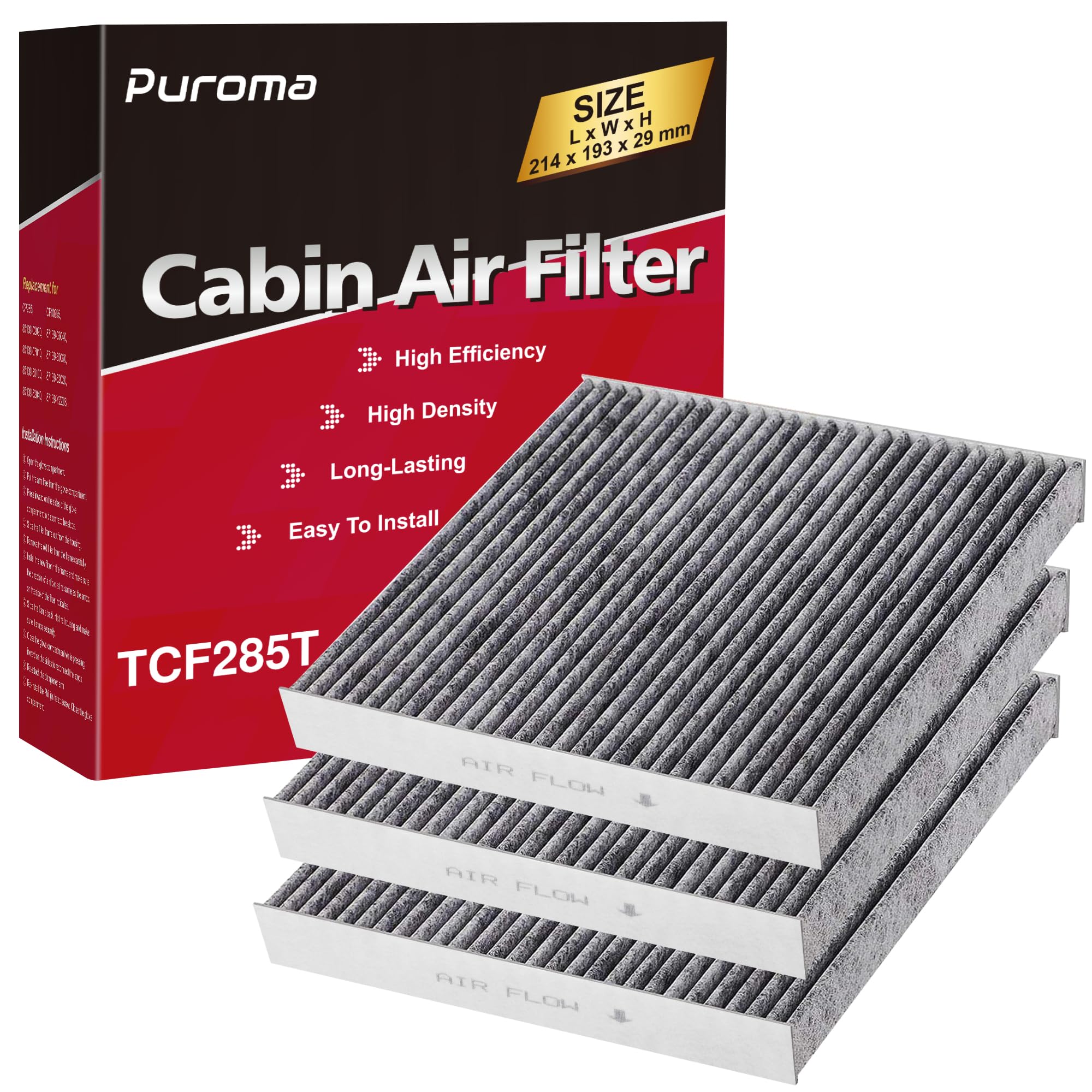
1. Puroma 3 Cabin Air Filter (CP285)
Our pick — over 4.5★ from 14,500+ verified ratings; the strongest balance of quality and price.
Three rigid, charcoal-heavy filters that make the Toyota family’s air smell showroom fresh.
The smartest move here is the math: one box delivers three activated-carbon filters, so you are stocked for years of yearly swaps instead of reordering every twelve months. Each unit runs 7.6 inches long, 8.43 inches wide, and 1.14 inches thick, and the package weighs in at 0.68 kg — noticeably more substantial than single-filter rivals because of the dense carbon layer.
What wins people over is the fit and the build. Owners of a Gen5 4Runner put it plainly: “Way better quality than any ‘brand name’ I’ve used in the past. Rigid, lots of pleats, lots of charcoal – and a perfect fit.” The rigid frame keeps its shape while you slide it in, which matters in tight glove-box openings. It is not just for Toyota either — the compatibility list stretches across Lexus, Subaru, Land Rover, Jaguar, and even Scion and Pontiac models.
The installation is genuinely tool-free, with an airflow arrow printed on the side so you cannot put it in backwards. The dense carbon media does the odor work, while the close-meshed non-woven layer stops particles before they reach your HVAC system. The only real trade-off is that a denser filter can slightly reduce airflow compared to a thinner paper one, but most buyers report the breeze stays strong. If you are comparing this to the lighter 0.4 kg RICHWEI CF10134, know that this Puroma is built for multi-year stockpiling, not a single swap.
Why it earns the top spot
- Three filters in one box at a value that is tough to top
- Rigid frame with dense pleats survives rough installs
- Massive fitment list across Toyota, Lexus, and more
- Tool-free install with a clear airflow arrow
Who should think twice
- Dense carbon media can slightly restrict airflow on some models
- Basic packaging with no installation guide included
Reach for this if: you drive a Toyota or Lexus and want a multi-year supply of odor-fighting filters in one order. It is the pick that makes the most financial sense per filter in this lineup.
Look elsewhere if: your vehicle is not on the compatibility list — fitment is everything with cabin filters.
2. RICHWEI CF10134 Cabin Air Filter
A dual-element carbon and paper combo that fits a huge slice of the Honda and Acura lineup.
This single filter weighs just 0.4 kg, which is noticeably lighter than the 0.68 kg Puroma pack above, but the construction still impresses. The filter combines two layers — an activated carbon sheet for odors and a nonwoven paper layer for particle capture — so you get odor-fighting power without giving up basic dust filtration. Owners of a 2004 Honda Accord confirm: “It appears to be well-made. I like that it has a dual element charcoal and paper filter.”
The fitment range is the real headline. It replaces a long list of OEM part numbers including CF10134, 80219-SHJ-A01, and 80292-SDA-407, and it covers Honda models from the 2003-2021 Accord all the way through the 2006-2022 Ridgeline. The Acura side is just as broad, spanning the 2004-2014 TL to the 2015-2020 TLX. That kind of cross-generation coverage makes it an easy choice for families with multiple Hondas in the driveway.
The catch is airflow. Several owners mention the filter fits and filters well but note the denser carbon media can restrict the breeze through the vents, and the listing itself flags airflow as a mixed point. If you run the AC on max constantly, this is worth knowing; if you just want fresh, clean air, the dual-layer construction delivers.
Solid all-rounder: the dual-layer carbon-and-paper build earns consistent praise for quality and fit across two decades of Honda and Acura models, with the only recurring gripe being airflow on some vehicles.
Best for: Honda and Acura owners who want a well-built carbon filter without paying for a multi-pack or premium branding. It is the cheap single-swap answer compared to the pricier Purolator PBC36080 for the same brand family.
Watch out: airflow can feel weaker than a thinner paper filter on certain models, so if vent force matters most, weigh that before ordering.
3. KAX CF10775 Premium HEPA Cabin Air Filter
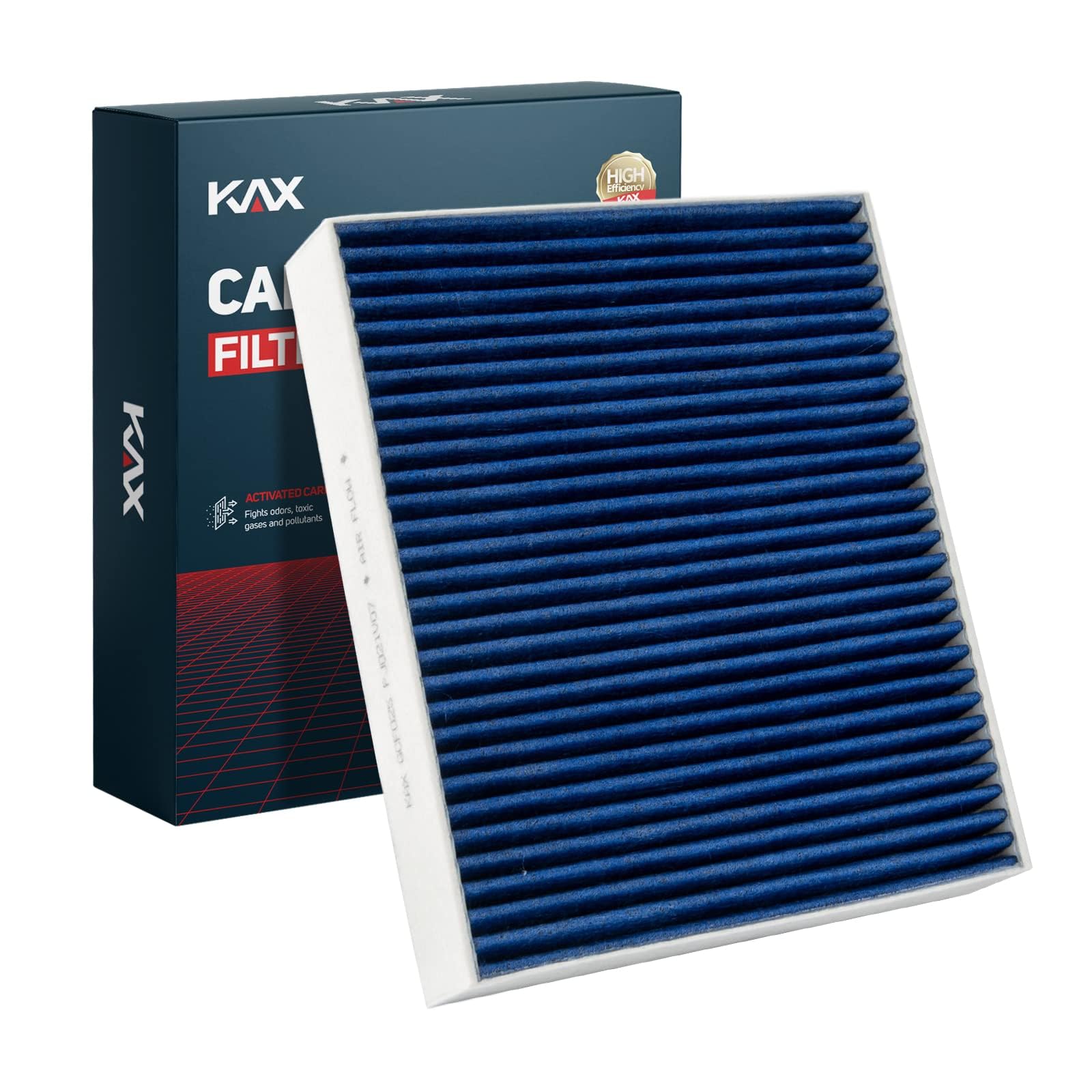
The allergy sufferer’s pick, with true HEPA-grade media that catches what paper filters miss.
This is the filter to grab if microscopic particles are your enemy. The core uses a HEPA-compliant dual-layer carbon matrix that the maker says removes 99.9% of particles sized 0.1 to 0.3 microns — the range where pollen, fine dust, and some allergens live. That is a meaningful step up from a standard pleated paper filter, and it carries the brand’s claim of outperforming basic OEM parts by 35%. It is the densest filtration in this lineup.
It is also big. At 9.4 inches long, 8 inches wide, and 1.4 inches thick, this is the largest filter here, and it is built for the GM family: Chevrolet Cruze, Trax, Malibu, Sonic, and Spark, plus Buick Encore, LaCrosse, Verano, and Regal, with Cadillac and Saab coverage thrown in. Customers note the fit is spot-on, and one noted a clear increase in airflow after installation because the factory unit was already dirty.
The honest trade-off is odor control. While the media includes carbon, at least one owner was blunt that this product “DOES NOT REMOVE ODOR AT ALL” despite the charcoal — so if your priority is killing smells rather than trapping particulates, a dedicated carbon filter serves you better. If your priority is breathing clean, especially with allergies, this is the strongest choice in the group. It out-captures the 99.5% ECOGARD XC11801 by a decimal point, but skips the scent layer that the Purolator units carry.
What makes it stand out
- HEPA-grade media captures 99.9% of 0.1–0.3 micron particles
- Biggest filter here at 9.4″ x 8″ x 1.4″ for high capacity
- Tool-free install in under 5 minutes with included manual
- Broad GM, Buick, and Cadillac coverage
What to keep in mind
- Carbon layer is light — don’t expect serious odor elimination
- Dense HEPA media can restrict airflow on older, weaker blowers
Choose this if: allergies or fine-particulate sensitivity drive your decision and you drive a GM or Buick. The capture rate is the finest in this roundup, so it is the one to trust for a dusty commute.
skip it if: your main complaint is smells like smoke or farm odors — you want a heavier carbon load.
4. ECOGARD XC11801 Premium Cabin Air Filter
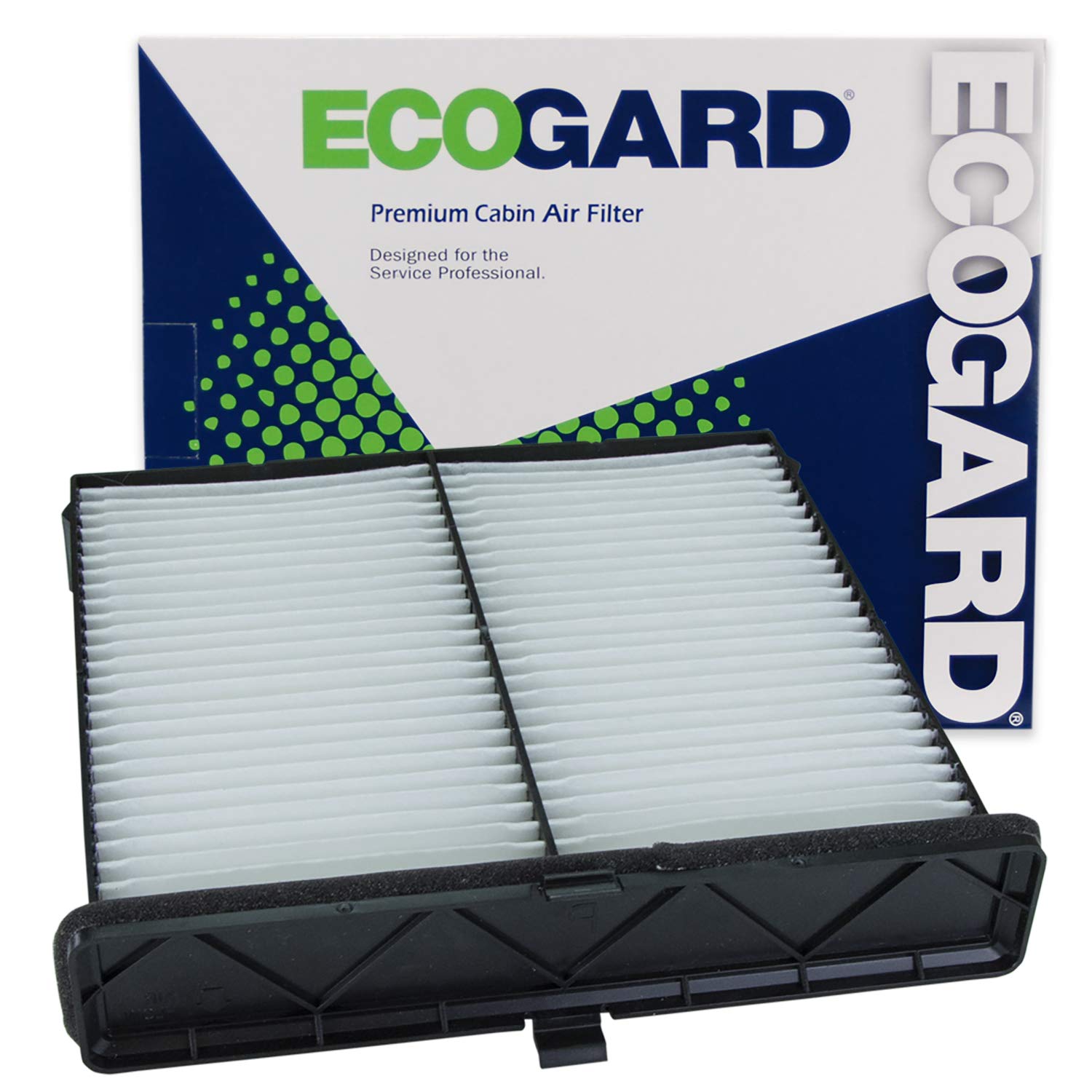
A featherlight polyester filter that slots into modern Mazdas with zero fuss.
At just 2.56 ounces, this is the lightest filter in the roundup, and it is a pure polyester media built for the Mazda family: CX-30, 3, 3 Sport, CX-50, and CX-5. It captures up to 99.5% of dust, pollen, air pollution particles, and pet dander before they reach the cabin — nearly the same capture rate as the KAX HEPA above, but in a lighter, less restrictive package that keeps airflow strong.
The fitment is tight and modern, covering the 2020-2026 CX-30 2.5L and the 2019-2026 Mazda 3. Owners confirm the fit with minimal effort: “Fit my 2024 CX-30 perfectly. Works as advertised. Good price. No smell. Easy instructions.” One owner noted the whole swap takes less than 10 minutes, which makes this a genuinely painless DIY job even for a first-timer.
The trade-off is the media itself. Polyester catches particles well but skips the activated carbon layer, so odor removal is not its strength — it is a clean-air filter, not a smell fighter. Budget-wise it undercuts dealership pricing sharply, with owners calling it “cheap insurance” compared to the roughly a shop charges for the same swap. If you are choosing between this and the Purolator PBC36080 for a Honda, this one trades scent for a faster, easier install.
Swift and simple: the lightest filter here delivers near-HEPA capture rates with minimal airflow restriction, and the under-10-minute install makes it the easiest DIY in the lineup.
Grab it for: late-model Mazda 3, CX-30, and CX-50 owners who want strong particle filtration and an easy swap. It is the one to beat for anyone allergic to complicated installs.
Not for: drivers who need carbon to kill odors — this filter has no charcoal layer.
5. Purolator PBC25764 PurolatorBOSS
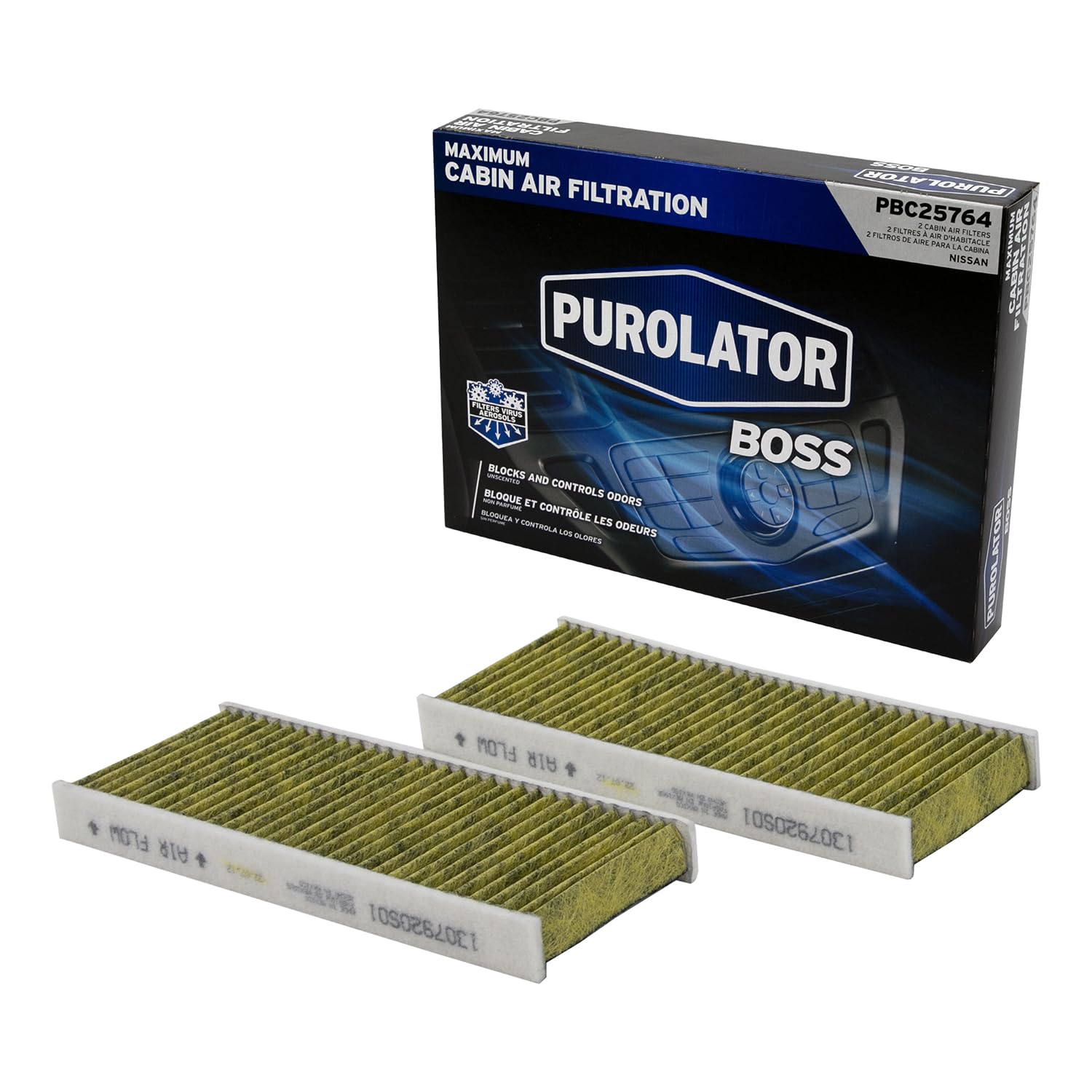
A Febreze-infused carbon filter that takes on industrial smells and keeps the cabin fresh.
If smells are your nemesis, this is the filter built for you. The electrostatically-charged micro fibers trap microscopic particles while the activated carbon layer attacks odors and fumes, and the Febreze freshness adds a light, clean scent that owners say even tames noxious paper mill odors. One owner with a former smoker’s vehicle reported the filter “nearly eliminates” those lingering smells — a strong endorsement for the worst-case odor scenario.
The build quality is where Purolator earns its reputation. The heavy-duty rigid frame survives the notoriously tight and awkward Frontier install, where filters get bent and flexed into place. One owner noted it “doesn’t lose its shape during installation,” which is a real concern on that model. Airflow direction is clearly marked, taking the guesswork out of the swap, and the whole job takes less than 15 minutes on most vehicles.
The catch is fitment, which owners call mixed. It is designed for the 2005-2021 Frontier, 2005-2012 Pathfinder, and 2005-2015 Xterra, but some report it does not work with the 2022 Nissan Frontier. That makes the “Confirmed Fit” tool essential before you order — verify your exact model year, or you may get a filter that does not seat right.
Why odor hunters love it
- Febreze freshness plus carbon handles even industrial smells
- Rigid frame survives tight, bend-heavy installs
- Blocked fine dust and kept the cabin cleaner per owners
- Clear airflow marking for a simple to use swap
The fitment warning
- Some 2022 Frontier reviewers point out it does not fit
- Premium quality carries a higher price than basic filters
Pick this up if: you drive a 2005-2021 Nissan Frontier, Pathfinder, or Xterra and battle persistent odors. It is the strongest scent-fighting option in this whole list, period.
Double-check before ordering: the 2022 Frontier falls outside confirmed fitment for several owners, so verify your exact year.
6. ATP Automotive FA-18 Carbon Activated Filter
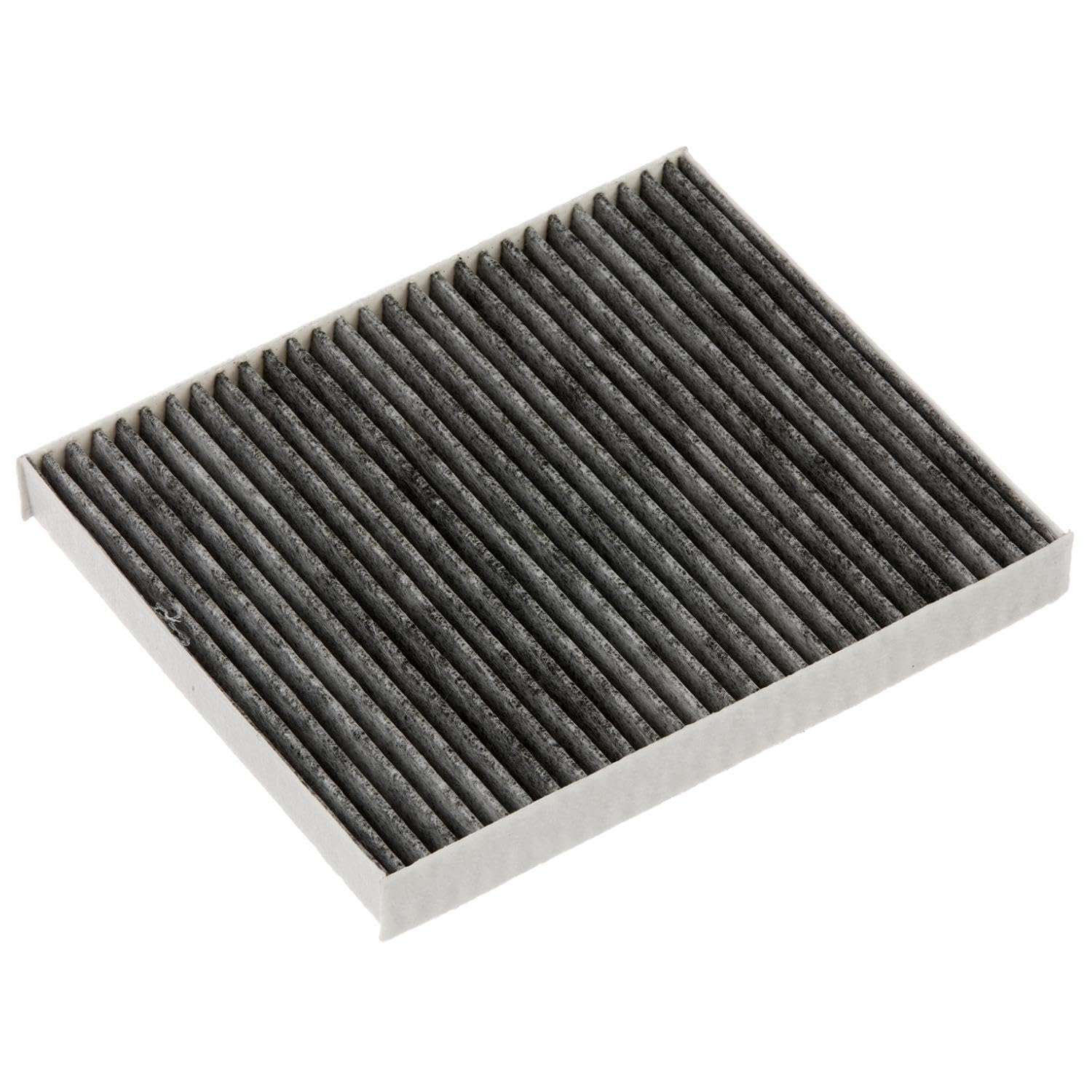
A coconut-shell carbon filter that scrubs 98 percent of vent-borne contaminants for less than dealer parts.
Premium filtering does not have to mean a premium price. This ATP filter uses a coconut-shell-based activated carbon — a highly porous media that is excellent at trapping odor molecules — and the maker rates it to filter 98 percent of contaminants entering through the air vents. At 8.88 inches long, 7.33 inches wide, and just 1 inch thick, it is a slim, dense unit built for Ford and Lincoln models like the Explorer, Flex, and Taurus SHO.
Owners consistently call out the improved air seal and the odor work. One 2011 Ford Taurus SHO owner said the filter “effectively eliminates musty AC smells,” while another running a 2013 Explorer Sport found it cheaper than the dealer and a perfect fit. The heavy-duty build draws praise too — compared to a thinner OEM unit with fewer pleats, this one reads as noticeably more substantial.
The one caveat owners flag is airflow restriction. The denser carbon media filters more but can feel slightly more restrictive than a basic paper filter, which one review described as a reason to knock a star off. If your blower is strong, you will not notice; if it is already weak, this denser media may make it feel slower.
Great value carbon: coconut-shell media delivers excellent odor removal and a tight air seal for a fraction of dealer cost, with the only complaint being slightly reduced airflow on some vehicles.
Best for: Ford Explorer, Flex, and Taurus owners who want serious carbon odor control on a budget. It is the wallet-friendly answer to the pricier PurolatorBOSS units.
Consider the trade-off: the dense media filters more but may slightly reduce vent airflow on weaker blowers.
7. Purolator PBC36080 PurolatorBOSS
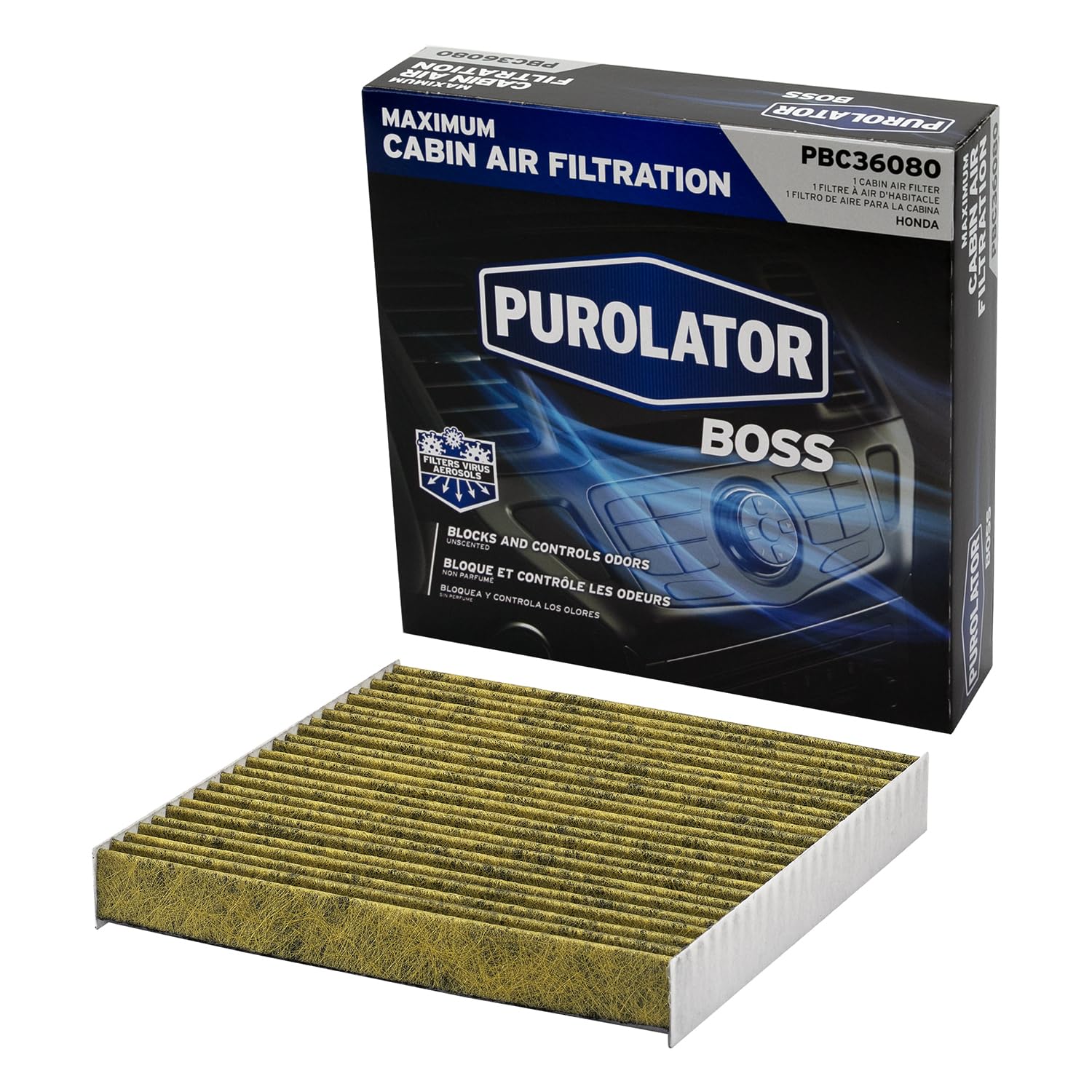
The premium Honda-family filter that makes the interior smell fresh right after the swap.
This is the priciest filter in the lineup, and it earns that position with the same PurolatorBOSS construction as its Nissan sibling — electrostatically-charged micro fibers paired with activated carbon and a Febreze freshness layer. It is built for the recent Honda family: 2017-2024 CR-V, 2016-2023 Civic, and 2016-2024 HR-V, with the 8.31 x 8.07 x 1.06 inch dimensions matching the OEM footprint exactly.
Owners call it a perfect replacement for the factory unit, with one 2020 CR-V owner noting the interior smelled fresh immediately after installation. The fit behind the glove box is tool-free, and the carbon-and-fiber media handles both particles and odors. The value case is strong against dealership pricing — owners describe it as “a great value over ever going to the dealer” with quality similar to OEM.
The honest warning is sizing. While fitment is overwhelmingly positive, a few shoppers say receiving the wrong size in the box, which is a QA hiccup rather than a design flaw. Also note that even the maker’s own fitment tool has hiccups — one 2024 Accord EX owner had to select a one-year-older model to find the correct part number, so cross-check your vehicle carefully. For the sticker price, the RICHWEI CF10134 offers similar Honda coverage for less, but without the Febreze scent.
Why it leads the premium tier
- Carbon plus Febreze delivers fresh-smelling cabin air
- Exact OEM fit for recent Honda CR-V, Civic, and HR-V
- Easy glove-box install with included sheet
- Strong value versus dealership pricing
What to watch
- A few owners received the wrong size in the box
- Fitment tools can mislead — verify your exact model year
Reach for it if: you drive a 2017-2024 Honda CR-V, Civic, or HR-V and want the best-smelling cabin in this roundup. It is the one that feels like a luxury upgrade.
Verify first: the occasional wrong-size shipment and finicky fitment tools mean you should double-check your part number before ordering.
Understanding the Specs
Activated Carbon Media
This is the porous charcoal layer that traps odor molecules and some harmful gases before they reach your nose. Filters with a heavy carbon load — like the Puroma 3-pack or the ATP coconut-shell unit — are the ones to choose when smells bother you. Plain paper filters skip this layer entirely, so they cost less but do nothing for odors.
HEPA and Particle Capture
HEPA-grade media is engineered to catch microscopic particles — the KAX filter here captures 99.9% of particles down to 0.1–0.3 microns, while the ECOGARD polyester unit catches 99.5% of dust and pollen. If allergies drive your purchase, look for a stated capture percentage; standard filters do not advertise one because they cannot match those numbers.
FAQ
How often should I replace my cabin air filter?
Will a cabin air filter remove smoke or farm odors?
How do I know a filter fits my exact car?
Can I install a cabin air filter myself without tools?
What is the difference between a HEPA filter and a carbon filter?
Does a denser filter reduce my AC airflow?
Is buying a 3-pack of filters worth it?
Why did I receive the wrong size filter?
Can a cabin air filter improve my car’s AC performance?
Final Thoughts: The Verdict
For most drivers, the vehicle cabin air filter winner is the Puroma 3-Pack because it combines strong build quality, serious carbon density, a massive Toyota and Lexus fitment list, and a multi-year supply in one box. If allergies drive your decision, the KAX HEPA filter delivers the finest particle capture of the group. And if odor elimination is your top priority in a recent Honda, the Purolator PBC36080 with its Febreze carbon layer is the pick to reach for.
How We Picked
We do not accept paid placement. Every pick is matched to a real buyer and a real use-case; we do not hands-on test units.
Sources & Methodology
Specifications: manufacturer listings and product documentation. Review insights: verified customer reviews, as of August 2026. Pricing: not shown on this page (it changes often); check the current price via the retailer link.
As an Amazon Associate, GoCarLife earns from qualifying purchases. This does not affect which products we feature.