
Our readers keep the lights on and the garage heater humming. As an Amazon Associate, I earn from qualifying purchases.
Specs are compiled from manufacturer listings and verified buyer reviews and can change over time — please confirm the key details on the product page before buying.
The core promise of any vehicle cell phone booster is simple: it grabs the weak signal outside your car, amplifies it, and rebroadcasts it inside so your calls stop dropping and your data actually loads. The real challenge isn’t finding a booster—it’s finding one that matches your vehicle’s size, your carrier’s bands, and your patience for installation. This guide breaks down the top performers by what they actually do on the road, not just what the spec sheet promises.
I’m Mo Maruf — the founder and writer behind GoCarLife. This guide is built by comparing the manufacturers’ published specifications and the patterns across verified customer reviews, so you get each pick’s real strengths and trade-offs instead of marketing spin.
Whether you’re a full-time RVer, a long-haul trucker, or a weekend overlander, the right vehicle cell phone booster turns “no service” from a dead end into a minor inconvenience.
Our Picks at a Glance

How To Choose The Best Vehicle Cell Phone Booster
Before you spend money, understand that a booster doesn’t create signal from nothing—it amplifies whatever weak signal exists outside. If you’re in a true zero-coverage dead zone, nothing will help. But if you have one or two bars outside, a good booster can turn that into three or four bars inside.
Antenna Type: The Roof Is Your Friend
The outside antenna is the hardest-working part of the kit. An omnidirectional antenna receives signal from all directions, which is perfect for moving vehicles since you can’t aim it at a tower. Most strong kits use a magnetic or permanent mount on the roof, because metal gives the antenna a solid ground plane to work with.
Frequency Bands: Match Your Carrier
Every carrier broadcasts on specific frequency bands, usually listed as numbers like Band 12, Band 13, or Band 4/66. Your booster must support the bands your phone uses, or it simply won’t help. Check your phone’s specs, then cross-reference them with the booster’s supported bands before buying.
Single vs. Multi-User
A single-user booster (often a cradle style) is cheap and works for one phone placed near it. A multi-user system rebroadcasts signal over a wider area, so everyone in the car or RV gets a boost at once. If you travel with family or coworkers, don’t settle for a cradle.
Quick Comparison
| Model | Best For | Max Gain | Bands Supported | Mount Style | Amazon |
|---|---|---|---|---|---|
| weBoost Drive 4G-X OTR★ Best Overall | Long-haul trucks, multi-user | — | 12/17, 13, 5, 4, 25/2 | 17″ Omni Whip | Amazon |
| weBoost Drive Reach OTRLong-Range Pro | Maximum range, large rigs | 50 dB | 12/17, 13, 5, 4, 25/2 | Omni Whip | Amazon |
| HiBoost C30GSmart Choice | Cars, SUVs, daily drivers | High Power | 12/17, 13, 5, 4, 25/2 | Magnetic Roof | Amazon |
| APlusBoost SF-S1 | SUVs with roof racks | — | 12/17, 13, 5, 4/66, 2/25 | Roof Rack Omni | Amazon |
| SureCall Fusion2Go 3.0 RV | Large RVs & campers | 2x Output | Multi-band (698-2155 MHz) | Permanent Omni | Amazon |
| JACOOL Vehicle Booster | Versatile vehicle coverage | Smart Gain | 2/4/5/12/13/17/25/66 | Suction Cup Omni | Amazon |
| GAGBK Car Booster | Budget-minded road trippers | 65 dB | 12/13/17 | Magnetic Whip | Amazon |
| SureCall N-Range 2.0 | Single user, easy install | — | 700, 1700/2100, 2.4, 5 GHz | Cradle Style | Amazon |
In‑Depth Reviews
1. weBoost Drive 4G-X OTR (470210)
Our pick — over 4★ from 900+ verified ratings; the strongest balance of quality and price.
The heavy-duty trucker’s choice for turning a dead highway into a working office.
This is the kit that fleet drivers and serious travelers gravitate to, and for good reason. The included 17-inch omnidirectional antenna grabs weak signal from every direction, while the booster rebroadcasts it to multiple phones at once—so every passenger benefits, not just the driver. Carrier support is broad across Verizon, AT&T, T-Mobile, Sprint, and U.S. Cellular, on bands 12/17, 13, 5, 4, and 25/2.
Real-world results are impressive. In one documented test, speeds jumped from 0.99/0.00 Mbps to 4.38/2.00 Mbps, which was enough to enable VOIP calls and streaming. That’s the difference between being stuck and being connected. The trade-off is that the internal antenna placement is critical—it needs to be separated from the outside antenna by metal to avoid feedback. The thread-lock is essentially superglue, so position everything carefully before tightening.
The unit is also portable, moving easily between a truck, boat, and RV, and it adds up to 2 hours of extra talk time by draining less battery. The caveat: mounting hardware is designed primarily for trucker mirrors, so car owners may need to improvise. But as one owner put it in a review, “It works – it’s not a miracle, but it works.”
strongest OTR signal
- Boosts signal for every passenger, not just one phone
- Weather-resistant 17″ antenna with 3-way CB mount
- Proven speed jumps—0.99/0.00 to 4.38/2.00 Mbps
pricey install
- Mirror-mount hardware limits car installation
- Internal antenna placement is fussy and critical
off-road hero: you drive a truck or large SUV and want a proven multi-user system with real performance data behind it.
budget buyers: you’re looking for a quick cradle setup for a single phone in a small sedan.
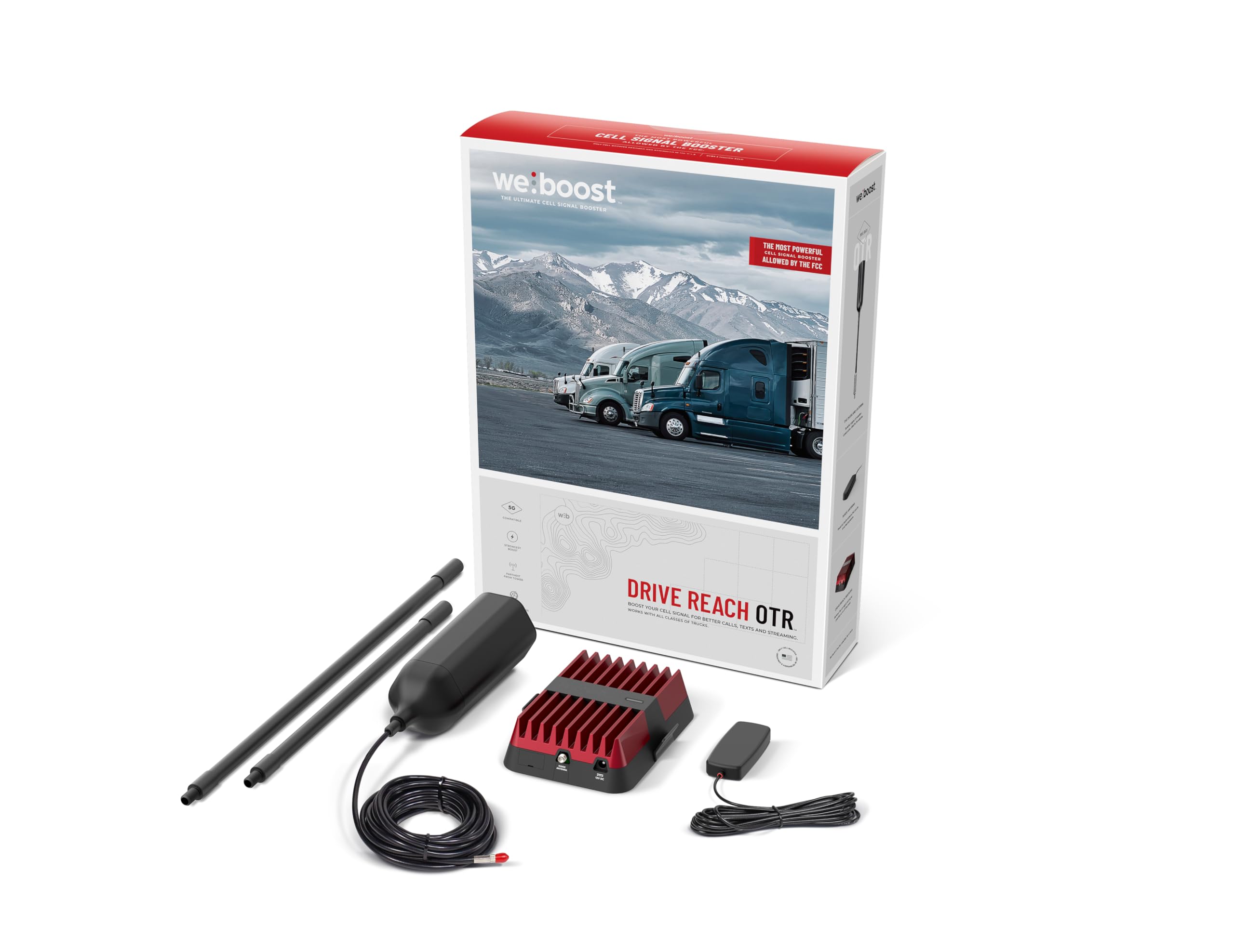
2. weBoost Drive Reach OTR (477154)
The big-box booster with 50 dB gain for reaching distant towers.
If your route takes you through the most remote stretches of Texas or New Mexico, this is the kit that trucking fleets order four at a time. The Drive Reach OTR delivers 50 dB maximum gain, the strongest signal amplification in this lineup, and it supports all U.S. carriers on bands 12/17, 13, 5, 4, and 25/2. The full kit is generous: a Drive RV antenna, 13-inch and 18-inch mast extensions, antenna spring, and thread-lock packets.
The real-world reports are emphatic. Truckers running the I-10 corridor report constant 3-4 bars with calls, texts, and emails all working. One coast-to-coast test with AT&T lost signal exactly once, on a mountain pass in California, while maintaining Netflix, YouTube, and Spotify the rest of the way. Full-time travelers report consistent connectivity across long-haul routes.
The honest downside is that the antenna assembly lacks durability and some units arrive missing mounting parts, requiring extra purchases. The booster box also runs hot, so avoid mounting it in an enclosed space. It’s a premium price for a premium result, but buyers repeatedly call it worth it.
extended reach range
- 50 dB max gain reaches the farthest towers
- Supports multiple devices simultaneously
- Backed by weBoost’s two-year warranty
bulky antenna
- Antenna assembly can lack durability
- Booster runs hot; needs open mounting space
long-haul king: full-time truckers and overlanders who need consistent signal in the most remote corridors.
city drivers: you want an easy, all-inclusive kit without sourcing extra mounting parts.
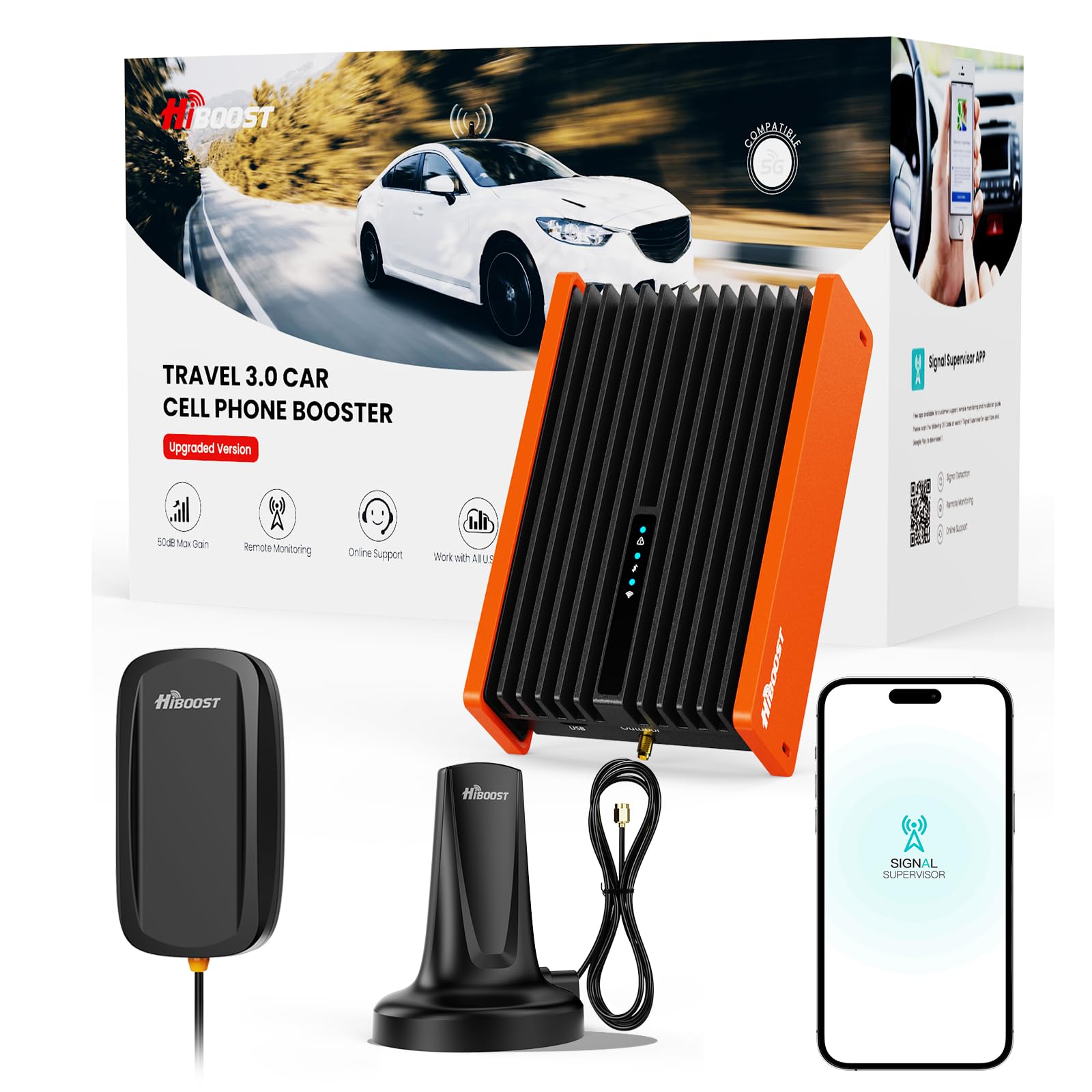
3. HiBoost C30G Car Booster
The rugged daily-driver booster with an app-guided setup.
For sedan and SUV owners who just want their commute to stop dropping calls, this is the most polished option. The magnetic outdoor antenna mounts on your roof in seconds, and the rugged metal booster is wrapped in a silicone cover to shrug off bumps and weather. It boosts both 4G LTE and 5G on bands 12/17, 13, 5, 4, and 25/2, covering AT&T, Verizon, and T-Mobile.
The differentiator here is the companion app, which guides you through installation and shows signal detection in real time. One iPhone 15 Pro Max user in a weak T-Mobile area went from zero bars to full bars, including 5G UC coverage, and confirmed it working across Verizon, AT&T, and Boost. The inside antenna comes with a 9.84 ft cable and the outside with 13.12 ft, giving you plenty of length to position them properly.
The catch is that antenna separation can be tricky in smaller trucks—one Tacoma owner had to place the external antenna at the tailgate and the internal one by the foot pedal to avoid a signal loop. The power cord is also on the short side, so plan your mounting locations with the app before everything is tightened down.
budget friendly boost
- App-guided setup takes the guesswork out of placement
- Works with 5G including UC bands
- Built-to-last metal housing with silicone cover
modest gain
- Antenna separation is critical in smaller vehicles
- Short power cord limits placement freedom
value pick: you want a modern, app-assisted booster for a car or SUV with a straightforward roof mount.
extreme coverage: you have a crew-cab truck with limited roof space and need a simpler physical layout.
4. APlusBoost SF-S1

The roof-rack booster with a live signal display for overlanding rigs.
This one is built specifically for SUVs, off-road rigs, and overland builds that already have a roof rack. The SF-S1’s defining feature is its smart HD display, which shows indoor and outdoor signal strength in real time, plus an installation guide, frequency band switch, and troubleshooting—all without needing a phone app. It supports three bands: 12/17, 13, 5, 4/66, and 2/25 for 3G, 4G LTE, and 5G.
The foldable omni outdoor antenna is a clever touch for easy storage, and the materials are built to handle outdoor weather. In rural areas with minimal existing signal, buyers report the booster lifting 1-2 bars to a usable level, making it a genuine lifeline for campsites and remote trails. The 15ft 3D-FB cable and 5ft LMR100 cables give you room to route everything cleanly.
Be clear-eyed about the big requirement: this needs a roof rack. The product page doesn’t scream that detail, and one buyer found out the hard way. On a Rivian R1S, installation was difficult, requiring antennas to be placed farther apart than recommended or connectivity worsened. The manual for cable penetration is also thin, so expect to spend real time on setup, possibly up to six hours.
slim design ease
- HD display gives you live signal monitoring without an app
- Foldable outdoor antenna is weather-resistant and easy to store
- Boosts 5G on five frequency bands
lower power
- Requires a roof rack for installation
- Setup is involved; mispositioning can hurt signal
compact choice: overlanders and off-roaders with a rack already mounted who want real-time signal feedback.
heavy users: you drive a stock SUV with no roof rack and want a magnetic mount instead.
5. SureCall Fusion2Go 3.0 RV

The permanent-mount powerhouse with 2x output for big rigs and motorhomes.
For full-time RVers, this is the system that makes life on the road actually work. SureCall’s exclusive 2XP Technology delivers up to 2x the output power of similar boosters, which means you can travel farther from the cell tower and still hold a connection. The kit covers the full North American spectrum from 698-2155 MHz, supporting every major carrier, and comes with an omni-directional external antenna plus a whip-style indoor antenna.
In an Airstream—which is notorious for being a Faraday cage that blocks signal—owners mention a marked improvement once the second unit was installed, with web browsing and streaming finally possible. The signal is strongest near the indoor antenna, so mounting placement matters. The unit weighs 1.4 pounds and uses a durable metal housing, and it’s assembled and tested in the USA.
The honest caveat is that the indoor antenna range is limited; you need to stay within a few feet of it for the best effect. Some customers note the booster drops from 5 bars to 2 bars after power-up and only improves when the phone touches the interior antenna. A 42-foot fifth wheel owner found the cables long enough but couldn’t get consistent performance without physical contact with the antenna.
RV tailored setup
- 2X output power reaches towers at greater distances
- Covers all North American carriers on multiple bands
- Permanent omni antenna is built for RV life
roof mount needed
- Indoor antenna range is short; stay within feet for best results
- Performance can be inconsistent without antenna contact
camper companion: motorhome and fifth-wheel owners who can mount a permanent antenna and want multi-user coverage.
sedan owners: casual campers who want a simple magnetic mount and aren’t ready for a permanent install.
6. JACOOL Vehicle Booster
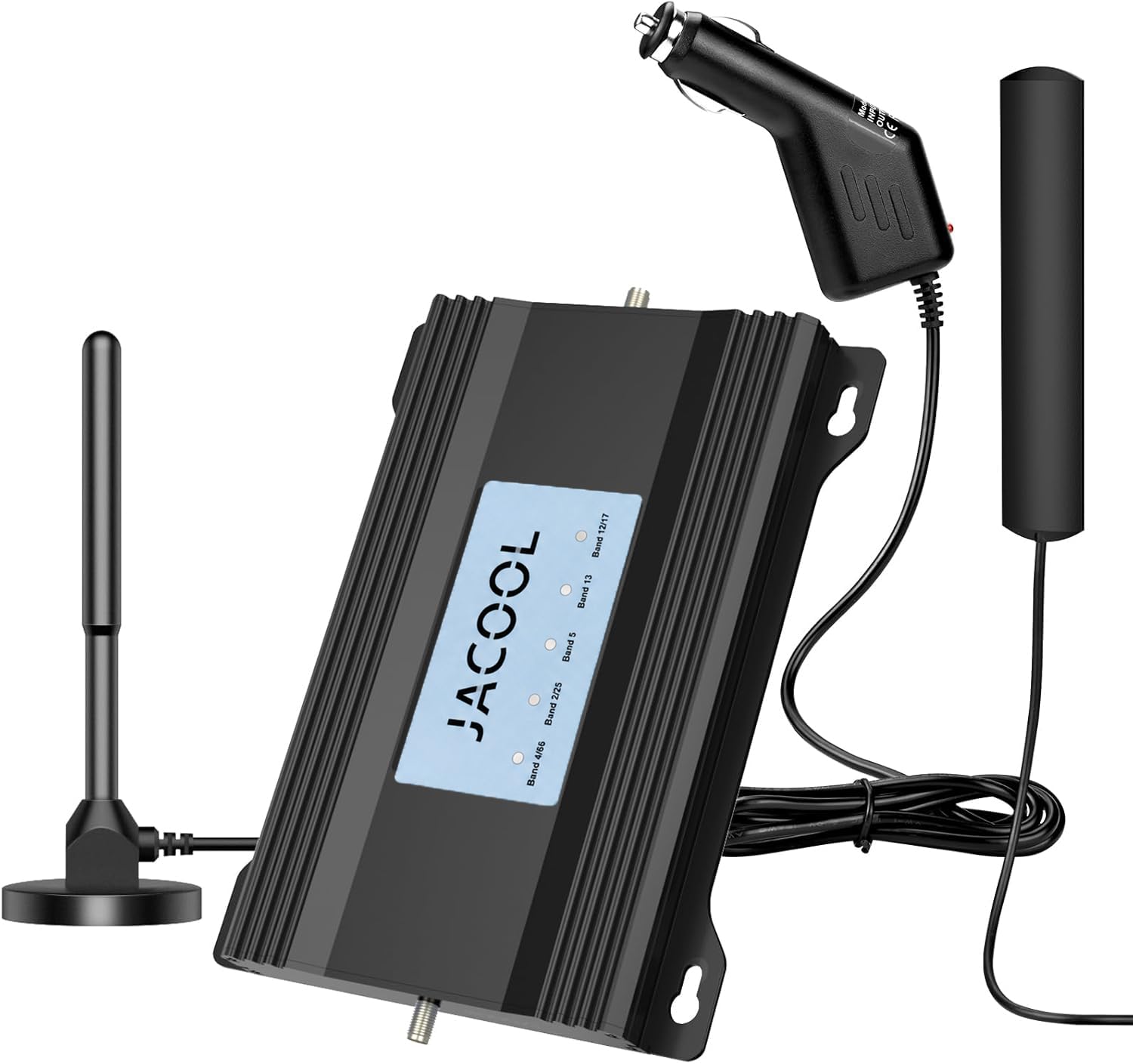
The suction-cup booster covering 8 bands for trucks, RVs, and SUVs.
This JACOOL kit strikes a strong balance between capability and simplicity. It amplifies bands 2/4/5/12/13/17/25/66, which is a broad sweep of the spectrum used by Verizon, AT&T, T-Mobile, and others for both 5G and 4G LTE. The high-gain omnidirectional outdoor antenna uses a suction cup mount, so you don’t need to drill or modify your vehicle—just attach it securely and go.
The smart gain control is the key intelligent feature here. The booster automatically detects the incoming signal strength and adjusts itself to prevent self-oscillation, which is the feedback loop that ruins weaker systems. The package includes the booster, the suction-cup antenna, an inside patch antenna, and a 3-year manufacturer warranty. The installation is designed to feel secure and professional without permanent changes to your truck or RV.
A frequent source of owner frustration is the warning about the patch antenna: don’t attach it to any metal parts inside the vehicle, or performance drops. The booster also needs at least 1-2 bars of existing outdoor signal to work—it won’t create coverage from nothing. Buyers who follow the placement rules report solid results, while those who don’t are often left puzzled.
quick install kit
- Covers 8 frequency bands for broad carrier support
- Suction cup mount means no drilling required
- Smart gain control prevents signal feedback loops
average gain
- Patch antenna placement is picky; avoid metal surfaces
- Needs a baseline outdoor signal to be effective
DIY friendly: anyone who wants a genuinely multi-purpose booster that transfers between car, truck, and RV.
pro installs: you only ever drive in true zero-signal zones where no outside signal exists to amplify.
7. GAGBK Car Booster

The entry-level magnetic whip that gives budget-minded road trippers a real boost.
This GAGBK kit is the smart pick when you want solid coverage without a premium price tag. It focuses on bands 12/13/17, which covers the most common LTE bands for Verizon, AT&T, T-Mobile, and others. The outside magnetic whip antenna mounts on your roof in minutes, and the aluminum alloy booster keeps itself cool with better heat dissipation, which helps extend its life.
The automatic gain control delivers up to 65 dB of amplification and automatically adjusts to the incoming signal to prevent self-oscillation. An LED indicator shows connection status, and sleep mode reduces power draw when the booster isn’t in use—a thoughtful detail for protecting your car’s battery. Installation takes about 10-20 minutes with all accessories included and no drilling required.
The key limitation is that the boost only truly shines when the inside antenna contacts the phone, as one buyer put it: “The system works but you have to put the antenna on the phone to have the maximum power.” That’s more of a single-phone setup than a multi-user system. Also, check your phone’s bands before buying—this only works on 12/13/17.
affordable entry
- 65 dB max gain at a budget-friendly price
- Compact aluminum body with sleep mode
- Complete kit; no drilling required
basic features
- Boosts only bands 12/13/17; check your phone first
- Best results require antenna contact with the phone
starter option: you’re on a budget and your phone operates on bands 12/13/17, and you travel solo or in pairs.
power seekers: you need coverage for multiple passengers or your carrier uses bands this doesn’t support.
8. SureCall N-Range 2.0

The hands-free cradle booster that installs in three steps and moves between any vehicle.
This is the ultimate simplicity play for a single driver. The SureCall N-Range 2.0 uses a cradle design, so you drop your phone in the upgraded hands-free cradle, and the booster focuses its power directly on that one device. The ball-joint attachment and swivel base give you flexible mounting options: adhesive, permanent base, or vent clip. Setup is a literal 3-step process, and the whole unit weighs just 11.2 ounces, so it’s easy to move between vehicles.
The Extended Range Technology is designed to boost cellular reliability, and it works across all North American carriers on 700 MHz and 1700/2100 MHz bands. The real-world reports are genuinely split, which is why it lands lower on this list. Some owners in Oregon mountains saw their signal jump from 1-2 bars to 4-5 bars, enabling online classes and tests via phone tethering. Others report the green light only lasts a minute or two after reboot before dropping to the red (not-working) state.
Reliability is the recurring theme in owner feedback—it works brilliantly for some and stops working for others, sometimes within a year. The value question also splits buyers, with some calling it excellent and others saying it’s not worth the price. That inconsistency is the key reason it’s the right choice for a cautious single user, not a family hauler.
versatile band support
- Fast, simple 3-step installation
- Ultra-portable 11.2 oz design transfers easily
- Cradle-style focus boosts a single phone effectively
cable length short
- Reliability is inconsistent across buyer reports
- Single-user design won’t cover the whole cabin
flexible fit: a solo commuter who wants a transferable, easy-to-install cradle booster for one primary phone.
large rigs: you need a dependable multi-user system for family trips or long-haul work.
Understanding the Specs
Max Gain (dB)
This is the raw amplification power of the booster, measured in decibels. A higher number like 50 dB or 65 dB means the booster can amplify a very weak outside signal into something stronger inside. In practice, higher gain helps you hold a call in more remote areas, but it also demands more careful antenna separation to prevent feedback.
Frequency Bands
Think of bands as the specific radio “channels” your carrier uses. A booster that supports Band 12/17 and Band 13 covers the low-frequency spectrum that travels far and penetrates buildings well. If your carrier uses a band your booster doesn’t support, the booster simply won’t help you. Always verify your phone’s bands against the booster’s list before purchasing.
FAQ
Will a vehicle cell phone booster work in a true dead zone with no signal at all?
How do I know if a booster will work with my carrier?
What is the difference between a single-user and multi-user booster?
Why is antenna placement so important for a vehicle booster?
Can I move my booster between different vehicles?
Do vehicle signal boosters require FCC approval?
What does the sleep mode feature do on a booster?
Will a booster work with 5G phones and networks?
Final Thoughts: The Verdict
For most people, the vehicle cell phone booster winner is the weBoost Drive 4G-X OTR because it delivers proven, multi-user performance with a rugged antenna built for long-haul life. If you want maximum reach for the most remote routes, grab the weBoost Drive Reach OTR with its 50 dB gain. And for a smart, app-assisted daily driver setup, the HiBoost C30G is the one to reach for. The weBoost models dominate owner reviews for their proven reliability and multi-user coverage.
How We Picked
We do not accept paid placement. Every pick is matched to a real buyer and a real use-case; we do not hands-on test units.
Sources & Methodology
Specifications: manufacturer listings and product documentation. Review insights: verified customer reviews, as of August 2026. Pricing: not shown on this page (it changes often); check the current price via the retailer link.
As an Amazon Associate, GoCarLife earns from qualifying purchases. This does not affect which products we feature.