
Our readers keep the lights on and the garage heater humming. As an Amazon Associate, I earn from qualifying purchases.
Specs are compiled from manufacturer listings and verified buyer reviews and can change over time — please confirm the key details on the product page before buying.
If you run 35-inch tires, air down for the trail, or blast train horns, the difference between a great vehicle-mounted air compressor and a so-so one is measured in minutes and decibels. This guide sorts through 9 serious on-board options — from quick-fill tanks to continuous-duty pumps — so you can pick the one that fits your rig and your real-world use without overpaying for features you don’t need.
I’m Mo Maruf — the founder and writer behind GoCarLife. This guide is built by comparing the manufacturers’ published specifications and the patterns across verified customer reviews, so you get each pick’s real strengths and trade-offs instead of marketing spin.
Here is the breakdown of the vehicle-mounted air compressor options that earn their spot under your hood or in your bed, ranked by real-world performance and owner satisfaction.
Our Picks at a Glance


How To Choose The Best Vehicle-Mounted Air Compressor
Picking between these isn’t about which one has the highest number on the box. It’s about matching the pump to your tires, your tank, and how often you actually need air on demand.
Match the CFM to your tire size
The single most useful spec is airflow, measured in CFM (cubic feet per minute). A small pump pushing 1.59 CFM is perfect for topping off a tank for horns. A dual-cylinder unit blowing 6.35 CFM is what you want when you’re refilling four aired-down 35-inch tires after a trail run.
Understand duty cycle before you buy
Duty cycle tells you how long a compressor can run before it needs to cool off. A 30% duty cycle at 100 PSI means it runs 3 minutes and rests 7. If you plan to run air tools or fill a big tank, look for a higher duty cycle or a heavier unit, or you’ll be waiting around for it to cool down.
Quick Comparison
| Model | Best For | Flow Rate | Max PSI | Weight | Amazon |
|---|---|---|---|---|---|
| ARB CKMA12★ Best Overall | Reliable all-rounder | High-output (fast fills) | Auto-shutoff 90-100 | 7.7 lbs | Amazon |
| ZHSYMX Universal 150 PSIBudget Champion | Budget horn & suspension | 1.9 CFM | 150 PSI | — | Amazon |
| ROAD2SUMMIT KitTop Performer | Portable power | 6.35 CFM | 150 PSI | 16 lbs | Amazon |
| Vixen Horns VXC8301 | High-pressure horns | 1.7 CFM | 200 PSI | 9.3 lbs | Amazon |
| Kohree Dual Cylinder | Fast dual-cylinder fills | 12.35 ft³/min | 150 PSI | 24 lbs | Amazon |
| VEVOR 6L Tank Kit | Tank + portability combo | 6.35 CFM | 150 PSI | 28.1 lbs | Amazon |
| VIAIR 20005 Kit | Air horns & suspension | 1.59 CFM | 150 PSI | 19.8 lbs | Amazon |
| ALL-TOP 6L Tank | Versatile tank use | 7.06 ft³/min | 150 PSI | 16 lbs | Amazon |
| VIAIR 450C | Continuous-duty pro jobs | 1.8 CFM | 150 PSI | 10.8 lbs | Amazon |
In‑Depth Reviews
1. ARB CKMA12 On-Board Air Compressor
Our pick — over 4.5★ from 400+ verified ratings; the strongest balance of quality and price.
The overlander’s gold standard that fills tires fast and quietly, with a mount that pivots into tight spots.
Buyers report the compressor pushes a tank from 40 to 90 PSI in 1.5 to 2 minutes and brings a tire from 10 to 32 PSI quickly. It weighs 7.7 pounds, which makes the 16-pound portable kit below feel like a boat anchor in comparison — 2.1x heavier by the numbers.
Installation is the real project. Installation takes a full day or weekend, and you’ll need to buy your own fittings because the ports are 1/8″ BSPP, which don’t thread with standard hardware. The rotatable mount is the standout feature, letting you position the pump in places a fixed bracket won’t reach.
The wiring harness is built for ARB’s air lockers, so it feels overcomplicated if you’re only using this for tires. Quality is the #1 thing owners praise — the hard-anodized cylinder bore and sealed, moisture-resistant case mean this is a buy-once unit, even if the upfront cost stings. One owner of a cheaper Firestone unit said they wished they’d bought the ARB first.
compact proven performer
- Blazing fill times on tanks and tires
- Quiet, solid engineering-grade build
- Rotatable mount solves odd mounting angles
needs wiring care
- Install eats a full weekend
- Needs non-standard BSPP fittings (sold separately)
- Wiring harness is complex for tire-only use
reliable builds: you want a reliable, fast, permanent on-board solution for tires and lockers and don’t mind a involved install.
tight installs: you need bolt-on simplicity in an afternoon, or you’re on a tight budget for a first compressor.
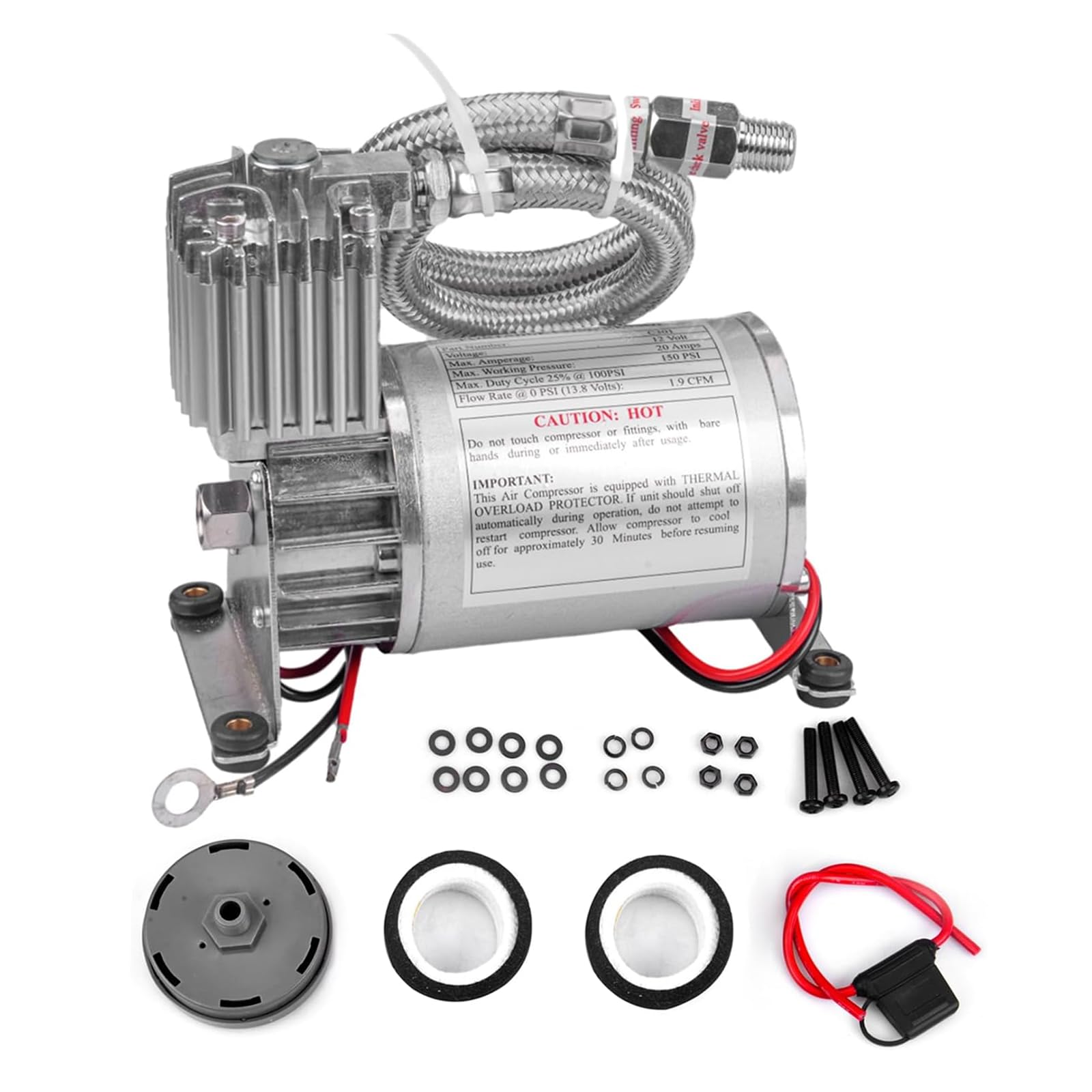
2. ZHSYMX Universal 150 PSI Horns Compressor
A wallet-friendly pump that feeds horns and bags without complaint — if you can live with the noise.
You can fill a 0.8-gallon tank in 40 to 60 seconds with this 12V compressor, which pushes air at 1.9 CFM (cubic feet per minute) through a 1/4 NPT (standard threaded) hose. One buyer mounted it on a 2016 F-150 frame and confirmed the speed. It’s built for train horns, air suspension, and tire inflation, so it’s a versatile budget pick for light-duty jobs.
The big trade-off is comfort: owners describe it as very noisy with noticeable vibration that travels into the cabin. You’ll also need to buy an extra fitting to make it work, and the air filter needs rerouting if you care about keeping dust out of the pump.
The stainless-steel cylinder and braided leader hose with check valve speak to decent construction, and the thermal overload protector switch stops the motor from overheating. One owner’s first unit failed after four months, but the seller replaced it without hassle, though the replacement’s longevity is unverified. It’s the right choice when you want on-board air on a budget.
budget horn power: The cheapest way to get horns and bags working, with the expectation of some cabin noise. For tire-heavy duty, the higher-CFM options below earn their price.
3. ROAD2SUMMIT Heavy Duty Portable 12V Kit
A 6.35 CFM powerhouse that chews through Jeep tires, promising serious airflow in a portable package.
This kit is all about output. With a max pressure of 150 PSI and 6.35 CFM (180L/Min) of airflow, it fills Jeep tires well, and the built-in gauge matches the TPMS, so you can trust what you read. The hefty 16-pound weight comes from the hollow metal shell and aluminum cylinder, which keep it from overheating on long runs.
It’s technically “portable” thanks to the carry bag, 10-foot power cord, and 26-foot rubber hose, but at 16 pounds, you’ll want it bolted down or stashed out of the way. Owners note the battery clamps are secure and the cord stays cool, but the hose gets noticeably hot by the time you’re on your last tire.
The case is sturdy and the build is solid for occasional use. At high altitude — 10,000 feet — it slows down noticeably, which is physics, not a defect. The real caveat is the pressure gauge, which owners find hard to read while it’s pumping, so keep a separate handheld gauge handy for precision. It’s a no-nonsense choice for the weekend wheeler.
trailside: you want max airflow per dollar and the weight doesn’t scare you.
shop work: you crave a permanently mounted, clean under-hood install — this is a strap-it-in-bed unit at heart.
4. Vixen Horns VXC8301 Heavy Duty Onboard Compressor

Screams to 200 PSI for noisy horns and bags, wrapped in stainless steel mesh for heat defense.
This one’s defining spec is 200 PSI — higher than most on this list — delivered at 1.7 CFM through a ¼” NPT hose. It’s built for train horns, air suspension, and air ride systems, and owners confirm it fills tanks quickly, with one saying it outpaced a pricier major-brand model they owned before.
The stainless steel mesh leader hose with check valve is the standout feature, protecting against heat and high pressure while stopping tank air from flowing back into the pump. The detachable, washable intake filter is also a smart touch — you can remote-mount it to a spot away from dust and moisture, which improves performance and throttle response.
Reliability is the most-praised aspect, with strong performance backing it up. But durability is the honest weak spot: owners mention filters breaking and, in one case, the unit burning up after two years of hard winter use, draining a truck battery in the process. Noise is mixed, too — some find it tolerable, others very loud. It’s a value pick for horn builders who want high pressure without the premium ticket.
tankless steady flow: You get 200 PSI headroom and a great price, but the filter and long-term durability demand a gentle touch. Best for dedicated horn and bag setups, not daily tire duty.
5. Kohree 12V Dual Cylinder Air Compressor

Dual cylinders push a torrent of air — a 35-inch tire jumps from 8 to 35 PSI in about 90 seconds.
This is the airflow king of the list. The dual-cylinder design delivers 12.35 ft³/min (350L/min), which is roughly double the ROAD2SUMMIT’s output. In real terms, an owner inflated a 35-inch off-road tire from 8 to 35 PSI in about 1.5 minutes, and another reported airing up all tires in 6 minutes flat. If speed is your priority, this is the benchmark.
All that power comes at a cost: 24 pounds of metal, hollow shell, and dual aluminum cylinders for heat dissipation. It’s “portable” in name, but the four rubber feet on the base suggest it’s meant to sit steady while you work. The 26-foot hose reaches all four corners of a truck without moving the unit, and the heat-resistant rubber handle is a thoughtful touch for long sessions.
Owners praise the build quality and the accuracy of the inline gauge, though a few note the gauge reads slightly off even when off. The carrying case zipper is cheap, and one unit arrived missing the tire adaptor, with customer service slow to respond. It comes with a 2-year manufacturer service warranty, which softens that risk. For the off-roader who hates waiting, this is the one.
quick top-ups: you air down frequently and want the shortest possible refill time.
long sessions: 24 pounds feels like too much bulk, or if you need a permanently mounted under-hood unit.
6. VEVOR 12V Heavy Duty Air Compressor with 6L Tank
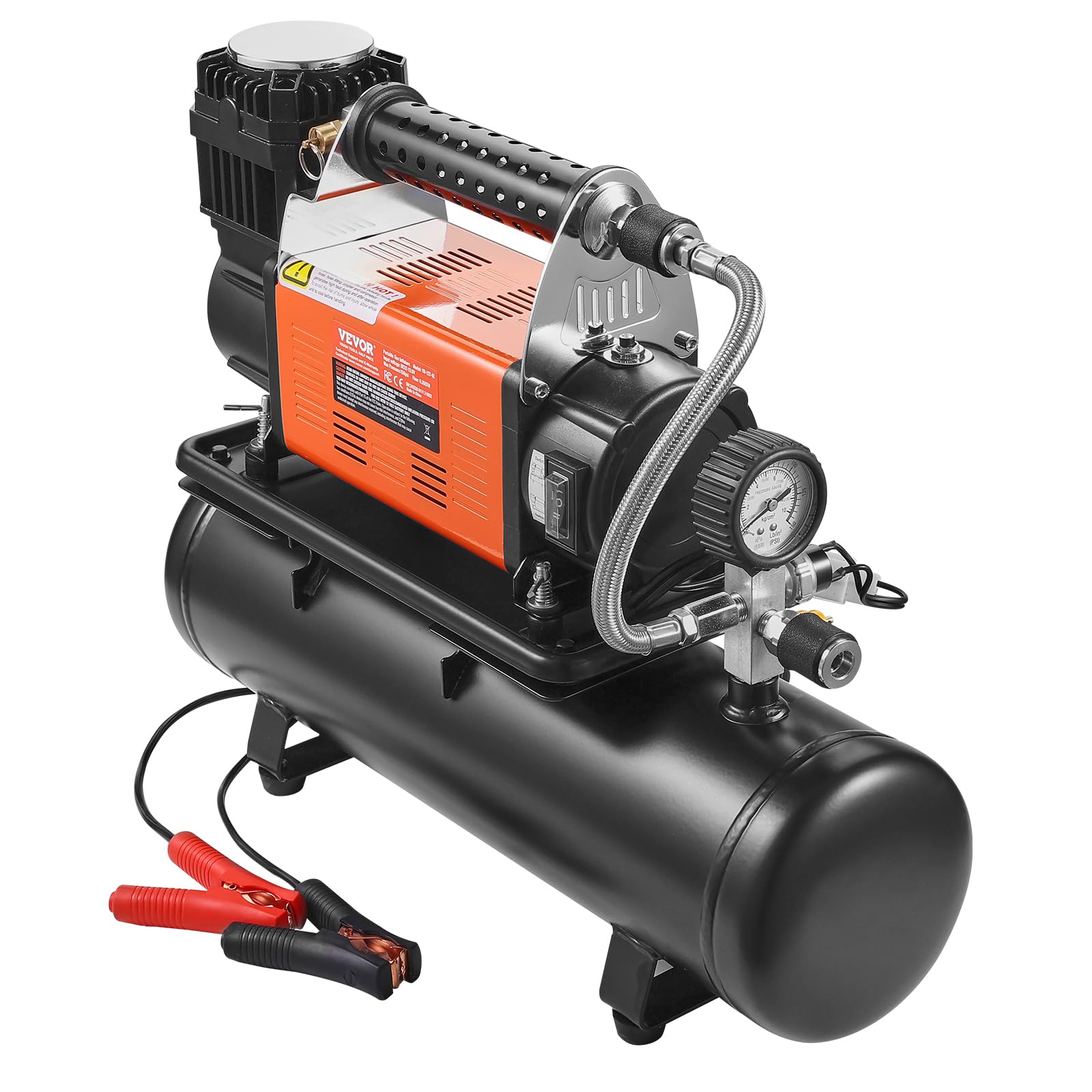
A 6-liter buffer tank smooths out the air and lets four tires fill at once — smart for wheeling.
You get both direct inflation and a buffer of stored air because this unit pairs a 6.35 CFM pump with a 6-liter tank. Customers note filling all four Jeep tires at once at about 10 PSI per minute, with smooth switching between tank mode and direct pressure. The tank also smooths out the pulsation you feel with tankless pumps.
The digital tire inflator is the hidden gem — hold the trigger to start, release to stop, no toggling the compressor switch. Real-time pressure monitoring makes hitting an exact PSI easy. The 28.1-pound weight is substantial, but it’s compact enough for trunk storage and includes a 26-foot rubber hose.
Build quality earns high marks, with owners saying it’s a clear step up from cheaper plastic models and noting it “more than keeps up” with a friend’s ARB setup. It’s a great tool for wheeling, overlanding, and light home projects like running a roof coil nailer. If you want tank versatility without jumping to a permanent install, this balances both worlds nicely.
tank storage bonus: the combined tank-and-direct system lets you inflate everything at once or use stored air for a quick top-off, all with a digital gauge that removes guesswork.
7. VIAIR 150 PSI High-Flow Air Source Kit (20005)

A turnkey tank-and-compressor bundle that fires horns loud and runs 30 minutes straight.
This is the complete package for horn and suspension duty. The 280C VIAIR compressor sits on a 150 PSI-rated 2.0-gallon matte black tank with 5 ports, delivering 120 PSI with low amp draw. It fills the tank from 0 to 145 PSI in 3 minutes 40 seconds, so your horns stay ready to blast.
The 30% duty cycle at 100 PSI means it can run 30 minutes continuously before needing a cooldown, which is plenty for horns and air tools. The IP54 rating for dust and water resistance means you can mount it inside or outside the vehicle, in the bed or under the chassis. Owners mention installing a normally-open relay to prevent battery drain from tank leaks, and one says it survived two months of hard off-roading without issue.
Flow is rated at 1.59 CFM, which is modest for tire work — this is explicitly not meant to fill truck tires from flat to full, but it tops off fine. The included pressure switch (110/145 PSI), safety valve, and drain cock make it a proper system. Owners do note it takes about 20 minutes to top off 35-inch tires, so manage expectations. For the horn-and-bag crowd, this is the polished, ready-to-run answer.
air tools: truck owners powering train horns, exhaust brakes, and air lockers who want a clean, pre-assembled tank unit.
occasional: those who refill large aired-down tires regularly — you’ll want a higher-CFM pump.
8. ALL-TOP Air Compressor with 6L Tank Kit

Rock-solid airflow of 7.06 ft³/min for utility work, with a 6-liter tank that never pulses.
The calling card here is versatility. Beyond tire inflation, owners run blow guns, spray guns, nailers, and drills off it, and one even uses it to blow sand. The 7.06 ft³/min airflow and 150 PSI max pressure, paired with the oil-free 6-liter steel tank, deliver constant pressure with zero pulsation — a step up from smaller single-cylinder units.
At 16 pounds, it’s manageable, and the hollow metal shell with aluminum cylinder aids heat dissipation. The kit includes a 6.5-foot power cord, 26-foot rubber hose, digital inflator with pressure gauge, and 3 nozzle adapters. The auto shutoff at 150 PSI is a welcome safety feature, and it handles 85 PSI truck and van tires without breaking a sweat.
Reliability is genuinely mixed. Owners say the digital deflator/inflator works great and it’s good value, but a couple of units failed quickly — one died after five minutes with a shredded brush wire, another after three uses. The 24-month low-maintenance warranty is a safety net, but you may need to use it. For the price, it’s a capable utility compressor if you’re willing to roll the dice.
tank plus capacity: It’s a jack-of-all-trades tank system with strong specs, but quality control is inconsistent. Budget buyers should weigh the warranty against the failure reports.
9. VIAIR 450C Industrial Air Compressor

The workhorse for OEM and shop use — runs nonstop, fills a 5-gallon tank to 145 PSI in 3 minutes.
This is the professional’s pick. Designed for drilling, air brushing, spraying, and nailing, the 450C is rated for 100% duty cycle, meaning it can run continuously without the cooldown breaks other compressors need. In practice, owners run it steadily on truck air suspension systems — one uses it on a Ford F-550 carrying several tons for a tree business — and it holds up.
The 1.8 CFM flow rate and 18-inch stainless steel braided leader hose with 1/4″ NPT check valve are built for reliability. Reviewers point out it airs up four 265/75/r16 truck tires from 20 to 32 PSI in about a minute. Max amp draw is 23 amps, so plan your wiring accordingly — you’ll likely need a separate relay and fuse setup.
Build quality and performance are the top praised aspects, with one long-term owner calling it roughly 3x faster than a Vixen pump and quieter too. It does run hot enough to burn a hand, but never shuts down, and the thermal overload protector is your safety net. It’s the quiet, powerful, low-maintenance option for the owner who wants industrial-grade reliability over raw speed.
pro shops: you need a continuous-duty unit for suspension, tools, or airing tires and want VIAIR’s proven track record.
hobbyists: you want a pre-wired, all-inclusive kit — this needs a relay, fuse, and fittings bought separately.
Understanding the Specs
CFM (Air Flow Rate)
This is how much air the pump moves per minute. Higher CFM means faster tire fills and quicker tank recovery. For refilling aired-down 35-inch tires, you want at least 6 CFM. For horns and suspension, 1.5-2 CFM is usually enough since you’re just pressurizing a tank.
Duty Cycle
Duty cycle tells you how long a compressor can run before it overheats and needs a break. A 30% duty cycle at 100 PSI means 3 minutes of running, then 7 minutes of rest. If you’re running air tools or filling large tanks, a 100% duty cycle unit like the VIAIR 450C is worth the money.
Tank Size
A built-in tank stores compressed air so you can use it for quick bursts without the pump running constantly. Bigger tanks (2-6 gallons) mean more stored air for horns and tools, and they reduce pulsation. But they add significant weight — a 6-liter tank kit can weigh 28 pounds or more.
Max PSI
This is the highest pressure the compressor can produce. Most vehicle systems cap at 150 PSI, which is more than enough for tires and horns. Some units, like the Vixen, go to 200 PSI, giving you extra headroom for accessories that need higher pressure.
FAQ
Can a vehicle-mounted air compressor fill truck tires from flat?
What size air tank do I need for train horns?
How long does it take to install an on-board compressor?
What does duty cycle mean for daily driving?
Can I mount the compressor outside my vehicle?
Do I need a separate air tank if I have a compressor?
Are portable compressors as good as mounted ones?
What wiring do I need for a hard-wired compressor?
Final Thoughts: The Verdict
Across the board, the vehicle-mounted air compressor winner is the ARB CKMA12 because it combines the fastest real-world fill times with a build quality that owners consistently rank #1, and it’s the crowd favorite with 4.7 stars across 400+ owners. If you want sheer speed for aired-down tires, grab the Kohree Dual Cylinder. And for the pure horn-and-suspension crowd wanting a ready-to-run tank system, the VIAIR 20005 is the one to reach for.
How We Picked
We do not accept paid placement. Every pick is matched to a real buyer and a real use-case; we do not hands-on test units.
Sources & Methodology
Specifications: manufacturer listings and product documentation. Review insights: verified customer reviews, as of August 2026. Pricing: not shown on this page (it changes often); check the current price via the retailer link.
As an Amazon Associate, GoCarLife earns from qualifying purchases. This does not affect which products we feature.