
Our readers keep the lights on and the garage heater humming. As an Amazon Associate, I earn from qualifying purchases.
Specs are compiled from manufacturer listings and verified buyer reviews and can change over time — please confirm the key details on the product page before buying.
Your dashboard oil light only warns you after pressure has already dropped dangerously, leaving you guessing whether it’s a bad sensor or a failing pump. A vehicle oil checker gives you a precise number instead of a guess, so you can tell if you need a cheap sensor swap or a full engine teardown before spending any money. There are two main types: mechanical gauge kits that read actual pounds per square inch (PSI, the unit of pressure) and optical testers that judge oil quality by how much light passes through it. Pick the one that matches your skill level and your engine.
I’m Mo Maruf — the founder and writer behind GoCarLife. This guide is built by comparing the manufacturers’ published specifications and the patterns across verified customer reviews, so you get each pick’s real strengths and trade-offs instead of marketing spin.
If you need to verify a suspect oil pressure reading or track when your oil is actually worn out, the right vehicle oil checker pays for itself the first time it stops you from paying for an unnecessary repair or oil change.
Our Picks at a Glance


How To Choose The Best Vehicle Oil Checker
First, decide what you are actually trying to find out. If an oil light is flickering or you suspect the pump is weak, you need a mechanical gauge that reads pressure in PSI. If you just want to know whether the oil is still good between changes, an optical tester that measures transmittance is the faster, cleaner tool. These are different jobs, and very few kits do both.
Match the Tool to the Symptom
Pressure gauge kits screw into the same port your oil sending unit uses, then read live pressure when the engine runs. This tells you if the oil pump, filter, or pressure-limiting valve is working. Optical testers, by contrast, dip a probe into the oil through the dipstick tube and shine light through a sample—dirtier oil blocks more light, giving you a percentage of remaining life without ever draining a drop.
Check Your Engine’s Port and Thread Size
Before buying any mechanical kit, know what you drive. The adapters are the whole game: a kit with only a couple of sizes (like 1/8″ and 1/4″ NPT) may not fit a European car with metric ports (M12 x 1.5, M14 x 1.5). Kits with 10 adapters covering both NPT and UNF threads, plus metric sizes, are far more likely to have the piece you need waiting in the case.
Read the Gauge Scale and Hose Length
For most gasoline and small diesel engines, a gauge scaled to 140 PSI is ideal—you get a clear reading at idle pressures of 20-40 PSI without the needle barely moving. Hose length matters more than you’d think: a 60-inch hose lets you route the gauge up to the windshield for a drive test, while a 30-inch hose works for a static check but is awkward for real-time monitoring.
Quick Comparison
| Model | Best For | Type | Gauge Range | Adapters Included | Amazon |
|---|---|---|---|---|---|
| ABN Engine Oil Pressure Kit★ Best Overall | Transmission & engine pressure | Mechanical Gauge | 0-500 PSI | 10 Fittings | Amazon |
| DAYUAN Cylinder Oil TesterBest Coverage | Metric & standard coverage | Mechanical Gauge | 0-140 PSI | 10 Adapters | Amazon |
| YSTOOL Oil Pressure TesterSmart Pick | Confirming sensor failures | Mechanical Gauge | 0-140 PSI | 10 Adapters | Amazon |
| ZJERYL GULL Oil Pressure Kit | Budget-friendly diagnosis | Mechanical Gauge | 0-140 PSI | 10 Adapters | Amazon |
| LEIMO KPARTS Tester | Basic DIY checks | Mechanical Gauge | 0-140 PSI | 10 Adapters | Amazon |
| JIFETOR Oil Pressure Kit | Small diesel & motorcycle engines | Mechanical Gauge | 0-100 PSI | 3 Adapters | Amazon |
| KAISAL Engine Oil Tester | Fast 2-second quality checks | Optical Quality | Transmittance % | — | Amazon |
| AUTOOL Engine Oil Tester | Peace-of-mind monitoring | Optical Quality | Transmittance % | — | Amazon |
| QPKING AS503 Oil Tester | Tracking oil degradation | Optical Quality | Transmittance % | — | Amazon |
In‑Depth Reviews
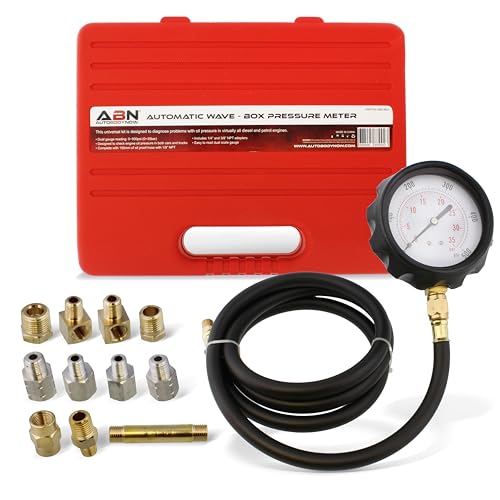
1. ABN Engine Oil Pressure and Transmission Fluid Diagnostic Tester Tool
Our pick — 4.5★ from 750+ verified ratings; the strongest balance of quality and price.
The only kit here that doubles as a transmission line tester, with a 60-inch hose that reaches the driver’s seat.
If you have ever wanted to watch oil pressure climb while actually driving, this is the kit for you. The 60-inch (152.4cm) hose is twice the length of the JIFETOR’s 30-inch line, and owners use that reach to route the gauge up where they can see it during a road test—something shorter hoses just cannot do. The “pressure” thing everyone raves about is the build quality: solid brass fittings, a brass extension tube, and a gauge wrapped in a black protective coating that shrugs off knocks in the toolbox.
This kit earns its keep beyond simple engine checks. Because it reads up to 500 PSI (35 Bar), it can also tap into transmission fluid pressure circuits, which is how several owners confirmed a failing transmission without pulling the pan. The downsides are real but manageable: connecting the threaded adapters means rotating the whole gauge assembly since there is no swivel joint, and buyers report it reads about 10psi off compared to other gauges—”not that bad for the price,” as the review pages sum it up, though it means you should trust trends over absolute numbers.
You get a lot of parts for the money: six brass fittings, four adapters, an extension tube, the gauge, the hose, and a blow-molded 13″ x 10″ x 2.3″ case that keeps it all organized. The thread style is NPT, so it is most at home on American domestic and imported cars and small pickups. If you need one tool to cover both engine oil pressure and transmission line pressure, this is the one to grab.
The Good Stuff
- Reads up to 500 PSI and 35 Bar, so it covers transmission work too
- 60-inch hose lets you monitor pressure from the cab
- Solid brass fittings and a protective gauge coating for longevity
- Everything fits in a heavy-duty blow-molded case
The Trade-Offs
- Reported to read about 10psi off compared to other gauges
- No swivel fitting—you rotate the whole gauge to connect
- Connectivity gets mixed feedback from owners
Reach for it if: you want a versatile tester that handles both engine oil pressure and transmission fluid circuits, with a hose long enough for real driving checks.
Keep looking if: you need lab-grade accuracy at the needle—this one is close but not dead-on.
2. DAYUAN Engine Cylinder Oil Pressure Diagnostic Tester Tool Set
Metric and standard threads in one case, with a 90° coupler that reaches ports others can’t.
The thing that wins people over here is the adapter spread. This kit ships with 10 oil switch port adapters covering metric sizes (M10 x 1.0, M12 x 1.5, M14 x 1.5, M16 x 1.5, M18 x 1.5) and standard sizes (1/8″ x 27 NPT, 1/4″ x 18 NPT, 3/8″ x 20 UNF, 1/2″ x 20 UNF, R 1/8″), so it is the rare set that fits both a BMW and a Ford without hunting for extra parts. It tests oil pump pressure and also low oil warning devices, and the 1200mm of hose with quick-coupling adaptors reaches switch ports buried deep in the engine bay.
That 90-degree coupling adaptor is the quiet hero here—when your oil pressure switch sits at an awkward angle, it lets you thread in straight instead of fighting the hose. The dual-scale gauge reads 0-10 bar (0-140 PSI) on an 80mm shock-proof dial, which is the ideal range for gasoline engines where a warm idle typically sits around 35/40 psi. One owner with a 250,000-mile engine used it to confirm his pump was fine, noting 80psi on start-up, which saved him from chasing a non-existent engine failure.
The case is compact at 12.99 x 10.63 x 2.76 inches—about 24% bigger than the JIFETOR’s 10.5 x 7.75 x 2 case—with room for all 13 pieces. The brass construction and 1-year warranty back it up. For the money, this is the set most likely to have the exact adapter your engine needs already in the box.
Why It Stands Out
- 10 adapters including both metric and NPT/UNF threads
- 90° coupler for tight, awkward access points
- Shock-proof dual scale gauge reads 0-140 PSI
- Blow-molded case keeps all 13 pieces organized
Consider This
- Hose is 1200mm—long enough for static checks but not cab viewing
- Best for oil pump pressure, not transmission circuits
Grab this when: you own multiple cars including imports and want one kit that covers metric and standard ports without extra trips to the store.
Think twice if: you specifically need to test transmission line pressure—that is the ABN’s job.
3. YSTOOL Oil Pressure Tester Kit with 4FT Hose
The confirm-your-sensor specialist—owners use it to prove a bad switch, not a bad pump.
Flickering oil light got you nervous? This kit is built for exactly that moment. Multiple owners describe the same scenario: a red light flickers, and instead of guessing, they threaded this tester into the oil pressure switch port and watched the gauge show healthy pressure—proving the sensor was the liar. The 4FT (48-inch) hose made of rubber nylon resin has a max working pressure of 300 PSI, which is plenty for the 0-140 PSI gauge range. There is a straight quick coupler and an elbow version in the case so you can adapt to wherever the test port sits.
The gauge itself is the star of the show for readability. It uses a 3-inch big dial with a dual scale of 0-140 PSI and 0-10 Bar, and the short-range marking makes it easy to read the 1-2 Bar region where a warm idle usually lives. The 10 threaded adapters are marked with numbers, so matching the right one to your engine is quick. Steel adapters and brass quick couplers resist rust, and a small bag of spare seal gaskets means you can refresh the sealing washers as they wear.
What wins people over is the balance of quality and ease of use—owners note it is “inexpensive for the quality” and comes in a very organized toolbox that is small and light enough to live in the car without taking up space. The metal gauge head with shockproof rubber cover handles daily use. If your goal is answering “is my pump dying or is my sensor lying?”, this is the kit built for that exact question.
The Highlights
- 3-inch dial with 0-140 PSI scale is easy to read at idle pressure
- 4FT hose with 300 PSI max working pressure
- 10 numbered adapters plus both straight and elbow couplers
- Spare seal gaskets included
Watch Out For
- Hose not long enough to route into the cab for driving tests
- Best suited to static checks near the engine bay
Pick this if: your oil light flickers and you want a no-guess answer on whether the pump or the sensor is at fault.
skip it if: you plan to monitor pressure while driving—go for the longer-hose ABN.
4. ZJERYL GULL Oil Pressure Tester Tool Kit

A dual-display gauge with 10 adapters for under half the price of pro-shop tools.
For the home mechanic who wants a credible pressure reading without spending Snap-on money, this kit delivers. It comes with 10 adapters fitted into a red blow-molded case, each marked with a number so you can match your engine’s port quickly. The dual-display gauge head has a clear scale and sits inside a rubber buffer cover that is both shockproof and scratchproof—the kind of protection that keeps a dropped gauge alive. The design works on most gasoline and small diesel engines, as long as oil pressure stays under 140 PSI.
What stands out in owner accounts is how well it handled real diagnostic work. On a 2014 Mustang 5.0, it confirmed a bad pressure sensor by showing good oil pressure, and on a 2006 Ranger V6 it verified the oil light was a sending unit problem, not a crankshaft position sensor issue. The oil-resistant, high-temperature hose bends freely, and the brass straight and elbow fittings give you options for both straight-in and tight-angle ports.
Honest feedback on the limits: it is “not heavy duty but it did the job for diagnosis,” which is exactly the right expectation at this level. The functionality and quality receive mixed feedback, with most using it fine and a few reporting it does not work as advertised. If you want a cheap, capable kit for occasional diagnostic checks and you are comfortable inspecting your own results, this is a solid entry point.
What Works
- Rubber-buffered, shockproof gauge head
- 10 numbered adapters in a fixed red case
- Oil-resistant, bendable hose
- Brass straight and elbow quick fittings
Keep In Mind
- Not heavy-duty—best for occasional home diagnostics
- Mixed quality feedback across owners
Good for: the budget-conscious DIYer who needs a functional pressure check on a modern engine.
Not for: daily professional shop use where tools take a beating.
5. LEIMO KPARTS Engine Oil Pressure Tester Kit

A tidy molded case holds a 3-inch dial and 10 adapters for simple shade-tree diagnostics.
The 3-inch dial reads 0-140 PSI and 0-10 Bar with a clear dual scale, and the short-range marking makes the 1-2 Bar idle zone easy to read. The gauge rides inside a shockproof cover, and the whole kit packs into a molded case with everything secured for transport. Materials span Copper, Rubber, ABS Plastic, Iron, and Aluminum—a mix that keeps cost down while still giving you a serviceable tester.
The 10 adapters are marked with numbers for easy matching, and both a straight and elbow coupler are included for different port positions.
The 4FT hose is rated to 300 PSI working pressure, and there’s a 180-day warranty on all parts with unconditional return service. The practical caveat: the purge button can leak oil when pressed, so keep a rag handy during tests. If you want a basic, affordable pressure gauge kit for occasional peace-of-mind checks, this one does the job without fuss.
The Upside
- Accuracy within a couple psi of the markings
- 3-inch dial, 0-140 PSI, easy idle-zone reading
- 10 numbered adapters and two coupler styles
- 180-day warranty with unconditional returns
The Catch
- Purge button can leak oil when pressed
- Not built for heavy-duty shop use
Reach for this if: you want a cheap, reasonably accurate way to verify oil pressure on a single vehicle.
Look elsewhere if: you need professional-grade durability or cab-length hose—those cost more.
6. JIFETOR Oil Pressure Tester Kit Professional

A 100 PSI gauge for smaller engines, with a compact case 24% slimmer than the DAYUAN.
This kit is tuned for the smaller side of the engine world. Its gauge tops out at 100 pounds per square inch (0-100 PSI / 0-7 Bar), which makes it ideal for gasoline and small diesel engines—motorcycles, ATVs, cars, and light trucks—where oil pressure rarely approaches that ceiling. The 3-inch dial has a rubber cover and a big scale that is easy to read, and it returns to zero automatically since it has no pressure holding function. The 30-inch rubber nylon resin hose is fitted with a 1/8″ NPT brass adapter and can connect to the included 1/4″ and 3/8″ adapters, with a max working pressure of 300 PSI.
Where owners really praise this kit is on high-compression and rebuilt engines. One account details monitoring oil pressure after rebuilding a Kohler CV750 engine—critical during initial start-up and bench testing. Another tells of a C10 pickup whose aftermarket mechanical gauge read nothing when warm; this tester revealed the truck still had 25psi at idle when warm, well within tolerance, proving the old gauge was the problem. That 30-inch hose is short enough to keep the gauge near the engine bay, which suits bench testing perfectly.
The trade-off is adapter coverage: it includes just 3 sizes (1/8″, 1/4″, 3/8″ NPT), and one owner found the fittings did not match their Buick Regal. The blow-molded case is compact at 10.5 x 7.75 x 2 inches, with locking buckles and a molded handle for travel. A 1-year warranty covers quality issues with free fitting replacement or refund. If you work on smaller engines and want a portable, no-fuss tester, this hits the mark.
Its Strengths
- 100 PSI gauge suits motorcycles, ATVs, and small diesel engines
- 3-inch rubber-protected dial, easy to read
- Auto-return to zero for quick successive tests
- Slim blow-molded case with locking buckles
Its Limits
- Only 3 adapter sizes—may not fit every port
- 30-inch hose not for in-cab driving checks
Best for: small-engine owners and bench testers who want a portable gauge that fits tight cases.
Not ideal if: you drive an American V8 with unusual port sizes—the limited adapters may bite you.
7. KAISAL Engine Oil Tester with 50-inch Flexible Probe

A 2-second transmittance test with sound prompts and a 50-inch probe that reaches any dipstick.
Skip the wrench entirely—this is the no-drain option for checking oil health. It measures oil transmittance in just 2 seconds to reveal impurities and metal powder, and the 1270mm (50-inch) PTFE hose probe bends flexibly down the dipstick hole, so you never have to pull a drain plug or even open the hood beyond the dipstick tube. The handheld unit runs on 4 AAA batteries (included) and has a non-slip silicone grip for one-handed operation.
The crowd favorite here is the simple, unambiguous result. The 2.8-inch backlit LCD shows an analog bar graph with clear status: 60-100% transmittance shows “OK”, 30-60% shows “!” to get your attention, and below 30% shows “×” to warn you to change the oil—each with a beep tone. Owners describe uncoiling the probe, feeding it down the dipstick hole, and pressing a couple buttons to get an answer, and several report changing oil ahead of schedule after seeing an early warning. It also has a backlit button for reading in the dark.
There are real operating rules to respect: engine temperature must be below 60°C during the test, and if the probe cannot fully immerse in oil, you need to pull a sample into a clean container. The auto power-off kicks in after 5 minutes of no operation. This optical screening tool reports oil clarity, not viscosity or chemical breakdown. Backed by a 3-year product service promise, this is the fastest way to get a “change it or keep it” answer.
Why It Wins
- 2-second test with audiovisual OK / warning / change prompts
- 50-inch flexible PTFE probe reaches down the dipstick
- Backlit 2.8-inch LCD readable in sun or dark
- Runs on included AAA batteries with auto power-off
Be Aware
- Engine must be below 60°C to test
- Optical screening only—no viscosity or chemical analysis
Choose this if: you want a 2-second, no-mess answer on whether your oil is still good, without touching a wrench.
Skip if: you need to measure actual pressure in PSI—that is a mechanical gauge’s job.
8. AUTOOL Engine Oil Tester with 31.5-inch Flexible Probe

An 800mm probe and °C/°F switchable display for confirming oil life on Honda Fit or 22% used oil alike.
This optical tester makes oil-change decisions feel scientific instead of guessing by mileage. It measures transmittance on a 0-100% scale, with status icons—”△” warning, “×” recommended replacement, “OK” qualified—so you know at a glance where your oil stands. It supports both gasoline and diesel engine modes, and you can switch the display between °C and °F, with real-time oil temperature shown to confirm the engine is below the safe 60°C testing limit.
The 800mm oil-resistant probe is flexible enough to slip down the dipstick hole or into oil sump sampling, using high-precision sensors for stable readings. Owners love the confidence: one bought a used truck where the previous owner swore the oil was fresh six months prior, and the tester showed only 22% oil quality, confirming a change was overdue before any engine damage. Another matched the tester’s reading against their 2019 Honda Fit’s service indicator and got an exact match on oil life.
The 2.8-inch backlit display reads clearly in sun or night, and the whole unit is lightweight at 12.8 ounces. AUTOOL backs it with a three-year warranty and lifetime technical support. This screening tool judges oil clarity, which correlates with contamination. If you want a fast, portable way to know when to stop trusting the sticker and start trusting the oil, this does it cleanly.
The Appeal
- 0-100% transmittance with clear status icons
- Oil-resistant 800mm flexible probe
- Switchable °C/°F with real-time temperature display
- 3-year warranty plus lifetime technical support
The Reality
- Optical readings only—won’t measure viscosity or additives
- Probe needs full immersion for accurate results
Take this if: you want quick, trustworthy oil-health answers between changes, especially on used cars with unknown service history.
Pass if: your concern is mechanical pressure—that needs a gauge kit, not a light sensor.
9. QPKING AS503 Engine Oil Quality Tester

The budget optical checker that convinced an owner to skip a oil change with a 70% good reading.
Before you hand over cash for an oil change, this tester gives you a reason to pause. It measures engine oil transmittance and displays oil temperature as a quick maintenance reference for both gasoline and diesel engines. The 31.5-inch (800mm) flexible PTFE probe reaches many narrow or angled dipstick tubes without disassembly, and the 2.8-inch backlit LCD shows transmittance, oil temperature, engine mode, battery level, and status indicators all at once.
The money-saving story is the standout here. One owner was ready to change oil, ran this tester first, saw the oil was still 70% good, and skipped a oil change entirely. That is the kind of return that makes a small tool feel like an investment. It is also praised as an easy-to-use tool for diesel or regular gas engines, letting you know when it truly is time. The workflow is simple: clean the probe, select gasoline or diesel mode, fully immerse the sensor tip, start the test, and wipe the probe after.
The maker states it is an optical screening tool, not a laboratory oil-analysis system. It won’t report viscosity, TBN, wear metals, fuel dilution, coolant contamination, or exact remaining oil life, and molybdenum or graphene additives may skew readings. There are also reports of inconsistent percentage readings across retests, so treat it as a trend indicator, not gospel. If you want a low-cost way to sanity-check oil freshness, this fits the bill.
The Benefits
- 31.5-inch flexible PTFE probe reaches tight dipstick tubes
- 2.8-inch backlit LCD with full status readout
- Gasoline and diesel modes for different engines
- Can save the cost of an unneeded oil change
The Honest Limits
- Inconsistent readings reported on retests
- Not a lab tool—no viscosity or additive analysis
Worth it for: the bargain hunter who wants a rough “is my oil still good” check before spending on a change.
Not for: anyone wanting scientific-grade oil analysis—that is lab territory.
Understanding the Specs
Pressure Gauge Range (PSI/Bar)
This is the number on the dial that tells you how much force the oil is exerting on the engine’s moving parts. For most gasoline and small diesel engines, a gauge scaled to 0-140 PSI (or 0-10 Bar) is ideal—it gives a readable needle movement at idle pressures of 20-40 PSI. A 0-500 PSI gauge, like the ABN, adds headroom for transmission fluid circuits but can feel less precise at low engine idle pressures. Always compare your reading against the vehicle maker’s recommended spec, since every engine has its own normal range.
Threads and Adapters (NPT, UNF, Metric)
These are the threaded fittings that screw into your engine’s oil pressure switch port. “NPT” and “UNF” are different thread standards, and metric sizes (M10, M12, M14, M16, M18) are common on imports. A kit with 10 adapters covering multiple standards—like the DAYUAN or YSTOOL—is far more likely to fit your engine on the first try. If your port size is not in the box, you are stuck making a trip to the parts store, so check your engine’s thread type before buying.
FAQ
How do I test my oil pressure with a gauge kit?
What is the difference between a pressure gauge and an oil quality tester?
Will a 100 PSI gauge work on my car?
What thread sizes do I need for a Ford or Chevy?
Can I test transmission fluid pressure with an oil pressure gauge?
How long does the probe need to be for an oil quality tester?
Are oil quality testers accurate?
What should oil pressure read at idle versus high speed?
Why does my oil pressure gauge read zero sometimes?
Final Thoughts: The Verdict
Across the board, the winner is the ABN Engine Oil Pressure and Transmission Fluid Diagnostic Tester Tool because it is the only kit here that covers both engine oil pressure at up to 500 PSI and transmission fluid circuits, with a 60-inch hose long enough for real driving checks. If you want the widest adapter coverage for both metric and standard ports with a 90° coupler for tight spots, grab the DAYUAN. And for a fast, no-wrench answer on oil freshness between changes, the KAISAL delivers a 2-second transmittance test with clear status prompts.
How We Picked
We do not accept paid placement. Every pick is matched to a real buyer and a real use-case; we do not hands-on test units.
Sources & Methodology
Specifications: manufacturer listings and product documentation. Review insights: verified customer reviews, as of August 2026. Pricing: not shown on this page (it changes often); check the current price via the retailer link.
As an Amazon Associate, GoCarLife earns from qualifying purchases. This does not affect which products we feature.