
Our readers keep the lights on and the garage heater humming. As an Amazon Associate, I earn from qualifying purchases.
Specs are compiled from manufacturer listings and verified buyer reviews and can change over time — please confirm the key details on the product page before buying.
When a wave crashes over the gunwale, a great VHF handheld keeps working while a good one fails. You need a radio that floats when you drop it, survives a dunking, and keeps your voice cutting through the wind when it matters most. That distinction separates a safety tool from a paperweight, and this guide ranks models on those real-world demands.
I’m Mo Maruf — the founder and writer behind GoCarLife. This guide is built by comparing the manufacturers’ published specifications and the patterns across verified customer reviews, so you get each pick’s real strengths and trade-offs instead of marketing spin.
Below are the handhelds owners trust most, ranked by waterproofing, battery stamina, and talk range. Choosing the right vhf handheld radio means matching those specs to the water you boat on, not just the biggest wattage number.
Our Picks at a Glance

How To Choose The Best VHF Handheld Radio
Before comparing models, focus on the specs that matter most on the water. A VHF handheld is your lifeline to the Coast Guard, other boats, and weather forecasts, so prioritize waterproofing, battery, range, then extras like GPS.
Waterproofing: The IPX Rating Explained
The IPX rating determines whether your radio survives a splash or a full submersion. You will see IPX7, meaning it can handle submersion in 1 meter of water for 30 minutes, and IPX8, which goes deeper for longer. If you boat in rough conditions, a floating model with a higher rating is the safer bet.
Battery Life and Charging
To avoid a dead radio mid-trip, check the battery capacity in mAh and the average runtime in hours. A radio with 1800mAh and a 10-hour runtime will outlast a 1500mAh unit on a long trip. Also check how it charges — USB-C is convenient for power banks, but a dedicated drop-in cradle is often more sturdy on a boat, where connections get wet and jostled.
Quick Comparison
| Model | Best For | Waterproof Rating | Battery Life | Output Power | Amazon |
|---|---|---|---|---|---|
| Uniden Atlantis 275★ Best Overall | Overall Reliability | IPX8 / JIS8 | Internal Li-ion | 6W / 2.5W / 1W | Amazon |
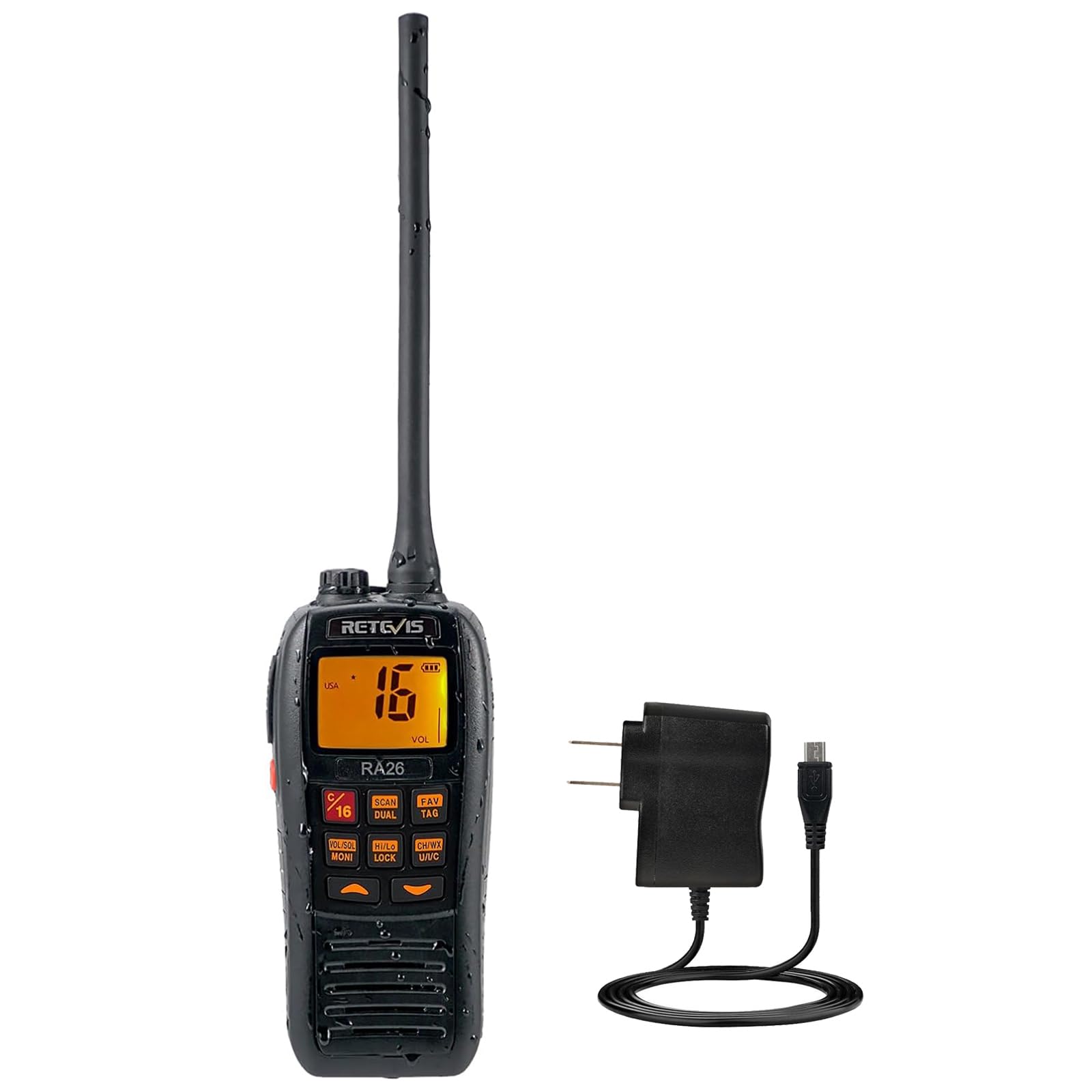
| Retevis RA26Budget Champion | Budget Kayaking | IP67 | 8 hours | 5W | Amazon |
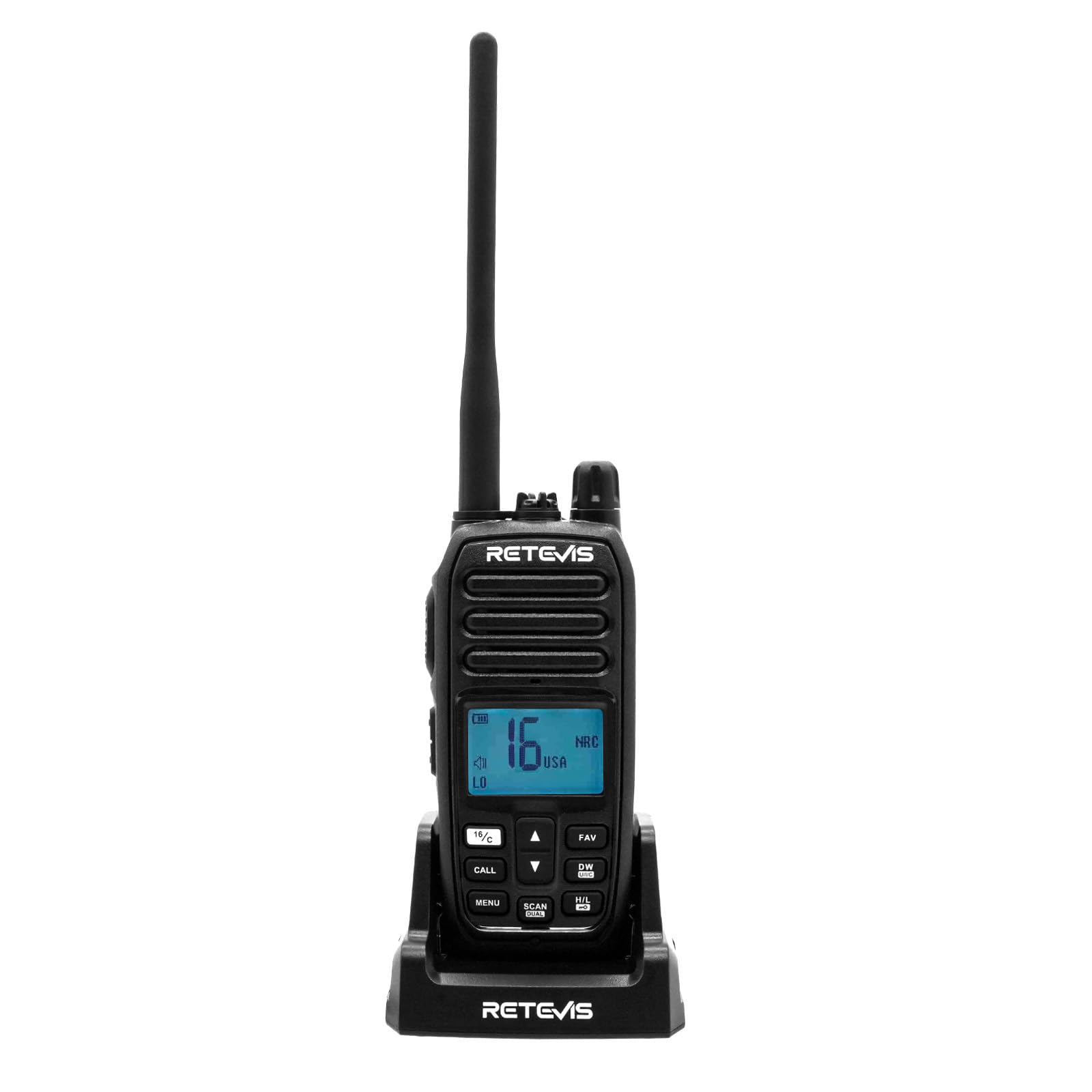
| Retevis RM21Noise Killer | Noise Cancellation | IP67 | 10 hours | 5W / 3W / 1W | Amazon |
| Standard Horizon HX210 | Compact Value | IPX7 | 1850 mAh | 6W / 2.5W / 1W | Amazon |
| Cobra BlueBound 350 | Lightweight Portability | IPX7 | 12 hours | 6W / 3W / 1W | Amazon |
| ICOM IC-M25 | USB Charging | IPX7 | 11 hours | 5W / 1W | Amazon |
| ICOM IC-M73 | Professional Build | IPX7 | 18 hours | 6W | Amazon |
| Standard Horizon HX890 | GPS & DSC | IPX8 | 10 hours | 6W | Amazon |
| Standard Horizon HX400 | Commercial Use | IPX8 | 10 hours | 6W | Amazon |
In‑Depth Reviews
1. Uniden Atlantis 275
Our pick — over 4.5★ from 500+ verified ratings; the strongest balance of quality and price.
This floating radio survives a pool test and keeps transmitting.
This is the radio owners trust when the spray gets serious, holding a 4.6-star crowd favorite status with the largest LCD in its class at 25mm high and 40mm wide. The screen switches between a paper-white backlight for daytime and a red one for night, so you never squint at the channel readout in any light. That big screen sits inside a body that meets the toughest waterproof standard around, rated IPX8 and JIS8, meaning it survives submersion deeper and longer than the IPX7 units on this list.
You get 6 watts of transmit power, but you can dial it down to 2.5W or 1W to save battery when you are just chatting nearby boats. It floats, and it even clears its own speaker of water after being dunked — a trick that reportedly kept it working after a full pool submersion while a rival Standard Horizon HX-890 sank and died. It pulls in all USA, Canadian, and International marine channels, including the newer 4-digit and Canadian “B” channels, plus every NOAA weather channel and alert. The 3-year warranty covers the waterproofing for the full term, which is rare confidence.
Reliability and sound quality are the two things owners praise most, with each getting 31 mentions in the review data. The main trade-off is the battery: it charges quickly and the radio is light, but some owners found the stock battery hard to replace and one belt clip broke within a month. That said, the emergency strobe light and built-in flashlight make this the easiest pick for anyone who wants one box that does everything.
Why It Wins
- Meets the toughest IPX8 waterproof standard and floats
- Dual-color LCD is the biggest in its class
- Full 3-year waterproof warranty included
- Selectable 6W, 2.5W, or 1W power output
Fair Caveats
- Replacement battery can be hard to source
- Belt clip durability drew mixed feedback
Reach for this if: you want the most rugged, feature-packed handheld that floats and carries a real waterproof warranty.
Think twice if: you plan to hot-swap spare batteries all day — the internal pack makes that awkward.
2. Retevis RA26
A featherweight 220g companion that fits a kayak day trip perfectly.
If you paddle a kayak or fish close to shore, this is the entry-level radio that owners keep coming back to. It weighs just 220 grams, about a quarter of the heft of the Retevis RM21 at 620 grams, so it disappears on a PFD strap. The 1500mAh battery is rated for 8 hours of average life, and as buyers report, it genuinely “lasts a day trip” on the water. Charging is via micro USB, which means no bulky dock cluttering your kitchen counter.
It is certified IP67 waterproof, surviving 30 minutes in 1 meter of water, and it floats if you drop it overboard. The radio covers 88 channels across US, International, and Canadian groups, plus NOAA weather alerts. The Dual and Tri-Watch functions let you monitor channels 9, 16, and a custom channel simultaneously, so you never miss a distress call while scanning. The backlit LCD automatically adjusts brightness for reading in direct sun or darkness.
Functionality is what wins people over here, getting the most owner mentions by far. The honest catch is range — feedback on how far it actually reaches is mixed, which is typical for a budget 5W handheld. It also lacks the noise-canceling tech of pricier units, so wind can bleed into transmissions.
Solid pick for: kayakers, dinghy sailors, and first-time buyers who want a floating, waterproof radio without spending premium money.
The trade-off: expect close-range performance and no advanced noise filtering — that is what the higher-tier models add.
3. Retevis RM21
The workhorse that filters engine roar down to a clear voice.
When your commute is a fishing boat deck with engines screaming, this is the radio that keeps you heard. The RM21 uses a one-press AI noise cancellation system to strip out engine noise, wind, and waves from your transmissions, and owners say the DSP filtering is better than units costing far more. It carries a beefier 1800mAh battery rated for 10 hours of operation and 60 hours of standby — a 20% capacity jump over the RA26’s 1500mAh — making it the longer-endurance sibling in this lineup. It is rated IP67 waterproof and floats, with a red flashing light that activates when the sensor hits water so you can spot it if it goes over the side.
The transmit power switches between HI/MI/LO at 5W, 3W, and 1W, so you can match output to your distance needs and stretch that battery. A battery saver mode further reduces power draw for all-day trips. It includes a dual-band watch with instant channel 16 access for emergency Coast Guard calls, plus NOAA weather alerts. The 7-color backlit LCD and included charging dock round out a package that feels more premium than its price suggests.
Functionality earns the most praise here with 22 owner mentions, and quality is close behind at 19. Reception gets its own positive mentions, with one owner noting the radio “is on 12 hours a day” and still holds a charge well. The main caveat is physical: at 620 grams, it is noticeably heavier — a 2.8x weight gap compared to the RA26 — so it is less ideal for long pocket carries. It is the pick for anglers and yacht crews who spend full days in noisy, wet conditions.
Standout Strengths
- One-press AI noise cancellation cuts engine and wind noise
- 1800mAh battery delivers 10 hours of operation
- Red flashing water alarm helps locate it if dropped
- Replaceable battery pack, rare in this class
Weight to Watch
- 620g is the heaviest in this lineup
- Scan mode stops on continuous weather broadcasts
Best suited to: offshore fishermen and yacht crews who need clear voice in engine noise and all-day endurance.
Look elsewhere if: you want a pocket-sized radio for a kayak — the RA26 is 400 grams lighter.
4. Standard Horizon HX210
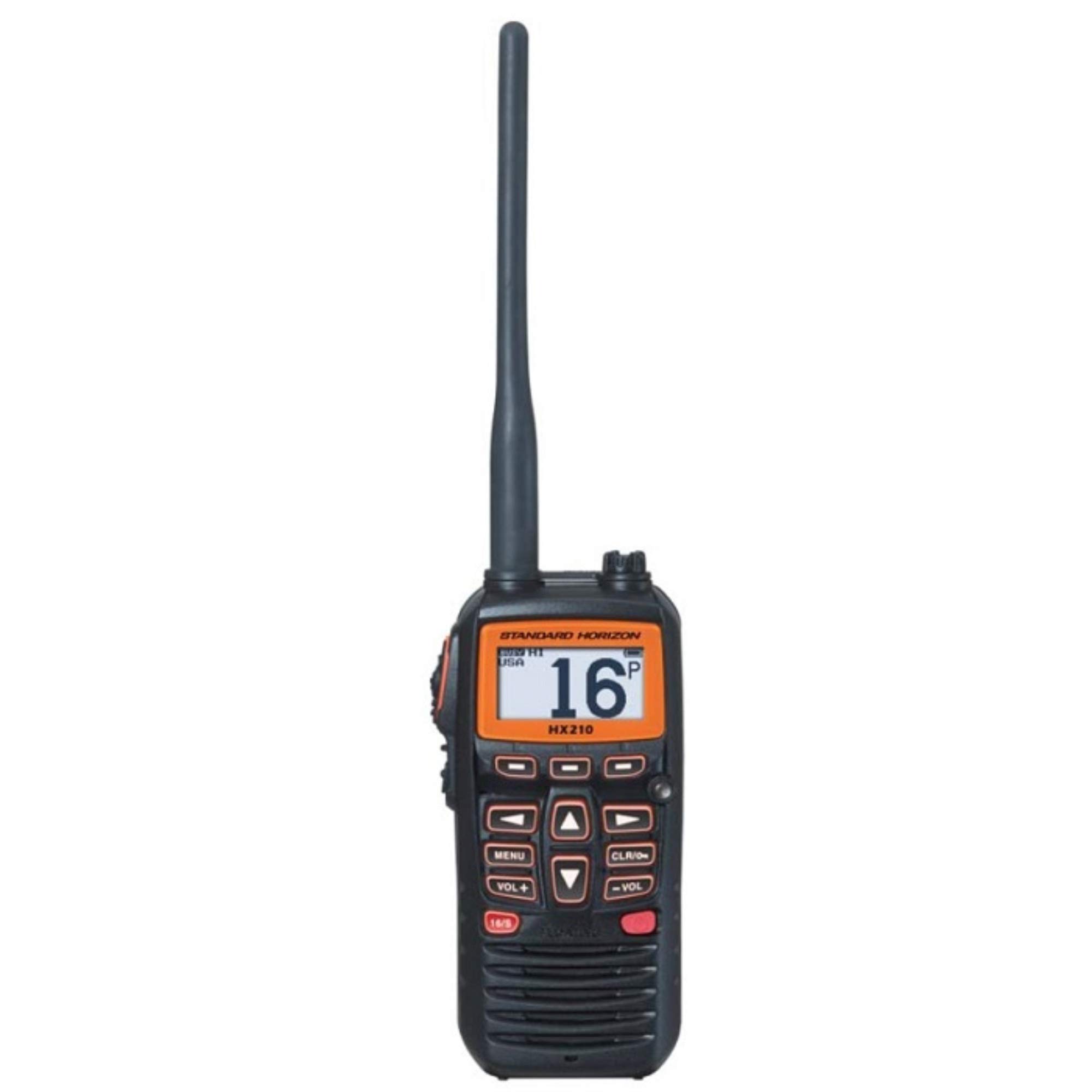
A Japanese-built pocket radio that packs surprising punch.
Owners consistently describe this one as a solid, reliable handheld that slips into a pocket and just works. It floats and carries an IPX7 rating, meaning it survives 30 minutes submerged at 1 meter, with a 3-year waterproof warranty behind it. Inside is a high-capacity 1850mAh Li-Ion battery — the same class as the pricier Uniden — and a 3-hour rapid desktop charger that works from both 12V DC and 110V AC. You get selectable 6W, 2.5W, or 1W output power, covering all USA, International, and Canadian channels.
what separates it is the built-in FM broadcast receiver covering 76MHz to 108MHz, so you can tune into music or news when you are not on the marine channels. The oversized dot-matrix display and E20 easy-to-operate menu system make it friendly for first-timers, and programmable function keys let you customize quick access. A water-activated emergency strobe light adds a safety layer if the radio goes overboard. At 16 ounces, it feels substantial but still pocket-friendly.
The value story is strong — it is built in Japan and often priced below the premium name brands while outperforming a Cobra in direct comparison, according to owners. The recurring gripe is the belt clip, which some found problematic on a lifejacket, and battery life draws mixed feedback with some reporting charging quirks. It is a great do-it-all for the sailor who wants a trustworthy spare or a primary radio for near-shore cruising, and owners note it is particularly handy in sailboat races.
Grabs it for: boaters who want a reliable, easy-to-learn radio with FM radio built in and a flexible antenna that stows small.
Keep in mind: the clip can fight a lifejacket, so a lanyard may be the better carry method.
5. Cobra BlueBound 350

A 9.44-ounce featherweight with modern USB-C juice.
For sheer portability, nothing here matches this one — it weighs just 9.44 ounces, making it the lightest unit in the lineup and an easy grab-and-go for any boat. It is built around a high-visibility orange floating core, so if it goes overboard you can spot it bobbing instead of sinking. The 6-watt output switches down to 3W or 1W, and the battery is rated for 12 hours of average life, the best runtime of any floating handheld here. It charges via USB-C, which is the modern standard you likely already have on your phone charger.
The display is day/night selectable, keeping channel readouts visible in bright sun and after dark. Tri-Watch mode lets you monitor channels 9, 16, and a user-specified channel at once — exactly what you want in busy waterways. It covers 98 channels total with NOAA weather alerts on 12 weather channels plus the emergency broadcast channel. The IPX7 rating means it handles full immersion, and the included lanyard, belt clip, and charger round out the package.
The maximum talking range is listed at 25 miles, though that depends heavily on conditions and antenna height. Owners describe it as a quality package that works as expected on the water, with good sound and easy portability between boats. The honest limit is that it is a newer model with fewer long-term ownership stories yet, so the reliability track record is still building. For the casual boater who wants the lightest, most modern-feeling handheld, this is a smart reach.
What Makes It Easy
- Lightest at 9.44 ounces, ideal for pocket or PFD
- USB-C charging with a 12-hour battery rating
- High-visibility orange floating core
- 25-mile maximum talking range
Newer Model Notes
- Fewer long-term owner reports so far
- Range on Canadian waters not yet confirmed by owners
Pick this for: boaters who switch vessels often and want the lightest radio with modern USB-C charging.
Hold off if: you need a proven multi-year track record — the older ICOM and Standard Horizon units have that history.
6. ICOM IC-M25

The rain-proof ICOM that keeps casting when others quit.
Here is the brand reputation buyers trust when they have been burned before. The IC-M25 is a compact 7.84-ounce handheld that floats and flashes when it hits water, so you can recover it from a dunking. It runs on a 5W/1W switchable output and delivers 11 hours of battery life, charging from any 5V USB socket — meaning a portable power bank can revive it on a long trip. The frequency range spans 156-174 MHz, covering the standard marine bands.
Owners specifically praise its rain performance, calling it reliable “rain or shine” when other radios develop water issues during casting. One owner noted it has survived three years of constant, frequent use. The ergonomics get high marks too, with a size that fits comfortably in a variety of hand sizes and easy squelch adjustments. Reception and overall quality both draw strong positive mentions, making it an easy radio to recommend for weather reports, with a one-button switch for weather channels.
The honest limit is range — it is a handheld, so owners note you need a fixed mount with a proper antenna for long-distance work. Battery life gets mixed reviews, with some finding it good and others wanting more. As a spare in a ditch bag or a primary for a small boat, though, it punches well above its size. The blue trim and solid ICOM build give it a premium feel that justifies reaching for it every trip.
Choose it for: kayakers and small-boat owners who want ICOM reliability with the convenience of USB charging.
Know before buying: long-range communication needs a fixed antenna setup, not any handheld.
7. ICOM IC-M73

A 20-year ICOM legacy condensed into a 6-watt powerhouse.
This is the professional-grade workhorse for those who refuse to compromise. It delivers 6 watts of transmit power — the highest output class on this list — and tops the chart with an 18-hour battery life rating, the longest of any handheld here. The frequency range covers 156.025-157.425 MHz, and it is waterproof and submersible, ready for the roughest conditions. It weighs 320 grams and uses an easy-to-hold hourglass design that fits a gloved hand naturally.
Quality is the thing owners praise most, with 26 mentions, and functionality follows close behind at 21. A long-time ICOM user notes two of their handhelds are approaching 20 years old with only battery replacements needed — a durability story few brands can match. The desktop charger with cigarette lighter adapter means it charges in the car or at the dock. An optional speaker/mic is available for noisy environments, and the compact size, at just 1.2″D x 2.1″W, is smaller than most owners expect before it arrives.
It is not without quirks: the display lacks a backlight, so night use needs a flashlight, and complex features like channel scanning require the manual. The build is solid and the basic operations are straightforward. For the commercial boater or serious offshore angler who wants a radio that simply never quits, this is the one. The price reflects the ICOM name, but so does the longevity.
The Professional Edge
- 18-hour battery life leads the entire lineup
- 6-watt output with a compact hourglass grip
- Proven multi-decade reliability from ICOM users
- Charges via desktop cradle with car adapter
Missing Conveniences
- No display backlight for night operations
- Advanced features require reading the manual
Reach for it if: you need maximum battery endurance and professional-grade build for commercial or serious offshore use.
Choose another if: you boat mostly at night — the unlit display is a real drawback in the dark.
8. Standard Horizon HX890

A GPS distress beacon and radio fused into one floating unit.
When you are kayaking far from shore, this radio answers the question “what if something goes wrong?” It packs a built-in GPS receiver that powers a DSC distress button — one press broadcasts your exact position to nearby vessels and the Coast Guard, a feature no other handheld on this list matches. The MOB (Man Overboard) function and GPS navigation display make it a genuine emergency tool, not just a communication device. It floats with a strobe light, is waterproof, and carries a 10-hour battery rating on a 6-watt output.
Owners who kayak and sail trust it for its tough build and water resistance, with GPS capability earning its own positive mentions. The battery is replaceable, and it even accepts a 5xAAA adapter as a backup power source — a clever redundancy. It charges fully in about 3 hours, and the FM receiver is a bonus for entertainment when you are off the marine channels. The frequency range spans the full marine band, and the 2-pound weight includes the high-capacity LiPo battery.
The honest criticism from owners is range — like all handhelds, it is limited to a few miles, best for near-shore use. Battery charging also gets mixed feedback, with some reporting quirks. But for the paddler who wants GPS distress signaling as a safety net, this is the definitive choice. The MMSI programming is straightforward, and owners note it is simple to set up with free MMSI registration through organizations like the Power Squadron.
Ideal for: kayakers, sailors, and anyone who wants GPS-based distress signaling in a floating, waterproof package.
Set expectations: surface range is limited to a few miles — it is a near-shore safety tool, not an open-ocean powerhouse.
9. Standard Horizon HX400
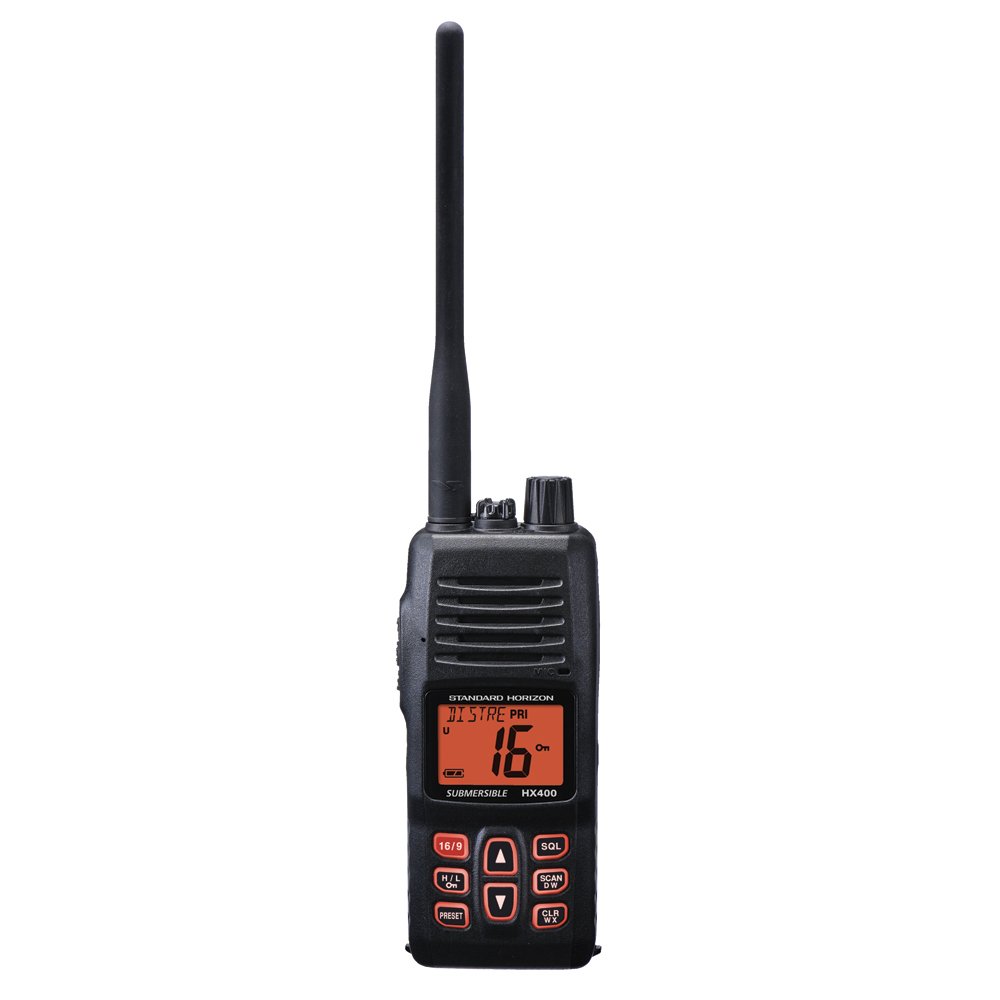
A commercial-grade workhorse that doubles as a programmable LMR radio.
This is the specialists’ choice — a radio that works the marina by day and can be reprogrammed for business frequencies by night. It is a simple, reliable workhorse that owners describe as consistently dependable in harsh marine conditions like rain and drops. The HX400 is submersible and carries a 10-hour battery life rating, with owners reporting the battery lasts so long they only recharge about weekly. The drop-in charger base makes dock-side charging easy.
The defining feature is its programmability: using the optional YCE13 software and USB-57B cable, you can remove unused VHF channels, add HAM or business frequencies with tone squelch, and customize channel names. It even includes a built-in scrambler for private communication. The frequency range spans 134-174 MHz, wider than standard marine-only radios, which is why commercial crews and workboat operators gravitate to it. Owners pair it with the CMP460 speaker/mic for noisy decks, and it performs well in that setting.
Quality leads the positive mentions at 11, with reliability close behind. The physical volume knob is a favorite over button-based controls, and the build feels solid. The catch is programming — it is difficult without dealer knowledge, and the hand mic’s earpiece cover can dislodge, risking water intrusion. Scan mode also stops after transmit and needs a manual restart, which some owners find annoying. For the commercial operator who needs a versatile, tunable radio, this versatility is worth the learning curve.
The Versatile Edge
- Programmable for VHF, HAM, and business frequencies
- Built-in scrambler for private channels
- Long battery life, recharge about weekly
- Physical volume knob preferred over buttons
Learning Curve
- Programming requires optional software and cable
- Hand mic earpiece cover can dislodge
Meant for: commercial crews, workboat operators, and radio hobbyists who need channel programmability beyond marine bands.
Not the pick if: you want plug-and-play simplicity — this one rewards owners who read the manual.
Understanding the Specs
Waterproof Ratings
IPX7 means a radio survives submersion in 1 meter of water for 30 minutes. IPX8 is a step tougher, handling deeper and longer submersion. If you boat in rough water or kayak where a dunking is likely, the floating designs with these ratings are the ones that keep working after a spill.
Battery Capacity and Runtime
Battery life is measured in mAh (milliamp-hours, a measure of energy storage) and hours of average operation. A 1800mAh battery rated for 10 hours outlasts a 1500mAh unit rated for 8 hours on a full day trip. Charging matters too — USB-C and 5V USB are convenient for power banks, while drop-in cradles are more sturdy for constant dockside use.
FAQ
What does IPX7 waterproof mean on a VHF radio?
How long does a VHF handheld battery last?
Should I get a radio that floats?
Is a 6-watt radio better than a 5-watt radio?
What is a NOAA weather alert on a marine radio?
Can I use a marine VHF radio on land?
What is DSC and do I need it?
How do I charge a VHF handheld on a boat?
Final Thoughts: The Verdict
For most people, the vhf handheld radio winner is the Uniden Atlantis 275 because it pairs the toughest IPX8 waterproof rating with a floating design, a dual-color screen, and a full 3-year waterproof warranty. If you want long-range GPS distress signaling, grab the Standard Horizon HX890. And for a budget-friendly entry that floats and charges via micro USB, the Retevis RA26 is the one to reach for.
How We Picked
We do not accept paid placement. Every pick is matched to a real buyer and a real use-case; we do not hands-on test units.
Sources & Methodology
Specifications: manufacturer listings and product documentation. Review insights: verified customer reviews, as of August 2026. Pricing: not shown on this page (it changes often); check the current price via the retailer link.
As an Amazon Associate, GoCarLife earns from qualifying purchases. This does not affect which products we feature.