
Our readers keep the lights on and the garage heater humming. As an Amazon Associate, I earn from qualifying purchases.
Specs are compiled from manufacturer listings and verified buyer reviews and can change over time — please confirm the key details on the product page before buying.
You want that unmistakable Ah-Ooooo-ga blast that turns every head on the dock or the boulevard. The right vintage boat horn delivers that classic 1930s car sound, but the real question is which one survives a season of salt spray and enthusiastic use. This guide breaks down the two best vintage-style OOGA horns on the market, focusing on sound character, installation reality, and the durability that actually matters on the water.
I’m Mo Maruf — the founder and writer behind GoCarLife. This guide is built by comparing the manufacturers’ published specifications and the patterns across verified customer reviews, so you get each pick’s real strengths and trade-offs instead of marketing spin.
You get the classic “ah-ooga” sound you want, but first decide how loud you need it and how much wiring you are willing to tackle. That choice drives which vintage boat horn fits your restoration or modern runabout.
Quick Picks
- Vixen Horns Ahooga Horn (VXH1002R) — Classic Tone
- FARBIN Vintage OOGA Horn with Button — Loudest Blast
How To Choose The Best Vintage Boat Horn
The vintage boat horn market splits into two philosophies: one prioritizes pure, attention-grabbing volume with a raspy mechanical tone, while the other leans into a cleaner, more authentic old-car “ahoooogah” character. Your choice shapes how people hear you coming across the water, so it pays to match the horn’s personality to your boat and your tolerance for installation fiddling.
Decibel output matters more on water
On open water there are no walls to bounce sound off, so the raw loudness rating does the heavy lifting. A 120 dB horn pushes a sharper, more piercing note that can cut through wind and engine noise, while a 110 dB unit delivers a mellower call that still startles pedestrians and gets attention at the dock. Both are well above talking volume, but the gap matters if you boat in busy harbors.
Compressor vs. tank makes installation simpler
The biggest myth about vintage horns is that you need a bulky air tank and complex plumbing. Most modern OOGA horns pack a maintenance-free electric air compressor right into the housing, so you just mount the horn, connect 12V power, and press the button. That single design choice eliminates the old-school headache of sourcing air lines and checking tank pressure.
Quick Comparison
In‑Depth Reviews
1. Vixen Horns Ahooga Horn (VXH1002R)

The red horn that nails the 1930s Ah-Ooooo-ga and makes everyone on the dock laugh.
This Vixen Horns unit delivers the distinctive old car “Ah-Ooooo-ga” sound at 110 dB, which buyers report turns heads and startles pedestrians exactly as intended. Its red finish and compact 10 x 12 x 9 inch body deliver an authentic antique look., while the integrated maintenance-free air compressor means you never hunt for an external air tank or extra plumbing.
Installation is the thing owners praise most — the one-bolt mount design and included wire leads make it an easy plug-in job, especially on golf carts and classic vehicles like a 72 Baja Bug. That easy mounting pairs with a full 1-year warranty covering all parts, so you get a solid safety net if anything fails early.
Here is the honest trade-off: this horn is quieter than the FARBIN, at 110 dB versus 120 dB, so it suits dockside signaling more than open-water blasts. The mechanical OOGA design uses a friction diaphragm (a moving part that rubs to create the sound) that wears out over time. Some owners mention the horn dying after about six weeks of normal use, while others fix it with a simple adjustment. If you want that “gah” drop at the end of the note — close to a real Model T sound — this delivers it, but watch reliability across the review pages.
Where it wins
- Authentic “ahoooogah ahooga” sound loved for its classic character
- One-bolt mount and included wire leads make install genuinely simple
- Integrated maintenance-free compressor, no air tank needed
- 1-year warranty on all parts
Where it stumbles
- Some units stop working after roughly six weeks of normal use
- Friction diaphragm wears out and needs periodic adjustment
- Quieter than its main rival at 110 dB
Reach for it if: you want the most authentic old-car tone and want the easiest possible one-bolt install on a golf cart, classic car, or small boat.
Think twice if: reliability is your top priority — the recurring complaint is early failure, so treat it as a fun accessory rather than a lifetime component.
2. FARBIN Vintage OOGA Horn with Button
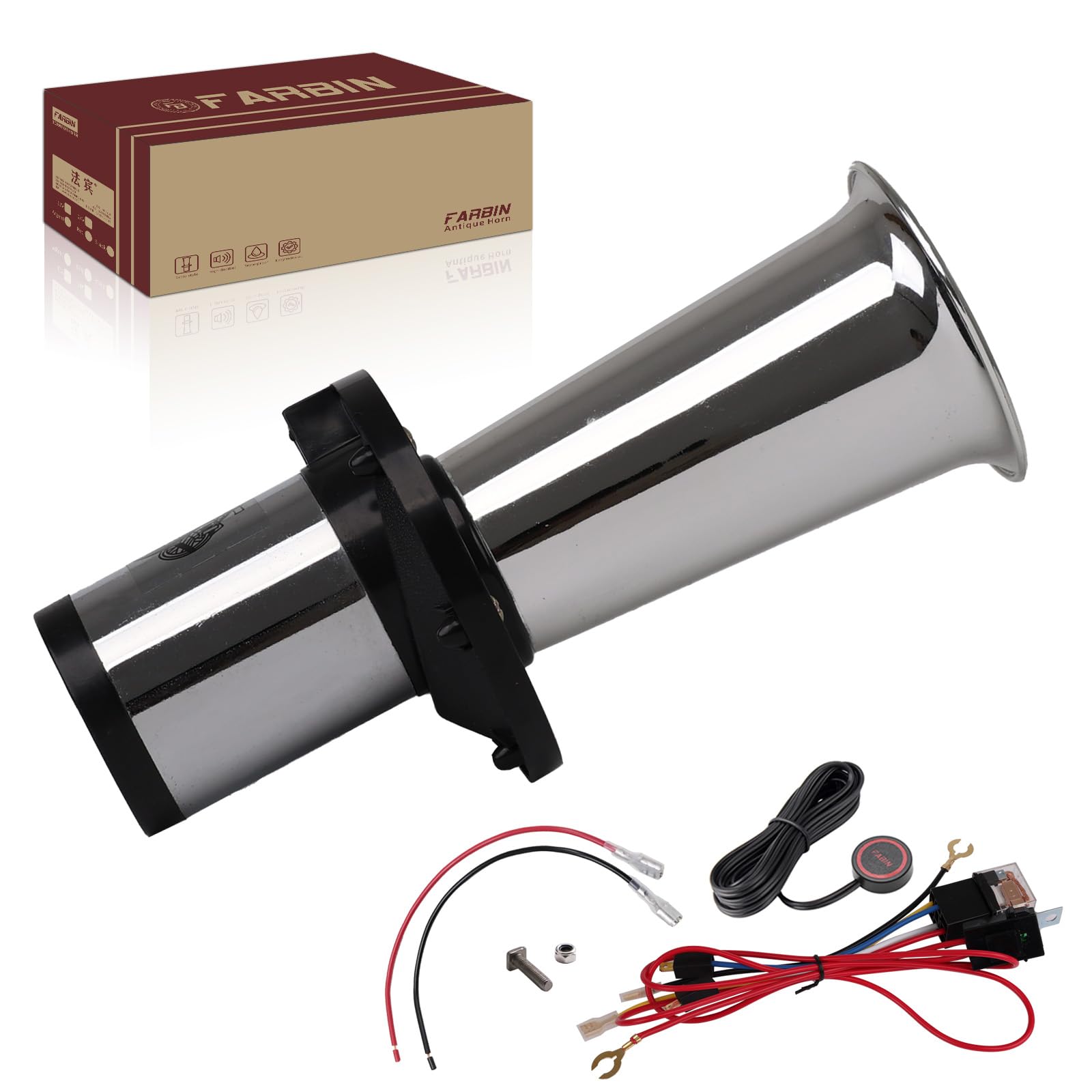
The chrome scream-machine that fires a 120 dB blast loud enough for open water.
If sheer volume is your priority, this FARBIN kit tops the class at 120 dB — versus the Vixen’s 110 dB — and buyers confirm it “definitely screams” the moment you hit the button. The chrome-plated polymer tube looks the part of a vintage horn while the vacuum chrome-plated compressor housing keeps the whole package solid and weather-resistant for varied temperature environments.
The kit arrives with relay wiring harnesses and a button, plus wiring instructions with color diagrams, so it is built to be wired manually into any 12V vehicle. FARBIN markets it broadly for trucks, SUVs, pickups, yachts, jeeps, and engineering vehicles, which makes it the more versatile choice if you plan to move it between a boat and a tow vehicle. An internal long red copper coil drives fast response without a bulky air cylinder.
The honest catch involves the wiring. Customers note the instructions made “absolutely no sense” and that no connecting wire was included to tie the new horn into the existing horn wire, so a DIY install could take longer than you expect. Quality feedback is otherwise strong — “very good quality” and “works great” appear repeatedly — but verify your wiring plan before you start if you are not comfortable reading a basic relay diagram.
Volume first: This is the louder pick at 120 dB, which gives it the edge for cutting through wind and engine noise on open water.
Wiring reality: The included harness and button are a plus, but the confusing instructions and missing connector wire are a real hurdle for novice installers.
Best for: boaters and truck owners who want maximum warning volume and are comfortable handling basic relay wiring themselves.
skip it if: you want a true plug-and-play setup — the wiring documentation may leave you figuring out the connections on your own.
Understanding the Specs
Noise Level (dB)
Decibels measure how loud the horn blasts, and the scale is not linear — a jump from 110 to 120 dB is a noticeably sharper, more piercing note. On open water, that extra punch helps the sound travel farther without bouncing off walls. The Vixen sits at 110 dB while the FARBIN pushes 120 dB, so the FARBIN wins the volume battle.
Integrated Air Compressor
Both horns draw air from a built-in maintenance-free electric compressor rather than an external tank. That means no bulky cylinder, no air lines to route, and no pressure checks — just power, mount, and press the button. The FARBIN’s compressor uses a long red copper coil for fast response, while the Vixen relies on a high-efficiency permanent motor.
FAQ
Do vintage boat horns need an air tank?
Will a 12V horn work on my boat’s electrical system?
How loud is 120 dB compared to 110 dB?
Why does my OOGA horn stop working after a few months?
Is the FARBIN horn hard to install?
Can I mount a vintage horn on a golf cart?
Which vintage horn sounds closer to a real Model T?
Are these horns weather-resistant for marine use?
Final Thoughts: The Verdict
For most boaters, the vintage boat horn winner is the Vixen Horns Ahooga Horn because it nails the authentic 1930s tone with a fuss-free one-bolt install that suits a dock-side DIY project. If you want maximum warning volume and a chrome look that pops on a tow vehicle or yacht, grab the FARBIN Vintage OOGA Horn. And if reliability is your top worry, keep your expectations measured on both — these are fun, characterful additions built around that classic Ah-Ooooo-ga charm, not forever components.
How We Picked
We do not accept paid placement. Every pick is matched to a real buyer and a real use-case; we do not hands-on test units.
Sources & Methodology
Specifications: manufacturer listings and product documentation. Review insights: verified customer reviews. Pricing: not shown on this page (it changes often); check the current price via the retailer link.
As an Amazon Associate, GoCarLife earns from qualifying purchases. This does not affect which products we feature.