
Our readers keep the lights on and the garage heater humming. As an Amazon Associate, I earn from qualifying purchases.
Specs are compiled from manufacturer listings and verified buyer reviews and can change over time — please confirm the key details on the product page before buying.
That split-second of silence when you turn the key — no crank, just a dashboard flicker — is the exact moment a dead car battery announces itself. A voltmeter for car battery testing turns that panic into a five-minute diagnosis, telling you whether to charge, replace, or start shopping for an alternator instead. This guide breaks down the testers that actually read a 6V or 12V system clearly, so you stop guessing and start knowing.
I’m Mo Maruf — the founder and writer behind GoCarLife. This guide is built by comparing the manufacturers’ published specifications and the patterns across verified customer reviews, so you get each pick’s real strengths and trade-offs instead of marketing spin.
You need a meter that tells you whether your car won’t start because of a dead battery or a failing alternator. This guide covers the top-rated voltmeter for car battery systems, explains which type suits your garage, and shows you how to read results that reveal a bad cell versus a dead alternator.
Our Picks at a Glance


How To Choose The Best Voltmeter For Car Battery
Your choice depends on how deep you want to diagnose. A simple voltage check tells you the current charge level, but a true battery analyzer measures the battery’s ability to deliver power — the part that actually fails as the battery ages.
Voltage Check vs. Load Test
A digital voltmeter shows you the surface charge, which can look healthy even on a dying battery. A load tester pushes current through the battery to simulate the starter’s draw, revealing weak cells that a simple voltage read misses.
Understanding CCA (Cold Cranking Amps)
CCA measures how much current a battery can deliver at freezing temperatures to start an engine. Testers with a CCA range like 100–2000 cover nearly every car, truck, and marine battery, letting you compare the reading against the number printed on your battery’s label.
Battery Chemistry Compatibility
Modern cars often use AGM (absorbent glass mat) or gel batteries, not just standard flooded lead-acid. If your vehicle has one of these, you need a tester that explicitly lists AGM flat plate, AGM spiral, or gel support in its specs — otherwise the reading won’t be accurate.
Quick Comparison
| Model | Best For | CCA Range | Battery Types | Display | Amazon |
|---|---|---|---|---|---|
| OBDResource BR502★ Best Overall | Full health analysis | 100–2000 | Flooded, AGM, Gel | 1.8-inch HD | Amazon |
| MOTOPOWER MP0514BBest Value | Simple battery & alternator check | — | 12V only | 4-digit LCD + LEDs | Amazon |
| Linkstyle GaugeInstall & Forget | Permanent dash install | — | 12V/24V | LED Digital | Amazon |
| TopDiag BT300 | Multi-standard testing | 20–2000 | Flooded, AGM, Gel | Backlit LCD | Amazon |
| Stetsom MiniVT | Compact audio-system monitoring | — | 7V–30V | 3-digit Blue LED | Amazon |
| Taramps VTR 1000 | Car audio voltage monitoring | — | 10V+ DC | Red LED | Amazon |
| Yaegoo Load Tester | Heavy-duty load testing | Up to 1000 | 6V & 12V | Analog gauge | Amazon |
| KAIHENG CSY-4 | Basic budget load testing | — | 6V & 12V | Analog gauge | Amazon |
| KAIWEETS KVB02 | Color display diagnostics | 50–2000 | Flooded, EFB, AGM, GEL | 2.68-inch Color | Amazon |
In-Depth Reviews
1. OBDResource BR502 Battery Tester
Our pick — over 4.5★ from 950+ verified ratings; the strongest balance of quality and price.
The pocket analyzer that tells you replace-or-charge in under two seconds.
Clip on the BR502 and its 1.8-inch HD screen gives you a clear verdict — “Good,” “Normal,” or “Poor” — in about two seconds, so you skip the guesswork of needle swings. This voltmeter for car battery systems reads a full health profile: SOH (state of health, or how much life is left), SOC (state of charge, or how full it is), internal resistance, and CCA (cold cranking amps, the power to start in cold weather) across a 100–2000 range, covering cars, SUVs, boats, and motorcycles.
The “plug and play” design is genuinely beginner-friendly, and it handles 6V, 12V, and 24V systems including flooded, AGM flat plate, AGM spiral, and gel batteries. If you accidentally reverse the clips, the polarity protection stops the unit from firing, so you won’t burn out the internal circuit — a real safety net for first-timers.
Buyers report that the cables stay flexible even in cold weather, which makes winter testing far less frustrating. One owner caught a failing battery this way: “In my case voltage was ok but the Amp draw was bad” — the tester flagged the true problem that a simple voltage read would have missed.
What Wins People Over
- Functionality is the most-praised trait, with dozens of owners calling out how well it does the core job
- Ease of use is a close second — intuitive operation for beginners
- Performs comparably to pricier units, per multiple owner accounts
The Honest Trade-offs
- The lowest CCA setting is 100 Amps — it won’t test tiny batteries below that
- Accuracy gets mixed feedback, with one owner seeing big CCA reading differences
- Instructions could be clearer for absolute novices
Reach for this if: you want a full battery health report — not just voltage — for any vehicle in the driveway, and you want it in about two seconds.
Look elsewhere if: you need to test small batteries under 100 CCA, like some lawn mower or motorcycle batteries.
2. MOTOPOWER MP0514B Tester
The plug-and-test meter that checks both the battery and the alternator in one go.
This one is beautifully simple. Before you start the car, the 4-digit LCD shows your battery’s resting voltage with accuracy up to 0.01 volts. Then you start the engine and the 8 colored LED indicators tell you whether the alternator is charging properly — a two-step dance that catches the most common electrical failures.
The testing range spans 4 to 20V DC, so it’s not just for 12V car batteries; you can check other devices too. A 50cm extension cable with 30A alligator clips makes reaching awkward battery terminals easy. Weighing only 150 grams with a black rubber paint finish, it’s light and grippy in the hand, and easy to keep in the door pocket.
Owners repeatedly call it basic but effective — one noted it performs as well as a tester from a national auto parts chain for a fraction of the hassle. The clarity of the dual voltage-plus-LED display is the standout feature for readability.
The Two-Step Check: battery first, alternator second — the LEDs make the verdict instantly readable without any interpretation.
Keep In Mind: battery life gets occasional negative feedback, and the 4–20V range means you can’t test 24V truck systems.
Choose this for: the everyday driver who wants a clear battery-or-alternator answer without learning battery standards.
Not for you if: you run 24V vehicles or want detailed CCA ratings — this one just gives you the voltage and a simple health verdict.
3. Linkstyle Battery Voltage Gauge
A permanent dash-mounted gauge that tracks voltage and charge percent at a glance.
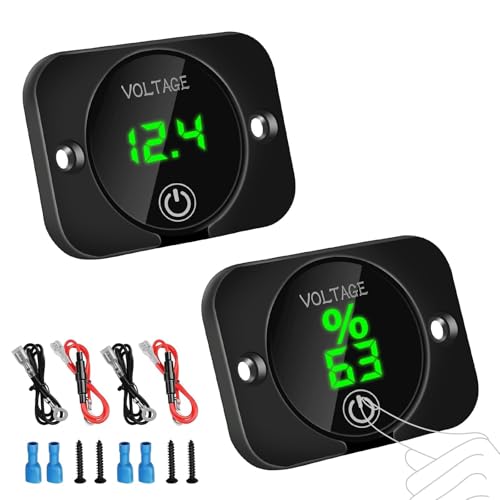
Unlike handheld testers you clip on and pull off, this 2-in-1 gauge mounts permanently and monitors in real time. The DC 6-30V test range with ±0.1V accuracy handles 12V and 24V vehicles, and a touch switch lets you flip between live voltage and battery percentage — or turn the display off to save power while stored.
An IP65 waterproof rating and a 10A fuse for overload and short-circuit protection make it safe for exposed installs on boats, motorcycles, ATVs, and golf carts. Owners say it powers on and off with the ignition, which is exactly what you want from a permanent gauge — no draining the battery while parked.
The percentage readout is the catch. Owners mention it’s not consistent across battery sizes — a 12V 8Ah LiFePO4 might show 100% while a 12V Li-ion reads 75% when full. The voltage readout is the reliable one; treat the percentage as a rough guide.
Best for: RVs, boats, and solar setups where you want constant battery awareness, not periodic testing.
The Fixture Flaw: percentage accuracy varies by battery type — trust the voltage number, not the percent.
Go with this if: you want a low-maintenance monitor that wakes up with the ignition.
Think twice if: you need lab-grade percentage accuracy across multiple different battery chemistries.
4. TopDiag BT300 Battery Load Tester
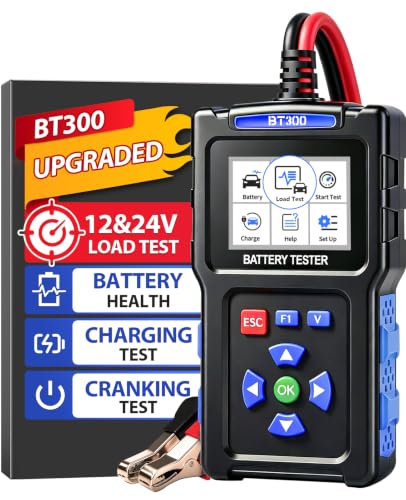
The professional-grade analyzer that speaks every battery standard up to 2000 CCA.
Professionals will appreciate the BT300’s universal compatibility. It tests batteries from 20–2000 CCA (cold cranking amps) across standards like CCA, JIS, GB, SAE, MCA, CA, DIN, IEC, EN, and BCI — so it reads the codes on virtually any battery worldwide, from a motorcycle to a fleet truck.
You get both a quick test and a standard test, plus cranking and charging system checks. The SOH (state of health) and SOC (state of charge) readings take about 10 seconds. A backlit LCD and one-button operation keep it approachable, and it supports seven languages including English, Spanish, French, and German.
One distinction: it’s powered by the car battery itself — the USB port is only for software updates, not charging. It’s not compatible with 6V systems or lithium batteries, so check your battery type first.
The Pro Toolkit
- Functionality is praised by the most owners — it’s the #1 discussed aspect
- Ease of use ranks second; the one-button design works for DIYers
- Software updates via USB keep it current
The Pro Caveats
- Accuracy gets mixed feedback — some customers note CCA off by about 30%
- 6V batteries and lithium packs won’t work here
Perfect for: multi-vehicle households or small shops that need one tool for every battery standard.
skip it if: you only own a standard 12V car — the KAIWEETS below offers a color screen for simpler needs.
5. Stetsom MiniVT Voltmeter

The thumbnail-sized monitor audio enthusiasts wire straight to the amplifier.
This is not a diagnostic tool — it’s a dedicated baby monitor for your car audio system. The 3-digit blue LED readout tracks real-time voltage so you can watch for drops when the bass hits. It measures DC voltage from 7V to 30V, which comfortably covers a 12V system under load.
It weighs just 12.8 grams, so it mounts nearly anywhere with minimal wiring effort. Owners are using it on amplifiers, lithium battery banks, and on a Chinese mini excavator — proof of its versatility in 12V and 24V applications. The remote-power feature ties it to your audio system’s turn-on lead.
Quality and installation are the most-praised traits, with owners calling it easy to read at a glance. Note that “high accuracy” is a marketing claim — several owners say it’s not the precision instrument the listing implies — but for monitoring voltage trends, it’s ideal.
Built For: car audio guys who want constant voltage telemetry on the amplifier, not a full battery health report.
Size Reality: it’s genuinely tiny — one owner called it “a little too small,” but that’s the point of the MiniVT.
Get this if: you run amps or lithium batteries and want a live voltage readout in a tiny footprint.
Look past it if: you need load testing or battery health percentages — this only shows voltage.
6. Taramps VTR 1000 Voltmeter
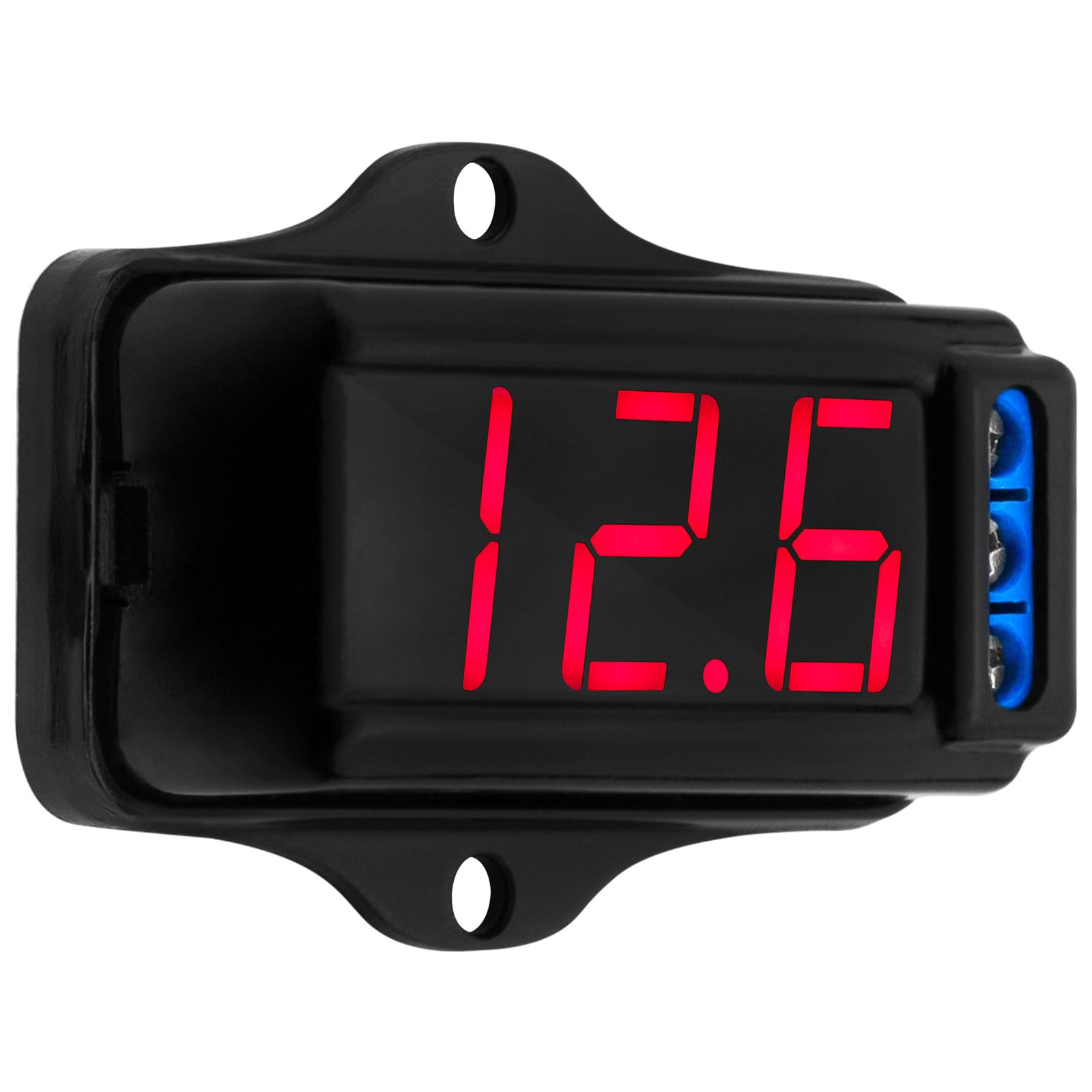
The car-audio favorite that keeps a cool, calm red eye on your system’s voltage.
From the respected Brazilian audio brand Taramps, the VTR 1000 is a no-frills voltmeter for keeping tabs on electrical voltage. The red LED display is intentionally not overly bright — owners specifically praise it as easy to read without being distracting at night. It runs on 10V DC minimum, so it sits comfortably on a 12V automotive system.
The unit is small — about 2 x 3 x 1 inches — and mounts anywhere with minimal fuss. It’s built for car audio monitoring, giving you a constant read on whether your voltage is sagging under heavy bass load. The “miniature” footprint makes it easy to place in a dash or A-pillar pod.
It’s accurate, but not real-time. One owner comparing it to a bass knob noted the refresh rate is slow — about a whole second — so it’s a monitor, not a live telemetry tool. SPL competitors note the mounting holder can pop off under heavy vibration, a fixable quirk with zip ties.
The Vibe: clean, simple, and functional — a no-nonsense voltage monitor for the audio crowd.
The Feedback: love the dim red display; leave it if you need instant refresh rates.
Choose this for: a discrete, readable voltage monitor in your car audio setup that won’t blast your eyes at night.
Not for you if: you want instant-response voltage data for hardcore SPL competition builds.
7. Yaegoo Car Battery Load Tester

The classic analog load tester that old-school mechanics still trust.
This is the classic load tester — a rugged box with an analog gauge and a big switch that dumps a real 100 Amp load on a 12V battery (or 50 Amp on 6V) to mimic what the starter draws. It tests 6V and 12V batteries up to 1000 CCA (cold cranking amps), with voltage accuracy of ±0.2V, so you see how the battery behaves under stress.
The build is properly heavy-duty: a perforated ventilated case to avoid overheating, an insulated carry handle, and copper clips with red/black rubber grips for clear polarity. It handles car, truck, RV, motorcycle, and boat batteries up to 1000 CCA, and the load switch simulates starter motor draw so you can see if the battery holds up under real strain.
Reliability is the most-praised aspect — owners say it performs just as well as testers that cost far more, with one noting it helped diagnose a failing starter before it stranded them. One owner flagged a minor build gripe: the meter was poorly attached on arrival, fixed easily with silicone adhesive.
Why It Wins: reliability — this is the tool ex-auto-parts-store managers reach for, outperforming its price bracket.
Watch Out: an occasional unit has a loosely attached meter face; check it on arrival.
Grab this if: you want a true load test — not just voltage — and prefer a tactile analog gauge over digital menus.
Ignore if: you want digital health percentages or CCA analysis screens; this shows a simple needle verdict.
8. KAIHENG CSY-4 Battery Load Tester

The no-frills load tester that’s been the garage standard since batteries existed.
This is the classic “hold the load for up to 10 seconds” tester. A 100 Amp fixed load current for 12V batteries (50 Amp for 6V) simulates starter motor consumption by draining current through the resistive coil, and the analog gauge shows how the voltage holds up under that strain. It works on cars, trucks, SUVs, motorcycles, RVs, boats, and golf carts.
Buyers call it “basically simple to use” — the design has been around for decades, and self-explanatory operation means you rarely need the manual. It’s a DIY staple for quickly telling good from bad battery condition, with red/black rubber-gripped copper clips for a safe terminal connection.
The honest trade-off is durability. Multiple reviewers point out the tester breaking within 7 months, and the clamps falling off — the physical strain of the load test is tough on cheap construction. But its ability to catch a battery that shows 12.3V at rest yet fails under load (one owner’s exact golf cart scenario) makes it a valuable diagnostic ally.
Where It Shines
- Functionality is the most-discussed aspect — it does the core load test job right
- Ease of use is a top trait; simple to use knob-and-clip design
- It saved one owner the cost of an unnecessary new battery
The Reality Check
- Durability is the top negative — units breaking within 7 months
- Clamps are a weak point, with several owners reporting them falling off
Buy it for: cheap, no-fuss load testing on multiple vehicles without learning digital menus.
You’ll need: a gentle hand and realism about durability — treat the clamps carefully and it will serve.
9. KAIWEETS KVB02 Battery Tester
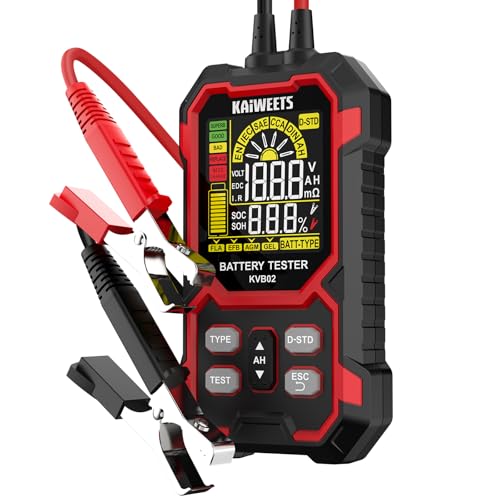
The color-screen analyzer that’s readable in direct sunlight and backed for three years.
This tester attacks the biggest flaw of budget digital units: a hard-to-read screen. The 2.68-inch color display stays clear even in direct sunlight, a feature owners explicitly praise for reducing eye strain. It’s a full diagnostic tool reading SOH, SOC, voltage, resistance, and CCA across a 50–2000 range for standard, EFB, AGM, and GEL batteries.
The build is durable — a TPE+ABS case that resists drops and impacts — and the Kelvin 4-wire clamps minimize contact resistance for precise readings. A 4-in-1 safety system guards against reverse polarity, short circuits, overcurrent, and overvoltage. It’s powered by your car battery, so no internal batteries to replace, and it ships with a 3-year warranty.
Functionality and quality are the two most-praised aspects, with one owner noting it’s surprisingly accurate for the price. The recurring complaint is the instruction manual — novices find it tough to get started without better guidance, and the multi-step menu requires some learning.
The Big Win: that color display — genuinely readable in bright light, and the rugged case survives shop use.
The Learning Curve: the manual lacks detail for novices; power users will fly through the menus.
Reach for this if: you want a modern color analyzer for 12V/24V fleets with a warranty that outlasts the tool.
Pass if: you want zero learning curve — the MOTOPOWER above is more instant-information.
Understanding the Specs
CCA Range & Battery Types
CCA (cold cranking amps) is the number that matters most for winter. A tester with a range like 100–2000 CCA reads the cold-start power of nearly any car or truck battery, and it should match the CCA figure printed on your battery’s label. Battery chemistry matters too — AGM, gel, and standard flooded batteries need a tester that explicitly supports their type for an accurate reading.
SOH, SOC & Load Testing
SOH (state of health) tells you how much life the battery has left, while SOC (state of charge) shows current charge level. A plain voltmeter only gives you SOC — a dying battery can show a full charge. A load tester pushes current through to mimic the starter’s draw, exposing weak cells. For a complete picture, you want a unit that measures both voltage and cranking health.
FAQ
What is the difference between a voltmeter and a battery load tester?
What is a good voltage reading for a car battery?
What does CCA mean on a battery tester?
Can a voltmeter tell if my alternator is bad?
Will a car battery tester work on my AGM battery?
How often should I test my car battery?
What is the difference between SOH and SOC?
Can I test a 24V truck battery with these testers?
Do I need a battery tester if I have a multimeter?
What should I do if my tester shows my battery needs replacement?
Final Thoughts: The Verdict
For most drivers, the best voltmeter for car battery health is the OBDResource BR502 — it delivers SOH, SOC, CCA, and internal resistance on a clear screen in about two seconds, covering nearly every vehicle you own. If you want the simplest possible battery-plus-alternator check, the MOTOPOWER MP0514B gets it done. You grab the KAIWEETS KVB02 for its sunlight-readable color screen and the 3-year warranty that backs it.
How We Picked
We do not accept paid placement. Every pick is matched to a real buyer and a real use-case; we do not hands-on test units.
Sources & Methodology
Specifications: manufacturer listings and product documentation. Review insights: verified customer reviews, as of August 2026. Pricing: not shown on this page (it changes often); check the current price via the retailer link.
As an Amazon Associate, GoCarLife earns from qualifying purchases. This does not affect which products we feature.