
Our readers keep the lights on and the garage heater humming. As an Amazon Associate, I earn from qualifying purchases.
Specs are compiled from manufacturer listings and verified buyer reviews and can change over time — please confirm the key details on the product page before buying.
Most car breakdowns start with a battery that seemed fine yesterday. A battery voltage tester replaces that guesswork with a definitive charge, replace, or relax verdict. The best pick here measures true battery health in seconds, not just surface voltage.
I’m Mo Maruf — the founder and writer behind GoCarLife. This guide is built by comparing the manufacturers’ published specifications and the patterns across verified customer reviews, so you get each pick’s real strengths and trade-offs instead of marketing spin.
Whether you wrench on your own truck or just want to avoid a cold-morning no-start, the right battery voltage tester pays for itself the first time it saves you from buying a battery you never needed.
Our Picks at a Glance


How To Choose The Best Battery Voltage Tester
Before you click buy, decide where this tool will live. A pocketable voltage checker that lives in your glove box solves a different problem than a shop-grade analyzer bolted to a service cart.
Understand CCA and What It Tells You
CCA (cold cranking amps) measures how much starting power your battery can deliver in freezing weather. A tester that measures CCA against your battery’s rated spec — usually printed right on the case label — tells you if the battery is aging out before it strands you.
Decide Between Simple Voltage and Load Testing
A bare voltmeter reads surface charge, which looks fine even when the battery is dying inside. A conductivity or load tester pushes real current and measures the drop. For any car you depend on daily, skip the plain voltmeter and get something that applies an actual test.
Quick Comparison
| Model | Best For | Test Range | CCA Range | Key Feature | Amazon |
|---|---|---|---|---|---|
| TOPDON BT600★ Best Overall | Shop-grade diagnostics | 12V / 24V | 100 – 2000 | Built-in printer | Amazon |
| MOTOPOWER MP0514CBest Value | Glove-box quick checks | 4 – 20V DC | — | 0.01V accuracy | Amazon |
| OBDResource BR502Budget Champion | Budget CCA analysis | 6V / 12V / 24V | 100 – 2000 | 99.6% accuracy | Amazon |
| SUPNOVA SB-234 | Marine & RV mounts | 7 – 100V | — | IPX7 waterproof | Amazon |
| Veepeak 1220 | Home mechanic value | 12V | 100 – 2000 | 99.9% reliability | Amazon |
| DLYFULL B4 | Household battery drawer | 3V – 12V packs | — | 12 battery types | Amazon |
| TOPDON BT50 | Spark-free home use | 12V | 100 – 2000 | Spark-free clamps | Amazon |
| Battery Tender 026-0020 | Analog load testing | 6V / 12V | Up to 1000 | 100A load test | Amazon |
| KONNWEI KW600 | Waveform analysis | 12V | 100 – 2000 | Oscilloscope graph | Amazon |
In‑Depth Reviews
1. TOPDON BT600
Our pick — over 4.5★ from 700+ verified ratings; the strongest balance of quality and price.
The shop-grade analyzer that prints a proof-of-test receipt for every customer.
This is the tester your local mechanic wishes he had. The built-in thermal printer spits out a proof-of-test report instantly, which is why a busy shop owner reports choosing it over his interstate tester and handing customers “the printed receipt every time.” At 1.29 kg it has real heft, but that weight buys a 3.5-inch color screen that is bigger than 90% of car battery testers on the market.
Test results claim up to 99.5% accuracy, and you can work across 12V and 24V lead-acid batteries from 100 to 2000 CCA. That covers regular flooded, AGM flat, AGM spiral, GEL, and EFB types across sedans, motorcycles, pickup trucks, heavy-duty trucks, and boats. There is even a mini-USB port for free lifetime software updates, though it only works with Windows systems.
The honest limit: this is a 12V/24V tool, so it will not test 6V batteries separately. One owner found that out the hard way with a 13.29V reading that the unit refused to display. It also carries a 55 °C upper temperature rating — a smaller margin than the budget MOTOPOWER’s 70 °C if you work in extreme engine-bay heat.
What wins people over
- Built-in printer creates instant, professional test reports
- 3.5″ color screen, larger than most testers
- Handles 12V and 24V systems across many battery chemistries
- Survives daily shop abuse, even after being dropped
Where it stumbles
- No 6V battery testing support
- Upper temperature rating of 55 °C is lower than the budget pick
- Software updates require a Windows PC
The professional’s pick: If you run a shop or sell used cars and need documented proof for every battery, this is the one.
Think twice if: You only test one personal car — a simpler, cheaper unit will do the same job without the printer.
2. MOTOPOWER MP0514C
A 150-gram glove-box guardian with 8 LED lights that tell the truth fast.
If you want one cheap tool that answers “is my battery okay?” without any learning curve, this is it. The “plug-and-test” design means you clip on, read the 4-digit LCD showing voltage down to 0.01 volts, and glance at the 8 colored LEDs for the verdict. It even checks the alternator after you start the engine.
It tests a 4 to 20V DC range, which covers 12V car batteries and plenty of other devices, using a 50cm extension cable and 30A alligator clips. The rubber paint finish gives a stable, non-slip grip, and at only 150 grams it disappears into a glove box. Safety nets include reverse connection protection and over-voltage protection.
One owner confirmed the 11.17V “dead” reading against a multimeter, so the accuracy is real. The only repeated complaint is that no pouch or case ships with it — a minor drawback for a tool this portable. And unlike the TOPDON above, its upper temperature rating reaches 70 °C, so it shrugs off hotter environments.
This is not a CCA tester, so it won’t tell you about internal health the way the pricier analyzers do. It just tells you the voltage truth, and for most drivers that is 90% of the battle.
The peace-of-mind pick: This is the perfect starter tester for a non-mechanic who wants to know if a jump start is actually going to fix things.
The trade-off: It measures surface voltage, not true starting capacity, so a battery that reads fine can still fail a real load test.
3. OBDResource BR502
Full CCA testing at a price that shocks the premium brands.
This is the budget pick that refuses to act like one. For the money it delivers genuine CCA testing across 6V, 12V, and 24V batteries from 100 to 2000 CCA, covering flooded, AGM flat plate, AGM spiral, and gel types. The built-in intelligent microprocessor claims an accuracy rate up to 99.6%, and results land on the 1.8-inch HD screen within two seconds.
Beyond voltage, it reads the battery’s SOH (state of health) and SOC (state of charge), internal resistance, and gives a clear replace-or-charge recommendation. The design is genuinely beginner-friendly: clip it on correctly and it works, whether the battery sits in the vehicle, out of it, or is completely dead. Reverse-connection protection means a fumbled hookup won’t fry the circuit.
Cables stay flexible in cold temperatures, a small detail that matters on a winter morning. The recurring caveat is that the CCA-to-amp-hour conversion is a “close enough” estimate, and the lowest CCA setting is 100 amps, which rules out tiny specialty batteries.
The smart-buy verdict: This gives you the same core analysis as testers costing several times more, in a small, light, self-powered package.
The fine print: For a professional shop, the output lacks the polish and documentation of the TOPDON BT600.
4. SUPNOVA SB-234

The bolt-on monitor that keeps a 72V golf cart honest in the rain.
This one is different by design: it is not a shop tool, it is a permanent dashboard companion. With an IPX7 waterproof rating, it survives being soaked in water for 72 hours without leaking, making it a fit for electric motorcycles, golf carts, RVs, and boats. The 7 to 100V range means it covers 12V, 24V, 36V, 48V, 60V, 72V, and 84V systems including ternary lithium, lead-acid, AGM, and LiFePO4 batteries.
It ships with a mounting bracket, double-sided tape, and screws, plus 23.62-inch (60cm) wires for installation. The color LCD shows voltage and remaining capacity as a percentage, and a buzzer alarm can be set for low and high voltage. A short press of the “M” key toggles between voltage and temperature in Celsius, and the power-off memory keeps your settings when power is removed.
The catch is setup — it must be configured correctly or the percentage will always show 100%. Golf cart buyers report it works great on 48V six-8V-battery packs and is accurate against a meter, but they stress reading the manual step-by-step. In direct sunlight, some find the display hard to see, though others say it stays very bright.
Reach for this if: You own an electric vehicle, RV, or boat and want a permanent, weatherproof battery gauge mounted right where you can see it.
Look elsewhere if: You want a handheld tool for occasional checks — this unit needs wired install and setup patience.
5. Veepeak 1220

The compact analyzer that has survived a year of real garage use.
This red-cased tester punches far above its size. At just 0.29 kg and 5.06 inches long, it delivers full 12V battery analysis including SOC (state of charge), SOH (state of health), voltage, internal resistance, and CCA across 100 to 2000 CCA. The high-performance chip and premium clamps claim voltage testing accuracy of 0.01V with overall reliability up to 99.9%.
Where it stands out is the alternator and starting-system test. With the engine running, it measures ripple, loaded, and unloaded voltage to check charging; during cranking, it evaluates start performance. It supports all the battery standards — CCA (SAE), EN, DIN, JIS, IEC — across cars, SUVs, trucks, motorcycles, RVs, boats, and ATVs.
Safety is a headline feature: reverse polarity protection, a spark-proof design, and no-heat connections. The main complaint is the user interface, which uses unexplained abbreviations like “R” for resistance and expects you to know your battery’s rated CCA without much guidance.
Unlike the SUPNOVA above, this is a handheld tester for spot checks, not a permanent mount. And it beats the budget OBDResource on polish, with a one-year replacement warranty backing it.
The home-mechanic standard: A genuinely accurate, compact unit that handles both battery health and alternator output for a fair price.
The learning curve: Newbies may need to look up a few specs before the readouts make full sense.
6. DLYFULL B4

The drawer-cleaner that tells you which AA and button cells are actually done.
This is the quiet hero of the list for anyone with a junk drawer full of orphaned remote batteries. It handles 12 battery types including 1.2V Ni-MH, 3.7V Li-ion, 9.0V, and 12.0V alkaline packs, plus assorted sizes like AAA, AA, C, SC, D, N, button cells, CR123A, CR-V3, 2CR5, 23A, and 27A. The smart LCD shows both a percentage and a battery-level bar for the tested cell.
It weighs under 0.36 pounds, so it travels easily between the office and the workshop — indeed, one owner liked it enough to buy a second for the garage. It comes with two 1.5V AAA batteries to power itself, and a check button you hold for 3 seconds runs a self-test on its own juice and shows “Err” if it needs replacing.
The trade-off is that this is a household voltage tester, not a car analyzer — it won’t test your truck’s 12V starting battery under load. A few owners found the battery-type markings hard to read and the display turns off quickly after a test. Some NiMH readings have been less consistent than the alkaline ones.
Who this suits: Camera users, parents of toy-heavy households, and anyone who tests CR123A security batteries on a schedule.
Who it skips: Car owners needing cranking-amp analysis — get a dedicated 12V automotive tester instead.
7. TOPDON BT50

Ten seconds to a lab-grade read, with zero spark risk near a fuel line.
This is the safety-first version of the TOPDON family. The claim that earns it a home in any garage: spark-free technology that eliminates explosion risk during testing, backed by reverse polarity protection and anti-overheating safeguards. At 215 g and 4.9 inches long, it slips into a toolbox drawer easily and runs on batteries from 8V DC up.
Accuracy is the story — an upgraded algorithm delivers lab-grade results in seconds, reading CCA in the 100 to 2000 range for all 12V lead-acid batteries. A lube tech describes it simply: “takes 10 seconds max and you have an accurate reading.” The bright LCD supports six languages (English, Spanish, French, German, Italian, Russian), and the one-button operation keeps it friendly for every skill level.
It comes with a 12-month warranty and lifetime technical support. Against the Veepeak above, this one edges ahead on interface clarity with its six-language support and on raw safety with the spark-free design. The recurring gripe is minor: the positive side clamp can come apart on some units, and for heavy pro use the small load wire suggests it’s better suited to the home mechanic.
The confident DIY choice: Spark-free safety, fast results, and multi-language menus make this the friendliest advanced tester here.
The durability note: It’s built for home use — a busy shop should step up to the BT600’s heavier build.
8. Battery Tender 026-0020
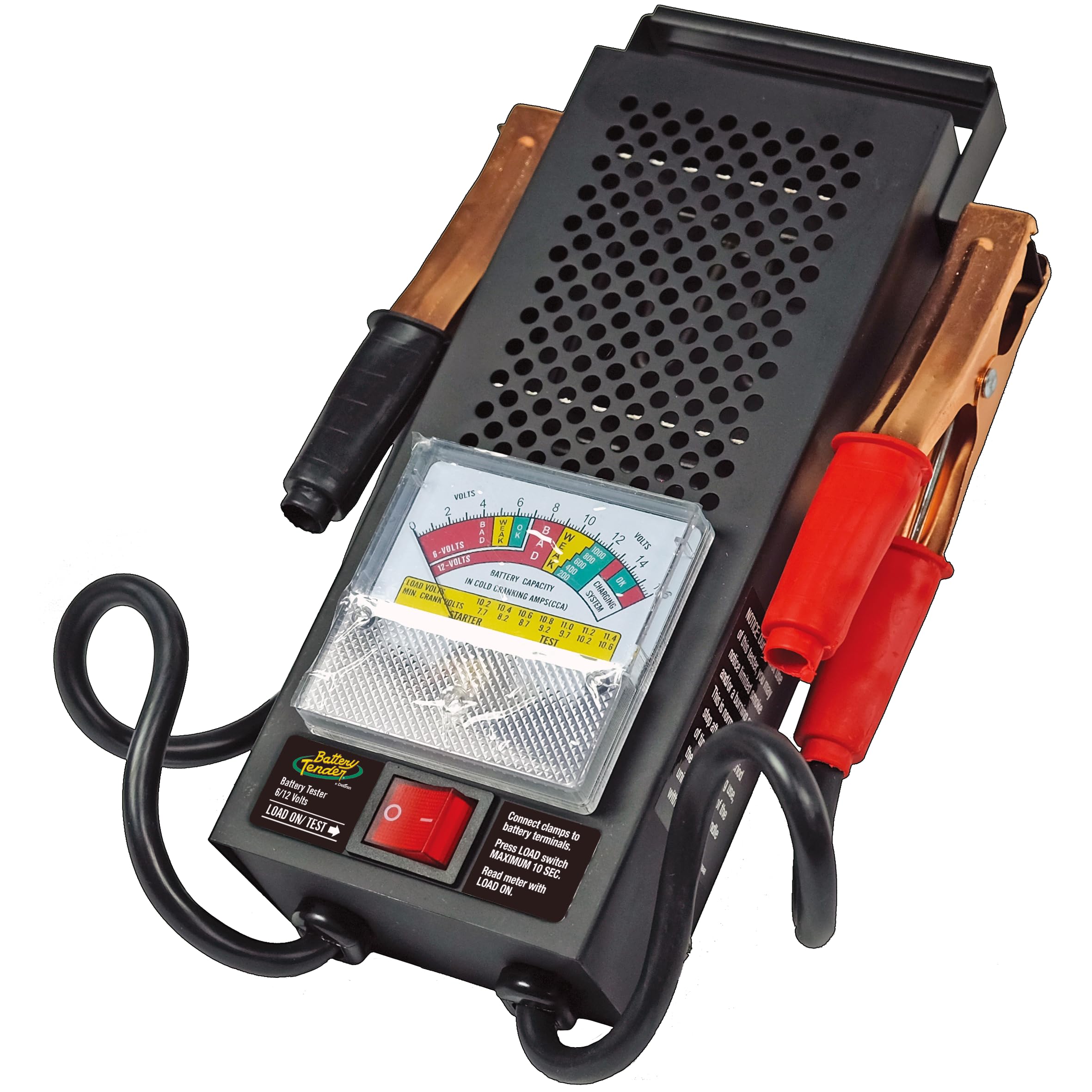
The analog workhorse that pounds 100 cold amps into a verdict, no chips required.
Sometimes the old way is the honest way. This is a real load tester, not a conductivity guesser: it pushes a 100 amp load against 12V batteries or 50 amps against 6V batteries and reads the result on a color-coded analog dial. The single toggle switch makes operation dead simple — no menus, no calibration, no software.
It tests 12V and 6V starter or deep-cycle batteries for vehicles with up to 1,000 cranking amps, covering cars, pickup trucks, SUVs, motorcycles, RVs, boats, and ATVs. The rubber-insulated carrying handle and heavy-duty color-coded alligator clamps are built for years of service — one owner reports his still works great after 3 and a half years. It also checks starter motor draw and helps diagnose the charging system.
The honest caveat is that it makes a smell when running and can smoke slightly on first use as the coils burn in. Heat is a real factor: there are no digital failsafes, so you can burn out the coils if you ignore the instructions about run time and cool-down. This is a tool that demands you pay attention while using it — unlike the quiet, passive BT50 above.
The trusty diagnostic workhorse: For pure, physical load testing that can’t be fooled by surface charge, this analog unit is the reliable pick.
The attention requirement: It runs hot and needs cool-down respect — it’s not a “set and forget” tool.
9. KONNWEI KW600

The oscilloscope-style analyzer that draws your engine’s start pulse on a color screen.
For the diagnostics hobbyist, this is the fun one. Its 2.4-inch color LCD doesn’t just give numbers — it displays test results in text and graphing, and shows real-time battery voltage as a waveform during cranking. An owner comparing it to his previous tool called the oscilloscope start graph “useful,” and it exposed that 4 UPS batteries were at 2% SOH after seven years.
It reads voltage, internal resistance, cold cranking amps, battery health, and charge status on all 12V 100 to 2000 CCA batteries including flooded, AGM flat plate, AGM spiral, and GEL. Claimed accuracy reaches up to 99%, powered by a top-level STM-32 main chip for speed. There is no internal battery — it draws power from the battery under test — so it’s always ready.
The extras make it the most future-proof pick: lifetime software updates via the included mini-USB cable, and a firmware update is a common first step for owners. At 381 g it has a solid, professional feel. The main limitation is shared with the cheaper OBDResource: the screen can be dim in direct sunlight, and it struggles with hybrid vehicles that lack a conventional starter.
The enthusiast’s upgrade: If you read graphs like a mechanic and want to see your start cycle as a waveform, this is the one to reach for.
The mismatch: Hybrid owners may find it can’t test their AGM packs without a traditional starter motor.
Understanding the Specs
CCA (Cold Cranking Amps)
This is the number printed on your battery’s label that measures starting power in cold weather. A tester that checks CCA against the rated spec reveals a battery’s true condition — a dying battery can show full voltage but fail a CCA test, which is exactly why a plain voltmeter misses the problem.
Conductivity vs. Load Testing
A conductivity tester measures internal resistance and estimates health without draining the battery. A load tester, like the analog Battery Tender, physically pushes 100 amps and watches the voltage drop. Shops prefer conductivity for speed; purists prefer a real load for proof.
FAQ
What is the difference between a voltage tester and a load tester?
Will a 12V battery tester work on my motorcycle battery?
Can I test a lithium or LiFePO4 battery with a car battery tester?
What does the CCA number mean on my battery?
How do I test my alternator with a battery tester?
Why does my tester show a percentage that never changes?
Is a higher temperature rating better for a battery tester?
What is reverse polarity protection and why do I need it?
Can a battery tester tell me if I need a new battery?
Final Thoughts: The Verdict
Across the board, the battery voltage tester winner is the TOPDON BT600 because it pairs a large 3.5-inch screen with a built-in printer — a genuine edge if you want documented proof of every battery test. If you want pure value with true CCA analysis on a budget, grab the OBDResource BR502. And for a glove-box essential that answers “is it jumped or replaced?” in seconds, the MOTOPOWER MP0514C is the one to reach for.
How We Picked
We do not accept paid placement. Every pick is matched to a real buyer and a real use-case; we do not hands-on test units.
Sources & Methodology
Specifications: manufacturer listings and product documentation. Review insights: verified customer reviews, as of August 2026. Pricing: not shown on this page (it changes often); check the current price via the retailer link.
As an Amazon Associate, GoCarLife earns from qualifying purchases. This does not affect which products we feature.