
Our readers keep the lights on and the garage heater humming. As an Amazon Associate, I earn from qualifying purchases.
Specs are compiled from manufacturer listings and verified buyer reviews and can change over time — please confirm the key details on the product page before buying.
That unnerving side-to-side shimmy when an 18-wheeler passes, the sagging rear end that blinds oncoming traffic with your headlights, the constant death-grip on the steering wheel — a weight distributing hitch is the cure for all of it. These systems use spring bars to transfer the trailer’s tongue weight across your truck’s axles, leveling the ride and adding friction-based sway control so you tow with authority instead of anxiety. This guide breaks down the best performers by towing capacity, sway control style, and ease of daily use, so you can match the right kit to your trailer’s weight without paying for capability you’ll never use.
I’m Mo Maruf — the founder and writer behind GoCarLife. This guide is built by comparing the manufacturers’ published specifications and the patterns across verified customer reviews, so you get each pick’s real strengths and trade-offs instead of marketing spin.
You want a hitch that keeps your truck and trailer level and stable, so you can drive without white-knuckling the wheel. We’ve ranked the most dependable weight distributing trailer hitches based on specs and real owner feedback, covering rated capacities from 10,000 to 15,000 pounds. The right sway control keeps your rig stable and your steering predictable on every mile.
Our Picks at a Glance


How To Choose The Best Weight Distributing Trailer Hitches
Buying a weight distributing hitch is a safety decision, not just an accessory purchase. The right unit keeps your truck and trailer level, your brakes effective, and your steering responsive. The wrong one — or one rated too low — can leave you fighting the wheel on every downhill curve. Here are the three pillars to get right before you spend.
Match the Ratings to Your Real Weights
Every hitch carries two numbers you cannot ignore: the gross trailer weight rating (GTWR) and the tongue weight rating. Your loaded trailer’s total weight must sit under the GTWR, and the downward force at the coupler must sit under the tongue weight rating. A good rule is to buy a hitch rated at least 10-15% above your heaviest loaded scenario. For example, a 10,000-pound-rated hitch comfortably covers a 7,000-8,000-pound travel trailer, giving you a buffer for water, gear, and cargo. Never guess your weights — a trip to a public scale is cheap insurance.
Choose Your Sway Control Style
Sway control is where these hitches differ most. Round bar systems use friction between the bar and the hitch head to dampen movement — simple, effective, and affordable. Trunnion bars use a similar friction principle but with a different bar shape for better ground clearance. Chain-based systems like the Andersen use tension chains and a friction cone to absorb sway, and they are often quieter. The most advanced setups use a spring-and-cam system that actively resists sway without relying on friction alone, which means consistent performance without lubrication. Consider how much sway resistance you need based on your trailer’s size, length, and how often you tow in windy conditions.
Setup and Daily Use Matters
Some hitches require a 45-minute install with large sockets and torque wrenches, while others snap on in minutes. If you hook up and unhook your trailer every weekend, a lighter, tool-free design saves you real time and frustration. Also think about backing up — some sway control systems require you to disconnect the spring bars before reversing, while integrated systems let you back up without touching anything. Pair that with the shank’s rise and drop adjustment; you want a range that lets you achieve a level trailer and vehicle combination for the safest, most stable tow.
Quick Comparison
| Model | Best For | GTWR | Tongue Weight | System Weight | Amazon |
|---|---|---|---|---|---|
| Husky Towing 30849★ Best Overall | Heavy campers needing strong sway control | 12,000 lbs | 1,200 lbs | 104 lbs | Amazon |
| Fastway ConnectBest Value | Mid-size travel trailers on a budget | 10,000 lbs | — | 89 lbs | Amazon |
| Camco Eaz-Lift EliteSolo Install Pick | Solo installers wanting a complete kit | 10,000 lbs | 800 lbs | 91.1 lbs | Amazon |
| CURT TruTrack 2P | Bumper-pull trailers needing friction sway | 10,000 lbs | 1,000 lbs | 94 lbs | Amazon |
| Camco Eaz-Lift ReCurve R3 | Towing without the clunking noise | 12,000 lbs | 1,200 lbs | 89 lbs | Amazon |
| CURT TruTrack 4P | Active anti-sway for single-axle trailers | 10,000 lbs | — | — | Amazon |
| Equal-i-zer 4-Point | Maximum sway resistance on big rigs | 10,000 lbs | 1,000 lbs | 102 lbs | Amazon |
| Andersen No-Sway (14K) | Lightweight, quiet, tool-free setup | 14,000 lbs | — | 49 lbs | Amazon |
| Andersen No-Sway (10K) | Quiet towing with easy chain tensioning | 10,000 lbs | — | 49 lbs | Amazon |
| Blue Ox SwayPro BXW1000 | Noise-free sway control in all weather | 10,000 lbs | — | 68 lbs | Amazon |
| Blue Ox SwayPro BXW1500 | Heavy 15,000-lb trailers and large campers | 15,000 lbs | 1,500 lbs | 95 lbs | Amazon |
In-Depth Reviews
1. Husky Towing 30849 Weight Distribution Hitch
Our pick — over 4.5★ from 550+ verified ratings; the strongest balance of quality and price.
This Husky kit is the heavy-hauling workhorse that keeps big campers tracking straight and level.
The Husky earns the top spot because it pairs a 12,000-pound gross trailer weight rating with 1,200 pounds of tongue weight capacity — enough muscle for a 30-foot camper. The bolt-together ball mount and shank assembly uses a dual sway control platform, and the black polyester finish shrugs off rust and corrosion. Buyers report it calmed the sway of a 30-foot camper dramatically, and one owner confirmed it “handled 10,500 lb trailer (1,045 lb tongue weight) well, distributing load across all wheels.”
Setup is more involved than the chain-style alternatives — it needs large sockets and a torque wrench — but the payback is a rock-solid connection that keeps the front wheel well of your truck from rising. Owners saw their front wheel well rise only 1/8 inch after a proper setup, confirming the weight transfer is working. The 8-inch total height adjustment (5-5/8-inch rise and 2-3/8-inch drop) with a 10-inch shank gives you room to level most truck and trailer combos. The interchangeable spring bars fit either side of the hitch head, simplifying the install.
For a half-ton truck pulling a 26-foot-plus trailer, this hitch is the balance. Owners mention it balanced the truck proportionally to the camper, kept headlights level even on windy roads, and saved hundreds compared to RV store prices. The lift brackets make hooking up safer and easier. It’s not lightweight at 104 pounds, so plan for that when lifting it into place.
What Owners Love
- Excellent sway control — the top-mentioned strength by far
- Heavy-duty alloy steel construction that feels built for the long haul
- Strong value vs. RV dealership pricing for the capability
Setup Notes
- Initial install is tricky — the instructions are vague and you need a helper
- At 104 pounds, it’s a heavy unit to maneuver
Reach for this: half-ton trucks with 26-foot-plus travel trailers who want proven sway control and don’t mind a one-time heavy install.
Look elsewhere if: you want a tool-free, lightweight design you can swap between vehicles in minutes — this one is a set-and-forget unit.
2. Fastway Connect Weight Distribution Hitch
The Fastway Connect gives budget-minded towers a complete setup with a pre-installed 2-5/16-inch ball.
The headline here is simplicity: hardened steel chains connect the spring arms to your trailer frame, and you adjust weight distribution by simply changing which chain link hooks the frame. No drilling required, and it fits RV, cargo, utility, horse, and ATV trailers. The 2-5/16-inch hitch ball comes pre-installed, and the standard shank offers a 3-inch drop and a 7-inch rise for leveling versatility in a 2-inch receiver.
With a 10,000-pound towing capacity, it’s rated 20% lower than the Husky above, and at 89 pounds it’s lighter too. Customers note it levels a Jeep and trailer with no problem and stabilizes a 22-foot tagalong well. One note: it’s not a lightweight system, and a buyer pulling a 6,000-pound travel trailer found it overkill, noting “the system is way too heavy for my setup as it goes up to a GVW of 10,000.” Know your trailer’s weight before committing.
Installation is the recurring mixed point — some owners found the chains tricky to attach, and you’ll want tools on hand (most people have them, but not everyone). The build quality and price, though, make this a strong entry-level pick. For a first-time WDH buyer with a mid-size travel trailer, this delivers the core benefits — improved steering, braking, and stability — without the premium price tag.
Solid all-rounder: Owners consistently praise the heavy-duty build and how well it stabilizes a trailer, making it an easy recommendation for 5,000-to-8,000-pound setups.
One honest caveat: you need tools and patience for the first hookup — watch a video beforehand to avoid frustration with the chain attachment.
3. Camco Eaz-Lift Elite 800 Pounds Weight Distribution Hitch Kit
The Camco Eaz-Lift Elite ships ready to go with the ball and sway control pre-installed and torqued.
This kit shines because it arrives nearly assembled, saving you setup time. The 2-5/16-inch hitch ball and the sway control ball come pre-installed and torqued to specification on the adjustable ball mount, and the U-bolts and chain package are already on the spring bars. That means less time fiddling with a torque wrench and more time on the road. The sway control clamps on and adjusts manually to your desired firmness — unclamp it to turn it off entirely.
With a 10,000-pound support rating and an 800-pound tongue weight capacity, it’s a great match for a 5,000-pound trailer behind a mid-size truck. Owners reported it dramatically improved handling on a 3/4-ton Suburban and was essential for factory tow ratings. One buyer with a 3/4-ton Suburban said it made a dramatic difference in how well-behaved their car trailer tows. The lowest drop setting barely fits a 19-inch coupler on a 4Runner, so full-size truck owners should double-check their coupler height.
Over time, owners put 8,000-plus miles on it and loved it — solid sway control in gusty winds and a flatter ride. One recurring note: over-tightening the sway controller can stress the trailer mount (one owner broke theirs at 3,500 miles, and the company swapped the hitch under warranty). The 1-year limited warranty covers you, and the pre-installed parts save real time. It’s a complete, easy-to-install system that gets the basics right.
Best for solo installers: The pre-torqued ball and sway control mean the hard part is already done, and the universal spring bars fit either side so you can’t mix them up.
Who should think twice: If you haul near 10,000 pounds, this 800-pound tongue rating is a step down from the 1,200-pound Husky or 1,000-pound CURT units — keep to the mid-weight class.
4. CURT 17601 TruTrack 2P Weight Distribution Hitch

CURT’s TruTrack 2P uses two friction points to lock out sway and level your rig with zero guesswork.
The TruTrack 2P stands out for its integrated two-point sway control — friction at the brackets resists lateral movement and keeps your trailer aligned. Unlike chain-based models, the adjustable brackets provide fixed support, and the head tilt adjustment simplifies setup by eliminating the need for washers. Rated for 10,000 pounds towing with a 1,000-pound tongue weight and forged spring bars, it’s built for serious bumper-pull trailers.
Owners are emphatic about the difference it makes. One reported “ZERO sway at 65MPH on the highway” with 18-wheelers passing, keeping truck and camper leveled. It eliminates bouncing, brake nose-dive, and restores front-end height. The adjusting bolts instead of washers are a welcome plus. It’s heavy — adding an estimated 80-100 pounds behind the rear axle — so be prepared for the weight when installing.
The 10,000-pound rating pairs with a 94-pound item weight, putting it mid-pack for heft. Some owners needed a pole tongue adapter and professional installation for lack of tools, though the process itself is straightforward once you dial in the ball height. The limited lifetime warranty backs the carbon steel construction, and the powder coat finish resists the elements. For a heavy buggy hauler or a new camper upgrade, this is a performance-first pick that owners call a clear upgrade over older systems.
The performance pick: Two-point friction sway control plus fixed brackets delivers near-zero sway at highway speeds, even in truck traffic.
Plan for the install: The weight and the need for larger sockets mean a helper or a shop speeds things up, and you’ll want to confirm your trailer’s coupler setup.
5. Camco Eaz-Lift ReCurve R3 Weight Distribution Hitch
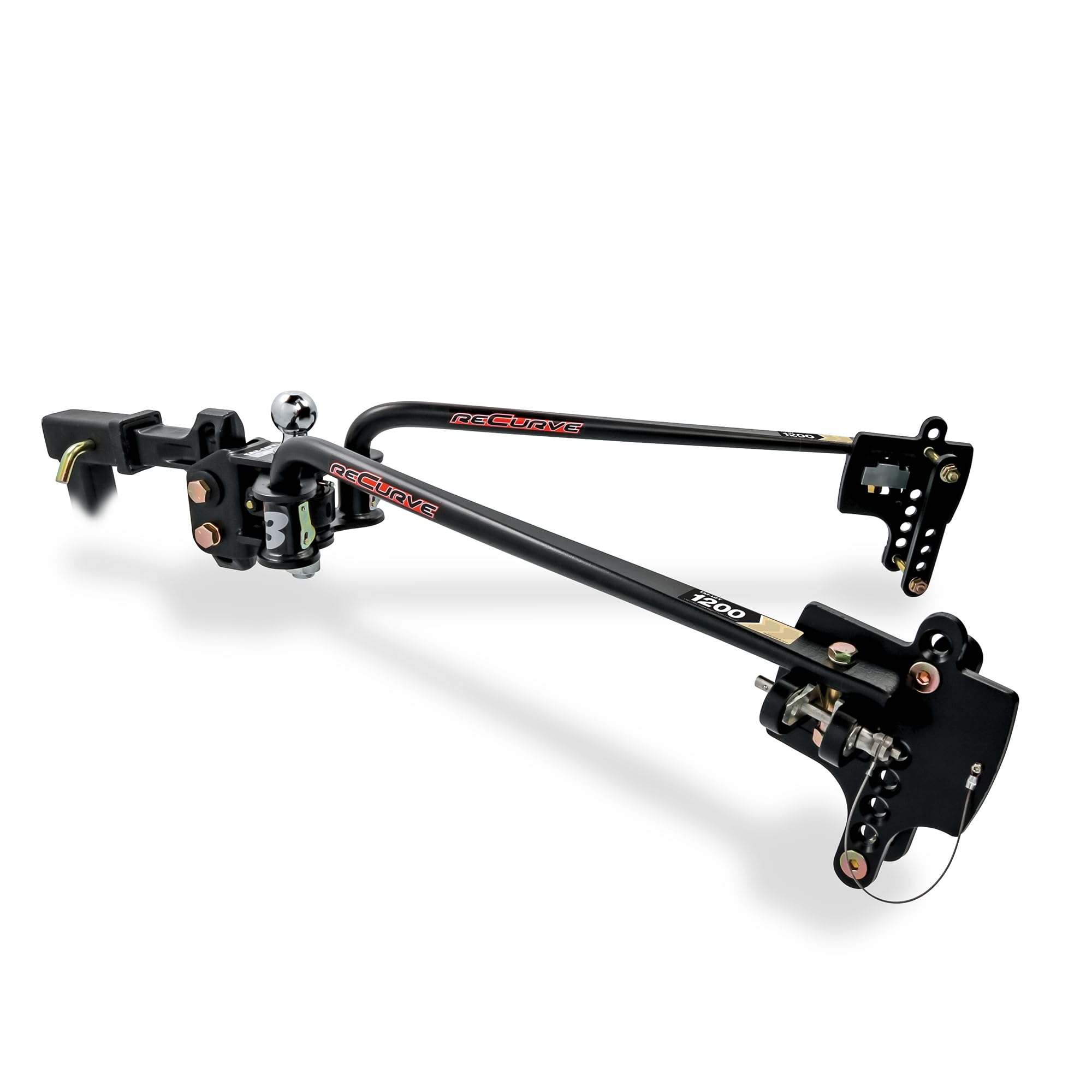
The ReCurve R3 eliminates the clunk and creak of traditional hitches for a quiet, confident haul.
No chains, no grease, no noise — that’s the R3’s promise, and it delivers. The patented top-loading spring bars snap into place without grease and give you superior ground clearance. The built-in sway control turns on and off with a simple bolt turn, so you can reverse or navigate tight spaces without interference. Built from high-carbon steel, it carries a 12,000-pound GTWR with a 1,200-pound max tongue weight and a 2-5/16-inch ball rated to 15,000 pounds.
Owners consistently highlight how easy it is — no drilling, no welding, and the top-snap bars mean no chains to wrestle. One owner towed a 7,000-pound trailer with no sway and no bounce, calling it a standout. The adjustable weight distribution washer and sway control let you fine-tune the ride, and the no-noise features eliminate the metal-on-metal clunking that plagues friction-bar designs. Backing up requires no disconnect, which saves time at every campsite.
The 5-year limited warranty is among the best in this category. The bars are heavy but manageable, and the initial setup — while challenging — comes with clear instructions. Owners with a 3,700-pound trailer and a 10,000-pound tow rating found it perfect, and the R3’s ease of use makes it a favorite for anyone who hooks up frequently. The brushed finish and no-grease design mean less maintenance over the long haul.
Quiet and clean: The no-chain, no-grease, no-noise design is a genuine upgrade for anyone tired of the creaks and clanks from a traditional round-bar hitch.
Consider this: The initial dial-in takes some reading, and heavy bars mean you’ll want a steady grip during installation.
6. CURT 17500 TruTrack 4P Weight Distribution Hitch
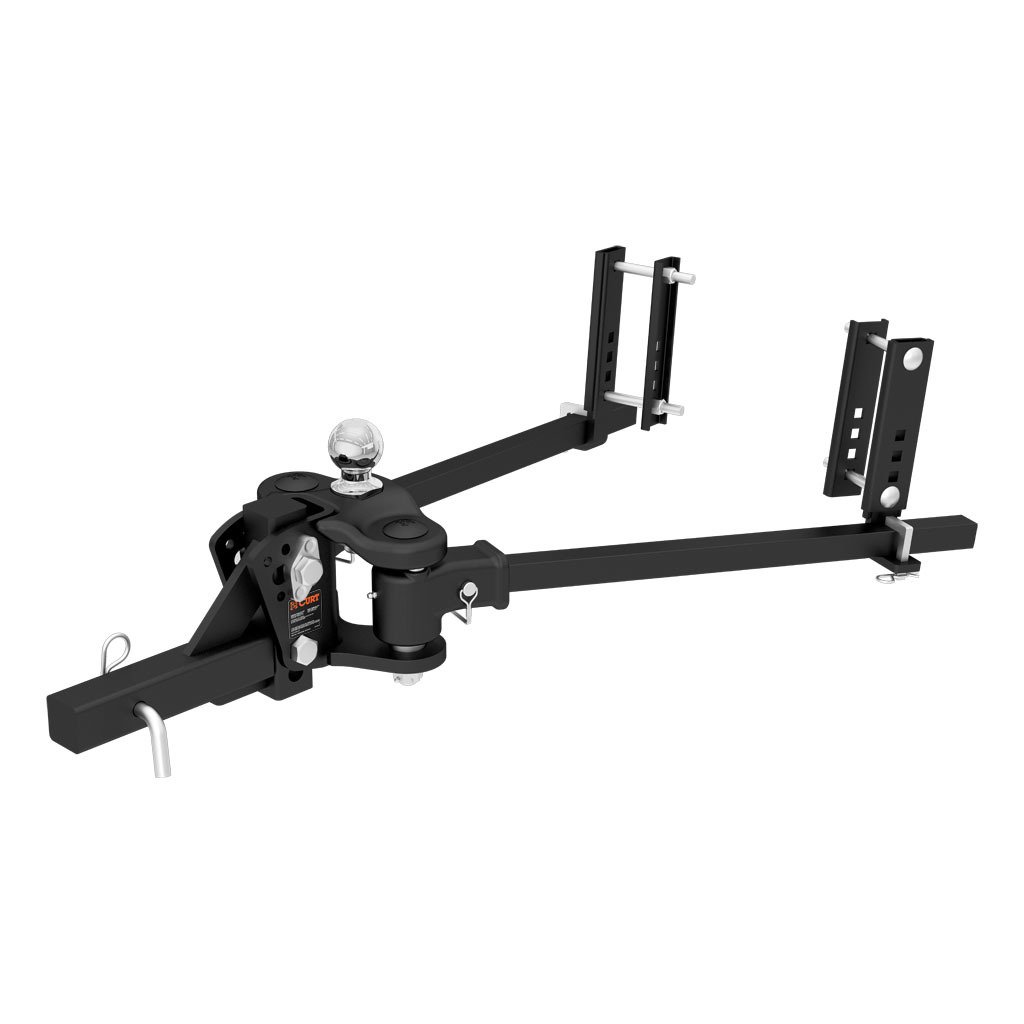
The TruTrack 4P adds four active sway-control points that resist sway without relying on friction alone.
This is CURT’s take on active anti-sway: a spring-and-cam system with hardened components that works to keep your trailer aligned, rather than just creating friction. Four points of sway control work together, and the welded head with cast pieces and trunnion-style forged steel spring bars give it a stout, truck-grade feel. Rated for, the 10,000-pound towing capacity makes it a fit for lighter single-axle travel trailers and below-10k setups.
Reviewers point out a major improvement in sway control — one went from a previous 55-mph sway limit to a rock-solid 68 mph stable, with only slight movement at 70. The higher ground clearance than chain models is a real advantage on uneven terrain. The adjustable brackets provide fixed support just like the 2P, but the spring-and-cam system means consistent performance without regular lubrication. The 2-5/16-inch ball is included, which saves a separate purchase.
It’s a sturdy, well-built unit — but it is not lightweight. Owners explicitly warn that if you want a lightweight hitch system, this is not it. The install can take a few hours, and over-tightening the L-brackets has bent them for some, so follow the torque specs carefully. For a 3,500-pound single-axle trailer, it’s a wonderful match that owners still use after years of service, even stepping up to a 6,500-pound double-axle. The limited lifetime warranty backs the carbon steel build.
The Strongest Points
- Four-point active sway control that works without grease or friction pads
- Higher ground clearance than chain-style hitches
- The 2-5/16-inch ball is included in the box
Watch Outs
- Heavy and tough to fit — light-duty towers should look elsewhere
- Setup took owners up to 4 hours, and over-tightening can bend brackets
Best for: single-axle travel trailers in the 3,500-6,500-pound range where you want active sway resistance without the grease maintenance.
Think twice if: you tow near the 10,000-pound maximum or want a quick, lightweight setup — this one is heavy and demands careful torquing.
7. Equal-i-zer 4-Point Sway Control Hitch

The Equal-i-zer’s integrated 4-point sway control is the benchmark for keeping big trailers planted.
This hitch is the one that other hitches get compared to. Its integrated 4-point sway control provides resistance at both the hitch head and the spring bar sockets, working together to prevent sway before it starts. The weight-distributing design transfers tongue weight to all axles, keeping the front of your tow vehicle firmly planted. It’s engineered to work with virtually all bumper-pull trailers — RV, horse, cargo, boat, and utility — including trailers with surge brakes.
The numbers tell the story: a 10,000-pound trailer weight rating and a 1,000-pound tongue weight rating, with spring bars that are 36 inches long and 1-3/8 inches wide. The 12-inch shank offers a 7-inch maximum rise and a 3-inch maximum drop for leveling. Owners have towed 5,000-pound Airstreams with zero sway at 55-60 mph, and another has put 10,000-plus miles over 3 years on a 4,300-pound trailer with no sway and weight distributed to all four wheels.
The catch: setup is serious work. The ball needs 430-ft-lb of torque, which often requires a thin-wall socket and a shop’s help. The hitch itself is noisier than chain-free designs until greased with white lithium spray. At 102 pounds, it’s a beast to handle. But for those who tow a 34-foot camper or a 28-footer behind an F150, the safety improvement is obvious and worth the effort — owners call it essential. The ball is not included, so budget for that separately. The limited lifetime warranty backs the alloy steel build.
The sway-control king: Four integrated friction points deliver the strongest resistance to trailer sway in this class — 400-mile drives with zero movement are the norm, not the exception.
Commit to the setup: The 430-ft-lb ball torque and the weight of the unit mean this is a plan-ahead purchase, not a quick bolt-on.
8. Andersen Hitches Weight Distribution Hitch (14K)

At 49 pounds, the Andersen No-Sway is roughly half the weight of traditional hitches and far easier to handle.
The Andersen is a paradigm shift in weight distribution. Instead of heavy steel spring bars, it uses a ball-and-socket design with tension chains and a friction cone to absorb sway and bounce. The result is a system that weighs just 49 pounds — compared to 89-104 pounds for steel-bar hitches — and is dramatically easier to install, remove, and store. It includes mounting plates, bolts, chains, and the ball, so it’s a complete package.
With a 14,000-pound GTWR rating, it’s the highest-capacity hitch in this lineup, yet it’s the lightest. Owners love that they can hook up in about 15 seconds with no bars to align. The red spring tensioners make adjustment visual and simple. One owner who upgraded from a 90-pound Husky trunnion hitch found the Andersen weighed less than 40 pounds, eliminated sway behind semis on a 430-mile trip, and needed no disconnect for backing or tight turns. The friction cone fights sway at the source, right in the ball housing.
The 3-4-5-6-inch bracket sizes accommodate different trailer frame heights. Shoppers say it performs particularly well in windy conditions, with one towing in 10-15 mph winds with no sway, and a scale test showing near 50/50 axle distribution. The frame-mounted brackets are quieter than bar designs and require no grease. The lifetime warranty and American manufacturing add confidence. For those who tow a toy hauler or 29-foot trailer and want to reduce payload and strain, this is the modern choice — just know the premium price reflects the innovative design.
Why It Wins Fans
- At 49 pounds, it’s less than half the weight of steel-bar hitches
- 15-second hookups with no spring bars to align or disconnect for backing
- Quiet operation — no clunking, creaking, or grease
Reality Check
- The premium price is the biggest hurdle for budget buyers
- Owners note it doesn’t fully eliminate porpoising — keep weight loaded over the trailer axles
Reach for it if: you want the lightest, quietest, easiest-to-use system that handles up to 14,000 pounds — ideal for frequent hookups and solo setup.
skip it if: you’re on a tight budget or prefer the familiar, heavy-duty feel of traditional steel spring bars.
9. Andersen Hitches Weight Distribution Hitch (10K)
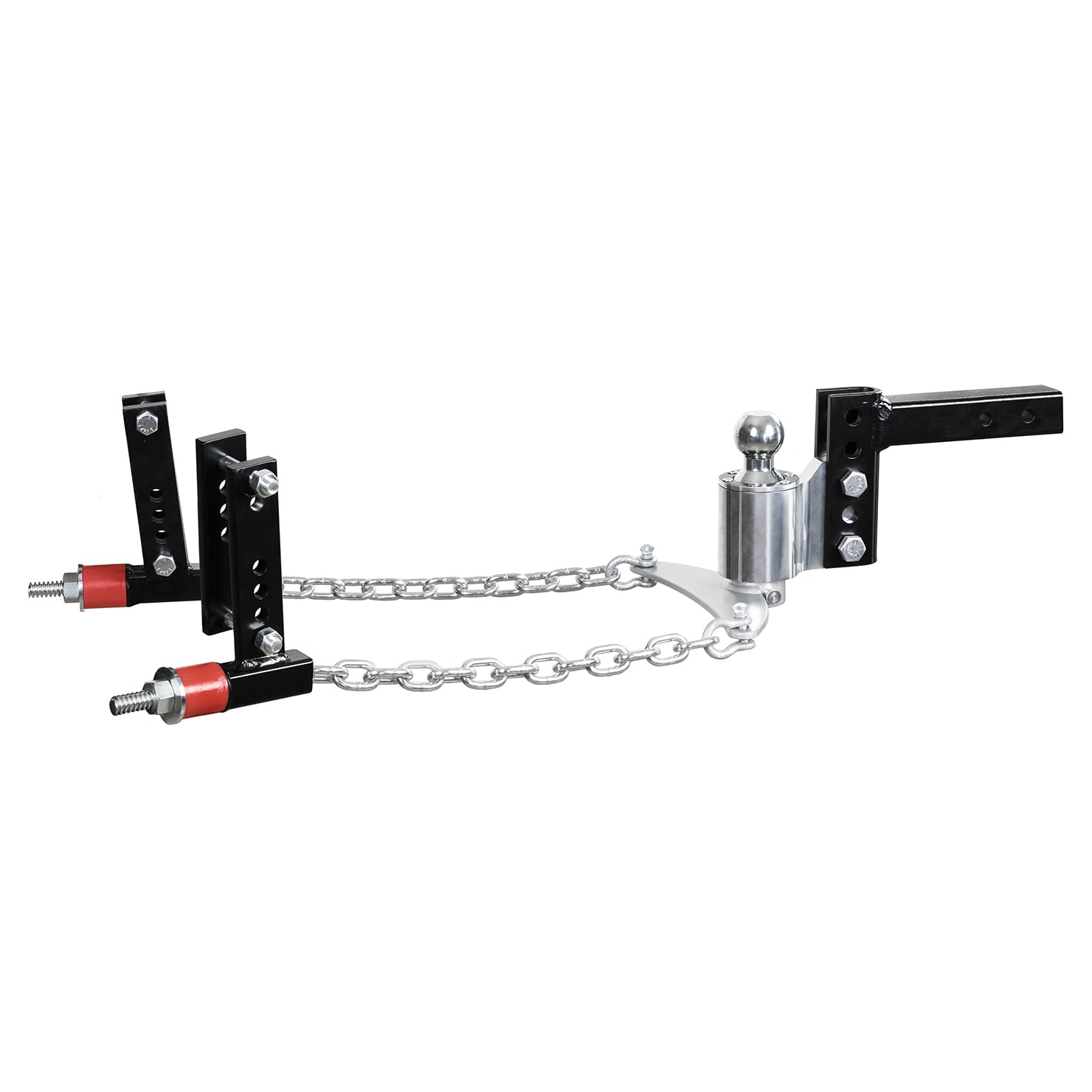
This 10,000-pound Andersen keeps the same tool-free chain setup and quiet ride in a lighter-duty package.
For those who don’t need the full 14,000-pound rating, this Andersen delivers the same innovative design at a 10,000-pound capacity. The fixed 4-3/8-inch brackets provide a consistent head angle for common truck and trailer height combos, and the tension chains attach and detach faster than traditional spring bars — no tools needed for routine field adjustments. The friction cone sits inside the ball housing, damping sway and road bounce right at the source.
Weighing the same 49 pounds as its bigger sibling, it’s easy for a single person to handle — owners note it’s simple enough for anyone to install alone. One fleet owner called it ideal for novice users, with rock-solid stability at 70 mph with 18-wheelers, even when the trailer outweighed the tow vehicle. The 2-inch ball is included, and the American-made construction with a lifetime warranty gives it a solid backing. There are no torsion bars to disconnect for backing up, and the quiet operation is a consistent theme.
The 49-pound mass is a standout — owners coming from 80-100-pound systems find it liberating. Setup took an owner about 2 hours with clear instructions, and the effective sway control and weight distribution earned high marks. One important caveat: this system is not suitable for boat trailers — one owner returned it after it severely damaged their trailer brakes. Stick to travel, cargo, and utility trailers. For a recreational tower with a standard 2-inch ball coupler, this is a quiet, easy, and effective upgrade.
easy daily use: Tool-free chain tensioning, no spring bars, no noise, and easy backing make this the most approachable hitch in the lineup for a 10,000-pound class.
Not for boaters: This design is for travel and utility trailers — keep it away from boat trailers to avoid brake damage.
10. Blue Ox BXW1000 SwayPro Weight Distributing Hitch

The Blue Ox SwayPro delivers noise-free sway prevention that never gives up, even in rain or snow.
The SwayPro’s defining feature is its trunnion-style sway control that uses rotating latches and clamp-on brackets for quick setup — and it’s completely silent. The friction-based sway prevention never stops working, whether it’s dry, raining, or snowing, which is a real advantage over systems that need dry metal-on-metal contact to function. The kit includes a standard coupler hitch head, a 7-hole shank with a 9-inch receiver-stinger, spring bars, and all mounting hardware.
Rated for a 10,000-pound maximum towing weight, it’s a strong fit for F150s and half-ton trucks pulling 24-30-foot trailers. Buyers report no sway from Dallas to Toronto despite 18-wheeler pressure on a 24-foot aluminum car hauler, and a clean 600-mile test on a Keystone Bullet with no sway, no noise, and easy backing. The 7-hole shank gives you up and down adjustability for leveling, and the good ground clearance means fewer scrapes on uneven terrain.
At 68 pounds, it’s lighter than the steel-bar heavyweights but still substantial. Owners note the high engagement force and recommend a 3/4-inch breaker bar and sockets for setup. It works with tongue boxes and doesn’t interfere with trailer accessories. The limited lifetime warranty adds confidence. For those who tow in varying weather and want quiet, dependable sway control without the grease and noise of traditional friction bars, the SwayPro is a compelling premium pick.
Weather-proof sway control: The noise-free design keeps working in rain and snow, unlike friction-bar systems that need dry contact — a real safety edge.
Plan for the install: It needs a breaker bar and sockets to set up, and the 68-pound weight is manageable but not feather-light.
11. Blue Ox BXW1500 SwayPro Weight Distributing Hitch
The BXW1500 takes the SwayPro’s design and scales it up for 15,000-pound loads and 1,500-pound tongue weights.
This is the heavy-duty version of the SwayPro, built for the biggest bumper-pull trailers. The spring bars are rated for a 1,500-pound tongue weight and a 15,000-pound gross towing weight — enough for a 35-foot travel trailer or a large enclosed cargo hauler. It prevents rear-end sag and improves ride balance, with the same noise-free sway prevention that works in rain or snow. The kit includes the hitch head, a standard 7-hole shank, clamp-on brackets, spring bars, and all hardware.
Owners have tested it hard: a 2016 F150 pulling a 35-foot, 8,900-pound trailer with no sway at 65 mph in 25-35 mph crosswinds with gusts to 50. Another owner credits the antisway system with preventing a jack-knife when they hit a snow pile on the highway with a 29-foot enclosed trailer and five snowmobiles — it stopped the trailer from jack-knifing and avoided a collision. The 7-hole shank provides leveling adjustment, and the clamp-on brackets mean no drilling into your trailer frame.
It’s not subtle in size — the shank sticks out 14 inches, which is great for tailgate clearance but a shin hazard when walking behind the truck. At 95 pounds, it’s a hefty unit. The sway control receives mixed feedback: most report very little sway, while a few mention occasional sway in extreme conditions. One owner noted chains can get stuck in the latches, so follow the tension instructions. For those towing heavy loads in demanding conditions, the BXW1500’s 15,000-pound rating and proven performance make it a serious contender.
Built for the Big Stuff
- 15,000-pound capacity and 1,500-pound tongue weight rating
- Can prevent a jack-knife in emergency situations — owners credit it with avoiding a collision
- No drilling needed with the clamp-on brackets
Considerations
- The 14-inch shank overhang is a shin hazard and adds length behind the truck
- An occasional report of chains binding in the latches
For the heavy haulers: if you’re pulling a 35-foot camper or a loaded enclosed trailer, this 15,000-pound-rated system with all-weather sway control is built for the task.
Look elsewhere if: your trailer is under 8,000 pounds — this is overkill and the weight and size become a daily inconvenience.
Understanding the Specs
Gross Trailer Weight Rating (GTWR) vs. Tongue Weight
The GTWR is the maximum total weight of your loaded trailer the hitch is designed to handle. The tongue weight is the downward force the trailer’s coupler puts on the hitch ball — typically 10-15% of the loaded trailer weight. You must stay under both numbers. A 12,000-pound GTWR hitch with a 1,200-pound tongue rating is a balanced match for a camper whose loaded weight is near 10,000 pounds with a 1,000-1,100-pound tongue.
Rise and Drop: Getting Level
The shank of a weight distributing hitch can be installed with the ball either raised or lowered to match your truck’s receiver height to your trailer’s coupler height. A spec like “8-inch total height adjustment with a 5-5/8-inch rise and a 2-3/8-inch drop” tells you the range you have to work with. The goal is a level trailer and a level truck so your headlights stay aimed at the road, not the sky or the pavement.
FAQ
How do I know what weight distributing hitch size I need for my trailer?
What is the difference between round bar and trunnion bar spring bars?
Do I need to disconnect the sway control when backing up?
Why does a weight distributing hitch need a specific ball size?
How much tongue weight can my vehicle handle before I need a weight distributing hitch?
What is the difference between friction sway control and integrated sway control?
How long does a weight distributing hitch last?
Can a weight distributing hitch be used with any trailer type?
Final Thoughts: The Verdict
For most people, the weight distributing trailer hitches winner is the Husky Towing 30849 because it pairs a 12,000-pound capacity with proven, heavily-praised sway control at a value that owners consistently call a bargain. If you want the ultimate in easy, quiet daily use, grab the Andersen Hitches 14K — at 49 pounds it’s under half the weight of steel-bar systems and hooks up in seconds. And for those pulling the biggest bumper-pull trailers, the Blue Ox BXW1500 delivers a 15,000-pound rating with noise-free, all-weather sway control that owners credit with preventing an emergency jack-knife.
How We Picked
We do not accept paid placement. Every pick is matched to a real buyer and a real use-case; we do not hands-on test units.
Sources & Methodology
Specifications: manufacturer listings and product documentation. Review insights: verified customer reviews, as of August 2026. Pricing: not shown on this page (it changes often); check the current price via the retailer link.
As an Amazon Associate, GoCarLife earns from qualifying purchases. This does not affect which products we feature.