
Our readers keep the lights on and the garage heater humming. As an Amazon Associate, I earn from qualifying purchases.
Specs are compiled from manufacturer listings and verified buyer reviews and can change over time — please confirm the key details on the product page before buying.
Hand-waxing a full car is a two-hour forearm workout you never asked for, and the real question most buyers have is simple: which buffer actually makes paint shine without risking a burn-through?
I’m Mo Maruf — the founder and writer behind GoCarLife. This guide is built by comparing the manufacturers’ published specifications and the patterns across verified customer reviews, so you get each pick’s real strengths and trade-offs instead of marketing spin.
For most garages, a dual-action (DA) buffer is the safe pick because its random orbit minimizes clear-coat damage risk compared to a rotary. This car wax buffer roundup ranks eight corded and cordless machines by real owner experience, so you can match one to your skill level and the size of the job.
Our Picks at a Glance


How To Choose The Best Car Wax Buffer
Before you buy a buffer, you need to know three things: will it damage your paint, can it actually remove swirls, and do you want to stay plugged in or move freely around the car? These three factors decide which machine fits your garage and your skill level.
Dual Action vs Rotary: The Safety Question
A dual-action (DA) buffer spins the pad on an offset, oscillating path — the pad never stays in one spot, which slashes the risk of “burning” the clear coat. A rotary spins directly and cuts faster but punishes mistakes. For your first machine, DA is the forgiving choice.
Orbit Throw and OPM: How Fast It Works
The orbit throw (measured in millimeters) is how far the pad travels side to side; a longer throw like 15mm covers more ground per pass. OPM (oscillations per minute) is the speed dial — higher numbers remove defects, lower numbers are for gentle wax application.
Quick Comparison
| Model | Best For | Power Source | Speed Range | Pads Included | Amazon |
|---|---|---|---|---|---|
| VERVEWAVE Cordless Kit★ Best Overall | Dewalt owners wanting cordless freedom | Dewalt 20V battery | 1800–5500 RPM | 17 pieces | Amazon |
| AVID POWER DA KitBest Value DA | Budget full-car polishing | Corded electric | 2700–6500 OPM | 4 pads + 2 discs | Amazon |
| SPTA Mini OrbitalTight-Space Specialist | Tight spaces and motorcycles | Corded electric | 2000–5500 OPM | 6 pads + 12 discs | Amazon |
| ZOTA Mini Polisher | Detail work in door jambs | Corded electric | 3000–7200 RPM | 9 pads + discs | Amazon |
| BATOCA 1100W DA | Marble, floors and large surfaces | Corded electric | 2500–5500 RPM | Foam + wool pads | Amazon |
| SPTA Cordless Mini | Emblems and chrome details | 12V battery x2 | 2000–4500 OPM | 54 pads | Amazon |
| BATOCA 700W DA | Complete kit for boat gel coat | Corded electric | 1000–3800 OPM | Foam + wool + bonnets | Amazon |
| Griot’s Garage G9 | First-time paint correction | Corded electric | 2000–6400 OPM | 6″ backing plate | Amazon |
In‑Depth Reviews
1. VERVEWAVE Cordless Buffer Polisher Kit
Our pick — over 4.5★ from 450+ verified ratings; the strongest balance of quality and price.
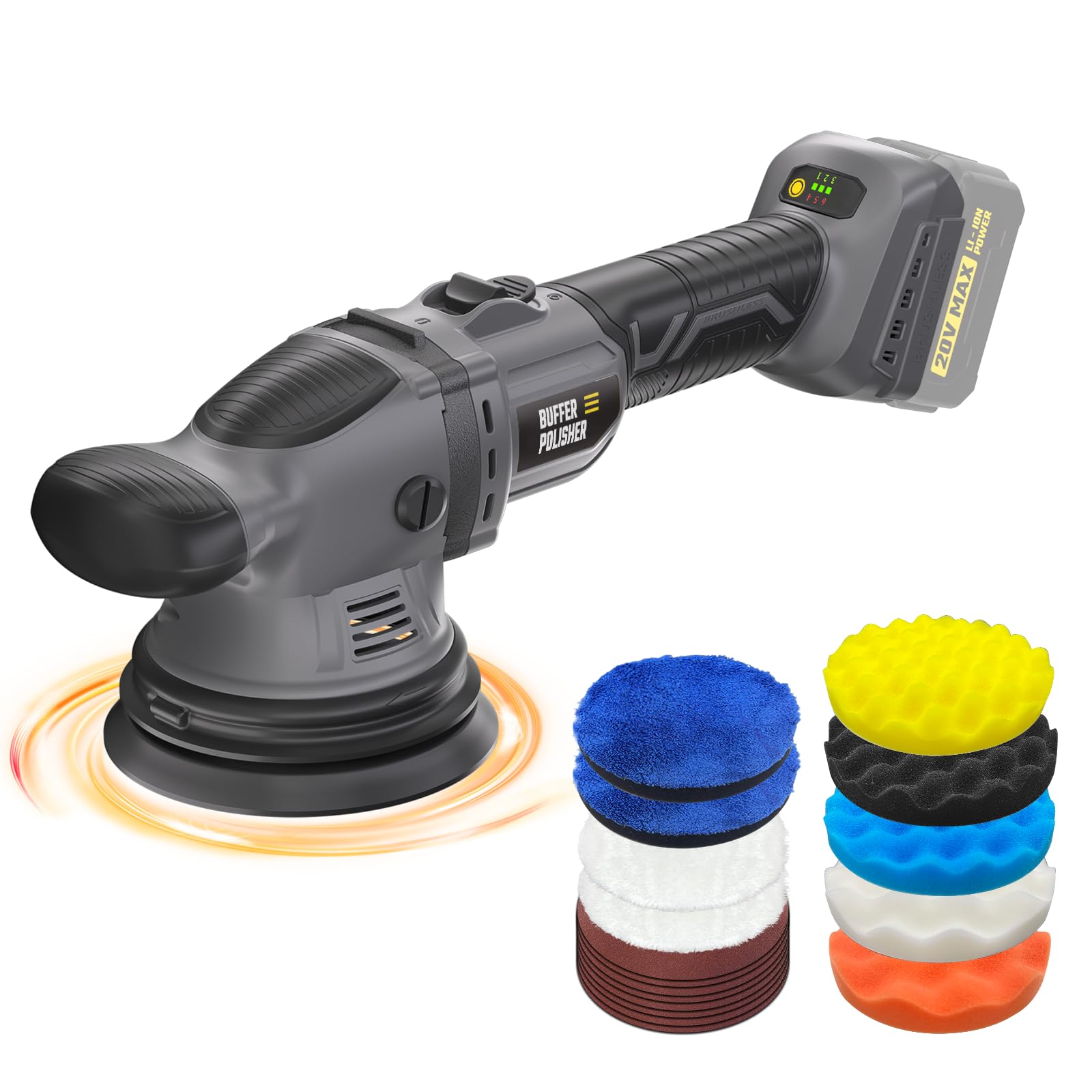
The cordless buffer that vanishes the extension cord for anyone already on Dewalt 20V batteries
If your garage is already full of Dewalt 20V tools, this buffer slides right onto that battery system with zero new chargers to buy. The kit ships as tool-only, so you supply the battery, and the brushless motor (an efficient motor design that runs cooler and lasts longer than a brushed one) makes the most of that shared power.
You get six speeds from 1800 to 5500 RPM, so you can pick low gear for laying down wax, mid gear for polishing, and top gear for removing oxidation. A lock switch stops the machine from firing up accidentally when you grab it, and buyers report running it for 1.5 hours straight while still having over 50% battery left — enough to finish a whole car on one charge.
The 17-piece kit includes five foam pads, two wool pads, two waxing pads, and eight sandpapers, so it arrives ready to work. Owners describe it as light, well-balanced, and beginner-friendly, with a noticeable shine improvement even on sun-faded boat gel coat when paired with a marine compound.
cordless freedom
- Exceptional runtime — 1.5 hours of use still leaves over half the battery
- Six speeds from 1800 to 5500 RPM cover waxing through defect removal
- Brushless motor runs quieter and extends motor life
battery life limits
- Battery and charger sold separately — you must already own Dewalt 20V gear
- Random orbital motion is gentler, so heavy correction takes longer than a rotary
portable detailing: you already own Dewalt 20V batteries and want to ditch the cord for weekend detailing.
long sessions: you have no battery system yet and would rather buy a corded machine that works from the start.
2. AVID POWER 5″/6″ Dual Action DA Polisher Kit
A corded dual-action that delivers proven shine at an entry-level price
This AVID POWER kit is the everyday answer for a full-car polish without a premium price tag. Its 5-amp motor spins the pad at 2700 to 6500 OPM across six dial positions, and the dual-action design (the pad oscillates in a random orbit rather than spinning in one spot) keeps the risk of burning your paint low for a first-time user.
The rubberized body and an adjustable D-handle with five positions give you a non-slip, comfortable grip while you work. Owners have used this exact machine to restore a 22-foot boat’s gel coat in three hours — a job they said would have cost at a pro shop, and one that needed the speed dial to handle both compounding and finish work.
It arrives with two 5-inch foam pads, two 6-inch foam pads, a foam disc in each size, and a detachable D-handle. The 5″ and 6″ backing plates mean you can also carry it over to furniture, ceramic, wood, or metal. A few owners mention speed drift under sustained pressure and occasional durability gripes, so treat it as a capable value tool rather than a pro-grade daily.
beginners: the budget-conscious owner who wants a proven, beginner-safe DA to polish and wax a whole car or boat.
tight spots: you detail professionally and need a machine that holds exact speed under heavy load for hours every day.
3. SPTA Mini Orbital Polisher 3 Inch
A 3-inch powerhouse that slips into mirrors and edges a full-size buffer can’t reach
The SPTA Mini is built for the awkward zones — teardrop trailers, motorcycle fairings, door mirrors, and the tight edges around a repaint. Its 3-inch pad and 10mm orbit throw (the side-to-side travel distance of the pad) make it the centerpiece for detail work, and the 780-watt motor gives it surprising authority for its size.
Six speeds from 2000 to 5500 OPM let you step down for wax or crank up for compound. The speed dial sits right above your thumb, so you can adjust without breaking your stance. What wins owners over is the build quality — it’s the thing people praise most — plus performance that one buyer compared favorably to a more expensive brand at half the price.
The kit includes 3-inch and 4-inch polishing pads, wool pads, 12 sanding discs, a pad conditioning brush, scratch remover, microfiber towels, and a carry bag. Be honest about the realities — it’s slightly heavy for its class, and a few users find the lock/start button awkward to operate. But for cut-and-buff work in tight spaces, it delivers a professional glossy finish without fatigue, as customers note.
small panels: your work is mostly tight spots and small panels — mirrors, edges, motorcycles, or a boat’s corners.
large surfaces: you need to polish large flat panels fast; a 3-inch pad covers less ground per pass than a 6-inch.
4. ZOTA Mini Polisher 2″ / 3″

The 2-inch and 3-inch pair that conquers door jambs and A-pillars
The ZOTA is the detailer’s secret weapon for the spots a 6-inch machine physically cannot fit: door jambs, body lines, headlight edges, and the A-pillar. It ships with both a 2-inch and a 3-inch backing plate, and switching between them is quick — owners note it’s easy to swap pads mid-job, which matters when you’re working around emblems and trim.
Its 380-watt motor spins from 3000 to 7200 RPM across six speeds, and the 8mm orbit movement lets it remove swirls right up to a mirror finish. The high-impact nylon body (a nylon shell toughened with 30% glass fiber) keeps the whole tool at just 3.75 pounds, so it stays manageable even in overhead or sideways positions. Buyers repeatedly call out effectiveness and size as the top reasons they’d recommend it — it polishes a truck perfectly and handles small parts without drama.
The kit includes three 3-inch sponge pads, a 3-inch wool pad, four 2-inch sponge pads, a 2-inch microfiber fast pad, spare carbon brushes, and a microfiber towel. The included pads are a weak link per several owners, and a few find it heavier than expected for a mini. Pair it with quality pads and it punches far above its size.
mirrors and trim: anyone whose paint has tight details — jambs, pillars, motorcycles, or small-area scratch repair.
big jobs: you want one machine to do the whole car; this is a companion tool, not a full-panel workhorse.
5. BATOCA 15mm Dual Action Polisher 1100W
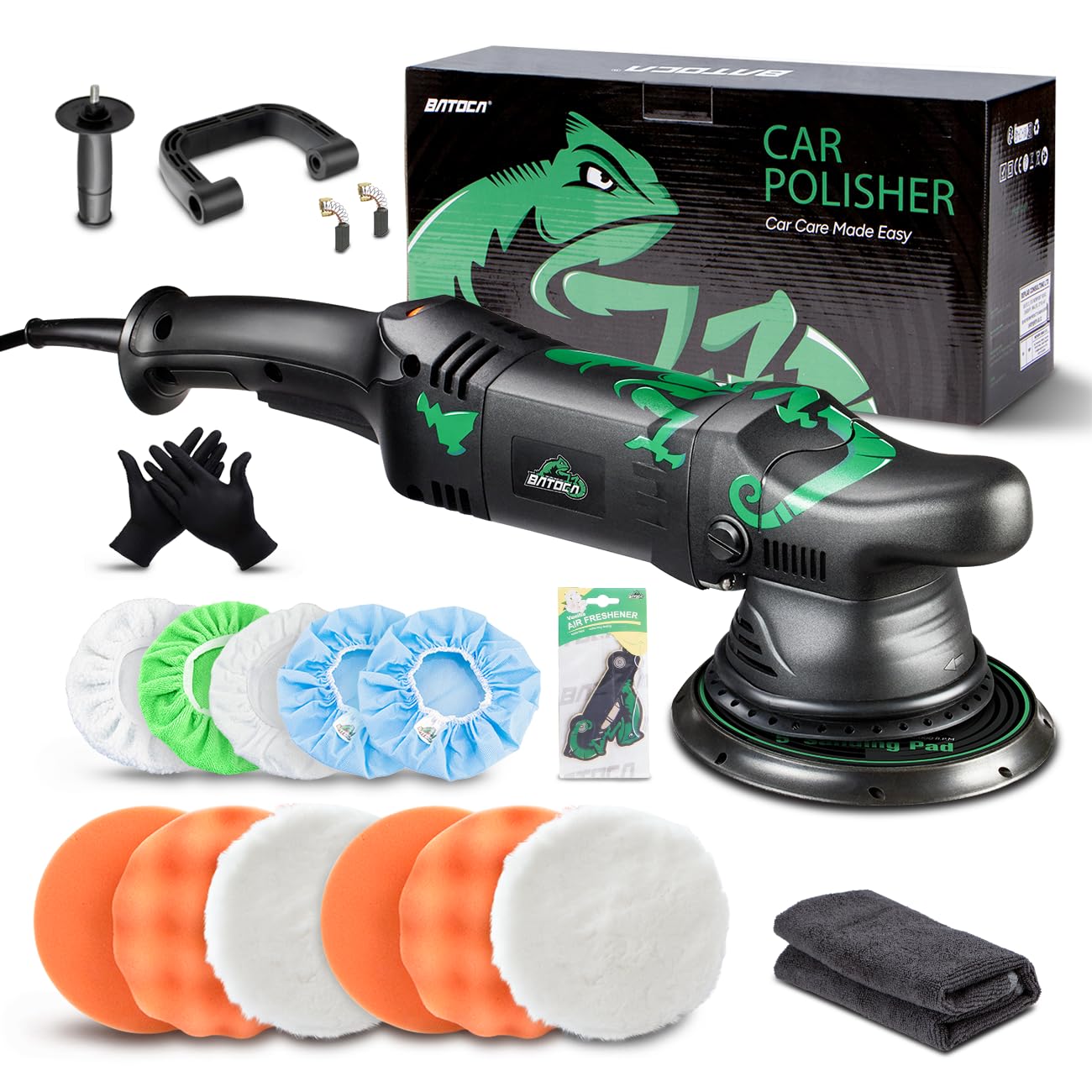
A long 15mm throw that covers more paint per pass than shorter-orbit machines
This BATOCA stands apart on its 15mm orbit throw — the distance the pad travels in its random orbit — which is noticeably longer than the 8mm or 10mm found on most budget DAs. Longer throw means the pad covers more surface per second, so a full-panel correction goes faster, and its 1100-watt motor keeps the pad spinning with constant power under pressure.
Six speeds from 2500 to 5500 RPM let you dial from gentle wax application up to defect removal, and the eccentric design (an off-center shaft that makes the pad wobble in a random path) means beginners can pick it up quickly without the fear of burning paint. Owners have run a full two-stage cut and polish on a Subaru Outback with it, noting it handles the job but does run warm after an hour and a half of continuous work.
It ships with foam pads, wool pads, a polishing bonnet, both a straight and a D-handle, and spare carbon brushes. The stock pads wear quickly (some last only a couple of uses), so plan to swap in better-quality pads; the machine itself keeps performing.
stubborn swirls: you want faster panel coverage on cars, boats, or even marble and floors thanks to that 15mm throw.
light maintenance: you’d rather pay extra upfront for premium pads included — this kit expects you to bring your own later.
6. SPTA Cordless Mini Polisher 12V
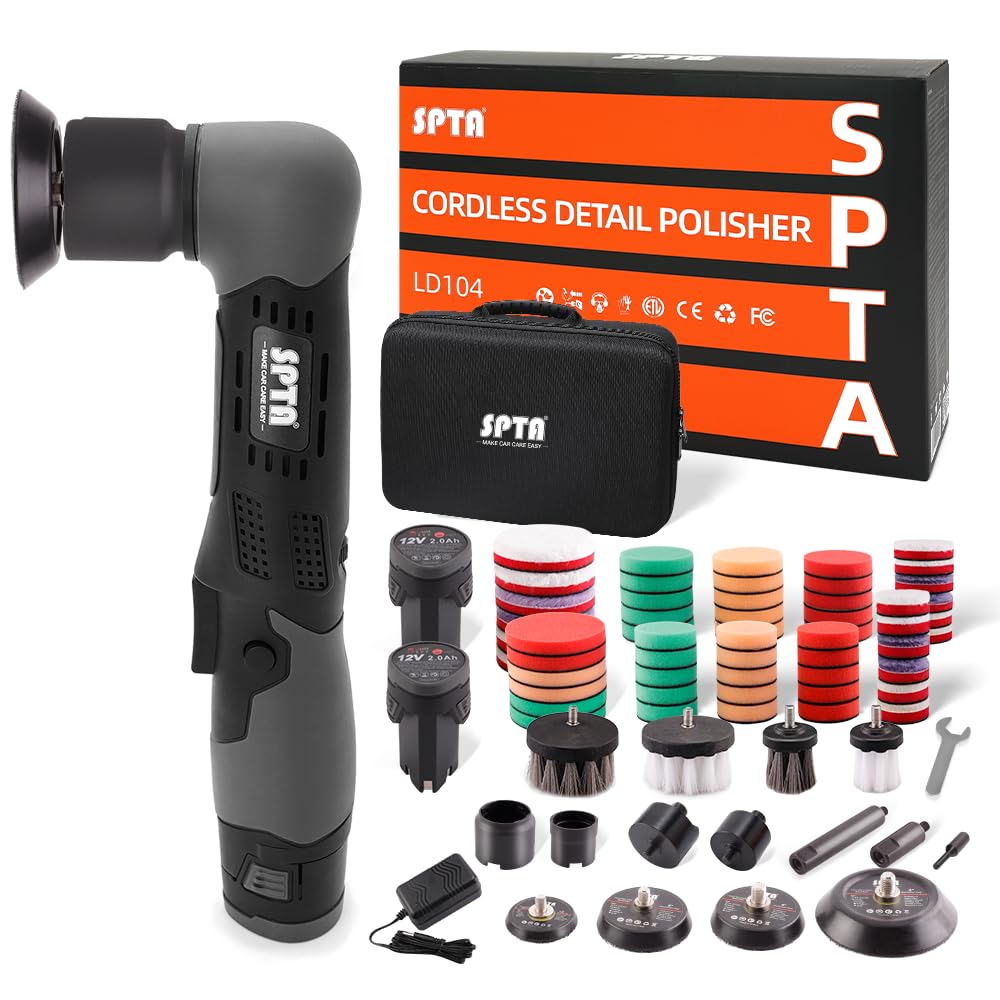
A pocket-size cordless polisher built for emblems and chrome without hunting an outlet
This SPTA micro polisher answers the question of how to polish the tiny stuff without dragging a cord: it runs on two included 2000mAh batteries (milliamp-hours, the unit of battery capacity), so one charges while the other works. The kit is genuinely all-inclusive, with 54 pads across three sizes, backing plates in 25mm, 50mm, and 80mm, brushes, and spare eccentric blocks.
The dual-action free-spinning rotation runs from 2000 to 4500 OPM, which owners say is enough to remove light scratches and swirls, polish chrome, and restore shine on motorcycles and tight car areas. Quality is what wins people over — it’s the most-praised aspect — and the included array of accessories makes it a complete detailing kit right out of the bag. It’s light, easy to grip, and far less tiring than hand-polishing an emblem by finger.
Battery life varies: some reviewers point out long sessions, while others see roughly 10 minutes of runtime. One buyer measured 45–55 minutes of continuous use but watched the battery degrade noticeably after about ten charge cycles. If you’re doing quick touch-ups and spot details, this is a brilliant little tool; if you expect to polish a whole car on one charge, it will frustrate you.
quick touch-ups: quick spot corrections, emblems, chrome, and motorcycle details where portability beats raw power.
deep defects: you need sustained runtime for large panels — bring the second battery and expect to swap.
7. BATOCA 6″ Dual Action Polisher 700W
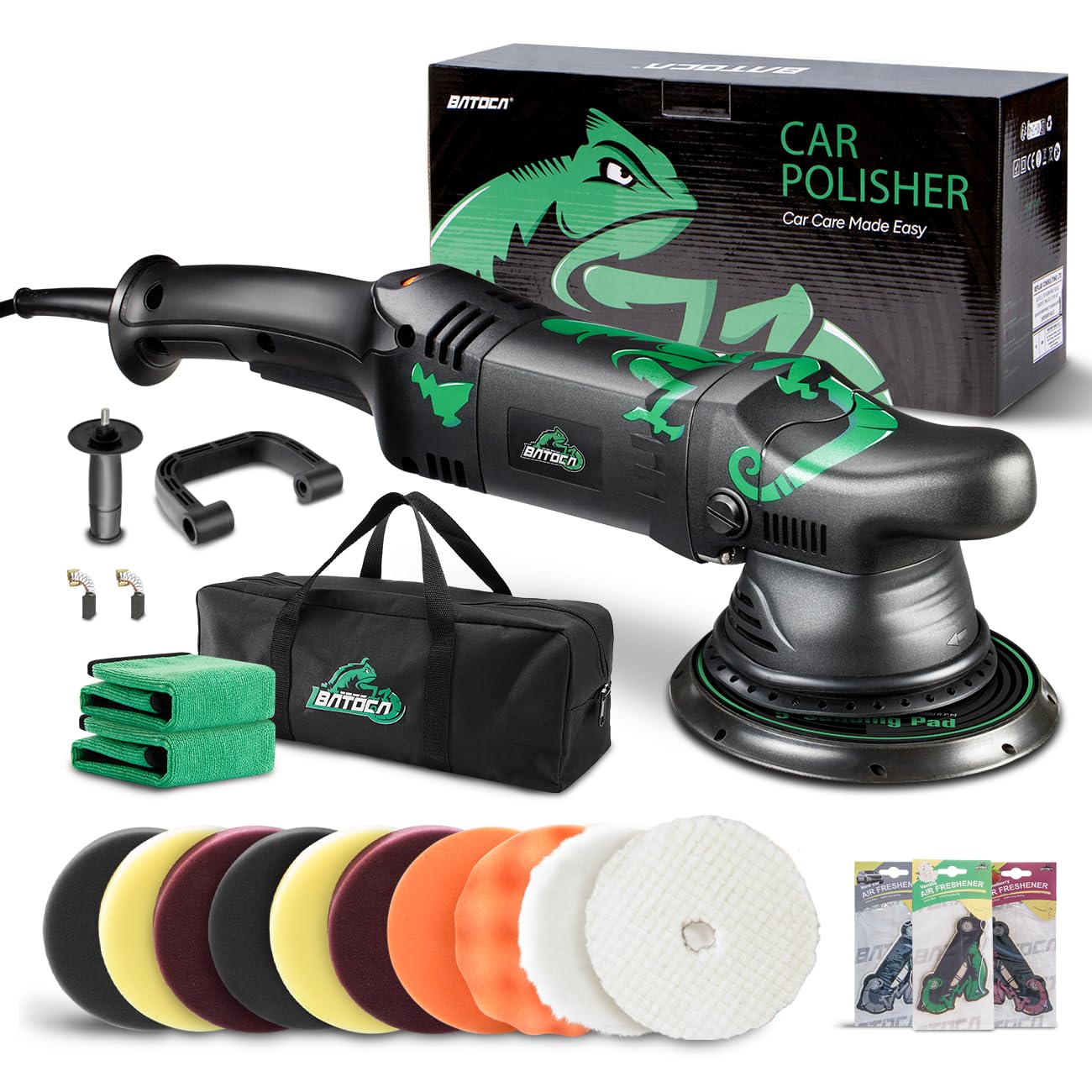
A 700-watt all-in-one kit that arrived ready to detail three cars in a single day
The 700-watt BATOCA is the “everything included” answer for someone who wants one box with a machine, pads, bonnets, sandpaper, towels, gloves, and a tool bag. One owner detailed three cars over eight hours straight without the tool faltering, and it earns consistent praise as a well-made, easy-to-use value — quality and functionality are the two most-praised aspects.
Its dual-action eccentric design (an off-center shaft that makes the pad oscillate in a random orbit) makes it beginner-friendly, and the six-speed dial runs from 1000 to 3800 OPM — a slightly lower top speed than some rivals, which favors controlled waxing and buffing over aggressive cutting. Shoppers say it works great on boat gel coat, and the included spare carbon brushes are meant for periodic replacement around the six-month mark.
Experienced detailers note the included pads are tough and stiff from the start, needing a break-in period. That’s a minor hurdle on an otherwise complete package that one buyer called “heavy duty” and capable of almost any job. It also includes a straight handle and D-handle so you can pick your grip.
daily polishing: you want a single, complete starter kit for waxing, buffing, and polishing cars or boats without buying extras.
extreme correction: you demand a high top speed for serious defect removal — this tops out at 3800 OPM.
8. Griot’s Garage G9 Random Orbital Polisher

A 1000-watt machine that first-timers praise for correcting scratches without burning paint
The Griot’s G9 is the polisher that experienced detailers quietly recommend to novices, and the review pattern explains why: a first-time user pulled off a two-step correction on a badly scratched truck with zero stalling. Its 1000-watt motor and 9mm orbit throw deliver the cut needed for real paint correction, while the dual-action random orbit keeps it forgiving enough that burning paint “without burning paint” is the exact praise owners repeat most.
Six speeds from 2000 to 6400 OPM cover gentle waxing to aggressive compounding, and the speed dial is accessible for both right- and left-hand users. The double-shot rubber grip and contoured shroud (a rubber-wrapped body shaped to fit your palm) are designed for extended sessions, and the fan-cooled counterbalance keeps vibration low — a trait buyers specifically single out. It ships with a 6-inch vented backing plate and a 10-foot quick-connect power cord, and you can convert it to a 5-inch pad system with an optional backplate, which owners confirm works without stalling.
Quality and performance are the two most-praised aspects, and users say it rests on stable foam pads when you set it down. The trade-off is price — it’s the premium pick here — and heavy correction still takes time. But for a do-it-once machine that novices can trust on real paint, the G9 is the definition of buy-once.
serious hobbyists: the first-time polisher who wants a premium, low-vibration machine that won’t punish mistakes on real clear coat.
budget buyers: it costs more than the value picks above, and true defect removal still demands patience and the right pads.
Understanding the Specs
Orbit Throw
The orbit throw is the distance (in millimeters) the pad travels in its random side-to-side path. A longer throw like 15mm means the pad covers more surface per rotation, so you finish panels faster. A shorter throw like 8mm or 9mm is more precise for tight spots but covers ground more slowly.
OPM and RPM
OPM (oscillations per minute) and RPM (revolutions per minute) both describe how fast the pad moves. Higher numbers, like 5500 or 6400, are for removing defects and oxidation. Lower numbers are for laying down wax gently. A machine with a wide speed range is more versatile because one tool covers both jobs.
FAQ
Can a car wax buffer burn my paint?
Is a cordless buffer as powerful as a corded one?
What is the difference between a dual action and a rotary polisher?
How do I know which pad size I need?
Will a Dewalt 20V battery work with any cordless buffer?
How many speeds do I really need on a buffer?
Can I use a car buffer on a boat or motorcycle?
How long do the included pads last?
Final Thoughts: The Verdict
Across the board, the car wax buffer winner is the Griot’s Garage G9 because its 1000-watt motor and forgiving dual-action design let a first-timer correct real scratches without the fear of burning paint. If you already own Dewalt 20V batteries and want to cut the cord, grab the VERVEWAVE kit — buyers report 1.5 hours of use with over half the battery left. And for the budget-conscious full-car job, the AVID POWER restored a 22-foot boat’s gel coat in three hours for a fraction of a pro shop’s bill, making it the value pick worth reaching for first.
How We Picked
We do not accept paid placement. Every pick is matched to a real buyer and a real use-case; we do not hands-on test units.
Sources & Methodology
Specifications: manufacturer listings and product documentation. Review insights: verified customer reviews, as of August 2026. Pricing: not shown on this page (it changes often); check the current price via the retailer link.
As an Amazon Associate, GoCarLife earns from qualifying purchases. This does not affect which products we feature.