
Our readers keep the lights on and the garage heater humming. As an Amazon Associate, I earn from qualifying purchases.
Specs are compiled from manufacturer listings and verified buyer reviews and can change over time — please confirm the key details on the product page before buying.
That glowing yellow tire icon on your dash is the car’s way of saying something is wrong. It usually means a tire is low, the battery in a sensor is dead, or the sensor itself has quit. A new wheel tire pressure sensor can solve that problem fast. This guide covers nine picks that get the job done, from a one-sensor replacement for a single wheel to a full 10-sensor system for an RV.
I’m Mo Maruf — the founder and writer behind GoCarLife. This guide is built by comparing the manufacturers’ published specifications and the patterns across verified customer reviews, so you get each pick’s real strengths and trade-offs instead of marketing spin.
Every choice here is rated on how easy it is to install, how well it reads pressure, and how long it lasts — so you can finally escape the low-tire warning light with a solid wheel tire pressure sensor that fits your car, your trailer, or your whole fleet.
Our Picks at a Glance


How To Choose The Best Wheel Tire Pressure Sensor
Before you pick a sensor, you need to match three things: your car’s TPMS frequency (most are 315MHz or 433MHz), the sensor type (internal or external), and how you plan to handle the programming or relearn step. A sensor that does not match your car’s frequency simply will not communicate with the dash.
Match the Frequency First
Your vehicle’s onboard computer listens on one frequency — either 315MHz or 433MHz. Almost all American-brand cars from Ford, Chevy, and GMC use 315MHz. Many Asian and European brands use 433MHz. Some newer dual-frequency sensors, like the Autel MX-Sensor, cover both bands in one unit, so you do not have to guess.
Pre-Programmed vs. Universal vs. Clone
Pre-programmed sensors come ready to pair with a specific list of vehicle models — you just install and do the relearn drive cycle. Universal sensors (like the Autel MX) arrive blank and must be programmed with a TPMS tool first, which adds a step but makes them compatible with nearly every car. Clone sensors copy the original sensor’s ID, so the car thinks nothing changed and no relearn is needed.
Internal vs. External
Internal sensors sit inside the tire, mounted on the valve stem, and are the standard on most modern cars. They last 4–8 years on a sealed battery but require a tire shop to install. External sensors screw onto the valve stem from outside. They are easy to install with no tools, have replaceable batteries, and can be swapped between vehicles, but they are more exposed to kerb damage and theft.
Quick Comparison
| Model | Best For | Frequency | Battery Life | Mount Type | Amazon |
|---|---|---|---|---|---|
| Autel MX-Sensor (1-Pack)★ Best Overall | DIY replacement for any car | 315+433MHz | 4–6 years | Internal (press-in) | Amazon |
| Autel MX-Sensor (4-Pack)Top Performer | Professional shop inventory | 315+433MHz | 4–6 years | Internal (press-in) | Amazon |
| Masoll M13 SystemBest for RV | RV & trailer monitoring | 433MHz | — | External (screw-on) | Amazon |
| RENECTIV 4-Pack | GM & Buick models | 433MHz | — | Internal (flange) | Amazon |
| Marsflex PMV-107J | Toyota & Lexus | 315MHz | 5–8 years | Internal (flange) | Amazon |
| A-Premium 4-Pack | GM trucks & SUVs | 315MHz | — | Internal (clamp-in) | Amazon |
| MORESENSOR Signature | Ford & Mercury | 315MHz | 5–8 years | Internal (snap-in) | Amazon |
| Masoll External Set | DIY quick swap for GM cars | 315+433MHz | ~2 years | External (screw-on) | Amazon |
| GUTA GT30 System | Heavy RV with 10+ tires | 433MHz | up to 4 years | External (screw-on) | Amazon |
In‑Depth Reviews
1. Autel TPMS MX-Sensor 315+433MHz (1-Pack)
Our pick — over 4.5★ from 300+ verified ratings; the strongest balance of quality and price.
The do-it-all sensor that talks to almost any car on the road.
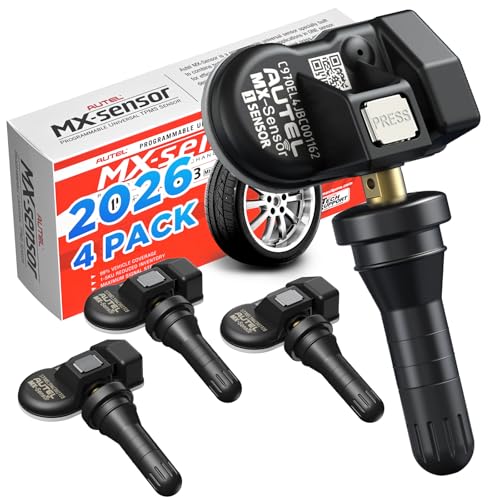
This single Autel sensor covers both 315MHz and 433MHz frequencies in one compact unit, which means it works with 98% of vehicles without you having to guess the band. It uses an upgraded 88 chip — a newer processor inside the sensor — that owners say gives a stronger signal during wireless programming compared to older sensor chips. The whole sensor weighs just 11g, so it is noticeably lighter than most internal sensors you will find.
Buyers report it fits and programs cleanly on everything from a 2010 Toyota RAV4 to a 2020 Ford Escape. The catch: this sensor arrives blank. You need an Autel TPMS programming tool (like the TS501 Pro or TS508) to write the vehicle data onto it before installation. That extra step buys you the flexibility to use one SKU across your whole fleet. The battery is rated for 4–6 years or 24,000 miles, and the sensor operates from -40°C to 125°C — so extreme winter cold or desert heat will not knock it out.
As owners put it: “Easy to program and relearn via Autel TS501 Pro using OBD and auto create methods.” About 27 buyers cite ease of setup as the top reason to buy, and 26 more praise the build quality. If you are the kind of person who likes to tune your own car and has (or plans to buy) an Autel tool, this is the single most versatile sensor you can get.
Smart Invite
- Dual 315+433MHz frequency covers nearly every passenger car
- 11g body is lighter than most sensors, reducing wheel vibration
- 100% clone-able — no relearn needed if you copy the original sensor ID
- Rated for extreme temps from -40°C to 125°C
One Hiccup
- Requires an Autel TPMS tool to program (cannot be used without one)
- Battery life at 4–6 years is shorter than the Marsflex’s 5–8 years
- Only one sensor per pack — buying a full set of four costs more upfront
Grab It If: you already own an Autel TPMS tool or plan to buy one, and you want one sensor model that works for every car in your driveway.
Look Elsewhere If: you want a pre-programmed sensor you can install without any scanning tool — the RENECTIV or A-Premium packs skip the programming step.
2. Autel TPMS MX-Sensor Set of 4 (315+433MHz)
The same universal sensor tech, now in a full four-pack for the whole car.
This is the same Autel MX-Sensor from the top pick, but sold as a set of four — one for each wheel. The big advantage here is inventory simplicity: with one SKU, this pack covers 99% of direct-TPMS vehicles across American, Asian, and European brands. Like the single, each sensor runs the 88 chip for fast wireless programming and supports both 315MHz and 433MHz frequencies. The body weighs just 11g per sensor and uses a press-in rubber valve stem.
The key difference from pre-programmed packs is that these sensors still need programming with an Autel TPMS tool before they will talk to your car. That open up a neat trick: you can clone the original sensor IDs, which means the car thinks nothing changed and no relearn procedure is required. Owners mention using these on a 2021 Nissan Titan and a 2009 Hyundai Sonata without issues. The 4-pack also includes both rubber and metal valve stems, so you can pick whichever fits your rim best.
The trade-off is price — the four-pack costs more than pre-programmed alternatives like the RENECTIV or Marsflex sets. But if you run a shop or maintain multiple cars, being able to program 20 sensors at once with a compatible Autel tool saves serious time.
Professional Edge
- One SKU covers 99% of vehicles, cutting inventory cost
- 100% clone-able for no-relearn installation
- Includes both rubber and metal valve stems
- Up to 20 sensors can be programmed in one batch with Autel tools
Fine Print
- Requires an Autel TPMS tool (no other brand of scanner works)
- Not compatible with 12V/24V commercial vehicles or Bluetooth-based TPMS
Ideal For: repair shops or serious DIYers who own an Autel tool and want one universal sensor that does not care what pulls into the bay.
Not For: anyone who wants to open the box and install without touching a programmer.
3. Masoll M13 Tire Pressure Monitoring System
Solar-powered tire monitoring you set and forget — ideal for RV road trips.
The Masoll M13 is a complete system: a central LCD display monitor plus four external screw-on sensors. The display charges itself through a solar panel on top, so you never have to plug it in. It also has an anti-reflective screen and auto-brightness, which owners say keeps readings clear even in direct sunlight, though some find the screen tough to read in very bright conditions.
What sets the M13 apart is its auto-calibration. You inflate your tires to your preferred pressure, and the system takes that as the reference point. It then alarms when pressure rises 25% above or drops 15% below that baseline — no manual threshold setting required. The pressure range goes from 0 to 87 PSI with an accuracy of 1.5 PSI, which is tight enough to catch a slow leak before it becomes a blowout. One owner reported that the alarm caught a trailer tire losing air at 3,000 miles and saved the tire.
Reliability earns the most owner praise by a wide margin, with over 100 buyers calling it solid. The intelligent sleep/wake mode means the monitor powers on when it detects motion and shuts down after 15 minutes of stillness, conserving battery. For trailers longer than 38 feet, Masoll recommends adding a signal booster.
Smart Choice: RV owners who want a no-fuss, solar-powered system that stays charged without cables and catches pressure drops before they strand you.
4. GUTA GT30 Trailer TPMS with 10 Sensors
Massive coverage for big rigs — up to 46 tires across three trailers.
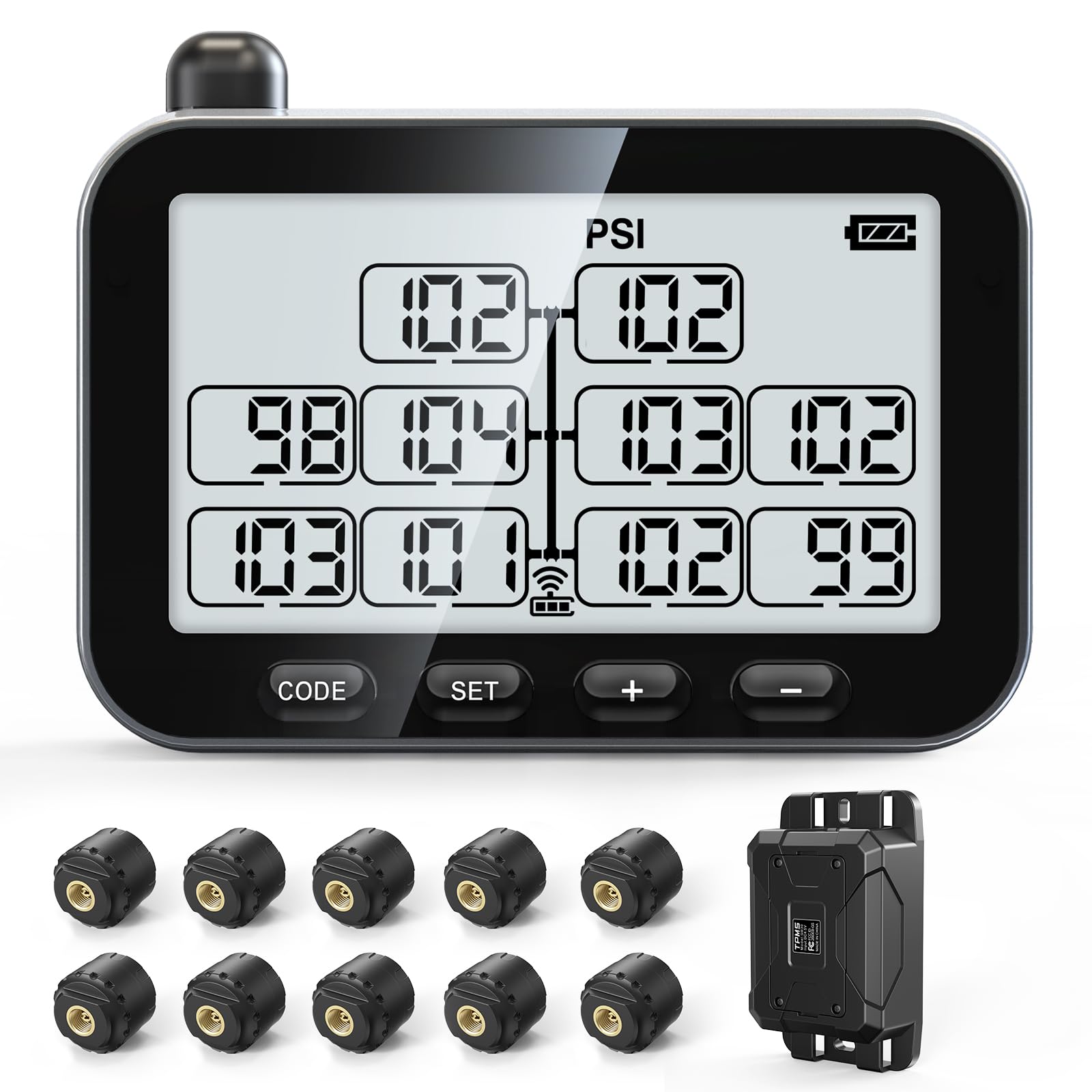
The GT30 is built for serious RVers and fifth-wheel owners who need to monitor more than four tires. It ships with 10 external sensors and a signal booster to punch the signal through a long trailer. The system can handle pressure up to 188 PSI and tire temperature up to 185°F — figures that cover heavy-duty truck and motorhome tires with room to spare.
Setup is notably simple. The sensors use a wireless programming process that pairs them before you screw them onto the valve stems. The monitor then takes the current pressure as the reference and auto-sets alarm thresholds at +25% and -15% of that figure. There are six alert modes: high/low pressure, high temperature, fast leak, missing sensor signal, and low sensor battery. One owner driving a Class A motorhome said the system monitored all eight RV tires and the towed vehicle without a single dropout over 3,600 miles.
The monitor runs on a built-in rechargeable lithium battery that lasts 12–14 days per charge. Owners say the backlight can be hard to read on a sunny windshield, so mounting it on the dash with velcro is a common workaround. Sensor batteries are replaceable CR2032 cells rated for up to 4 years.
Trailer Ready: you need to track pressure and temp on every tire of a motorhome and trailer — the 10 sensors and booster handle what smaller systems cannot.
5. MORESENSOR Signature Series 315MHz 4-Pack

A pre-programmed four-pack that just needs a relearn — no separate tool purchase required.
The MORESENSOR Signature Series comes ready to pair with 120+ American-brand models right from the start. You still have to do a relearn procedure once they are installed — that is a standard drive cycle or a simple tool sequence from your owner’s manual — but you do not need to program them from scratch. That makes this a much simpler option for someone who just wants to replace four dead sensors without buying a TPMS tool.
Customers note smooth installation on a 2011 Crown Victoria, a 2008 Mercury Marquis, and a 2009 Mustang GT. The stated battery life is 5–8 years, which beats the Autel’s 4–6 years. One owner noted the shop installer struggled with the rubber valve security and ended up swapping to a metal valve — something to keep in mind if you prefer the feel of a metal stem. The sensors are IP67 waterproof (dust-tight and can handle immersion in water), so heavy rain and car washes will not hurt them.
The catch is that these are pre-programmed for specific makes, so you need to use Amazon’s Part Finder or check fitment before buying. They are not the universal blank slate that the Autel MX-Sensor is. But for Ford, Lincoln, and Mercury owners, this is a straightforward, well-priced swap.
Reach For This If: you drive a Ford, Mercury, or Lincoln from the last 15 years and want a four-pack you can hand to a tire shop without programming instructions.
6. RENECTIV TPMS Sensor 433MHz 4-Pack
A 433MHz set that targets GM, Buick, Cadillac, and GMC specifically.
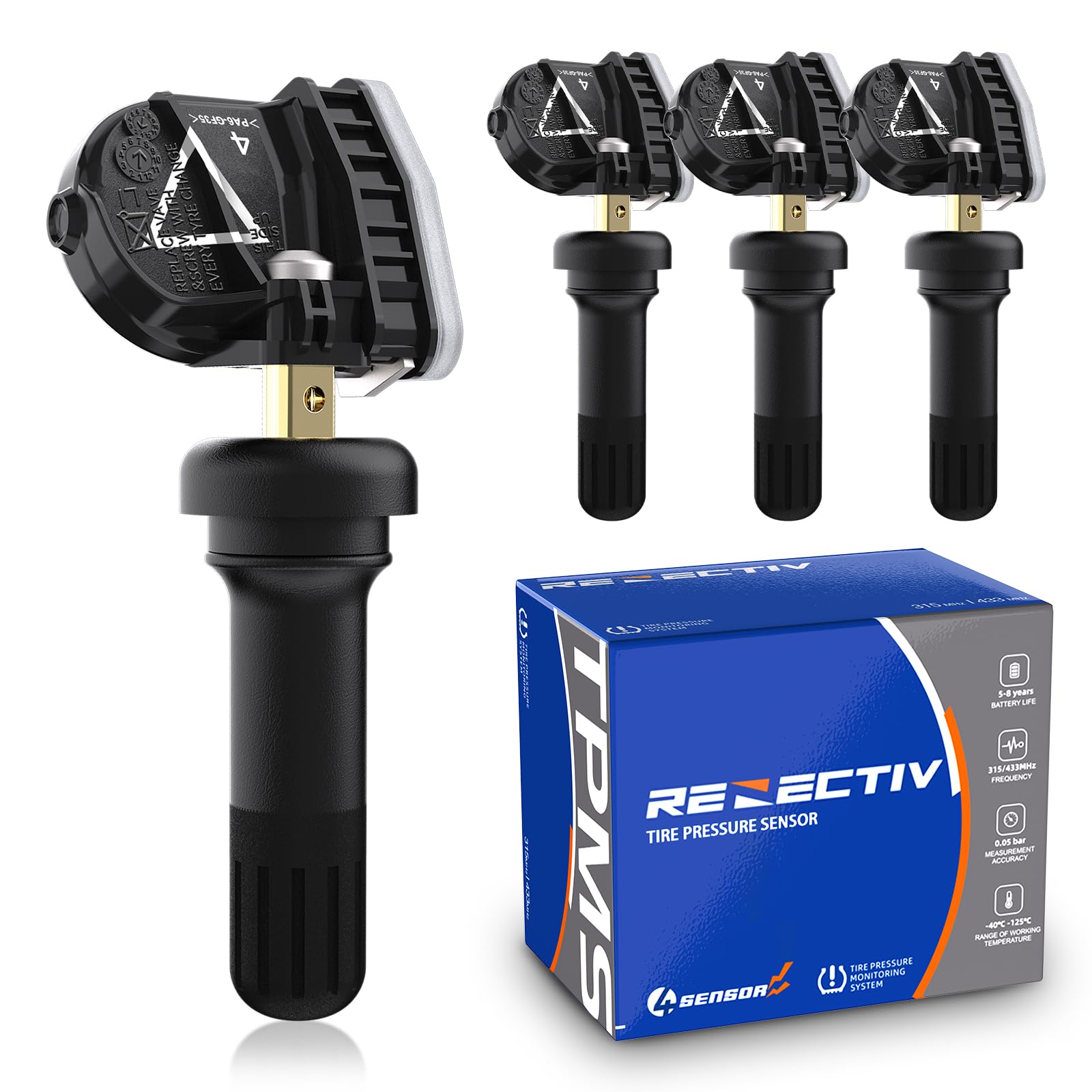
The RENECTIV set is pre-programmed for a defined list of vehicles — mostly GM-family brands — and arrives ready to activate with a TPMS scan tool. The critical spec is the 433MHz frequency, which is the standard for many Buick and Cadillac models. If your car runs 315MHz, this set will not communicate, so double-check your car’s frequency before ordering.
What wins owners over is the value: a four-pack at a price that often beats what a single dealer sensor would cost. One owner mentioned paying for this sensor versus at a dealer and at a tire shop. Data from 566 ratings shows functionality and quality are the most-praised aspects, with 45 and 19 mentions respectively. Some reviewers point out that the sensors occasionally show the wrong tire position after the relearn, though it corrects itself on the next drive cycle.
Durability gets a mixed reception from a smaller group of buyers, with a few sensors failing early. The set carries a one-year warranty from RENECTIV, which offers a safety net if you hit a dud.
Best For: 433MHz GM and Buick owners who want a budget-friendly kit and have a scan tool to activate the sensors.
7. A-Premium 315MHz Pre-Programmed TPMS 4-Pack
A straightforward 315MHz set for GM trucks and SUVs, pre-programmed and ready to relearn.
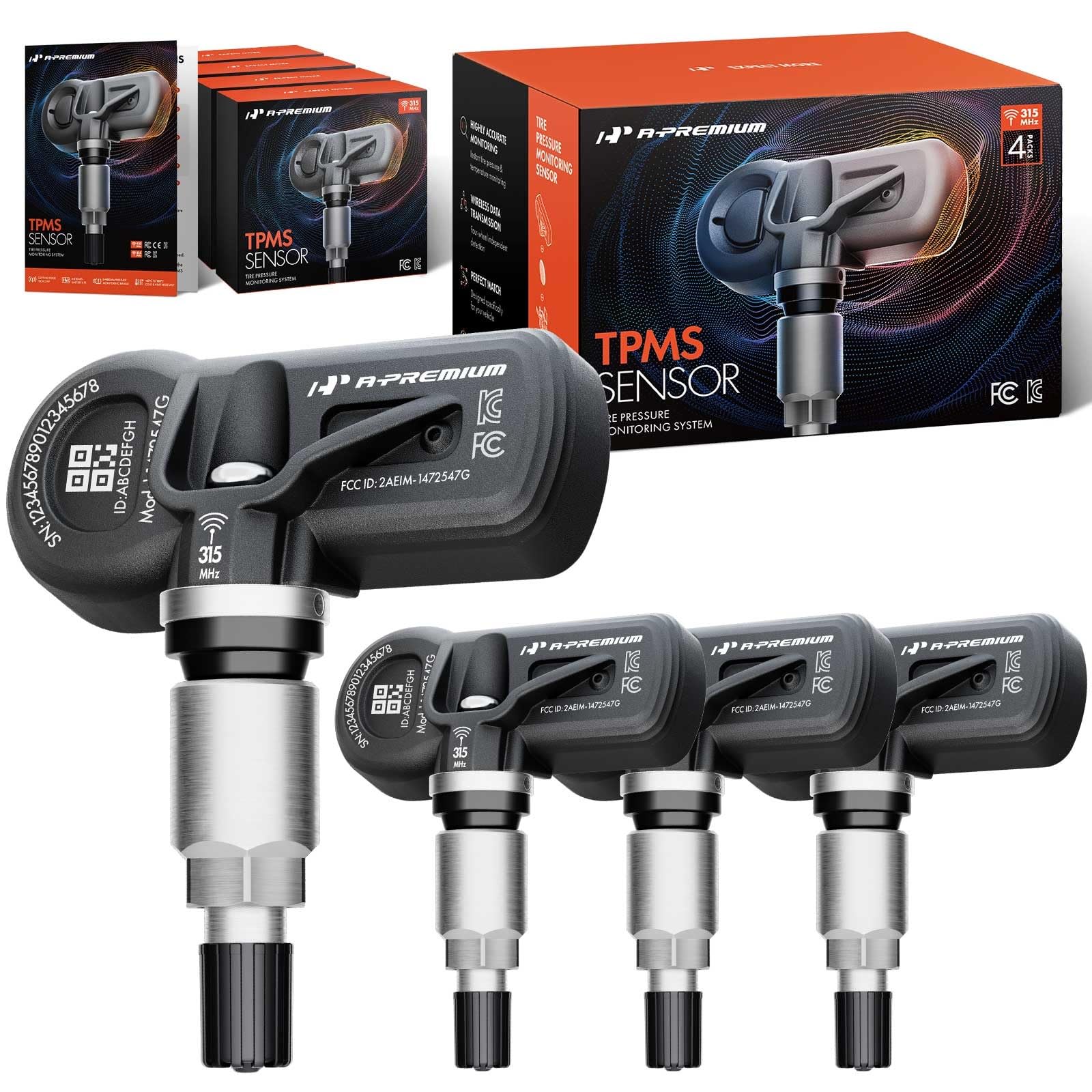
A-Premium’s 4-pack is pre-programmed for a broad list of Chevrolet, GMC, Cadillac, Buick, Saab, and Saturn models from the 2006–2020 range. The sensors use a clamp-in aluminum valve stem — an upgrade over rubber stems that some tire shops find more secure. They are FCC and IC certified and tested to SAE J2657 standards, a third-party industry benchmark for TPMS reliability.
The pressure range stretches from 0 to 130.53 PSI with an accuracy of ±0.06 Bar, which is tight enough to catch a slow leak. The response time is listed at 1 second, meaning the dashboard updates fast when pressure changes. A few owners received sensors that appeared to be returns or had low-battery errors from the start, so it is worth inspecting the package as soon as it arrives. The 2-year guarantee from A-Premium gives you room to get a replacement if that happens.
Functionality is the top owner praise here, with 30 buyers calling it a solid performer. The set works with a TPMS relearn tool (sold separately) to sync to your truck after installation. The main caveat: these are pre-programmed rather than clone-able, so if your vehicle requires a specific sensor ID, you will need to do the standard relearn procedure.
Reach For This If: you own a Chevy Silverado, GMC Sierra, or Cadillac Escalade and want a pre-programmed set with metal stems and a 2-year guarantee.
8. Masoll TPMS Sensor Set for GM (Dual 315/433MHz)
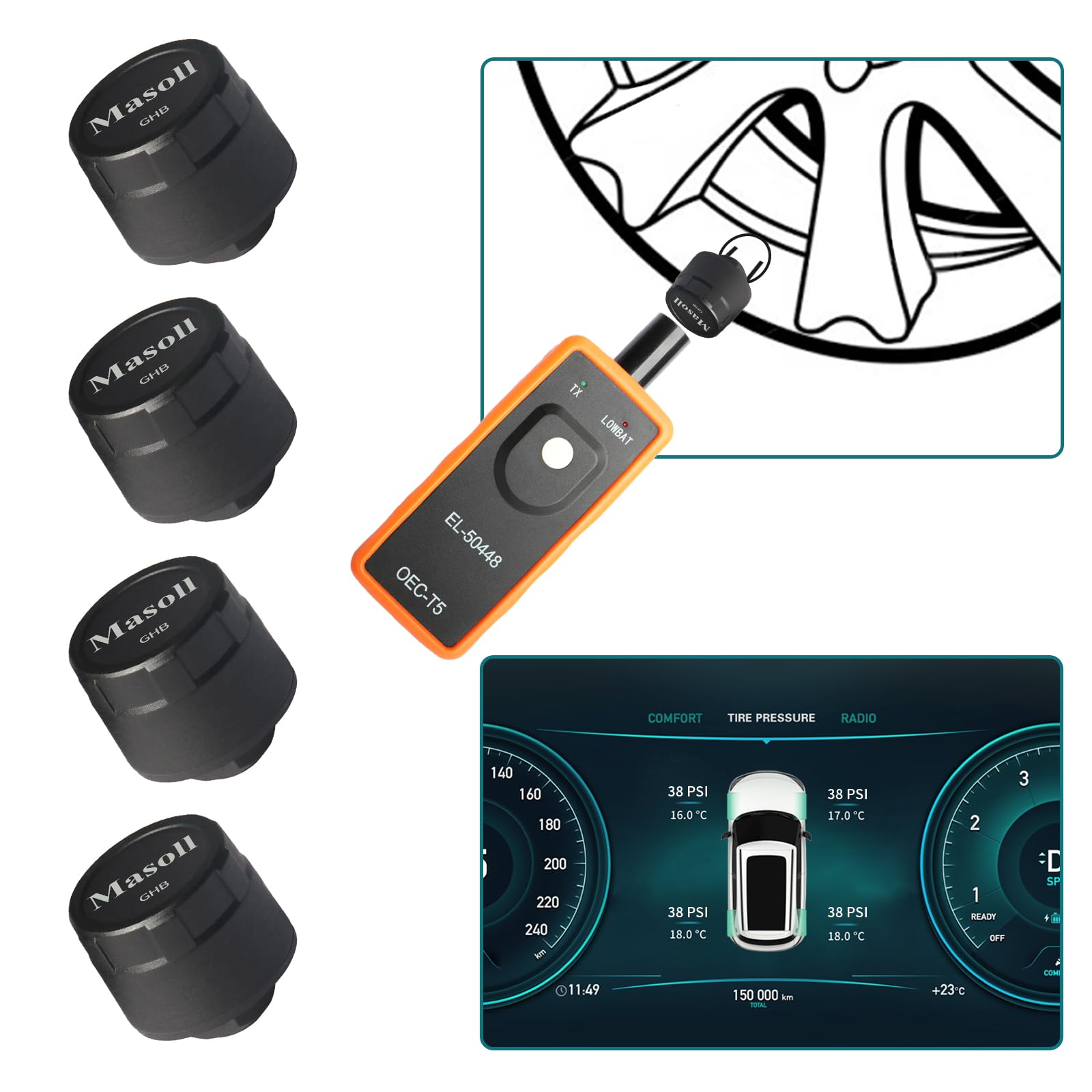
External sensors you can screw on in five minutes — no tire dismounting needed.
This Masoll set is different from every other pick on this list because the sensors sit on the outside of your valve stem. That means you can install them yourself with zero tools: just screw each sensor onto the stem, use the included TPMS relearn tool to sync it to your car, and you are done. The kit works with both 315MHz and 433MHz frequencies, so it covers GM-branded vehicles (Chevy, Buick, Cadillac, GMC) from 2006 onward.
Shoppers say the setup takes about five minutes for an HD truck and that the sensors are accurate within 1.5 PSI. The external design means the battery is replaceable — when it dies after about 2 years, you open the sensor and swap in a new one rather than buying a whole new unit. That is a real cost saver over internal sensors whose sealed batteries force a full replacement. The trade-off is physical size: the sensors are bulky enough that one owner said the cap rubbed against a kerb during a tight turn. And because they sit outside, they are more exposed to weather and road debris.
The kit comes with spare o-rings and theft-deterrent nuts. The pack of 4 costs well under half of what a dealer would charge for internal replacements.
Great For: drivers who want to swap sensors themselves in minutes and avoid a tire shop visit. Skinny On It If: you are worried about kerb strikes or theft — the external caps sit exposed.
9. Marsflex TPMS Sensors PMV-107J 315MHz 4-Pack

A pre-programmed four-pack for Toyota and Lexus with a claimed 5–8 year battery.
The Marsflex set replaces OEM part numbers PMV-107J, 42607-33011, and 42607-33021, covering a long list of Toyota, Lexus, Scion, and Pontiac Vibe models. At 315MHz, these match the frequency used by most Toyota and Lexus vehicles. The standout spec is the battery life claim of 5–8 years — that is a 25% longer span than the Autel’s 4–6 years. The operating temperature range is -40°C to 125°C, matching the heavy-duty Autel spec.
Of all the products here, this one has the highest owner count for functionality — 91 buyers call them effective. The most-discussed trade-off is programming, which gets a mixed reception with 20 mentions. Some owners say the sensors paired without issue after inflating the tires, while a few report the TPMS warning light returning after 40–60 miles, requiring a second visit to a shop. The 1-year warranty covers replacements, but note that a small number of buyers experienced early failures.
Value for money is the second-most-praised aspect, with 47 owners calling them a bargain compared to OEM replacements that can run + each. If you drive a Toyota or Lexus and want to save serious cash over dealer parts, this set is the most-reviewed budget option here.
Grab It If: you own a compatible Toyota or Lexus and want the lowest-cost four-pack with the longest battery life claim. Think Twice If: your vehicle needs a perfect pairing every time — a small percentage of buyers needed a second attempt.
Understanding the Specs
Frequency (315MHz vs. 433MHz)
This is the radio channel your car’s computer uses to talk to the sensor. American brands like Ford, Chevy, and GMC mostly use 315MHz. Asian and European brands tend to use 433MHz. A dual-frequency sensor (like the Autel MX) detects and works on whichever channel your car needs, so you never have to guess — that is the safest buy if you are unsure.
Internal vs. External Mount
Internal sensors sit inside the tire, mounted on the valve stem. They are the standard fit on most modern cars. They last longer on sealed batteries but require a tire shop to install. External sensors screw onto the valve stem from outside. You can install them in minutes with no tools, and the batteries are often replaceable, but they are exposed to kerb damage and theft.
Pre-Programmed vs. Universal
Pre-programmed sensors arrive already set for a specific list of vehicle models. You install them and do a relearn procedure (a drive cycle or a reset sequence from your manual). Universal sensors arrive blank and must be programmed with a TPMS tool before installation. They offer wider coverage but require an extra device and step.
Relearn vs. Clone
A relearn is a procedure — usually a magnet sweep or a drive cycle — that tells your car which sensor is at which wheel. Cloning copies the original sensor’s exact ID onto the new sensor. If you clone, the car does not know the sensor was changed, so no relearn is needed. Clone-able sensors (like the Autel MX) save time if you swap wheels often.
FAQ
Will any TPMS sensor work with my car?
How long do TPMS sensor batteries last?
Do I need a special tool to program TPMS sensors?
What is a TPMS relearn procedure?
Can I install TPMS sensors myself?
What happens when a TPMS sensor battery dies?
Is 315MHz or 433MHz better?
What is the difference between snap-in and clamp-in sensors?
Will these sensors work on my trailer or RV?
How do I know if my car has a TPMS sensor issue?
Final Thoughts: The Verdict
For most drivers, the wheel tire pressure sensor that makes the most sense is the Autel MX-Sensor (1-Pack) because it covers both frequencies, is clone-able, and weighs just 11g — but you need an Autel tool to program it. If you want a pre-programmed set you can install without a tool, the MORESENSOR Signature Series 4-Pack is the right call for Ford and Lincoln owners at a solid value. And for RV and trailer duties, the Masoll M13 System gives you solar charging and auto-calibration so you can focus on the road, not the dashboard.
How We Picked
We do not accept paid placement. Every pick is matched to a real buyer and a real use-case; we do not hands-on test units.
Sources & Methodology
Specifications: manufacturer listings and product documentation. Review insights: verified customer reviews, as of July 2026. Pricing: not shown on this page (it changes often); check the current price via the retailer link.
As an Amazon Associate, GoCarLife earns from qualifying purchases. This does not affect which products we feature.