
Our readers keep the lights on and the garage heater humming. As an Amazon Associate, I earn from qualifying purchases.
Specs are compiled from manufacturer listings and verified buyer reviews and can change over time — please confirm the key details on the product page before buying.
You turn the key, and nothing happens — except that sinking feeling. The real question is not if you need a new battery, but which one will keep you from standing in a cold parking lot again. This guide breaks down the six best options on the market so you know exactly which replacement fits your car, your climate, and your daily routine without the confusing sales pitch.
I’m Mo Maruf — the founder and writer behind GoCarLife. This guide is built by comparing the manufacturers’ published specifications and the patterns across verified customer reviews, so you get each pick’s real strengths and trade-offs instead of marketing spin.
The most important spec to understand is cold cranking amps (CCA) — the measure of how much starting power the battery delivers in freezing weather — and the right car battery for your vehicle balances that number with the physical size (its group size) that fits your battery tray.
Our Picks at a Glance

How To Choose The Best Car Battery
Buying a car battery feels overwhelming because you suddenly have to care about things like cold cranking amps, group sizes, and AGM versus flooded lead-acid. But the choice depends on three simple questions: Does it fit in my car? Does it have enough power to start in winter? And does the technology match my driving habits?
Group Size — The Only Fit Number That Matters
Group size is a standardized physical dimension set by the Battery Council International (BCI). A Group 48 battery, for example, will not physically fit in a car that calls for a Group 51R, even if both are 12-volt batteries. Check your owner’s manual or your current battery label for the group size before buying anything. Terminals (the posts you connect cables to) also have positions — left positive or right positive — so verify that orientation too.
Cold Cranking Amps (CCA) — Your Winter Start
CCA is the number of amps a fully charged battery can deliver for 30 seconds at 0°F while staying above 7.2 volts. A higher CCA means easier starts in cold weather, but more is not always better — your car’s manufacturer already spec’d the minimum for a reason. Going too far above that number is usually harmless, but dropping below it means a sluggish start when the temperature dips.
AGM vs Flooded — Which Chemistry Fits Your Life
AGM (Absorbent Glass Mat) batteries use a fiberglass mat to hold the electrolyte, making them spill-proof, more vibration-resistant, and better for stop-start cars. Flooded (wet cell) batteries are cheaper but need periodic water checks and can leak if tipped. If your car has a start-stop system, you need an AGM battery — a flooded battery will not last long in that role. For older cars without stop-start, a good flooded battery still works well and saves money.
Quick Comparison
| Model | Best For | CCA | Capacity | Weight | Amazon |
|---|---|---|---|---|---|
| MARXON Group 48 H6 L3★ Best Overall | Best Overall | 760 CCA | 70 Ah | 48 lbs | Amazon |
| Autocessking H5 Group 47Best Value | Best Value | 680 CCA | 60 Ah | 39 lbs | Amazon |
| ACDelco Gold 51RAGM | Compact & Reliable | — | — | 32 lbs | Amazon |
| Goodyear 35-AGM | Premium Performance | 650 CCA | 55 Ah | 39.7 lbs | Amazon |
| Odyssey PC925LMJ | High-Vibration Use | 330 CCA | 52 min RC | 26 lbs | Amazon |
| OPTIMA RedTop 34 | Top-Tier Power | 800 CCA | 50 Ah | 37.9 lbs | Amazon |
In‑Depth Reviews
1. MARXON Group 48 H6 L3 Car Battery
Our pick — 4.5★ from 700+ verified ratings; the strongest balance of quality and price.
The heavy-duty AGM that packs 760 CCA into a stop-start-ready package without the premium price.
A buyer driving a Euro sedan reported that it fit perfectly in a trunk-mounted tray and started a Jaguar XF without hesitation after an overnight charge. The three-year warranty takes the edge off buying an unfamiliar brand, and the AGM construction means you can mount it in a start-stop car without the early failure that flooded batteries suffer in that role.
The deepest praise from owners focuses on the sheer bang-for-buck. Shoppers compare it favorably to dealer replacements, noting it arrived quickly and charged up in about six hours. MARXON claims a 40% faster charging time than standard SLA batteries. A recurring observation is that this unit appears to be an AGM deep-cycle design, meaning a deep discharge does not permanently kill it the way it would a conventional battery. “I have had this battery in a car for almost a year with no issues,” one owner sums up — still starting strong and holding a charge.
What wins owners over
- Highest capacity of the group at 70 Ah and 760 CCA — stops winter-start worry cold.
- True AGM design compatible with stop-start vehicles, saving an estimated 10% in gas per trip.
- Three-year warranty and affordable price — half what many dealer batteries cost.
- Fast charge acceptance; buyers report 97-98% capacity after a voltage-method recharge.
A real caveat to weigh
- Packaging in transit can be flimsy — a few units arrived damaged, though the vendor replaced them with stronger packaging.
- The brand is not a household name, so long-term reliability (past three years) is harder to predict than with a legacy brand.
Reach for this if: you drive a stop-start vehicle, need strong cold-cranking power in a Group 48 or H6 fitment, and want AGM performance without a dealer-level markup.
Look elsewhere if: you are set on a name you recognize from auto parts stores, or your car requires a smaller group size like 51R.
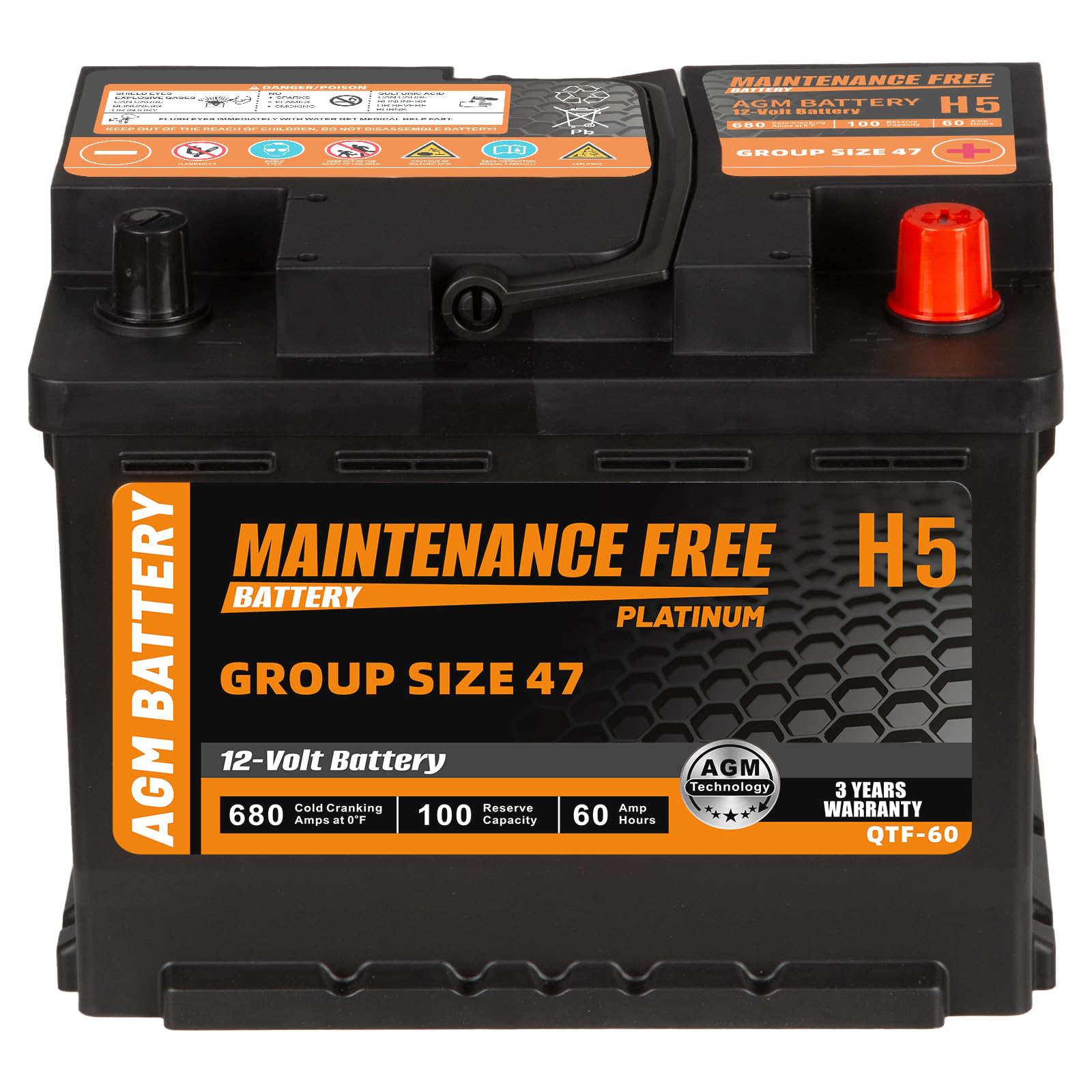
2. Autocessking H5 Group Size 47 AGM Battery
A compact AGM that fires up a diesel truck on the first crank, at half the price of a parts-store replacement.
This Group 47 (H5) battery delivers 680 CCA and 60 amp-hours in a package that is measuring 9.57 inches long versus the MARXON at 10.95 inches — making it the right choice for cars and trucks with limited tray space. One buyer dropped it straight into a 2003 Ford F350 diesel and, in their own words, “cranked like a champ!” right from the start. The AGM construction uses high-density negative paste for what the maker claims is four times the cycle life of a standard battery.
Vibration resistance is a standout here — the maker rates it 18 times more vibration-resistant than a conventional flooded battery, which matters if you drive rough roads or off-road occasionally. It can also handle extreme temperatures from -40°C to 75°C, so a Canadian winter or a desert summer is within its range. Just keep in mind that this is a starting battery, not a deep-cycle unit — it is not meant for solar projects or sustained accessory draw.
Why it stands out
- 680 CCA in a compact Group 47 package — plenty of power for most sedans, SUVs, and even diesel trucks.
- AGM with high vibration resistance (18x standard) handles rough roads without internal damage.
- Three-year warranty and a price that runs about half of what brick-and-mortar stores charge.
- Reviewers praise the excellent packaging — units arrive charged and protected from transit damage.
One thing to plan for
- Not designed for deep-cycle use — if you need a battery for trolling motors or solar storage, choose a different type.
- Long-term reliability is still unproven since the brand is relatively new to the market.
Ideal for: drivers with a Group 47/H5 fitment who want AGM durability and strong starting power without overspending.
Pass on this if: your vehicle needs a larger battery or you plan to use it for deep-cycle applications like powering accessories.
3. ACDelco Gold 51RAGM AGM Battery
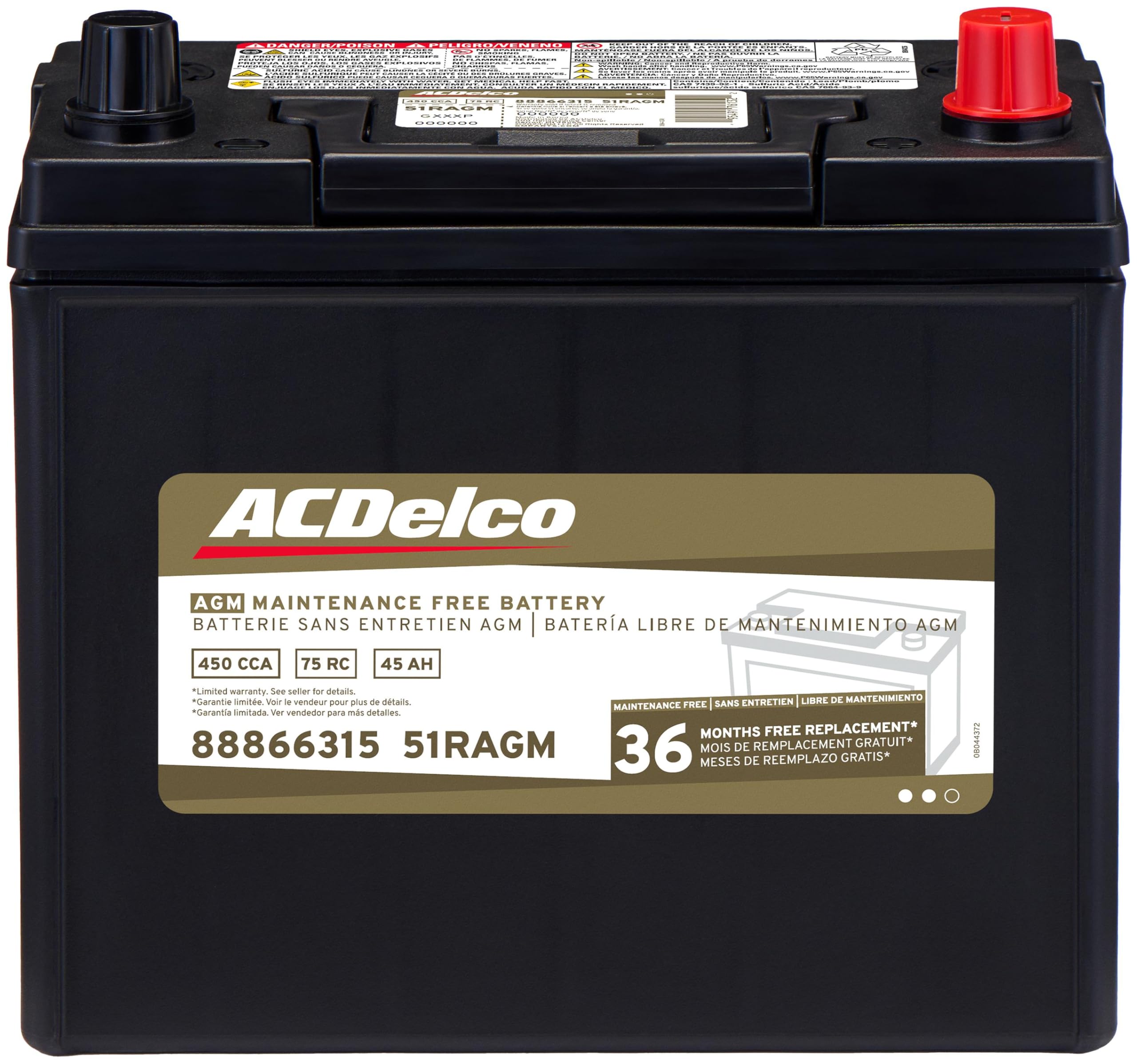
The 32-pound featherweight that one owner says “lasted 11 years in a truck” — and fits Honda Civics perfectly.
This is the lightest battery on the list at 32 pounds, which is 16 pounds lighter than the MARXON at 48 pounds that matters if you wrestle batteries in and out of tight engine bays. It is a Group 51R size, which is the standard fitment for many Honda Civics, Acuras, and smaller sedans. One owner noted that despite Amazon’s compatibility checker saying it would not fit their 2000 Acura Integra, it was the correct 51R size and worked great. The battery quality is the single most praised aspect among owners, followed closely by solid performance.
The showstopper story comes from a buyer who used an ACDelco battery in their truck for 11 years before needing a replacement. That is an outlier, but it speaks to the manufacturing consistency that comes from being an OEM supplier for General Motors. The 36-month warranty adds confidence, and the AGM construction means it is maintenance-free — no water top-offs, no corrosion cleaning.
No-drama daily driver: this battery does not try to wow you with specs — it fits, it starts, and it lasts. The recurring observation is that it outperforms the typical Walmart-branded replacement by a wide margin.
Best for: Honda Civic, Acura Integra, and other Group 51R vehicles where a lightweight, trustworthy AGM that simply works is the priority.
skip it if: your car requires a larger group size like 48, 35, or 34 — this 51R is small and will not physically fit a larger tray.
4. Goodyear 35-AGM Platinum Series Battery
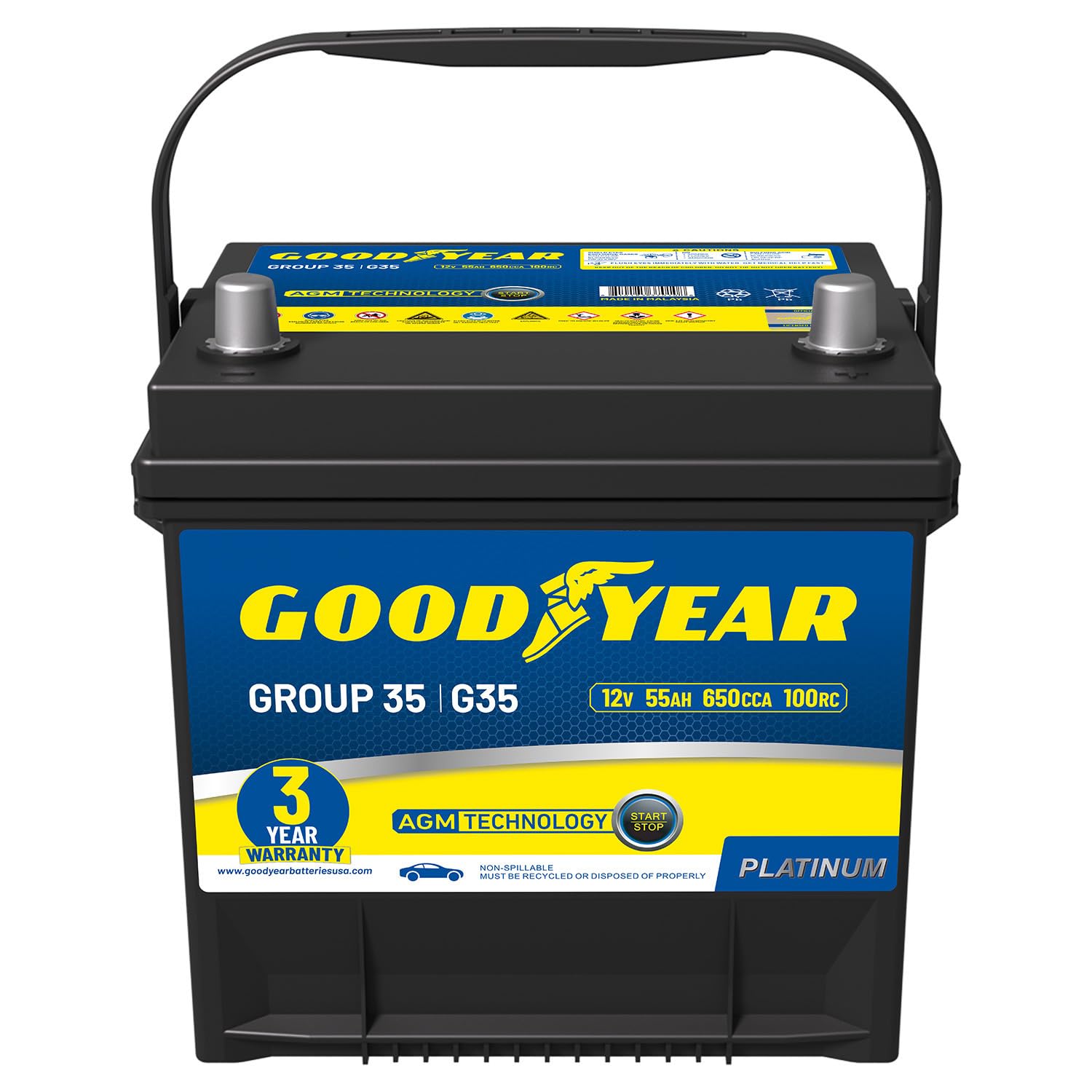
A name you trust from the tire aisle steps into batteries — with a 100-minute reserve that keeps electronics humming.
The Goodyear 35-AGM delivers 650 CCA and 55 amp-hours, but the real story is the 100-minute reserve capacity (RC). That is the number of minutes the battery can run your car’s essential electronics if the alternator fails, which is a strong safety margin. For comparison, that is nearly double the reserve capacity of some smaller batteries. At 39.7 pounds, it is a midweight AGM that fits Group 35 applications, and owners mention it fixed LED headlight flicker — a common symptom of a worn-out battery that cannot maintain consistent voltage.
The CE-certified build and ISO-certified factory give it a quality pedigree, and the spill-proof AGM design means you can install it in multiple positions (just not upside down). Owners swapping out auxiliary batteries in Mercedes E-Class and Jeep Wrangler models report a perfect fit and immediate restoration of stop-start functions. A single review flags a warranty-service headache, but the broader consensus is that this is a legitimate, well-made replacement for OEM-grade performance.
Strong, with a watch-out: the 100-minute reserve capacity is a genuine differentiator for anyone who runs accessories or wants alternator-failure protection. The warranty service concern, while rare, means you should buy from a seller with a good return policy.
Choose this for: a Group 35 fitment where you want a known brand, strong reserve power, and the upgrade from flooded to AGM for better voltage stability.
Think twice if: you are on a tight budget — there are capable AGMs at a lower price point — or if you prioritize a low-maintenance warranty experience above all.
5. Odyssey PC925LMJ Battery

A 26-pound power cell that runs a V8 ski boat, a spot welder, and still starts your ATQ after nine years.
The Odyssey PC925 is not your typical car battery — it is a compact, sealed AGM rated at 330 CCA and 52 minutes of reserve capacity, but it is built for applications that murder ordinary batteries: off-road vehicles, motorcycles, snowmobiles, and car audio systems. At 26 pounds, it is the lightest battery here, yet customers note it lasting 8 to 9 years in abusive conditions — one buyer used it as a starter for a 5.0-liter Coyote V8 from 2018 until 2026 before noticing any weakness. The four-year full replacement warranty (not a pro-rata deal) is the best in this group.
What sets Odyssey apart is the recharge efficiency — the maker claims it can accept a full recharge in 4 to 6 hours, faster than any sealed lead-acid competitor. The design handles deep discharges without damage, making it the only battery on this list that works equally well as a starting battery and a deep-cycle power source. The mounting flexibility (non-spillable at any angle except inverted) makes it a go-to for custom builds where the battery sits on its side or at an angle.
What makes it special
- Extreme lifespan — 3 to 10 years of service life with up to 400 cycles at 80% depth of discharge.
- Fastest recharge of any sealed lead-acid: 100% in 4 to 6 hours keeps you moving.
- Deep-cycle capable — the only pick here that doubles as a starter and a deep-cycle battery.
- 4-year full replacement warranty with no pro-rata phase for the first three years.
Consider this
- 330 CCA is low for a main-start battery in a full-size car with a gas V8 — it suits auxiliary or specialty use best.
- Premium pricing and limited return options — non-returnable on Amazon with additional shipping restrictions.
- Fitment can be tricky in some ATVs (e.g., Kawasaki Teryx 4) requiring spacer removal or terminal rerouting.
Perfect for: off-road toys, motorcycles, marine applications, car audio setups, or any use where deep cycling, vibration, and odd-angle mounting are everyday realities.
Not for: a daily-driver sedan that just needs a simple Group 34 or 48 replacement — the CCA is too low for reliable cold starts in a large engine.
6. OPTIMA RedTop 34 AGM Battery

The 800-CCA legend that survived eight years in a V8 Grand Cherokee and is fifteen times tougher than a standard battery.
It also carries a 100-minute reserve capacity and a 50 Ah rating, all wrapped in the famous SpiralCell design that uses 99.99% pure lead wound into spirals for maximum surface area. The result is starting power that owners describe as “instant” even in harsh winters, with one buyer reporting it lasted eight years in a 2001 V8 Grand Cherokee before developing a bulge. The RedTop also claims up to three times longer life than standard flooded batteries and 15 times more vibration resistance.
Battery quality is the single most-praised aspect, with 194 positive mentions — far more than any other aspect on any battery in this guide. The price tag is the highest here, but owners often frame it as roughly per year of service life, which beats replacing a cheap battery every two to three years. The AGM construction is maintenance-free and allows versatile mounting, though the RedTop is strictly a starting battery — it is not designed for deep-cycle use. A small minority report early failure, but the overwhelming majority of owners describe it as a multi-year investment that starts every time.
The performance benchmark: 800 CCA and a 100-minute reserve make this the strongest starter on the list. The price is steep, but the 8-year lifespan stories suggest it can be cheaper in the long run than replacing a budget battery every two years.
For the driver who wants: maximum cranking power, extreme cold-weather confidence, and a battery that often outlasts two of its cheaper competitors.
Opt out if: you are watching your upfront spending, or your vehicle does not need 800 CCA — most cars start just fine with 650-700.
Understanding the Specs
Cold Cranking Amps (CCA)
CCA measures how many amps the battery can deliver for 30 seconds at 0°F without dropping below 7.2 volts. Think of it as your winter-starting insurance. A battery with 760 CCA (like the MARXON) will spin a cold engine faster than one with 650 CCA (like the Goodyear). If you live where it gets truly cold, aim for a CCA number at or above your vehicle manufacturer’s specification.
Amp-Hours (Ah) & Reserve Capacity (RC)
Amp-hours tell you the total energy storage — a 70 Ah battery (the MARXON) holds 27% more energy than a 55 Ah battery (the Goodyear). Reserve Capacity (RC) is the minutes the battery can run your car’s electronics if the alternator fails. The Goodyear’s 100-minute RC is excellent safety net; the Odyssey’s 52-minute RC is fine for short auxiliary runs but not for prolonged emergency power.
FAQ
Can I put an AGM battery in a car that came with a flooded battery?
What does group size mean and why does it matter?
Is 800 CCA too much for a small car?
How long should a car battery last?
What is the difference between a starting battery and a deep-cycle battery?
Does a car battery need maintenance?
Will a heavier battery always be better?
Can I use a car battery for my lawn tractor or ATV?
Final Thoughts: The Verdict
For most buyers, the car battery that ticks all the boxes is the MARXON Group 48 H6 L3, because it delivers 760 CCA and 70 Ah of AGM power at a price that undercuts dealer batteries by hundreds of dollars, backed by a three-year warranty. If you drive a Group 47 or H5-fitment vehicle and want a lighter, more affordable AGM that still cranks a diesel without hesitation, grab the Autocessking H5. And for the buyer who wants the outright highest cranking power and is willing to pay a premium for legendary longevity, the OPTIMA RedTop 34 is the investment that keeps a V8 starting strong for nearly a decade.
How We Picked
We do not accept paid placement. Every pick is matched to a real buyer and a real use-case; we do not hands-on test units.
Sources & Methodology
Specifications: manufacturer listings and product documentation. Review insights: verified customer reviews, as of July 2026. Pricing: not shown on this page (it changes often); check the current price via the retailer link.
As an Amazon Associate, GoCarLife earns from qualifying purchases. This does not affect which products we feature.