
Our readers keep the lights on and the garage heater humming. As an Amazon Associate, I earn from qualifying purchases.
Specs are compiled from manufacturer listings and verified buyer reviews and can change over time — please confirm the key details on the product page before buying.
Picking a whip antenna for a truck feels deceptively simple — a metal rod is a metal rod, right? Not quite. The difference between a CB that reaches across town and one that barely hits the next stoplight depends on a few easily overlooked specs. This guide breaks down nine top options, from budget fiberglass to high-power steel, so you know exactly what you are mounting on your rig.
I’m Mo Maruf — the founder and writer behind GoCarLife. This guide is built by comparing the manufacturers’ published specifications and the patterns across verified customer reviews, so you get each pick’s real strengths and trade-offs instead of marketing spin.
Whether you drive a daily commuter or a weekend off-roader, the right whip antenna for truck can make the difference between clear chatter and frustrating dead air.
Our Picks at a Glance


How To Choose The Best Whip Antenna for Truck
The antenna is the most critical component of your CB system. Here are the key factors that separate a reliable whip from a frustrating one.
SWR — The Number That Determines Everything
SWR stands for Standing Wave Ratio — a measure of how well your antenna matches your radio. The lower the SWR, the more power actually goes out through the antenna. Anything below 1.5:1 is excellent; 2.0:1 is the maximum you want. A poorly tuned antenna with high SWR can even damage your radio. Most whips need some trimming or a tunable tip to get the SWR right for your specific truck. The buyer consensus is clear: tuning is not optional—it is the step that makes everything work.
Material: Fiberglass vs. Stainless Steel
Fiberglass whips (like FireStik and Prostick) are flexible, lightweight, and bounce off tree branches without snapping. They are ideal for off-road use and low clearance parking. Steel whips (like the Browning and 102-inch Pro Trucker) offer better signal efficiency because they are a true quarter-wave or half-wave length electrically. But steel is rigid — a branch or a low garage door can bend or break it. Your choice depends on where you drive. Fiberglass forgives mistakes; steel rewards a clear path.
Length and Ground Plane
Longer antennas generally transmit further because they are closer to the ideal CB wavelength of about 108 inches for a quarter-wave. A 4-foot whip is a good daily compromise between range and clearance. A 102-inch whip is the gold standard for range, but it requires a solid ground plane — usually the metal roof of a truck cab. If your mount is on a plastic bumper or a fiberglass bed, you will need to run a bonding wire to the frame for the antenna to work properly.
Quick Comparison
| Model | Best For | Length | Power Rating | Material | Amazon |
|---|---|---|---|---|---|
| 4ft Black Firefly★ Best Overall | Best Overall | 4 ft | 200 W | Fiberglass | Amazon |
| Prostick 4′Budget Value | Budget Value | 4 ft | 1000 W | Fiberglass | Amazon |
| Firestik FS-3BK 3′Low Clearance | Low Clearance | 3 ft | 650 W | Fiberglass | Amazon |
| Tram TCT-9 | Professional Truckers | 51 in | 15,000 W | Aluminum/Steel | Amazon |
| Wilson T2000 | Mid-Range Workhorse | 59 in | 3,500 W | Steel Whip | Amazon |
| FireStik 5′ II | High-Performance Fiberglass | 5 ft | 1000 W | Fiberglass | Amazon |
| Browning BR-78 | Premium Steel Range | 63 in | 15,000 W | Stainless Steel | Amazon |
| 102″ Pro Trucker | Maximum Range | 102 in | — | Stainless Steel | Amazon |
| Xprite LED Whip | Off-Road Visibility | 4 ft | — | Fiberglass w/ LED | Amazon |
In‑Depth Reviews
1. FireStik 4ft Black Firefly
Our pick — over 4.5★ from 900+ verified ratings; the strongest balance of quality and price.
The crowd-favorite whip that balances ease of tuning with real-world range.
The Firefly earns its top spot because it delivers the lowest SWR right from the start with almost no effort. Buyers report that an SWR of 2.5 on their old antenna dropped to 1.4 on channel 19 with this one — and they did it by simply raising the capacitance cap half an inch, without touching the tuning screw. That is a rare level of beginner-friendliness for a whip.
At 4 feet, it is a popular length for daily drivers: long enough for solid receive and transmit, short enough to clear most parking garages. The fiberglass shaft is noticeably thinner and more flexible than the standard FireStik, which makes it forgiving on the trail — owners mention it handles tree slaps and highway speeds with confidence. The trade-off? A few owners find it less sturdy than the thicker models; one snapped theirs during flexibility testing even with a spring mount. If you bash through heavy brush regularly, you might want the more rigid FireStik II.
The tip cover is replaceable, a small detail that keeps this antenna on the road longer. As one buyer put it, the Firefly is a “great replacement for old Firestick” — easy to tune, good reception, and light enough for solid mounting without a spring.
What Wins Owners Over
- Exceptional SWR performance with minimal tuning — 1.4 on CH19 is common
- Flexible fiberglass can take trail abuse and highway wind
- Easy screw-top tuning ideal for beginners
One Thing to Know
- Thinner than standard FireStik; not as durable for extreme off-road bashing
Reach for this if: you want a proven, easy-to-tune 4-foot whip that works for daily driving and light off-road use without a headache.
Look elsewhere if: you need a tank that shrugs off repeated branch impacts on tough trails.
2. Prostick 4′ Foot Fiberglass 1000 Watt CB Radio Antenna
A sturdy fiberglass whip that handles high power but demands you do your homework on SWR.
The Prostick is a price-conscious pick with a serious upside: it is rated to handle up to 1000 watts, giving you headroom if you ever upgrade your radio. The “VibraSorb” anti-breakage design is a real feature — the fiberglass mast and nickel-plated brass ferrule hold up well on trail rigs. Customers note it surviving severe bending past 45 degrees and constant tree slaps without cracking.
The catch is upfront work. This antenna ships electrically long, meaning it has a heavy SWR from the start — one buyer measured over 6:1. You will need to trim the copper wire under the red cap, usually around 1.5 inches, to bring the SWR down to 1.2 or 1.3. A NanoVNA or SWR meter is essential. If you skip this step, you risk poor performance or radio damage. Performance is the most-praised aspect, but tuning gets mixed feedback because of this required effort. That said, once trimmed, reviewers point out a VNA-fine-tuned SWR of 1.2-1.3 on channel 1 and 40, with a dip at 1.1 on channel 20 — excellent figures.
It is made in the USA, which adds a layer of construction quality confidence. But the lack of clear instructions and the need for trimming means this is not a pick-and-play antenna. If you are comfortable with a little DIY tuning, the Prostick is a solid 4-foot whip at a budget-friendly price that outperforms its cost.
Where It Excels
- Impressive durability in trail conditions — survives bending past 45°
- High 1000W power rating offers expansion room
Before You Buy
- Requires trimming the whip for proper SWR; not ready from the start
- No printed instructions included for the tuning process
A smart buy when: you have an SWR meter and are willing to spend 20 minutes trimming for a sub-1.5 SWR on a budget.
Not for you if: you want a screw-on-and-drive solution with zero setup.
3. Firestik FS-3BK 3′ 650W Tunable Tip CB Antenna
A short, tough whip that fits under a garage door without sacrificing too much range.
At 3 feet, this Firestik is built for the driver who cannot leave their antenna on the roof because of clearance. The tunable tip is a genuine beginner-friendly feature — you adjust the SWR with your bare hands, no tools or trimming required. Owners achieve SWRs as low as 1.1:1 with the right coax, and the consensus is that quality and performance are the top traits, with over a hundred owners praising the build alone.
There is a physical trade-off: a 3-foot antenna will never reach as far as a 4-foot or 102-inch whip. Shoppers say it talks about 6 miles with full quieting, which is solid for its size, but they also acknowledge that longer antennas offer more coverage. The upside is that you can keep it mounted full-time without worrying about low overhangs. The glass-fiber reinforced shaft and hi-performance loading coil give it the durability to survive tree and garage hits without damage — something a steel whip would not manage.
The reception is praised for both urban and rural areas. Several owners say it outperforms expectations for a short antenna, especially when paired with a good ground plane. If your daily route includes parking garages or low-clearance carports, the 3-foot Firestik is the smart compromise.
What Stands Out
- Tool-free tunable tip makes SWR adjustment painless
- Durable enough for daily tree and garage door impacts
The Range Reality
- Shorter length naturally reduces transmit range vs 4 ft or longer whips
Ideal for: daily drivers and garage-parkers who need a tough, short antenna they never have to remove.
Avoid if: maximum CB range is your top priority — longer whips perform better.
4. Tram TCT-9 15,000-Watt Trucker Twin-Coil CB Antenna

The antenna that professional truck drivers reach for when reliability and raw power handling matter.
The Tram TCT-9 is a different animal from the fiberglass whips above. It uses a twin-coil aluminum design with a 42.25-inch stainless steel whip and a 9-inch shaft, all built to handle 15,000 watts. This is serious hardware for serious setups. What wins buyers over is the SWR right from the start — multiple buyers report readings of 1.1:1 across all 40 channels with no tuning required. That is nearly unheard of for a whip and speaks to the engineering.
The trade-off is physical fragility. The whip is long and rigid; one owner reported it snapping at the plastic center after hitting a branch. For open-road highway truckers, this is rarely an issue. But if your route involves low-hanging trees or tight off-road trails, the fiberglass options above are tougher. The range, however, is “amazing” according to owners, with excellent receive and transmit performance once mounted with a good ground plane. At 13 ounces, it is light for its size, and the stainless steel 3/8-inch x 24 all-thread mount fits standard CB brackets.
This is the pick for the driver who values immediate, low-SWR performance over impact resilience. It is the antenna of choice for professional truckers for a reason.
Built for the highway: exceptional out-of-box SWR around 1.1:1 makes it near-perfect for big-rig drivers who need range without tuning fuss.
Watch the branches: the plastic center joint is a weak point against impact; not suited for off-road use.
5. Wilson Antennas T2000 3500 Watt Trucker Antenna

A 49-inch steel whip that offers big-rig performance at a price far below truck-stop retail.
The Wilson T2000 is a classic trucker antenna with a 49-inch stainless steel whip and a larger coil housing that allows for better power handling at 3,500 watts. from the start, the SWR is often 1.5:1 with no tuning needed, which is impressive for a steel whip. The 10-inch shaft uses a standard 3/8-inch x 24 thread for easy mounting.
Build quality is the top-rated aspect, with over 30 owners calling it well-made. The reception is praised as clear and broad, with one owner using it for stereo AM/FM as well. It feels solid and stays sturdy even at highway speeds. The durability feedback is mixed, however — a small number of owners mention the whip snapping at the base, typically after repeated flexing or impact. For most daily drivers and highway users, this is a non-issue, but it is note if you drive in brush-heavy environments.
This is a strong mid-range pick that competes directly with the Tram above but at a lower power rating and a lower price point. If you want a steel whip that works from the start and donot need the Tram’s 15,000W capacity, the Wilson is your antenna.
Why It’s Popular
- Great out-of-box SWR around 1.5:1 saves tuning time
- Solid build quality and clear reception praised by hundreds of owners
Watch For
- Some customers note the whip snapping at the base after hard impacts
A solid pick when: you want a proven, durable steel whip for highway use at a price that undercuts retail significantly.
Think twice if: your route is heavy on brush or low branches — fiberglass flexes, steel does not.
6. FireStik 5 Feet II Tunable Tip — Black

A 5-foot fiberglass whip that delivers near-perfect SWR readings and exceptional range for its class.
The FireStik 5′ II is the top of the fiberglass food chain. It uses a 5/8 wave length design rated at 1000 watts, and it is the longest fiberglass whip on this list at 5 feet. This extra length translates directly into more range. Owners routinely measure SWR of 1.0:1 on all channels 1-40 after tuning, which is as good as it gets.
What makes this antenna stand out is the lug-nut effect at the base: a tapered design that transfers stress away from the threads, reducing vibration loosening. This is a thoughtful engineering detail for long-term reliability. The glass fiber reinforced shaft balances flexibility and ruggedness — most owners say it is stable at highway speeds with no visible whipping. One owner reported making contact 10 miles away on the first try with an out-of-box SWR of 1.1:1 on channel 1 and 1.3:1 on channel 40.
The only consistent note of caution is the sensitivity of the tuning knob. A few owners found it too easy to overshoot the balance. But once set, the antenna holds well and delivers “additional miles of receiving and transmitting” compared to shorter models.
Why It Leads
- Nearly perfect SWR of 1.0:1 across all channels achievable with careful tuning
- Longer 5-foot length gives noticeable range advantage over shorter fiberglass whips
One Detail
- Tuning knob is highly sensitive; requires patience to dial in
Your best bet for: maximizing range with a fiberglass whip — the 5-foot length and low SWR potential are class-leading in this material class.
skip it if: you want a set-and-forget antenna and dislike fine-tuning a sensitive knob.
7. Browning BR-78 Flat-Coil CB Antenna
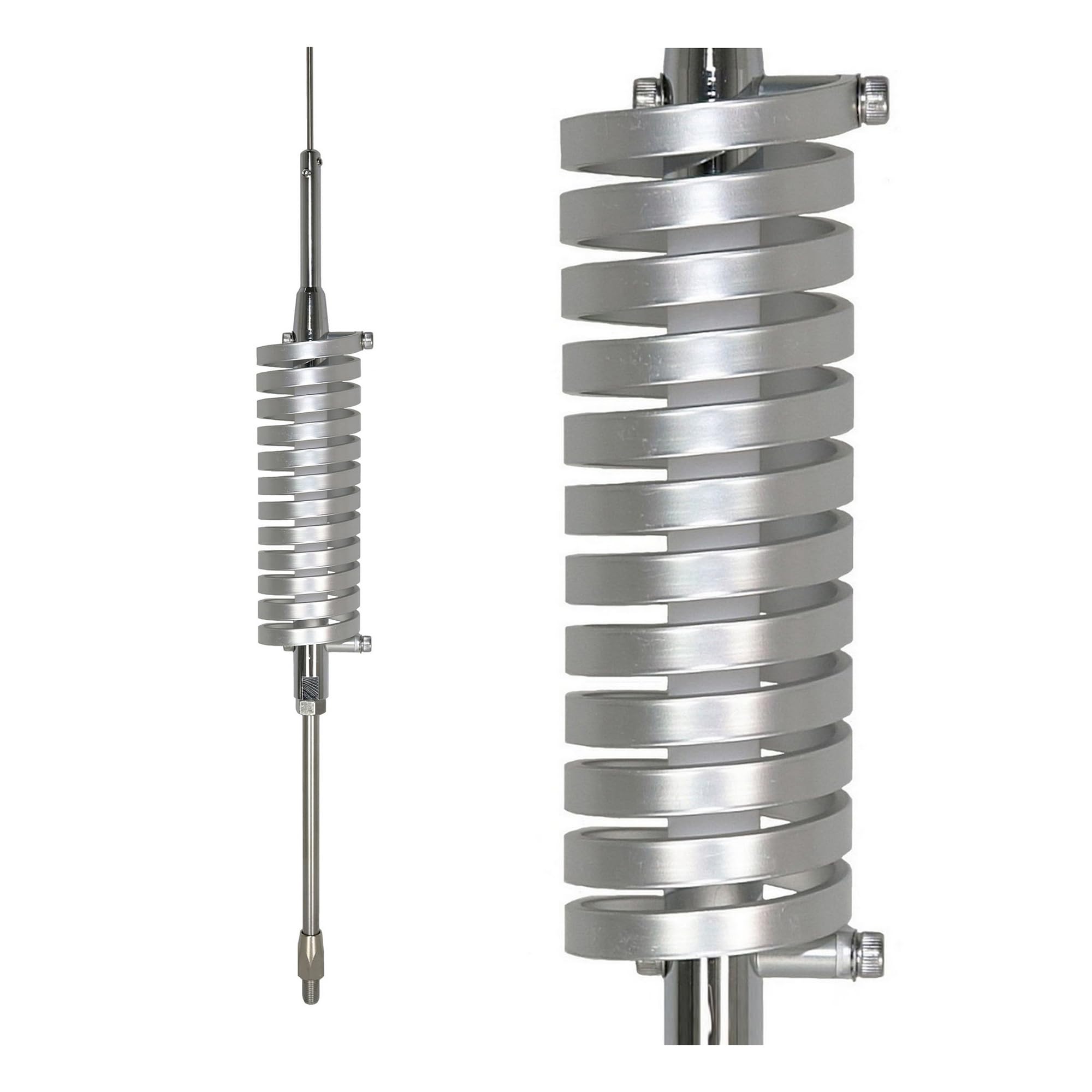
A premium steel whip that offers a 25% range increase and handles 15,000 watts without breaking a sweat.
The Browning BR-78 is a serious piece of equipment. At 63 inches tall, it is the second longest whip on this list after the 102-inch classic. It uses a stainless steel 17-7 PH tempered 3 mm tapered whip and shaft — the same alloy used in aerospace springs, chosen for its exceptional durability. The flat-coil design covers 25 MHz to 30 MHz, making it usable for both CB and 10-meter ham radio. Out-of-box SWR is often around 1.2:1 on 10 meters, which is excellent for a non-tunable whip.
Owners consistently praise the range. One reviewer noted a 25% increase in coverage over their previous antenna. Another paired it with a Stryker 955 HP and described the audio as “crisp” with skip from across the US. The steel whip outperforms fiberglass in signal efficiency, and buyers notice. The antenna quality is the most praised aspect, with over 30 owners calling it top-tier. The installation is generally straightforward, though some owners found the out-of-box SWR higher than advertised and needed to trim the whip by over an inch — a common requirement for steel antennas that is not a dealbreaker.
The Browning is a premium pick. If you are running a high-power radio and want maximum range from a durable steel whip, this is the one. It is not for the faint of budget, but the performance justifies the investment.
Range and power: the BR-78 is a top-tier performer with 15,000W capacity and a 63-inch steel whip that delivers a measurable increase in coverage.
Setup note: some owners need to trim the whip for best SWR; not always perfect from the start.
8. Pro Trucker 102″ Stainless Steel Whip Antenna

The full quarter-wave classic — 102 inches of stainless steel for the best possible CB range.
There is no getting around the physics of CB radio: a full quarter-wave antenna at 102 inches is the most efficient length for transmit and receive. The Pro Trucker delivers exactly that in a 17-7 PH tapered stainless steel whip. It is the reference standard for range, and owners confirm it delivers “incredible reception” and “very good SWR” right from the start. The SWR is naturally low because it is a true electrical quarter-wave — no loading coil needed to fake the length.
You do pay for that performance in practicality. At 8.5 feet tall, this antenna will not fit in most garages. You need a heavy-duty mount (a spring is standard practice) and a good ground plane. One owner mounted it to a plastic bumper initially and got poor performance until they ran a bonding wire to the frame — then it worked “perfect.” That is the reality of a 102-inch whip: the ground is everything. It comes packaged in a PVC pipe for safe shipping, which buyers appreciate. Durability is the second most-praised aspect; reviewers point out bending the whip regularly without it snapping, though “nothing extreme” is the common caveat.
If you have the clearance and the mount, nothing on this list matches the raw transmitting efficiency of the 102-inch Pro Trucker. But it demands space and a proper installation.
The Unbeatable Advantage
- True quarter-wave length delivers best possible CB range and efficiency
- Durable stainless steel withstands regular flexing without snapping
What It Requires
- Needs a solid ground plane and likely a bonding wire for proper performance
- 102-inch height is impractical for many trucks — low clearance is a dealbreaker
Go for it if: you have the overhead clearance and a metal roof cab, and you want the absolute best transmit range a CB whip can give.
Pass if: you park in a garage, drive under low branches, or have a fiberglass/plastic body without a ground plan.
9. Xprite 4FT CB Antenna with Spiral Amber LED Whip Light

A 4-foot CB whip that doubles as an amber LED light show for night-time trail visibility.
The Xprite is the wildcard of this list. It is a fully functional 4-foot CB radio antenna with an integrated spiral amber LED whip light that provides 360-degree illumination. The LEDs are driven by an upgraded chip and are tightly coiled for brightness. An included rocker switch lets you turn the lights on and off from the cab. Owners describe them as “amazingly bright” and easy to install, with long cords that reach most mounting locations. The antenna itself operates in the 26.9-27.5 MHz frequency range with a standard 50 ohm impedance.
The dual-purpose design means you get CB functionality and vehicle visibility in one unit. For off-road convoys, night runs, or anyone who wants their rig to stand out, this is a clever solution. The IP67 waterproof rating means it handles rain, snow, and mud without issue. The universal 3/8-inch x 24 threaded mount fits most CB radio setups. Keep in mind that channel tuning requires a professional or someone experienced with a meter — the antenna element and the LED wiring share the same physical space, so tuning is more specialized than a standard whip.
This is a niche pick. If you do not need or want the LED whip light, the fiberglass options above are better pure-performance antennas. But if you want your whip to be seen as much as it is heard, the Xprite is a genuinely unique and well-reviewed option.
Visibility and function: the integrated amber LED whip light is bright and practical for off-road night use, all while serving as a working CB antenna.
Tuning is trickier: the dual-purpose design means SWR adjustment is less straightforward than a standard whip; budget for professional tuning help.
Understanding the Specs
SWR (Standing Wave Ratio)
This is the health score for your antenna’s match with your radio. A reading of 1.0:1 is perfect — all power goes out the antenna. A reading of 2.0:1 or higher means you are reflecting power back into the radio, which reduces performance and can damage the radio over time. Every whip antenna needs tuning, either by trimming the whip or adjusting a tunable tip, to get the SWR down. You absolutely need an SWR meter or a NanoVNA to do this. The reviews above show that even the best-rated antennas often need some tuning to hit their balance.
Ground Plane
Your antenna needs a metal surface underneath it to “reflect” the signal and help it radiate properly. This is the ground plane. A metal roof, a metal truck bed, or a hood all work well. If your mount is on a plastic bumper, a fiberglass topper, or a non-metallic surface, the antenna will perform poorly. The fix is a bonding wire — a short copper strap or wire that connects the antenna mount’s ground to the vehicle’s metal frame. The 102-inch whip is especially sensitive to this; owners who skip the bonding wire report weak signals until they fix the ground.
FAQ
What length whip antenna is best for a pickup truck?
How do I tune a whip antenna for my truck?
Can I use a whip antenna on a fiberglass or plastic truck bed?
Is a stainless steel whip better than a fiberglass one?
What does the power rating (watts) mean on a whip antenna?
Will a 3-foot whip antenna work as well as a 4-foot one?
What is a tunable tip and why do I need one?
How do I mount a whip antenna on a truck without drilling?
Can I use a CB whip antenna for a ham radio (10 meters)?
What does “SWR adjustable mounting stud” mean on the 102-inch whip?
Final Thoughts: The Verdict
For most drivers, the whip antenna for truck that is the best all-around pick is the 4ft Black Firefly because it combines easy tuning, flexible durability, and proven SWR performance at a fair price. If you want maximum range from a fiberglass whip, the FireStik 5′ II lead on range with its 5-foot length and tunable tip. And for the steel purist who demands the highest efficiency, the Browning BR-78 delivers outstanding performance for high-power setups.
How We Picked
We do not accept paid placement. Every pick is matched to a real buyer and a real use-case; we do not hands-on test units.
Sources & Methodology
Specifications: manufacturer listings and product documentation. Review insights: verified customer reviews, as of July 2026. Pricing: not shown on this page (it changes often); check the current price via the retailer link.
As an Amazon Associate, GoCarLife earns from qualifying purchases. This does not affect which products we feature.