
Our readers keep the lights on and the garage heater humming. As an Amazon Associate, I earn from qualifying purchases.
Specs are compiled from manufacturer listings and verified buyer reviews and can change over time — please confirm the key details on the product page before buying.
You bolt on parts, you tune, you hope the air-fuel mix is right. But hope is a terrible tuning tool. A wideband AFR gauge is the only tool that shows your engine’s real-time air-fuel ratio — lean under load, rich at idle, or spot-on. This guide breaks down the best options on the market so you can pick the one that fits your budget and your build.
I’m Mo Maruf — the founder and writer behind GoCarLife. This guide is built by comparing the manufacturers’ published specifications and the patterns across verified customer reviews, so you get each pick’s real strengths and trade-offs instead of marketing spin.
Whether you are chasing every last horsepower, saving a boosted motor from detonation, or just want to know your daily driver is running safely, finding the best wideband afr gauge depends on speed, accuracy, and how it fits into your particular setup.
Our Picks at a Glance


How To Choose The Best Wideband AFR Gauge
Your engine’s life depends on the air-fuel ratio staying within a safe window. A wideband gauge is the only tool that tells you exactly where that window is.
Sensor Type: Bosch LSU 4.2 vs. 4.9
The sensor is the heart of the system. The Bosch LSU 4.9 is the current standard — it heats up faster, responds quicker, and is more accurate than the older 4.2. Most modern wideband kits use the 4.9, and it is worth prioritizing for any build that sees track time or frequent tuning changes.
Display and Readability
A gauge you cannot read at a glance is worse than no gauge. Digital numeric readouts give you an exact number, while LED bar-graph sweeps (like a 270-degree arc) make it easy to spot a lean or rich swing without taking your eyes off the road for long. Some gauges also offer dimming features to keep visibility comfortable at night.
Outputs for Logging and ECU Integration
If you tune your own car, you need a gauge that talks to your laptop or ECU. A 0-5V analog output is the bare minimum for data logging. More advanced units offer CAN bus output or even OBDII passthrough, which lets your tuning software (like HP Tuners) read the wideband signal directly through the factory diagnostic port.
Quick Comparison
| Model | Best For | Sensor Type | Display Type | Data Output | Amazon |
|---|---|---|---|---|---|
| AEM 52mm X-Series Wideband & Boost★ Best Overall | Best All-in-One Kit | Bosch LSU 4.9 | High-Res Digital LED | CAN Bus (AEMnet) | Amazon |
| AEM X-Series OBDIITop Performer | smooth ECU Tuning | Bosch LSU 4.9 | Digital LED | CAN Bus (OBDII) | Amazon |
| Innovate DB RED (LC-2)Best Value | Accurate Data Logging | Bosch LSU 4.9 | Digital LED | Dual 0-5V Analog | Amazon |
| Innovate MTX-L Plus | Budget-Conscious Tuner | Bosch LSU 4.9 | Digital LED | 0-5V Analog | Amazon |
| GlowShift Black 7-Color | Style at a Fair Price | Bosch LSU 4.9 | Multi-Color Digital LED | 0-5V Analog | Amazon |
| Prosport EVO Series | Slim Profile Install | Bosch LSU 4.9 | Dual-Color Digital Sweep | 0-5V Analog | Amazon |
| Auto Meter Phantom 5779 | Classic Analog Look | Bosch LSU 4.2 | Digital Segment & LED Bar Graph | 0-4V Analog | Amazon |
| Auto Meter Sport-Comp II 3670 | Traditional Gauge Aesthetic | Bosch LSU 4.2 | Analog Stepper Motor | — | Amazon |
In-Depth Reviews
1. AEM 52mm X-Series Gauge Kit Wideband & Boost
Our pick — over 4.5★ from 100+ verified ratings; the strongest balance of quality and price.
The two-in-one kit that monitors both fuel and boost in a single tidy package.
This AEM X-Series kit pairs a wideband air/fuel gauge with a 35PSI boost gauge in one unit, saving you pod space and wiring hassle. The high-resolution digital display makes glancing at your AFR or boost pressure easy even in direct sunlight. It is CAN-bus enabled through AEMnet, meaning it can daisy-chain with other AEM components and compatible data loggers for a clean, synchronized setup.
What wins people over is the accuracy and the built-in alarm system. The review pages sum it up: “Very accurate and easy to read, the alarm functions for the high and low values are great also.” There is no guessing when your tune starts to drift — you set a threshold and the gauge flags it. At 2.4 pounds, it is noticeably heavier than the Innovate MTX-L Plus at 1.9 pounds, a weight difference that reflects the sturdy all-metal feel and included boost sensor.
That said, its 12 x 9 x 3-inch package size is sizable, and a few owners note that the 52mm gauge body is a hair thinner than some standard pods, so test-fit your pod before finalizing the install.
What owners love
- Combined wideband and boost gauge simplifies monitoring.
- High-resolution LED display is exceptionally clear.
- CAN-bus ready for smooth integration with AEMnet systems.
A few trade-offs
- Thinner profile may not fit snugly in every universal pod.
- Premium price reflects the dual-function kit.
Reach for this if: You want a single gauge that covers fuel and boost, and you value CAN-bus integration for future upgrades.
Think twice if: You only need an AFR gauge and do not want to pay for the integrated boost sensor.
2. AEM X-Series Wideband UEGO AFR Sensor Controller (OBDII)
The fastest wideband controller that logs straight through your OBDII port.
If your tuning workflow involves HP Tuners or other open-source software, this is the gauge to build around. The AEM X-Series OBDII variant sends AFR data directly through the factory CAN-bus, meaning you see real-time readings inside your tuning software without extra wiring or a separate data-logger. AEM says it is the fastest responding wideband AFR controller on the market.
The consensus among owners is that accuracy and quality are its standout traits — it “works good to log my wideband on hptuners through obd port,” as one owner put it. The kit includes a Bosch LSU 4.9 sensor, so you get quick warm-up and reliable readings from the moment you start the engine. It also weighs about 0.5 kg and has a compact 6 x 5 x 5-inch package, making it easy to tuck away under the dash.
The key compatibility note: this unit is designed for CAN-bus vehicles, typically 2013 and newer. Older vehicles with serial data protocols will need a workaround, so check your car’s system before purchasing.
Ideal if: You tune with HP Tuners and want a single-cable solution that gives you real-time AFR in your logs.
Heads up: It is only plug-and-play on CAN-bus vehicles (generally 2013+); older cars may require pin modifications.
Get this for: smooth integration with modern ECUs and tuning software via OBDII.
skip it if: You drive a pre-2013 vehicle that uses serial data rather than CAN-bus.
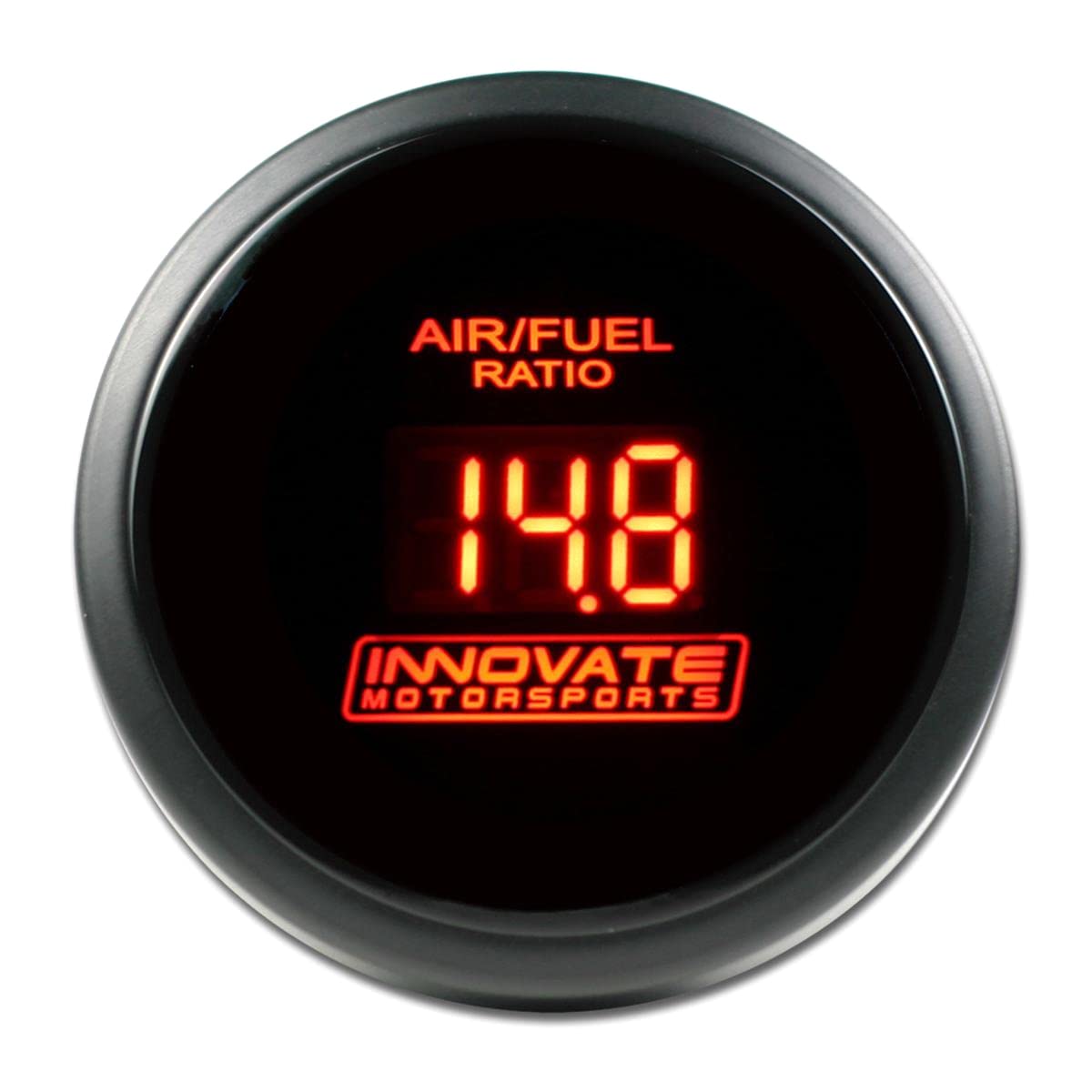
3. Innovate Motorsports 3796 DB RED Wideband Air/Fuel Gauge Kit (LC-2)
A proven workhorse that pairs industry-leading accuracy with flexible analog outputs.
The Innovate DB RED kit features their patented DirectDigital wideband technology and two configurable 0-5V analog outputs. For a tuner running a standalone ECU, that second output is gold — you can log the AFR to your laptop while simultaneously feeding a signal to the ECU for closed-loop fueling. The complete kit includes the LC-2 controller, Bosch LSU 4.9 sensor, weld-in bung, and programming cable, all for a mid-range price that undercuts most premium options.
Accuracy here is the headline. The review data repeatedly calls it “the most accurate on the market,” and owners confirm it stays consistent even under demanding conditions. One detailed a 6-month stint on a turbocharged FC RX-7 with zero drift. The sensor is sensitive to a clean 12V supply, however — a few owners note that a poor ground or voltage dip can cut sensor life to 1,000-1,500 miles. A relay and solid wiring connection solve this quickly.
At just 140 grams, the gauge is lightweight, though its inclusion in a 20.47 x 1.57 x 20.47-inch box is bulky due to the long sensor cable.
Best for: The hands-on tuner who needs dual analog outputs for logging and ECU integration.
Install tip: Use a dedicated relay and a clean ground to protect sensor life.
Reach for this if: You run a standalone ECU or need simultaneous data logging and ECU feedback.
Look elsewhere if: You want a simple plug-and-play gauge with no wiring fuss.
4. Innovate Motorsports 3918 MTX-L Plus Wideband Gauge

The entry-level Innovate that balances a strong reputation with an accessible price.
The MTX-L Plus is the most popular wideband gauge in its class for a reason — it is easy to install, offers solid response time, and includes the same Bosch LSU 4.9 sensor found in much pricier kits. Installation gets a lot of praise from owners, with many calling it straightforward for a DIY garage project. The metal housing is built to last, and the universal fit means it drops into any standard 2-1/16-inch pod.
But the customer experience here is a mixed bag. While some call it reliable, others report sensor failures within a month and the dreaded E8 error code appearing. The most-discussed aspect by a wide margin is reliability — it is the highest-count topic in reviews, and Amazon labels it as “mixed” for a reason. One owner said their unit “worked for 2 days, then the readings are way off,” while another had zero complaints. A voltage stabilizer resolved the gauge rebooting during cranking for some.
At 1.9 pounds, it is a few ounces lighter than the AEM combo kit, though its package dimensions (9 x 7 x 7 inches) are equally substantial.
Good if: You are on a budget and want the Innovate sensor ecosystem with a straightforward install.
Be mindful: Sensor reliability is inconsistent — budget for a potential replacement sensor down the line.
Choose this when: Price is a primary concern and you are comfortable troubleshooting a potential voltage issue.
Pass if: You need absolute reliability from the start for a critical race motor.
5. GlowShift Black 7 Color Digital Wideband Air Fuel Gauge Kit

Seven display colors and a complete kit make this the tuner-friendly style leader.
The GlowShift Black 7 Color Series is a complete package — it comes with the Bosch LSU 4.9 sensor, control box, weld-in bung, three separate wiring harnesses, a gauge visor, and mounting bracket. Everything you need to go from box to running, including step-by-step instructions. The 7 solid color modes and 2 color cycle modes let you match your dash lighting exactly. A bonus: when you connect the dimmer wire to your headlight switch, the gauge brightness drops by 30% automatically, which owners appreciate for night driving.
Quality is the thing that gets the most praise. Owners say it “reads the same as the dyno” and that the kit is “very easy to use.” It is also built from aluminum, plastic, and stainless steel, giving it a solid feel for the price. The honesty here is that reliability gets mixed notes — some have seen the gauge freeze at a single reading (like 14.7) until the car is restarted, and a few report the sensor failing after a couple of years. Glowshift offers a one-year warranty and, notably, will sell you a replacement gauge-only for around if it fails beyond that period.
For a daily driver or weekend project car where absolute race-grade uptime is not the priority, the value is strong.
What stands out
- 7 color modes and 2 cycle modes for custom matching.
- Comprehensive kit includes every component and harness.
- Automatic 30% dimming with headlight connection.
What to watch for
- Some units freeze on a single reading until restart.
- Reliability is mixed over the long term.
Grab this for: A complete, ready-to-install kit with customizable lighting at a reasonable price.
Think twice if: You need a gauge that can survive years of daily abuse without a hiccup.
6. Prosport EVO Series Digital Wideband Air Fuel Ratio Gauge

Extremely thin housing that fits tight dash spots where other gauges cannot go.
The Prosport EVO Series solves a specific pain point: depth. It measures only about 1.5 inches deep including the mounting studs, making it the go-to choice for shallow gauge pods or custom dash panels. The gauge itself is a 52mm unit with a 270-degree digital sweep and an outer LED bar-graph that makes AFR changes easy to track peripherally. It comes with a Bosch LSU 4.9 sensor, a 10-foot wiring harness, and a selectable blue or red digital display with a blackout face when the ignition is off.
Installation draws positive remarks for being straightforward, and the slim profile is a genuine differentiator. The display reads across a 10.0:1 to 20.0:1 range, giving you full visibility from rich cruise to lean deceleration. A 0-5V output is included for data logging, so tuners can capture the signal during a dyno session.
The honest trade-off is that a few owners have had calibration issues. One reported that after calibrating the sensor twice, the gauge reads correctly at idle but locks at 10.0 at full throttle — a frustrating experience for a gauge at this price point. The Prosport EVO has a thinner body than the AEM X-Series combo by a notable margin, but it also lacks the CAN-bus features of higher-end competitors.
Great for: Tight installs where every millimeter of depth matters, and you want a clean blackout face.
Watch out for: Calibration inconsistencies that a small number of owners have experienced.
Pick this if: You are fighting for space in a shallow gauge pod or custom panel.
pass on it if: You want a proven, no-drama wideband track record from a more established brand.
7. Auto Meter Phantom 5779 Wide Band Air Fuel Ratio Kit

A familiar name with a classic aesthetic and a modern digital face.
The Auto Meter Phantom 5779 brings the brand’s storied reputation to the wideband world. It combines a digital segment display with an LED radial bar graph, giving you both an exact number and a visual sweep of your AFR. The kit includes a custom-tuned.1 AFR Resolution Bosch LSU 4.2 sensor, an 8-foot wiring harness, a 304 stainless steel weld-in bung, and mounting hardware. It works on both 12V and 16V systems, so it is compatible with nearly any street or race car.
Owners say it is responsive and useful for tuning. One noted it has a 10 to 17 AFR range that reacts quickly to changes, making it a solid tool for carburetor tuning. It comes with everything you need except a mounting pod, so factor that into your prep. The kit weighs 1.2 pounds, which is lighter than many competitors.
A recurring complaint is that some owners receive the dreaded E2 error code repeatedly. One frustrated owner described sending the sensor and gauge back twice with no resolution. Others report that the wiring is thin and the instructions are vague, so this is not the most beginner-friendly kit. Also note the use of the older Bosch LSU 4.2 sensor rather than the more common 4.9.
Best for: Enthusiasts who trust the Auto Meter name and want a classic look with a digital readout.
Consider if: You are comfortable with basic wiring and want a lightweight, sensor-rich kit.
Choose this for: A straightforward wideband kit from a legacy brand if you are willing to troubleshoot occasional E2 errors.
Pass if: You want the faster warm-up and wider availability of a Bosch LSU 4.9 sensor.
8. Auto Meter Sport-Comp II 3670 Wideband Air/Fuel Ratio Gauge

An analog gauge that reads like a traditional instrument, not a video game.
For the purist who wants a swinging needle over a flashing number, the Auto Meter Sport-Comp II delivers. It uses a race-proven digital stepper motor that runs a self-calibration sequence at startup, then sweeps across an 8:1 to 18:1 AFR range. The gauge is lit with white LED through-the-dial lighting, which owners say is clear and visible at night. The kit comes with a custom-tuned.1 AFR resolution Bosch LSU 4.2 sensor, 8-foot harness, and 304 stainless steel weld-in bung.
The design has a quirk. A few owners discovered a flaw: the gauge has a 12.5V threshold that can cause premature O2 sensor heating and mode toggling in cars with slightly lower voltage. One resourceful owner fixed it by adding a 1N5822 diode to the power wire, effectively raising the threshold. That is a fix a seasoned DIYer can manage but a beginner would find frustrating. There is also a report of the wrong product being shipped (a transmission temp gauge instead).
At 2.4 pounds, the Sport-Comp II is on the heavier side, like the AEM combo kit, but it lacks CAN-bus or dual-output flexibility.
Who it suits: The analog-loving enthusiast who will not miss a digital readout and has wiring experience.
Watch for: The voltage threshold design issue that may require a simple diode mod to stabilize.
Buy it for: The classic needle look, if you prefer analog sweep and are comfortable with a potential wiring quirk.
Avoid if: You want a plug-and-play modern digital gauge with reliable out-of-box performance.
Understanding the Specs
Wideband Sensor: LSU 4.2 vs. 4.9
The sensor reads the oxygen content in your exhaust. The Bosch LSU 4.9 is the newer standard — it heats up faster (meaning accurate readings sooner), is more durable, and is the sensor nearly every modern kit uses. The older LSU 4.2 works fine but is less common now, so replacement sensors can be harder to find. If you are building a new setup, prioritize the 4.9.
Digital vs. Analog Display
Digital displays show an exact numeric AFR (like 14.7), which is best for tuning work where you need a precise number. Analog gauges use a needle sweep, which some drivers find easier to read at a glance on a race track. Some digital gauges combine both with a bar-graph sweep that shows changes without needing to focus on digits.
0-5V Analog Output
This is the jack that sends your AFR reading to an ECU, data logger, or laptop. Almost all wideband kits have at least one 0-5V output. If you are tuning with a standalone ECU or logging with software like HP Tuners, you need this. A second analog output (like on the Innovate DB RED) lets you log and feed the ECU at the same time.
CAN Bus and OBDII Connectivity
CAN Bus is a faster, more modern communication protocol used in most cars from the 2010s onward. Some wideband gauges (like the AEM X-Series OBDII) can send their AFR data directly through your car’s OBDII port. This lets your tuning software see the wideband reading without extra wiring. It does require a CAN-Bus vehicle, typically 2013 or newer.
FAQ
What is the difference between a narrowband and a wideband AFR gauge?
Do I need a wideband gauge if my car already has O2 sensors?
Can I use a wideband AFR gauge with an E85 fuel system?
What is the ideal AFR reading for a gasoline engine?
How long does a wideband O2 sensor last?
Can I install a wideband gauge myself?
What does the E8 or E2 error code mean on my wideband gauge?
Do I need a separate controller box, or does the gauge include it?
Is a digital or analog wideband gauge better for a race car?
Will a wider AFR display range make my car run better?
Final Thoughts: The Verdict
For most builds, the winner is the AEM 52mm X-Series Wideband & Boost Kit because it combines a wideband AFR gauge and a boost gauge in one crisp, high-resolution display with CAN-bus integration — an unbeatable combo for anyone running forced induction. If you want a fast OBDII passthrough that works smoothly with modern tuning software, grab the AEM X-Series OBDII. And for budget-conscious tuners who still want the genuine Bosch LSU 4.9 sensor, the Innovate DB RED LC-2 Kit is the best value, provided you give it a clean 12V supply.
How We Picked
We do not accept paid placement. Every pick is matched to a real buyer and a real use-case; we do not hands-on test units.
Sources & Methodology
Specifications: manufacturer listings and product documentation. Review insights: verified customer reviews, as of July 2026. Pricing: not shown on this page (it changes often); check the current price via the retailer link.
As an Amazon Associate, GoCarLife earns from qualifying purchases. This does not affect which products we feature.