
Our readers keep the lights on and the garage heater humming. As an Amazon Associate, I earn from qualifying purchases.
Specs are compiled from manufacturer listings and verified buyer reviews and can change over time — please confirm the key details on the product page before buying.
Slapping an enormous tire onto your bike is the single quickest way to change how it looks and feels. That extra contact patch delivers a different kind of confidence in corners and at stops. But a wide tire is a serious fitment puzzle — the wrong section width or aspect ratio can turn your dream build into a rubbing, wobbling headache. This guide walks you through the five best options, from value-driven radials to Harley-specific whitewalls, so you match the fat rubber to your ride without the guesswork.
I’m Mo Maruf — the founder and writer behind GoCarLife. This guide is built by comparing the manufacturers’ published specifications and the patterns across verified customer reviews, so you get each pick’s real strengths and trade-offs instead of marketing spin.
Whether you are chasing cornering grip, cruiser longevity, or that massive show-stopping look, choosing the right rubber depends on understanding load ratings and section widths — which is exactly what this breakdown of the widest motorcycle tire options gives you: a clear, data-backed match for your bike and your riding style.
Our Picks at a Glance


How To Choose The Best Widest Motorcycle Tire
Picking a wide tire is not just about looks — it affects your bike’s geometry, speedometer calibration, and how the chassis handles a lean. Start with the section width (the tire’s widest point in millimeters) that your swingarm and fender can physically clear, then match the aspect ratio to keep your overall diameter close to stock. A small clearance mistake can chew up a tire in a few miles.
Load Index and Carrying Capacity
Every wide tire has a load index stamped on the sidewall — that number paired with the load capacity in pounds tells you how much weight it can safely support. A heavy touring cruiser or a bike with a passenger and luggage needs a much higher load capacity than a lighter sport bike. Ignoring this spec risks poor handling and a tire that overheats on long hauls.
Radial Construction vs Bias Ply
Radial tires (common on modern sport and touring bikes) flex more in the sidewall, giving a smoother ride and better grip at lean. Bias-ply tires, like the Dunlop D402, use crisscrossed layers that are heavier but more stable under a straight-line load — which is why Harley tours on them. Pick the construction that matches your typical ride: canyons or highways.
Tread Compound and Wet Weather Grip
The rubber compound determines how quickly the tire warms up and how sticky it gets. A softer compound grips like glue in the dry but wears out fast on highway commutes. Tires with fine-grain silica in the compound, like the Bridgestone S22, improve wet performance noticeably — worth a look if you ride in rain frequently.
Quick Comparison
| Model | Best For | Section Width | Load Capacity | Weight | Amazon |
|---|---|---|---|---|---|
| Bridgestone S22★ Best Overall | Aggressive street / light track | 180mm (tread) / 5 in carcass | 600 lbs | 9.7 lb | Amazon |
| Shinko 009 RavenBest Value | Long life / value / wet & dry | 180mm | 805 lbs | 14.1 lb | Amazon |
| Pirelli Night Dragon GT | Harley baggers / heavy cruisers | 200mm | 937 lbs | 18.8 lb | Amazon |
| Dunlop Harley-Davidson D402 | Harley touring / wide whitewall | 130mm (front) / MU85 rear | 908 lbs (rear) | 17 lb | Amazon |
| Michelin Scorcher 11 | Massive CVO / custom show | 240mm | — | 17.2 lb | Amazon |
In‑Depth Reviews
1. Bridgestone Battlax Hypersport S22 Motorcycle Tire
Our pick — over 4.5★ from 600+ verified ratings; the strongest balance of quality and price.
The sticky sport radial that wakes up in the cold and never lets go.
This is the tire for riders who live in the twisties but still commute on rainy mornings. The S22 is Bridgestone’s top street-sport offering, and the crowd favorite — a massive 4.7 stars with over 600 ratings — backs up every claim. The thing everyone raves about is the quality of the rubber (owners call it out more than 40 times): a front-and-rear compound that uses fine-grain silica to grab wet pavement without sacrificing dry stick. Buyers report it “sticks like glue” and even outperforms Pirelli Rosso tires on a Panigale, which is strong company.
The catch is mileage — this is a soft compound that rewards grip over lifespan. Some owners see around 5,000 miles out of a rear, and the front tread can wear quickly if you brake hard into corners. At just 9.7 pounds, it is the lightest tire in this lineup by a wide margin (the Pirelli Night Dragon is at 18.8 pounds), which cuts unsprung weight noticeably on a sport bike. It comes in the popular 180/55ZR17 size with a 73W load-speed rating, good for 600 pounds and sustained 168+ mph runs. If you ride a naked or a supersport and value corner-entry feel over last-year mileage, this is your tire.
The S22 also carries only 600 pounds of load capacity — the lowest in this comparison. That is fine for a solo sport bike, but a fully loaded sport-tourer or a two-up weekend would push past that limit. Keep the S22 on a relatively light machine and it will reward you with what one buyer called “the best wet weather street tire ever”.
What wins riders over
- Superb dry and wet grip — silica compound works from cold
- Lightest in the lineup at 9.7 lb, sharpens handling feel
- Proven on track — warm enough at 50°F for hard riding
The honest trade-offs
- Soft compound wears fast, some rears done by 5,000 mi
- 600 lb load capacity limits two-up or loaded touring use
- Front tread durability is mixed — hard brakers see quicker wear
Reach for this if… you ride a sport bike or naked and want race-level grip that still works the next morning in the wet.
Look elsewhere if… you need a tire to carry a passenger and luggage across a long summer tour — the load ceiling is too low.
2. TIRE 009 RAVEN REAR 180/55ZR17 73W RADIAL TL
The long-mileage champion that saves you cash every second rear tire.
If your bike chews through premium rubber in a season, the Shinko 009 Raven will change your wallet math. A 180/55ZR17 radial with a 6-ply casing, it is built for the rider who mixes highway slogs with weekend backroads and hates watching tread disappear. The consensus in over 280 ratings (4.6 stars) is that these tires wear far longer than the competition: owners mention longer tread life than other tires they have used, and one owner on a Yamaha FJ09 saw minimal wear at 600 miles compared to a Rosso 2 that would be done at 1,200. The review pages sum it up: “Shinko tires are the best tires for the money for motorcycles.”
It is a harder compound, which is the secret to its longevity, but that also means it takes longer to warm up. Customers note it allows controllable drifting with throttle before full temp, which some riders love and others find unsettling. It is W-rated (168 mph), aramid-belted, and DOT-approved — a fully modern radial that punches way above its price category.
At 14.1 pounds, it is 4.4 pounds heavier than the S22 but still well within the range for a sport-touring or standard bike. The real-world trade-off is clear: you trade some initial corner bite for a tire that will still have deep tread when your buddy is shopping for his third set. For the daily commuter or the budget-conscious sport rider, this is the smart play.
Why it earns its place
- Best-in-group tread life — owners often see double the mileage
- 805 lb load capacity handles loaded bikes and passengers
- Predictable, progressive breakaway at the limit, not snap
Who should think twice
- Harder compound needs a warm-up before full grip arrives
- Not the go-to for track days or supersport pace
- Shinko reputation still makes some riders skeptical
Grab this for… budget-conscious riding or high-mileage commuting on a standard or naked bike.
Pass if… you need instant edge grip from the first corner on a cold morning — the compound takes time.
3. Pirelli Night Dragon GT Rear Tire (200/55-17)

Harley-approved rubber that hauls a bagger and a passenger without flinching.
That massive capacity is no accident: this tire is tailored for Harley-Davidson touring and bagger models that carry serious weight. At 4.9 stars from 112 ratings, it is the highest-rated tire here, and owners confirm it delivers. The thing that wins people over is the ride quality — reviewers point out better road contact while leaning and a tire that “sticks when it’s not supposed to.”
One owner measured 7,000 miles on their first Night Dragon, beating the 8,500-9,000 they got from a Metzler or Dunlop before it. That is strong mileage for a cruiser tire that still grips well in the rain. The trade-off is weight: at 18.8 pounds, it is 9.1 pounds heavier than the S22 — that extra mass is noticeable during wheel removal and accelerates rear-suspension wear slightly. It is a pure street radial with a vehicle-specific fit (Harley baggers primarily), so it will not work on a sport bike swingarm.
Buyers also note the break-in process — the first 100 miles require careful riding as the release compound is slick. Some owners lightly sand the surface with 400-grit paper to speed it up. Once scrubbed in, the Night Dragon GT delivers a planted, confidence-inspiring rear end that makes a 900-pound cruiser feel manageable in the corners.
What makes it the heavy-hauler pick
- 937 lb load capacity — highest in this lineup, built for heavy baggers
- Excellent wet grip from a silica-enhanced compound
- Proven 7,000+ mile lifespan on big cruisers
Real things to weigh
- 18.8 lb weight — the heaviest here, adds unsprung mass
- Vehicle-specific fitment, not for sport or standard bikes
- Break-in period needs care for the first 100 miles
Choose this if… you ride a Harley bagger or heavy cruiser and want the highest load capacity available.
skip it if… your bike is a sport or standard model — the 200mm section and specific fitment will not suit your chassis.
4. Dunlop Harley-Davidson D402 Front Motorcycle Tire MT90B-16 (72H) Wide White Wall
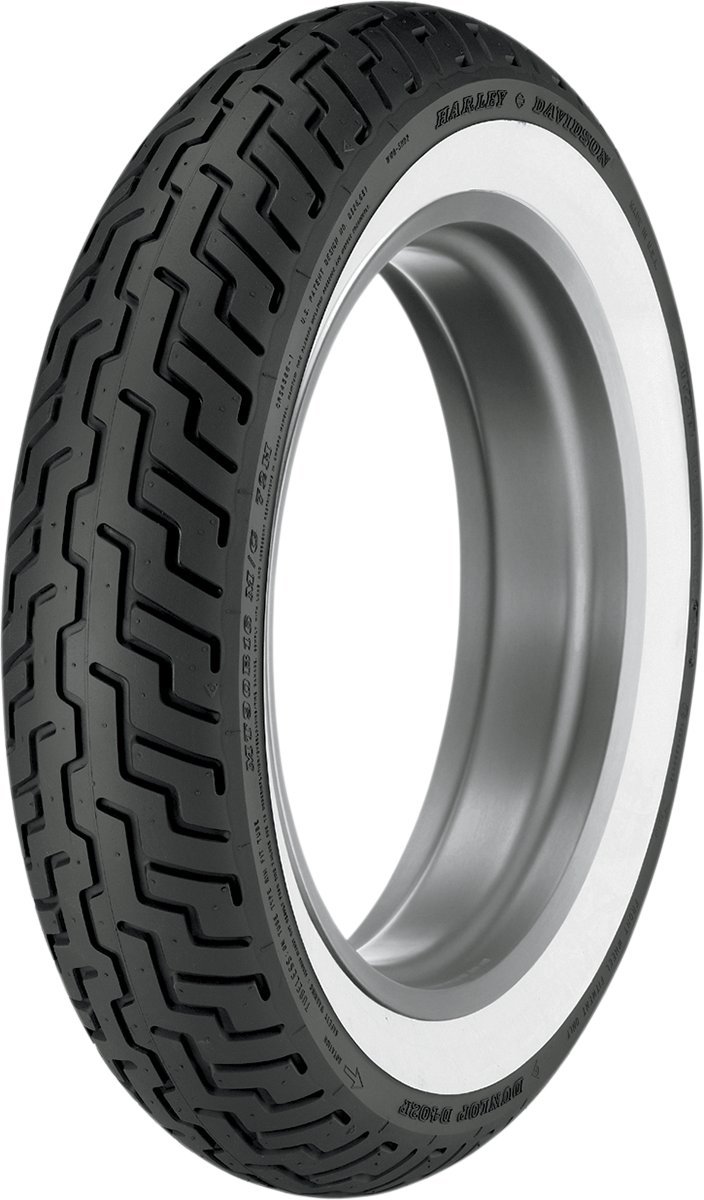
The only Harley-approved touring tire with that iconic wide white wall.
The Dunlop D402 has been the standard on Harley touring bikes for years, and this MT90B-16 front tire is the definitive choice for riders who want the classic whitewall look without sacrificing load capacity. The wide white sidewall is the biggest visual statement in this list — buyers mention the appearance more than 20 times in their reviews, calling it a perfect match for Road King Classics and Heritage models. At 4.7 stars from 357 ratings, it is the most-reviewed tire here, and the feedback is steady: quality, fit, and that unmistakable look.
This is a bias-ply tire, not a radial. The three-ply polyester casing with two fiberglass belts gives it a stiffer feel under load, which is exactly what a heavy touring bike needs to track straight on the highway. The load capacity on the wider MU85B16 rear reaches 908 pounds — very close to the Pirelli Night Dragon’s 937 pounds. Dunlop uses a computer-tune tread profile with an offset center groove that quiets the tire on rain grooves and steel-grated bridges, a specific complaint on some big bikes.
The front-specific D402F MT90B16 is not interchangeable with the rear D402 tire, so pay attention to the part number. Some buyers mention the ride quality as good but noticeably firmer than a radial — that is the bias-ply character. It is an H-rated tire (130 mph), which is more than enough for any legal highway pace. If your project requires a whitewall and you want the genuine Harley-Davidson approved part, this is the only option that fits.
What earns the loyalty
- Authentic wide whitewall appearance — the classic Harley look
- 908 lb rear load capacity for loaded touring
- Bias-ply stability tracks well on heavy bikes
The real fitment caveats
- Front-specific tire — do not swap with rear D402
- Bias-ply construction rides firmer than a radial
- H-speed rating limits very high-speed riding
Pick this if… you are restoring or upgrading a Harley touring bike and the whitewall look is non-negotiable.
Look elsewhere if… you want a radial touring tire with a softer ride — this is bias-ply and that feel is built in.
5. Michelin Scorcher 11 Harley-Davidson® Rear Motorcycle Tire 240/40R-18 (79V)

The fattest production radial you can stuff into a stock Harley swingarm.
A 240-millimeter tire on a production motorcycle is not common, and the Michelin Scorcher 11 makes the most of every millimeter. Designed as original equipment for the CVO Softail Breakout and V-Rod models, this 240/40R-18 radial is the widest in this lineup and one of the biggest you will find without going to a custom car tire conversion. The sheer look of a 240mm rear is the main attraction — it fills the fender gap completely and gives the bike a planted, steamroller stance. The value proposition is strong, too: shoppers say paying around less than what a Harley dealer charges for the same tire. The consensus calls the Scorcher 11 a perfect fit.
The 40-aspect ratio keeps the sidewall low, which means the tire responds quickly to steering input despite its width. Michelin uses a rubber compound derived from its championship-winning race tires, balancing durability with grip. The ride quality gets consistent praise — owners who switch from stock Dunlops notice smoother highway running and better turn-in: “it rides a lot smoother and takes the turns better” is a typical owner note. At 4.8 stars from 121 ratings, this tire has the second-highest average score in the group, only behind the Pirelli Night Dragon.
The obvious limitation is fitment — this tire fits a very specific set of Harley models (CVO Breakout, V-Rod Muscle, Night Rod Special, and approved years for Sportster SuperLow). It will not work on a standard Dyna or Softail without significant modification. It is also a heavy tire at 17.2 pounds, but that is expected for a 240mm radial. If your bike is one of the approved platforms, the Scorcher 11 is the undisputed wide tire king.
What makes it the wide winner
- 240mm section width — the widest production tire in this guide
- Factory-fit for CVO Breakout and V-Rod, no mods needed
- Smoother ride and better turn-in than stock Dunlops, per owners
The narrow fitment reality
- Very specific Harley model compatibility — not universal by any stretch
- 17.2 lb weight adds unsprung mass
- 40-series sidewall can feel stiff over sharp bumps
Buy this for… a CVO Breakout or V-Rod where you want the widest possible stock-compatible tire and a significant price savings over the dealer.
Do not buy if… your bike is not on the approved list — the 240mm fitment is extremely model-specific and will not work on most standard frames.
Understanding the Specs
Section Width, Aspect Ratio, and Overall Diameter
The first number in a tire size (like 200 in 200/55-17) is the section width in millimeters — the widest point of the tire from sidewall to sidewall. The second number (55) is the aspect ratio, a percentage of the width that tells you how tall the sidewall is. So a 200/55 has a sidewall height of 110mm, while a 240/40 has a sidewall of 96mm — shorter in proportion to its width, which sharpens steering response. Changing either value changes the tire’s overall diameter, which can affect speedometer accuracy and whether the tire rubs your fender or swingarm. Always check that the new rolling diameter stays within 3-5% of your stock tire.
Load Index and Speed Rating
The load index (for example, 73 on the Shinko 009 Raven) corresponds to a specific weight limit in pounds — 805 pounds in that case. The speed rating (W, H, V) tells you the maximum safe speed for the tire. A W-rating is good for 168 mph, an H-rating for 130 mph. On a heavy cruiser, you rarely push past H speeds, but the load index is critical: a touring bike loaded with gear and a passenger can exceed 800 pounds, so you need a tire with a 900+ pound capacity (like the Pirelli Night Dragon’s 937 pounds or the Dunlop D402’s 908 pounds). Going below your bike’s loaded weight creates dangerous heat buildup.
FAQ
What is the widest motorcycle tire that will fit my bike without modifying the swingarm?
Is a wider motorcycle tire always better for grip?
How does a wider tire affect the highway ride?
Can I use a car tire on my motorcycle for maximum width?
How does the section width differ from the tread width?
Will a 240mm tire fit on a standard Harley Softail?
How long should a wide motorcycle tire last?
Do I need a tube inside a wide radial tire?
Is a higher load index always better for my bike?
What does the speed rating (W, H, V) mean for a wide tire?
Final Thoughts: The Verdict
For most people, the widest motorcycle tire that balances real-world grip, weight, and value is the Bridgestone Battlax Hypersport S22 because it is the lightest and stickiest choice for sport bikes and naked bikes, backed by a massive loyal following. If your priority is long tread life and a low per-mile cost, grab the Shinko 009 Raven — it outlasts tires costing twice as much. And for the pure, show-stopping width that turns heads at every stop, the Michelin Scorcher 11 at 240mm is the undisputed king of the road, provided your bike is on the short fitment list.
How We Picked
We do not accept paid placement. Every pick is matched to a real buyer and a real use-case; we do not hands-on test units.
Sources & Methodology
Specifications: manufacturer listings and product documentation. Review insights: verified customer reviews, as of July 2026. Pricing: not shown on this page (it changes often); check the current price via the retailer link.
As an Amazon Associate, GoCarLife earns from qualifying purchases. This does not affect which products we feature.