
Our readers keep the lights on and the garage heater humming. As an Amazon Associate, I earn from qualifying purchases.
Specs are compiled from manufacturer listings and verified buyer reviews and can change over time — please confirm the key details on the product page before buying.
Getting stuck is part of the adventure—getting stranded because your winch gave out is not. A 5000 lb electric winch is the recovery lifeline for everything from a buried ATV to a boat trailer that refuses to budge, but the difference between a one-and-done pull and a first-use solenoid pop depends on a few critical specs you cannot see from the product photo. You need a winch that actually delivers its rated pull, survives a dunk in a mud hole, and lets you control it from a safe distance when the strap is under tension. This guide breaks down the four real contenders, cuts through the marketing claims, and tells you exactly which one earns its spot on your bumper.
I’m Mo Maruf — the founder and writer behind GoCarLife. This guide is built by comparing the manufacturers’ published specifications and the patterns across verified customer reviews, so you get each pick’s real strengths and trade-offs instead of marketing spin.
Whether you are pulling a side-by-side out of a creek or winching a generator into a truck bed, the 5000 lb winch you choose determines whether you get home or get a tow bill.
Our Picks at a Glance

How To Choose The Best 5000 Lb Winch
A 5000 lb winch is a piece of emergency gear first and an accessory second. The wrong one means you do not get unstuck—or worse, you get stranded when the electronics quit halfway through the pull. Focus on these three factors before you look at anything else.
Gear Ratio and Motor Power
A higher gear ratio (a number like 171:1) multiplies the motor’s torque so a relatively small motor can pull the full 5000 lb rating. You trade speed for pulling force—a 147:1 ratio moves rope faster but with less grunt. A 1.3 HP motor paired with a 171:1 gear train will crawl but it will not stall. A 2.2 HP motor with a 147:1 ratio spins faster and still clears the rated load. Match the ratio to your use case—slow and steady for deep mud, faster for trailer loading.
Water and Dust Sealing (IP Rating)
An IP68 rating means the winch is sealed tight enough to survive river crossings and pressure washers. Anything less than IP67 or IP68 is essentially splash-resistant. That matters because mud, silt, and road salt will kill a winch faster than overloading it. A sealed solenoid housing is just as important as the motor seal—if the solenoid corrodes, the winch is dead even if the motor is dry.
Control Options and Rope Type
Synthetic rope weighs roughly a third less than steel cable, does not rust, and will not whip dangerously if it snaps. However, it frays against rocks. A wired remote about 6.9 feet long lets you stand outside the danger zone of a loaded line; a 4.2-foot remote means you are dangerously close. A wireless remote is convenient, but the range number on the box (usually 100 feet) is line-of-sight—expect half that in thick trees or behind a vehicle.
Quick Comparison
| Model | Best For | Motor Power | Gear Ratio | IP Rating | Amazon |
|---|---|---|---|---|---|
| X-BULL 5000lbs (2S)★ Best Overall | Best Overall Value & Durability | 1.3 HP | 171:1 | IP68 | Amazon |
| KYX Electric Trailer Jack | RV Leveling & Trailer Positioning | 12V DC Motor | — | Sealed Weatherproof | Amazon |
| X-BULL γ Series Winch | Best All-Around Recovery Performer | 2.2 HP | 147:1 | IP68 | Amazon |
| RUGCEL WINCH Truck Crane | Heavy Lifting Into Truck Beds | 12V Electric Winch | — | — | Amazon |
In‑Depth Reviews
1. X-BULL 5000lbs Electric Winch (2S Series)
Our pick — over 4★ from 200+ verified ratings; the strongest balance of quality and price.
The shop-favorite workhorse with a 171:1 gear crawl that refuses to stall.
The defining move here is the 171:1 gear ratio (meaning the motor spins 171 times for each drum rotation)—a 171:1 ratio versus the γ Series’ 147:1, which means this motor turns slow and mean. The full-load line speed is only 3.3 feet per minute, so you are trading speed for grunt. That is exactly what you want when you are stuck axle-deep in mud and need steady, relentless pull without overheating the motor. The 1.3 HP motor is paired with a 3-stage planetary gear system and an upgraded brake switch that owners mention holds a loaded car without creeping.
Functionality and quality each get the most praise in the review pages—owners consistently call out that it fits tight ATV bumpers at 13.2 inches long and that the wireless remote has almost zero lag at the rated 100-foot range (line-of-sight). At 27.4 pounds it is heavier than the γ Series (27.4 pounds vs 23.2 pounds), which is a sign of the steel body construction that earns the IP68 waterproof rating (dust-tight and submersible). Customers note it “saved a ton of money vs name brand products” and mention the remote is genuinely well-built. One owner did report a solenoid that failed on the first use, which is the main reliability caveat to know—check your connections immediately after install. This is the pick for the buyer who wants the most torque, not the most speed.
What Everyone Loves
- Steel body with IP68 sealing—survives river crossings and pressure washing.
- 171:1 gear ratio provides exceptional low-speed torque for heavy pulls.
- Synthetic rope is durable and safe, with no cable-snap recoil risk.
- Wireless remote works at a genuine 100 feet with near-zero lag, per owners.
The Honest Caveat
- The solenoid can be the weak link; several reviewers point out failure on first excursion—test it before you need it.
Reach for this if: you want the most bang-for-buck winch with IP68 protection and the pulling torque of a dedicated recovery tool, and you prefer slow-and-steady power over fast line speed.
Grab the γ Series instead if you need a winch for quick trailer positioning where line speed matters more than brute torque.
2. X-BULL γ Series Winch 5000 lb

The stronger-faster sneak attack that pulled a loaded van onto a trailer without breaking a sweat.
This is the surprise performer of the group. The 2.2 HP pure-copper motor is a significant step up from the 1.3 HP motor in the 2S Series, and the 147:1 gear ratio (which tells you how many motor turns equal one drum spin) spins the rope faster—faster than the 2S (147:1 vs 171:1). The trade-off is slightly less ultimate torque, but buyers report it “pulled a fully loaded van up on my trailer with ease” off a 12v battery. The IP68 rating (dust-tight and submersible) is the same on both X-BULL units, so water sealing is equal. But the γ Series is lighter at 23.2 pounds, making it easier to mount on a Polaris RZR or a tight ATV bumper.
The wired remote is 6.9 feet long—6.9 feet, compared to the 2S Series’ 4.2-foot remote—which matters for safety because you can stand well outside the danger zone of a taut synthetic rope. The wireless remote also has a 100-foot range, though owners note the battery compartment on the remote feels cheap. At 4.7 stars, it is the highest-rated winch in the list, though with a smaller sample size than the 2S. This γ Series is sharper at speed than the 2S because the 2.2 HP motor means you are not waiting forever for the drum to finish spooling.
Why It Wins
- 2.2 HP motor offers noticeably faster line speed without giving up the full 5000 lb rating.
- 6.9-foot wired remote keeps you safe during the pull—you can stand well outside the snap zone.
- Weighs 23.2 pounds—among the lightest for a 5000 lb winch with an IP68 housing.
The Fine Print
- The remote’s battery compartment and clip feel less sturdy than the rest of the winch, per owners.
Your pick if: you want the fastest line speed among genuine 5000 lb winches here, with a safe longer wired remote, and you prioritize motor power over the deep-gear crawl of the 171:1 unit.
Choose the 2S instead if you are pulling extremely heavy loads at the limit of the rating in deep mud—the 2S’s deeper gear ratio will suit you better there.
3. KYX Electric Trailer Jack 5000lb with Remote
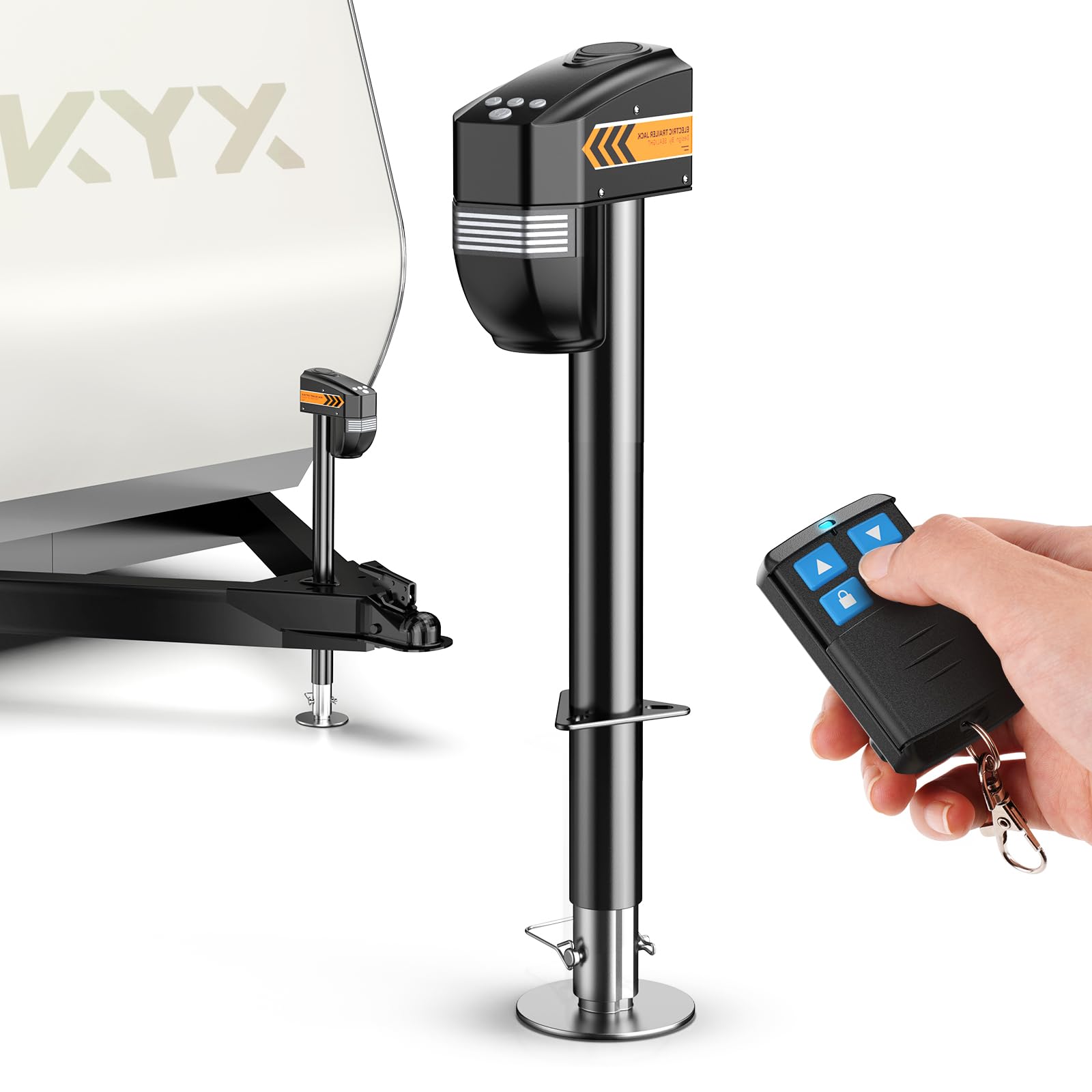
The arm-saver that lets one person level a 30-foot camper in minutes.
This is a vertical jack, not a horizontal-pull winch—it lifts and lowers trailer tongues, not recovers off-road vehicles. The motor-driven system raises a 5000 lb RV tongue from 9.84 inches to 33.85 inches, which is a huge range for trailers with varying hitch heights. The wireless remote works up to 30 meters away (about 98 feet) line-of-sight, and owners say it means you can stand at the leveling block and adjust without needing a second person inside the trailer. The term “arm saver” comes up repeatedly—a real relief for anyone who has cranked a manual jack on a hot afternoon.
It includes a waterproof cover and a sealed housing designed for dust and rain. The key trade-off is speed: shoppers say the electric operation is “~3x slower than expected,” and the manual crank mode also has high resistance. The included wires run short for some camping trailers, needing an extra 2 feet to reach the battery. One unit arrived with reverse internal wiring, which is frustrating, though the build quality is otherwise described as “sturdy.” This is a purpose-made product for RVers who want to ditch the manual crank—think of it as a convenience upgrade, not a recovery tool. If you need a horizontal pull, choose the X-BULL 2S instead.
Why RVers Like It
- 30-meter wireless remote lets you level solo—no yelling “stop” at the driver.
- Lift range of 9.84 to 33.85 inches covers everything from small campers to full-size travel trailers.
- Weather-sealed construction with included cover protects against rain and dust.
The Slow-Down
- Electric operation is slow; manual cranking is also stiff, per owner reports.
- Some units need longer power leads to reach a trailer battery.
Buy this for: leveraging a 5000 lb trailer tongue without bending over or cranking by hand—ideal for full-time RVers and anyone parking a camper weekly.
Not for: off-road recovery—this is a vertical jack, not a horizontal winch, and it is slow even for that job.
4. RUGCEL WINCH Truck Crane with 5000 lb Winch

The truck-mounted mini-crane that lifts engines, generators, and AC units into the bed.
This is a whole different beast—it combines a folding truck crane with a 5000 lb electric winch, designed to hoist heavy loads into a pickup bed instead of pulling them across the ground. The boom extends from 47.2 inches to 64.96 inches, with three height settings ranging from 51.18 inches to 88.98 inches. The base rotates 360 degrees with a locking handle that secures it in place once you position the load. Owners have used it to lift HVAC units onto roofs and engines into engine bays. The included 5000 lb winch does the pulling while the crane provides the leverage and height.
The unit is built from painted galvanized steel and weather-resistant, but owners note that the solenoid and controller (the parts that switch the winch on and off) rusted within a year in outdoor service. Assembly takes around 4 hours with three people (assume that going in). The winch is included and works for light-to-moderate duty, but it is not a standalone recovery winch—it is a crane system first. The overall rating is lower (3.8 stars) due to missing parts issues with some units and weak swivel-lock design. For someone who regularly lifts heavy, awkward loads into a bed, this is a smart solution; for everyone else, it is overbuilt and hard to fit.
Standout Specs
- Boom extends to 64.96 inches with three height settings, covering truck beds and low roofs.
- 360-degree rotation with a locking handle for precise positioning.
- Foldable design saves space when not in use.
Worth Knowing
- Requires a 3-person assembly session—budget 4 hours.
- Weak solenoid and controller show rust after a year of outdoor exposure.
- Some units arrive missing critical parts like the pulley assembly.
Best fit for: truck owners who lift heavy machinery, generators, or HVAC units regularly—the crane-and-winch combo saves your back and replaces a second person.
Think twice if: you just want a trail winch—this is a specialty crane, not a bumper-mounted recovery tool.
Understanding the Specs
Gear Ratio (e.g. 171:1)
This number tells you how many times the motor spins to turn the drum once. A 171:1 ratio means the motor turns 171 times for each drum rotation—high torque, slow line speed. A 147:1 ratio turns the drum faster but with less multiplication of torque. For deep mud or a heavy pull, a higher ratio is safer because the motor works in its balance without bogging. For trailer winching where speed matters, a lower ratio is fine. Never choose a winch by motor HP alone; the gear ratio is what turns that HP into pulling force.
IP Rating (IP68)
The IP (Ingress Protection) rating tells you how resistant the winch is to dust and water. IP68—the highest number you commonly see outside industrial gear—means the winch is fully dust-tight and can be submerged in over 1 meter of water for an extended period. For off-road recovery that involves river crossings, swampy trails, or pressure-washing the winch after a trip, IP68 is essential. If the rating is not stated, assume the winch is splash-resistant at best, and the solenoid will fail the first season.
Synthetic Rope vs Steel Cable
Synthetic rope is roughly 80% the strength of steel of the same diameter but weighs about a third less. It does not rust, does not throw dangerous shrapnel if it snaps (it flops rather than whips), and is much easier to handle. The trade-off: synthetic rope frays against sharp rocks and UV light degrades it over years, while steel lasts nearly forever but corrodes. For most ATV and light-truck users, synthetic is the safer, more practical choice—just protect the rope with a fairlead and avoid dragging it over sharp edges.
Wired Remote Length
The length of the wired remote determines how far you can stand from the winch during a pull—and that is a safety issue. A 6.9-foot remote lets you stand outside the 6-foot “snap zone” of a loaded synthetic rope, while a 4.2-foot remote puts you dangerously close to the action. With a wireless remote, the stated range (usually 100 feet) is line-of-sight; trees, the vehicle body, or a steep angle can cut the effective range in half. Always plan your recovery so you operate controls from a safe angle, never in line with the tensioned rope.
FAQ
Will a 5000 lb winch pull my 6000 lb truck?
What is the difference between a 171:1 and a 147:1 gear ratio?
Can I use an electric trailer jack as a recovery winch?
How long does synthetic rope last?
Does an IP68 rating mean the winch is waterproof?
Why do some winches have a 4.2-foot wired remote and others a 6.9-foot one?
Can I mount a winch on any ATV or UTV?
What does the wireless remote range mean in real use?
Do I need a mounting plate?
Are cheaper winches worth the savings?
Final Thoughts: The Verdict
For most buyers, the 5000 lb winch winner is the X-BULL 5000lb 2S Series because it pairs a 171:1 gear ratio with genuine IP68 waterproofing at a price that undercuts the big brands by a wide margin. If you want faster line speed and a longer wired remote for safety, grab the X-BULL γ Series—its 2.2 HP motor pulls a loaded van without hesitation. And for RV owners who just want to park the trailer without a manual crank, the KYX Electric Trailer Jack is the right tool for the job, provided you can live with its slow speed. Whichever you choose, test your winch before you need it—a dry-fire test in the driveway reveals solenoid issues before the trail does.
How We Picked
We do not accept paid placement. Every pick is matched to a real buyer and a real use-case; we do not hands-on test units.
Sources & Methodology
Specifications: manufacturer listings and product documentation. Review insights: verified customer reviews, as of July 2026. Pricing: not shown on this page (it changes often); check the current price via the retailer link.
As an Amazon Associate, GoCarLife earns from qualifying purchases. This does not affect which products we feature.