
Our readers keep the lights on and the garage heater humming. As an Amazon Associate, I earn from qualifying purchases.
Specs are compiled from manufacturer listings and verified buyer reviews and can change over time — please confirm the key details on the product page before buying.
Getting a 7,000-pound truck unstuck from a mud bog is not a job for raw muscle—it is a job for leverage. A winch and pulley system lets your winch work smarter by either doubling your pulling power or redirecting the line around a tree when the trail runs out of straight line. The right snatch block kit transforms a frustrating recovery into a 15-minute operation, but picking one means sorting through load ratings, rope diameters, and build materials that can either save your day or leave you stranded.
I’m Mo Maruf — the founder and writer behind GoCarLife. This guide is built by comparing the manufacturers’ published specifications and the patterns across verified customer reviews, so you get each pick’s real strengths and trade-offs instead of marketing spin.
Whether you drive a weekend Jeep or a full-size diesel work truck, here is the honest breakdown of the best winch and pulley system options that real owners actually trust to get them out of trouble.
Our Picks at a Glance


How To Choose The Best Winch and Pulley System
Buying a snatch block seems simple until you see the numbers: 10 Ton, 18 Ton, 24,000 lbs, 79,366 lbs. These ratings mean very different things for your safety, and pairing the wrong block with your winch can turn a recovery into a failure. Here is what actually matters.
Working Load Limit vs. Break Strength
Working Load Limit (WLL) is the maximum load you should put on the block during normal use—think of it as the safety ceiling. Break strength (or Minimum Breaking Strength) is the point where the part is guaranteed to fail. A reputable snatch block will have a WLL roughly half its break strength, giving you a serious safety margin. Never exceed the WLL, even if the break strength looks tempting.
Rope Compatibility: Steel Cable vs. Synthetic Rope
Not all snatch blocks work with both types of winch line. Steel cable requires a deeper, wider groove and harder sheave material to avoid fraying and kinking. Synthetic rope is gentler on the block but demands a smooth, burr-free pulley surface so the soft fiber does not get cut. Most modern blocks accept both, but always check the diameter range listed—typically 7/32” to 3/8” or up to 5/8” on larger units.
Material and Coating: Rust and Impact Resistance
Forged steel is the gold standard for strength, but unprotected steel rusts fast in mud and rain. Look for galvanized, E-coated, or powder-coated finishes that keep corrosion off critical pivot points. Aluminum blocks shed weight but have a lower load ceiling and wear faster under heavy use. A grease zerk fitting is a bonus—it lets you pump lubrication into the axle so the pulley keeps spinning freely through grit and grime.
Quick Comparison
| Model | Best For | Load Capacity (WLL) | Rope Diameter | Weight | Amazon |
|---|---|---|---|---|---|
| TGL Snatch Block Kit★ Best Overall | Complete all-in-one recovery kit | 10 Ton (22,000 lbs) | 7/32” – 3/8” | Kit (multiple pieces) | Amazon |
| AUTMATCH Snatch BlockTop Performer | Heavy-duty single block performance | 18 Ton (39,683 lbs) | Up to 1/2” | 7.62 lbs | Amazon |
| ALL-TOP Forged Snatch BlockBest Value | Extreme break strength and coating durability | 18 Ton (79,300 lbs break) | Under 5/8” | 7.04 lbs | Amazon |
| METOWARE Recovery Kit | Budget-friendly complete kit | 10 Ton (22,000 lbs) | 7/32” – 3/8” | Kit (4 pieces) | Amazon |
| Rhino USA Snatch Block | Aerospace polymer pulley, lightweight | 13.5 Ton (27,000 lbs) | Up to 3/8” | 5 lbs | Amazon |
| GearAmerica 9 Ton (2-Pack) | Two-pack value for multiple rigging setups | 9 US Ton (18,000 lbs) | 7/32” – 3/8” | 2-pack (2 blocks) | Amazon |
| GearAmerica Smart Snatch Block | Compact block for UTV/ATV storage | 12,000 lbs (24,000 lbs break) | Up to 7/16” | 2.86 lbs | Amazon |
| Greteefor Double Block and Tackle | Garage/attic heavy lifting and tree work | 7,200 lbs (32 kN) | Up to 15mm (3/5”) | 8.69 lbs | Amazon |
| Factor 55 RRP | Lightweight premium for synthetic rope | 2 Ton (WLL 22) | Up to 1/2” | 1.4 lbs | Amazon |
In‑Depth Reviews
1. TGL Snatch Block Kit
Our pick — over 4.5★ from 850+ verified ratings; the strongest balance of quality and price.
The one-box rescue that pays for itself the first time you use it.
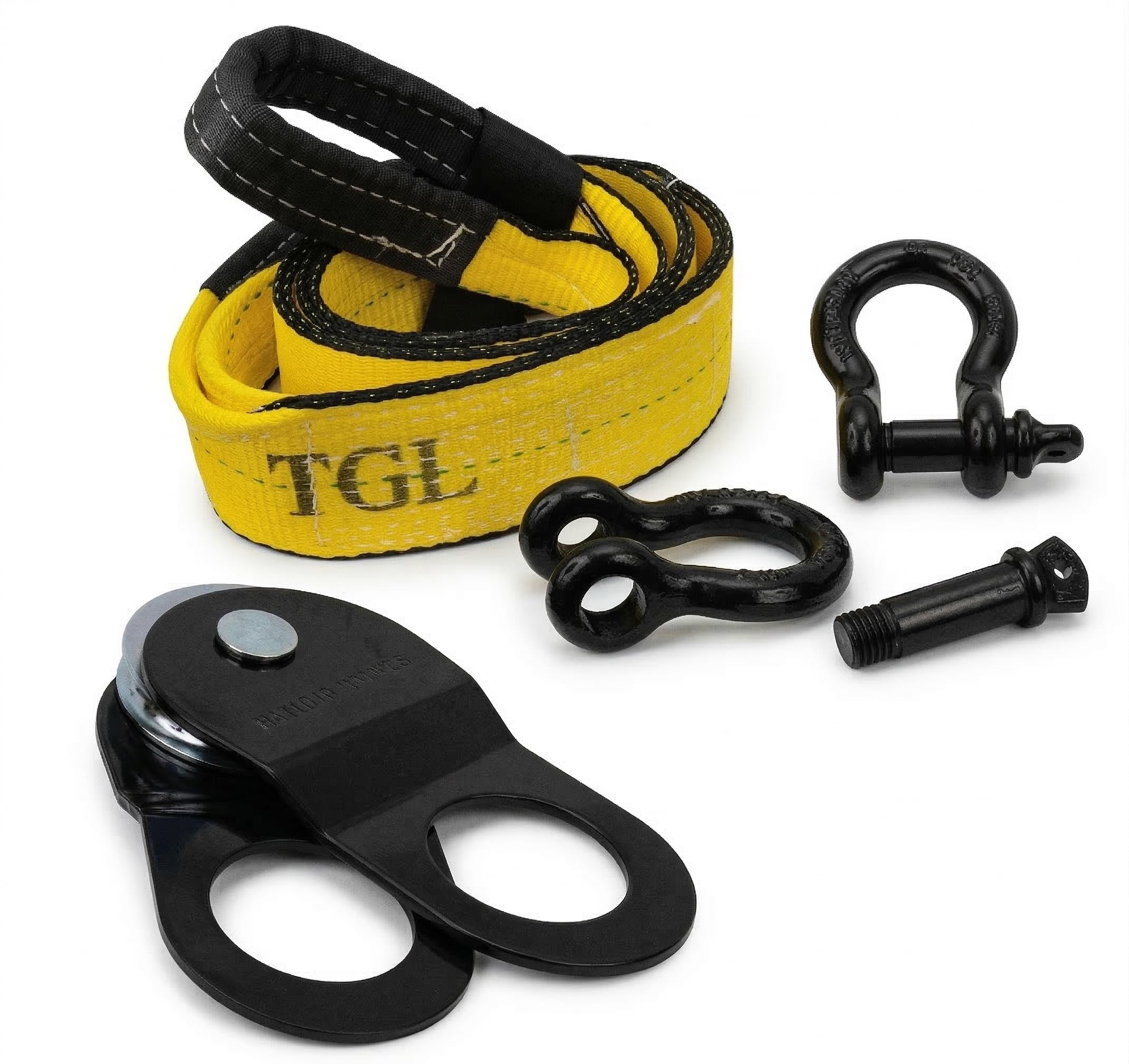
This is the rare recovery kit that actually includes everything a weekend off-roader needs before heading into the woods. You get a 10-ton snatch block, an 8-foot tree saver strap, a short tow strap with reinforced eye loops, and two 3/4-inch D-ring shackles—all in one yellow-and-black bundle. The snatch block itself works with steel cable or synthetic rope from 7/32-inch up to 3/8-inch diameter, and the powder-coat finish keeps corrosion off when you store it wet. The kit’s tensile strength is rated at 30,000 pounds, so it handles full-size trucks without blinking.
What wins people over is the sheer completeness. Owners have used the tree saver to anchor a live tree while the snatch block doubled their winch line to pull a 1-ton diesel Ram and trailer out of a deep hole, and later to right a flipped Toyota on the same trip. The recurring observation is that the kit “paid for itself multiple times.” A few owners flag that the retaining rings on the snatch block can work loose with repeated use, so checking them before every trip is smart practice. There is no carrying case included, but an aftermarket zipper bag solves that easily.
The real-world edge: You are not buying a single pulley—you are buying a full recovery system that works as a winch extension strap, a recovery bridle, and a redirect anchor all in one. The 4.8-star consensus across a very large owner base tells you this is not a gamble.
Reach for this if: you want one purchase that covers tree saver, towing strap, shackles, and snatch block for Jeep, Ford, or Toyota recovery.
Look elsewhere if: you need a block with an 18-ton or higher WLL for heavy-duty commercial towing—the 10-ton cap tops out on smaller rigs.
2. AUTMATCH Winch Snatch Block 18 Ton
A forged steel brute that shrugs off loads that would snap smaller blocks.
If you drive a heavy diesel pickup or haul commercial equipment, the 18-ton Working Load Limit here is the number that matters. The block is made from ultra-strong drop-forged steel with a heat-treated alloy steel and brass axle, and the entire exterior gets a zinc-galvanized and powder-coated finish that stands up to salt, mud, and rain. At 7.62 pounds, this is noticeably heavier than the ALL-TOP forged block (which is 7.04 pounds), and that extra heft comes from the brass bushing and the copper grease nipple that lets you pump lubrication into the pivot to keep it spinning smoothly through years of use. It accepts rope up to 1/2-inch diameter, making it compatible with larger tractor winch lines that smaller blocks cannot handle.
The review pages sum it up: “Wow what a substantially well made pulley!” The eyelets are sufficiently rounded for soft shackle use without worrying about chafing the fabric. The high-visibility orange color makes it easy to spot if you drop it in the woods. The single trade-off is weight—at nearly eight pounds, it is not the block you want in a small UTV storage compartment. But for a truck bed or tool box, it disappears.
The catch: This is a single block, not a kit. You will need to supply your own tree saver strap, shackles, and rope separately. For the raw strength per dollar, it is a very tough act to beat.
Best for: full-size trucks, tractors, and commercial recoveries where 18-ton WLL gives you real safety margin.
skip it if: you want an all-in-one kit—buy the TGL above if you prefer one box with straps and shackles.
3. ALL-TOP Forged Snatch Block (18 Ton)
Forged steel with a finish so tough it outlasts the truck.
ALL-TOP applies a proprietary 12-stage coating process—forging, heat hardening, galvanization, E-coating, and an ultra-high-wearing-resistant powder top coat—that delivers what owners call “double and even triple the durability of similar products.” The 18-ton working load is identical on paper to the AUTMATCH block, but the break strength here is 79,300 pounds, which is statistically slightly higher than the AUTMATCH’s 79,366 (effectively the same). At 7.04 pounds, the ALL-TOP shaves about half a pound off the AUTMATCH without sacrificing strength. The block accepts rope up to 5/8-inch diameter, so it works with the thickest winch lines on the market.
The crowd favorite aspect here is durability—35 owners highlight how the block survives repeated extreme recoveries without galling or seizing. One owner used it to winch a 10-ton truck onto a trailer and reported no deflection or wear. The 99-year/999-month low-maintenance warranty tells you the maker is confident. A small number of owners mention the grease fitting can be finicky; using a standard grease gun works but requires a bit of patience. If you want a single block that will outlast your ownership of the vehicle, this is it.
Honest trade-off: no tree saver or shackles in the box, and at over 7 pounds it is too heavy for a small UTV compartment. For a pickup bed or recovery bag, this is a set-and-forget piece of gear.
Reach for this if: you want the best corrosion and impact resistance in the sub-premium tier, backed by a warranty that is basically lifetime.
Look elsewhere if: you need a complete kit with straps and shackles—buy the TGL for that convenience.
4. METOWARE Offroad Recovery Kit

A heavy-duty kit that punches well above its pay grade.
The METOWARE kit mirrors the TGL formula—snatch block, tree saver, and two D-ring shackles—at a slightly lower entry cost. The snatch block is rated at 10 tons, works with 7/32-inch to 3/8-inch cable or synthetic rope, and wears a durable corrosion-resistant electrophoretic paint finish that resists rust. The tree saver is a 3-inch by 8-foot orange strap that doubles as a tow strap or winch extension. The two 3/4-inch D-ring shackles are electro-galvanized with silicon bumper protectors and certified to a 45-capacity rating. Owners have used this kit to pull down a 3-foot diameter, 15-foot tall tree trunk without any fraying or tearing on the strap.
The most-discussed aspect is quality—53 owners single out the build. The heavy-duty theme runs strong, with 37 owners noting how solid the components feel. The snatch block itself is larger than many expect; one owner noted it “was huge” and barely fit in a UTV compartment, but also acknowledged that the size means “it will do what I need it to do.” If storage space is tight in a side-by-side or small Jeep, measure your compartment first. Otherwise, this is a fantastic entry point for someone building their first recovery kit.
What owners love
- Quality hardware with heavy-duty D-rings oversized for safety
- Tree saver strap handles massive tree-pulling without damage
- Snatch block pulley is surprisingly heavy and durable for the price
The honest size note
- Snatch block is larger than expected—does not fit small UTV storage compartments
- No carrying case included for the kit
Reach for this if: you are building a recovery kit on a tighter budget and still want a complete 4-piece system with certified shackles.
Look elsewhere if: you need an 18-ton block for heavy-duty towing—the 10-ton cap is fine for SUVs and Jeeps, not for full-size diesels.
5. Rhino USA Snatch Block (13.5 Ton)
An aerospace-grade polymer pulley that sheds weight without shedding strength.
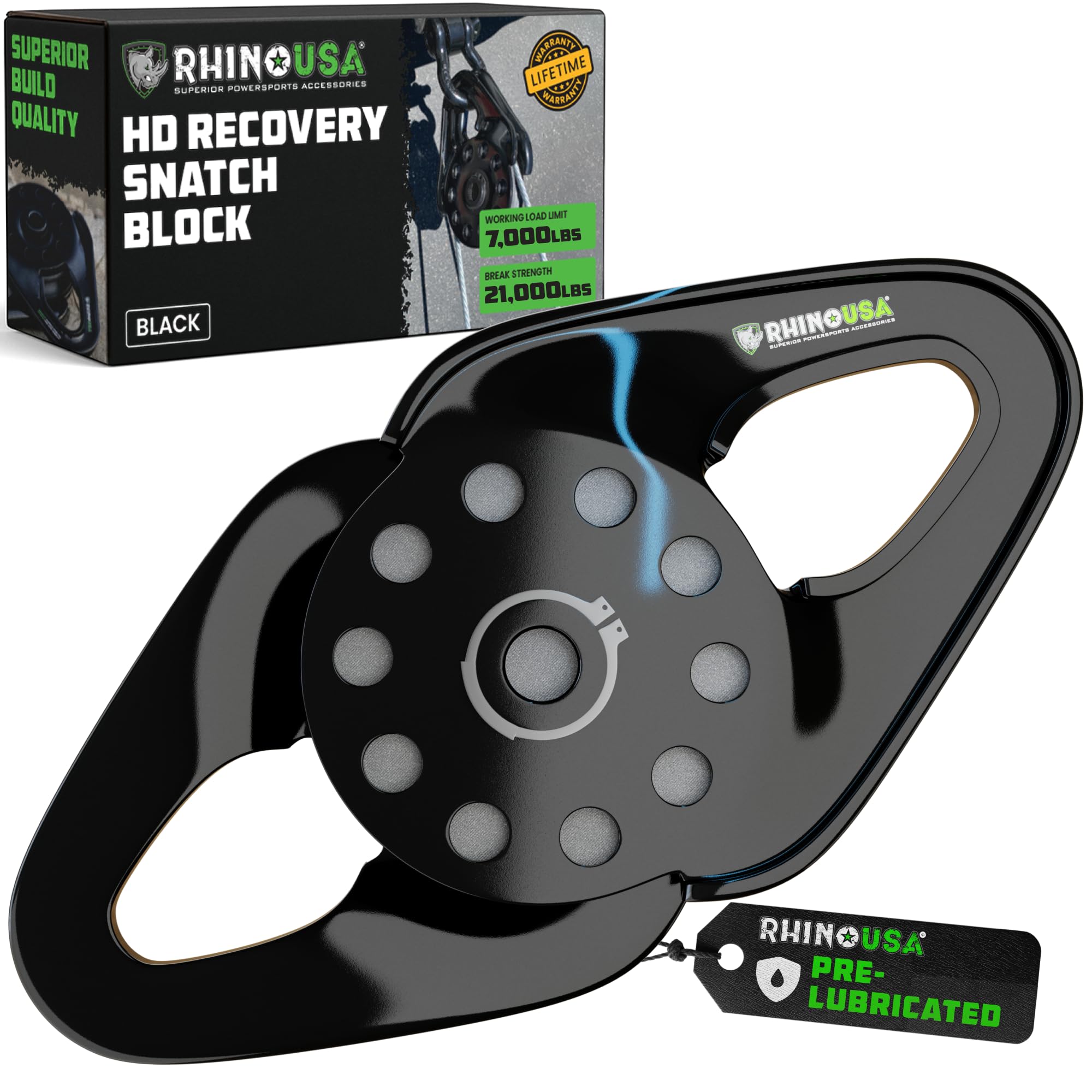
Most snatch blocks are forged steel bricks. The Rhino USA uses a cutting-edge aerospace polymer pulley paired with a 6mm powder-coated drop-forged steel frame, bringing the total weight to just 5 pounds—lighter than the AUTMATCH and ALL-TOP by a noticeable margin. The 13.5-ton (27,000 lbs) WLL is higher than the 10-ton kits but still lower than the 18-ton monsters, putting it in a balance for full-size SUVs and light trucks. It accepts synthetic rope or steel cable up to 3/8-inch diameter and works with common 3/4-inch shackles.
The quality rating is the standout here—56 owners praise the build. The pulley runs smooth with no rough edges, and buyers report it works flawlessly with synthetic winch lines without any rope damage. The USA-based, family-owned business story resonates, though some owners note the product is manufactured in China despite the American branding. The polymer wheel is a genuine advantage if you are weight-sensitive, but a few owners express caution about long-term wear under extreme heat compared to an all-steel block. For weekend trail riding and moderate recoveries, this is a smart, lighter alternative.
Why it stands out
- Aerospace polymer pulley saves significant weight—5 lbs total vs 7+ for all-steel blocks
- High 13.5-ton WLL for the weight class
- Excellent customer service from a family-run USA business
The honest note
- Polymer sheave may wear faster than steel under extreme commercial use
- Made in China despite USA branding; some buyers feel misled
Reach for this if: you want to save a couple of pounds in your recovery bag without dropping below a 13.5-ton rating.
Look elsewhere if: you insist on an all-forged steel block or need an 18-ton WLL for commercial-grade recovery.
6. GearAmerica 9 Ton Snatch Block (2-Pack)

Two snatch blocks in one buy—build a compound pulley system without a second trip.
If you want to run a true 3:1 or 4:1 mechanical advantage system, you need two snatch blocks. GearAmerica sells a 2-pack of 9 US Ton (18,000 lbs) blocks that work with both steel cable and synthetic rope from 7/32-inch to 3/8-inch diameter. Each block is built with a heavy-duty steel frame and orange powder coating that stands out on the trail. The design philosophy is simple: set up one block at the anchor and one on the vehicle, and you effectively triple your winch’s pulling power while cutting the strain on the winch motor.
Owners note that the blocks are “heavy-duty and easy to operate.” The 2-pack is ideal for recovers that require a directional change plus a power double—for example, winching a vehicle around a tree while also multiplying line pull. A small batch of units arrived with locked-up bearings; GearAmerica replaced them promptly under the Lifetime Performance Guarantee. A few owners mention the snap rings feel flimsy; replacing them with aftermarket rings solves the issue. For the price of a single block from some brands, you get two ready-to-run units here.
The key insight: Two blocks let you create a mechanical advantage that a single block cannot. This is the pick if you plan to do serious winching with compound rigging.
Reach for this if: you are building a compound pulley system and prefer a matched pair that ships together.
Look elsewhere if: you only need one block for basic redirect—buy a higher-capacity single block instead.
7. GearAmerica Smart Snatch Block 24,000 lbs

Pocket-sized muscle that disappears into a UTV cubby until you need it.
Most snatch blocks are bulky, but the GearAmerica Smart Snatch Block measures less than 6 inches long and weighs just 2.86 pounds. That is lighter than the Rhino USA block and less than half the weight of the AUTMATCH. Despite the compact size, it carries a 12,000 lb Working Load Limit with a Minimum Breaking Strength of 24,000 lbs—enough for small to medium 4x4s, ATVs, and UTVs. It accepts rope up to 7/16-inch diameter and works with both D-rings and soft shackles.
The construction quality is the most praised aspect—13 owners highlight the fit and finish. The block includes a built-in grease zerk (a small grease fitting) that lets you lubricate the axle in dirty, muddy conditions, though a protective cap over the zerk would be a welcome addition. One owner used it to recover a 12,000 lb skid steer from deep mud uphill after a Warn winch and a truck in 4-low failed—proof of the block’s real-world strength. The size is polarizing: some find it “smaller than anticipated” and note the connection opening radius limits shackle size. For UTV and ATV owners, the compact footprint is a feature, not a flaw.
The smart angle: This block is tune for the weight and space constraints of UTV/ATV recovery kits. At 2.86 lbs, you can keep it onboard full-time without sacrificing cargo space.
Reach for this if: you drive a UTV, ATV, or small Jeep and need a snatch block that fits in a tight storage compartment.
Look elsewhere if: you regularly recover heavy diesel trucks—the 12,000 lb WLL is undersized for 3/4-ton and 1-ton vehicles.
8. Greteefor Heavy-Duty Double Block and Tackle
A 4:1 mechanical advantage system that turns one person into a lifting crew.
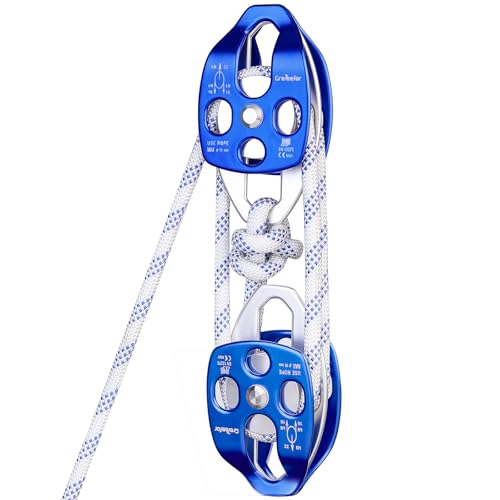
This is not a winch-mounted snatch block—it is a standalone double-block-and-tackle pulley system designed for lifting and pulling without any powered winch. The 4:1 mechanical advantage means you only need one-quarter of the force to lift a load: a 200 lb pull on the rope moves 800 lbs. The dual pulleys are CE-certified and forged from aluminum, handling loads up to 32 kN (about 7,200 lbs). The 100-foot-long, 1/2-inch rope is thick enough (11mm) that it does not bite into your hands when hoisting heavy weight.
The quality and functionality scores are nearly equal—34 owners highlight the build quality and 30 praise how well it works. Owners have used it to fell trees by pulling the top in the desired direction, to move heavy logs up a hill, and as a garage hoist for attic storage. Assembly takes about a minute, and the rotating plates and swing-side design make rope installation straightforward. The instructions are a bit sparse; you may need to watch a video to get the threading right the first time. The rope itself gets frequent praise—”rope alone worth the price” is a common sentiment. If you need a non-powered lifting system for farm, garage, or trail work, this is it.
Honest limitation: This is not a snatch block for your winch line—it is a manual block and tackle for lifting. Do not buy it if you need an off-road recovery snatch block. Buy it if you need to lift an engine block, hoist a deer, or drag logs uphill.
Reach for this if: you need a manual 4:1 lifting system for garage, attic, tree work, or farm use and value a complete 100-foot rope setup.
Look elsewhere if: you need a winch-mounted snatch block for off-road recovery—this is a different tool for a different job.
9. Factor 55 Rope Retention Pulley (RRP)

The lightest, most refined rope retention pulley for synthetic line purists.
Factor 55 is the premium name in recovery hardware, and the RRP (Rope Retention Pulley) is their answer to a specific problem: when a standard snatch block goes slack, the rope can escape the pulley groove and cost you time. The RRP uses rubber retention fingers that grip the synthetic rope during momentary slack, keeping the line seated in the groove so you do not have to re-thread it. The pulley is machined from a single piece of billet 6000-series aluminum with a Mil-A-8625 F hard-anodized surface, and the friction surface is treated with Teflon to reduce heat and wear. At 1.4 pounds, it is dramatically lighter than any steel block on this list—lighter than the GearAmerica Smart Snatch Block by over a pound.
The quality and lightweight design are the top draws. Owners call it “a lightweight replacement for a standard snatch block with synthetic line.” The tapered outside edge reduces soft shackle contact, and the oversized hole radius prevents chafing. A few owners note that proper technique is required to avoid rope burn, and the WLL of 2 tons (22) means this is purpose-built for synthetic-rope recoveries on medium-duty vehicles, not for steel cable or heavy commercial loads. If you have already invested in a Factor 55 FlatLink or similar soft-shackle setup, this pulley completes the ecosystem.
what separates it
- Rubber rope retention fingers prevent line escape during slack—a real time-saver
- Teflon-coated friction surface reduces heat and wear on synthetic rope
- At 1.4 lbs, it is the lightest option by a wide margin
The honest premium tax
- Price is significantly higher than steel blocks with higher WLL
- Only for use with synthetic rope—will not work with steel cable
- 2-ton WLL is fine for Jeeps and SUVs but undersized for heavy diesel recovery
Reach for this if: you run synthetic winch rope, value extreme weight savings, and are willing to pay for premium billet-aluminum engineering.
Look elsewhere if: you use steel cable, need a high WLL for heavy trucks, or are on a budget—this is a specialized tool for a specific rigging style.
Understanding the Specs
Working Load Limit (WLL) vs. Break Strength
Every snatch block has two numbers: the Working Load Limit is the safe maximum load you can put on it during a normal recovery, and the Break Strength (or Minimum Breaking Strength) is the load at which the component is guaranteed to fail. A safety-conscious manufacturer designs the block so the break strength is roughly double the WLL—that built-in safety margin protects you if a recovery puts unexpected strain on the gear. A 10-ton WLL block, for example, typically has a break strength around 20 tons. Always rig with the WLL as your hard ceiling; the break strength is not a target, it is the emergency boundary.
Rope Diameter and Material Compatibility
Snatch blocks specify a rope diameter range they accept, usually listed as a fraction like “7/32” to 3/8”” or “up to 5/8”.” Using a rope thinner than the minimum can let it slip sideways in the groove; using one thicker than the maximum can jam the pulley. Steel cable needs a deeper groove and harder sheave material than synthetic rope, which is softer and can be cut by burrs or sharp edges. Many modern blocks work with both, but always confirm before rigging. If you run synthetic winch line, a block with a smooth, Teflon-coated or polished groove will extend your rope’s life significantly by reducing friction heat.
FAQ
What is the difference between a snatch block and a regular pulley?
How do I use a snatch block to double my winch power?
Can I use a snatch block with steel cable and synthetic rope interchangeably?
How much weight can a 10-ton snatch block actually handle?
What does a grease zerk (grease nipple) do on a snatch block?
Do I need a tree saver strap with my snatch block?
How do I choose between forged steel and aluminum snatch blocks?
What size D-ring shackle do I need for my snatch block?
Can I use a snatch block for tree felling or lifting logs?
How often should I inspect and maintain my snatch block?
Final Thoughts: The Verdict
Across the board, the winch and pulley system winner is the TGL Snatch Block Kit because it combines a proven 10-ton snatch block with a tree saver, tow strap, and certified shackles—everything a weekend off-roader needs in one purchase, backed by a massive owner base who vouch for its real-world reliability. If you want a standalone block with an 18-ton capacity that shrugs off heavy diesel recoveries, grab the AUTMATCH Snatch Block. And for owners who run synthetic rope and crave the absolute lightest, most refined pulley on the market, the Factor 55 RRP is the one to reach for—just pair it with a quality soft shackle and enjoy the weight savings every time you open your recovery bag.
How We Picked
We do not accept paid placement. Every pick is matched to a real buyer and a real use-case; we do not hands-on test units.
Sources & Methodology
Specifications: manufacturer listings and product documentation. Review insights: verified customer reviews, as of July 2026. Pricing: not shown on this page (it changes often); check the current price via the retailer link.
As an Amazon Associate, GoCarLife earns from qualifying purchases. This does not affect which products we feature.