
Our readers keep the lights on and the garage heater humming. As an Amazon Associate, I earn from qualifying purchases.
Specs are compiled from manufacturer listings and verified buyer reviews and can change over time — please confirm the key details on the product page before buying.
The draft you feel near a closed window is money leaving your home. A worn-out gasket is the silent culprit — it lets heat escape in winter, invites dust and noise in summer, and forces your HVAC to work harder. This guide lines up eight window gasket replacements that actually stick, seal, and stay put so you can fix the problem without trial and error.
I’m Mo Maruf — the founder and writer behind GoCarLife. This guide is built by comparing the manufacturers’ published specifications and the patterns across verified customer reviews, so you get each pick’s real strengths and trade-offs instead of marketing spin.
Whether you’re fighting a draft under a double-hung sash or resealing an RV window that leaked on your last trip, the right window gasket replacement depends on your frame type, gap size, and how much time you want to spend installing it.
Our Picks at a Glance


How To Choose The Best Window Gasket Replacement
Picking the right gasket starts with measuring your frame’s channel, not guessing. A gasket that is too thin rattles, one that is too thick jams the window shut. Focus on three things: the gap you need to fill, the shape of the slot your frame uses, and the material that handles your climate without cracking.
Measure Your Gap and Slot Shape First
Use a coin or a cheap caliper to measure the width of the gap when the window is closed. Then look at the frame channel — some frames have a skinny kerf slot (about 1/8 inch wide), others have a wider T-slot, and many just need a flat, self-adhesive strip. Buying a bulb seal for a flat-frame window wastes money; buying foam tape for a kerf channel won’t lock in.
Match the Material to Your Weather
Silicone stays flexible from deep freeze to scorching sun, making it the longest-lasting choice for exterior doors and windows. EPDM rubber offers excellent cold-weather performance without cracking. Standard vinyl is budget-friendly but can harden and shrink after a few seasons in direct sun. Thermoplastic Elastomer (TPE) strikes a good middle ground — it stays pliable and resists UV damage.
Don’t Overlook the Installation Method
Kerf-mount and T-slot gaskets slide into a channel — no adhesive, no mess, and easy to replace. Self-adhesive strips are faster for flat surfaces but rely on a totally clean, dry surface to stay stuck. Foam tape compresses easily to fill uneven gaps but wears out faster than rubber or silicone bulb seals under constant friction.
Quick Comparison
| Model | Best For | Mount Type | Length | Material | Amazon |
|---|---|---|---|---|---|
| Window Weatherstrip Seal 1/4″ Bulb Bubble Kerf Mount★ Best Overall | Double-hung windows with kerf slots | Kerf Mount | 17 ft | TPE | Amazon |
| Frost King Tubular Vinyl Gasket WeatherstripBudget Champion | Budget, one-door or one-window quick fix | Nail/Tack | 17 ft | Vinyl | Amazon |
| VITAM AMO Weather Stripping Seal StripTop Performer | Large uneven gaps, DIY draft blocking | Self-Adhesive | 18 ft | EPDM Rubber | Amazon |
| White Weather Stripping Self Adhesive Foam Tape | Noise reduction and compression on uneven frames | Self-Adhesive | 13 ft | CR Foam / Neoprene | Amazon |
| Upgrade RV Window Seal Strip | RV fixed windows | Press-In | 10 ft | EPDM Rubber | Amazon |
| RV Window Rubber Seal Strip | Camper and travel-trailer windows | Lubricate & Press-In | 13 ft | EPDM Rubber | Amazon |
| M-D Building Silicone Gasket Seal | Exterior doors and windows, extreme weather | Peel-and-Stick | 20 ft | Silicone | Amazon |
| T-Slot Mount Window Weatherstrip Seal | Aluminum frame windows, truck caps, T-channel | T-Slot | 25 ft | TPE / PP Base | Amazon |
In‑Depth Reviews
1. Window Weatherstrip Seal 1/4″ Bulb Bubble Kerf Mount
Our pick — 4.5★ from 500+ verified ratings; the strongest balance of quality and price.
The kerf-mount champ that slides into place and stays there.
This gasket is made from Thermoplastic Elastomer (TPE), a material that stays soft and flexible without the brittle cracking you get from cheap vinyl. It uses a standard 3/16-inch kerf depth and 1/8-inch kerf width to lock into the channel on most double-hung and casement windows. The bulb measures 1/4 inch in diameter with a thin 1/32-inch wall, so it compresses easily to seal uneven gaps.
You get 17 feet in a single piece — enough for several windows. The stiff channel insert (the kerf) makes sliding it into the frame slot quick. The crowd-favorite praise here is quality and installation ease; people report taking about 1.5 hours to do eight windows, which is fast compared to softer gaskets that fight you. Made in the USA, and available in four colors to match your trim.
The trade-off is that the 1/4-inch bulb works best on frames with a kerf slot — if your window has a flat surface or a T-channel, you will need a different mount type. The size feedback is mixed: some find the bulb diameter perfect, a few say it runs small for wider gaps. Measure your existing slot first.
What Wins People Over
- Rigid kerf insert slides in easily and holds tight
- Soft but strong bulb seals drafts on double-hung windows effectively
- Made in the USA from durable TPE that resists cold
The Fit Note
- Only fits frames with a standard 3/16″ kerf slot
- Some owners find the 1/4″ bulb too small for very wide gaps
Reach for this if: your double-hung or casement window has a kerf channel and you want a clean, adhesive-free install that buyers call the “best they have used.”
Look elsewhere if: your window frame is flat or uses a T-slot — you will need a different mount style.
2. Frost King Tubular Vinyl Gasket Weatherstrip, 1/2″ W, 1/4″ T, 17′ L
A no-frills vinyl tube that nails down a draft for pocket change.
This is about as simple as a gasket gets — a hollow, tubular vinyl strip that you nail, tack, or staple into place on the door or window stop. It measures 1/2 inch wide and 1/4 inch thick, running 17 feet long, enough to seal one average window or door. The vinyl material compresses when the window closes, blocking drafts and cushioning the frame at the same time.
The crowd-values here is quality and ease of installation for the price. Buyers report it works “excellent for drafts” and is “sturdy and easy to work with.” The catch is that functionality and adhesion get mixed reactions — it works great as a temporary or seasonal fix, but several owners mention it has limited exterior life. No adhesive comes with it, and the instructions are sparse, so you will need a hammer and brad nails (or contact cement if you prefer a stick-down approach). An occasional package arrives as old stock with faded packaging, but the product itself holds up for light-duty use.
Think of this as a low-commitment fix for a single drafty door or a rental where you do not want permanent modification. It is not built for extreme weather or long-term exterior exposure.
The quick read: A cheap, effective stopgap for one door or window — nail it, trim it, and call it done. Not the choice for a whole-house refresh or a location that bakes in full sun.
Grab it if: you need a fast, inexpensive fix for a single draft with zero measuring and minimal tools.
skip it if: you want a long-term exterior seal that lives through multiple seasons.
3. VITAM AMO Weather Stripping Seal Strip for Doors Windows 18 Feet
Nearly 13,000 owners back this EPDM strip for wide, uneven gaps.
This is among the most popular self-adhesive gaskets on the market, with a proven track record for sealing gaps from 5/16 inch up to 15/32 inch — noticeably thicker than the Seal Supply kerf-mount at 0.48 inches vs 0.03 inches. Made from VITAM AMO’s specially formulated EPDM rubber, it resists freezing and cracking in low temperatures, making it a strong choice for exterior doors in cold climates.
The sealing strip measures 18 feet long by 0.54 inches wide. A unique design feature is the multi-hole pattern along the strip: these holes reduce the force needed to close the door and absorb some sound waves, so the door closes quieter and with less slamming pressure. Installation is simple — peel the yellow film, press onto a clean dry surface, and trim with scissors. Owners say it is “easy to cut and install on wood/painted surfaces” and “stays flexible in cold.”
The honest downside is the adhesive. Many owners mention the initial stick is strong, but it can fail over time, especially on dusty or humid surfaces. Several recommend reinforcing with super glue or wood glue for a permanent hold. Measure your gap carefully — if the strip is too thick, the door may be hard to close and you might need a pull latch. It works well on portable AC window kits, door frames, and even window screens to block mosquitoes.
Why Owners Love It
- Thick EPDM rubber seals large gaps (5/16″ to 15/32″) that foam tape cannot fill
- Multi-hole design reduces door slam noise and absorbs sound
- Stays flexible in cold weather — no cracking
The Adhesive Catch
- Backing adhesive can lose grip over time; may need extra glue for a permanent bond
- If you pick a strip too thick for your gap, the door becomes hard to close
Pick this for: sealing large, uneven gaps around exterior doors, portable AC units, or drafty wood windows where foam tape is too thin.
Think twice if: you want a set-and-forget solution on a high-use door — the adhesive is the weak link and needs clean prep to last.
4. White Weather Stripping Self Adhesive Foam Tape, 1″ Wide X 3/8″ Thick, 13 Feet

High-density foam that one owner says cut noise by 20 decibels.
If you need to compress a seal into a misshapen or uneven gap, closed-cell foam is often the best tool. This tape is made from CR foam and neoprene — it is dense and not easily compressed, unlike soft open-cell foam that flattens permanently. It measures 1 inch wide by 3/8 inch thick, and comes in two rolls totaling 13 feet. The foam handles temperatures from -50°C to 150°C, so it works in attics, garages, and outdoor sheds.
The strong grid adhesive backing is the standout feature here — owners consistently call it “extremely sticky,” warning that you must align it perfectly before pressing because repositioning peels paint. One owner described using it on a front door and said it “reduced noise by 20 decibels” to the point their dogs stopped barking at every sound outside. The foam is bright white, firm, and easy to cut with scissors or a blade.
A few owners note the foam is “too hard” for their specific gap, meaning it does not squish down enough to create a seal on very narrow spaces. It also demands a perfectly clean, alcohol-wiped surface to bond properly. This is a fantastic choice for interior doors, sliding doors, electrical enclosures, and any odd-shaped frame where a rubber bulb seal would not fit.
The noise-blocking specialist: if your main complaint is sound transmission through a door gap, this dense foam with its tenacious adhesive is the most effective budget fix in the list. Just watch your paint when positioning it.
Best for: interior doors with uneven gaps, noise reduction, and situations where you need a firm, compressible seal that does not deform.
Not ideal if: your gap is narrow and you need a soft, squishy seal — the high density resists compression.
5. Upgrade RV Window Seal – 0.5 x 0.275inch 10FT (White)
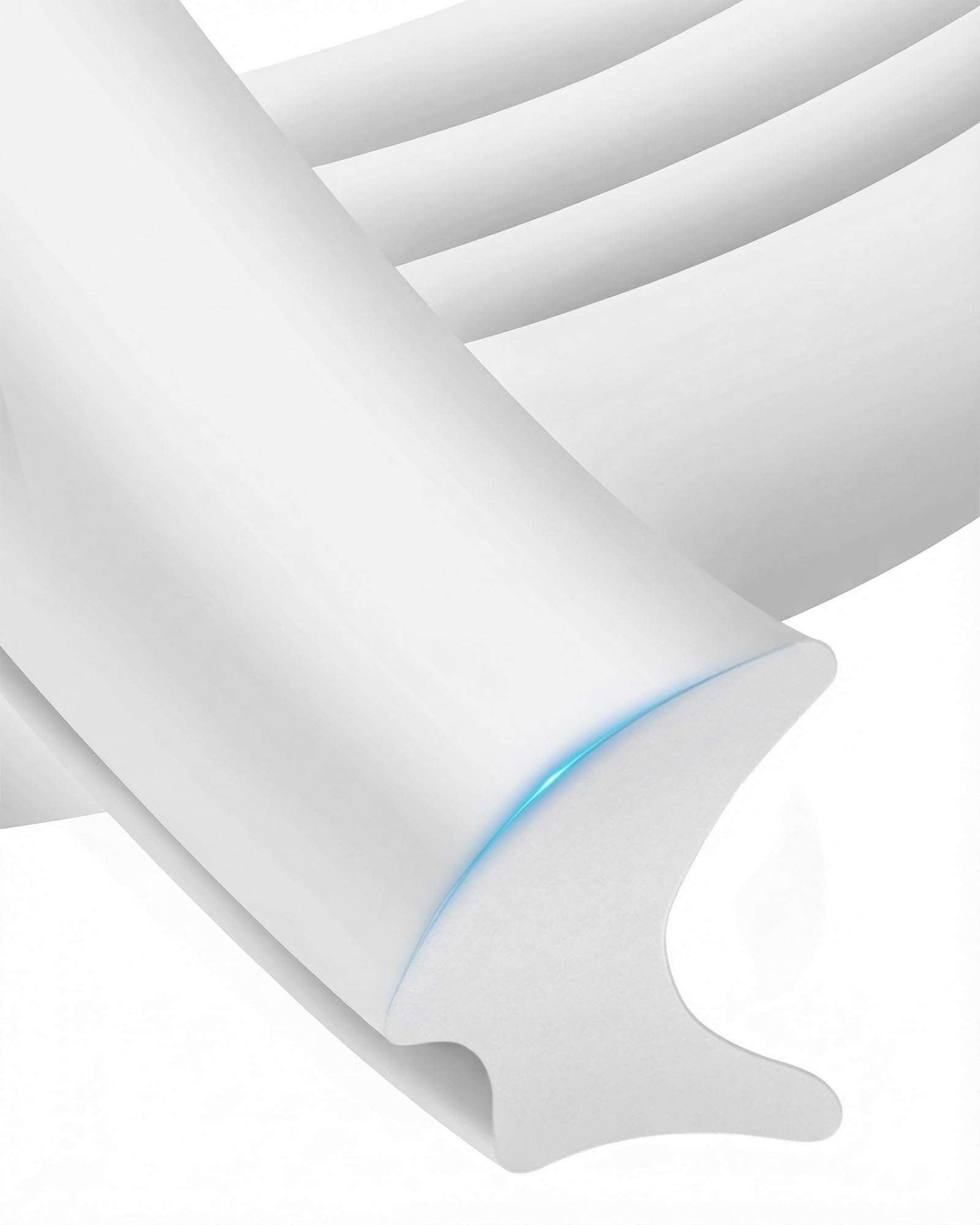
Thickened EDPM rubber that locks out rain on RV fixed windows.
This is an upgraded RV window seal with a wider bottom profile measuring 0.5 inches high by 0.275 inches wide, and runs 10 feet long. It is specifically designed for stationary (non-sliding) RV glass windows. The EDPM rubber resists UV radiation and stays flexible, so it does not become brittle and crack after a season of sun exposure.
Installation is a press-in job: you measure, cut freely, and push the strip into the gap between the glass and the fixed metal frame. Owners confirm it fits 2006 Forest River Sunseeker and 2004 Lexington 270 windows perfectly, and note it “blocked water effectively.” The trade-off is that because it is thicker than many OEM strips, you need to apply significant force to seat it. Taking your time and pushing back towards corners after completing turns helps the fit look professional.
One thing to watch: this seal is for fixed windows only, not sliding glass sections. If your RV has aluminum seal sections on some windows, leave those in place and cut the new rubber to fit around them. The 10-foot length covers most single windows, but you can buy longer options if you need to do the whole rig.
What Buyers Appreciate
- Thicker than original seals, creating a tighter barrier against rain and wind
- EDPM rubber resists UV and stays flexible in sun exposure
- Press-in installation is a straightforward DIY job
The Fit Caution
- Requires significant force to press into the channel — not a loose fit
- Only for fixed RV windows, not sliding glass sections
Get this for: resealing fixed RV windows that have been leaking or letting in road noise — the thicker EDPM outperforms original thin seals.
Reconsider if: you need a seal for a sliding window or a household window; this is designed for the RV/Truck frame channel.
6. RV Window Rubber Seal Strip, 1/2″ x 1/4″ Locking Gasket, 13 Feet

13 feet of flexible EPDM that fits vintage campers and modern vans alike.
This black rubber seal strip measures 1/2 inch by 1/4 inch and comes in a single 13-foot piece, giving you more coverage than the 10-foot RV seal above. The EPDM material handles heat and weather without corrosion, which matters for a camper that bakes in the sun all summer. Unlike the self-adhesive options, this one uses a lubricated press-in method — you wet the frame with soapy water or silicone spray, then push the gasket between the glass and metal frame.
Customers note a great fit on older travel trailers, including a 1992 Terry trailer where the original gasket had shrunk. The material is flexible enough to work around curves, though one owner noted it does not hold molded shapes at sharp corners and can pop back out if you force a tight radius. The consensus among buyers is that this is a “decent seal” that does not leak; it is slightly smaller than some OEM Forest River seals but functions perfectly well.
This is a solid middle-ground choice for camper owners who want a standard 1/2 x 1/4 profile without paying premium-brand prices. The 13-foot length covers two to three windows, and you can cut it to exact size with a knife.
The practical camper seal: easy to install with lubrication, fits many trailer windows, and resists weather. The only recurring note is that sharp corners may need adhesive to stay put — but the p-touch seal is watertight for standard window shapes.
Ideal for: owners of older travel trailers or campers who need a standard 1/2″ x 1/4″ EPDM gasket that is easy to cut and install.
Not the best if: your windows have very sharp 90-degree corners — the material may need extra adhesive to hold the shape there.
7. M-D Building Silicone Gasket Seal for Doors and Windows, 20ft

Silicone that stays flexible in deep freeze and scorching summer.
If you want a gasket that handles the worst weather without hardening, this is your pick. Made from premium silicone rubber, it remains flexible in extreme cold and heat — no cracking in winter or melting in summer. This 20-foot strip uses a peel-and-stick application: no nails, no staples, no hardware needed. It carries a UL listing for smoke and draft control, meaning it meets fire-safety standards for sealing around doors.
The teardrop-shaped seal compresses to close gaps around exterior doors and windows, blocking drafts, dust, moisture, and insects. Owners enthusiastically praise its effectiveness — the “top positive aspect” among over 30 mentions — and note it works particularly well for sealing air filter return grills and eliminating door drafts. One owner said they “have used this type of weatherstripping for years” and love it.
The main drawback is adhesion: the peel-and-stick backing is not as tenacious as some owners want. Several note the seal holds well but wish it were stickier, and recommend adding a bead of silicone caulk for a permanent installation. It is also relatively thin, so it is not designed for large, uneven gaps or warped frames. Reviewers point out it is best suited to precise, relatively new doorframes with consistent gaps.
What Makes It a Premium Pick
- Silicone rubber stays flexible from freezing winters to hot summers without cracking
- UL listed for smoke and draft control — a solid safety credential
- easy peel-and-stick installation with no hardware required
The Honest Limitation
- Adhesive could be stronger; consider caulk for a truly permanent fix
- Too thin for large or irregular gaps — works best on even doorframes
Choose this for: exterior doors in extreme climates where you need a silicone seal that outlasts foam and rubber, and the frame is in good shape.
Pass if: your door has big uneven gaps or the frame is warped — this strip demands a relatively straight surface to seal.
8. T-Slot Mount Window Weatherstrip Seal 5/16″ Bulb Bubble for 3/16″ Slot

A T-anchored bulb seal built for aluminum frames and truck cap channels.
This gasket uses a T-shaped polypropylene (PP) base that slides into a standard 3/16-inch T-slot receptacle — the kind you find on aluminum storm windows, truck camper shells, and some commercial doors. The bulb measures 5/16 inch in diameter with a 1/32-inch wall thickness, made from Thermoplastic Elastomer (TPE). The T-anchor is reinforced and semi-rigid, which makes pulling it through the channel much easier than a solid rubber strip.
Shoppers say it fits perfectly on 11-year-old Leer camper shells and aluminum apartment windows. The quality and fit are the most-praised aspects, with 24 and 23 positive mentions respectively. One owner noted the T-slot design meant “no adhesive backer” and that the semi-rigid plastic T made installation smooth — “had it been solid rubber it might have taken longer and required much more dish soap and water.” The 25-foot length is generous, leaving extra for future replacements.
The minor complaints center on accurate measurement — the 5/16-inch bulb is a common size, but make sure your T-slot receptacle is exactly 3/16 inch wide. This seal also slips into window screen bases, so it is versatile beyond just windows. The black color and OEM-quality construction make it a near-invisible repair on dark frames.
The T-slot answer: if your window has a T-channel — especially aluminum frames or a Leer/ARE camper shell — this is the correct gasket. The TPE bulb is soft and flexible, while the PP base locks in place without adhesive. A straightforward, permanent-looking repair.
Best suited for: truck camper shells, aluminum storm windows, and any frame with a 3/16″ T-slot channel — this is the specialist pick.
Not the right fit if: your window uses a kerf slot or a flat adhesive surface; the T-base will not lock into a different channel shape.
Understanding the Specs
Bulb vs. Foam vs. Tubular — Which Shape Seals Best?
The shape of the gasket determines how it compresses against the window edge. A hollow bulb-shaped gasket (like the Seal Supply kerf-mount or T-slot) collapses under pressure but springs back, creating a consistent seal even on slightly warped frames. Foam tape compresses easily too, but it can take a permanent set after repeated use, especially if the gap is excessive. Tubular vinyl (like the Frost King) is hollow and cushions well, but it needs nailing or stapling and can feel stiff in cold weather. For most windows, a bulb seal offers the best long-term compression and recovery.
Understanding Kerf, T-Slot, and Self-Adhesive Mounts
The mounting method matters just as much as the gasket material. Kerf-mounted seals slide into a narrow channel (kerf) on the window frame — no glue needed, and they pull out easily for replacement. T-slot seals use a T-shaped plastic base that locks into a matching T-channel. Self-adhesive strips are the simplest: peel the backing and press onto a flat surface. The catch is that adhesive-backed seals need a perfectly clean, dry, oil-free surface to stay stuck permanently — moisture or dust will cause them to peel over time. If your window has a kerf or T-slot, use that; it will last longer than any adhesive strip.
FAQ
How often should I replace window gaskets?
Can I mix different gasket types on the same window?
Will a thicker gasket always seal better?
Is silicone or EPDM rubber better for exterior windows?
Will a window gasket stop road noise from an RV?
How do I remove old gasket adhesive without damaging the frame?
Can I install a kerf-mount gasket if my window has no existing kerf slot?
What is the difference between a T-slot and a kerf-mount gasket?
Will adhesive foam tape damage painted window frames?
Why does my new gasket pop out at the corners?
Final Thoughts: The Verdict
For most people, the window gasket replacement winner is the Window Weatherstrip Seal 1/4″ Bulb Bubble Kerf Mount because it slides into a standard kerf channel in minutes, seals double-hung windows without adhesive, and the TPE material handles cold without cracking. If you need to plug a large uneven gap with no kerf slot, the VITAM AMO Weather Stripping Seal Strip is the crowd favorite with its thick EPDM rubber and noise-reducing holes. And for a T-slot frame in an aluminum window or truck cap, the T-Slot Mount Window Weatherstrip Seal is the one to reach for — it locks in without glue and stays put.
How We Picked
We do not accept paid placement. Every pick is matched to a real buyer and a real use-case; we do not hands-on test units.
Sources & Methodology
Specifications: manufacturer listings and product documentation. Review insights: verified customer reviews, as of July 2026. Pricing: not shown on this page (it changes often); check the current price via the retailer link.
As an Amazon Associate, GoCarLife earns from qualifying purchases. This does not affect which products we feature.