
Our readers keep the lights on and the garage heater humming. As an Amazon Associate, I earn from qualifying purchases.
Specs are compiled from manufacturer listings and verified buyer reviews and can change over time — please confirm the key details on the product page before buying.
You pull into the driveway after a long day, and the next morning your windshield is a solid sheet of frost. Crank the engine, blast the defroster, and wait — five, ten, fifteen minutes — while your breath fogs the glass faster than the vents can clear it. A plug-in 12V defroster sends direct heat to the glass so you see clearly in seconds, not minutes.
I’m Mo Maruf — the founder and writer behind GoCarLife. This guide is built by comparing the manufacturers’ published specifications and the patterns across verified customer reviews, so you get each pick’s real strengths and trade-offs instead of marketing spin.
After combing through dozens of models and thousands of owner experiences, these eight make the cut as the best window defroster for car options you can buy today.
Our Picks at a Glance

How To Choose The Best Window Defroster for Car
A 12V defroster clears your windshield fast without draining your battery or blowing a fuse. The choice depends on specs that determine whether you wait 30 seconds or 15 minutes.
Wattage and Heating Speed
Power is measured in watts (W), and in this category you’ll see 150W and 200W models. The 200W heaters deliver noticeably more heat to the glass — think of it as the difference between a hair dryer on low versus high. A 150W unit works fine for light frost or fog, but a 200W unit cuts through ice and heavy condensation faster. Just remember that higher wattage draws more current, so check your car’s fuse rating (usually 10A or 15A for the cigarette lighter circuit).
Fan Strength and Airflow
Heat alone is useless without a fan to push it across the glass. The fan’s power determines how large an area the warm air covers. A weak fan creates a hot spot the size of a dinner plate, while a strong fan clears the entire driver’s side quadrant. Look for models with at least two speed settings — you want a high-speed blast for quick defogging and a lower setting for maintaining visibility afterward.
Build Quality and Safety
These heaters sit on your dashboard for extended periods, so materials matter. ABS and heat-resistant polymer plastics resist warping. A built-in fuse in the cigarette lighter plug protects your car’s electrical system if the unit shorts out. Poorly made wiring can overheat the plug and damage your 12V outlet, so skip anything flimsy.
Mounting Versatility
Not all defrosters attach the same way. Some include a 360-degree rotating base with adhesive pads for dashboard mounting. Others have a suction cup for the windshield itself. A few offer a headrest clip so you can aim warm air at rear passengers or the rear window. Consider where you want the airflow directed — at the windshield for defrosting, or at your feet for cabin warmth — and pick a mount that lets you adjust the angle easily.
Quick Comparison
| Model | Best For | Wattage | Weight | Mount Type | Amazon |
|---|---|---|---|---|---|
| ELOHEI 150W★ Best Overall | Best for Small Cars | 150W | 13 oz | Suction cup (windshield) | Amazon |
| KINOWJI 200WAlso Great | Best Overall / Best Heat | 200W | 12 oz | 360° rotating base | Amazon |
| KINOWJI UpgradedTop Performer | Best Dual Fan / 3-Speed | — | — | 360° rotating base | Amazon |
| Showvigor 150W | Budget Choice / Light Frost | 150W | 11.7 oz | 360° rotation with vents | Amazon |
| Baquler 2-Pack | Best Multi-Pack / Rear Seats | 150W | 1.54 lb (pair) | Dashboard + headrest clip | Amazon |
| Ouffun 200W | Handheld Option / Portable | 200W | 11.7 oz | Detachable base, 360° rotating | Amazon |
| Qidoe 200W | Premium Build / Safety Focus | 200W | 12.3 oz | 360° rotating base with adhesive pad | Amazon |
| SubZero 12650 | Handheld / Folding Design | — | — | Rotating removable base | Amazon |
In‑Depth Reviews
1. ELOHEI 150W Car Heater
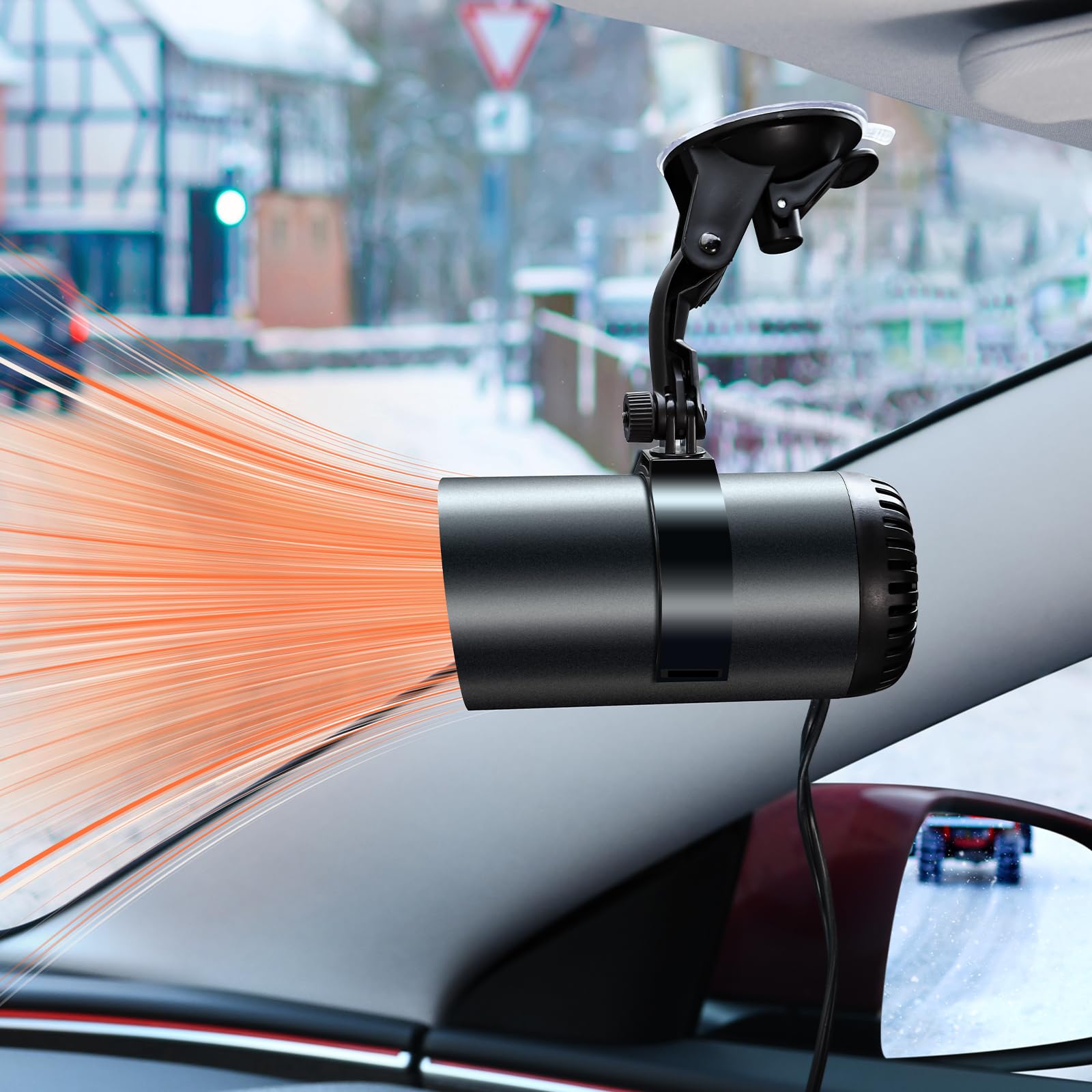
A 150W unit designed specifically to attach to the windshield glass via suction cup.
This defroster has a clear design philosophy: mount it on the windshield itself rather than the dashboard. The suction cup attaches directly to the glass, which means the warm air blows across the surface from point-blank range. Its compact dimensions (6.06 x 5.16 x 3.31 inches — the largest package size of any single unit here) still fit easily on the glass without blocking your view. The dual-mode switch toggles between hot air for winter defrosting and cool air for summer cabin circulation.
The problem is the fan. Owners mention the airflow is so weak that “you probably couldn’t blow out a candle.” The heat output is also minimal — one buyer mentioned you have to hold the unit in your hand to feel any warmth. Several reviews describe the unit quitting after a single day of use. A few owners had a different experience, saying the unit heated their windows effectively for a short period, but the overwhelming consensus is that the 150W power and weak fan combine for poor performance. The cord also runs hot during use, which one owner flagged as a safety concern.
If you are on a very tight budget and expect to use this only for the lightest condensation on a small car window, the ELOHEI may clear a tiny area. But at 2.2 stars across 123 ratings, it is the lowest-scoring model here. The KINOWJI 200W costs very little more and delivers dramatically more heat and airflow. Compared to the Showvigor at 11.7 ounces, this one is 1.3 ounces heavier for no real advantage.
The One Thing It Does
- Suction cup mount is purpose-built for windshield glass, not dashboard
- Dual-mode switch for both heat and cool air circulation
The Honest Catch
- Fan is extremely weak — owners say it cannot even blow out a candle
- Multiple reports of the unit dying after one day; reliability is a major problem
Buy it only if: you cannot spend a dollar more and accept that it may only clear a small spot of fog directly in front of the vent.
Do not buy if: you need real defrosting power — literally every other model here outperforms it based on owner feedback.
2. KINOWJI 200W 12V Car Heater
Puts out 200 watts of heat you feel immediately, not after a long idle.
This is the unit that earns the top spot because it hits the one spec that matters most: 200W versus the common 150W. That extra wattage — 200W versus the 150W of the ELOHEI and Showvigor models translates into heat that lands on the glass quickly — owners describe the airflow as “amazing,” with one buyer noting the fan alone is strong enough to cool the back seat of a large SUV. It weighs 12 ounces, so it sits on the dash without feeling bulky.
The 360-degree rotating base lets you direct warm air exactly where you need it, whether that is the windshield for frost or side windows for fog. Three fan speeds give you control: a fast blast for initial clearing, then a quieter setting to keep the view clear. The big caveat is reliability — the customer consensus calls it mixed, and a small number of buyers report that the unit stops working after a few weeks or develops an intermittent short. That means treat this as a seasonal helper, not a permanent fixture. Owners mention: “The fan was amazing, until it wasn’t.”
At 193 reviews and a 3.9-star rating, this is the most popular and highest-rated model on the list — the crowd favorite beats both the ELOHEI (2.2 stars with 123 reviews) and the Baquler (3.1 stars with 112 reviews) by a wide margin. If you want heat that actually clears the windshield, the KINOWJI is the one.
Why Owners Grab This One
- 200W means faster frost-busting than any 150W model on this list
- 3-speed fan gives you adjustable airflow — quiet enough to leave running
- 360° base aims heat at windshield, side windows, or rear passengers
The Honest Catch
- Some units quit after a few weeks; reliability gets mixed marks from owners
- At 12 oz it is light, but the short power cord limits where you can place it
Reach for it if: you need real heat — 200W — to cut through ice and heavy fog, and you do not mind rolling the dice on long-term durability for immediate performance.
Look elsewhere if: you want a defroster that lasts several winters without worry, as a few customers note early failures.
3. KINOWJI 2026 Upgraded Car Heater
A dual-fan design that circulates air to the back seat while defogging up front.
This upgraded KINOWJI shares the same brand DNA as the top pick but approaches the problem from a different angle: dual fans. Instead of a single fan nozzle, it pushes air across a wider area. Reviewers point out the performance is strong — one buyer with kids in the back seat called it “the best invention tbh” for keeping rear passengers cool in summer and warm in winter. The three-speed fan (low, medium, high) lets you dial in just enough airflow without blasting your face.
The build uses ABS and heat-resistant polymer hard plastic, with a built-in fuse in the cigarette lighter plug for automatic power-off protection. The 360-degree rotation means you can aim one fan at the windshield and the other toward the cabin. Performance gets positive marks from shoppers, and the airflow earns consistent praise as effective. The trade-off is that heat output earns mixed reviews — some owners say it keeps the cabin comfortable, while others wish it ran hotter. One owner reported the unit stopped working after two weeks, so reliability is not guaranteed.
Note that the 200W KINOWJI (pick #1) runs warmer on paper, while this one prioritizes coverage. If your main need is defogging a single windshield fast, stick with the 200W. But if you want to circulate air to the back seat on a cold morning, this dual-fan design does something the single-nozzle models cannot.
Why Owners Like It
- Dual fans move air to the back seat — rare in this category
- 3-speed fan lets you pick between a strong blast and quiet circulation
- Fuse-protected plug gives confidence against electrical shorts
The Honest Catch
- Heat output is weaker than the single 200W models, per owner feedback
- One buyer had a unit fail after two weeks; build consistency is a question
Best if: you drive a larger vehicle — SUV, minivan, or crew-cab truck — and want warm air reaching the second row.
Think twice if: heavy ice and sub-zero temps are your norm; the heat here leans “warm” more than “scorching.”
4. Showvigor 150W Car Heater
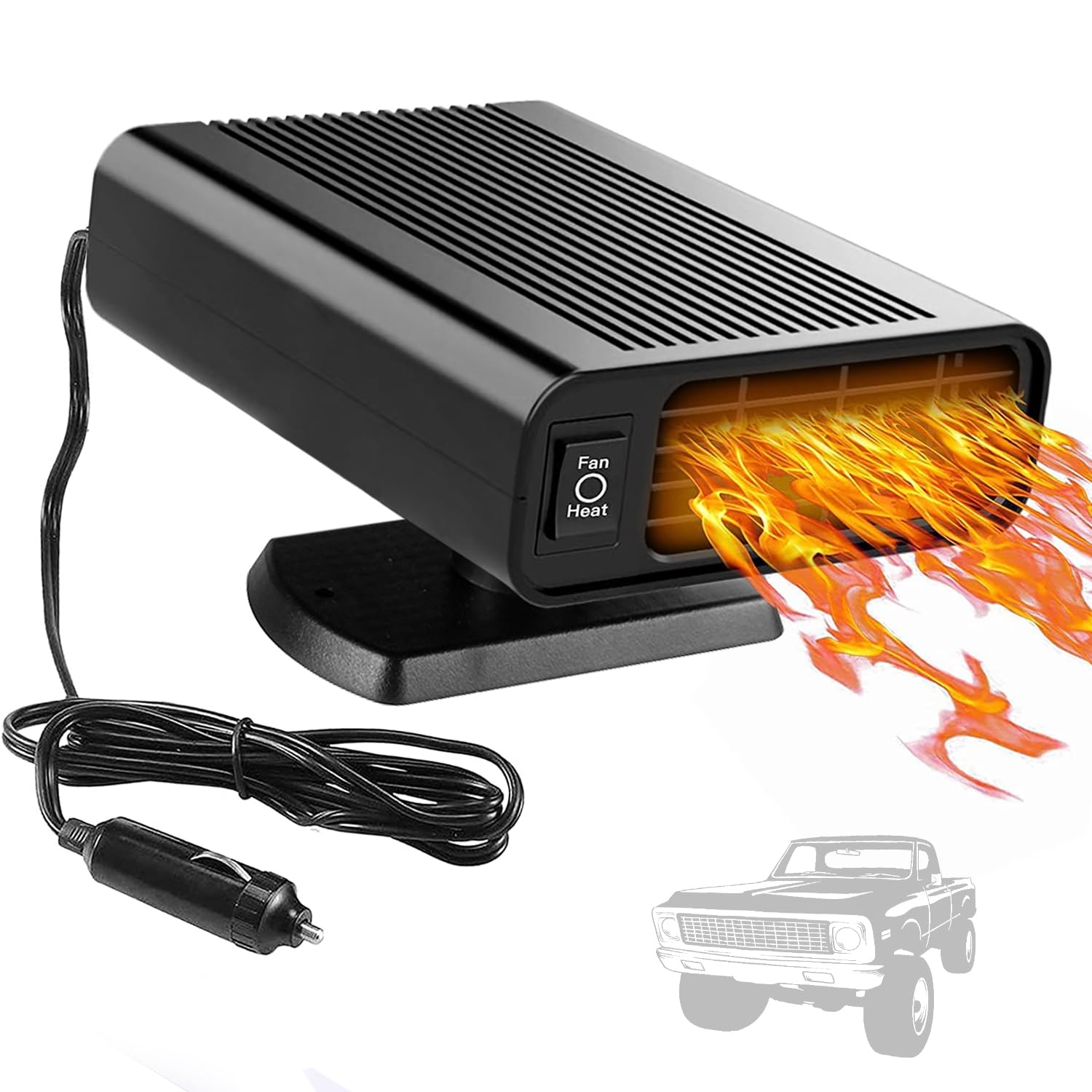
A featherlight 150W unit that lives in your glovebox for surprise frost mornings.
At just 11.7 ounces, this is among the lightest defrosters on the list — a full 1.3 ounces lighter than the ELOHEI. It claims 30-second heating technology, meaning you plug it into your 12V socket and feel warm air within half a minute. The 360-degree rotation with adjustable vents lets you aim the airflow precisely, and the dual-function design switches between heat and cool fan mode for summer use.
The real-world experience is more mixed. Owners agree it produces warm air, but the heating takes a long time to build up enough to actually clear a windshield. Shoppers say: “Takes a long time for the heat to come up enough to clear the windshield.” That makes it best suited for light frost or fog rather than thick ice. A few owners found the heat output insufficient in colder weather, with one calling it disappointing. On the positive side, several owners say the defrosting is perfect for their needs and that the unit works as stated without issues so far.
Compared to the 200W KINOWJI, this one trails noticeably in heat intensity — the gap shows that 150W is a compromise. But if your winters are mild and you mostly deal with condensation rather than ice, the Showvigor’s light weight and low cost make it a perfectly fine emergency tool to keep stashed in the door pocket.
Why It’s Worth Considering
- Lightest on the shelf at 11.7 oz — easy to keep in the car at all times
- Full 360° rotation with adjustable vents for precise aim
- Claims 30-second warm-up; owners confirm it gets warm quickly even if not scalding
The Honest Catch
- 150W is noticeably weaker than 200W — expect a slow clear on thick frost
- Several owners wish the fan pushed more air; airflow feels modest
Take it if: you want a lightweight spare that lives in the glovebox for occasional fog or light frost and you do not expect it to tackle heavy ice.
Pass if: you regularly face sub-zero mornings and need a windshield cleared fast — the 200W KINOWJI is worth the step up.
5. Baquler 2-Pack 150W Car Heater

Two 150W units that mount behind headrests to blow warm air at the rear windows.
This is the only 2-pack on the list, and it solves a problem single units cannot: clearing rear windows and warming back-seat passengers. Each heater runs at 150W and includes a dashboard adhesive base plus a headrest clip — you can mount one on the front seat headrest and aim it at the rear window or at the second row. The bundle weighs 1.54 pounds total, making it the heaviest option here but also the most versatile for larger vehicles.
The reality is that heat output is the most-discussed downside. Owners note the warmth is only effective within about 3 inches of the vent; beyond that, it feels like a cool breeze. One owner tried running a unit for 2 hours and reported it failed to heat the vehicle. The base adhesive also gets negative feedback for not sticking well. However, some owners in warmer climates or small cars (like a Honda Civic) find the units heat quickly and use little battery. The fairing and pillow clip design is genuinely useful — it is the only model here that ships with hardware for headrest mounting.
If your need is defogging a single windshield, a single 200W unit like the KINOWJI is a better spend. But if you want to defrost the rear glass without running your engine defroster for 20 minutes, or if you have kids in the back who complain about cold feet, the Baquler 2-pack is the one solution that actually covers the whole cabin.
Why It’s a Unique Solution
- Two units in one box — cover front and rear glass simultaneously
- Headrest clip included; no other model here offers this mounting option
- ABS build with built-in fuse adds safety to the multi-unit setup
The Honest Catch
- Heat only feels warm within a few inches; cabin heating is minimal
- Adhesive dashboard base gets mixed reviews for not staying stuck
Choose this if: you drive a minivan, SUV, or extended-cab truck and need to defog the rear windows without cranking the engine defroster.
skip it if: you only need one windshield cleared — a single 200W heater will outperform both of these combined.
6. Ouffun 200W Car Heater
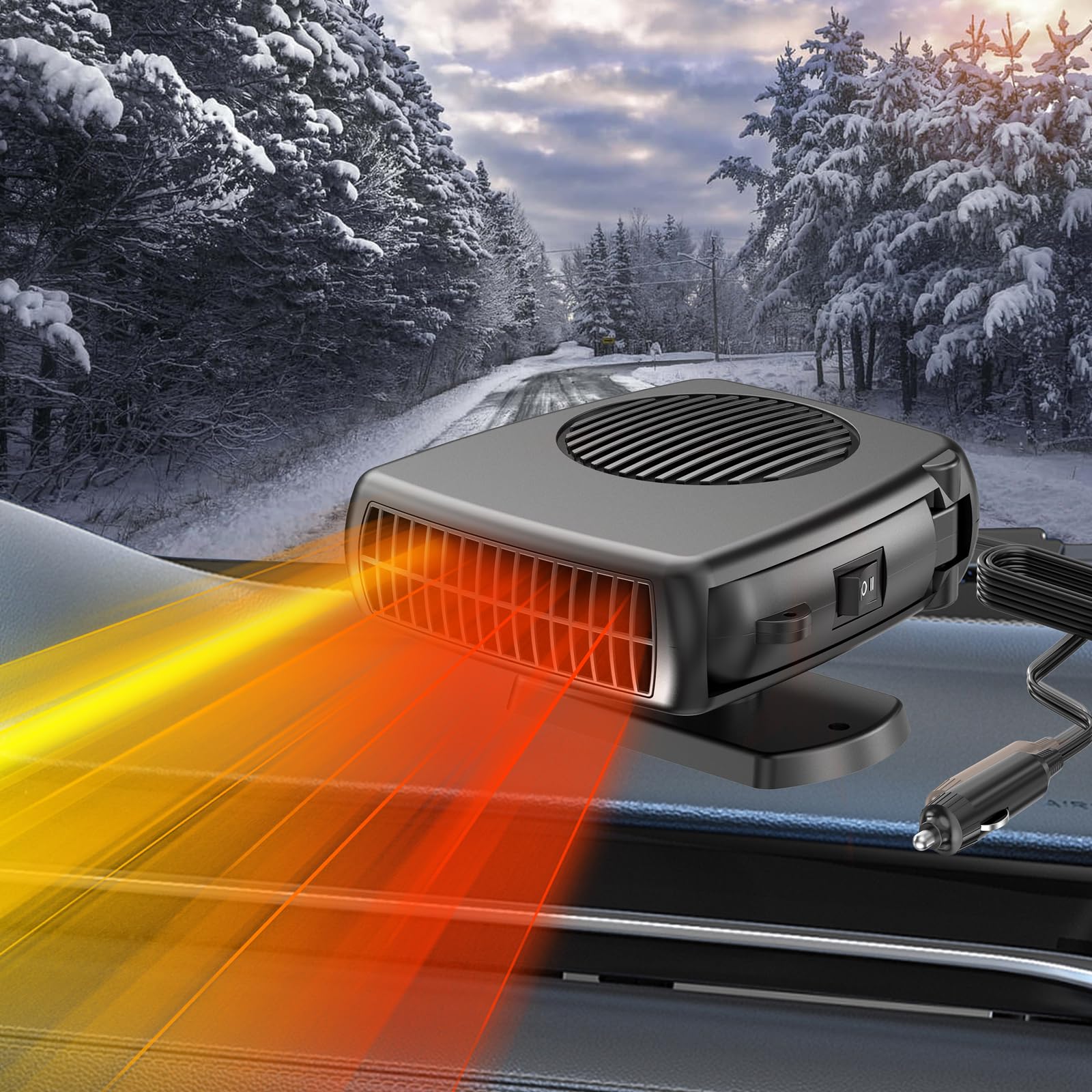
A 200W heater with an external handle so you can point it by hand at stubborn ice patches.
This is the only model that comes with an external handle and a switch positioned on the handle itself, making it easy to hold and aim. The 200W rating puts it on equal power footing with the KINOWJI, but the design approach is different: you can detach the base and use the compact body to blow heat directly at a fogged window while holding it. The blowing port adjusts vertically and horizontally, and the 360-degree rotating base adds mounting flexibility when you want hands-free operation.
The catch is durability. Several buyers report the unit lasted about 3 days before failing. One reviewer noted a new version is less effective than an older unit they owned, with weaker heat and fan output. The build uses ABS with a thick copper cable, and the manufacturer claims three rounds of quality checks, but the actual owner experience suggests inconsistency. On the positive side, a few owners in mild climates find it handy for defogging and use it as a hand warmer when the car cabin is slow to heat. It is also one of the lightest 200W options at 11.7 ounces.
For the price, the Ouffun offers 200W heat in a more maneuverable package. The risk is that you may get a unit that lasts a few days or one that runs reliably for months — the review data does not skew decisively either way. If you want guaranteed heat and reliability, the KINOWJI 200W (#1) is the safer bet.
Why It’s a Smart Pick
- Full 200W — matches the KINOWJI for raw heat output
- Handle design lets you aim manually; detachable base for handheld use
- Thick copper cable stays cool during operation, per manufacturer spec
The Honest Catch
- Durability is a gamble — some owners say it died after 3 days
- Newer units may have weaker performance than older batches, per one owner comparison
Grab it if: you like the idea of holding the heater in your hand to target specific fog patches on the windshield.
Pass if: reliability is your top priority — the mixed durability reviews make this a risky pick for daily use.
7. Qidoe 200W Car Heater
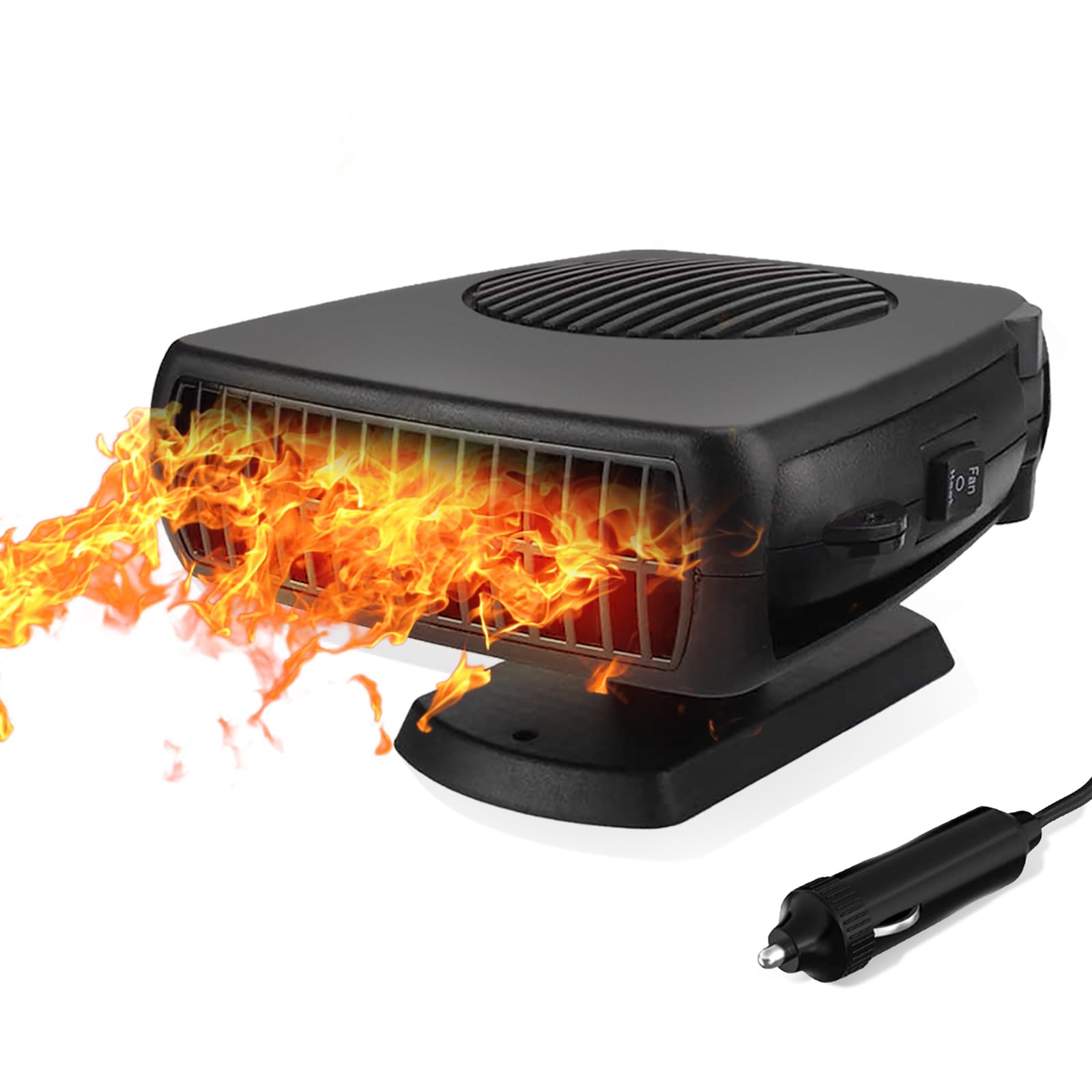
A 200W heater that prioritizes safety with overheat protection and high-temp-resistant plastic.
This Qidoe model targets the buyer who is as concerned about electrical safety as they are about heat output. It is built from high-quality ABS and heat-resistant polymer hard plastic, and it includes automatic overheat shutdown — the listing emphasizes “energy-saving performance with low power consumption and minimal noise.” The 360-degree rotating support base uses double-sided adhesive tape or a non-slip mat for installation. At 12.3 ounces and 200W, it matches the KINOWJI on power but leans harder on safety engineering.
The owner experience tells a different story. The most-discussed aspect is reliability, and it trends negative. Multiple customers note the unit blows fuses within minutes of plugging it in — one owner went up to a 30-amp fuse before giving up. The heat output also gets consistent negative feedback, with owners saying it “does not warm anything” and comparing the air to lukewarm rather than hot. One owner reported the switch broke and stayed on constantly, with loose wiring in the plug. A few owners on the positive side say the fan is effective for cooling, but that is not the primary function of a defroster.
Given the 2.4-star rating across 74 reviews and the volume of negative feedback about electrical issues and inadequate heat, this is a model to approach with caution. The KINOWJI 200W costs less and delivers better performance and higher owner satisfaction. If your main concern is overheating, the KINOWJI’s built-in fuse offers similar protection without the blown-fuse complaints.
The Upside on Paper
- 200W power with automatic overheat shutdown for confidence
- Heat-resistant ABS and polymer plastic construction
- 360° rotating base with adhesive pad for flexible mounting
The Honest Catch
- Blows fuses frequently — one owner blew a 30-amp fuse using it
- Heat output is consistently described as too weak to defrost windows
Consider it if: the safety features genuinely matter to you and you are willing to risk underwhelming heat for built-in overheat protection.
pass on it if: reliable defrosting is the goal — the KINOWJI 200W costs less and actually works.
8. SubZero 12650 12V Defroster

A folding-handle defroster you can hold in one hand or mount with included screws.
This SubZero model is the veteran of the list, with a design that has been around long enough to earn a brand name. Its key differentiator is the folding handle that doubles as a carrying grip — you can hold it and aim warmth at a stubborn patch of ice, or fold the handle and set it on the removable rotating base for dashboard use. The package includes double-sided tape and screws for permanent mounting, which is rare for this category (most models only include adhesive pads).
The heat output is the main complaint. Owners say the heater lacks “a whole lot of power” — one buyer ran it for 30 minutes and only cleared “one little spot” on the windshield. Another owner in a freezing climate called it “useless in extreme cold.” Several report the unit stops working after one use, and instructions do not clearly show where to replace the fuse. On the positive side, a few owners in milder conditions (above freezing) found it adequate for occasional fog, and the rotating base is genuinely sturdy. The 90-day manufacturer warranty is better than nothing, but it does not inspire confidence for a product that some owners say fails immediately.
If you need a budget option for very light duty — say, clearing condensation in a garage-kept car — the SubZero’s folding handle and dual mounting options give it a slight edge over the ELOHEI in versatility. But for actual winter defrosting, the KINOWJI or Showvigor are leagues ahead in heat performance.
What Stands Out
- Folding handle for handheld use — unique to this model
- Includes screws and double-sided tape for two mounting options
- Removable rotating base for angled dashboard placement
The Honest Catch
- Weak heat — owners say it fails to defrost even in above-freezing weather
- 90-day warranty is short; some units quit after one use
Best for: a spare defroster to keep in the trunk for rare use, where the folding handle and screw-mount options add convenience.
Not for: anyone who needs a defroster that actually melts ice — the heat output is borderline ineffective even in mild cold.
Understanding the Specs
Wattage (150W vs 200W)
This is the single most important spec for a defroster. Wattage measures how much electrical power the heater converts into heat. A 200W unit produces 200 watts of heat, compared to 150 watts from a 150W unit — think of it as the difference between a warm breeze and a hot blast. The higher the wattage, the faster frost and fog clear from the glass. But higher wattage also draws more current from your car’s 12V socket, so check that your vehicle’s fuse rating (usually printed on the fuse panel cover) can handle the load. Most cars are fine with 200W, but older or compact cars may have a 10-amp circuit that maxes out at 120W.
Fan Strength and Airflow
Heat without airflow is like a radiator with no fan — the warmth stays in one spot. A defroster’s fan speed (measured by the number of speeds or airflow volume) determines how large an area the warm air covers. A weak fan creates a hot spot the size of a plate, while a strong fan pushes heat across the full width of the windshield. Look for at least two speeds: a high setting for rapid defogging and a quiet low setting for maintaining visibility. The best models here offer three speeds. In cold weather, a weak fan is the most common complaint — reviewers point out “you probably couldn’t blow out a candle.”
FAQ
Will a 12V defroster drain my car battery?
Can I leave a defroster plugged in and running overnight?
Why does my defroster blow fuses?
150W vs 200W — which should I choose?
Can I use a defroster on the rear window?
How long does it take to defrost a windshield?
Will any defroster fit an SUV or truck?
What is the best mount location — dashboard or windshield?
Can I use a defroster in summer too?
Are cheap defrosters safe?
Final Thoughts: The Verdict
For most buyers, the Window Defroster for Car winner is the KINOWJI 200W because it delivers the best heat and airflow at a price that undercuts every other functional 200W model. If you want a dual-fan design that reaches the back seat, grab the KINOWJI Upgraded. And for the best value in a lightweight emergency tool, the Showvigor 150W is the one to reach for.
How We Picked
We do not accept paid placement. Every pick is matched to a real buyer and a real use-case; we do not hands-on test units.
Sources & Methodology
Specifications: manufacturer listings and product documentation. Review insights: verified customer reviews, as of July 2026. Pricing: not shown on this page (it changes often); check the current price via the retailer link.
As an Amazon Associate, GoCarLife earns from qualifying purchases. This does not affect which products we feature.