
Our readers keep the lights on and the garage heater humming. As an Amazon Associate, I earn from qualifying purchases.
Specs are compiled from manufacturer listings and verified buyer reviews and can change over time — please confirm the key details on the product page before buying.
There is nothing worse than being stuck in mud or snow, pulling the winch line out, and then realizing your solenoid just clicks or does nothing at all. The problem is rarely the winch itself — it is almost always the wiring kit that connects the battery to the solenoid. A flimsy solenoid or a set of too-short jumper cables turns a recovery tool into dead weight. The right kit delivers reliable power on demand with a straightforward installation.
I’m Mo Maruf — the founder and writer behind GoCarLife. This guide is built by comparing the manufacturers’ published specifications and the patterns across verified customer reviews, so you get each pick’s real strengths and trade-offs instead of marketing spin.
The key is matching the electrical capacity of your setup to the load your winch pulls. That is exactly what this guide to the best winch wiring kit will help you do.
Our Picks at a Glance

How To Choose The Best Winch Wiring Kit
The solenoid-relay contactor is the heart of your winch system — it takes the tiny signal from your dash switch and turns it into the massive power flow that spins the drum. Pick the wrong one, and you get slow spooling or a dead stick mid-pull.
Match the Amp Rating to Your Winch
The current rating (in amps — a measure of electrical current flow) tells you how much power the solenoid can handle without overheating. A 250-amp unit suits 1500-5000-lb ATV and light UTV winches that draw less peak current. A 500-amp contactor is built for 8000-17000-lb rigs — full-size trucks and heavy-duty winches — so you do not burn out the switch mid-recovery.
Check the Wiring and Connectors
Look at the pre-wired cables and their lugs (the ring terminals that bolt to your battery and motor). Short jumper cables force you to stretch wiring or add extensions, which adds failure points. Kits that come with hand-corded remotes or twin wireless controllers give you flexibility to operate the winch from a safe distance, out of the line of a snapped cable.
Weather Protection Matters
If you ride or drive in wet, snowy, or muddy conditions, a sealed box and an IP67 rating (meaning the enclosure is dust-tight and can survive submersion in a meter of water for 30 minutes) keep the solenoid contacts from corroding or freezing shut. Without that seal, moisture gets inside and the solenoid can stick, especially in extreme cold.
Quick Comparison
| Model | Best For | Current Rating | Wattage | Key Feature | Amazon |
|---|---|---|---|---|---|
| Torkettle 250A Kit★ Best Overall | ATV / light-UTV winches (1.5k-5k lb) | 250 A | 3000 W | 14-ft corded remote + 4 pre-wired lugs | Amazon |
| Torkettle 500A Kit | Heavy-duty truck winches (8k-17k lb) | 500 A | 6000 W | Twin wireless remotes + pre-wired box | Amazon |
| LLNSEAUTO 250A Kit | Universal ATV fit with handlebar switch | 250 A | — | IP67-rated solenoid + rocker thumb switch | Amazon |
In‑Depth Reviews
1. Torkettle 12V 250A Winch Solenoid Relay Contactor with Hand Corded Controller
Our pick — over 4★ from 40+ verified ratings; the strongest balance of quality and price.
A 250-amp ATV workhorse with a 14-foot cord that puts you safely away from the action.
This kit is built for 1500-5000-lb ATV and UTV winches. The solenoid carries 250 A and 3000 watts, which is plenty for a light off-road rig pulling a machine out of a ditch or loading a deer. The long 14-foot hand-corded remote lets you disconnect the remote from the machine and walk to a spot where you can see the line, rather than guessing from the driver seat. It comes with four pre-wired lugs (two for the motor, two for the battery), and the color-coded wires — green and black for the in/out switch, blue and yellow for the motor, black and red for the battery — keep confusion low.
The weather-resistant steel with a powder-coated black finish resists mud, light rain, and trail vibration. Owners mention the kit works great straight from the start — literally “plug and play” — though the general sentiment is that the instructions are minimal. The wires themselves could stand to be longer if your winch has a spread-out mounting setup. A small number of units arrive with a defect where the solenoid fires in only one direction, meaning you have to swap the power leads to reverse the winch.
Given the 3000-watt capacity and the four-lug prep, this is the most straightforward kit for a first-time ATV owner who wants a reliable solenoid without extra wiring guesswork.
Smart-rig choice: If your winch pulls 5000 lb or less and you place a premium on a long remote cord and color-coded installation, this is the pick that just works for the majority of users.
The one caveat: A handful of solenoids click in one direction only — test both winch in/out routes before you bolt everything down permanently.
Grab this if: you are wiring an ATV or light UTV and want a simple, 250-amp kit with a 14-foot cord that keeps you at a safe distance.
Pass on it if: your winch demands more than 3000 watts — you need the 500-amp unit above.
2. Torkettle 12V 500A Winch Solenoid Contactor Relay with Box and Twin Remote Controller

A 500-amp beast that feeds big winches and comes with twin remotes to keep you clear of the cable.
This is the one to grab if you are powering a full-size winch in the 8000-17000-lb range. The solenoid handles 500 A of current and 6000 watts — at 6000 watts versus the 250-amp Torkettle’s 3000 watts, so it does not get hot or slow on a heavy pull. The contactor itself is already mounted in a weather-resistant box that tidies up the wiring, and you get three 6-foot AWG4 cables plus one short 16.1-inch battery cable with factory lugs.
The big draw is the two remote controllers — both wireless — for operation from the cab or 20 feet away. The catch is the build-your-own wiring effort: the motor jumper cables measure just 3 inches (76 mm), which owners found too short for a clean install. Many turn to YouTube for guidance because the printed instructions are incomplete or wrong, as buyers report a consistent complaint about missing wiring diagrams. A handful mention the solenoid stopped working within a week, so the run-to-run reliability is a point worth watching.
An 8,000-lb Warn 8274 winch runs perfectly once connections are sorted — a solid heavy-duty solution for those comfortable with extra cable work.
What carries the pull
- True 500 A / 6000 W — at 6000 watts versus a typical 250-amp kit’s 3000 watts, handling heavy winch loads without strain.
- Twin wireless remotes let you winch from the cab or a safe distance.
- Pre-wired box keeps everything neat and protects the solenoid from trail splashes.
Where the install bites
- Motor jumper cables are only 3 inches (76 mm) — expect to add your own longer leads.
- Wiring instructions are reportedly wrong or missing; have a YouTube tutorial ready.
Reach for this kit if: you run a heavy 8k-17k-lb winch and want the amp headroom of a 500-amp contactor with twin remote flexibility.
Look elsewhere if: you expect a plug-and-play install with clear diagrams and full-length cables from the start.
3. LLNSEAUTO 12V 250A Winch Solenoid Relay Contactor with Terminal Caps & Winch Rocker Thumb Switch
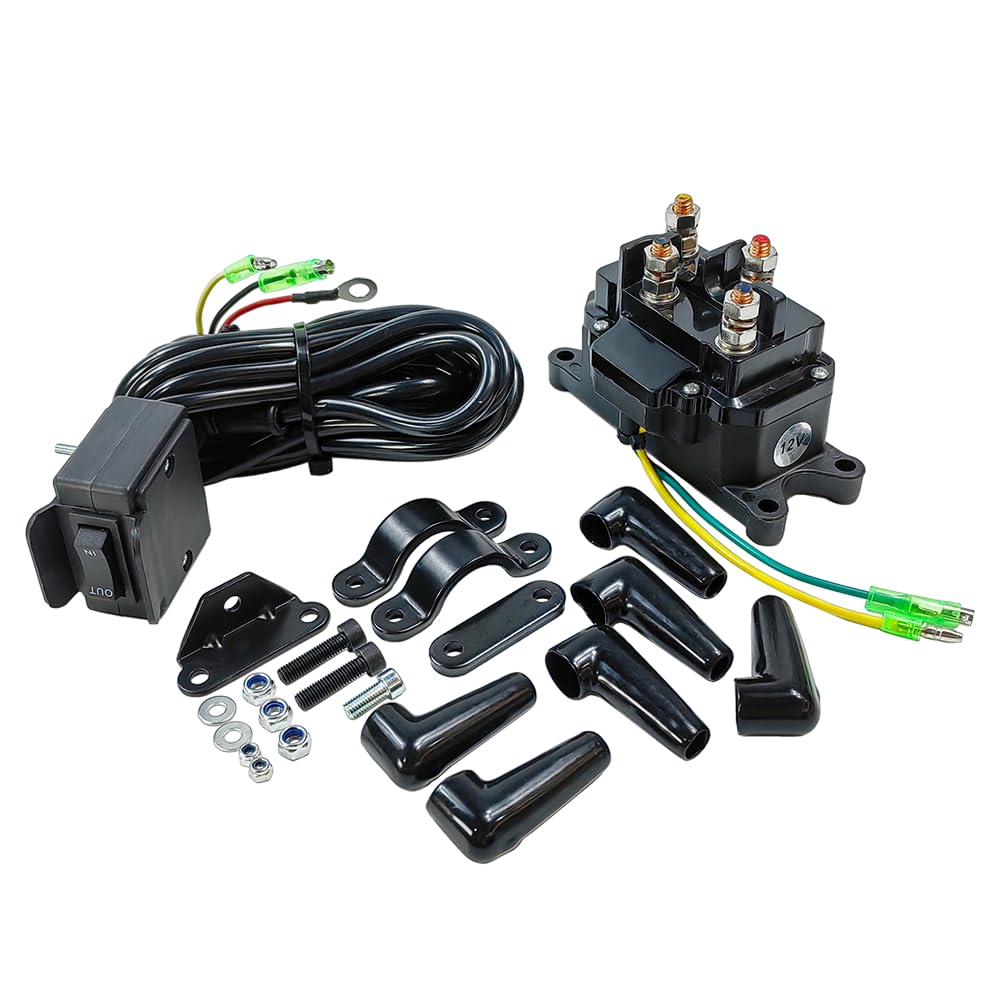
A sealed 250-amp solenoid with an IP67 badge and a handlebar thumb switch for quick control.
This one stands apart for riders who tackle deep mud or leave their machines parked outside all winter. The solenoid carries an IP67 rating — meaning the housing is sealed against dust and can handle being submerged in a meter of fresh water for half an hour without the electrical guts shorting. That seal also keeps out the moisture and condensation that cause a solenoid to stick in freezing temps. The kit includes a handlebar rocker thumb switch plus mounting brackets, so you control the winch in and out without reaching for a remote, keeping both hands on the bars.
Compatibility is broad — the maker lists it as a direct fit for KFI, WARN, RAMSEY, BADLAND, POLARIS, HONDA, and a dozen other 12-volt winch systems in the 1500-5000-lb range. The switch wiring was reportedly marked backward on a few units, requiring you to cut and swap the connectors. And buyers in climates like Wisconsin note that while the solenoid works fine in warm weather, it can stick in extreme cold despite the IP seal — internal cleaning and re-lubing were needed to keep it reliable. The handlebar clamps may also be too small for thicker handlebars, which matters if your bars have a large diameter.
For a well-built, competitively priced solenoid that brings a handlebar switch and a genuine IP67 seal, this is the easiest choice for an ATV rider who faces regular water crossings.
Why it wins in the wet
- IP67-rated housing keeps dust and water out — survives submersion and sloppy trail conditions.
- Comes with a handlebar thumb switch plus mounting hardware — no separate remote purchase.
- Broad compatibility with most major ATV winch brands (WARN, Ramsey, Badland, Polaris, Honda, etc.).
The weather reality
- Solenoid can stick in extreme cold (below freezing) — not a winter-proof unit from the start.
- Handlebar clamps may not fit oversized handlebars; switch wires may be reversed from the start.
Get this if: you ride in wet, muddy terrain and need the dust/water protection of a true IP67 solenoid with a handlebar thumb switch.
Think twice if: deep winter riding is your main season — a cold-climate rider may need to pull and lubricate the solenoid contacts early.
Understanding the Specs
Amp Rating (A) & Wattage (W)
The amp rating tells you how much electrical current the solenoid can switch without burning up its internal contacts. A 250-amp unit running at 12 volts handles 3000 watts of power — that is plenty for a small ATV winch drawing momentary peak loads. A 500-amp unit provides 6000 watts, while a 250-amp unit provides 3000 watts, which is needed for heavy-duty truck winches that pull harder and longer. If you run a solenoid below its amp rating, it stays cool and lasts. Push too close to the limit and the contacts weld shut.
IP Rating (Ingress Protection)
The IP67 standard means the solenoid housing is completely dust-tight (the “6”) and can survive immersion in a meter of freshwater for 30 minutes (the “7”). That matters if you cross creeks, ride in heavy rain, or store the vehicle outdoors. Without an IP rating, moisture creeps into the solenoid contacts, causing corrosion, intermittent clicking, or a stuck plunger — especially when temperatures drop below freezing. A sealed unit also keeps mud and trail grit away from the moving parts.
FAQ
What size winch wiring kit do I need for a 5000-lb winch?
Can I use a 500-amp solenoid on a small ATV winch?
Does an IP67 solenoid actually prevent freezing?
What does the remote cable length really matter?
Are pre-wired lugs worth paying extra for?
Can a winch solenoid work in reverse?
How do I know if a wiring kit fits my winch brand?
What does the “coil voltage” of 12 volts mean?
Why do some wiring kits come without good instructions?
Final Thoughts: The Verdict
For most people, the best winch wiring kit overall is the Torkettle 250A Kit because it delivers a reliable 250-amp solenoid with a 14-foot corded remote and color-coded wiring that simplifies install on ATVs and light UTVs. If your rig demands more, the Torkettle 500A Kit brings 500-amp capacity and twin wireless remotes for heavy-duty truck winches. And for riders who cross creeks, ford mud holes, or leave the machine parked outside year-round, the LLNSEAUTO IP67 unit with its handlebar thumb switch is the one to reach for — just be aware that extreme cold can still cause the solenoid to stick without a little internal upkeep.
How We Picked
We do not accept paid placement. Every pick is matched to a real buyer and a real use-case; we do not hands-on test units.
Sources & Methodology
Specifications: manufacturer listings and product documentation. Review insights: verified customer reviews, as of July 2026. Pricing: not shown on this page (it changes often); check the current price via the retailer link.
As an Amazon Associate, GoCarLife earns from qualifying purchases. This does not affect which products we feature.