
Our readers keep the lights on and the garage heater humming. As an Amazon Associate, I earn from qualifying purchases.
Specs are compiled from manufacturer listings and verified buyer reviews and can change over time — please confirm the key details on the product page before buying.
Window tint laws vary by state, and a visual guess won’t cut it when you’re facing a ticket or a customer complaint. The real question is simple: is that film actually at the legal VLT percentage, and how much UV and infrared is it blocking? This guide covers the meters that give you a definitive number—from the law-enforcement favorite to compact shop tools—so you pick the right spec sheet for your work.
I’m Mo Maruf — the founder and writer behind GoCarLife. This guide is built by comparing the manufacturers’ published specifications and the patterns across verified customer reviews, so you get each pick’s real strengths and trade-offs instead of marketing spin.
Whether you run a tint shop, perform state inspections, or just want to verify your own car’s tint, this roundup of the best window tint reader for your workflow cuts through the speculation and delivers clear, measurable truth.
Our Picks at a Glance

How To Choose The Best Window Tint Reader
Picking the right meter depends on three core questions: what you need to measure, how thick the glass is, and where you’ll be reading the display. Here’s a quick breakdown of the features that separate a handy tool from a frustrating one.
VLT, UVR, and IRR — what each measurement tells you
VLT (Visible Light Transmission) is the legal number — it’s the percentage of visible light that passes through the glass, and it’s what police and inspection stations check. UVR (Ultraviolet Rejection) and IRR (Infrared Rejection) tell you how well the film blocks UV rays and heat. If you’re a professional installer, having all three readings on one screen makes customer demonstrations and film comparisons far more convincing.
Slot depth and glass compatibility
Most meters use a slot you slide over the glass. An 8 mm slot fits standard car side windows, while a wider 14 mm slot (like on some newer models) accommodates thicker glass or multi-layer samples. A 6 mm slot is common on ultra-compact, auto-on testers, but it will only work with roll-down side windows — not windshields or fixed glass.
Calibration and ease of daily use
Automatic calibration on startup is the standard you want. It removes the guesswork: power on with an empty slot, and the meter zeros itself. A backlit display with rotation makes a huge difference when you’re reading numbers from an awkward angle inside a vehicle. Rechargeable batteries save you from hunting for disposables mid-job, while models with included hard cases protect the device between inspections.
Quick Comparison
| Model | Best For | Weight | Slot Depth | Power Source | Amazon |
|---|---|---|---|---|---|
| Tint Meter Inspector II TM2000★ Best Overall | Law enforcement & shop compliance | 3.2 oz | Standard side windows | Battery included | Amazon |
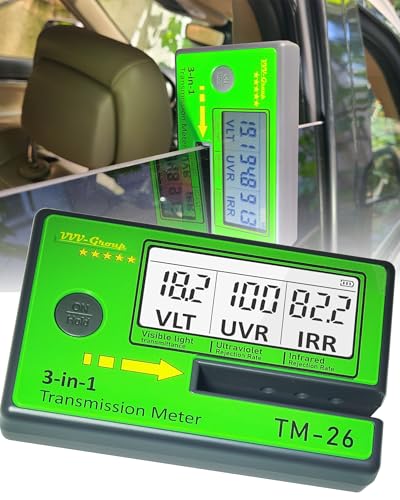
| Digital TM-26Triple-Value Pick | Accurate VLT/UVR/IRR on a budget | 10.2 oz | 8 mm | Battery powered | Amazon |
| Tint Meter TM-28 | Rechargeable versatility | 15.8 oz | 14 mm | Rechargeable Li-Ion | Amazon |
| RockRose LS162 | All-in-one portable testing | 5.8 oz | 8 mm | Battery powered | Amazon |
| MR CARTOOL Tester | Value in a small shop | 5.8 oz | 8 mm | Battery powered | Amazon |
| GOYOJO GT116 | Readability & build quality | 7.1 oz | 8 mm | Battery powered | Amazon |
| Ayamuba Tint Checker | Instant side-window checks | 2 oz | 6 mm | CR2032 (included) | Amazon |
In‑Depth Reviews
1. Tint Meter Inspector II TM2000
Our pick — over 4.5★ from 250+ verified ratings; the strongest balance of quality and price.
The law-enforcement standard that settles every argument about tint legality.
This is the meter that police departments and state inspection stations reach for — and the same one a North Carolina tint shop owner called “exactly what our law enforcement uses.” At just 3.2 ounces it is unbelievably light, a full 4.9 times lighter than the TM-28 (which weighs 15.8 ounces), making it the kind of tool you can carry in your pocket all day without noticing. It is assembled in the USA and traceable to NIST (National Institute of Standards and Technology) standards, so the number on the screen carries real weight with officers and customers alike.
Buyers consistently praise the functionality and quality — functionality is the most-discussed aspect, with quality close behind. The recurring praise is that it works equally well on side windows and fixed glass. A few owners find the price a mixed value compared to multi-function meters, but the trade-off is clear: when you need a legally defensible reading, this is the meter the pros trust.
What wins people over
- Ultra-portable at 3.2 oz — easy to keep on you
- Used by law enforcement for compliance checks
- NIST traceable for defensible readings
The honest trade-off
- No UVR or IRR measurement — VLT-only
- Higher price than multi-function alternatives
Reach for this if: you need a legally accepted reading from a meter that law enforcement trusts — shop owners and inspectors will appreciate the certified accuracy.
Look elsewhere if: you want UV and infrared rejection numbers in a single tool; this is a dedicated VLT machine and nothing else.
2. Digital Window Tint Meter TM-26
A budget-friendly meter that measures VLT, UVR, and IRR without cutting corners.
For roughly a third of the price of the TM2000, this meter gives you three critical readings — VLT, UVR, and IRR — in one device. Accuracy is the most-praised aspect, with owners consistently reporting quick, consistent measurements. “Measures UV, IR, and VLT accurately; confirms tint performance,” is the typical experience. The 8 mm slot fits standard side roll-down windows, and the automatic self-calibration on startup means you are ready to test seconds after turning it on.
The honest caveat: it measures side windows only, and a few users find the IRR readings less reliable than the VLT results. Still, for a shop or an enthusiast who wants a full picture of a film’s performance without spending premium dollars, the TM-26 delivers real value. The data hold function locks the numbers on screen so you can record or show them without fumbling for a pen.
The big pluses
- Measures VLT, UVR, and IRR in one handy device
- Automatic zero-calibration every time you power on
- Data hold function for easy documentation
What to note
- Limited to side roll-down windows (8 mm slot max)
- IRR performance draws mixed feedback
Best bet for: an installer or inspector who needs all three light measurements on a sensible budget — tough to top the value-to-feature ratio here.
skip it if: you work with fixed glass or laminated windshields; the slot depth restricts you to side windows only.
3. Tint Meter TM-28
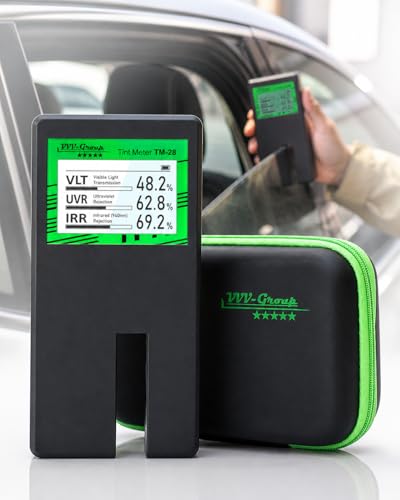
The rechargeable meter with a rotating backlit screen that makes readings readable from any angle.
The TM-28 solves a real-world problem: trying to read a dark display while you are hunched inside a car door frame. Its large backlit LCD can be manually rotated, so the numbers always face you. It also offers the widest slot in this lineup at 14 mm (0.55 inches) — nearly double the 8 mm standard — which means it fits thicker glass and loose film samples with no struggle. A built-in rechargeable lithium-ion battery eliminates the “dead battery mid-job” frustration that disposable-powered meters create.
Accuracy and storage are the two most-discussed aspects here. “This is ultra portable and works as advertised,” one owner noted, proving its portability doesn’t sacrifice precision. It is heavier than the TM2000 at 15.8 ounces, but the trade-off is the extra features: multiple display modes for VLT, UVT, IRT, or rejection values let you toggle between transmission and rejection data depending on whether you are selling a film or verifying compliance.
Standout strengths
- 14 mm slot for thicker glass and loose film samples
- Rotatable backlit LCD for easy reading in any position
- Built-in rechargeable battery with USB charging
One drawback
- Heavier than most options at 15.8 oz
Grab it when: you need a self-contained, rechargeable tool with a wide slot for varied film thickness and a display you can actually read — ideal for mobile installers.
Think twice if: weight and pocketability are your top priorities; the TM2000 is significantly lighter.
4. RockRose Portable Tint Meter LS162

Compact enough for a pocket, accurate enough for a production line — a true mobile tool.
Weighing in at just 5.8 ounces and powered by two disposable batteries (not included), the RockRose LS162 is built for mobile technicians who move between cars all day. The 8 mm slot handles filmed glass and car side screens, and the real-time self-calibration on startup means you never pause to tweak settings. It measures VLT, UVR, and IRR simultaneously and locks the data on screen with a button press.
The accuracy impresses owners — one noted their VLT reading came within 0.5% of the shop’s own reference meter. The LS162 is a Linshang design (model LS162), a known name in light measurement, so the internals are proven. The main thing to know is that the IRR reading is on a wide spectrum, so results may differ slightly from a film’s spec sheet. Still, for a portable tester that fits in your tool pouch, this is a strong performer.
Why it works
- Very lightweight at just 5.8 oz — disappears in a pocket
- Real-time automatic calibration for zero-setup testing
- Data lock freezes all three readings for easy recording
Heads up
- Batteries are not included
- IRR accuracy is slightly variable due to wide spectrum measurement
Grab this for: drive-through inspections, quick mobile checks, or anytime you need a featherlight tester that still gives you VLT, UVR, and IRR — a solid compact companion.
Pass if: you want a rechargeable device or need to measure windshields and fixed windows.
5. MR CARTOOL Portable Solar Tester Meter

A dependable 3-in-1 meter that small shops swear by for daily state inspections.
This meter has been on the market since 2019 and holds a strong following among auto service shops. “We do state inspections and this has worked perfectly,” one shop owner reported, adding that they expected to spend much more. The MR CARTOOL combines UV transmission, IR transmission, and visible light transmittance in a single device. It accepts samples up to 8 mm thick and uses a real-time dynamic self-calibration after power-on, so you see 100, 0.0, 0.0 on the screen before inserting any glass.
Lightweight at 5.8 ounces, it is nearly identical in portability to the RockRose LS162. The catch is the same — batteries are not included — and the meter is limited to side windows. For a small shop or a mobile detailer who needs a straightforward, budget-friendly way to verify tint compliance day after day, this is a workhorse that keeps delivering.
Built for reliability
- Has proven itself in auto service shops for years
- Simultaneous UV, VL, and IR transmission display
- Ultra-low power consumption extends battery life
Keep in mind
- Batteries not included
- Side-window only due to 8 mm slot limit
Reach for this: if you run a small shop doing regular inspections and need a reliable, straightforward meter that won’t drain your budget — it’s a proven value.
Look elsewhere if: you require rechargeable power or a wider slot for thicker samples.
6. GOYOJO GT116 Tint Meter

The meter that makes reading tint numbers easy — literally, with a large, clear display.
If you’ve ever squinted at a tiny, dim screen in bright sunlight, the GT116 is your answer. Readability is among the most-praised aspects, with owners noting the large and clear display that works well even in natural light. Quality and accuracy lead the conversation here — both are the top-mentioned aspects. “Great tool! Easy to use, accurate, and clear display,” sums up the typical experience. The device measures UV, VL, and IR transmission through an 8 mm slot and offers a data lock function for recording results.
Weighing 7.1 ounces, it sits in the middle of the pack for portability. It takes disposable batteries (not included), and like most 8 mm slot meters, it is designed for side windows. The manufacturers behind it also note it works best in natural sunlight. For a shop professional who spends all day looking at a display, the clarity here is a real daily comfort upgrade over dimmer alternatives.
The clear advantages
- Large, bright display is highly praised for readability
- Automatic self-calibration for accurate, repeatable results
- Lightweight at 7.1 oz and compact design
One caveat
- Batteries not included
Best suited for: tint installers and inspectors who want an easy-to-read display and proven accuracy — the display clarity is a genuine quality-of-life upgrade.
Consider another if: you need rechargeable power or a slot wider than 8 mm.
7. Ayamuba Window Tint Meter
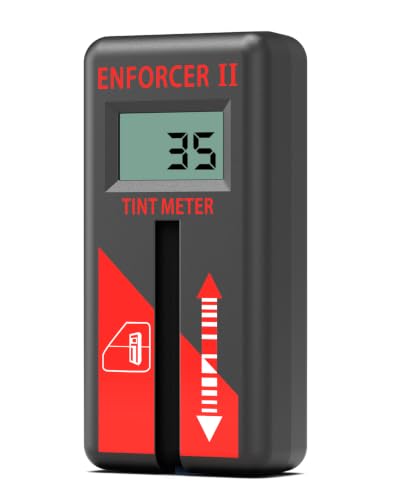
The no-button, instant-read meter that powers on the moment you touch glass.
This is the most unique design in the lineup: there is no power button. You simply slide the 6 mm open slot onto your side window glass, and the meter turns on automatically. Within seconds you see your VLT reading, and when you remove it, the meter powers off. It weighs just 2 ounces (about 60 grams) and is the lightest tint reader here, making it practically forgettable until you need it. The accuracy is rated at ±2%, which owners confirm with real-world tests — one tested a 61% and a 29% reference sample and got the expected numbers.
The 6 mm slot is narrower than the competition, so it only works on roll-down side windows — not fixed glass or windshields. But for its intended job, owners call it “fast, simple to use, and highly accurate.” It includes a hard case and two reference samples for quick checks. “Accurate and durable,” one tester noted, praising the matte finish and sturdy build. This is a specialist tool, but within its niche it is brilliantly simple.
What makes it special
- Auto-on operation — zero buttons, instant reading
- Ultra-light at 2 oz — the most portable meter here
- ±2% accuracy with reference samples included
The limitation
- 6 mm slot works only on roll-down side windows
- Single-function VLT only, no UVR or IRR
Perfect for: a quick compliance check on side windows where speed matters — tint shop installers and inspectors will love the drop-and-read simplicity.
Not for: anyone needing to test windshields, fixed glass, or measure UV/infrared rejection.
Understanding the Specs
VLT — Visible Light Transmission
This is the number that matters to law enforcement. VLT is the percentage of visible light that passes through your window glass and film. A 35% VLT means 35% of light comes through, which is a common legal limit in many states. The lower the percentage, the darker the tint. Every meter on this list measures VLT, but some give you additional readings for UV and infrared.
Slot Size and Glass Compatibility
The slot is the opening you slide over the glass. Standard meters use an 8 mm slot for typical car side windows. The TM-28 expands that to 14 mm for thicker glass or loose film samples, while the Ayamuba uses a slim 6 mm slot for ultra-compact auto-on operation. If you plan to test windshields or fixed rear glass, look for a meter with a wider opening or one designed to clamp onto glass rather than slide over it.
FAQ
Can a window tint reader test windshields or only side windows?
Does a higher slot depth like 14 mm give better results than 8 mm?
Why would I need UVR and IRR readings instead of just VLT?
How often does a tint meter need to be calibrated?
Are rechargeable tint meters better than those using disposable batteries?
Will a 6 mm slot work on all car side windows?
What does NIST traceable mean on a tint meter?
Can a tint meter damage window film or glass during testing?
Final Thoughts: The Verdict
For the majority of shoppers, the best window tint reader to buy is the Tint Meter Inspector II TM2000 because it delivers the legally defensible, NIST-traceable accuracy that law enforcement trusts, and its 3.2-ounce weight makes it easy to carry all day. If you want full UVR and IRR measurements on a budget, grab the Digital TM-26. And for the fastest possible side-window checks with zero buttons to press, the Ayamuba Tint Meter is the one to reach for.
How We Picked
We do not accept paid placement. Every pick is matched to a real buyer and a real use-case; we do not hands-on test units.
Sources & Methodology
Specifications: manufacturer listings and product documentation. Review insights: verified customer reviews, as of July 2026. Pricing: not shown on this page (it changes often); check the current price via the retailer link.
As an Amazon Associate, GoCarLife earns from qualifying purchases. This does not affect which products we feature.