
Our readers keep the lights on and the garage heater humming. As an Amazon Associate, I earn from qualifying purchases.
Specs are compiled from manufacturer listings and verified buyer reviews and can change over time — please confirm the key details on the product page before buying.
You don’t have to live with that annoying wiper scratch right in your line of sight, the haze that makes night driving feel risky, or the water spots that no amount of glass cleaner seems to touch. A windshield polishing kit is your chance to restore the glass yourself, avoid an expensive replacement, and get back the clarity you bought the car with — but the choices range from simple cerium oxide powder to all-in-one kits with sealants, and picking the wrong one can mean hours of wasted elbow grease. This guide explains which kits remove scratches, what the work involves, and how to match a kit to your glass damage.
I’m Mo Maruf — the founder and writer behind GoCarLife. This guide is built by comparing the manufacturers’ published specifications and the patterns across verified customer reviews, so you get each pick’s real strengths and trade-offs instead of marketing spin.
Whether you are tackling a single deep gouge, a windshield full of wiper haze, or just want to keep your glass looking new, here is everything you need to find the right windshield polishing kit for the job ahead of you.
Our Picks at a Glance
How To Choose The Best Windshield Polishing Kit
Before you pick a kit, the most important thing to understand is the scratch itself — a deep gouge you can catch with your fingernail is a different problem from a swirl mark or wiper haze. Most kits are designed for fine, shallow defects, and trying to polish out a deep rock chip will just frustrate you. Knowing what you are up against is the first step to a good result.
Scratch Depth: The Fingernail Test
Run your fingernail across the scratch. If your nail catches, the scratch is deep and a polishing kit alone likely won’t fix it. These kits are made for surface-level imperfections: wiper streaks, light scratches you can hardly feel, water spots, and the haze that builds up over years. Some kits with coarser compounds can handle slightly deeper marks, but every product here notes it is “for fine scratches only.” If you have a chip or a deep gouge, you are in repair-kit territory, not polishing.
Abrasive Type: Cerium Oxide vs. Diamond
The vast majority of windshield polishing kits use cerium oxide, a fine abrasive that safely removes a microscopic layer of glass to level the surface. Diamond-based compounds (like the Eastwood kit) are an alternative for tougher jobs, but both rely on the same principle: you need a slurry (powder mixed with water) and a rotating felt pad to do the work. The particle size of the cerium oxide matters — smaller micron numbers mean a finer polish, while larger ones cut faster but leave a haze you may need to refine.
Kit Contents: All-In-One vs. Bare Essentials
Some kits are a single jar of powder and a felt pad, which assumes you already have a drill. Others include sandpaper in multiple grits, spray bottles, gloves, and towels. The more complete packages are better for a first-timer who doesn’t want to track down separate supplies. But a bigger box doesn’t always mean better results — in some cases, the core abrasive and pad quality matter far more than the extras.
Quick Comparison
| Model | Best For | Abrasive Type | Pad Size | Number of Items | Amazon |
|---|---|---|---|---|---|
| Gordon Glass Cerium Oxide Kit★ Best Overall | Best Overall | Cerium Oxide | 3 inches | 1 | Amazon |
| Glass Polish ProPremium Pick | Premium Pick | Cerium Oxide (3.5 micron) | — | 1 | Amazon |
| Glass Polish DIY 3″ KitMost Versatile | Most Versatile | Cerium Oxide (1.5 micron) | 3 inches | 1 | Amazon |
| Nu Finish Glass Restore & Repel | Two-Step Kit | Aluminum Oxide | — | 1 | Amazon |
| CARPRO CeriGlass 500ml | Best Value Compound | Cerium Oxide | — | 1 | Amazon |
| Permatex Windshield Repair Kit (6-Pack) | For Chips & Cracks | Resin | — | 6 | Amazon |
| Teenyyou 55 Pcs Kit | Budget Champion | Cerium Dioxide | 2.95 inches | 55 | Amazon |
| CARPRO CeriGlass 150mL | Compact Pick | Cerium Oxide | — | 1 | Amazon |
| Eastwood Pro Glass Polishing Kit | Diamond Abrasive | Diamond | — | 3 | Amazon |
In‑Depth Reviews
1. Gordon Glass Cerium Oxide Glass Polishing Kit
Our pick — over 4★ from 450+ verified ratings; the strongest balance of quality and price.
The straightforward pro formula that consistently delivers clearer glass for less than a tank of gas.
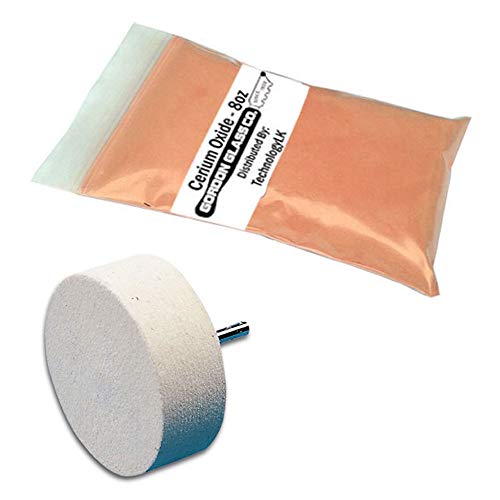
This is the kit that shop owners and DIYers alike keep coming back to, and the numbers back it up — it’s the crowd favorite with a strong 4.2-star showing from nearly 500 ratings. You get an 8-ounce bag of 85% pure cerium oxide and a single 3-inch thick felt polishing wheel, which you mount on any electric drill. What wins people over is effectiveness: the abrasive handles fine scratches, scuff marks, water spots, and hazy glass with a consistency that makes owners say things like “it works better than buying new glass.”
There is a real learning curve here, and the product page is honest that it is “time-consuming and messy.” The powder arrives unmixed, so you have to create a slurry yourself (roughly 2:1 water to powder, once you find the ratio), and it comes with no printed instructions — a common frustration that owners flag repeatedly. The slurry can be left to dry and re-wet later, which is a helpful touch for longer jobs. Unlike the all-in-one Nu Finish kit, which uses a pre-mixed liquid, this one demands more setup but delivers a deeper, more traditional glass-polishing result.
Across the reviews, a clear story emerges: for fine scratches that annoy you every time you drive, the stuff works beautifully — “cleared up a very annoying windshield scratch beautifully” is the kind of line that keeps selling this kit. But it also requires patience, a drill, and a willingness to get messy. If you have the tools and the time, you will save the cost of a replacement windshield many times over.
Gordon Cerium Oxide Kit: This kit is for the person who wants a professional-grade abrasive and doesn’t mind mixing their own paste and studying up on technique. skip it if you want a wipe-on, wipe-off solution — you will be better served by the Nu Finish kit or a pre-mixed compound.
For deep scratches: You have a drill, you are comfortable with a bit of a process, and you want the highest likelihood of actually removing that fine scratch.
Avoid light haze: The idea of mixing powder with water and buying a separate drill attachment sounds like too many steps — the learning curve is real.
2. Glass Polish Pro Cerium Oxide Glass Polishing Powder
The technician’s choice for tackling stubborn mineral deposits and restoring glass beyond factory shine.
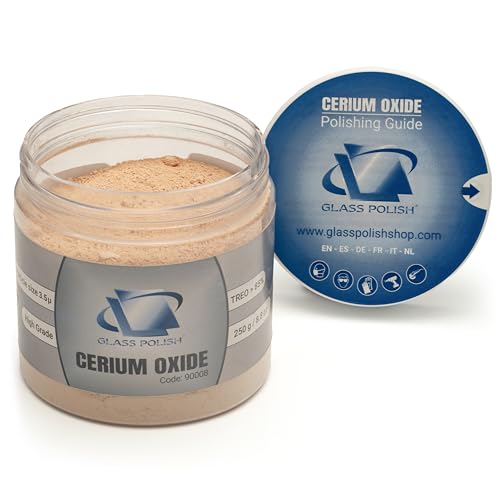
Where the Gordon Glass kit is the all-around workhorse, this one from Glass Polish Pro is the specialist for tough jobs like heavy water spots, chemical stains, and the kind of hard-water etching that makes a used car’s windshield look permanently dirty. The 3.5-micron cerium oxide particle size is finer than a lot of standard compounds, which means you get a higher polish, but it still cuts fast enough that buyers report achieving a “higher polish than new glass” on an older car.
The key differentiator here is the suspension-treated formula — a technical feature with a real-world benefit: it mixes easily with water, stays suspended longer (less shaking required), and creates a slurry that can be reactivated with water if it starts to dry out, which reduces waste. You get 8.8 ounces (250g) of powder, which goes a long way. The brand specifically notes this is “for faint, shallow scratches only” and recommends a two-stage abrasive kit for deeper marks — that level of honesty should build trust.
The main caveat matches every glass polish out there: it takes real effort. One owner spent two hours polishing light scratches on a watch crystal; another worked for hours on 30-year-old sliding glass doors with mixed results. The reviews are overwhelmingly positive (4.2 stars from nearly 250 ratings), but the work is manual and the result depends on your technique. Compared to the Nu Finish kit, which has a more forgiving consumer application, this is a professional-grade powder that rewards patience and preparation.
Glass Polish Pro Powder: This is the best pick for someone who has a specific, stubborn glass defect — water spots, mineral deposits, or haze that nothing else has touched — and is willing to put in the elbow grease. But if your scratch is deep, this powder will not be enough; you need a coarser starting compound.
For heavy etching: The detailer or homeowner facing hard-water etching that laughs at vinegar and commercial sprays.
Skip casual use: The instructions are minimal, and achieving a perfect finish on deep scratches requires the brand’s separate abrasive kit first.
3. GLASS POLISH DIY 3” (75mm) Windshield Polishing Kit
The kit with a cult following that has saved thousands of windshields from wiper haze—if you bring patience.
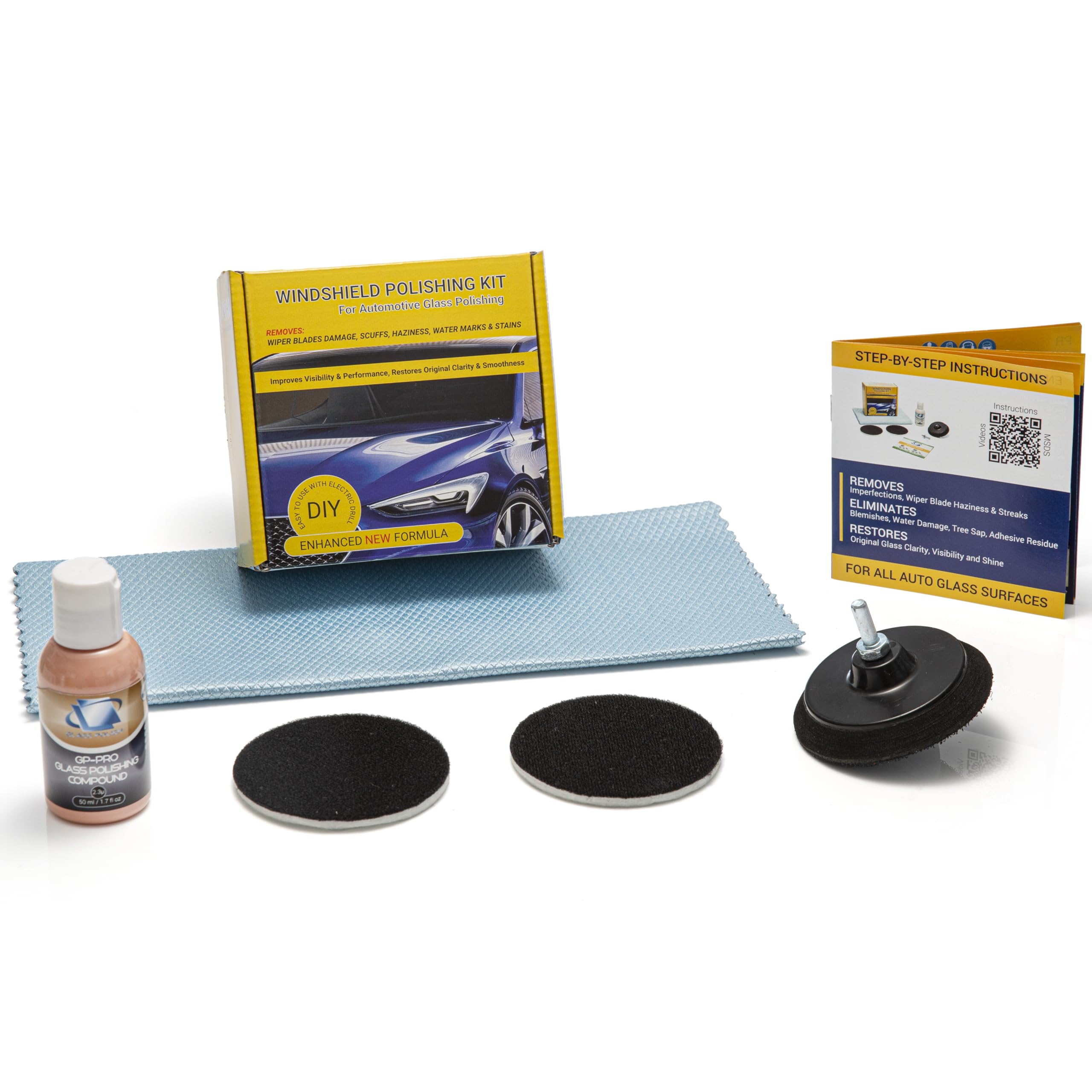
This is the kit that gets brought up in enthusiast forums time and again, and the numbers prove its reach: nearly 4,000 ratings, which is more than any other product on this list by a wide margin. Success is far from guaranteed — effectiveness is the most-discussed aspect, and it comes back as “mixed” — but the sheer number of owners who have gotten results speaks volumes. This is the 1.5-micron cerium oxide kit that comes with a drill attachment, backing pad, polishing pads, a cleaning cloth, and illustrated instructions with a QR code to video tutorials. It is the most complete package in the mid-range, designed specifically for a first-time user who has a drill and wants step-by-step guidance.
Quality is the most praised feature, and for good reason. The kit’s 3-inch felt pad and universal attachment fit most drills, and the instructions walk you through the right technique, including the critical step of keeping the surface wet and managing drill heat to avoid glass stress. Owners mention removing 80% of wiper blade scratches from a 50-year-old collector car’s windshield in 45 minutes, and one reviewer described completely removing all scratches from a new SUV windshield after eight 5-minute polishing rounds with cool-downs in between. That level of technique matters — the kit works beautifully when used correctly, but it does not forgive rushing.
Where it falls short, compared to the Gordon Glass kit which gives you more powder for the same money, is that some owners feel the 3-inch pad is too small for large windshields, and that a powder-only approach with a 5-inch pad would be faster. The work time is a real factor: owners note it takes “a long time” and requires multiple passes for any scratch that is not a surface-level wiper streak. The recurring gripe is that the kit is the “right idea but wrong set of tools” for deeper scratches, and some have moved on to larger pads for more aggressive jobs.
DIY 3 Inch Kit
- Comes with everything you need except a drill — no extra shopping
- The quality and build of the felt pad and backing plate are better than most budget kits
- Instructions and video tutorials make the initial learning curve much gentler
Small pad limits
- The 3-inch pad is slow for a full windshield — expect a multi-hour job
- Effectiveness on all but the finest scratches is mixed; deeper marks require coarser compound first
For tight spots: The first-time user who wants a proper, complete kit with support materials — this is the one to learn on.
Not for large areas: For deep, fingernail-catching scratches, this kit’s 1.5-micron abrasive is too fine; you would need the brand’s coarse scratch removal kit as a first step.
4. Nu Finish Glass Restore & Repel Kit
A two-step approach that cleans brilliantly but asks you to be patient with the finishing sealant.
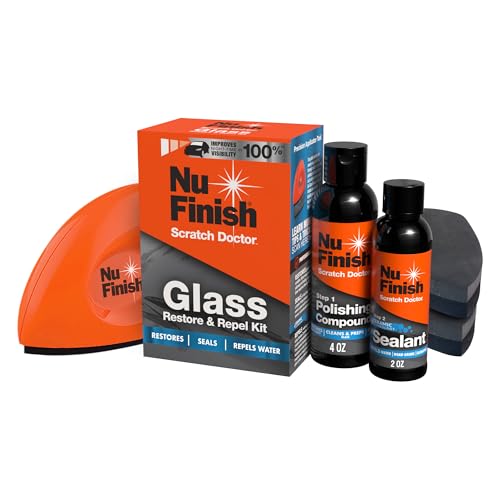
This kit from Nu Finish is different from every other product on this list because it is not just a polish — it is a regimen. The box contains a 4 oz bottle of glass polishing compound (based on aluminum oxide and zirconia alumina, not cerium oxide) and a 2 oz bottle of ceramic glass sealant, along with a precision applicator tool and two reusable sponges. The idea is step one: clean and polish the glass to remove road grime, water spots, and haze. Step two: apply the sealant to repel water, rock chips, and bird droppings for “up to two years.”
The cleaner strips old coatings and stubborn film better than any alternative. Owners specifically report that the polishing compound “removed 3-4 long scratches from the windshield caused by ice/debris” and made glass “shiny and clear.” The issue that dominates the negative feedback is the sealant: a significant number of owners find it leaves a greasy, streaky film that is hard to buff out, and many say it fails to create the water-beading effect promised. This is reflected in the data — scratch repair and messiness are the top negative aspects, and effectiveness overall is assessed as “mixed” by Amazon’s own analysis.
One of the main frustrations owners cite is the lack of clear instructions for the sealant step, which leads to a film that can take multiple attempts to correct. In a head-to-head comparison with the Gordon Glass kit, which is just an abrasive and a pad, the Nu Finish is far easier to get started with (no mixing powder), but its two-step process introduces a second variable that can go wrong. If you view the polish as the primary value and the sealant as a bonus, you will likely be satisfied. But if you are buying it specifically for the water-repellent finish, you may need to supplement it with a dedicated product like Rain-X.
Nu Finish Restore: The polishing compound in this kit is genuinely good at cleaning glass, and the applicator tool makes the job less messy than a powder slurry. But the sealant step is divisive: about half the owners say it ruined the clean finish they just created.
Quick shine fix: You want a simple polish that requires no mixing and you are comfortable skipping the sealant or working through its learning curve.
Skip long-term: You are buying this for the water-repellent sealant specifically — the reviews suggest it delivers inconsistent results.
5. CARPRO CeriGlass Glass Polish – 500ml (17oz)

The liquid that skips the mixing step and goes straight to work on wiper marks and water spots.
CARPRO is a well-known name in professional detailing, and this 500ml (17 oz) bottle is their pre-mixed liquid cerium oxide compound — no powder, no slurry ratios, just shake and apply. This makes it a fundamentally different product from the Gordon Glass and Glass Polish Pro kits, which require you to mix your own abrasive paste. For someone who wants to jump straight to the polishing step without measuring water and powder, this is a real time-saver. The compound is designed for use with a rotary machine or a dual-action polisher, and the manufacturer says it effectively removes swirls, light scratches, and tiny pits without distorting the glass the way traditional cerium oxide compounds sometimes do.
Performance across the reviews is strong but not universal. One owner completely restored a shower door by polishing off hard water stains, saying it looked “good as new.” Another tested it on a car’s paintwork (glass polish used on clear coat, which is not recommended) and reported it worked as advertised for detailing. The brand specifically notes it is effective with a rotary tool for deeper defects, and with a dual-action machine for lighter work like water spots and fine swirls. However, the recurring gripe is that it is “only a fine polish” — one owner tried it on visible wiper marks and saw no improvement after two hours of buffing, concluding the product name is misleading for scratches you can feel.
The biggest difference between this and the Gordon Glass kit is the format: the CARPRO liquid runs thinner and can be harder to control on a vertical surface (owners describe it as “incredibly runny”), while the Gordon Glass slurry is thicker and stays on the pad better. But for a pre-mixed product, the consistency is a deliberate choice — the thin formulation allows it to be used with a wider range of machines without clogging the pad. The price for 17 oz is higher per ounce than the powder kits, but if convenience is your priority, that premium is worth it.
CARPRO CeriGlass 500ml: This is the best choice for the detailing enthusiast who already owns a machine polisher and hates measuring powder. It will not remove deep scratches, but for haze, water spots, and light swirls, it is the fastest path to a clear windshield.
Pro results: The detailer who wants grab-and-go convenience with a trusted brand name.
Skip budget jobs: The thin formula is prone to running off vertical windshields, and it lacks the cutting power for scratches you can catch with a fingernail.
6. Permatex 09103-6PK Windshield Repair Kit (Pack of 6)
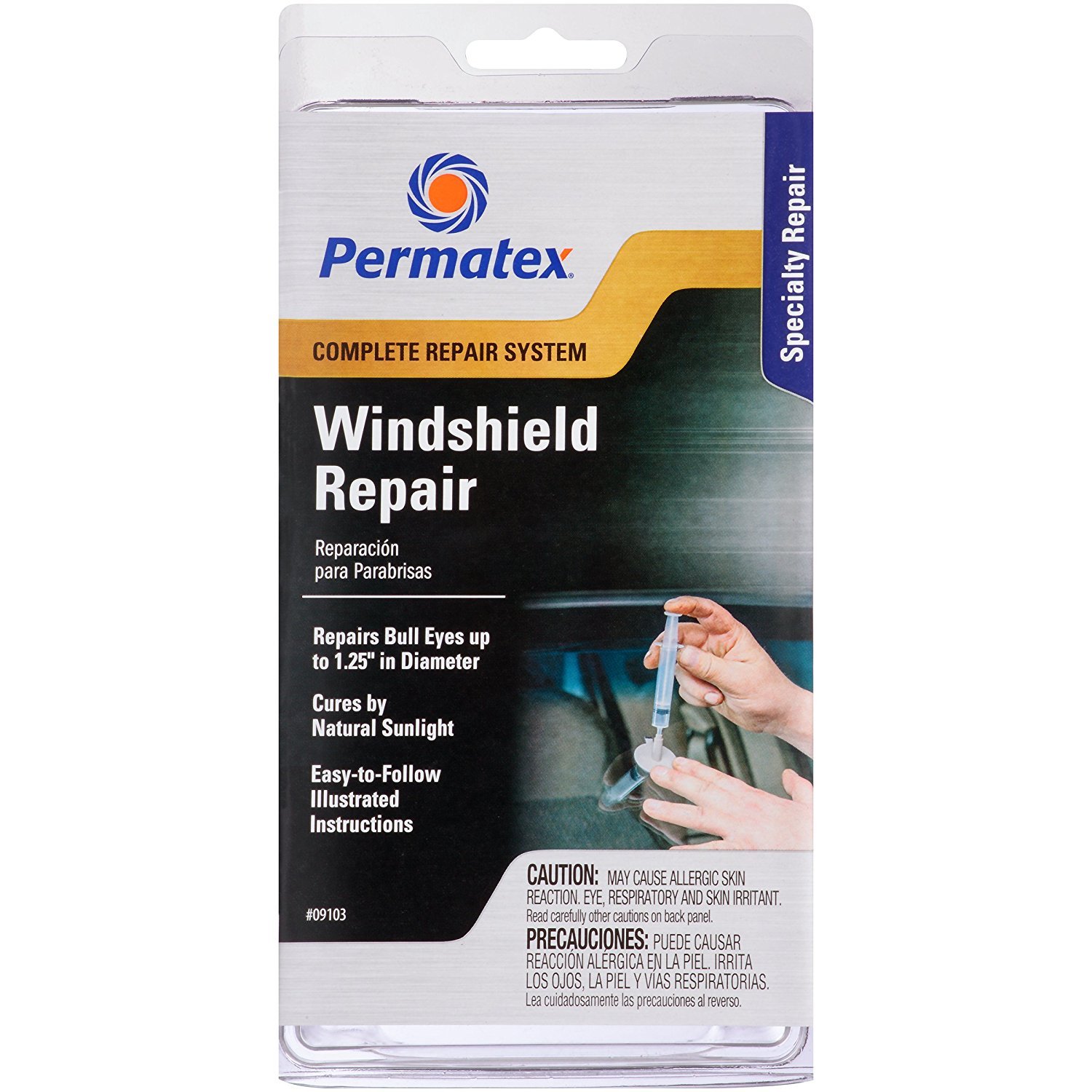
The kit that fixes rock chips, not scratches — and it does it in minutes with daylight as its catalyst.
This is a completely different tool for a completely different job. While every other kit on this list is about polishing surface imperfections, the Permatex kit is for repairing bullseyes, star damage, and chips up to 2.75 inches in laminated windshield glass — the kind of damage you get from a rock on the highway. It is a resin-based system that uses a spring-lock syringe to inject a clear filler into the crack, which then cures by natural daylight (no mixing required). You get a six-pack of repair tools in the box, making this a great value for a fleet vehicle owner or anyone who wants spares to keep in every car.
Effectiveness is the standout feature—it works as advertised for the right damage type. Owners say it makes chips “practically disappear” and adds structural strength back to the glass. One reviewer described making a dime-sized chip “nearly impossible to find” after the repair. The ease of use is also a major positive — no mixing, no powder, just clean the chip, apply the resin, and let the sun cure it. The kit has a strong 4.2-star rating across 140 ratings, and the positive comments cluster around how it saves hundreds of dollars versus professional replacement.
However, the Permatex cannot fix what it is not designed for. It does not remove scratches, wiper haze, or water spots. It is a repair kit, not a polish. There is also a durability concern mentioned in a few reviews: one owner reported the sealant “blew out in 4 minutes” under heat and pressure, suggesting that a chip repaired this way is not as strong as untouched glass. Overall, this is a perfect complement to a polishing kit — use the Permatex for chips and the Gordon Glass kit for wiper scratches — but it is not a replacement for either.
Permatex 6-Pack
- Designed and built specifically for chips and cracks up to 2.75 inches — not a polish that can’t fix a rock chip
- Cures by natural daylight with no mixing or batteries needed
- Six kits in one box, making it cheap enough to keep one in every vehicle
Small cracks only
- Will not touch scratches or haze — it is strictly for impact damage from stones and road debris
- A minority of customers note the cured resin can blow out under extreme heat
Emergency stash: You have a visible chip or star crack in the windshield and you want a fast, affordable fix without the cost of a replacement.
Not for big chips: You are trying to remove scratches — this is the wrong tool for that job.
7. Teenyyou 55 Pcs Glass Polishing Kit

The biggest box for the smallest spend — 55 accessories, but the core abrasive needs more testing.
On paper, this kit is the wildcard of the list: 55 pieces including cerium dioxide powder, multiple wool polishing wheels, felt pads, 40 sheets of sandpaper in 5 different grits, towels, gloves, and a spray bottle. The number of items is 55, versus the 1 item in the Gordon Glass kit, which gives you just the powder and a pad. For someone who has no tools at all and is starting from scratch, the Teenyyou kit looks like the obvious value choice. The instructions suggest a 1:1 cerium oxide to water paste ratio, and the kit includes sandpaper for wet-sanding deeper scratches before polishing — a step that many more expensive kits skip.
The reality across the review data is more sobering. The product has a modest 3.6-star average from only 17 ratings, and the reviewers point out a clear pattern: it works for some, but a significant number say it “did not work” and ultimately “just ended up replacing the windshield.” One owner who spent “two half days polishing” concluded it was impossible with a cordless drill. The kit also conspicuously lacks any printed instructions — the same complaint that dogs the Gordon Glass kit, but the Teenyyou kit has the added expectation of managing 55 components and 5 grits of sandpaper without guidance.
Compared to the DIY 3″ kit from Glass Polish (which has thousands of positive reviews and a well-documented process), the Teenyyou is a gamble. If you have the experience to know which grit to use and how to properly sequence sanding before polishing, you might get results for less money. But for a first-time buyer, the risk of ending up with a worse windshield than you started with is higher here than with any other product on this list. The raw materials are there, but the confidence is not.
Teenyyou 55 Pcs: This kit is for the adventurous budget buyer who already knows how to wet-sand glass and just wants a cheap box of consumables. For a beginner, the lack of any positive consensus is a warning flag — the Glass Polish DIY 3″ kit costs about the same and has a far better track record.
Starter bundle: You have experience sanding and polishing glass and you want a bulk supply of pads and sandpaper rather than a refined polishing system.
Skip professionals: You are a first-time user hoping for clear guidance and a reliable result — the risk of being disappointed is too high.
8. CARPRO CeriGlass Glass Polish – 150mL Kit (5oz)

The little liquid that conquered stains muriatic acid could not touch — a specialist for stubborn mineral deposits.
CARPRO CeriGlass in the 150mL (5 oz) size is the pocket-friendly version of the larger 500ml bottle reviewed above, but it comes as a kit with a microfiber applicator pad included. This is the version to buy if you only have a small windshield defect, a single window, or you want to test the product before investing in the larger bottle. The formula is identical — a pre-mixed cerium oxide liquid that creates a hydrophobic (water-repelling) effect on the glass as you polish. The smaller size makes it more manageable for hand application, though it still works best with a drill-mounted felt pad or a machine polisher for heavier defects.
The review data tells a story of a product that is incredible for specific problems but underwhelming for others. Performance is the top positive aspect, and the most dramatic example comes from an owner with a 1965 Ford Falcon who had tried everything (including muriatic acid) on glass stains, and the CARPRO CeriGlass was “the only thing that worked.” That is a powerful vote of confidence for hard water mineral deposits and acid rain etching. Another owner successfully removed severe scratches caused by abrasive cleaning from a car windshield, but it took repeated applications over an hour with a drill buffer pad, confirming that the liquid does work but demands effort.
The recurring negative is the small volume: at 5 oz, you use it up quickly on a large windshield, especially if you are chasing multiple scratches. The larger 17 oz bottle is a better value if you know you will use it, but this size makes sense for targeted repairs. The product creates a hydrophobic effect (water beads and runs off), which helps prevent future water spots, but it does not create the same level of permanent scratch removal you get from a heavy cerium oxide slurry. If your primary goal is scratch removal rather than stain removal, the Gordon Glass powder kit offers more abrasive for the money.
CARPRO CeriGlass 150ml: This is the best pick for hard water spots, acid rain etching, and mineral stains that nothing else seems to shift. But for general wiper scratch removal, the powder-based kits (with more abrasive volume per dollar) are a more reliable choice.
Sample size: The owner facing stubborn mineral stains on glass that have resisted every other glass cleaner and acid.
Skip multiple repairs: The 5oz bottle runs out fast if you are polishing a large area; budget for the 17oz version if you plan to do a full windshield.
9. Eastwood Pro Glass Polishing Kit
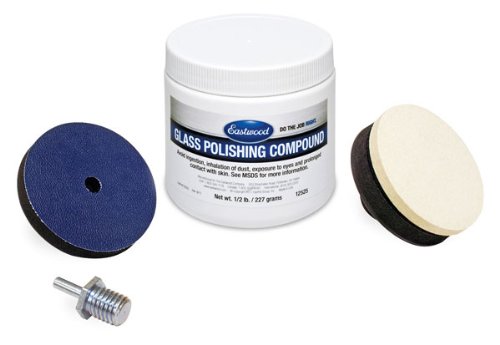
The diamond-dust specialist for old, irreplaceable windshields where only heavy grit can cut through the haze.
Eastwood is a respected name in automotive restoration, and this kit is their professional-grade answer to hazy, scratched glass that has built up damage over decades. The key differentiator is the abrasive: diamond powder, rather than the cerium oxide used by every other kit on this list. Diamond is significantly harder and cuts faster, which makes it the right choice for older windshields that are beyond the reach of a fine cerium oxide polish. The kit comes with a felt polishing buff, a drive spindle adapter for your drill or low-speed polisher, and what the brand calls a “concentrate” that you mix with water to create a slurry.
The reviews are sharply divided, and the data reveals a product that is either exactly what you need or a frustrating experience. The three positive reviews (out of the eight total) describe successful results: one owner used it on an Audi S7 and found that deeper scratches “smooth out and become transparent in light,” while others simply confirm it “works as described.” The critical advice from successful users is to use a slow speed, manage heat with a moist towel, and reapply paste often as it degrades. The drive spindle adapter is specifically designed for a drill, which gives you more control than a high-speed rotary tool.
But the negatives are hard to ignore. A glass replacement technician warned one owner they would “end up with a swirly, uneven finish,” and after an hour of work, the owner saw no improvement before ultimately replacing the windshield. Another reviewer bluntly stated it “didn’t even remove the scratches” and called it a “waste of money.” The 1.5-pound kit is the most expensive on this list, and the risk is that you need exactly the right technique to get a good result. This is not a kit for a casual user — it is for a restorer who knows glass polishing well and cannot get the result they need from a cerium oxide product.
Eastwood Pro Kit
- Diamond abrasive cuts faster than any cerium oxide compound, making it ideal for stubborn, years-old haze
- Designed specifically for older, hard-to-replace windshields where you want to avoid replacement
Learning curve
- Significant technique required — heat management and paste reapplication are critical for good results
- A real risk of introducing swirl marks or uneven finish if you do not follow the instructions precisely
For enthusiasts: You are restoring a classic car’s original windshield and you have glass polishing experience — the diamond cutting action is class-leading.
Skip beginners: You are a first-time user trying to fix a single scratch — the risk of making it worse is real, and a cerium oxide kit is more forgiving.
Understanding the Specs
Cerium Oxide Particle Size
The most important number in any powder-based polish is the particle size (microns). A smaller number, like 1.5 microns, produces a finer final sheen but cuts very slowly — it is for light wiper scratches and haze. A larger number, like 3.5 microns, cuts faster but leaves a surface that may need a finer polish afterward to restore full clarity. For your first project, a medium 3-inch pad with a 3-micron cerium oxide is the balance. If your scratch barely catches a fingernail, a 1.5-micron polish can handle it, but you will be working for a while.
Felt Polishing Pad Size
The diameter of the polishing pad directly affects how fast you can cover the glass. A 3-inch pad (the size used by most kits here) requires more passes but gives you more control over small defects and is less likely to overheat the glass on a tight curve. A 5-inch or 6-inch pad covers more area per pass, which is better for a full windshield, but it demands a more powerful drill and generates more heat. If you are polishing a single scratch, a 3-inch pad is fine. If you are polishing a full windshield, consider buying a larger pad separately.
FAQ
Can a windshield polishing kit remove a rock chip?
How can I tell if my windshield scratch is too deep for a polishing kit?
Do I need a special drill or can I use my cordless drill?
How long does a windshield polishing job typically take?
What is the difference between cerium oxide and aluminum oxide for glass?
Can I polish a windshield by hand without a drill?
Why do some kits include sandpaper? Do I need to sand before polishing?
How do I prevent the glass from cracking during polishing?
Can I use a windshield polishing kit on tempered glass like side windows?
What is a hydrophobic coating on glass and does a polish kit create one?
Final Thoughts: The Verdict
For the majority of shoppers, the best windshield polishing kit winner is the Gordon Glass Cerium Oxide Kit because it delivers the most reliable scratch removal in a simple, cost-effective package backed by nearly 500 positive ratings. If you want a complete system with step-by-step support and a more forgiving learning curve, grab the Glass Polish DIY 3″ Kit. And for tackling stubborn mineral deposits and water spots that nothing else can touch, the Glass Polish Pro is the one to reach for. Whichever you choose, remember that patience and heat management are the real secrets to a clear, scratch-free windshield.
How We Picked
We do not accept paid placement. Every pick is matched to a real buyer and a real use-case; we do not hands-on test units.
Sources & Methodology
Specifications: manufacturer listings and product documentation. Review insights: verified customer reviews, as of July 2026. Pricing: not shown on this page (it changes often); check the current price via the retailer link.
As an Amazon Associate, GoCarLife earns from qualifying purchases. This does not affect which products we feature.