
Our readers keep the lights on and the garage heater humming. As an Amazon Associate, I earn from qualifying purchases.
Specs are compiled from manufacturer listings and verified buyer reviews and can change over time — please confirm the key details on the product page before buying.
You have a wiper arm that refuses to budge from its spline (the ridged shaft it sits on), and what should be a five-minute swap turns into a half-hour wrestling match. You can rock it, pry at it, and spray every penetrating oil in the garage — and still end up barking your knuckles against the cowl (the plastic panel below the windshield). The right puller changes that completely: it applies steady, even lift so the arm pops off cleanly, without damage to the glass, the splines, or your patience.
I’m Mo Maruf — the founder and writer behind GoCarLife. This guide is built by comparing the manufacturers’ published specifications and the patterns across verified customer reviews, so you get each pick’s real strengths and trade-offs instead of marketing spin.
When you are fighting a rusty shaft on an old SUV or just want the right tool before you start the job, the best wiper arm puller saves you time, frustration, and the cost of a broken wiper motor.
Our Picks at a Glance

How To Choose The Best Wiper Arm Puller
A wiper arm puller is a simple tool — two jaws that grip under the arm and a center screw that pushes against the wiper shaft (the round metal rod the arm pivots on). But the differences in build quality, adjustability, and fit can mean the difference between a clean removal and a stripped thread. Here are the key factors to consider.
Jaw Design and Adjustability
Fixed-jaw pullers are light and cheap, but they only fit one size range. Adjustable pullers with sliding or swappable hook arms let you tackle everything from a compact hatchback’s rear wiper to a full-size truck’s front arm. The wider the opening range, the more vehicles you can service without buying a second tool.
Throat Depth
Throat depth is the distance the puller reaches in under the wiper arm. A shallow puller (around 1 inch) works on most cars, but some BMW, Volkswagen, and European models have very tight clearance around the cowl. If the puller cannot slide far enough under the arm, the center screw misses the shaft and the tool cannot bite.
Forcing Screw and Drive
The center screw does the heavy lifting. A coarse-thread screw with a wide handle or a 13mm hex head lets you apply steady torque without rounding the material. Some pullers rely on a plastic T-handle, which can snap under high force. A metal forcing screw with a wrench flat (a flat surface for a wrench to grip) gives you more leverage and control — and when the arm is really stuck, that extra bite matters.
Build Material
Most pullers are forged or stamped from carbon steel. Forged and heat-treated steel holds up better against seized parts without bending the jaws. A corrosion-resistant coating (black oxide or similar) also helps the tool survive garage humidity and occasional exposure to penetrating fluids.
Quick Comparison
| Model | Best For | Jaw Opening | Throat Depth | Weight | Amazon |
|---|---|---|---|---|---|
| FIRSTINFO Universal Puller★ Best Overall | Best Overall | Adjustable | Fits tight bays | 1.58 lb | Amazon |
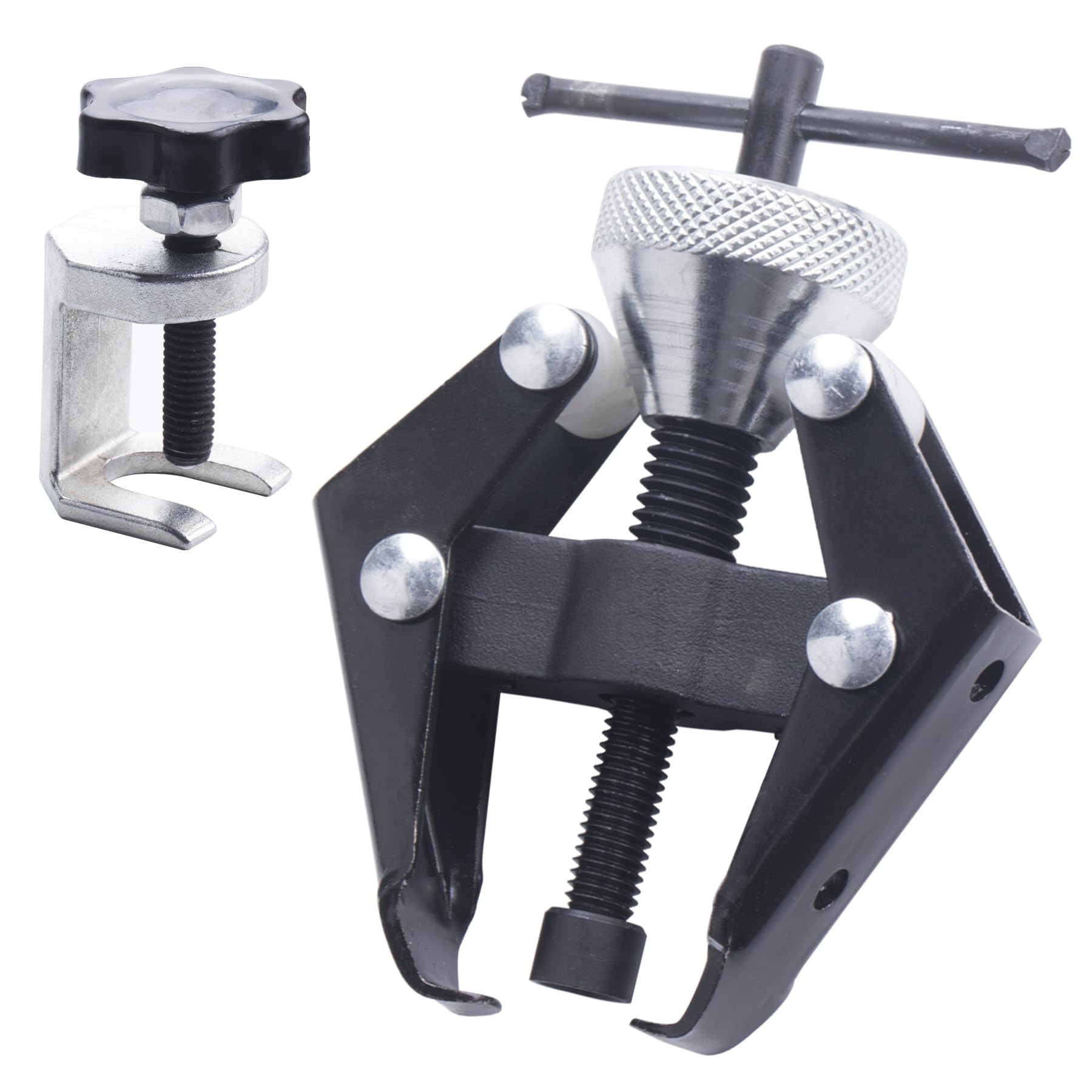
| Battery Terminal & Wiper Arm PullerBudget Champion | Budget Champion | Fixed + 2-jaw | Compact | 14.4 oz | Amazon |
| KZINO Windshield Wiper Puller | Best Value | Fixed | Standard | 14 oz | Amazon |
| EWK 8-30mm Adjustable Puller | Adjustable Fit | 8–30 mm | Standard | 13.6 oz | Amazon |
| OTC 4676 Wiper Puller | Simple & Reliable | Up to 5/8 in shaft | 1-1/16 in | — | Amazon |
| GLEXQLAO Adjustable Puller | Premium / Euro Fit | 15–36 mm | Max 39 mm | 1.23 lb | Amazon |
| BGS 7795 Wiper Puller | BMW / VW Specific | 24 mm | 32 mm | 7.04 oz | Amazon |
In‑Depth Reviews
1. FIRSTINFO Universal Windshield Wiper Arm Puller
Our pick — over 4.5★ from 550+ verified ratings; the strongest balance of quality and price.
Buyers report its adjustable jaws popped a stuck 11-year-old arm in seconds — it earns the top spot because of that raw, repeatable force.
The FIRSTINFO relies on a forged steel frame and a hook-arm system you can adjust for different wiper arm widths. You drive it with a 1/2-inch (13.2mm) wrench — technically a 13.2 mm wrench flat — so you get high torque without a plastic handle that might snap. The two radius-design hook couples (hooks with a curved shape that helps them grip) let you dial in the fit for wiper arms and battery terminals, so number plates stay readable at night.
Buyers praise its functionality and quality most of all. The tool is heavier than the EWK at 1.58 pounds, which keeps it seated under load. It is compact at 4.72 x 3.15 x 1.06 inches, so it squeezes into tight engine bays where a larger puller like the OTC cannot reach. One review puts it bluntly: “Rest are junk quality.”
Why It Wins
- Adjustable jaws fit many wiper arm sizes and battery terminals
- Operates with a socket wrench for high torque without handle breakage
- Compact enough for tight engine bay and cowl clearance
The Trade-Off
- Costs more than basic pullers
- Some owners mention the spindles cannot tighten near the center bolt
Reach for it if: you want one puller that handles everything from a rusty truck arm to a sealed battery terminal without a second tool.
Look elsewhere if: you only have one easy car to do — a basic puller may be all you need.
2. Battery Terminal and Wiper Arm Puller Tools (RAHQHD)
A tiny, affordable twin set — one buyer says it made a 2013 Ford Explorer’s wiper job “super easy.”
This two-piece set covers both battery terminal removal and wiper arm pulling at a price that is tough to top. It is made from 45# carbon steel (a medium-carbon steel grade) with a specialized heat treatment for higher hardness, so it resists corrosion. One owner reports pulling the wipers off a 2013 Ford Explorer with almost no effort.
The smaller puller, however, may struggle on very large wiper arms. One review notes it did not fit a VW Touareg’s arms, and the 2-jaw puller only barely worked after removing the hood strut (the gas-charged rod that holds the hood up). It is lighter than the FIRSTINFO at 14.4 ounces, which is great for storage but means less mass to resist the pull. For standard Japanese and American cars at a tight budget, it handles the job without drama.
Smart buy for: a homeowner who needs a reliable puller for occasional use on common cars and wants to spend very little. The weight and size trade-offs are real, but so is the value.
Grab it if: you need a light, entry-level tool for occasional wiper and battery terminal work on standard vehicles.
skip it if: you work on large European SUVs or heavy-truck wipers — the small puller may not fit.
3. KZINO Windshield Wiper Puller Tool

A single, self-contained tool that handles front and rear wipers — one owner pulled a rear wiper assembly without any drama.
The KZINO sits between the budget two-piece and the premium FIRSTINFO. Its knurled cone and center screw design works like this: tighten the cone, press the jaws under the clamp, turn the center screw, and lift. The knurling (a cross-hatched texture for grip) helps you hold the cone firmly. The package is compact at 5.31 x 3.15 x 1.54 inches and weighs 14 ounces — nearly identical to the budget set but in a single tool. Durability gets mixed feedback: some owners find it sturdy, while a few report the jaws bending under extreme force on very stubborn arms. It is a solid choice for the typical DIYer who wants one tool that works from the start without the premium price tag.
Solid middle ground: good functionality and quality, with mixed durability feedback that only matters if you regularly fight heavily rusted parts.
Choose it for: a straightforward front-and-rear wiper job on most cars, especially if you want a single tool.
Think twice if: you plan to use it daily in a shop or on heavily seized components — the FIRSTINFO’s forged build is tougher.
4. EWK 8-30mm Battery Terminal and Wiper Arm Removal Tool
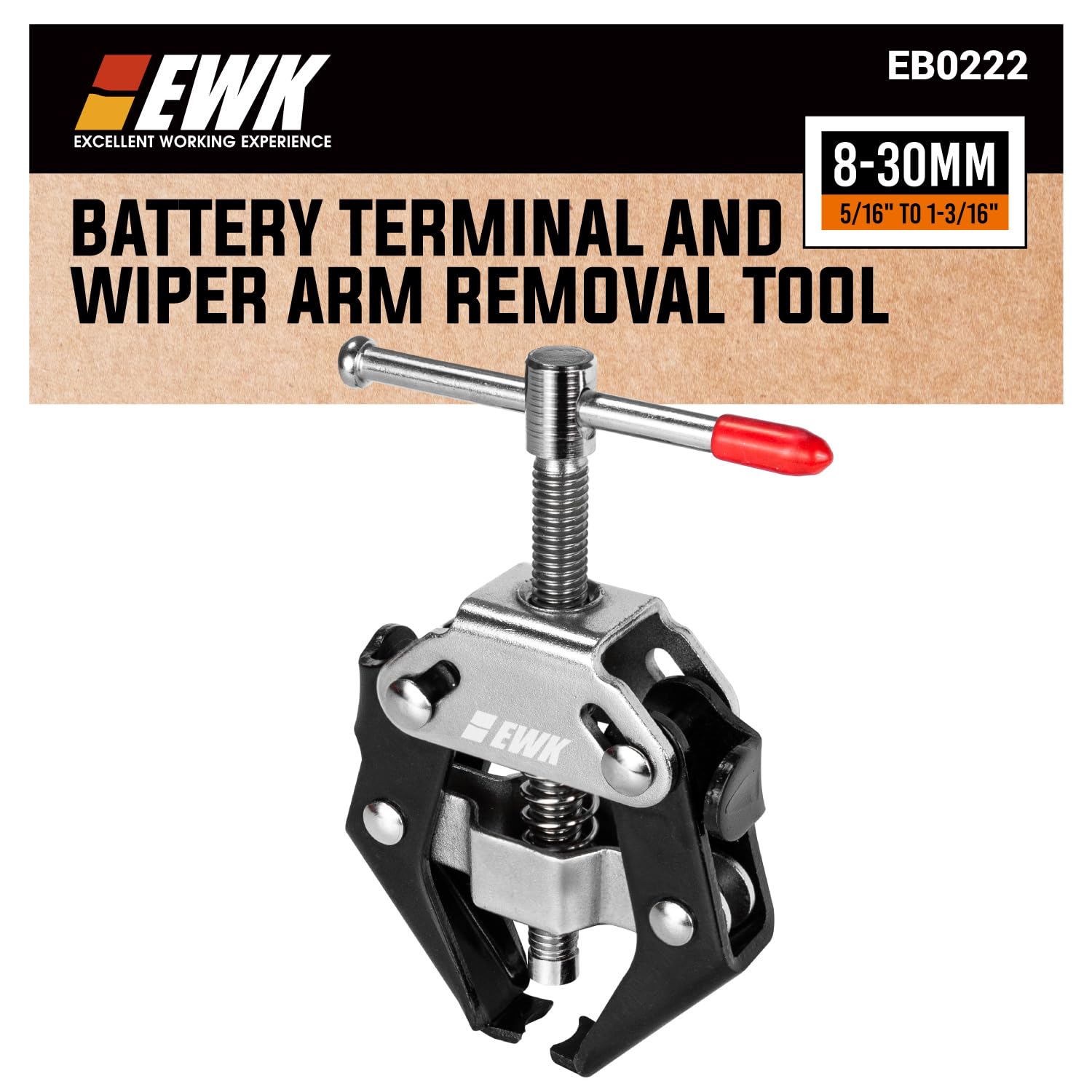
A self-centering T-handle stops the puller from walking off-center mid-turn — unlike the OTC 4676, which can shift under load on certain arms.
The EWK’s self-centering T-handle applies smooth, even pressure so the arm comes off predictably rather than with a sudden, dangerous pop. Its adjustable opening spans 8 to 30 mm (5/16 to 1-3/16 inches), covering most wiper arm bases and battery terminals with one tool. Carbon steel construction gives it the strength to fight corrosion-fused parts.
One owner reports removing a broken rear wiper arm from a 2007 Lincoln MKX on the first try — a job that would have taken hours with prying alone. The tool has a slight wobble when fully extended, as one review notes: “it’s not flimsy but it flops a bunch.” That is a minor annoyance, not a functional failure.
What Works
- Self-centering T-handle for even, controlled pulling
- Wide 8–30 mm adjustment range for many cars and small bearings
- Carbon steel build handles rusted parts reliably
A Minor Quirk
- The arm flops loosely when not under load
- Some durability concerns on very high-torque jobs
Best for: the hobbyist who wants precise control and adjustability without paying a premium.
Not for: shop-floor abuse on severely seized parts every day — the FIRSTINFO has more brute-force margin.
5. OTC 4676 Windshield Wiper Puller

A fixed-jaw puller with a throat depth of 1-1/16 inches that popped frozen 14-year-old wiper arms off a 2004 GMC Sierra 2500 with little effort.
OTC is a well-known name in automotive tools, and this puller uses a simple, rugged metal frame. It has a throat depth of 1-1/16 inches and foot spacing that accommodates wiper shafts up to roughly 5/8 inch in diameter. The forcing screw (the center bolt that pushes the arm off) has a rounded tip that engages the small depression on the wiper shaft, keeping it centered.
That said, the OTC is not adjustable and its fit range is narrower than other picks. Several customers note it fails on certain BMW and Acura models because the depth is insufficient. It also lacks a wrench point below the handle, so stubborn arms require two-handed force on the plastic knob — which can wear over time. It is a good tool for easy-to-medium removals on common domestic and Asian cars, but it falls short on deep-cowl European models.
Honest verdict: a dependable, simple puller for straightforward jobs. Check your vehicle before buying.
Good for: a quick job on a standard car where you just need a simple, low-cost tool that works.
Not for: BMW, Acura, or deep-cowl applications that need a longer reach or adjustable jaws.
6. GLEXQLAO Car Windshield Wiper Arm Puller (15–36 mm)

A deeper pull than the OTC 4676 — its 39 mm maximum depth reaches under tight cowls on models like the E39, E60, and VW Passat.
If you drive a BMW, Volkswagen, or another European make, you know the struggle of finding a puller with enough reach. The GLEXQLAO has a claw opening of 15 to 36 mm and a maximum pulling depth of 39 mm — deeper than most universal pullers. It is made from high-temperature forged steel for good toughness and hardness, and it is not prone to rusting.
One owner says it “worked great on my 2018 Passat. The only tool that worked.” Another used it on a 2013 Hyundai Genesis Sedan, noting it was deep enough for the tight arm. The puller weighs 1.23 pounds — lighter than the FIRSTINFO but still heavy enough to stay planted. Build quality is a top compliment, although the total review sample is smaller than some other picks.
Why It Fits
- 39 mm pulling depth reaches deep European wiper arms
- Adjustable 15–36 mm opening for varied arm sizes
- High-temperature forged steel for durability
The Trade-Off
- Smaller review pool than top picks
- Costs more than universal adjustable pullers
Reach for it if: your car is a BMW, VW, or similar European make with a deep cowl that other pullers cannot clear.
Pass if: you work on Asian or domestic cars — a universal puller offers more flexibility for less money.
7. BGS 7795 Windscreen Wiper Arm Puller
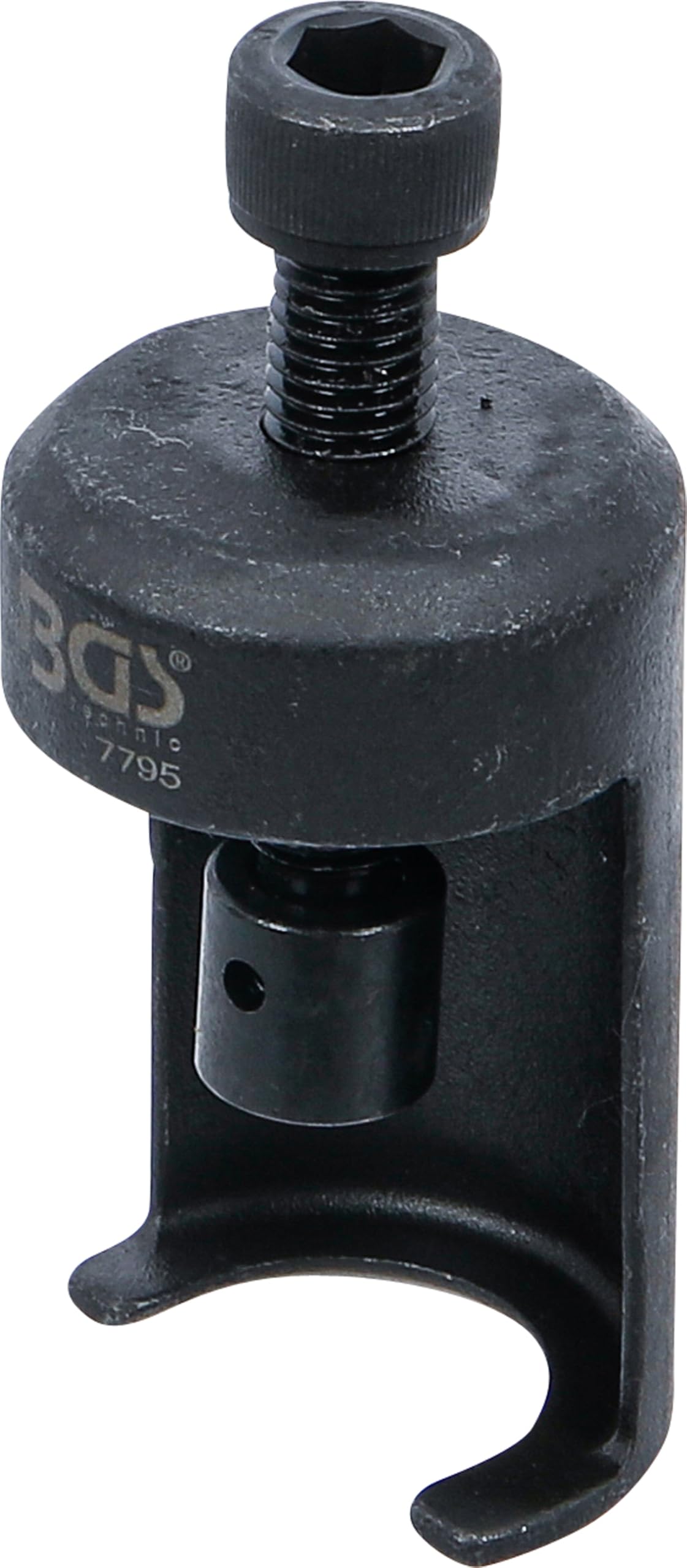
A German-made puller from chrome molybdenum steel (a tough alloy) that one owner says perfectly fits a MkIV Golf/Bora — and outperformed cheaper alternatives that “just broke.”
This is a vehicle-specific puller, not a universal one. It fits BMW 5-series E39 and 7-series E38 up to 2005, as well as VW Golf and Passat up to 2005. The material is chrome molybdenum steel — an alloy known for high strength and fatigue resistance. The claw opening is 24 mm and the pulling depth is 32 mm. One owner used it on an 02 Camaro’s pressed-on arms and called it “essential,” while another praised how it perfectly fits a MkIV Golf/Bora.
At only 7.04 ounces, it is the lightest puller here, but the alloy steel construction keeps it sturdy. It requires an 8 mm hex key (an Allen wrench) — not included — to operate. The narrow compatibility list means it is not for every garage, but if you own the exact models it fits, it is the most refined and purpose-built option available. It is also the most expensive pick on this list.
Precision tool: excellent for its targeted European models, with alloy steel that outperforms generic carbon steel on wear.
Get it if: you own or service a pre-2005 BMW 5/7-series or VW Golf/Passat and want a tool that fits without any wobble.
Avoid it if: you need a puller for other brands or newer models — the fixed jaw and specific fit limit its versatility.
Understanding the Specs
Throat Depth
Throat depth is how far the puller can reach under the wiper arm before its frame contacts the cowl or hood. A deeper throat (like the GLEXQLAO’s 39 mm) is essential on cars where the wiper arm sits very close to the glass or is recessed behind plastic trim. If a puller cannot slide far enough under, the center screw misses the shaft entirely and the tool is useless for that vehicle.
Jaw Opening vs Forcing Screw
The jaw opening determines which wiper arm bases the tool wraps around. An adjustable jaw (like the FIRSTINFO or EWK) covers many sizes with one tool. The forcing screw is what actually pushes the arm off — a coarse-thread screw with a hex head allows higher torque from a socket wrench, while a plastic T-handle is easier to turn by hand but can snap under extreme force.
FAQ
Will a wiper arm puller work on any car?
Can I use a wiper arm puller on battery terminals too?
How do I keep the forcing screw from damaging the wiper shaft?
What is the difference between a forged and stamped puller?
Does a heavier puller always work better?
Can I remove a rear wiper arm with the same tool?
Why does my puller keep slipping off the wiper arm?
How long do these pullers usually last?
Do I need penetrating oil before using the puller?
Is a vehicle-specific puller better than a universal one?
Final Thoughts: The Verdict
For most people, the wiper arm puller winner is the FIRSTINFO Universal Puller because its adjustable jaws, forged build, and socket-wrench compatibility give you the confidence to tackle any stuck arm without reaching for a second tool. If you want a budget entry point for occasional use, grab the RAHQHD two-piece set. And for European car owners who need deep reach under a tight cowl, the GLEXQLAO adjustable puller is the one to reach for.
How We Picked
We do not accept paid placement. Every pick is matched to a real buyer and a real use-case; we do not hands-on test units.
Sources & Methodology
Specifications: manufacturer listings and product documentation. Review insights: verified customer reviews, as of July 2026. Pricing: not shown on this page (it changes often); check the current price via the retailer link.
As an Amazon Associate, GoCarLife earns from qualifying purchases. This does not affect which products we feature.