
Our readers keep the lights on and the garage heater humming. As an Amazon Associate, I earn from qualifying purchases.
Specs are compiled from manufacturer listings and verified buyer reviews and can change over time — please confirm the key details on the product page before buying.
You need to strip a dozen wires for a new outlet, a trailer light, or a DIY project — and every single one has a different gauge. The last thing you want to do is fiddle with a tiny dial, guess the setting, and still nick the copper. Automatic wire strippers solve that: you just squeeze the handles, and the tool senses the wire size itself, strips the insulation clean, and lets you move on to the next connection. That is the whole promise — less time adjusting, more time finishing.
I’m Mo Maruf — the founder and writer behind GoCarLife. This guide is built by comparing the manufacturers’ published specifications and the patterns across verified customer reviews, so you get each pick’s real strengths and trade-offs instead of marketing spin.
The real choice is between a tool built for a lifetime of daily use and one that gets the weekend job done while staying affordable. The right automatic wire stripping tool saves you a lot more than just frustration — it lets you run through a bundle of wires in half the time.
Our Picks at a Glance

How To Choose The Best Automatic Wire Stripping Tool
The best automatic stripper depends on the wire types and volume you strip daily. A pro stripping Romex all day needs a different tool than a hobbyist building a PC.
AWG Range and Wire Type Compatibility
Every stripper handles a specific range of wire thicknesses, measured in American Wire Gauge (AWG). The lower the AWG number, the thicker the wire. A common range like 10-24 AWG covers most household wiring, automotive circuits, and electronics work. Some premium models reach up to 5 AWG for heavy-gauge industrial cable. Also check if the tool handles both solid and stranded wire — most self-adjusting models do, but a few are tune for one type.
Self-Adjusting Mechanism Quality
Self-adjusting mechanisms vary widely in quality. A quality mechanism grips the wire, sizes instantly, and cuts insulation without nicking copper on the first squeeze. A poor mechanism may require manual thumb-wheel tightening or lock up on small gauges. The best design requires no manual adjustment — insert wire, squeeze, and it strips cleanly.
Ergonomics and Build Materials
For extended stripping sessions, ergonomic handles reduce hand fatigue. Ergonomic, non-slip handles with a good grip reduce hand fatigue. The material of the body — fiberglass-reinforced plastic versus all-metal — affects weight and durability. A heavier, metal-bodied tool might feel more sturdy on a workbench, while a lighter plastic one is easier to carry in a tool pouch. Replaceable blades also extend the life of the tool significantly.
Extra Functions: Cutter, Crimper, and Safety Ratings
Many automatic strippers double as cutters or crimpers, saving you a separate tool. A built-in side cutter lets you trim wires to length in the same step. For anyone working on live circuits, look for a tool that is VDE-tested for safety up to a certain voltage (like 1000 V). If you are recycling scrap wire, a powered stripping machine with adjustable speed and blade depth is a different beast entirely — designed for volume, not portability.
Quick Comparison
| Model | Best For | AWG Range | Weight | Key Extra | Amazon |
|---|---|---|---|---|---|
| Jokari 20050★ Best Overall | Everyday value | 0.2 mm – 6 mm | 0.09 kg | Adjustable length stopper | Amazon |
| Klein Tools 11061Top Performer | Pro electrical work | 10-20 AWG solid, 12-22 AWG stranded | 12.6 oz | Tensioning thumb wheel | Amazon |
| KujectBest Value | Kit & organize | 24-10 AWG | — | Included ratchet crimper | Amazon |
| haisstronica HS | Two-tool set | 10-24 AWG | — | Includes manual stripper | Amazon |
| WEICON No. 6 | Live-work safety | 24-10 AWG | 105 g | VDE-tested to 1000 V | Amazon |
| WEICON No. 5 Pro | Heavy-gauge cable | 24-5 AWG | 169 g | Replaceable Solingen blades | Amazon |
| Knipex 12 64 180 | Durable pocket tool | 10-18 AWG | 4.32 oz | Fiberglass-reinforced body | Amazon |
| VEVOR BXJDD60 | Desk-based scrap recycling | 0.06″ – 0.98″ | 15.5 kg | 7 channels, 60W motor | Amazon |
| StripMeister E250 | Volume recycling pro | Ø1/8″ – Ø3/4″ | 21.4 lb | Variable speed, 1/4 HP motor | Amazon |
In-Depth Reviews
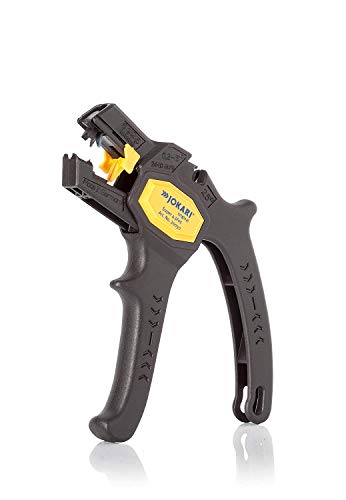
1. Jokari 20050 Ergonomic Super 4 Plus Automatic Wire Stripper
Our pick — over 4.5★ from 28,500+ verified ratings; the strongest balance of quality and price.
The compact German-made tool that cuts without nicking the copper underneath.
What wins people over here is how it handles wire after wire without a single adjustment. The self-adjusting mechanism works on cross-sections from 0.2 mm to 6 mm, and owners call it a “pleasure to operate” on almost any wire they feed it. The adjustable length stopper is a real time-saver when you need the same strip length across a whole bundle of wires — you set it once and run through the batch.
The plier-style handle with a lockable grip fits big hands comfortably, and the stainless steel and rubber construction feels solid without being heavy (0.09 kg). It is a crowd-favorite for a reason — the enthusiasm across buyers is genuine. The honest trade-off is durability: a minority report that the plastic components can give out within the first month, so treat it as a high-value workhorse rather than a tank.
One-sentence verdict: The best daily-driver for anyone stripping a mix of wire types who wants speed and ergonomics over brute-force build.
Reach for this if… you are a hobbyist, electrician apprentice, or DIYer who strips wires frequently and wants a tool that just works without a setup ritual.
Look elsewhere if… you need a tool that survives heavy daily drops on a job site — the plastic body is a trade-off for its light weight.
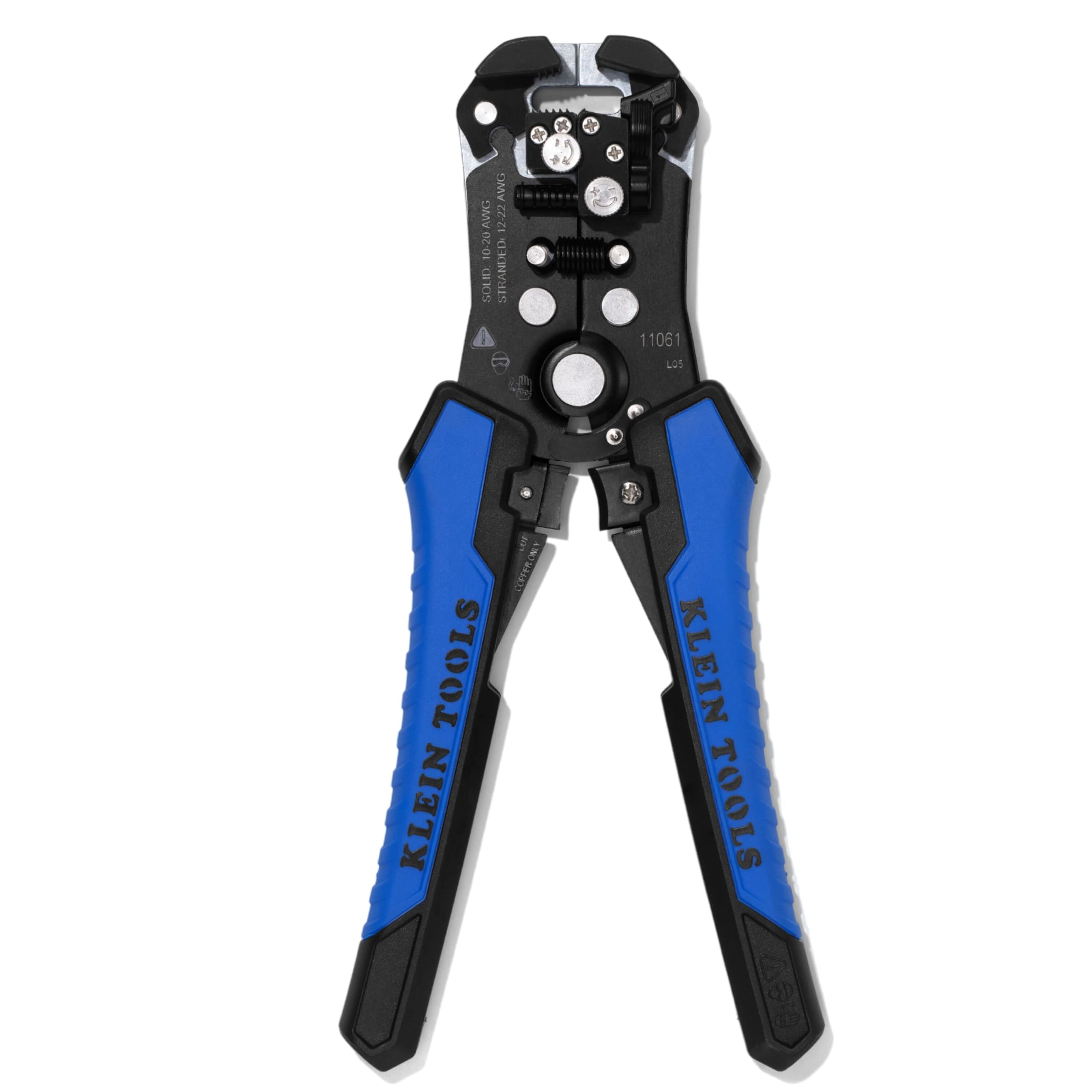
2. Klein Tools 11061 Self-Adjusting Stripper / Cutter
The professional-grade tool that electricians reach for on Romex and thermostat wire.
This is the one that steps up from the Jokari in build heft. It handles 10-20 AWG solid and 12-22 AWG stranded wire — plus 12/2 and 14/2 Romex cable — and the self-adjusting mechanism is widely praised for saving time switching between gauges. A built-in wire cutter on the handle lets you trim and strip in one motion, which is exactly what you want when you are in a panel or junction box.
The tensioning thumb wheel gives you fine control on smaller gauge wire so you do not nick the copper, and grooved grips reduce hand fatigue during long sessions. Owners consistently say it feels like a high-quality tool the moment you pick it up. The head is a bit bulky, so getting into tight spots in small junction boxes can be a squeeze. Still, for sheer performance on electrical wire, it is the pick that pros and serious DIYers end up keeping in their bag.
The bottom line: If you strip Romex or thermostat cables for a living, the Klein is the tool that pays for itself in time saved on the first day.
For you if… you are an electrician, security installer, or upfitter who strips multiple wire gauges daily and needs a heavy-duty feel.
skip it if… you work in cramped enclosures — the larger head might not fit where you need it.
3. Kuject Wire Stripper Crimping Tool for Heat Shrink Connectors
The wallet-friendly kit that strips, cuts, and crimps without needing a second tool bag.
This is the all-in-one solution for automotive, marine, and home DIY wiring where heat shrink connectors are common. The self-adjusting stripper handles 24-10 AWG and automatically adapts to solid, stranded, and bonded wires including Romex. A separate ratchet crimper is included for 22-10 AWG insulated terminals, applying steady pressure for a firm connection. The length stopper is a fan favorite — it keeps repeated strips uniform so every wire is ready to crimp.
The rubber ergonomic handles give you good control, and the hard case keeps everything organized. There is a real, honest flaw: the stripper adjustment can lock up when you try to tighten it for smaller wire, so the fine-tuning is not great. But the crimper and cutter work perfectly, and the feedback across owners is that the quality is solid for the price. It is a kit built for practical wiring jobs, not precision lab work.
Straight talk: The value equation is strong — you get a functioning stripper, a reliable crimper, and a sturdy case for less than most single tools cost.
Good for… anyone wiring a trailer, RV, or boat who needs a quick, portable kit with both stripping and crimping in one box.
Not ideal for… pros who need perfect stripper adjustment on every gauge — the mechanism has limits.
4. haisstronica Automatic and Manual Wire Stripper Set
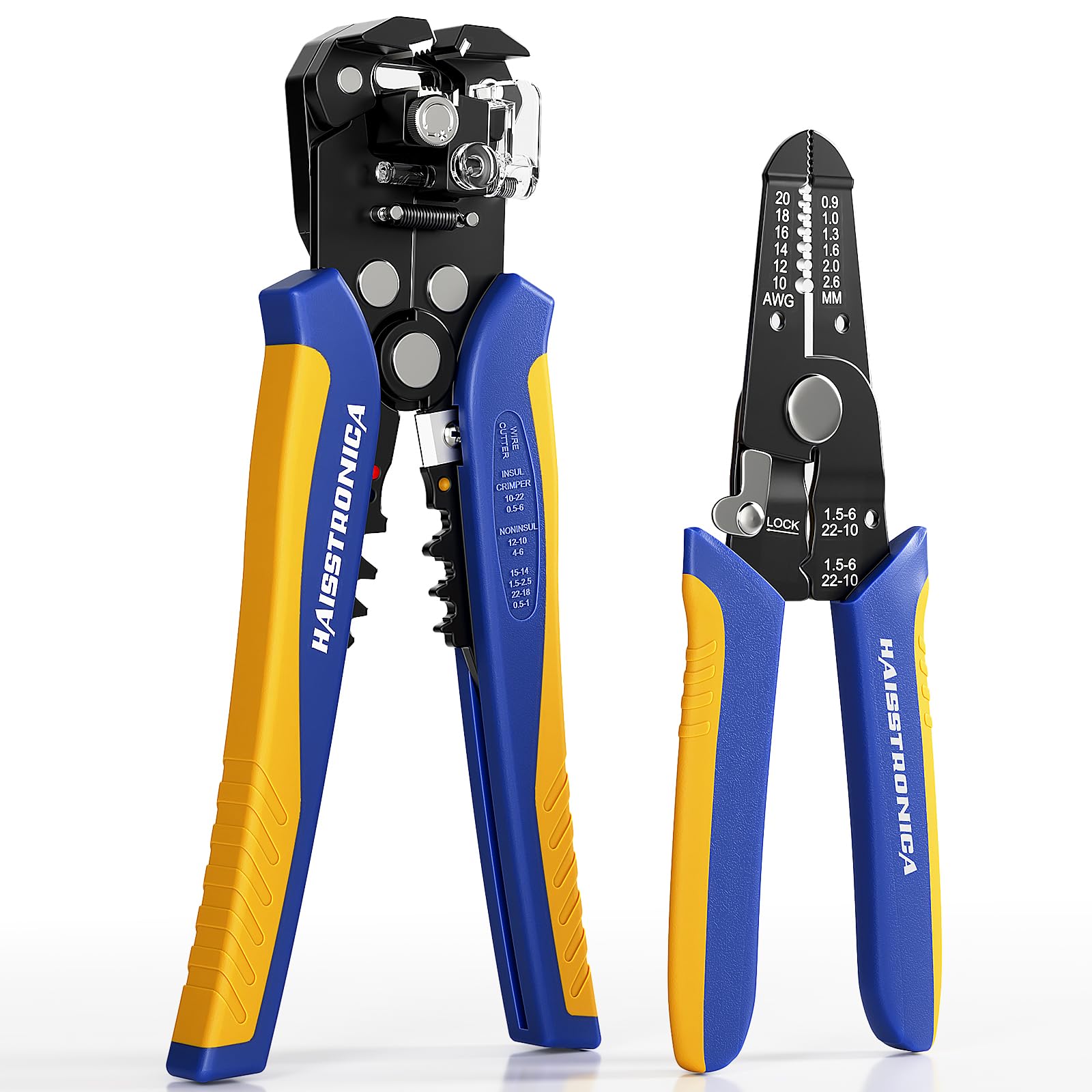
A two-tool approach — automatic for speed, manual for precision — in one package.
This set gives you both worlds: a self-adjusting stripper for 10-24 AWG you can whip through batch work with, and a manual stripper with fixed holes for 10-20 AWG when you need exact control on smaller electronics or ribbon cable. The automatic tool combines stripping, cutting, and crimping in one, so you do not have to switch tools for simple jobs. Owners say the quality feels solid for the price, and the non-slip rubber grips make a noticeable difference during repetitive work.
The manual stripper is the real extra — it handles multi-core and ribbon cable well, which the automatic tool is less ideal for. The automatic mechanism can be stiff from the start, but it loosens up after a few uses. It is a beginner-friendly set that also works for experienced DIYers who want the option of precision stripping without buying a second dedicated tool.
What this set does best: It removes the compromise between speed and control. Use the automatic for bulk wire, the manual for delicate ribbon or coaxial work.
Get this if… you work on both household wiring and electronics repair, and want one package that covers both without being overpriced.
Think twice if… you only strip one type of wire — you will use only one tool and the second will sit in the box.
5. WEICON Wire Stripper No. 6

The lightweight tool that is certified for work on live wires without the bulk.
This is the safety pick among automatic strippers. Fully insulated and individually VDE-tested to IEC 60900 standards, it is approved for work on live wires up to 1000 V — a feature very few tools in this category match. The self-adjusting system covers 24-10 AWG (0.2-6.0 mm²), and the fiberglass-reinforced housing and locking mechanism make it compact enough to store with confidence. Owners call it very light at 105 g — easy to keep in a pocket or tool pouch.
The cutting is consistently clean, and the ergonomic PVC handles provide a solid grip. Buyers report it works well even on 120 VAC hot wires in a pinch, though always follow proper safety rules. A few owners mention the plastic build feels less premium than metal tools, but that is the price for the electrical safety rating and the reduced weight. For electricians or maintenance techs working around live circuits, the certification alone makes it a smart choice.
The edge: The 1000 V VDE certification is rare in this price range — it is the tool you carry when safety compliance matters as much as speed.
For the electrician who… works on live panels or control cabinets and needs a tested, insulated tool that is quick to deploy.
Not for… heavy-gauge industrial cable — the 6 mm² limit means thicker wires will not fit.
6. WEICON TOOLS Wire Stripper No. 5 Pro
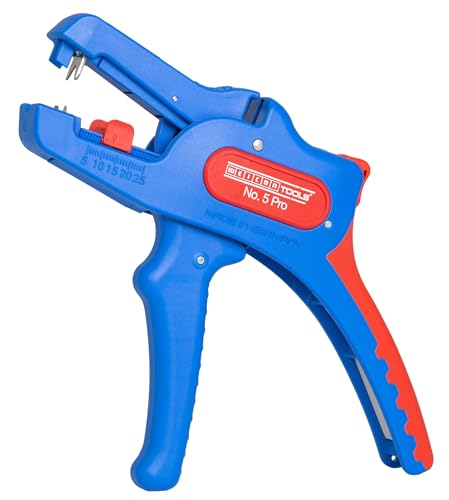
The German-engineered stripper that handles everything from fine wire up to 5 AWG cable.
This is the workhorse for cross-sections up to 16 mm² (that is 5 AWG), which covers thick industrial and battery cable. The self-adjusting mechanism is smooth-running with a wear-resistant design, and the integrated side cutter can handle flexible conductors up to 10 mm² and rigid ones up to 6 mm² — a powerful addition. The blades are made from high-quality knife steel from Solingen and are replaceable, extending the tool’s life significantly.
The ergonomic 2-K (two-component) handle is non-slip and designed for fatigue-free work. An adjustable length stop between 5-25 mm lets you set the strip length precisely for repeatable results. Owners describe it as “fast and efficient,” though a few note the locking mechanism does not always engage as expected. The TÜV-tested German quality and the sturdy plastic housing are reasons it commands a premium price. It is for someone who needs to strip large-gauge cable all day without the tool giving out.
Where it shines: The 5 AWG capacity beats every other hand-held stripper on this list — it is the only choice for heavy battery or inverter cable stripping.
Ideal for… industrial electricians, solar installers, and marine techs who work with thick conductors daily and need replaceable blades.
Overkill for… anyone who only strips 14-18 AWG wire — the Jokari or Klein will cover you for less.
7. Knipex Tools 12 64 180 Self-Adjusting Insulation Strippers
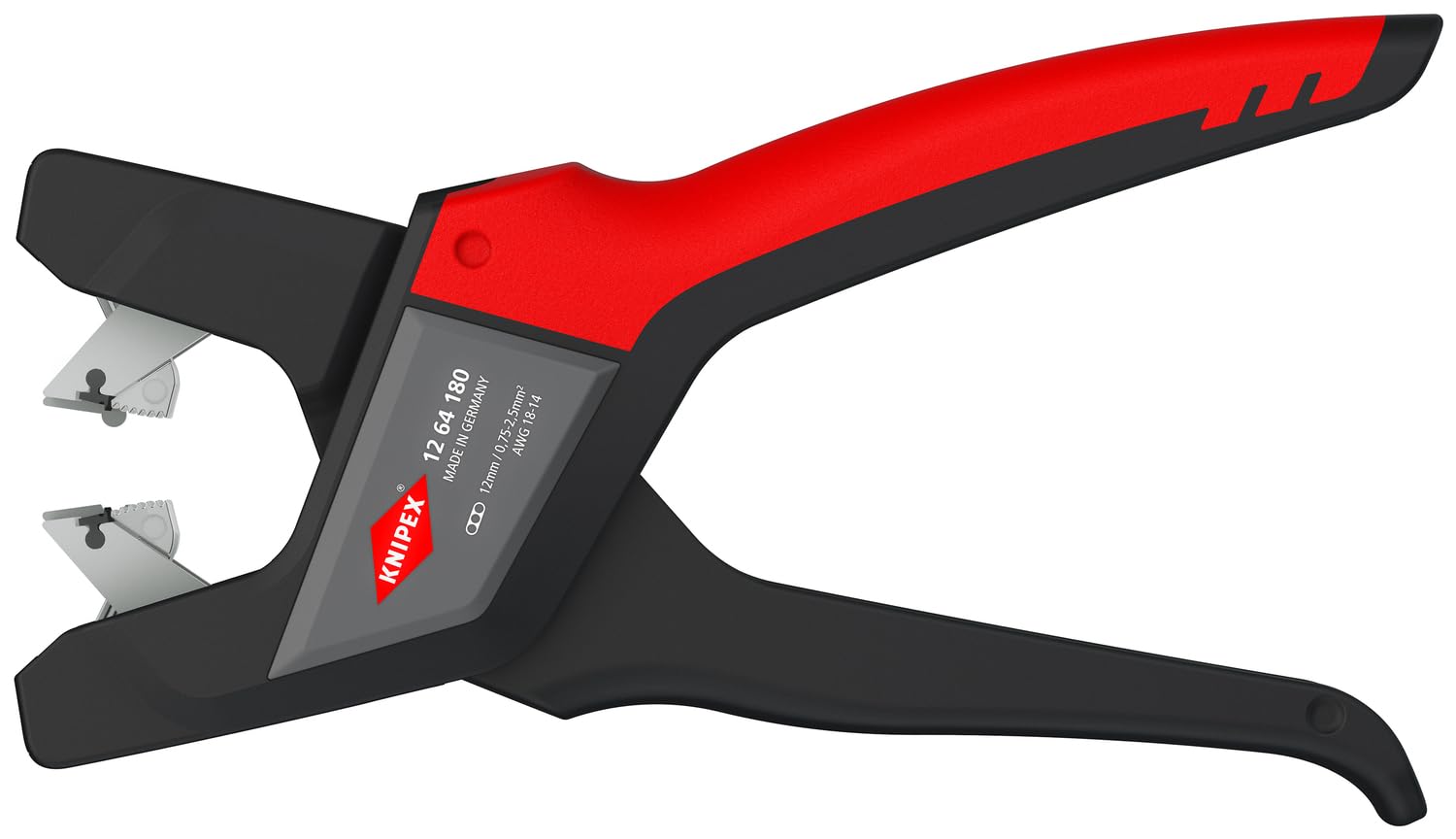
The lightweight, pocket-sized tool that survives workshop drops without a scratch.
Knipex has a reputation for tool-steel quality, and this model is a surprising featherweight at 4.32 ounces. It strips UF and flat cable from 10-18 AWG, using a front pull-through design that allows you to strip long runs of sheathing in a single motion — easier than rotating the tool around the cable. The body is fiberglass-reinforced plastic, which owners mention can survive 20 drops onto concrete while the tool keeps working perfectly.
It strips the outer sheath and the inner conductors in one pass, and a built-in wire looping hole handles conductors up to 12 AWG. The blade is oil-hardened special tool steel and is replaceable (part number 12 69 31). The trade-off is that it only strips ends, not mid-span — a few owners wish the side opened to strip long lengths for load centers. But for rapid, repetitive stripping on 14-10 AWG wire, owners call it a “major time saver” and a “great helper.”
Why it stands out: The durability-to-weight ratio is excellent — it is light enough to forget in your pocket, tough enough to thrive on a job site.
Grab it for… electricians and helpers who need a fast, reliable stripper for daily Romex work and want something that fits in a tool pouch without weighing it down.
Skip it for… stripping mid-span wire (getting insulation off a wire in the middle of a run, not the end).
8. VEVOR Electric Wire Stripping Machine 0.06″-0.98″ Automatic Wire Stripper

The benchtop workhorse that turns scrap copper recycling from a chore into a profit stream.
This is an entirely different category — a powered machine for volume stripping. The 60W gear motor feeds wire through one of 7 stripping channels (6 round, 1 flat) and strips the insulation in seconds. The blade is 65Mn spring steel, adjustable to fit wire diameters from 1.5 mm up to 25 mm. The clear acrylic panel lets you watch the process, and a pair of gloves is included for safety.
A cast iron body keeps it stable on a bench at 15.5 kg, so it does not wander during operation. Owners regularly say it “paid for itself” after a couple of recycling runs. The adjustment takes a little dialing-in for each wire type, but once set, it is fast and quiet enough that even a 9-year-old can run it. The trade-off is space — at 18.9 x 6.7 inches, it needs a permanent spot on the bench. But for anyone who regularly collects scrap copper wire, it is widely considered a fantastic time-saver.
Reality check: The VEVOR is not for occasional use. It is a recycling tool that earns its keep by stripping large volumes faster than any hand tool.
Perfect if… you are an electrician apprentice, recycler, or anyone with a steady stream of scrap wire — the machine handles the grunt work so you don’t have to.
Not for… hobbyists stripping a few wires here and there — the size and setup time are better suited to regular use.
9. StripMeister E250 Electric Automatic Wire Stripping Machine

The heavy-duty machine built with aircraft-grade aluminum for non-stop commercial recycling.
This is the top-tier powered stripper for serious scrap operations. The 1/4 HP DC motor with variable speed control handles wire diameters from 1/8 inch up to 3/4 inch, and the Ultra Grip Feeder Technology grips even twisted or mangled wires without jamming. The body is solid aircraft-grade aluminum with CNC-machined parts, so it is built to outlast many lighter machines. Owners upgrading from a drill-powered version call the E250 a huge leap in speed and ease — you set the depth, adjust the feed speed, and feed wire continuously.
A top-mounted blade depth reference knob makes quick adjustments easy, and the tool plugs into any standard 110V outlet. CSA and UL safety certification adds confidence. The honest feedback: it does not remove coating from wire in conduit (you have to pull that by hand), and you will want to buy extra blades. But buyers who scrap regularly say the E250 pays for itself quickly by making the stripping process fast enough to be profitable.
The final word: If recycling is your side hustle or your business, this machine turns hours of hand-stripping into a few minutes of feeding — the cost makes sense when volume is high.
Intended for… electricians, scrap metal recyclers, and junkers who process large amounts of copper wire regularly and want to boost their scrap yard payout.
Not for… small-batch recycling or occasional DIY — the investment is only worthwhile with a steady supply of wire.
Understanding the Specs
AWG Range
AWG (American Wire Gauge) is the standard for measuring wire thickness. The lower the number, the thicker the wire. A tool covering 10-24 AWG (like most hand-held strippers) handles common home wiring, automotive circuits, and electronics. If you need to strip heavy battery cable or industrial feeder wire, look for a stripper that goes down to 5 AWG or 6 mm² (like the WEICON No. 5 Pro) — no hand tool with a lower limit can handle those thick conductors without damaging them.
Self-Adjusting vs. Manual
A self-adjusting mechanism uses a spring-loaded jaw that conforms to the wire when you squeeze the handles. It cuts the insulation without nicking the copper and works across a range of gauges automatically. Manual strippers have fixed holes you match to the wire — they are more precise for small or delicate wires but slower when switching between sizes. A two-tool set (like the haisstronica) gives you both options, but for most people, a good self-adjusting tool is all you need.
VDE Safety Certification
VDE (Verband der Elektrotechnik) testing means the tool has been individually tested for insulation integrity at specified voltages. For a stripper rated to 1000 V, the plastic housing and handle are designed to prevent current from reaching your hand. This certification is essential for electricians who work on live circuits, but overkill for homeowners who always work with the power off. If you see “VDE-tested” on a tool, it has passed a specific standard for live-work safety.
Replaceable Blades
Blades dull over time, especially if you strip a lot of wire. A tool with replaceable blades (like the WEICON No. 5 Pro or the Knipex 12 64 180) can be refreshed instead of replaced, making it a better long-term investment. Blades are often made from high-carbon steel or tool steel, and some are oil-hardened for extra edge retention. If you plan to use the stripper heavily, confirm replacement blades are available before buying.
FAQ
Can an automatic wire stripper handle Romex cable?
What is the difference between AWG and mm² in wire stripper specs?
Will an automatic stripper damage stranded wire?
Can I use an automatic wire stripper on live circuits?
How do I clean and maintain automatic wire strippers?
What is the typical AWG range for a home-use automatic stripper?
Is a powered wire stripping machine better than a hand tool?
What does the adjustable length stopper do?
Can automatic wire strippers work on very thin wires (24-30 AWG)?
Final Thoughts: The Verdict
If you want one dependable pick, the best automatic wire stripping tool{“@context”: “https://schema.org”, “@graph”: [{“@type”: “ItemList”, “name”: “9 Best Automatic Wire Stripping Tool”, “url”: “https://gocarlife.com/best-automatic-wire-stripping-tool/”, “numberOfItems”: 9, “itemListElement”: [{“@type”: “ListItem”, “position”: 1, “name”: “Jokari 20050 Ergonomic Super 4 Plus Automatic Wire Stripper”, “url”: “https://gocarlife.com/best-automatic-wire-stripping-tool/#product-1”}, {“@type”: “ListItem”, “position”: 2, “name”: “Klein Tools 11061 Self-Adjusting Stripper / Cutter”, “url”: “https://gocarlife.com/best-automatic-wire-stripping-tool/#product-2”}, {“@type”: “ListItem”, “position”: 3, “name”: “Kuject Wire Stripper Crimping Tool for Heat Shrink Connectors”, “url”: “https://gocarlife.com/best-automatic-wire-stripping-tool/#product-3”}, {“@type”: “ListItem”, “position”: 4, “name”: “haisstronica Automatic and Manual Wire Stripper Set”, “url”: “https://gocarlife.com/best-automatic-wire-stripping-tool/#product-4”}, {“@type”: “ListItem”, “position”: 5, “name”: “WEICON Wire Stripper No. 6”, “url”: “https://gocarlife.com/best-automatic-wire-stripping-tool/#product-5”}, {“@type”: “ListItem”, “position”: 6, “name”: “WEICON TOOLS Wire Stripper No. 5 Pro”, “url”: “https://gocarlife.com/best-automatic-wire-stripping-tool/#product-6”}, {“@type”: “ListItem”, “position”: 7, “name”: “Knipex Tools 12 64 180 Self-Adjusting Insulation Strippers”, “url”: “https://gocarlife.com/best-automatic-wire-stripping-tool/#product-7”}, {“@type”: “ListItem”, “position”: 8, “name”: “VEVOR Electric Wire Stripping Machine 0.06\”-0.98\” Automatic Wire Stripper”, “url”: “https://gocarlife.com/best-automatic-wire-stripping-tool/#product-8”}, {“@type”: “ListItem”, “position”: 9, “name”: “StripMeister E250 Electric Automatic Wire Stripping Machine”, “url”: “https://gocarlife.com/best-automatic-wire-stripping-tool/#product-9”}]}, {“@type”: “Product”, “position”: 1, “name”: “Jokari 20050 Ergonomic Super 4 Plus Automatic Wire Stripper”, “image”: “https://m.media-amazon.com/images/I/31tPme0lGbL.jpg”, “brand”: {“@type”: “Brand”, “name”: “Jokari”}, “url”: “https://www.amazon.com/dp/B002BDNL4Q/?tag=gclmin-20”, “offers”: {“@type”: “Offer”, “url”: “https://www.amazon.com/dp/B002BDNL4Q/?tag=gclmin-20”}}, {“@type”: “Product”, “position”: 2, “name”: “Klein Tools 11061 Self-Adjusting Stripper / Cutter”, “image”: “https://m.media-amazon.com/images/I/71tbmRuoO7L.jpg”, “brand”: {“@type”: “Brand”, “name”: “Klein”}, “url”: “https://www.amazon.com/dp/B00CXKOEQ6/?tag=gclmin-20”, “offers”: {“@type”: “Offer”, “url”: “https://www.amazon.com/dp/B00CXKOEQ6/?tag=gclmin-20”}}, {“@type”: “Product”, “position”: 3, “name”: “Kuject Wire Stripper Crimping Tool for Heat Shrink Connectors”, “image”: “https://m.media-amazon.com/images/I/71VKZV+j+CL.jpg”, “brand”: {“@type”: “Brand”, “name”: “Kuject”}, “url”: “https://www.amazon.com/dp/B0FHK57GRC/?tag=gclmin-20”, “offers”: {“@type”: “Offer”, “url”: “https://www.amazon.com/dp/B0FHK57GRC/?tag=gclmin-20”}}, {“@type”: “Product”, “position”: 4, “name”: “haisstronica Automatic and Manual Wire Stripper Set”, “image”: “https://m.media-amazon.com/images/I/71R37W37h5L.jpg”, “brand”: {“@type”: “Brand”, “name”: “haisstronica”}, “url”: “https://www.amazon.com/dp/B0DY7GWVTN/?tag=gclmin-20”, “offers”: {“@type”: “Offer”, “url”: “https://www.amazon.com/dp/B0DY7GWVTN/?tag=gclmin-20”}}, {“@type”: “Product”, “position”: 5, “name”: “WEICON Wire Stripper No. 6”, “image”: “https://m.media-amazon.com/images/I/51GUES6naUL.jpg”, “brand”: {“@type”: “Brand”, “name”: “WEICON”}, “url”: “https://www.amazon.com/dp/B002KH2MPW/?tag=gclmin-20”, “offers”: {“@type”: “Offer”, “url”: “https://www.amazon.com/dp/B002KH2MPW/?tag=gclmin-20”}}, {“@type”: “Product”, “position”: 6, “name”: “WEICON TOOLS Wire Stripper No. 5 Pro”, “image”: “https://m.media-amazon.com/images/I/41yC+guYw0L.jpg”, “brand”: {“@type”: “Brand”, “name”: “WEICON”}, “url”: “https://www.amazon.com/dp/B0B6J1TSSS/?tag=gclmin-20”, “offers”: {“@type”: “Offer”, “url”: “https://www.amazon.com/dp/B0B6J1TSSS/?tag=gclmin-20”}}, {“@type”: “Product”, “position”: 7, “name”: “Knipex Tools 12 64 180 Self-Adjusting Insulation Strippers”, “image”: “https://m.media-amazon.com/images/I/51OpyQSwe1L.jpg”, “brand”: {“@type”: “Brand”, “name”: “Knipex”}, “url”: “https://www.amazon.com/dp/B0051YM6Z2/?tag=gclmin-20”, “offers”: {“@type”: “Offer”, “url”: “https://www.amazon.com/dp/B0051YM6Z2/?tag=gclmin-20”}}, {“@type”: “Product”, “position”: 8, “name”: “VEVOR Electric Wire Stripping Machine 0.06\”-0.98\” Automatic Wire Stripper”, “image”: “https://m.media-amazon.com/images/I/61fxqwh064L.jpg”, “brand”: {“@type”: “Brand”, “name”: “VEVOR”}, “url”: “https://www.amazon.com/dp/B0C26ZVQBN/?tag=gclmin-20”, “offers”: {“@type”: “Offer”, “url”: “https://www.amazon.com/dp/B0C26ZVQBN/?tag=gclmin-20”}}, {“@type”: “Product”, “position”: 9, “name”: “StripMeister E250 Electric Automatic Wire Stripping Machine”, “image”: “https://m.media-amazon.com/images/I/71VKuoLs2UL.jpg”, “brand”: {“@type”: “Brand”, “name”: “StripMeister”}, “url”: “https://www.amazon.com/dp/B074KNPSYP/?tag=gclmin-20”, “offers”: {“@type”: “Offer”, “url”: “https://www.amazon.com/dp/B074KNPSYP/?tag=gclmin-20”}}, {“@type”: “FAQPage”, “mainEntity”: [{“@type”: “Question”, “name”: “Can an automatic wire stripper handle Romex cable?”, “acceptedAnswer”: {“@type”: “Answer”, “text”: “Yes, many self-adjusting strippers (like the Klein Tools 11061 and the WEICON No. 6) strip both the outer sheath of 12/2 and 14/2 Romex and the individual inner conductors. The Klein 11061 is specifically listed to handle Romex 12/2 and 14/3. Always check the product specs for \”nonmetallic sheathed cable\” compatibility.”}}, {“@type”: “Question”, “name”: “What is the difference between AWG and mm² in wire stripper specs?”, “acceptedAnswer”: {“@type”: “Answer”, “text”: “Both are units of wire cross-sectional area. AWG (American Wire Gauge) is used in North America. mm² (square millimeter) is the metric standard. A tool spec showing \”0.2-6.0 mm²\” covers roughly 24 AWG down to 10 AWG. When comparing tools, look for the unit you are familiar with — many European brands like WEICON and Jokari use mm² alongside AWG equivalents.”}}, {“@type”: “Question”, “name”: “Will an automatic stripper damage stranded wire?”, “acceptedAnswer”: {“@type”: “Answer”, “text”: “A quality self-adjusting tool should not damage stranded wire because the mechanism sizes itself to the conductor’s outer diameter. The knife pressure is calibrated so it cuts the insulation without digging into the individual strands. The Klein 11061, for instance, is rated for 12-22 AWG stranded wire and owners confirm it strips cleanly without nicking the strands.”}}, {“@type”: “Question”, “name”: “Can I use an automatic wire stripper on live circuits?”, “acceptedAnswer”: {“@type”: “Answer”, “text”: “Only if the tool is explicitly VDE-tested and rated for live work. The WEICON No. 6 is tested to 1000 V and is insulated for that purpose. Most other strippers on this list are not certified for live-wire use. Always follow local safety regulations — do not rely on a tool’s plastic handle alone as insulation.”}}, {“@type”: “Question”, “name”: “How do I clean and maintain automatic wire strippers?”, “acceptedAnswer”: {“@type”: “Answer”, “text”: “Wipe the blades and jaws with a dry cloth after use to remove insulation residue. Lubricate the pivot joint occasionally with a light machine oil. For models with replaceable blades, replace them when the cut feels dull or starts leaving insulation behind. Storing the tool with the locking mechanism engaged prevents the spring from deforming.”}}, {“@type”: “Question”, “name”: “What is the typical AWG range for a home-use automatic stripper?”, “acceptedAnswer”: {“@type”: “Answer”, “text”: “Most good automatic strippers cover 10-24 AWG or 10-22 AWG. This range includes common household wire sizes: 14 AWG for lighting circuits, 12 AWG for outlets, 18-22 AWG for thermostats and doorbells, and 10 AWG for larger appliances like water heaters. That covers virtually all common DIY and electrical maintenance tasks.”}}, {“@type”: “Question”, “name”: “Is a powered wire stripping machine better than a hand tool?”, “acceptedAnswer”: {“@type”: “Answer”, “text”: “It depends on volume. A hand-held automatic stripper is faster than manual tools and ideal for occasional use up to a few dozen wires a day. A powered machine (like the VEVOR or StripMeister E250) is much faster for large volumes of scrap wire recycling, but it takes up bench space and requires setup. For most homeowners and electricians, a good hand tool is sufficient.”}}, {“@type”: “Question”, “name”: “What does the adjustable length stopper do?”, “acceptedAnswer”: {“@type”: “Answer”, “text”: “The length stopper is a physical stop on the tool that controls how much insulation is stripped off. You slide it to a set distance (e.g., 10 mm or 5-25 mm on the WEICON No. 5 Pro), and every wire you strip will have exactly the same amount of exposed copper. This is very useful when preparing multiple wires for a terminal strip or connector block where consistent strip length matters.”}}, {“@type”: “Question”, “name”: “Can automatic wire strippers work on very thin wires (24-30 AWG)?”, “acceptedAnswer”: {“@type”: “Answer”, “text”: “Some models handle 24 AWG (which is common in data cables and small electronics), but 30 AWG is generally too fine for self-adjusting mechanisms. For ultra-thin magnet wire or 30 AWG, a manual stripper with a fixed, small-diameter hole or a specialized thermal stripper is better. The Jokari 20050 works down to 0.2 mm, which is roughly 24 AWG, but not below that.”}}]}]}