
Our readers keep the lights on and the garage heater humming. As an Amazon Associate, I earn from qualifying purchases.
Specs are compiled from manufacturer listings and verified buyer reviews and can change over time — please confirm the key details on the product page before buying.
Wiring a trailer, running new circuits in a panel, or fixing a lamp — you reach for one tool more than any other: the combo that strips, cuts, and crimps without making you swap pliers. Most tools target either electricians handling heavy house wire or hobbyists working with tiny electronics. That mismatch turns a quick job into a frustrating search for the right jaw.
I’m Mo Maruf — the founder and writer behind GoCarLife. This guide is built by comparing the manufacturers’ published specifications and the patterns across verified customer reviews, so you get each pick’s real strengths and trade-offs instead of marketing spin.
After looking at what over 2,000 buyers report about their experiences, these wire stripping and crimping tools actually solve the real-world problem of making a secure connection without mangling the wire first — wire stripping and crimping tool choices that earn their place in your toolbox.
Our Picks at a Glance

How To Choose The Best Wire Stripping and Crimping Tool
The first thing to realize is that “wire stripping and crimping tool” covers a wide range of designs — from a simple plier-style combo that handles basic automotive connectors to a full ferrule kit (a ferrule is a small metal sleeve that goes on stranded wire before a terminal block) with a ratchet mechanism for control panel wiring. You need to match the tool to the wire gauge you handle most and the connector type you use.
Gauge Range Is Your Starting Point
The biggest mistake beginners make is buying a tool that only covers 12-20 AWG, then trying to crimp a tiny 22 AWG wire. Look at the AWG range printed on the tool — the wider that range, the fewer tools you will need overall. For standard household and automotive work, 10-22 AWG is a practical balance because it covers speaker wire, thermostat cable, and most trailer wiring.
Manual vs Self-Adjusting: Two Very Different Rhythms
A self-adjusting (automatic) stripper saves time when stripping dozens of wires of different gauges — just squeeze, and it finds the right depth. For fine electronic work or ribbon cable, a manual stripper with fixed holes gives you more control over cut depth and avoids nicking the conductor. Some kits include both, letting you switch between speed and precision as needed.
Angle, Leverage, and the Crimp Itself
An angled head (90-degree or offset) makes a massive difference in tight spots like a junction box or under a car dashboard — you can push straight onto the connector without your knuckles hitting metal. For leverage, a longer handle (9.5 inches vs 7 inches) gives you a stronger crimp with less hand force. And if you work with ferrules, a ratchet-action crimper (which locks and won’t release until fully compressed) is non-negotiable — it won’t release until the crimp is fully compressed, which means every connection is consistent.
Quick Comparison
| Model | Best For | Wire Gauge | Tool Length | Key Feature | Amazon |
|---|---|---|---|---|---|
| OTC 5950A CrimPro Angled★ Best Overall | Tight-space crimping | 12-20 AWG | 7 in | Angled head | Amazon |
| haisstronica Auto + Manual SetBest Value | Versatile wiring prep | 10-24 AWG | Varies | 2 strippers in one set | Amazon |
| Klein Tools 1001 | All-around electrician | 8-22 AWG | 8.5 in | Made in USA | Amazon |
| KATA Wiring Kit | Budget-friendly combo | 10-22 AWG | 9.5 in (crimper) | Long handle leverage | Amazon |
| Knipex 97 22 240 | Precision crimps | Ins + Non-ins | — | German build quality | Amazon |
| OTC 5950S Straight | Auto electrical work | 12-20 AWG | 7 in | Snap-On alternative | Amazon |
| haisstronica Ferrule Kit | Ferrule / panel wiring | AWG 23-7 | Varies | 2500pc ferrule set | Amazon |
In‑Depth Reviews
1. OTC 5950A CrimPro 4-in-1 Angled Wire Service Tool
Our pick — over 4.5★ from 800+ verified ratings; the strongest balance of quality and price.
The angled plier that finally lets you crimp without scraping your knuckles on metal.
The defining reason this OTC sits at the top is the 90-degree offset head — it changes the entire physics of reaching into a confined space like a car’s fuse box or an under-sink junction. Instead of you having to angle your whole wrist, the tool itself delivers the crimp at a right angle. It strips 12-20 AWG (American Wire Gauge) wire cleanly, so you can handle common automotive and household wiring. It crimps insulated and non-insulated connectors, and the gripping nose also pulls, twists, and bends wire so you don’t grab a second tool. The pivot bolt is the only durability concern some owners mention — a fair caveat for a tool that sees daily commercial abuse. But for the vast majority of home and shop use, this is the most versatile single tool on the list.
Buyers consistently highlight that the crimps come out well-formed even in spots where a straight Klein is impossible to fit. The crowd favorite verdict calls it a “nice pliers for when you need a 90-degree crimp because of limited room.”
What Wins People Over
- Angled head gives you access straight dash works and tight corners that straight pliers cannot reach — a real advantage over the OTC 5950S straight-jaw version
- Crimps 12-20 AWG insulated and non-insulated wire with consistent, solid connections
- Compact 7-inch body slips into a tool pouch without taking up valuable space
The Honest Trade-Off
- A handful of owners mention the pivot bolt snapping under heavy repetitive use — treat it as a shop tool, not a jackhammer
Reach for this if: your wiring work is mostly in vehicles, appliances, or tight enclosures where a straight tool leaves no room for your hands.
Look elsewhere if: you need to strip wires as small as 22 AWG on a regular basis — this tool’s floor is 12 AWG.
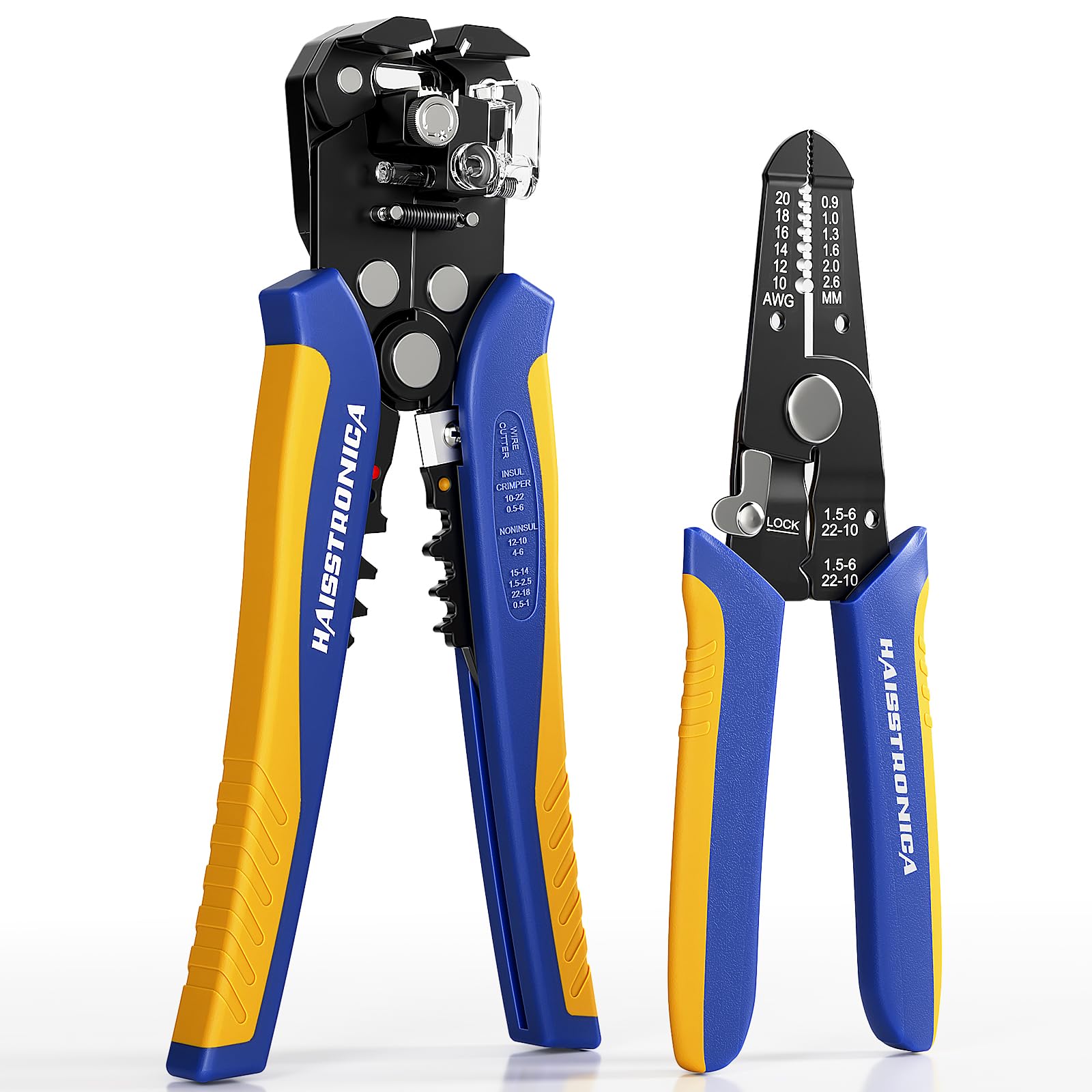
2. haisstronica Automatic and Manual Wire Stripper Set
Two strippers in one pack — one for speed, one for precision — at a price that makes the decision easy.
What makes this set different from a single-tool purchase is that you get both an automatic self-adjusting stripper (for 10-24 AWG wire) and a manual stripper with fixed stripping holes (for 10-20 AWG). The automatic one is the star for high-volume work: you just squeeze, and it strips, cuts, and even crimps without fiddling with dials or settings. The manual one steps in when you need to control the exact depth on a delicate wire or ribbon cable. Each tool has ergonomic non-slip rubber handles, so the grip stays secure even when your hands are somewhat greasy.
Owners of this set describe the automatic stripper as “magic” — it handles solid, stranded, and multi-core wire with the same easy squeeze. The quality is a common thread: well-made, very easy to use, and reliable for the price.
The Case For It
- Self-adjusting jaw handles 10-24 AWG without you needing to eyeball the gauge — just clamp and pull
- Includes a manual stripper for detail work like electronics repair where you want fixed-depth holes
- Non-slip grip makes one-handed stripping in tight spots much more controlled
The Catch
- The automatic mechanism can feel stiff from the start — it needs a few cycles to loosen up
Best as a starter or backup kit: if you do a mix of home wiring, automotive, and hobby work, having both styles in one box saves you a separate trip.
skip it if: you are a professional electrician who works exclusively with heavy-gauge (8 AWG and thicker) wire — the auto stripper tops out at 10 AWG.
3. Klein Tools 1001 Multi Tool — Made in USA

The American-made classic that handles a wider gauge span — from thick 8 AWG down to fine 22 AWG — than almost anything else here.
This Klein covers 8-22 AWG solid wire (10-26 AWG stranded), which is 50% more gap at the low end compared to the OTC’s 12-20 AWG range. That means you can strip a heavy 8 AWG battery cable and then turn around and crimp a 22 AWG thermostat wire without switching tools. The tool includes two cutters — one at the tip and one farther back — and it can shear bolts in common sizes like 4-40, 10-24, 10-32, 8-32, and 6-32, which is a bonus for panel work. The pivot nut is adjustable, so you can dial in the tension as the tool ages.
Customers note that the crimps on 22-18 gauge connectors are “extremely secure (hard to pull apart).” The consensus is that it outperforms more expensive forged Klein models at twice the price. The only real limit is that the leverage for cutting heavy screws like 10-24 and 10-32 is not the strongest, so take those cuts one at a time.
Why It’s a Favorite
- Widest gauge range on this list (8-22 AWG solid, 10-26 AWG stranded) — one tool for thick battery cable and fine signal wire
- Shears common machine screws (4-40, 10-24, 10-32, 8-32, 6-32) without needing a separate bolt cutter
- Made in USA with a lifetime warranty on material defects and workmanship
On the Flip Side
- The bolt-cutting leverage is limited — expect a few squeezes for larger sizes like 10-24 rather than a single clean snip
Grab this for: a single-tool solution that covers big-gauge battery cables and small control wires without compromise.
Think twice if: you crimp all day on deep assembly lines — the cushioned handles are comfortable, but a dedicated ratchet crimper might be faster for volume.
4. KATA Wire Crimper and Automatic Wire Stripper Tool Set
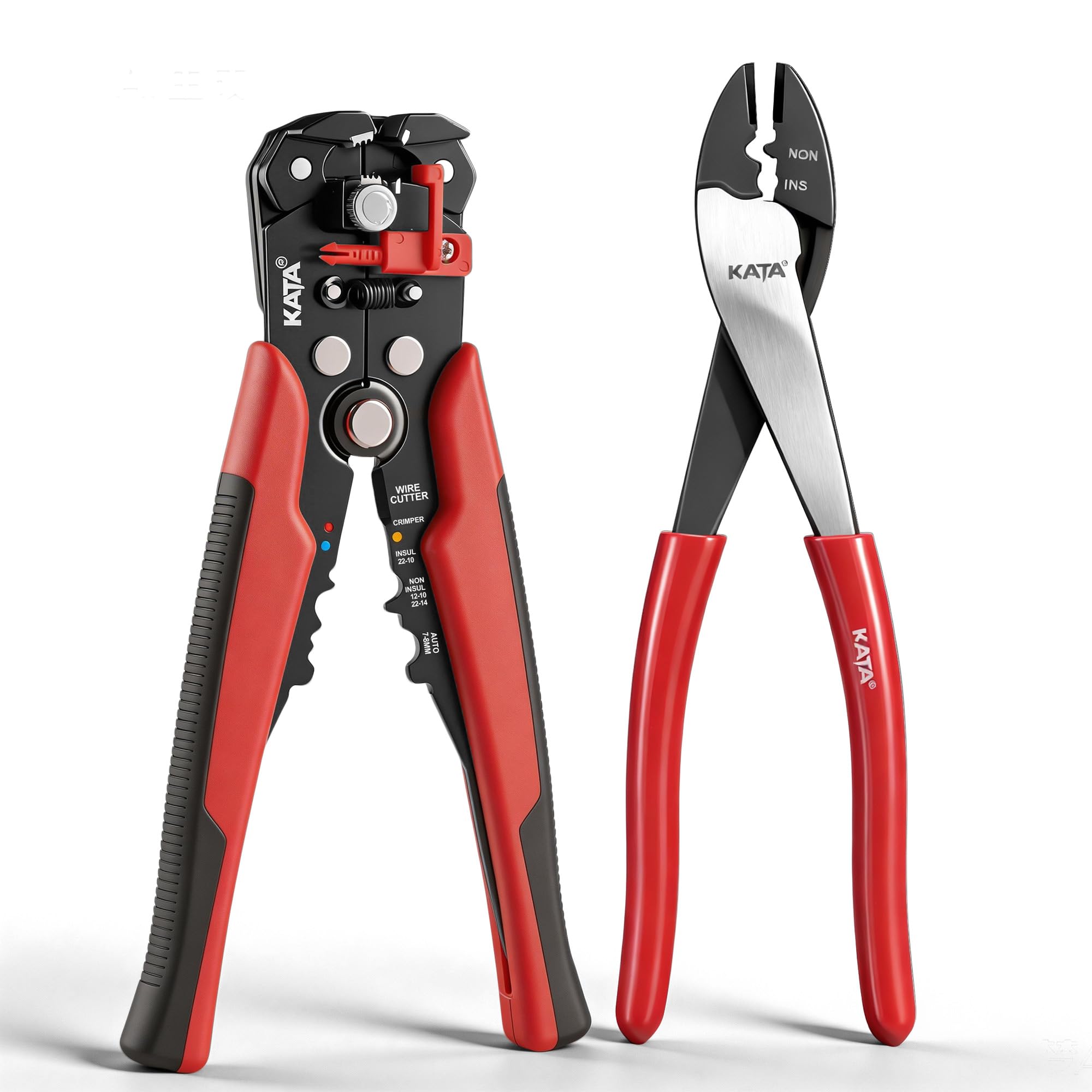
A two-tool kit that gives you a long-handle crimper for leverage and an automatic stripper for speed.
This KATA set separates the jobs: the automatic stripper handles 10-24 AWG insulation removal quickly, while the 9.5-inch crimping pliers deliver the extra leverage that a shorter 7-inch tool cannot match for firm terminal connections. The crimper is designed for 10-22 AWG insulated and non-insulated terminals, and its longer handle means you use less hand force to get a solid crimp — a real advantage if you are doing a batch of connectors. The set is ideal for automotive wiring, trailer repair, low-voltage LED work, and basic home electrical jobs.
The build quality impresses most owners — the automatic stripper is a significant step up from the old hole-in-pliers style. One practical note from buyers: the non-insulated crimp slot produces strong, permanent connections, while the insulated slot requires a full squeeze to avoid a weak hold.
What Stands Out
- 9.5-inch crimper handle gives you noticeably more mechanical advantage than compact 7-inch tools
- Two-tool set means you do not compromise — an automatic stripper for speed and a dedicated crimper for leverage
- Suitable range (10-22 AWG) covers common automotive and household wire sizes
The Honest Caveat
- Some owners note the metal is not premium grade and the cutter could be sharper — treat it as a capable budget-friendly kit rather than a pro-grade daily driver
Ideal for: a homeowner or weekend mechanic who wants the leverage of a long-handle crimper without paying for a premium brand.
Not for: daily professional use in a busy shop — the build quality is adequate, not industrial-duty.
5. Knipex Tools 97 22 240 Crimping Pliers

Knipex brings its legendary German stamping to a crimper that owners say they will pass to their grandchildren.
Knipex uses special-steel construction with a 4-millimeter-thick metal arm and a beefy split screw that keeps the jaws aligned crimp after crimp. It crimps insulated and non-insulated terminals, cuts cable, strips wire, and includes threaded holes for cutting copper and brass screws. The five screw cutters in the tool preserve the threads on the screw — a detail that matters when you are working on a panel where re-threading is a hassle. The ergonomic plastic grips reduce hand fatigue over a long session.
Reviewers point out that this tool produces “good quality, makes good crimps” — especially with heat-shrink connectors, where not a single crimp has failed in regular use. The quality is so consistent that one owner sums it up by saying “nothing better than Knipex.” The trade-off is that the tool is heavier than other 8-10 inch crimper/stripper combos, and the markings are not in English, though the function is intuitive.
The Knipex Advantage
- Special steel construction with 4 mm thick metal gives exceptional durability and jaw alignment
- Five screw cutters that preserve the thread on the screw — a rare feature for a crimper
- Owners consistently report zero failed crimps, even with sensitive heat-shrink connectors
The Fine Print
- Heavier than comparable crimper/stripper combos — you feel the weight in the hand during extended overhead work
- No English markings on the tool, so you need to know the gauges by sight or keep a reference handy
Buy it for: the absolute reliability of a Knipex that delivers connection consistency and will outlast cheaper tools by years.
Pass if: weight is a dealbreaker in your daily carry pouch — the 270 grams feels solid but not featherlight.
6. OTC 5950S CrimPro 4-in-1 Wire Service Tool
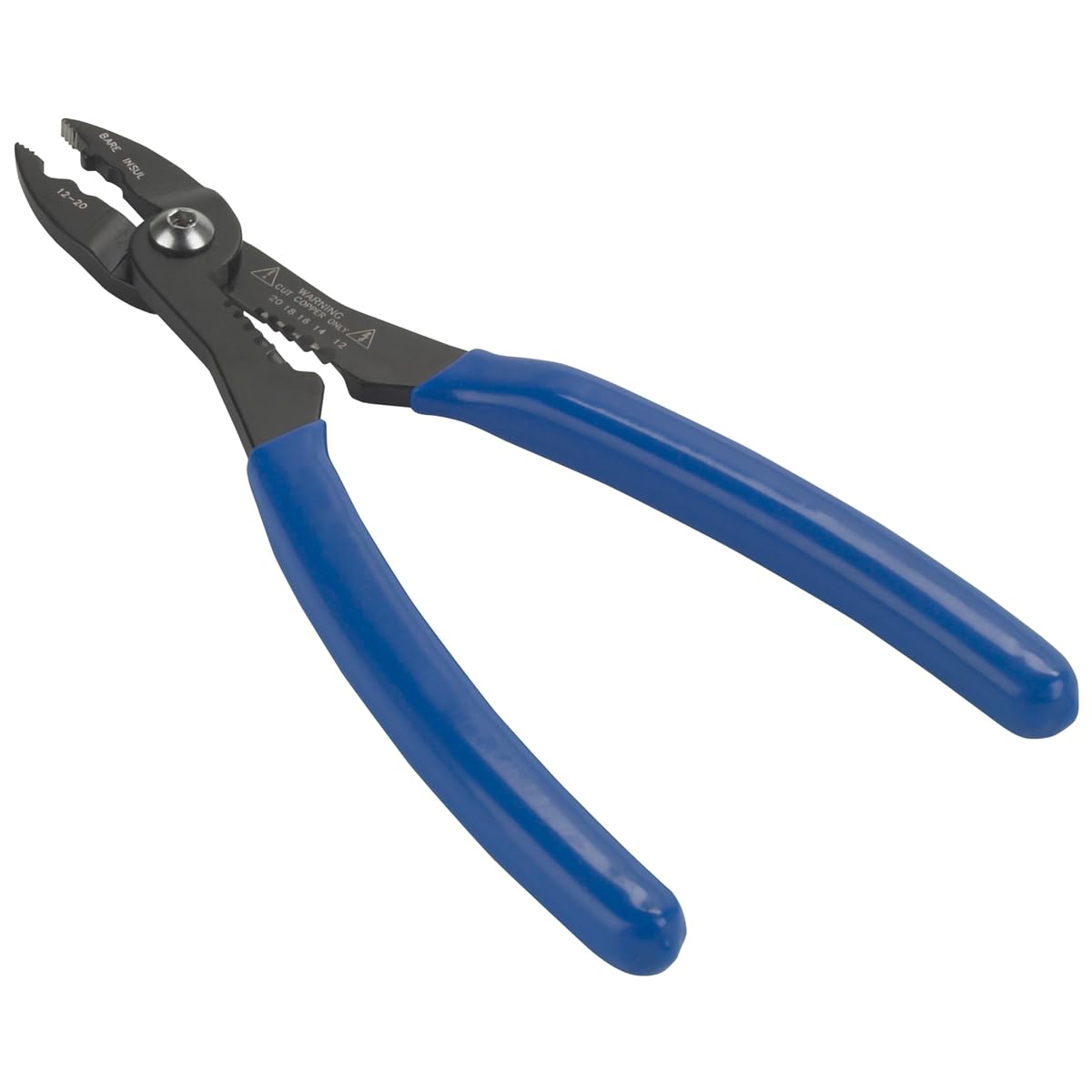
The straight-head version of OTC’s 4-in-1 that owners routinely compare to Snap-On at a fraction of the cost.
This is the straight-jaw sibling of the angled 5950A, and it serves a different buyer. If your work is mostly at a workbench or in an open bay where you don’t need the offset, the straight head gives you a more traditional feel while still packing the same 12-20 AWG crimper, stripper jaws, and a cutter that works above and below the pivot. The narrower head profile (compared to the Snap-On equivalent) actually gives you better visibility of the crimp as it closes. It pulls, twists, bends, and shapes wire through the gripping nose, so it really is a four-function tool in one body.
Buyers who have used both this and Snap-On side by side report that the only difference is that the wire cutter sits on the opposite side — the feel, the crimp quality, and the build are the same. It has been used for years in some shops and still holds up well. The compact 7-inch size is a point of mixed opinion: some find it perfect for a pocket, others wish it were a touch longer for more leverage.
Why It’s a Favorite
- Comparable quality to Snap-On at a much lower entry price — “feels and works the same” per owners
- Narrower head than the premium competition makes it easier to see what you are crimping
- Versatility: crimps, strips, cuts, and grips without changing tools
Consider This
- The compact size is a dividing line — some owners wish the handle were longer for more mechanical advantage on tight connectors
Get it for: a workbench or toolbox where you want the quality of a premium tool without the premium price tag.
pass on it if: all your wiring is in tight, angled enclosures — go for the angled 5950A instead.
7. haisstronica 2500PCS Ferrule Crimping Tool Kit
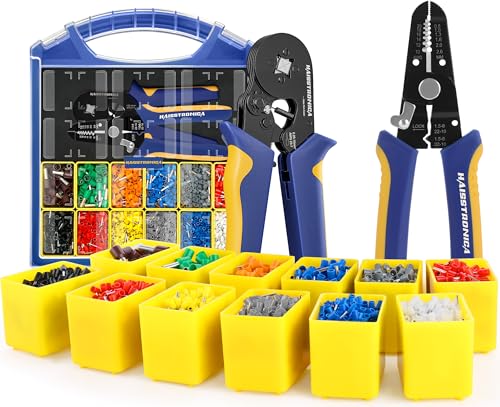
The full ferrule ecosystem — a ratchet crimper, precision stripper, and 2500 terminals in one case — for anyone who works on control panels.
This is the only entry on the list built specifically for ferrules (the little tinned-copper sleeves that prevent stranded wire from fraying in a terminal block). It includes a ratchet-style crimping tool that covers AWG 23-7 with a full-cycle mechanism — meaning it does not release until the crimp is fully compressed, so every connection is identical and secure. The precision stripper handles AWG 20-10 wire, and the kit comes with 12 different ferrule terminal sizes totaling 2500 pieces, stored in a durable carrying case that keeps everything organized. This is the set for industrial maintenance, control panel wiring, or any application where ferrules are the standard.
Owners confirm that both the stripping and crimping tools are solidly built. The ratchet mechanism works well with both collared and collarless ferrules. One buyer who uses it for PowerPole connectors on 18-gauge wire says the case keeps the entire set together so nothing gets lost. The only noted caution is that the ferrules are not color-coded to size, so you need to double-check the gauge before crimping.
What Makes It Special
- Ratchet-action crimper guarantees full compression before release — no guesswork, no weak connections
- 2500 ferrules in 12 sizes (AWG 23-7) means you have the right terminal for almost any wire gauge on hand
- Durable storage case keeps the crimper, stripper, and all 2500 terminals organized in one box
The Small Frustration
- The ferrules are not marked by color per size — you will need to either memorize the sizing or keep a gauge reference nearby
Reach for this if: you do any kind of terminal block or DIN-rail wiring where ferrules are required — this is a complete solution, not a partial kit.
it’s not for you if: you only crimp standard ring and spade connectors — the ratchet mechanism is overkill for basic automotive work.
Understanding the Specs
AWG Range (American Wire Gauge)
This is the most important number on the tool. AWG works backward — a smaller number means a thicker wire. 8 AWG is a heavy battery cable; 22 AWG is a thin thermostat or signal wire. A tool that covers 8-22 AWG (like the Klein) handles everything from thick power circuits to delicate sensors. A tool that only covers 12-20 AWG (like the OTC) is more focused on automotive and household wiring, but it will not work on the thickest battery cables or the thinnest control wires.
Ratchet vs Manual Crimp
A manual crimper works like a plier: you squeeze until it feels tight, and you release. A ratchet crimper locks the jaws in place and will not open until the crimp handle has traveled the full cycle, forcing you to complete a full compression. Ratchet crimpers are standard for ferrules and for any connection where consistency matters, because every crimp gets exactly the same force. Manual crimpers are faster and perfectly fine for non-critical connections like trailer lights or lamp rewires.
FAQ
Can one tool strip and crimp all wire sizes?
What is the difference between insulated and non-insulated crimp dies?
Why does my crimp sometimes feel loose?
How does a self-adjusting wire stripper work?
What does “full-cycle ratchet” mean?
Can I cut hardened wire or screws with a crimper?
What is a ferrule and when do I need one?
How do I maintain my crimping tool?
Is a longer handle always better for crimping?
Can I use these tools for live electrical work?
Final Thoughts: The Verdict
The wire stripping and crimping tool that fits most people best is the OTC 5950A CrimPro 4-in-1 Angled — its angled head turns every tight-space struggle into a clean crimp, and the depth of positive owner feedback backs that up solidly. If you prefer a wider gauge range that covers both heavy battery cables and small signal wires, the Klein Tools 1001 is the classic all-arounder. And for anyone doing control-panel work with ferrules, the haisstronica 2500PCS Ferrule Kit gives you the whole system in one box — tool, stripper, and 2500 terminals ready to go.
How We Picked
We do not accept paid placement. Every pick is matched to a real buyer and a real use-case; we do not hands-on test units.
Sources & Methodology
Specifications: manufacturer listings and product documentation. Review insights: verified customer reviews, as of July 2026. Pricing: not shown on this page (it changes often); check the current price via the retailer link.
As an Amazon Associate, GoCarLife earns from qualifying purchases. This does not affect which products we feature.