
Our readers keep the lights on and the garage heater humming. As an Amazon Associate, I earn from qualifying purchases.
Specs are compiled from manufacturer listings and verified buyer reviews and can change over time — please confirm the key details on the product page before buying.
You need to remove a single wire pin from a connector without destroying the connector, the wire, or the waterproof seal. A dedicated depinning tool (a small metal probe that releases the metal tab locking the terminal inside the plastic housing) does this cleanly. The wrong tool, like a screwdriver, can crack the plastic housing, forcing you to replace the entire harness.
A wire pin removal tool saves you the cost and time of replacing a damaged connector or visiting a shop. This guide compares the published specs and verified buyer feedback across nine popular kits. Each pick’s real strengths and trade-offs are laid out plainly — no marketing spin.
Matching a depinning tool to your exact connector family (like Weather Pack or Deutsch) and wire gauge (AWG) is what determines success.
Our Picks at a Glance


How To Choose The Best Wire Pin Removal Tool
A wire pin removal tool (also called a depinning tool or pin extractor) is a small metal probe that slides over or alongside a wire terminal (the metal end of a wire) inside a plastic connector housing. Its job is to press down the metal barb or locking tab that holds the terminal in place so you can pull the wire out cleanly.
Connector Family Compatibility
The most important factor is which connector family you use. Weather Pack, Metri-Pack, Deutsch DT/DTM/DTP, AMP Superseal, and Molex connectors all have different terminal shapes and barb positions. A tool designed for Metri-Pack 280 terminals will not fit a Deutsch size 20 contact. A versatile kit that covers several families saves you from buying a separate tool for each job.
Gauge Range & Contact Size
Tools work with a specific wire gauge range (AWG, American Wire Gauge — a standard for wire thickness) or contact size (like 16-20). Using a tool that is too thick can spread the connector cavity, while one that is too thin will not reach or depress the barb. Match the tool’s listed gauge to the wires you work on most often.
Build Quality and Handle Design
Stainless steel tips resist bending and rust, while aluminum or high-durability plastic handles give you better grip and control than bare steel. A knurled (textured) or ergonomic handle reduces hand fatigue when you remove many pins in one session.
Kit Size vs. Single Tool
Larger kits offer more size variety but may include duplicates and sometimes sacrifice tip quality to keep the cost low. A single-brand, dedicated tool for your main connector type usually gives a better fit and longer life than a budget multi-pack.
Quick Comparison
| Model | Best For | Connector Families | Pieces | Handle Material | Amazon |
|---|---|---|---|---|---|
| JRready ST5211★ Best Overall | Weather Pack & Metri-Pack | Weather Pack, Metri-Pack, AMP Superseal | 4 | Aluminum | Amazon |
| 30+4P Anglekai KitVersatile Starter | Budget versatility | Universal (most connectors) | 34 | Plastic | Amazon |
| Jonard Tools R-5926Precision Single-Tool | AMP CPC pins (16-20) | AMP CPC (contact sizes 16-20) | 1 | Plastic | Amazon |
| Kikerike 172-Piece Kit | Large variety on a budget | Universal (most connectors) | 172 | Stainless steel | Amazon |
| iCrimp Deutsch DT | Deutsch solid contacts | Deutsch DT | 3 | Aluminum | Amazon |
| JRready ST5231 | Deutsch DT/DTM/DTP | Deutsch DT, DTM, DTP | 4 | Aluminum | Amazon |
| EWK 12-Piece Set | GM & Ford applications | Weather Pack, Pack-Con, Ford | 12 | Metal | Amazon |
| 26PCS XiTuanYuan Kit | Broad compatibility | Universal automotive | 26 | Titanium steel | Amazon |
| Lisle 57750 | GM & Ford daily use | Pack-Con, Weather-Pack, Ford | 5 | Metal | Amazon |
In‑Depth Reviews
1. JRready ST5211 Pin Removal Tool KIT
Our pick — over 4.5★ from 650+ verified ratings; the strongest balance of quality and price.
Four aluminum-bodied extractors that cover the most common automotive connector families.
The ST5211 kit comes with four tools, each made for a specific terminal profile: one for Weather Pack terminals (16-18 AWG), one for Metri-Pack 150/280, one for Metri-Pack 480/630 and 56 Series, and one for AMP Superseal 1.5mm. You do not guess at sizes. Buyers report the machined aluminum handles and stainless steel shafts feel much more substantial than budget all-plastic picks. The carrying case keeps the four tools organized, so you are not digging through a bag of loose probes. Reviewers report replacing three Weather Pack connectors without cutting a single cable — the tool slides in, depresses the barb (the locking tab), and the wire comes out free. It also works on Holley connectors.
The trade-off is that some users report a tool breaking on the first use if forced into a mismatched connector. Treat it as a precision tool — never pry or twist hard. Thanks to the steel shafts and aluminum handles, it is sharper and more durable than the 30+4P Anglekai kit for its specific connector families.
Precision-matched set: The four tools cover Weather Pack, Metri-Pack 150/280, Metri-Pack 480/630/800, and AMP Superseal 1.5mm terminals — no guesswork, no wrong-size fumbling.
The right choice if: you regularly work on GM or automotive Weather Pack and Metri-Pack connectors and want dedicated tools that fit each terminal type exactly.
Hold up if: you need universal tools that will work on Deutsch connectors — this set is specifically designed for Weather Pack/Metri-Pack/AMP Superseal, not Deutsch contacts.
2. 30+4P Terminal Pin Removal Tool Kit
Thirty depinning tools plus casing tools for under twenty bucks — versatility first.
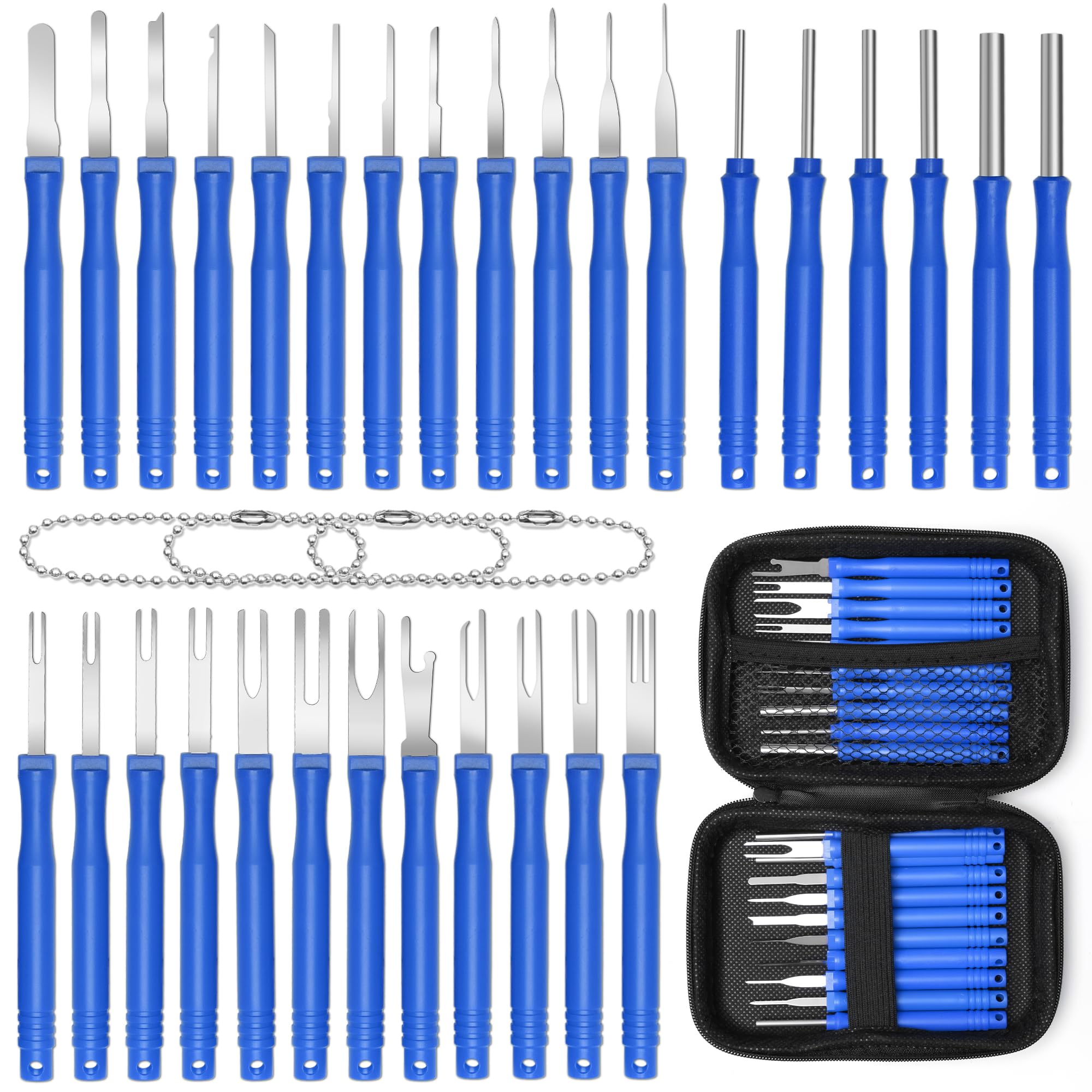
The Anglekai kit packs 10 double-pin extractors, 10 single-pin extractors, 10 casing tools, three steel chains, and a storage bag into one package. Each tool uses 0.8mm-thick stainless steel, which is thicker than many entry-level sets, and the plastic handles have a small hole at the end for a lanyard. Owners mention this kit saved them when working on an 8-pin Molex power adapter, finishing the job in under 15 minutes. It works on automotive, HVAC, RV, and heavy equipment connectors.
The catch: tools are unlabeled, so you will need to trial-fit sizes against your connector. Several owners note the set is missing the right size for red-gauge Deutsch contacts, and the handle on single-pin tools can snap if twisted hard. It is a solid explore-and-learn kit for occasional home use, especially when you are not sure which connector you will face next.
Quantity over specialization: 34 pieces give you a shot at most connector types, but labels would save trial-and-error time.
Reach for this if: you work on a random mix of connectors (cars, household devices, electronics) and want one low-cost box to cover the basics.
Look elsewhere if: you need a guaranteed fit for Deutsch solid contacts or want tools you can rely on daily without a backup.
3. Jonard Tools R-5926 Pin Extractor
A single plastic-bodied extractor with a plunger mechanism built for AMP CPC pins.
The R-5926 is a dedicated tool for contact sizes 16-20 AWG (0.063 – 0.040 inches — the range of wire thickness it fits) and works with nearly all AMP CPC-style connectors. Instead of a bare probe, it uses a plunger: you push the barrel over the pin, press the plunger to compress the tines, and the contact slides out. Customers note removing more than 70 pins from a set of 14-pin AMP plugs with medium effort. The tool is just 3 inches long and weighs about half an ounce, so it fits in a shirt pocket.
The same reviewers point out it can be uncomfortable for larger hands — the compact handle causes fatigue during repetitive work. Some users also find the barrel is slightly thinner than the official AMP/Tyco tool, so fit on certain connectors is less positive. For daily work on AMP CPC connectors, this tool pays for itself by saving damaged terminals. As one review states: it “works 95%+; rare difficulty likely due to prior pin damage.”
One-trick specialist: If you service AMP CPC connectors, this is the most elegant single-tool solution — no kit clutter, just a plunger mechanism that does one thing very well.
Your tool if: you extract pins from AMP CPC connectors daily and want a compact, field-friendly tool that fits in your pocket.
Not ideal if: you service multiple connector families — this tool handles only contact sizes 16-20 and will not work on Weather Pack or Deutsch connectors.
4. Kikerike 172-Piece Terminal Removal Tool Kit

Over 170 tools covering every imaginable connector size — but quality is a roll of the dice.
The Kikerike kit includes 59 single-pin extractors, 80 double-pin extractors, 3 three-pin extractors, and 30 casing tools. That many duplicates mean if you break one, a backup is in the bag. The tools are stainless steel with an O-ring handle for grip, and a waterproof protective bag keeps everything together. Buyers find it works well for automatic electrical repair on cars and motorcycles, and the sheer variety means you almost always find a tool that matches.
The trade-off: many shoppers say the tools feel flimsy — some have rough edges needing deburring (smoothing with sandpaper), and a few arrive defective. The random assortment means you get only about two complete sets in the bag, with the rest being duplicates. As one recurring observation puts it, these are “great to have in a pinch” but not for daily professional use.
Backup-rich set: Enough duplicates to survive breakage, but expect inconsistent tip quality and a few tools you will never use.
Grab this if: you want one enormous kit to cover unknown connectors on weekend projects and do not mind occasional breakage.
skip it if: you need reliable tools for daily automotive or industrial work — the inconsistent quality is a headache you can avoid with a smaller, better-made kit.
5. iCrimp Deutsch Contact Removal Tools, DT Series

Three anodized-aluminum tools purpose-cut for Deutsch DT solid contacts from 14 to 24 gauge.
The iCrimp set includes three sizes: DR01 for 20-24 AWG, DR02 for 16-18 AWG, and DR03 for 14-16 AWG. Each tool has a U-shaped tube blade (a U-shaped blade that acts like a tiny tube) that slips snugly around the wire and separates the terminal from its housing. The handles are knurled aluminum with a textured grip, and the stainless steel tips are non-magnetic. Owners who work on heavy-duty trucks, agricultural equipment, and outboard motors find these tools fit the Deutsch connectors on that equipment. Buyers report the tools survive concrete drops and are tough enough for field use.
The main caveat is size — several owners mention the tools feel large for tight spaces like Molex connectors inside electronics. The smallest DR01 works but requires extra effort in narrow cavities. One review calls it “a little big for my needs” when used on arcade wiring. If your work is exclusively Deutsch DT connectors on vehicles, these are right on target.
Deutsch-only precision: If you repair DT-series connectors on heavy equipment or automotive, these three tools cover the full gauge range without guessing.
Best suited for: mechanics and technicians who regularly service Deutsch DT connectors on trucks, tractors, and off-road vehicles.
Not for: compact electronic connectors — the aluminum handles are too bulky for tight spaces inside dashboards or consumer electronics.
6. JRready ST5231 Deutsch Pin Removal Tool

Three size-specific Deutsch extractors plus a pick tool, all in anodized aluminum.
The ST5231 covers the full Deutsch connector line: DRK-20DTM for size 20 contacts (max wire diameter 2.1mm), DRK-16DT for size 16 contacts (max 2.9mm), and DRK-12DTP for size 12 contacts (max 3.7mm). A DRK-RT1B pick removal tool (a small hook on one end, a mini screwdriver on the other) rounds out the set. The stainless steel shafts have an increased slotted length, meaning they can reach deeper into the connector housing to release terminals without damaging the wire harness. The anodized aluminum handles give a comfortable grip.
Diesel mechanics and industrial technicians praise the quality — reliable enough for Caterpillar engine harnesses and ITT Cannon receptacles. The three sizes give you “good relative options for most Deutsche connectors,” according to one buyer. The key difference from the iCrimp set: the included RT1B pick tool and wider size coverage that includes DTM and DTP series (the different Deutsch connector sub-families).
Deutsch coverage expanded: Covers DT, DTM, and DTP series (size 12, 16, and 20 contacts) with a bonus pick tool for wedgelocks (plastic retainers inside the connector).
Your kit if: you work on Deutsch connectors across multiple series (DT, DTM, DTP) and want a single, well-built set with a pick tool included.
Consider alternatives if: you only ever remove size 20 Deutsch contacts — a simpler two-tool set may save money and tool-box space.
7. EWK 12 Pcs Universal Automotive Wire Terminal Removal Tool Kit

Color-coded handles for quick identification, tailored to GM and Ford connector families.
The EWK kit splits into two groups: red-handled tools for GM-style connectors (spring-loaded tube, square blade, flat blades, fork blade, screwdriver) and green-handled tools for general wire terminals (four tubes and two flat twin blades). The color coding means you grab the right tool without squinting at tiny markings. The knurled surface on the handles provides a non-slip grip, and the blow-molded case keeps everything organized. Owners working on older Harley-Davidson FXR connectors report it was exactly what they needed after failing to find anything locally.
The trade-off is that the tube tip sizes are unlabeled — one careful owner measured and found the red-tube tools range from roughly 3mm to 4.3mm outer diameter, which covers many common domestic connectors. Some tubes had slight internal burrs that required light sanding. If you primarily repair GM and Ford vehicles, this set gives you the specific probes those connectors use, without paying for a massive kit you will never use.
Color-coded workflow: Red handles for GM connectors, green for general terminals — selection takes seconds once you learn the code.
Pick this if: you mostly work on domestic vehicles (GM Weather Pack, Ford) and want a curated set of the exact tool shapes those connectors need.
Pass if: you deal with imports, Deutsch contacts, or Molex electronics — this kit leans heavily on GM/Ford styles.
8. 26PCS Terminal Removal Tool Kit (XiTuanYuan)

Twenty-six titanium-steel tipped tools in a structured case for semi-professional use.
The XiTuanYuan kit is a step up in heft — nearly 3.2 pounds of tools with titanium-steel pins designed to resist bending under repeated use. The set covers most automotive wiring connectors, including cars, trucks, and motorcycles. The organized storage case keeps each tool in its own slot, making identification faster than digging through a bag. Buyers who use it a few times a year find it works well for golf cart connectors and occasional automotive repair. The kit is also heavy enough that it stays put on the workbench.
The quality is a mixed bag. Some owners describe the build as sturdy and well-made, while others note that the plastic case is flimsy and a few tool pins have snapped under heavy pressure. For someone working on electrical connectors a few times a year, this set is fine. For a daily-use mechanic, the mid-tier reliability may frustrate.
Semi-pro quantity: 26 tools with titanium-steel tips offer a good middle ground between budget multi-packs and premium single-tools.
A good buy if: you want a large but organized set for weekend car projects and do not need professional-grade durability.
Think twice if: you work on connectors every week — some pins may break, and the plastic case wears quickly in a work truck.
9. Lisle 57750 Wire Terminal Tool Kit

A five-tool metal set that has been the shop standard for GM and Ford pin removal for years.
The Lisle 57750 includes tools for conventional terminals as well as Pack-Con and Weather-Pack terminals found on many GM vehicles, plus a dedicated blue tool for many Ford applications. The handle design is smart: it slips over the probe to protect your hand and provide extra leverage when extracting stubborn pins. At 11.2 ounces total, it is light enough to toss in a tool bag but feels solid in the hand. The blow-molded case keeps the five probes organized. Buyers consistently describe these as “very sturdy” and “easily the best ones I have used.” One owner working on a 2007 Audi A4 noted the kit saved them from the dreaded broken clip on a high-pressure fuel pump connector.
The kit is not cheap compared to 34-piece budget sets, and for older classic cars a simple jeweler’s screwdriver may suffice. But if newer vehicles with Pack-Con and Weather-Pack connectors are your daily work, the Lisle kit’s quality is the crowd favorite. As buyers sum it up: “sturdy enough to last a lifetime — not some cheap thing that will fall apart.” It avoids the inconsistency of the Kikerike 172-piece kit by sticking with fewer, better-made tools for domestic connectors.
Lifetime build quality: Metal probes with a sliding handle guard produce the most consistently positive feedback across hundreds of customers — quality is the #1 praised aspect.
Grab this if: you work on GM and Ford connectors daily and want a kit that will last years without a broken tool.
Skip if: you need to service Deutsch or other European connector families — this kit is designed for domestic Weather Pack and Pack-Con terminals.
Understanding the Specs
Connector Family
This is the brand or type of plug you are working on — Weather Pack, Metri-Pack, Deutsch DT, AMP Superseal, and Pack-Con are common. Each family uses a different barb shape and size, so a tool designed for one may not physically fit another. Kits that list specific families in their specs are more likely to work correctly than tools that say “universal.” When in doubt, match the tool to the exact connector name stamped on your harness plug. Most automotive connectors have a series number (like Metri-Pack 280) molded into the plastic.
AWG (American Wire Gauge)
AWG measures the diameter of the wire itself. The number is counterintuitive: smaller gauge numbers (like 12 AWG) mean thicker wire, while larger numbers (like 24 AWG) mean thinner wire. A depinning tool designed for 16-18 AWG terminals has a probe that fits the cavity and barb of that size wire. Trying to use a tool for 20-24 AWG on a 12 AWG terminal will either not fit or may damage the connector by forcing it.
FAQ
What is the difference between a pin removal tool and a depinning tool?
Will a universal depinning tool work on my vehicle?
How do I know which size tool I need?
Can these tools damage my connector?
Are multi-piece kits worth buying for occasional use?
What is the proper technique for using a pin removal tool?
Can I reuse a terminal that I removed with an extraction tool?
How do I maintain my depinning tools?
What is the difference between Weather Pack and Metri-Pack connectors?
Final Thoughts: The Verdict
Across the board, the wire pin removal tool winner is the JRready ST5211 because its four aluminum tools match Weather Pack, Metri-Pack, and AMP Superseal connectors without guesswork — and the quality feedback is consistently positive across hundreds of owners. If you work strictly on Deutsch connectors, grab the JRready ST5231. And for domestic wire harness repairs on GM and Ford vehicles, the Lisle 57750 is the one to reach for.
How We Picked
We do not accept paid placement. Every pick is matched to a real buyer and a real use-case; we do not hands-on test units.
Sources & Methodology
Specifications: manufacturer listings and product documentation. Review insights: verified customer reviews, as of July 2026. Pricing: not shown on this page (it changes often); check the current price via the retailer link.
As an Amazon Associate, GoCarLife earns from qualifying purchases. This does not affect which products we feature.