
Our readers keep the lights on and the garage heater humming. As an Amazon Associate, I earn from qualifying purchases.
Specs are compiled from manufacturer listings and verified buyer reviews and can change over time — please confirm the key details on the product page before buying.
You have a blind spot the size of a sedan behind your rig, and you need a wireless backup camera with monitor that actually works — no drilling, no running video cables through the chassis, just a clear view every time you reverse. The trouble is, “wireless” can mean anything from a rock-solid 50-foot signal to a choppy stream that freezes mid-park. This guide cuts through the noise by matching each system to your real use-case — whether that’s a 40-foot fifth wheel, a work truck, or a rental trailer you hook up once a month.
I’m Mo Maruf — the founder and writer behind GoCarLife. This guide is built by comparing the manufacturers’ published specifications and the patterns across verified customer reviews, so you get each pick’s real strengths and trade-offs instead of marketing spin.
The honest truth: no single wireless backup camera with monitor does it all perfectly, but if you want the widest field of view and the most reliable connection for under a hundred bucks, the LeeKooLuu HD 1080P 7 Inch system is the one most owners end up happy with.
Our Picks at a Glance


How To Choose The Best Wireless Backup Camera with Monitor
A wireless backup camera system has two separate parts — a camera mounted on the back of your vehicle and a monitor you place on your dashboard or windshield. The “wireless” part means the video signal travels through the air, but both the camera and the monitor still need their own power source. Knowing how these pieces work together is the first step to picking the right one for your truck, RV, or trailer.
Determine Your Power Source: Hardwired vs. Battery vs. Solar
This is the biggest fork in the road. Some cameras get power by tapping into your vehicle’s reverse light circuit — they turn on when you shift into reverse. Others run on a built-in rechargeable battery that you charge via USB or a solar panel on top of the camera. A battery-powered, solar-supported camera is the easiest to install (just stick it on with a magnet), but you have to remember to charge it. A hardwired camera is always on when you need it, but the installation involves a bit more work because you need to connect it to a 12V power source. The monitor itself almost always plugs into a cigarette lighter socket or a USB port.
Prioritize Signal Reliability: Range and Antenna Design
The wireless video signal can be disrupted by the metal body of your vehicle or trailer. Look for a system with dual antennas and a 2.4GHz digital signal — these handle interference better than single-antenna setups. The stated range (often 200 to 500 feet in open air) drops significantly when the signal has to pass through a metal box trailer or an aluminum RV. Customer experiences suggest that a range of about 30 to 40 feet between the camera and the monitor is a realistic expectation for a solid connection with most rigs. Systems with a 40-foot real-world range are usually enough for a truck towing a standard travel trailer.
Match the Field of View to Your Vehicle’s Blind Spots
The field of view, measured in degrees, tells you how wide a scene the camera captures. A 120-degree angle is standard and works well for a direct rear view on an RV. A 150-degree or 170-degree angle shows you more of the sides, which is helpful for spotting vehicles in adjacent lanes or seeing the edges of a trailer when backing into a tight campsite. A wider angle also introduces a slight fisheye effect — straight lines look curved, and objects in the distance appear smaller than they actually are, so judge distances carefully at first.
Quick Comparison
| Model | Best For | Field of View | Monitor Size | Power Type | Amazon |
|---|---|---|---|---|---|
| Fookoo DW7Y5★ Best Overall | Furrion Pre-Wired RVs | 120° | 7″ | Hardwired | Amazon |
| LeeKooLuu LK10Best Value | Budget Truck Backup | 150° | 7″ | Hardwired | Amazon |
| AUTO-VOX SOLAR5-JPTop Performer | Premium Single Camera | 170° | 7.2″ | Solar + Battery | Amazon |
| FEISIKE Solar | No-Drill, Portable Use | 150° | 7″ | Solar + Battery | Amazon |
| DoHonest R50 | Compact 5″ Monitor | 150° | 5″ | Solar + Battery | Amazon |
| pemacom P16 | Long Distance Range | 150° | 7″ | Solar + Battery | Amazon |
| AUTO-VOX Solar5B | Dual Camera RV System | 110° | 7.2″ | Solar + Battery | Amazon |
| eRapta ACT702 | Dual Camera, Long Range | 150° | 7″ | Battery | Amazon |
| VOONOA VN007 | Dual Camera Solar Kit | 170° | 7″ | Solar + Battery | Amazon |
In‑Depth Reviews
1. Fookoo HD 1080P 7″ Wireless RV Backup Camera System (DW7Y5)
Our pick — 4.5★ from 750+ verified ratings; the strongest balance of quality and price.
The drop-in replacement for Furrion pre-wired RVs that costs half the price.
If your RV or camper already has a Furrion pre-wired mounting bracket, this system is the obvious choice — it fits the same four-bolt pattern (though some owners needed to drill a new set of holes on a Grand Design). The 7-inch IPS monitor delivers crisp images, and the camera’s 120-degree field of view is well-suited for a direct rear view on a travel trailer. Buyers report “no signal dropout with 33′ trailer,” which is a strong real-world test of its dual-antenna 2.4GHz wireless link.
Installation is straightforward: connect the camera to your vehicle’s 12-24V power supply and plug the monitor into the cigarette lighter. The system supports up to four cameras for split-screen coverage, and an SD card slot enables loop recording for evidence if needed. The IP69 waterproof rating and six infrared LEDs keep the view clear in rain and at night.
The main trade-off is that this system is not a drop-in replacement for the Furrion technology — the camera uses a different wireless protocol, so it won’t connect to an existing Furrion monitor. You also need to be aware of PWM (Pulse Width Modulation) issues with some GMC, Chevrolet, and Ford models after 2010 or 2015, which may cause flickering unless you use a power filter.
Top reasons to buy: The screen fits the existing RV bracket perfectly for most users, the image is sharp for backing and hitching, and the customer service team is quick to help if something goes wrong. The thing everyone raves about is how easy the install is — 183 owners mention installation positively.
A fair warning: The camera’s field of view is only 120 degrees, which is noticeably narrower than the 150-degree view on the LeeKooLuu system below — so you won’t see quite as far to the sides.
Reach for this if: You have a Furrion pre-wired RV and want the simplest bolt-on upgrade without paying the Furrion premium.
Look elsewhere if: You have a GMC, Chevrolet, or Ford built after 2010/2015 and don’t want to buy a separate PWM filter adapter.
2. LeeKooLuu HD 1080P 7 Inch Wireless Backup Camera for Truck (LK10)
The widest field of view at this price point, with a 150-degree angle that eliminates the most blind spots.
This system leads the pack on field of view — its 150-degree wide-angle lens gives you a wider picture than the Fookoo’s 120-degree view, which makes a real difference when merging or checking for cars in the lane next to you. The 7-inch monitor is pre-paired with the camera right from the start, so there is no pairing process — just connect the camera to your reverse light and plug the monitor into power.
The camera uses a 1/3-inch CMOS sensor and claims Starlight night vision technology, which means it performs well in low-light conditions like dim driveways or evening towing. The system also supports split-screen mode with up to four cameras, and it includes adjustable parking lines that you can customize on the monitor to match your trailer width.
The crowd seems to love the screen clarity and the ease of installation, but the honest catch is the wiring quality — several owners note the power wires are very thin, making them difficult to strip with standard tools, and the included inline splice can cut through the wire instead of piercing it. The suction cup mount for the monitor is also a weak point; one owner switched to Velcro for a more secure hold. As owners mention, the “wireless occasionally freezes/stutters,” so this is not the system for those who need a flawless, always-on rear view.
What wins people over: The 150-degree view is noticeably wider than most rivals at this price, the night vision is genuinely useful, and the pre-paired setup means you can be up and running in about 15 minutes.
The recurring gripe: The thin power wires require careful handling, and the suction cup monitor mount leaves some owners looking for a more permanent solution.
Reach for this if: You drive a pickup truck and your top priority is minimizing the blind spot with the widest possible rear view.
Look elsewhere if: You want a system with a rock-solid mount and thick-gauge wiring for a heavy-duty commercial application.
3. AUTO-VOX Wireless Backup Camera Solar Magnetic (SOLAR5-JP)
A 7.2-inch monitor and a 170-degree camera that pushes the boundaries of what a portable solar system can do.
This is the widest-angle camera on the list at 170 degrees, giving you the best peripheral vision for spotting vehicles and obstacles on either side of your trailer. The monitor is also the largest here — 7.2 inches with a 16:9 aspect ratio — and it supports dual-split screen if you add a second camera. The system touts a 524-foot wireless range, which is the longest claimed distance among these picks, and the dual-antenna design is built to handle interference from large metal vehicles.
The camera is completely portable: it mounts magnetically (or with an included metal plate for non-magnetic surfaces) and runs on a solar-rechargeable battery that lasts up to 20 hours. Built-in DVR recording with loop is standard, and the system includes a carrying case for storage between trips. The IP69K waterproof rating means it survives heavy rain and extreme temperatures from -4°F to 149°F.
The owner consensus is that the image quality is outstanding — one buyer called it “the best backup camera I have ever owned.” However, the recurring downside is durability: after a year of use, some units stop charging, and while the customer service team is praised for sending prompt replacements, it is a hassle to deal with. The 7.2-inch screen also stretches the image a bit, so it doesn’t offer a true wide view — the picture is simply zoomed to fill the screen.
Why owners recommend it: The huge 170-degree field of view and long battery life make it the best choice for larger RVs and fifth wheels where you need to see as much as possible.
Why some pass: The screen stretching and occasional charging failures after extended use mean you are paying for great features with a slight reliability trade-off.
Best for: RVers who want the widest possible rear view and a large screen for easy monitoring, and who are okay with a magnetic mount that can be moved between vehicles.
skip it if: You need a hardwired system with zero maintenance — the battery will eventually need a USB recharger or a replacement.
4. DoHonest R50 Solar Magnetic Wireless Backup Camera

The only solar-powered camera on the list with a 5-inch monitor, trading screen real estate for portability.
If you want the smallest possible dashboard footprint, the 5-inch IPS monitor on this DoHonest system is significantly less intrusive than the 7-inch screens on most competitors. The camera itself is a hefty 2.5 kg (about 5.5 lbs) and is powered by a 9600mAh rechargeable battery that claims up to 24 hours of use. The 150-degree wide-angle lens covers the basics well, and 16 IR LEDs provide strong night vision performance — owners consistently praise the clear picture in low light.
The magnetic mount uses neodymium magnets that hold securely on metal surfaces, and the base is padded to protect your paint. The camera is IP69K waterproof, meaning it handles pressure washing and extreme weather without issue. The transmission range is rated at 36 feet, which is conservative but realistic for most standard trailers. The system also includes a 1-year warranty and lifetime tech support.
Battery management is the main point of mixed feedback. The solar panel helps extend the charge, but many customers note that the battery stops holding a charge after a few months, or that the system drains the battery if left plugged in continuously. The 5-inch screen is also a trade-off — it is compact, but older eyes or those used to a larger display may find it harder to read details at a glance.
What it does well: The compact monitor is perfect for smaller dashboards, the magnetic hold is strong enough to survive a 50 mph fall, and the image quality, especially at night, earns consistent praise from owners — 102 mention picture quality positively.
The honest trade-off: Battery life is the most mixed aspect here (60 mentions), so plan to charge it via USB between trips, and consider that a 5-inch screen is easier to store but harder to read than a 7-inch.
Reach for this if: You want a truly portable camera that you can move between a truck and a trailer, and you don’t mind the smaller screen size.
Look elsewhere if: You need a large, easy-to-read monitor for a big RV or if you want a system that doesn’t require periodic battery charging.
5. FEISIKE Magnetic Solar Wireless Backup Camera
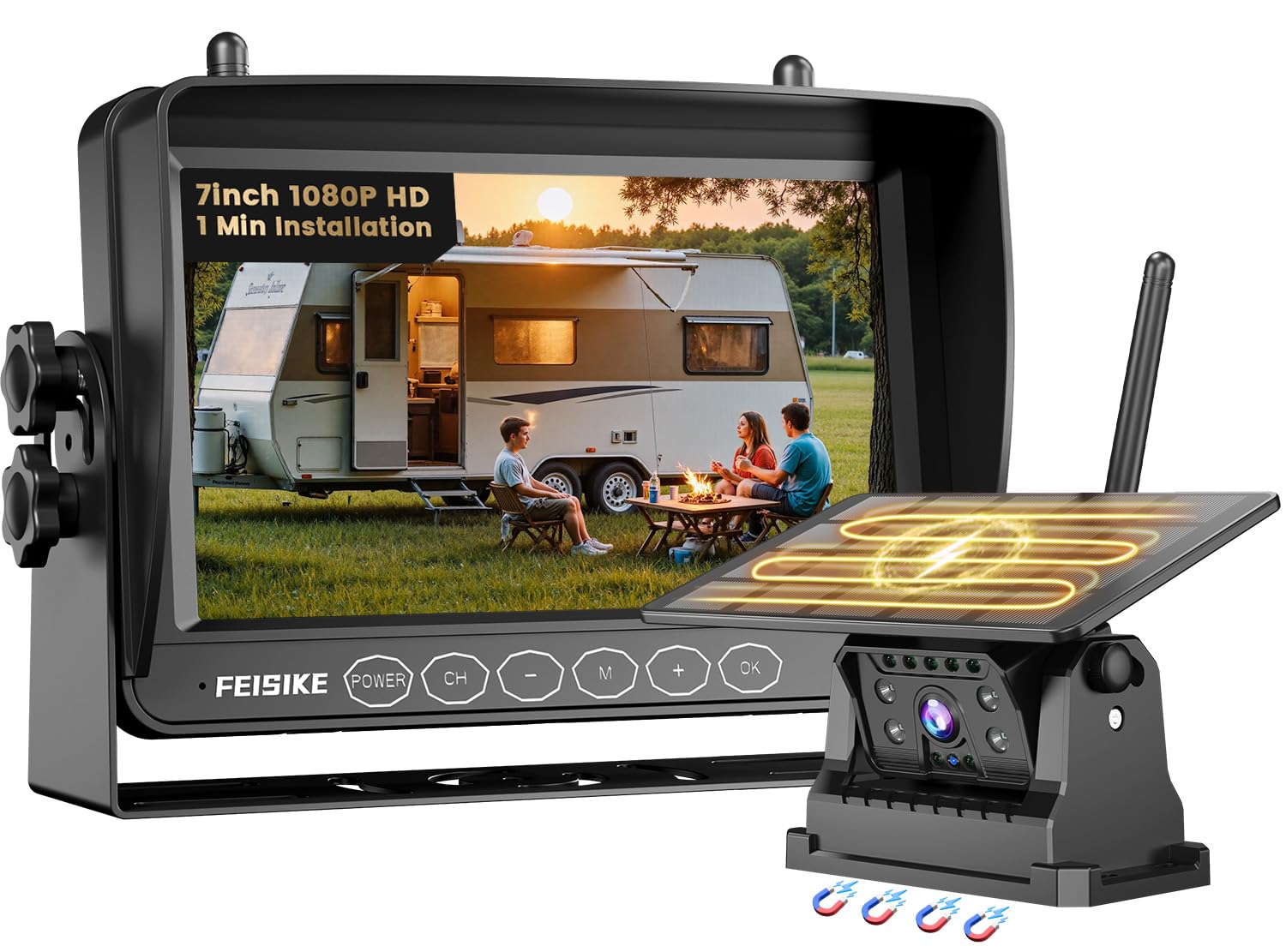
A 7-inch solar camera with a magnetic base that genuinely sticks to the bumper — no tools, no wires.
This FEISIKE system is built around the idea that you should be able to set up a backup camera in one minute flat. The camera has six strong neodymium magnets in its base, so it attaches to any metal surface on your truck, trailer, or RV without drilling or screwing. The 5W solar panel on top feeds a built-in lithium-ion battery that the manufacturer claims delivers up to 24 hours of runtime — in practice, reviewers point out getting 13+ hours of constant use without any sun, and more with solar trickle charging.
The 7-inch LED monitor shows a 150-degree view and includes automatic IR night vision that switches on when the light drops. The dual-antenna design provides the stated 40-foot signal range between vehicles, and the system supports a second camera for split-screen viewing. The camera body is IP69 waterproof and the rubber base is designed to protect your paintwork from scratches.
The biggest feedback from owners is that there is a slight video lag while driving on the highway — not a dealbreaker for backing up slowly, but noticeable if you rely on it as a rear-view mirror at speed. The touch buttons on the monitor can also be unresponsive, requiring multiple presses to switch channels or toggle the display. On the positive side, owners love the powerful magnet and the ability to move the camera between vehicles, such as from a truck to a horse trailer.
The thing everyone raves about: The magnetic mount is incredibly strong — shoppers say using it on rough roads and horse trailers without it budging.
The honest catch: The slight video lag and touchy buttons make this a backup camera, not a rear-view mirror replacement at highway speeds.
Reach for this if: You tow multiple trailers and want one camera that you can quickly move between a truck, a camper, and a boat trailer.
Look elsewhere if: You need a zero-lag system that can serve as a continuous rear-view mirror while cruising down the interstate.
6. AUTO-VOX 2 Solar Backup Camera Wireless for RVs (Solar5B)
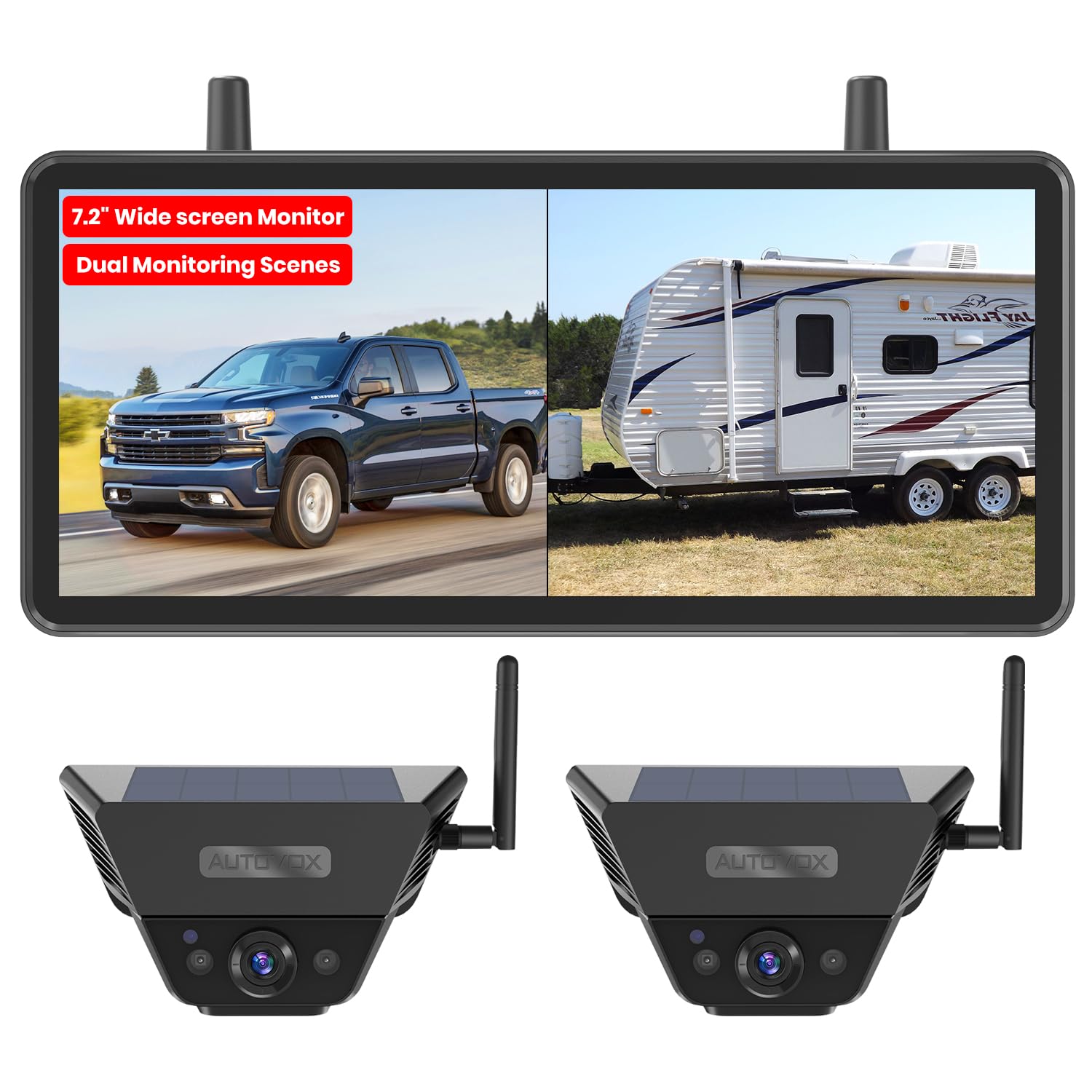
Two cameras, one 7.2-inch split-screen monitor — the full coverage solution for a 40-foot fifth wheel.
This is the dual-camera version of the AUTO-VOX system above, and it solves a specific problem: you want to see both the hitch ball for backing up and the rear of your trailer at the same time. The 7.2-inch monitor displays both feeds in a split-screen view, so you don’t have to toggle between channels. The two cameras are identical to the single-camera version, with the same magnetic mount, solar panel, and 110-degree field of view.
The 110-degree lens is actually narrower than the single-camera AUTO-VOX’s 170-degree view — a trade-off because the dual-camera system uses a different lens design. However, having two separate cameras means you get two perspectives, which often covers more total area than one wider lens. The system also includes the same DVR recording, auto-sleep modes (120s/240s/never), and IP69K waterproof rating. Buyers report the magnets are strong enough for rough roads and that the battery life is excellent, especially with the 240-second off timer.
The real-world performance shines for horse trailer owners who use one camera inside the trailer to monitor the animals and one on the back for reversing. The setup process is genuinely easy — stick the cameras on a metal surface, plug the monitor into a 12V socket, and it works. The single recurring issue is that the monitor mount lacks a suction cup option, so you are limited to the included dash bracket or an adhesive mount.
Why it stands out: Two cameras in one box with a single split-screen monitor makes this the simplest way to get front and rear coverage on a large trailer without buying a second system.
The honest trade-off: Each camera has only a 110-degree lens, so the individual views are narrower than the 150-170 degree lenses on single-camera systems.
Reach for this if: You tow a horse trailer, cargo trailer, or large camper and want to monitor two different areas simultaneously.
Look elsewhere if: You only need a single rear view — the single-camera AUTO-VOX has a wider lens and costs less.
7. eRapta Dual Magnetic Wireless Backup Cameras (ACT702)
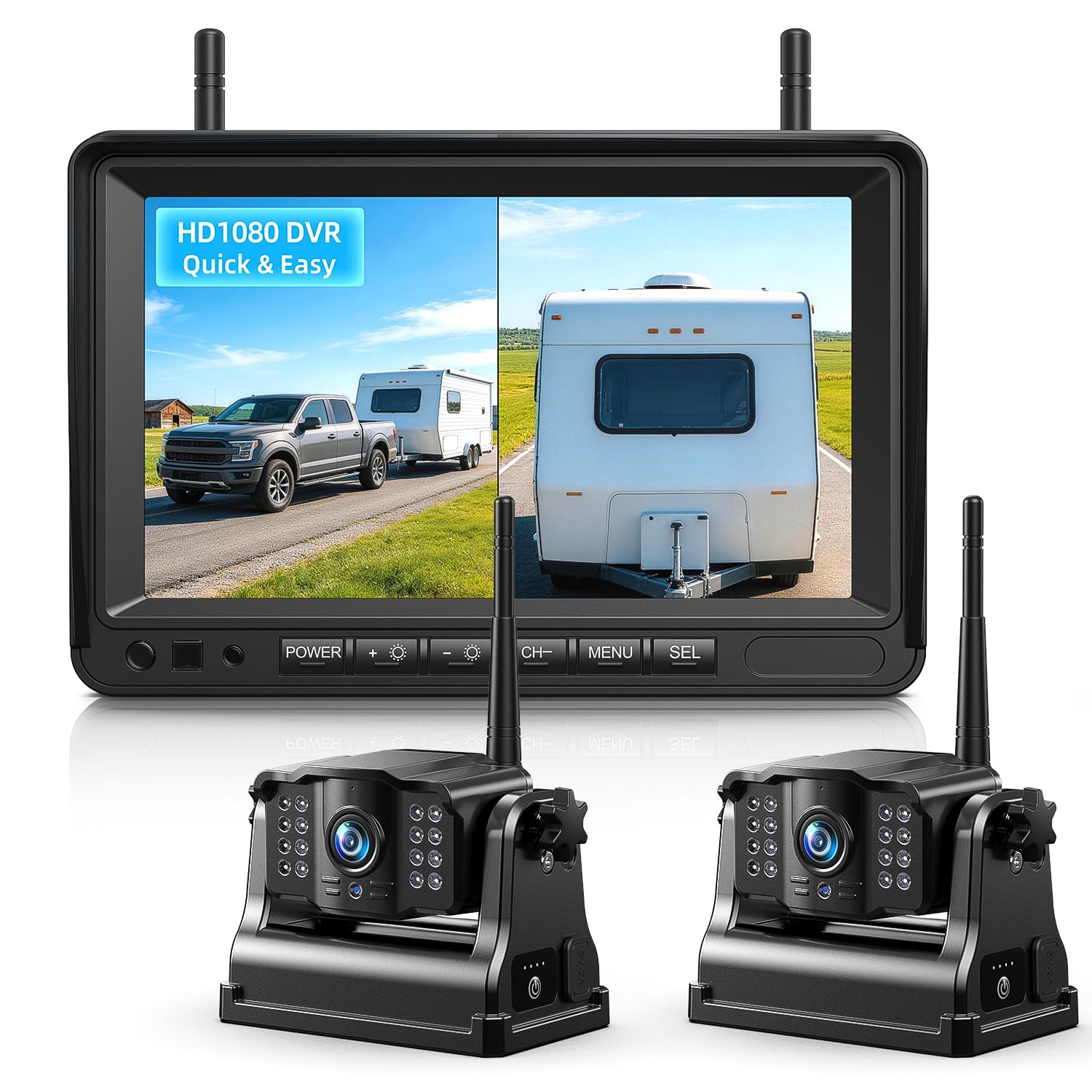
Two magnetic cameras that charge via USB and stay cord-free while in use — no solar panel required.
The eRapta system is different from the solar-powered options above because the cameras run entirely on a rechargeable 9600mAh lithium-ion battery. You charge them via a Type-C cable before your trip, then the cameras operate wirelessly for up to 12 hours. The 7-inch monitor shows a 150-degree wide-angle view and supports split-screen mode for the two included cameras, with the ability to expand up to four cameras total.
The magnetic base holds strongly to ferrous metal surfaces, and an included metal plate allows installation on aluminum or fiberglass trailers. The system uses 2.4GHz WiFi technology with dual antennas for a claimed range of 328 feet in open space and 40 feet between vehicles. Owners mention sharp 1080P video during the day, reliable connections at 24 feet, and impressive battery life that lasts days between charges for occasional use. The IP69K waterproof rating handles rain and wash downs without issue.
The honest downside is night vision quality — the camera switches to a grainy black-and-white mode in low light, and it can be washed out by headlights from following vehicles. The monitor is also very bright at night, so it can be distracting in a dark cab. One owner noted the 150-degree lens is too wide for a clean rear-view image, causing a fisheye effect that makes objects look further away than they are.
What owners love: The two cameras are ready to go from the start, the battery lasts for days of light use, and the magnetic mount is truly tool-free — one owner called it “perfect for limos.”
The recurring limitation: Night vision is a weak point, and the extreme wide-angle fisheye can make judging distances tricky until you get used to it.
Reach for this if: You want a dual-camera system without solar panels, and you typically drive during the day or have good ambient lighting at your destination.
Look elsewhere if: You regularly back into dark, unlit campsites or driveways and need excellent night vision to guide you.
8. pemacom RV Backup Camera with Solar Magnetic (P16)
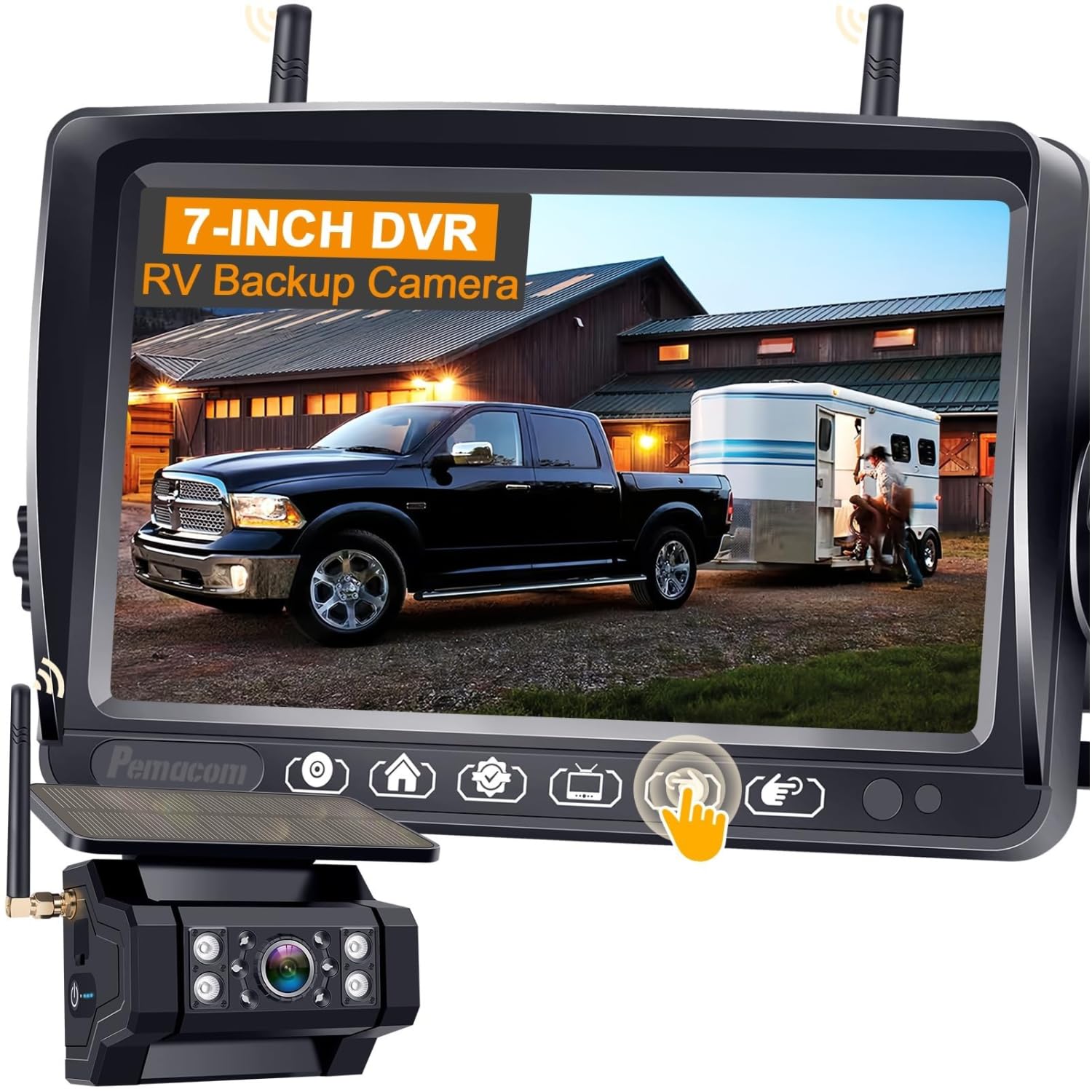
The 15000mAh battery is the biggest on the list, designed for all-day towing without a charge.
The pemacom system is built around a massive 15000mAh lithium-ion battery that the manufacturer says delivers between 15 and 24 hours of continuous use, depending on whether the night vision LEDs are active. A 5W monocrystalline silicon solar panel on the camera helps keep the battery topped off during daylight driving. The 7-inch LED monitor has a 150-degree field of view and includes a sunshade to cut glare on bright days.
The camera uses a digital frequency hopping technology built into a powerful signal receiver to avoid frame drops and interference, with a stated 50-foot range between vehicles. The base uses super-strong samarium cobalt magnets for a quick steel-surface mount, and a soft rubber layer protects the vehicle’s paint. The system is compatible with Furrion and Voyager series RVs, though that requires a separate metal bracket for non-ferrous surfaces.
The owner feedback is consistently positive on battery life — one review noted that after 12 hours of driving the battery only dropped one bar. The image quality is sharp and the magnetic hold is secure on rough roads. The honest concerns are that the fisheye effect distorts the view significantly, making objects appear more distant than they really are, and the solar charging may not keep up if you park in shaded areas or drive through a cloudy week of weather.
Its biggest strength: The 15000mAh battery is class-leading — you can drive all day without worrying about the camera dying, and the solar panel adds a useful trickle charge.
The honest trade-off: The fisheye distortion means you need to recalibrate your distance judgment when backing up, and the solar panel alone won’t fully recharge a dead battery.
Reach for this if: You take long road trips and don’t want to think about charging your backup camera every night.
Look elsewhere if: You need accurate distance perception through the camera — the fisheye effect makes objects look further away than they are.
9. VOONOA 2 Magnetic Wireless Backup Camera System (VN007)
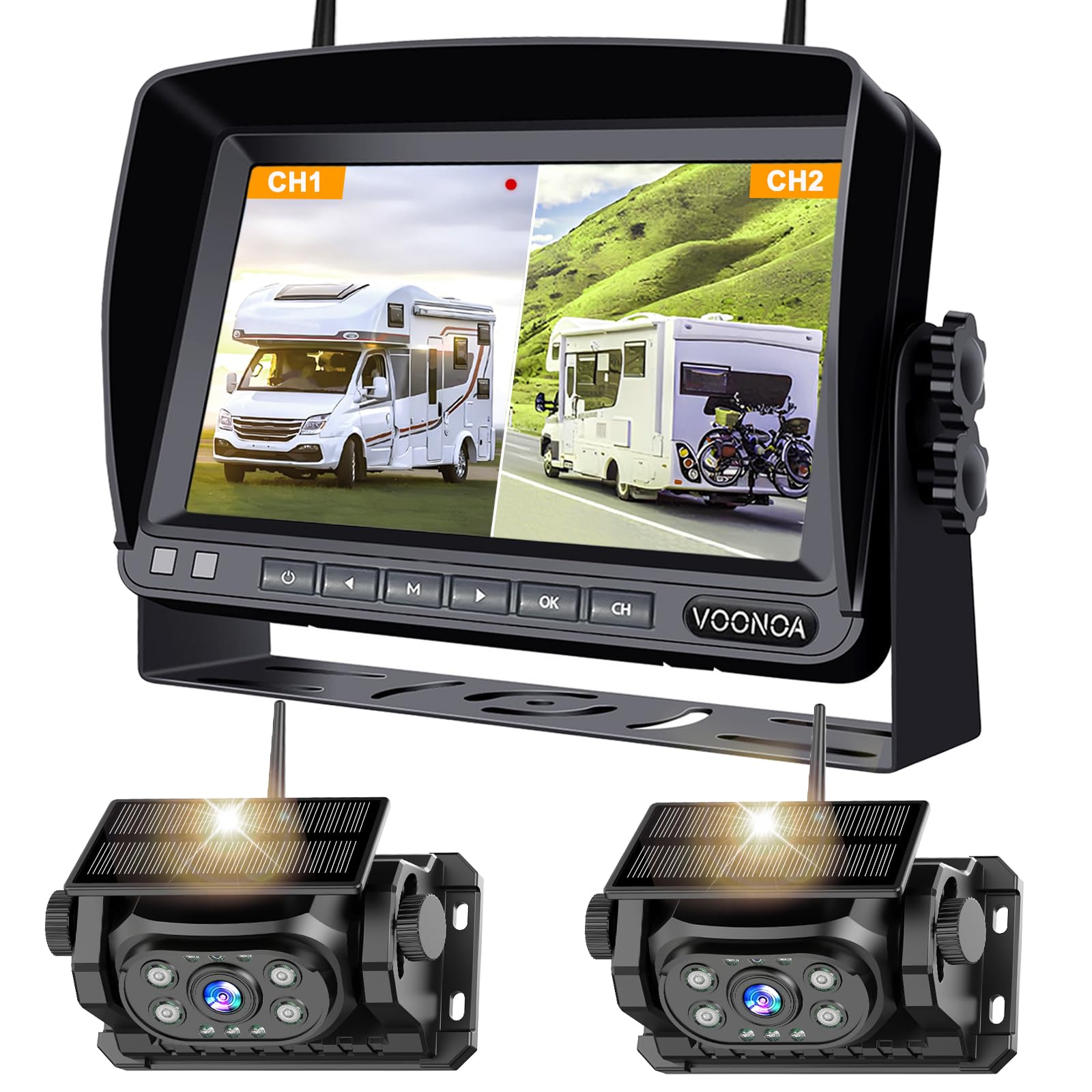
Two cameras with a 170-degree field of view and a 15000mAh battery — the most complete solar kit here.
The VOONOA system is the only dual-camera kit that combines a 170-degree ultra-wide lens with a 15000mAh battery on each camera. The 7-inch LCD monitor supports two channels and displays both feeds in a split-screen or toggled view, giving you comprehensive coverage of your rig — one camera on the hitch and one on the rear of the trailer, for example. The manufacturer claims a wireless signal range of up to 300 feet, though real-world performance is closer to 100 feet when the signal passes through a metal trailer.
Installation is genuinely wireless: six super-strong magnets on each camera base stick to any steel surface, and the monitor plugs into a 12V cigarette lighter or USB port. A fast charger and charging cable are included for pre-trip top-ups. The cameras have an innovative remote-controlled feature that turns the camera on or off with the monitor, so you don’t have to go outside to toggle the system. The kit comes with a 2-year replacement warranty and unlimited tech support.
The most positive feedback centers on the dual-camera capability and the strong magnets that hold the cameras securely in place. Owners use this system for everything from RV rear views to snow plowing to monitoring cargo in a truck bed. The recurring concern is solar charging — the solar panels are not sufficient to keep the cameras fully charged through a full day of use, so USB pre-charging is necessary for long trips. Several owners also report that the cameras stop charging altogether after a few months, though the manufacturer honors the warranty and sends replacements after verification.
Why it wins for coverage: Two 170-degree wide-angle cameras cover more total area than any other dual-camera system here, and the huge battery keeps them running through a full day of towing.
The biggest caveat: The solar charging is underwhelming — plan to charge the cameras via USB before each trip, and know that some units need a warranty replacement within the first year.
Reach for this if: You want the widest possible view from two cameras and don’t mind plugging them in to charge before a long journey.
Look elsewhere if: You need a system where the solar panel can actually keep the battery topped off indefinitely — this one needs a USB cable to stay fully charged.
Understanding the Specs
Field of View (Degrees)
This is the angle of view your camera captures. A 120-degree lens sees a narrower, more direct view behind you — good for a straight trailer hitch where you just want to see the ball. A 150-degree or 170-degree lens captures more of the sides, which helps when you are merging into traffic or checking for obstacles near the edges of your trailer. The trade-off is that a very wide lens creates a fisheye distortion, making straight lines look curved and objects in the image appear smaller and further away than they actually are — so you need a little practice to judge distances correctly.
Wireless Range (Feet)
This spec is almost always given as the maximum open-air range — for example, 200 feet with no obstacles. In real life, your signal has to pass through the metal body of your truck and trailer, which blocks and reflects radio waves. A realistic expectation is that you will get about 30 to 40 feet of reliable range between the camera and the monitor on a standard travel trailer. For longer trailers, look for systems with dual antennas or digital frequency hopping technology, which resist interference better than simple single-antenna setups.
Battery vs. Hardwired Power
Hardwired cameras connect directly to your vehicle’s 12V power supply — usually through the reverse light circuit — so they turn on automatically when you shift into reverse and never need charging. Battery-powered cameras, especially those with solar panels, are much easier to install because you just stick them on a metal surface with a magnet. However, you have to remember to charge them. A 9600mAh battery typically lasts 8 to 12 hours of continuous use, while a 15000mAh battery can last 15 to 24 hours. The solar panel helps extend that time, but rarely keeps the camera fully charged on its own.
Monitor Size and Resolution
Most monitors are either 5 inches or 7 inches diagonally. A 5-inch screen is easier to store and takes up less dashboard space, but it can be harder to read quickly at a glance. A 7-inch (or 7.2-inch) screen is more comfortable to use, especially for older eyes or when you are towing in tight spaces. All the systems here claim 1080P resolution, which is sharp enough to read a license plate or see a hitch ball clearly. The 7.2-inch screen on some models has a 16:9 widescreen aspect ratio, which can stretch the image slightly to fill the screen — not a true wide view, just a zoomed one.
FAQ
Does a wireless backup camera still need wires for power?
Will a magnetic backup camera stay on in a car wash or heavy rain?
What range can I expect between the camera and the monitor?
Can I add a second camera to a single-camera system?
Will a wireless backup camera work on an aluminum or fiberglass trailer?
What is a PWM filter, and do I need one?
How do I mount the camera if my vehicle doesn’t have a pre-wired bracket?
Can I use a wireless backup camera as a continuous rear-view mirror?
What does IP69K waterproof mean?
How long does the battery last on a solar-powered backup camera, really?
Final Thoughts: The Verdict
For most buyers, the wireless backup camera with monitor winner is the Fookoo DW7Y5 because it is the easiest install for the large population of Furrion pre-wired RV owners, the image quality is sharp, and the customer service track record is strong enough that even when issues come up, they get resolved. If you want the absolute widest field of viewand the lowest entry price, grab the LeeKooLuu LK10. And for true no-drill, no-wire freedom with a solar rechargeable battery that you can swap between a truck and a boat trailer, the FEISIKE solar system is the one to reach for.
How We Picked
We do not accept paid placement. Every pick is matched to a real buyer and a real use-case; we do not hands-on test units.
Sources & Methodology
Specifications: manufacturer listings and product documentation. Review insights: verified customer reviews, as of July 2026. Pricing: not shown on this page (it changes often); check the current price via the retailer link.
As an Amazon Associate, GoCarLife earns from qualifying purchases. This does not affect which products we feature.